FTTH Council Europe, February 2016
FTTH deployment in Ireland: Eir’s
experiences
David Renehan
Dave Bolsdon
Jonas Verstuyft
Speakers
2
Dave Bolsdon
GE
Jonas Verstuyft
FiberPlanIT
David Renehan
Eir
Introduction to Ireland and Eir
David Renehan
3
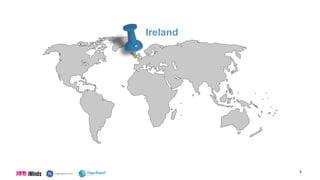
Ireland
4
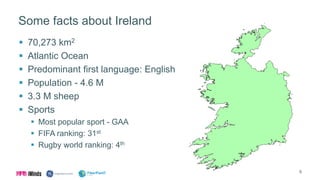
Some facts about Ireland
 70,273 km2
 Atlantic Ocean
 Predominant first language: English
 Population - 4.6 M
 3.3 M sheep
 Sports
 Most popular sport - GAA
 FIFA ranking: 31st
 Rugby world ranking: 4th
5
Who is Eir?
Formerly known as Eircom – rebranded in 2015
Incumbent telecoms operator in Ireland
Mobile operator with a 20% penetration in the Irish market
Both wholesaler and retailer of copper and fibre based broadband
6
Market situation in Ireland
Ireland is a relatively open market
Competition
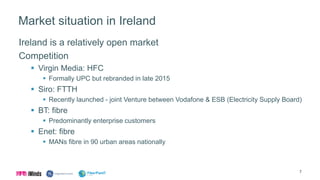
 Virgin Media: HFC
 Formally UPC but rebranded in late 2015
 Siro: FTTH
 Recently launched - joint Venture between Vodafone & ESB (Electricity Supply Board)
 BT: fibre
 Predominantly enterprise customers
 Enet: fibre
 MANs fibre in 90 urban areas nationally
7
Where is the competition
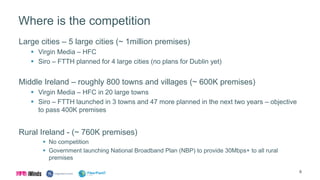
Large cities – 5 large cities (~ 1million premises)
 Virgin Media – HFC
 Siro – FTTH planned for 4 large cities (no plans for Dublin yet)
Middle Ireland – roughly 800 towns and villages (~ 600K premises)
 Virgin Media – HFC in 20 large towns
 Siro – FTTH launched in 3 towns and 47 more planned in the next two years – objective
to pass 400K premises
Rural Ireland - (~ 760K premises)
 No competition
 Government launching National Broadband Plan (NBP) to provide 30Mbps+ to all rural
premises
8
Irish National Broadband Plan
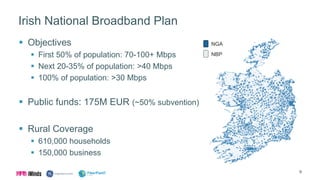
 Objectives
 First 50% of population: 70-100+ Mbps
 Next 20-35% of population: >40 Mbps
 100% of population: >30 Mbps
 Public funds: 175M EUR (~50% subvention)
 Rural Coverage
 610,000 households
 150,000 business
9
NGA
NBP
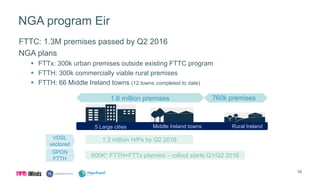
NGA program Eir
FTTC: 1.3M premises passed by Q2 2016
NGA plans
 FTTx: 300k urban premises outside existing FTTC program
 FTTH: 300k commercially viable rural premises
 FTTH: 66 Middle Ireland towns (12 towns completed to date)
10
5 Large cities Middle Ireland towns Rural Ireland
1.6 million premises 760k premises
VDSL
vectored
GPON
FTTH
1.3 million H/Ps by Q2 2016
600K+ FTTH+FTTx planned – rollout starts Q1/Q2 2016
Best practice: Evaluating architectures &
technologies
Jonas Verstuyft
11
FTTH, FTTB, FTTdp,…
Need?
Available?
Influencers?
Budget?
12
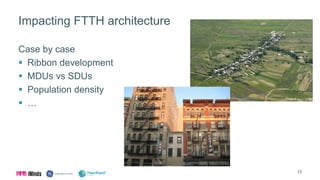
Impacting FTTH architecture
Case by case
 Ribbon development
 MDUs vs SDUs
 Population density
 …
13
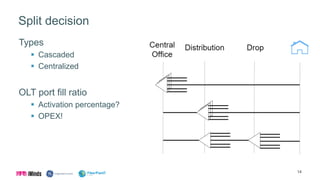
Split decision
Types
 Cascaded
 Centralized
OLT port fill ratio
 Activation percentage?
 OPEX!
14
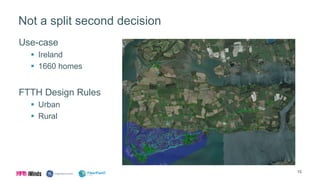
Not a split second decision
Use-case
 Ireland
 1660 homes
FTTH Design Rules
 Urban
 Rural
15
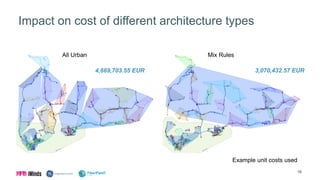
Impact on cost of different architecture types
16
Mix RulesAll Urban
3,070,432.57 EUR4,669,703.55 EUR
Example unit costs used
Deployment methods at Eir
Jonas Verstuyft
17
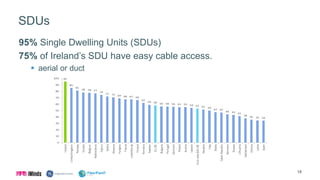
SDUs
95% Single Dwelling Units (SDUs)
75% of Ireland’s SDU have easy cable access.
 aerial or duct
18
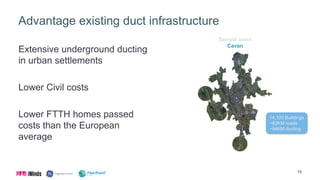
Advantage existing duct infrastructure
Extensive underground ducting
in urban settlements
Lower Civil costs
Lower FTTH homes passed
costs than the European
average
19
Sample town
Cavan
14,100 Buildings
~82KM roads
~94KM ducting
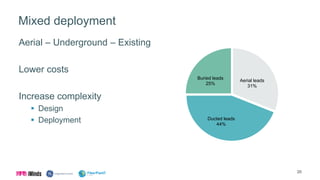
Mixed deployment
Aerial – Underground – Existing
Lower costs
Increase complexity
 Design
 Deployment
Aerial leads
31%
Ducted leads
44%
Buried leads
25%
20
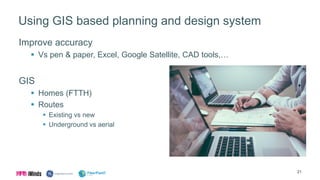
Using GIS based planning and design system
Improve accuracy
 Vs pen & paper, Excel, Google Satellite, CAD tools,…
GIS
 Homes (FTTH)
 Routes
 Existing vs new
 Underground vs aerial
21
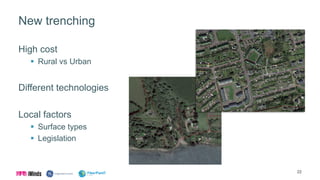
New trenching
High cost
 Rural vs Urban
Different technologies
Local factors
 Surface types
 Legislation
22
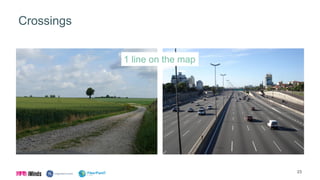
Crossings
23
1 line on the map
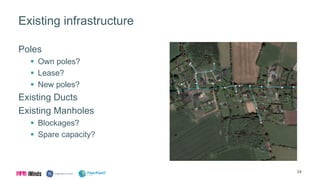
Existing infrastructure
Poles
 Own poles?
 Lease?
 New poles?
Existing Ducts
Existing Manholes
 Blockages?
 Spare capacity?
24
Best practice: Importance of input data
James Wheatley
25
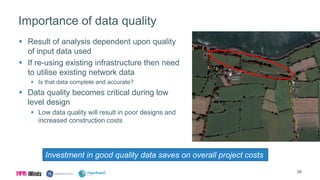
Importance of data quality
 Result of analysis dependent upon quality
of input data used
 If re-using existing infrastructure then need
to utilise existing network data
 Is that data complete and accurate?
 Data quality becomes critical during low
level design
 Low data quality will result in poor designs and
increased construction costs
26
Investment in good quality data saves on overall project costs
Network inventory as the data source
 GIS-based network inventory solutions
provide natural repository for data
 Particularly for expansion or over-build of
existing networks where re-using existing
infrastructure
 In greenfield deployments using network
inventory as data repository from the outset
provides benefits when network build is
complete
 Support for other process such as service
assurance and service fulfilment
27
How to improve data quality
 Desktop survey
 Use satellite imagery, street level imagery & LiDAR to
improve input data for first pass low level design
 Field survey
 Take initial low level design out into field to verify and modify
 Eliminate risk of changes to design occurring during
construction – often invalidates optimisation resulting in cost
overruns
 Eliminate paper from data round trip to streamline process
 Manage process with work management solution
28
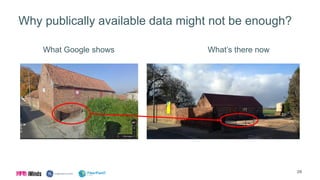
Why publically available data might not be enough?
29
What Google shows What’s there now
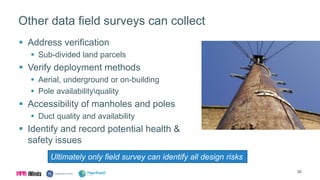
Other data field surveys can collect
 Address verification
 Sub-divided land parcels
 Verify deployment methods
 Aerial, underground or on-building
 Pole availabilityquality
 Accessibility of manholes and poles
 Duct quality and availability
 Identify and record potential health &
safety issues
30
Ultimately only field survey can identify all design risks
Best practice: Area classification
Jonas Verstuyft
31
Project success influencing factors
Revenue
 Take rate
 Competition
 Demographics
 Marketing
 ARPU
Costs
 Architecture
 Local restrictions?
 Deployment methods
 Local restrictions?
 Unit costs
 Population density
32
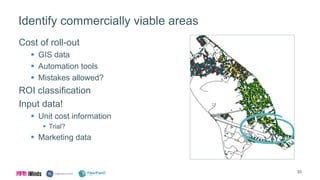
Identify commercially viable areas
Cost of roll-out
 GIS data
 Automation tools
 Mistakes allowed?
ROI classification
Input data!
 Unit cost information
 Trial?
 Marketing data
33
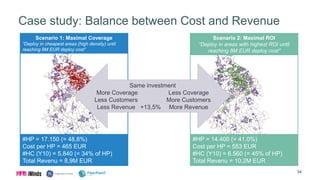
Case study: Balance between Cost and Revenue
34
Scenario 1: Maximal Coverage
“Deploy in cheapest areas (high density) until
reaching 8M EUR deploy cost”
#HP = 17.150 (= 48,8%)
Cost per HP = 465 EUR
#HC (Y10) = 5.840 (= 34% of HP)
Total Revenu = 8,9M EUR
Scenario 2: Maximal ROI
“Deploy in areas with highest ROI until
reaching 8M EUR deploy cost”
#HP = 14.400 (= 41,0%)
Cost per HP = 553 EUR
#HC (Y10) = 6.560 (= 45% of HP)
Total Revenu = 10,2M EUR
Same investment
More Coverage Less Coverage
Less Customers More Customers
Less Revenue +13,5% More Revenue
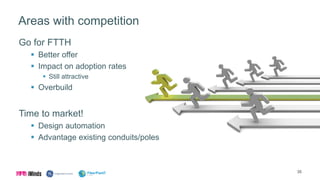
Areas with competition
Go for FTTH
 Better offer
 Impact on adoption rates
 Still attractive
 Overbuild
Time to market!
 Design automation
 Advantage existing conduits/poles
35
Rural and Urban deployment at Eir
David Renehan
36
Rural broadband in Eir
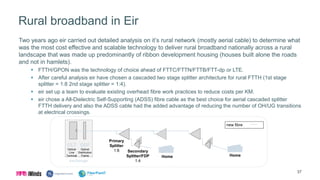
Two years ago eir carried out detailed analysis on it’s rural network (mostly aerial cable) to determine what
was the most cost effective and scalable technology to deliver rural broadband nationally across a rural
landscape that was made up predominantly of ribbon development housing (houses built alone the roads
and not in hamlets).
 FTTH/GPON was the technology of choice ahead of FTTC/FTTN/FTTB/FTT-dp or LTE.
 After careful analysis eir have chosen a cascaded two stage splitter architecture for rural FTTH (1st stage
splitter = 1:8 2nd stage splitter = 1:4).
 eir set up a team to evaluate existing overhead fibre work practices to reduce costs per KM.
 eir chose a All-Dielectric Self-Supporting (ADSS) fibre cable as the best choice for aerial cascaded splitter
FTTH delivery and also the ADSS cable had the added advantage of reducing the number of OH/UG transitions
at electrical crossings.
Primary
Splitter
1:8
new fibre
OLT
Optical
Line
Terminal
ODF
Optical
Distribution
Frame
exchange
Secondary
Splitter/FDP
1:4
Home Home
37
Rural broadband in Eir: Trial
In 2014 eir built its first trial rural FTTH network passing over 150
homes as a proof of concept to determine:
 The new access fibre work practices worked in the live network
 ADSS fibre cable was suitable for eir’s splitters/splicing & DP closures.
 Planning and GEO tools could record and manage the new rural FTTH
architecture.
 This was a huge success and proved useful to both eir and the rural
communities as to how FTTH could change their lives
In mid 2015 eir built a second trial rural FTTH network passing over
120 homes to fine tune the outcomes from the first rural trial:
38
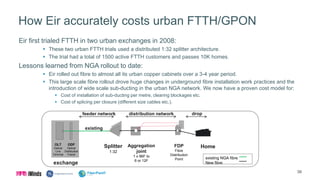
How Eir accurately costs urban FTTH/GPON
Eir first trialed FTTH in two urban exchanges in 2008:
 These two urban FTTH trials used a distributed 1:32 splitter architecture.
 The trial had a total of 1500 active FTTH customers and passes 10K homes.
Lessons learned from NGA rollout to date:
 Eir rolled out fibre to almost all its urban copper cabinets over a 3-4 year period.
 This large scale fibre rollout drove huge changes in underground fibre installation work practices and the
introduction of wide scale sub-ducting in the urban NGA network. We now have a proven cost model for:
 Cost of installation of sub-ducting per metre, clearing blockages etc.
 Cost of splicing per closure (different size cables etc.).
39
OLT
Optical
Line
Terminal
ODF
Optical
Distribution
Frame
Splitter
1:32
Aggregation
joint
1 x 96F to
6 or 12F
FDP
Fibre
Distribution
Point
exchange
distribution network drop
Home
feeder network
existing
existing NGA fibre
New fibre
How Eir accurately costs urban FTTH/GPON
Using planning tools to accurately cost future FTTH projects .
 Using eir’s FTTH planning tool and GEO analysis tools it is now possible to take the
learned costs and accurately produce a details BOM per new FTTH planned area.
 These tools can run various scenarios to evaluate what are the best FTTH rules to
apply to design the most efficient splitter/homes passed model and reduce
infrastructure costs.
40
Identifying commercially viable FTTH rural areas
Eir has spent the past few years analysing both urban and rural
access infrastructure.
Using GEO tools, Eir have mapped every premises in Ireland and
identified whether they are urban or rural and what exchange they
are served from:
 Is the premises served from an NGA enabled exchange?
 Is the exchange fibre enabled?
 Distance from exchange?
 Exchange density?
 Total length and type of existing cable infrastructure?
41
Identifying commercially viable FTTH rural areas
Using automated FTTH design simulators, GEO tools and an in
house algorithm it was possible to derive the cost H/P per dwelling
using various rules e.g.
 Cost per exchange area?
 Identify most cost effective routes per exchange?
 Identify most cost effective routes nationally?
 Launch from fibre enabled exchanges only?
 Etc.
From the above information it is now possible to calculate a detailed
BOM for any rural FTTH route and classify it as commercially viable
or not?
42
Something to remember?
 Learn from trials and earlier roll-outs
 Get accurate view on difficulties and costs
 Involvement of government in rural broadband
 Use tools for accurate cost estimations
 Save costs by reusing infrastructure
 Importance of data quality
43
FTTH Council Europe, February 2016
Thank you for your attention!
Any questions?

FTTH Deployment in Ireland: Eir's experiences (workshop FTTH EU Conference 2016)

  • 1.
    FTTH Council Europe,February 2016 FTTH deployment in Ireland: Eir’s experiences David Renehan Dave Bolsdon Jonas Verstuyft
  • 2.
  • 3.
    Introduction to Irelandand Eir David Renehan 3
  • 4.
  • 5.
    Some facts aboutIreland  70,273 km2  Atlantic Ocean  Predominant first language: English  Population - 4.6 M  3.3 M sheep  Sports  Most popular sport - GAA  FIFA ranking: 31st  Rugby world ranking: 4th 5
  • 6.
    Who is Eir? Formerlyknown as Eircom – rebranded in 2015 Incumbent telecoms operator in Ireland Mobile operator with a 20% penetration in the Irish market Both wholesaler and retailer of copper and fibre based broadband 6
  • 7.
    Market situation inIreland Ireland is a relatively open market Competition  Virgin Media: HFC  Formally UPC but rebranded in late 2015  Siro: FTTH  Recently launched - joint Venture between Vodafone & ESB (Electricity Supply Board)  BT: fibre  Predominantly enterprise customers  Enet: fibre  MANs fibre in 90 urban areas nationally 7
  • 8.
    Where is thecompetition Large cities – 5 large cities (~ 1million premises)  Virgin Media – HFC  Siro – FTTH planned for 4 large cities (no plans for Dublin yet) Middle Ireland – roughly 800 towns and villages (~ 600K premises)  Virgin Media – HFC in 20 large towns  Siro – FTTH launched in 3 towns and 47 more planned in the next two years – objective to pass 400K premises Rural Ireland - (~ 760K premises)  No competition  Government launching National Broadband Plan (NBP) to provide 30Mbps+ to all rural premises 8
  • 9.
    Irish National BroadbandPlan  Objectives  First 50% of population: 70-100+ Mbps  Next 20-35% of population: >40 Mbps  100% of population: >30 Mbps  Public funds: 175M EUR (~50% subvention)  Rural Coverage  610,000 households  150,000 business 9 NGA NBP
  • 10.
    NGA program Eir FTTC:1.3M premises passed by Q2 2016 NGA plans  FTTx: 300k urban premises outside existing FTTC program  FTTH: 300k commercially viable rural premises  FTTH: 66 Middle Ireland towns (12 towns completed to date) 10 5 Large cities Middle Ireland towns Rural Ireland 1.6 million premises 760k premises VDSL vectored GPON FTTH 1.3 million H/Ps by Q2 2016 600K+ FTTH+FTTx planned – rollout starts Q1/Q2 2016
  • 11.
    Best practice: Evaluatingarchitectures & technologies Jonas Verstuyft 11
  • 12.
  • 13.
    Impacting FTTH architecture Caseby case  Ribbon development  MDUs vs SDUs  Population density  … 13
  • 14.
    Split decision Types  Cascaded Centralized OLT port fill ratio  Activation percentage?  OPEX! 14
  • 15.
    Not a splitsecond decision Use-case  Ireland  1660 homes FTTH Design Rules  Urban  Rural 15
  • 16.
    Impact on costof different architecture types 16 Mix RulesAll Urban 3,070,432.57 EUR4,669,703.55 EUR Example unit costs used
  • 17.
    Deployment methods atEir Jonas Verstuyft 17
  • 18.
    SDUs 95% Single DwellingUnits (SDUs) 75% of Ireland’s SDU have easy cable access.  aerial or duct 18
  • 19.
    Advantage existing ductinfrastructure Extensive underground ducting in urban settlements Lower Civil costs Lower FTTH homes passed costs than the European average 19 Sample town Cavan 14,100 Buildings ~82KM roads ~94KM ducting
  • 20.
    Mixed deployment Aerial –Underground – Existing Lower costs Increase complexity  Design  Deployment Aerial leads 31% Ducted leads 44% Buried leads 25% 20
  • 21.
    Using GIS basedplanning and design system Improve accuracy  Vs pen & paper, Excel, Google Satellite, CAD tools,… GIS  Homes (FTTH)  Routes  Existing vs new  Underground vs aerial 21
  • 22.
    New trenching High cost Rural vs Urban Different technologies Local factors  Surface types  Legislation 22
  • 23.
  • 24.
    Existing infrastructure Poles  Ownpoles?  Lease?  New poles? Existing Ducts Existing Manholes  Blockages?  Spare capacity? 24
  • 25.
    Best practice: Importanceof input data James Wheatley 25
  • 26.
    Importance of dataquality  Result of analysis dependent upon quality of input data used  If re-using existing infrastructure then need to utilise existing network data  Is that data complete and accurate?  Data quality becomes critical during low level design  Low data quality will result in poor designs and increased construction costs 26 Investment in good quality data saves on overall project costs
  • 27.
    Network inventory asthe data source  GIS-based network inventory solutions provide natural repository for data  Particularly for expansion or over-build of existing networks where re-using existing infrastructure  In greenfield deployments using network inventory as data repository from the outset provides benefits when network build is complete  Support for other process such as service assurance and service fulfilment 27
  • 28.
    How to improvedata quality  Desktop survey  Use satellite imagery, street level imagery & LiDAR to improve input data for first pass low level design  Field survey  Take initial low level design out into field to verify and modify  Eliminate risk of changes to design occurring during construction – often invalidates optimisation resulting in cost overruns  Eliminate paper from data round trip to streamline process  Manage process with work management solution 28
  • 29.
    Why publically availabledata might not be enough? 29 What Google shows What’s there now
  • 30.
    Other data fieldsurveys can collect  Address verification  Sub-divided land parcels  Verify deployment methods  Aerial, underground or on-building  Pole availabilityquality  Accessibility of manholes and poles  Duct quality and availability  Identify and record potential health & safety issues 30 Ultimately only field survey can identify all design risks
  • 31.
    Best practice: Areaclassification Jonas Verstuyft 31
  • 32.
    Project success influencingfactors Revenue  Take rate  Competition  Demographics  Marketing  ARPU Costs  Architecture  Local restrictions?  Deployment methods  Local restrictions?  Unit costs  Population density 32
  • 33.
    Identify commercially viableareas Cost of roll-out  GIS data  Automation tools  Mistakes allowed? ROI classification Input data!  Unit cost information  Trial?  Marketing data 33
  • 34.
    Case study: Balancebetween Cost and Revenue 34 Scenario 1: Maximal Coverage “Deploy in cheapest areas (high density) until reaching 8M EUR deploy cost” #HP = 17.150 (= 48,8%) Cost per HP = 465 EUR #HC (Y10) = 5.840 (= 34% of HP) Total Revenu = 8,9M EUR Scenario 2: Maximal ROI “Deploy in areas with highest ROI until reaching 8M EUR deploy cost” #HP = 14.400 (= 41,0%) Cost per HP = 553 EUR #HC (Y10) = 6.560 (= 45% of HP) Total Revenu = 10,2M EUR Same investment More Coverage Less Coverage Less Customers More Customers Less Revenue +13,5% More Revenue
  • 35.
    Areas with competition Gofor FTTH  Better offer  Impact on adoption rates  Still attractive  Overbuild Time to market!  Design automation  Advantage existing conduits/poles 35
  • 36.
    Rural and Urbandeployment at Eir David Renehan 36
  • 37.
    Rural broadband inEir Two years ago eir carried out detailed analysis on it’s rural network (mostly aerial cable) to determine what was the most cost effective and scalable technology to deliver rural broadband nationally across a rural landscape that was made up predominantly of ribbon development housing (houses built alone the roads and not in hamlets).  FTTH/GPON was the technology of choice ahead of FTTC/FTTN/FTTB/FTT-dp or LTE.  After careful analysis eir have chosen a cascaded two stage splitter architecture for rural FTTH (1st stage splitter = 1:8 2nd stage splitter = 1:4).  eir set up a team to evaluate existing overhead fibre work practices to reduce costs per KM.  eir chose a All-Dielectric Self-Supporting (ADSS) fibre cable as the best choice for aerial cascaded splitter FTTH delivery and also the ADSS cable had the added advantage of reducing the number of OH/UG transitions at electrical crossings. Primary Splitter 1:8 new fibre OLT Optical Line Terminal ODF Optical Distribution Frame exchange Secondary Splitter/FDP 1:4 Home Home 37
  • 38.
    Rural broadband inEir: Trial In 2014 eir built its first trial rural FTTH network passing over 150 homes as a proof of concept to determine:  The new access fibre work practices worked in the live network  ADSS fibre cable was suitable for eir’s splitters/splicing & DP closures.  Planning and GEO tools could record and manage the new rural FTTH architecture.  This was a huge success and proved useful to both eir and the rural communities as to how FTTH could change their lives In mid 2015 eir built a second trial rural FTTH network passing over 120 homes to fine tune the outcomes from the first rural trial: 38
  • 39.
    How Eir accuratelycosts urban FTTH/GPON Eir first trialed FTTH in two urban exchanges in 2008:  These two urban FTTH trials used a distributed 1:32 splitter architecture.  The trial had a total of 1500 active FTTH customers and passes 10K homes. Lessons learned from NGA rollout to date:  Eir rolled out fibre to almost all its urban copper cabinets over a 3-4 year period.  This large scale fibre rollout drove huge changes in underground fibre installation work practices and the introduction of wide scale sub-ducting in the urban NGA network. We now have a proven cost model for:  Cost of installation of sub-ducting per metre, clearing blockages etc.  Cost of splicing per closure (different size cables etc.). 39 OLT Optical Line Terminal ODF Optical Distribution Frame Splitter 1:32 Aggregation joint 1 x 96F to 6 or 12F FDP Fibre Distribution Point exchange distribution network drop Home feeder network existing existing NGA fibre New fibre
  • 40.
    How Eir accuratelycosts urban FTTH/GPON Using planning tools to accurately cost future FTTH projects .  Using eir’s FTTH planning tool and GEO analysis tools it is now possible to take the learned costs and accurately produce a details BOM per new FTTH planned area.  These tools can run various scenarios to evaluate what are the best FTTH rules to apply to design the most efficient splitter/homes passed model and reduce infrastructure costs. 40
  • 41.
    Identifying commercially viableFTTH rural areas Eir has spent the past few years analysing both urban and rural access infrastructure. Using GEO tools, Eir have mapped every premises in Ireland and identified whether they are urban or rural and what exchange they are served from:  Is the premises served from an NGA enabled exchange?  Is the exchange fibre enabled?  Distance from exchange?  Exchange density?  Total length and type of existing cable infrastructure? 41
  • 42.
    Identifying commercially viableFTTH rural areas Using automated FTTH design simulators, GEO tools and an in house algorithm it was possible to derive the cost H/P per dwelling using various rules e.g.  Cost per exchange area?  Identify most cost effective routes per exchange?  Identify most cost effective routes nationally?  Launch from fibre enabled exchanges only?  Etc. From the above information it is now possible to calculate a detailed BOM for any rural FTTH route and classify it as commercially viable or not? 42
  • 43.
    Something to remember? Learn from trials and earlier roll-outs  Get accurate view on difficulties and costs  Involvement of government in rural broadband  Use tools for accurate cost estimations  Save costs by reusing infrastructure  Importance of data quality 43
  • 44.
    FTTH Council Europe,February 2016 Thank you for your attention! Any questions?