Regional status of soil pollution:
Eurasian subregional Soil
Partnership
P. Krasilnikov, G. Khasankhanova,
U. Abdullaev, E. Baibagyshov, S. Baliuk,
A. Chervan, A. Fateev, S. Safarli, A. Saparov
GLOBAL SYMPOSIUM ON SOIL POLLUTION | FAO HQ | ROME, ITALY, 2-4 MAY 2018
The scope of the region
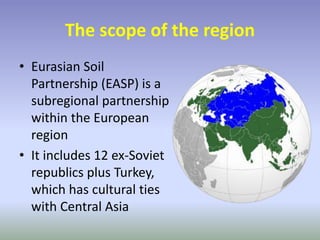
• Eurasian Soil
Partnership (EASP) is a
subregional partnership
within the European
region
• It includes 12 ex-Soviet
republics plus Turkey,
which has cultural ties
with Central Asia
Radionuclide contamination
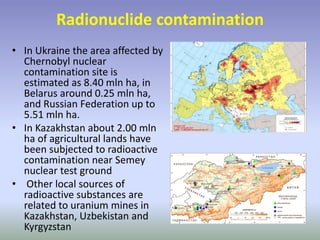
• In Ukraine the area affected by
Chernobyl nuclear
contamination site is
estimated as 8.40 mln ha, in
Belarus around 0.25 mln ha,
and Russian Federation up to
5.51 mln ha.
• In Kazakhstan about 2.00 mln
ha of agricultural lands have
been subjected to radioactive
contamination near Semey
nuclear test ground
• Other local sources of
radioactive substances are
related to uranium mines in
Kazakhstan, Uzbekistan and
Kyrgyzstan
Local industrial, urban and mining
contamination
• In Turkey the number of contaminated sites is expected to
be in the range of 1000-1500, of which 5-10 % are believed
to be sites requiring remediation, but in reality only few of
these sites were really treated
• In Russian Federation only 35-40 sites are studied annually,
with some overlapping from year to year for monitoring
dynamics at the most contaminated sites.
• Total area of contaminated soils in Russia is estimated on
the level of 3.60 million ha, including 1.4 million ha of
agricultural lands.
• In Kazakhstan, lands contaminated with heavy metals and
radioactive substances occupy about 21.50 million ha
Local industrial, urban and mining
contamination
• In Azerbaijan the area of contaminated soils is estimated
to be 33,300 ha, including 11,143 ha contaminated with
petrochemistry products, around 11,000 ha under mining
products, and 5,000 ha under construction waste.
• In Belarus, 44 cities have been studied within five-year
inventory to provide an assessment of petroleum
products, heavy metals, and sulphates and nitrites. Also
soils around the main 10 machine-building, petrochemical
and construction plants in Belarus are continuously
monitored.
• In Belarus most of the contaminated soils are found in
urban environments (78 thousand ha) and around the
highways (119 thousand ha), while only 10 thousand ha of
agricultural soils are contaminated.
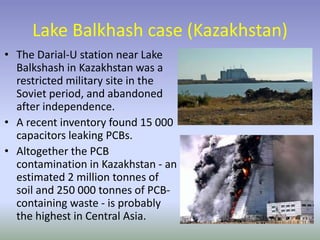
Lake Balkhash case (Kazakhstan)
• The Darial-U station near Lake
Balkshash in Kazakhstan was a
restricted military site in the
Soviet period, and abandoned
after independence.
• A recent inventory found 15 000
capacitors leaking PCBs.
• Altogether the PCB
contamination in Kazakhstan - an
estimated 2 million tonnes of
soil and 250 000 tonnes of PCB-
containing waste - is probably
the highest in Central Asia.
Diffuse contamination
• Diffuse contamination is commonly associated
with the excessive use of fertilizers and plant
protection products.
• The use of fertilizers was continuously decreasing
from 1980s, and dramatically fell down in the
1990s practically in all the ex-Soviet countries.
• For example, in Kazakhstan the total amount of
mineral fertilizers was more than 1000 kilotons in
1986 and only 31 kiloton in 2008; the doses per
ha of arable land decreased from 29 kg NPK to
1.5 kg.
Diffuse contamination
• The area polluted with pesticides is dynamic and
depends not only on the year, but also on the
season
• About 54% of surveyed soil in Uzbekistan is
polluted by pesticides. The special concern is the
local pollution of soil near to former agricultural
airfields, warehouses for storage of pesticides,
organic and mineral fertilizers
• On the territory of Ukraine there are about 3000
storehouses of obsolete pesticides, not taking
into account almost 2000 so-called "hot spots" -
polluted sites of ruined storehouses
Legislation
• In Turkey the general framework is formed by the
Environmental Law adopted in 1983, and amended in
2006.
• The adoption of the law was followed by important
regulations, such as the Solid Waste Control Regulation
(1991), the Environmental Impact Assessment
Regulation (1993), and especially the Hazardous Waste
Control Regulation (1995) that provided the necessary
measures to inhibit soil pollution.
• Finally, in 2001 the Soil Pollution Control Regulation,
which is currently the major regulation related to soil
pollution, was enforced
Legislation
• Some countries, like Kyrgyzstan, have a unique document
that regulates soil-related issues in the country, in this
case Regulation on monitoring of agricultural land of the
Kyrgyz Republic from 01.03.1999, No. 115. Responsible
body for monitoring is the State Ecological Inspectorate
and the Ministry of Emergency Situations under the
Government of the Kyrgyz Republic.
• Other countries have multiple regulations, including
specific regulations for focal territories, such as The Law of
Ukraine "On the legal regime of the territory radioactively
contaminated due to the Chernobyl disaster" of
27.02.1991 No. 791a - HP. Assessment of the risk of
radiation contamination is carried out by the Ministry of
Health.
Conclusions
• The soils of the major part of the Eurasian sub-region may
be regarded as strongly polluted. It is related with unwise
intensive industrial development of the Soviet Union,
excessive militarization of some areas, and imbalanced use
of agrochemicals.
• Currently soil pollution continues in spite of decreased
industrial activity and limited use of fertilizers in most
places. The main sources of soil pollution are heavy metals,
crude oil and petrochemical products.
• For agricultural fields pesticides are the main sources of
contamination.
• Strong political will is needed for addressing the challenge of
contamination in the region. Improved legislation and
significant investment are the requisites for successful soil
restoration.
Thank you for your attention
Status of Soil Pollution in Eurasia

Status of Soil Pollution in Eurasia

  • 2.
    Regional status ofsoil pollution: Eurasian subregional Soil Partnership P. Krasilnikov, G. Khasankhanova, U. Abdullaev, E. Baibagyshov, S. Baliuk, A. Chervan, A. Fateev, S. Safarli, A. Saparov GLOBAL SYMPOSIUM ON SOIL POLLUTION | FAO HQ | ROME, ITALY, 2-4 MAY 2018
  • 3.
    The scope ofthe region • Eurasian Soil Partnership (EASP) is a subregional partnership within the European region • It includes 12 ex-Soviet republics plus Turkey, which has cultural ties with Central Asia
  • 4.
    Radionuclide contamination • InUkraine the area affected by Chernobyl nuclear contamination site is estimated as 8.40 mln ha, in Belarus around 0.25 mln ha, and Russian Federation up to 5.51 mln ha. • In Kazakhstan about 2.00 mln ha of agricultural lands have been subjected to radioactive contamination near Semey nuclear test ground • Other local sources of radioactive substances are related to uranium mines in Kazakhstan, Uzbekistan and Kyrgyzstan
  • 5.
    Local industrial, urbanand mining contamination • In Turkey the number of contaminated sites is expected to be in the range of 1000-1500, of which 5-10 % are believed to be sites requiring remediation, but in reality only few of these sites were really treated • In Russian Federation only 35-40 sites are studied annually, with some overlapping from year to year for monitoring dynamics at the most contaminated sites. • Total area of contaminated soils in Russia is estimated on the level of 3.60 million ha, including 1.4 million ha of agricultural lands. • In Kazakhstan, lands contaminated with heavy metals and radioactive substances occupy about 21.50 million ha
  • 6.
    Local industrial, urbanand mining contamination • In Azerbaijan the area of contaminated soils is estimated to be 33,300 ha, including 11,143 ha contaminated with petrochemistry products, around 11,000 ha under mining products, and 5,000 ha under construction waste. • In Belarus, 44 cities have been studied within five-year inventory to provide an assessment of petroleum products, heavy metals, and sulphates and nitrites. Also soils around the main 10 machine-building, petrochemical and construction plants in Belarus are continuously monitored. • In Belarus most of the contaminated soils are found in urban environments (78 thousand ha) and around the highways (119 thousand ha), while only 10 thousand ha of agricultural soils are contaminated.
  • 7.
    Lake Balkhash case(Kazakhstan) • The Darial-U station near Lake Balkshash in Kazakhstan was a restricted military site in the Soviet period, and abandoned after independence. • A recent inventory found 15 000 capacitors leaking PCBs. • Altogether the PCB contamination in Kazakhstan - an estimated 2 million tonnes of soil and 250 000 tonnes of PCB- containing waste - is probably the highest in Central Asia.
  • 8.
    Diffuse contamination • Diffusecontamination is commonly associated with the excessive use of fertilizers and plant protection products. • The use of fertilizers was continuously decreasing from 1980s, and dramatically fell down in the 1990s practically in all the ex-Soviet countries. • For example, in Kazakhstan the total amount of mineral fertilizers was more than 1000 kilotons in 1986 and only 31 kiloton in 2008; the doses per ha of arable land decreased from 29 kg NPK to 1.5 kg.
  • 9.
    Diffuse contamination • Thearea polluted with pesticides is dynamic and depends not only on the year, but also on the season • About 54% of surveyed soil in Uzbekistan is polluted by pesticides. The special concern is the local pollution of soil near to former agricultural airfields, warehouses for storage of pesticides, organic and mineral fertilizers • On the territory of Ukraine there are about 3000 storehouses of obsolete pesticides, not taking into account almost 2000 so-called "hot spots" - polluted sites of ruined storehouses
  • 10.
    Legislation • In Turkeythe general framework is formed by the Environmental Law adopted in 1983, and amended in 2006. • The adoption of the law was followed by important regulations, such as the Solid Waste Control Regulation (1991), the Environmental Impact Assessment Regulation (1993), and especially the Hazardous Waste Control Regulation (1995) that provided the necessary measures to inhibit soil pollution. • Finally, in 2001 the Soil Pollution Control Regulation, which is currently the major regulation related to soil pollution, was enforced
  • 11.
    Legislation • Some countries,like Kyrgyzstan, have a unique document that regulates soil-related issues in the country, in this case Regulation on monitoring of agricultural land of the Kyrgyz Republic from 01.03.1999, No. 115. Responsible body for monitoring is the State Ecological Inspectorate and the Ministry of Emergency Situations under the Government of the Kyrgyz Republic. • Other countries have multiple regulations, including specific regulations for focal territories, such as The Law of Ukraine "On the legal regime of the territory radioactively contaminated due to the Chernobyl disaster" of 27.02.1991 No. 791a - HP. Assessment of the risk of radiation contamination is carried out by the Ministry of Health.
  • 12.
    Conclusions • The soilsof the major part of the Eurasian sub-region may be regarded as strongly polluted. It is related with unwise intensive industrial development of the Soviet Union, excessive militarization of some areas, and imbalanced use of agrochemicals. • Currently soil pollution continues in spite of decreased industrial activity and limited use of fertilizers in most places. The main sources of soil pollution are heavy metals, crude oil and petrochemical products. • For agricultural fields pesticides are the main sources of contamination. • Strong political will is needed for addressing the challenge of contamination in the region. Improved legislation and significant investment are the requisites for successful soil restoration.
  • 13.
    Thank you foryour attention