
Decision Supporting Framework
for Soil Erosion Control and
Ecosystem Services
Enhancement
Jae Yang*, K.J. Lim and P. Borrelli
1
Acknowledgements
Grants by Rural Development Administration (RDA)
and Ministry of Environment (MoE), Korea
Research Groups by SSORii and EcoSSSoil
2
3
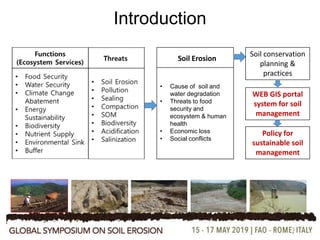
Introduction
Soil Erosion
• Cause of soil and
water degradation
• Threats to food
security and
ecosystem & human
health
• Economic loss
• Social conflicts
Soil conservation
planning &
practices
WEB GIS portal
system for soil
management
Policy for
sustainable soil
management
4
Objective
To propose a decision supporting framework for the
planning, assessment, and policy of soil and water
conservation, by integrating both soil erosion and
ecosystem services
5
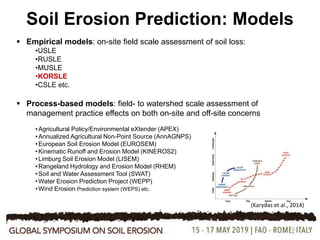
Soil Erosion Prediction: Models
(Karydas et al., 2014)
 Empirical models: on-site field scale assessment of soil loss:
•USLE
•RUSLE
•MUSLE
•KORSLE
•CSLE etc.
 Process-based models: field- to watershed scale assessment of
management practice effects on both on-site and off-site concerns
•Agricultural Policy/Environmental eXtender (APEX)
•Annualized Agricultural Non-Point Source (AnnAGNPS)
•European Soil Erosion Model (EUROSEM)
•Kinematic Runoff and Erosion Model (KINEROS2)
•Limburg Soil Erosion Model (LISEM)
•Rangeland Hydrology and Erosion Model (RHEM)
•Soil and Water Assessment Tool (SWAT)
•Water Erosion Prediction Project (WEPP)
•Wind Erosion Prediction system (WEPS) etc.
6
Soil Erosion Modelling
• Application of soil erosion models:
 Conservation planning and assessment
 Sediment source identification
 Assessment of management options
 Dynamic hydrologic and erosion assessment
• Selection of erosion model for conservation assessment and
planning
 Function of modeling purposes
 Characteristics of the natural system under study
 Data availability (Wagner et al., 2001)(Ascough et al., 2018)
• Simulate “what-if” scenarios at varying spatial and
temporal scales
7
Soil Erosion Modelling
 confined to the assessment of the amount of soil erosion and practice
effect
 not further linked to policy for implementation of sustainable soil
management
Ascough et al. (2018) Limitations:
• Site-specific
• Lack of credibility
• Insufficient data
• Difficulty in model parameter determination
• Absence of widely accepted modeling algorithms etc.
8
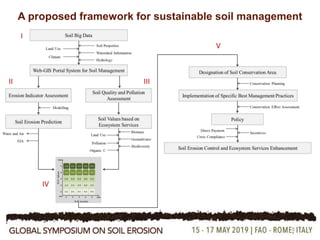
A proposed framework for sustainable soil management
I
II III
IV
V
9
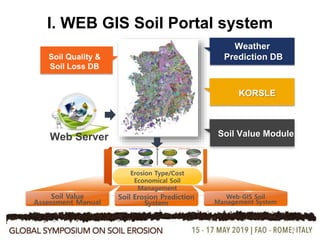
I. WEB GIS Soil Portal system
Soil Value
Assessment Manual
Erosion Type/Cost
Economical Soil
Management
Soil Erosion Prediction
System
Web-GIS Soil
Management System
10
II. Soil Erosion Prediction
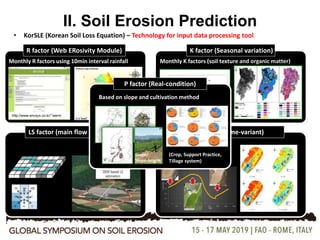
• KorSLE (Korean Soil Loss Equation) – Technology for input data processing tool
R factor (Web ERosivity Module)
Monthly R factors using 10min interval rainfall
http://www.envsys.co.kr/~werm
K factor (Seasonal variation)
Monthly K factors (soil texture and organic matter)
LS factor (main flow direction) C factor (Time-variant)
Computing Slope length based on topography
Date (Month)
1 2 3 4 5 6 7 8 9 10 11 12
USLEKfactor
0.078660
0.078665
0.078670
0.078675
0.078680
0.078685
Af
Monthly C factors
8 flow
directions
P factor (Real-condition)
Based on slope and cultivation method
(Crop, Support Practice,
Tillage system)
Slope/
Slope-length
11
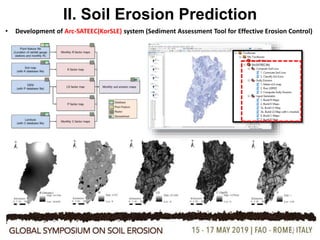
• Development of Arc-SATEEC(KorSLE) system (Sediment Assessment Tool for Effective Erosion Control)
II. Soil Erosion Prediction
12
II. Soil Erosion Prediction
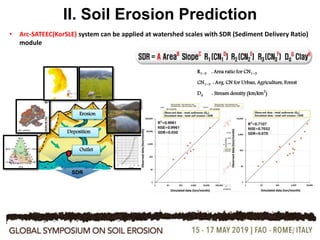
• Arc-SATEEC(KorSLE) system can be applied at watershed scales with SDR (Sediment Delivery Ratio)
module
Outlet
Deposition
Erosion
SDR
R1~3 : Area ratio for CN1~3
CN1~3 : Avg. CN for Urban, Agriculture, Forest
Dd : Stream density (km/km
2
)
13
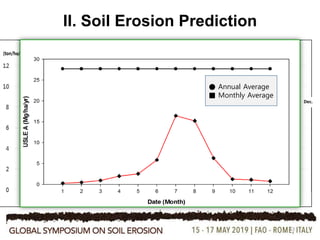
II. Soil Erosion Prediction
Watershed Information
Watershed AnalysisSoil Erosion at Watershed
Level
Jan. Feb. Mar. Apr. May Jun. Jul. Aug. Sep. Oct. Nov. Dec.
KORSLE A
● Annual Average
■ Monthly Average
14
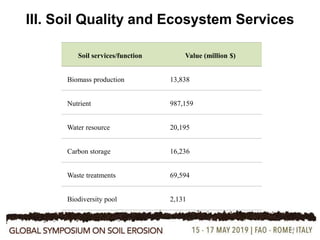
III. Soil Quality and Ecosystem Services
Soil Quality Index
Soil services/function Value (million $)
Biomass production 13,838
Nutrient 987,159
Water resource 20,195
Carbon storage 16,236
Waste treatments 69,594
Biodiversity pool 2,131
15
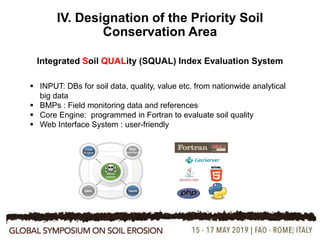
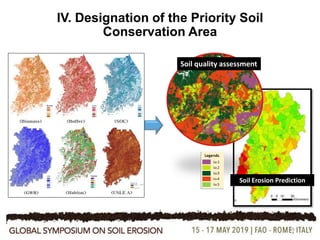
IV. Designation of the Priority Soil
Conservation Area
Integrated Soil QUALity (SQUAL) Index Evaluation System
 INPUT: DBs for soil data, quality, value etc. from nationwide analytical
big data
 BMPs : Field monitoring data and references
 Core Engine: programmed in Fortran to evaluate soil quality
 Web Interface System : user-friendly
16
IV. Designation of the Priority Soil
Conservation Area
Soil quality assessment
Soil Erosion Prediction
17
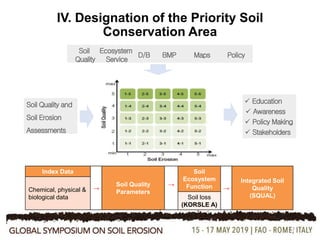
IV. Designation of the Priority Soil
Conservation Area
D/B Maps Policy
 Education
 Awareness
BMP
Soil Quality and
Soil Erosion
Assessments
Ecosystem
Service
Soil
Quality
 Policy Making
 Stakeholders
Index Data
→
Soil Quality
Parameters
→
Soil
Ecosystem
Function →
Integrated Soil
Quality
(SQUAL)
Chemical, physical &
biological data Soil loss
(KORSLE A)
18
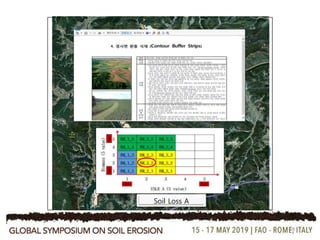
Soil Organic CarbonSoil Loss A
Click!
19
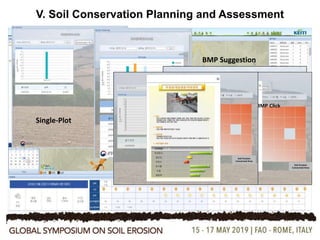
Single-Plot
Multi-Plots
Soil Function Click
Click
Soil Erosion
Safe Area
Soil Erosion
Concerned Area
Current Grade
Improve Grade
Soil Erosion
Concerned Area
BMP Click
Soil Erosion
Concerned Area
BMP Suggestion
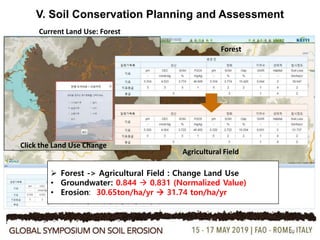
V. Soil Conservation Planning and Assessment
20
 Forest -> Agricultural Field : Change Land Use
• Groundwater: 0.844  0.831 (Normalized Value)
• Erosion: 30.65ton/ha/yr  31.74 ton/ha/yr
Click the Land Use Change
Current Land Use: Forest
Forest
Agricultural Field
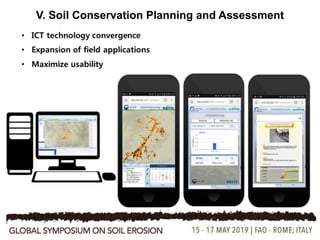
V. Soil Conservation Planning and Assessment
21
V. Soil Conservation Planning and Assessment
22
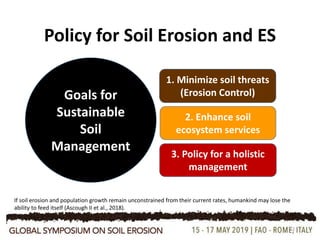
Policy for Soil Erosion and ES
Goals for
Sustainable
Soil
Management
1. Minimize soil threats
(Erosion Control)
2. Enhance soil
ecosystem services
3. Policy for a holistic
management
If soil erosion and population growth remain unconstrained from their current rates, humankind may lose the
ability to feed itself (Ascough II et al., 2018).
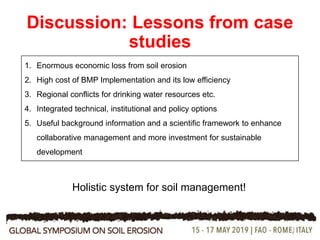
Discussion: Lessons from case
studies
23
1. Enormous economic loss from soil erosion
2. High cost of BMP Implementation and its low efficiency
3. Regional conflicts for drinking water resources etc.
4. Integrated technical, institutional and policy options
5. Useful background information and a scientific framework to enhance
collaborative management and more investment for sustainable
development
Holistic system for soil management!
24
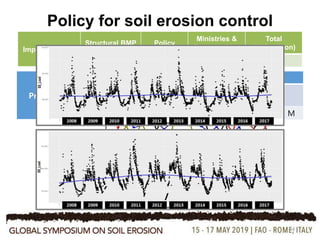
Policy for soil erosion control
Implementation
Structural BMP Policy
Ministries &
Organizations
Total
(US$ million)
13 projects 10 projects 10 386
Proposal
Management options (10 yrs) with <50 NTU
BMP Buyout
Forest
restoration
Total
US$ 680 US$ 105 US$ 104 US$ 935 M
25
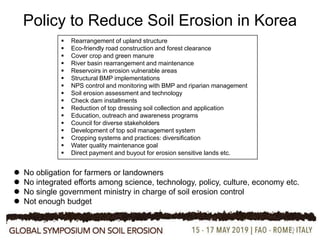
Policy to Reduce Soil Erosion in Korea
 Rearrangement of upland structure
 Eco-friendly road construction and forest clearance
 Cover crop and green manure
 River basin rearrangement and maintenance
 Reservoirs in erosion vulnerable areas
 Structural BMP implementations
 NPS control and monitoring with BMP and riparian management
 Soil erosion assessment and technology
 Check dam installments
 Reduction of top dressing soil collection and application
 Education, outreach and awareness programs
 Council for diverse stakeholders
 Development of top soil management system
 Cropping systems and practices: diversification
 Water quality maintenance goal
 Direct payment and buyout for erosion sensitive lands etc.
 No obligation for farmers or landowners
 No integrated efforts among science, technology, policy, culture, economy etc.
 No single government ministry in charge of soil erosion control
 Not enough budget
26
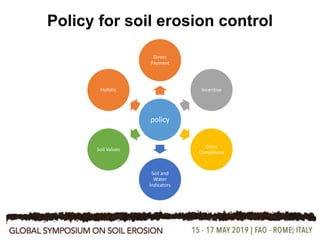
Policy for soil erosion control
policy
Direct
Payment
Incentive
Cross
Compliance
Soil and
Water
Indicators
Soil Values
Holistic
27
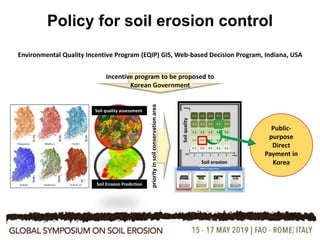
Policy for soil erosion control
Soil erosion
Soilquality
Environmental Quality Incentive Program (EQIP) GIS, Web-based Decision Program, Indiana, USA
Soil Erosion Prediction
Soil quality assessment
priorityinsoilconservationarea
Public-
purpose
Direct
Payment in
Korea
Incentive program to be proposed to
Korean Government
Discussion
28
 The web-based portal system provides up-to-date, ease-of-use
interface for decision makers/stakeholders/researchers
 BMP`s selection process is simple, but it will be helpful as a
screening tool to identify AOC (Area Of Concern).
 Needs more database on BMP, ecosystem services, quality and soil
properties
 SQUAL system is just an example protocol to develop the
management system
 A lot more of interactive works needed and continued
29
Summary
1. A proposed framework can be modified for different
countries having different spatio-temporal scales, and it can
depend on data availability.
2. Further long-term validation is definitely needed to improve
the credibility of the framework for use by farmers or policy
makers.
3. However, the proposed framework provides a protocol
useful for holistic planning of soil and water conservation
and policy implementation.
Decision supporting framework for soil erosion control and ecosystem services enhancement

Decision supporting framework for soil erosion control and ecosystem services enhancement

  • 1.
    Decision Supporting Framework forSoil Erosion Control and Ecosystem Services Enhancement Jae Yang*, K.J. Lim and P. Borrelli 1
  • 2.
    Acknowledgements Grants by RuralDevelopment Administration (RDA) and Ministry of Environment (MoE), Korea Research Groups by SSORii and EcoSSSoil 2
  • 3.
    3 Introduction Soil Erosion • Causeof soil and water degradation • Threats to food security and ecosystem & human health • Economic loss • Social conflicts Soil conservation planning & practices WEB GIS portal system for soil management Policy for sustainable soil management
  • 4.
    4 Objective To propose adecision supporting framework for the planning, assessment, and policy of soil and water conservation, by integrating both soil erosion and ecosystem services
  • 5.
    5 Soil Erosion Prediction:Models (Karydas et al., 2014)  Empirical models: on-site field scale assessment of soil loss: •USLE •RUSLE •MUSLE •KORSLE •CSLE etc.  Process-based models: field- to watershed scale assessment of management practice effects on both on-site and off-site concerns •Agricultural Policy/Environmental eXtender (APEX) •Annualized Agricultural Non-Point Source (AnnAGNPS) •European Soil Erosion Model (EUROSEM) •Kinematic Runoff and Erosion Model (KINEROS2) •Limburg Soil Erosion Model (LISEM) •Rangeland Hydrology and Erosion Model (RHEM) •Soil and Water Assessment Tool (SWAT) •Water Erosion Prediction Project (WEPP) •Wind Erosion Prediction system (WEPS) etc.
  • 6.
    6 Soil Erosion Modelling •Application of soil erosion models:  Conservation planning and assessment  Sediment source identification  Assessment of management options  Dynamic hydrologic and erosion assessment • Selection of erosion model for conservation assessment and planning  Function of modeling purposes  Characteristics of the natural system under study  Data availability (Wagner et al., 2001)(Ascough et al., 2018) • Simulate “what-if” scenarios at varying spatial and temporal scales
  • 7.
    7 Soil Erosion Modelling confined to the assessment of the amount of soil erosion and practice effect  not further linked to policy for implementation of sustainable soil management Ascough et al. (2018) Limitations: • Site-specific • Lack of credibility • Insufficient data • Difficulty in model parameter determination • Absence of widely accepted modeling algorithms etc.
  • 8.
    8 A proposed frameworkfor sustainable soil management I II III IV V
  • 9.
    9 I. WEB GISSoil Portal system Soil Value Assessment Manual Erosion Type/Cost Economical Soil Management Soil Erosion Prediction System Web-GIS Soil Management System
  • 10.
    10 II. Soil ErosionPrediction • KorSLE (Korean Soil Loss Equation) – Technology for input data processing tool R factor (Web ERosivity Module) Monthly R factors using 10min interval rainfall http://www.envsys.co.kr/~werm K factor (Seasonal variation) Monthly K factors (soil texture and organic matter) LS factor (main flow direction) C factor (Time-variant) Computing Slope length based on topography Date (Month) 1 2 3 4 5 6 7 8 9 10 11 12 USLEKfactor 0.078660 0.078665 0.078670 0.078675 0.078680 0.078685 Af Monthly C factors 8 flow directions P factor (Real-condition) Based on slope and cultivation method (Crop, Support Practice, Tillage system) Slope/ Slope-length
  • 11.
    11 • Development ofArc-SATEEC(KorSLE) system (Sediment Assessment Tool for Effective Erosion Control) II. Soil Erosion Prediction
  • 12.
    12 II. Soil ErosionPrediction • Arc-SATEEC(KorSLE) system can be applied at watershed scales with SDR (Sediment Delivery Ratio) module Outlet Deposition Erosion SDR R1~3 : Area ratio for CN1~3 CN1~3 : Avg. CN for Urban, Agriculture, Forest Dd : Stream density (km/km 2 )
  • 13.
    13 II. Soil ErosionPrediction Watershed Information Watershed AnalysisSoil Erosion at Watershed Level Jan. Feb. Mar. Apr. May Jun. Jul. Aug. Sep. Oct. Nov. Dec. KORSLE A ● Annual Average ■ Monthly Average
  • 14.
    14 III. Soil Qualityand Ecosystem Services Soil Quality Index Soil services/function Value (million $) Biomass production 13,838 Nutrient 987,159 Water resource 20,195 Carbon storage 16,236 Waste treatments 69,594 Biodiversity pool 2,131
  • 15.
    15 IV. Designation ofthe Priority Soil Conservation Area Integrated Soil QUALity (SQUAL) Index Evaluation System  INPUT: DBs for soil data, quality, value etc. from nationwide analytical big data  BMPs : Field monitoring data and references  Core Engine: programmed in Fortran to evaluate soil quality  Web Interface System : user-friendly
  • 16.
    16 IV. Designation ofthe Priority Soil Conservation Area Soil quality assessment Soil Erosion Prediction
  • 17.
    17 IV. Designation ofthe Priority Soil Conservation Area D/B Maps Policy  Education  Awareness BMP Soil Quality and Soil Erosion Assessments Ecosystem Service Soil Quality  Policy Making  Stakeholders Index Data → Soil Quality Parameters → Soil Ecosystem Function → Integrated Soil Quality (SQUAL) Chemical, physical & biological data Soil loss (KORSLE A)
  • 18.
  • 19.
    19 Single-Plot Multi-Plots Soil Function Click Click SoilErosion Safe Area Soil Erosion Concerned Area Current Grade Improve Grade Soil Erosion Concerned Area BMP Click Soil Erosion Concerned Area BMP Suggestion V. Soil Conservation Planning and Assessment
  • 20.
    20  Forest ->Agricultural Field : Change Land Use • Groundwater: 0.844  0.831 (Normalized Value) • Erosion: 30.65ton/ha/yr  31.74 ton/ha/yr Click the Land Use Change Current Land Use: Forest Forest Agricultural Field V. Soil Conservation Planning and Assessment
  • 21.
    21 V. Soil ConservationPlanning and Assessment
  • 22.
    22 Policy for SoilErosion and ES Goals for Sustainable Soil Management 1. Minimize soil threats (Erosion Control) 2. Enhance soil ecosystem services 3. Policy for a holistic management If soil erosion and population growth remain unconstrained from their current rates, humankind may lose the ability to feed itself (Ascough II et al., 2018).
  • 23.
    Discussion: Lessons fromcase studies 23 1. Enormous economic loss from soil erosion 2. High cost of BMP Implementation and its low efficiency 3. Regional conflicts for drinking water resources etc. 4. Integrated technical, institutional and policy options 5. Useful background information and a scientific framework to enhance collaborative management and more investment for sustainable development Holistic system for soil management!
  • 24.
    24 Policy for soilerosion control Implementation Structural BMP Policy Ministries & Organizations Total (US$ million) 13 projects 10 projects 10 386 Proposal Management options (10 yrs) with <50 NTU BMP Buyout Forest restoration Total US$ 680 US$ 105 US$ 104 US$ 935 M
  • 25.
    25 Policy to ReduceSoil Erosion in Korea  Rearrangement of upland structure  Eco-friendly road construction and forest clearance  Cover crop and green manure  River basin rearrangement and maintenance  Reservoirs in erosion vulnerable areas  Structural BMP implementations  NPS control and monitoring with BMP and riparian management  Soil erosion assessment and technology  Check dam installments  Reduction of top dressing soil collection and application  Education, outreach and awareness programs  Council for diverse stakeholders  Development of top soil management system  Cropping systems and practices: diversification  Water quality maintenance goal  Direct payment and buyout for erosion sensitive lands etc.  No obligation for farmers or landowners  No integrated efforts among science, technology, policy, culture, economy etc.  No single government ministry in charge of soil erosion control  Not enough budget
  • 26.
    26 Policy for soilerosion control policy Direct Payment Incentive Cross Compliance Soil and Water Indicators Soil Values Holistic
  • 27.
    27 Policy for soilerosion control Soil erosion Soilquality Environmental Quality Incentive Program (EQIP) GIS, Web-based Decision Program, Indiana, USA Soil Erosion Prediction Soil quality assessment priorityinsoilconservationarea Public- purpose Direct Payment in Korea Incentive program to be proposed to Korean Government
  • 28.
    Discussion 28  The web-basedportal system provides up-to-date, ease-of-use interface for decision makers/stakeholders/researchers  BMP`s selection process is simple, but it will be helpful as a screening tool to identify AOC (Area Of Concern).  Needs more database on BMP, ecosystem services, quality and soil properties  SQUAL system is just an example protocol to develop the management system  A lot more of interactive works needed and continued
  • 29.
    29 Summary 1. A proposedframework can be modified for different countries having different spatio-temporal scales, and it can depend on data availability. 2. Further long-term validation is definitely needed to improve the credibility of the framework for use by farmers or policy makers. 3. However, the proposed framework provides a protocol useful for holistic planning of soil and water conservation and policy implementation.