# Content.
• Introduction
• History
• Nomenclature of Enzyme
• Nature of enzyme
• Classification of Enzyme
• Mechanism and function of enzyme
• Factors affecting Enzyme
What is Enzyme?
• Enzymes are proteins that act as biological catalysts by accelerating
chemical reactions.but consume in reaction After reaction it will
seperate
• Enzyme means En- In
zyme- Yeasts
• The molecules upon which enzymes may act are called Substrate ( A
surface in which an enzyme is attached.
• And the enzyme convert the substrate into different molecules
known as Product.
What is catalysis?
• Catalysis is the process of increasing the rate of a chemical reaction
by adding a substance known as a catalyst. Catalysts are not
consumed in the reaction and remain unchanged after it.
• Catalyst A substance that makes a chemical reaction happen faster.
catalysts first observed by Jacob Berzelius in 1833-34.
• Biocatalyst A catalysts which is presence in living organisms
History.
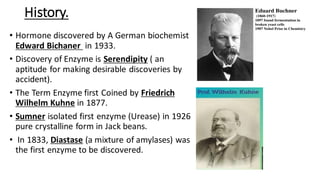
• Hormone discovered by A German biochemist
Edward Bichaner in 1933.
• Discovery of Enzyme is Serendipity ( an
aptitude for making desirable discoveries by
accident).
• The Term Enzyme first Coined by Friedrich
Wilhelm Kuhne in 1877.
• Sumner isolated first enzyme (Urease) in 1926
pure crystalline form in Jack beans.
• In 1833, Diastase (a mixture of amylases) was
the first enzyme to be discovered.
Nomenclature.
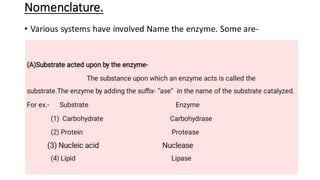
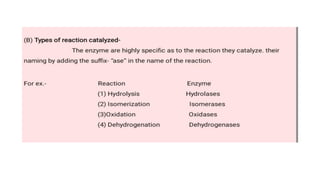
• Various systems have involved Name the enzyme. Some are-
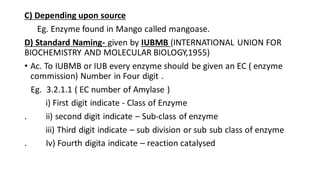
C) Depending upon source
Eg. Enzyme found in Mango called mangoase.
D) Standard Naming- given by IUBMB (INTERNATIONAL UNION FOR
BIOCHEMISTRY AND MOLECULAR BIOLOGY,1955)
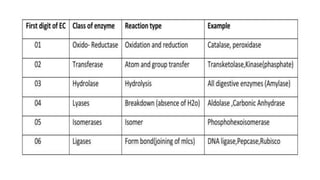
• Ac. To IUBMB or IUB every enzyme should be given an EC ( enzyme
commission) Number in Four digit .
Eg. 3.2.1.1 ( EC number of Amylase )
i) First digit indicate - Class of Enzyme
. ii) second digit indicate – Sub-class of enzyme
iii) Third digit indicate – sub division or sub sub class of enzyme
. Iv) Fourth digita indicate – reaction catalysed
Nature of Enzyme.
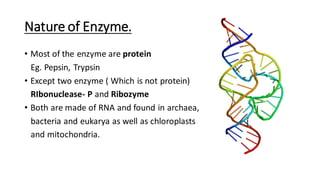
• Most of the enzyme are protein
Eg. Pepsin, Trypsin
• Except two enzyme ( Which is not protein)
RIbonuclease- P and Ribozyme
• Both are made of RNA and found in archaea,
bacteria and eukarya as well as chloroplasts
and mitochondria.
Classification of Enzyme.
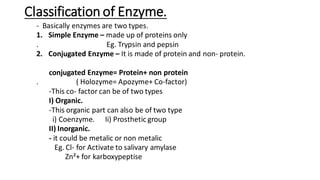
- Basically enzymes are two types.
1. Simple Enzyme – made up of proteins only
. Eg. Trypsin and pepsin
2. Conjugated Enzyme – It is made of protein and non- protein.
conjugated Enzyme= Protein+ non protein
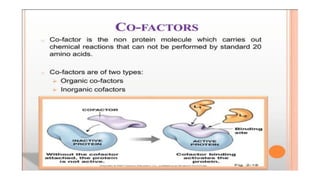
. ( Holozyme= Apozyme+ Co-factor)
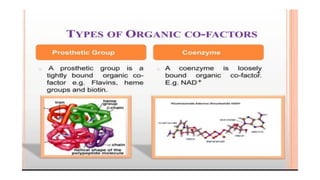
-This co- factor can be of two types
I) Organic.
-This organic part can also be of two type
i) Coenzyme. Ii) Prosthetic group
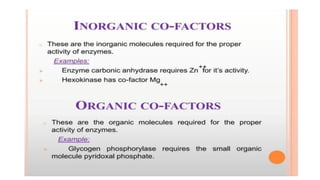
II) Inorganic.
- it could be metalic or non metalic
Eg. Cl- for Activate to salivary amylase
Zn²+ for karboxypeptise
Factors affecting Enzyme
• Temp
• PH
• Concentration
Enzyme.pdf
Enzyme.pdf
Enzyme.pdf

Enzyme.pdf

  • 2.
    # Content. • Introduction •History • Nomenclature of Enzyme • Nature of enzyme • Classification of Enzyme • Mechanism and function of enzyme • Factors affecting Enzyme
  • 3.
    What is Enzyme? •Enzymes are proteins that act as biological catalysts by accelerating chemical reactions.but consume in reaction After reaction it will seperate • Enzyme means En- In zyme- Yeasts • The molecules upon which enzymes may act are called Substrate ( A surface in which an enzyme is attached. • And the enzyme convert the substrate into different molecules known as Product.
  • 4.
    What is catalysis? •Catalysis is the process of increasing the rate of a chemical reaction by adding a substance known as a catalyst. Catalysts are not consumed in the reaction and remain unchanged after it. • Catalyst A substance that makes a chemical reaction happen faster. catalysts first observed by Jacob Berzelius in 1833-34. • Biocatalyst A catalysts which is presence in living organisms
  • 5.
    History. • Hormone discoveredby A German biochemist Edward Bichaner in 1933. • Discovery of Enzyme is Serendipity ( an aptitude for making desirable discoveries by accident). • The Term Enzyme first Coined by Friedrich Wilhelm Kuhne in 1877. • Sumner isolated first enzyme (Urease) in 1926 pure crystalline form in Jack beans. • In 1833, Diastase (a mixture of amylases) was the first enzyme to be discovered.
  • 6.
    Nomenclature. • Various systemshave involved Name the enzyme. Some are-
  • 8.
    C) Depending uponsource Eg. Enzyme found in Mango called mangoase. D) Standard Naming- given by IUBMB (INTERNATIONAL UNION FOR BIOCHEMISTRY AND MOLECULAR BIOLOGY,1955) • Ac. To IUBMB or IUB every enzyme should be given an EC ( enzyme commission) Number in Four digit . Eg. 3.2.1.1 ( EC number of Amylase ) i) First digit indicate - Class of Enzyme . ii) second digit indicate – Sub-class of enzyme iii) Third digit indicate – sub division or sub sub class of enzyme . Iv) Fourth digita indicate – reaction catalysed
  • 10.
    Nature of Enzyme. •Most of the enzyme are protein Eg. Pepsin, Trypsin • Except two enzyme ( Which is not protein) RIbonuclease- P and Ribozyme • Both are made of RNA and found in archaea, bacteria and eukarya as well as chloroplasts and mitochondria.
  • 11.
    Classification of Enzyme. -Basically enzymes are two types. 1. Simple Enzyme – made up of proteins only . Eg. Trypsin and pepsin 2. Conjugated Enzyme – It is made of protein and non- protein. conjugated Enzyme= Protein+ non protein . ( Holozyme= Apozyme+ Co-factor) -This co- factor can be of two types I) Organic. -This organic part can also be of two type i) Coenzyme. Ii) Prosthetic group II) Inorganic. - it could be metalic or non metalic Eg. Cl- for Activate to salivary amylase Zn²+ for karboxypeptise
  • 21.
    Factors affecting Enzyme •Temp • PH • Concentration