HONEYCOMBS
HONEYCOMBS
1
HONEYCOMBS
HONEYCOMBS
HONEYCOMBS
Group Members (G4)
 2013/123 K.N.D.CHATHURANGA
 2013/125 C.U.UDAGE
 2013/127 M.A.R. AMEERUTHEEN
 2013/128 M.H.A.S.D HETTIARACHCHI
 2013/135 G.M.G.S. TILAKARATHNE
 2013/136 P.M.C.S. BANDARA
 2013/137 K.W.K.R. HELITHA
 2013/138 I.P.S.C. KITHSIRI
 2013/143 H.M.M. ROUSHEN
 2013/147 M.W.M. IZMY
HONEYCOMBS
2
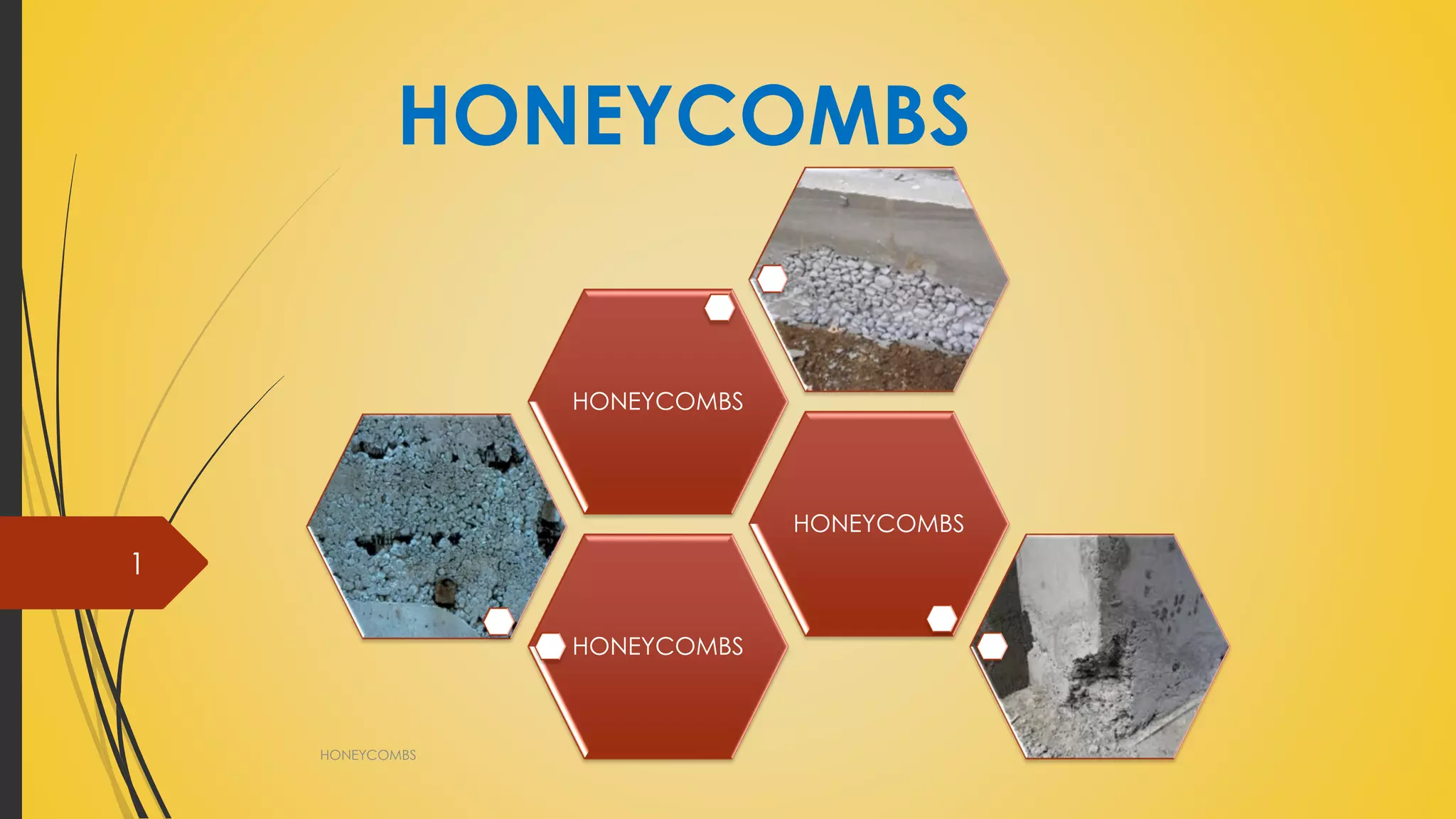
What are honeycombs?
 Honeycombs are the hollow spaces and cavities left in
concrete mass on surface or inside the concrete mass which is
caused by the mortar not filling the spaces between the
coarse aggregate particles.
HONEYCOMBS
3
Types of Honeycombs
HONEYCOMBS
4
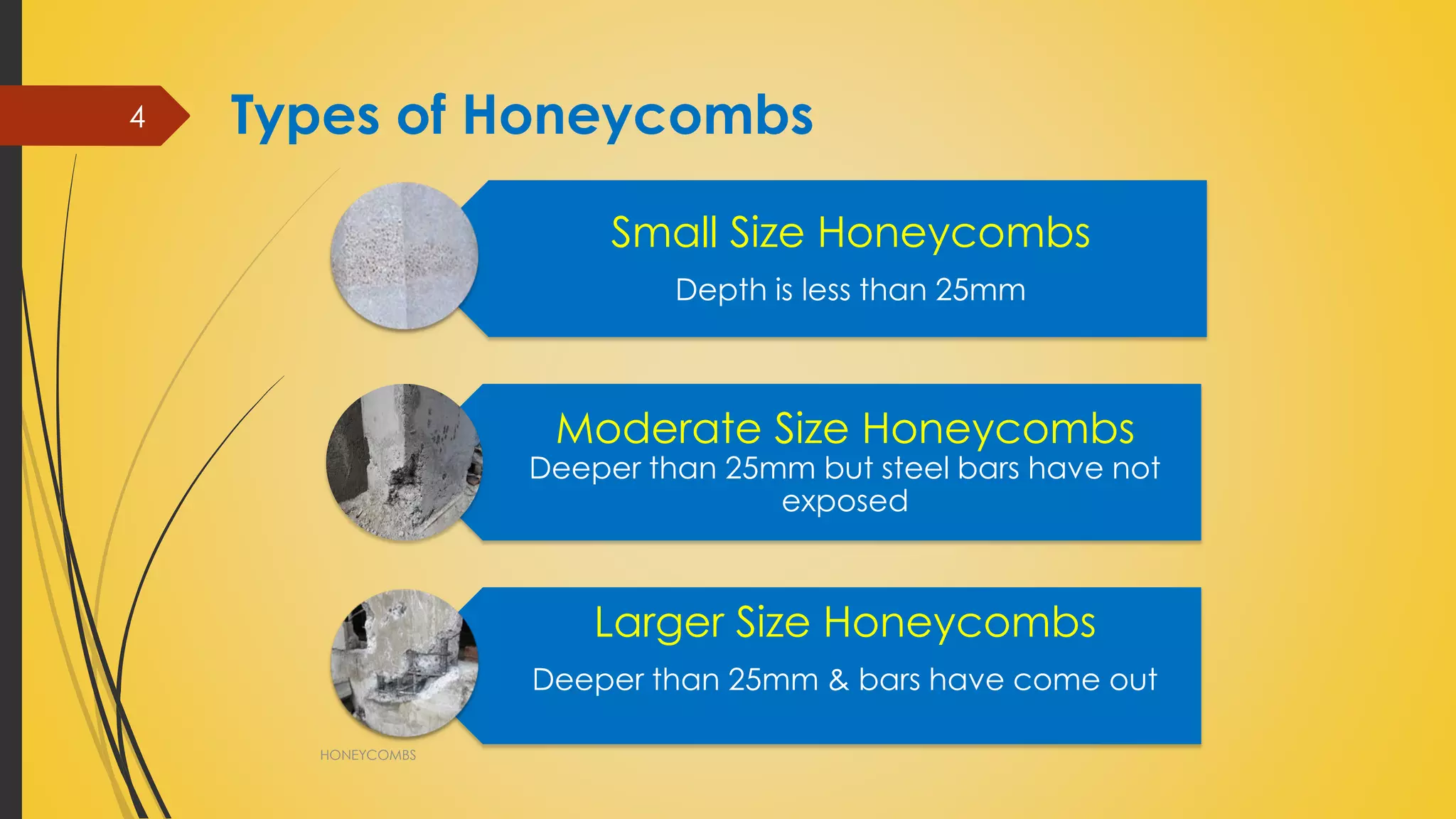
Small Size Honeycombs
Depth is less than 25mm
Moderate Size Honeycombs
Deeper than 25mm but steel bars have not
exposed
Larger Size Honeycombs
Deeper than 25mm & bars have come out
Where can we find Honeycombs?
 Honeycombs which are on sides and bottoms are visible to naked eyes and
can be detected when shuttering is removed. Honeycombs which are inside
mass of concrete can only be detected by advanced techniques like
ultrasonic testing etc.
HONEYCOMBS
5
Effects of Honeycombs
 Water and air enters inside
 Rusting and corrosion of reinforcement
 Reduce durability
 Less structural strength
 Reduces the load bearing capacity
HONEYCOMBS
6
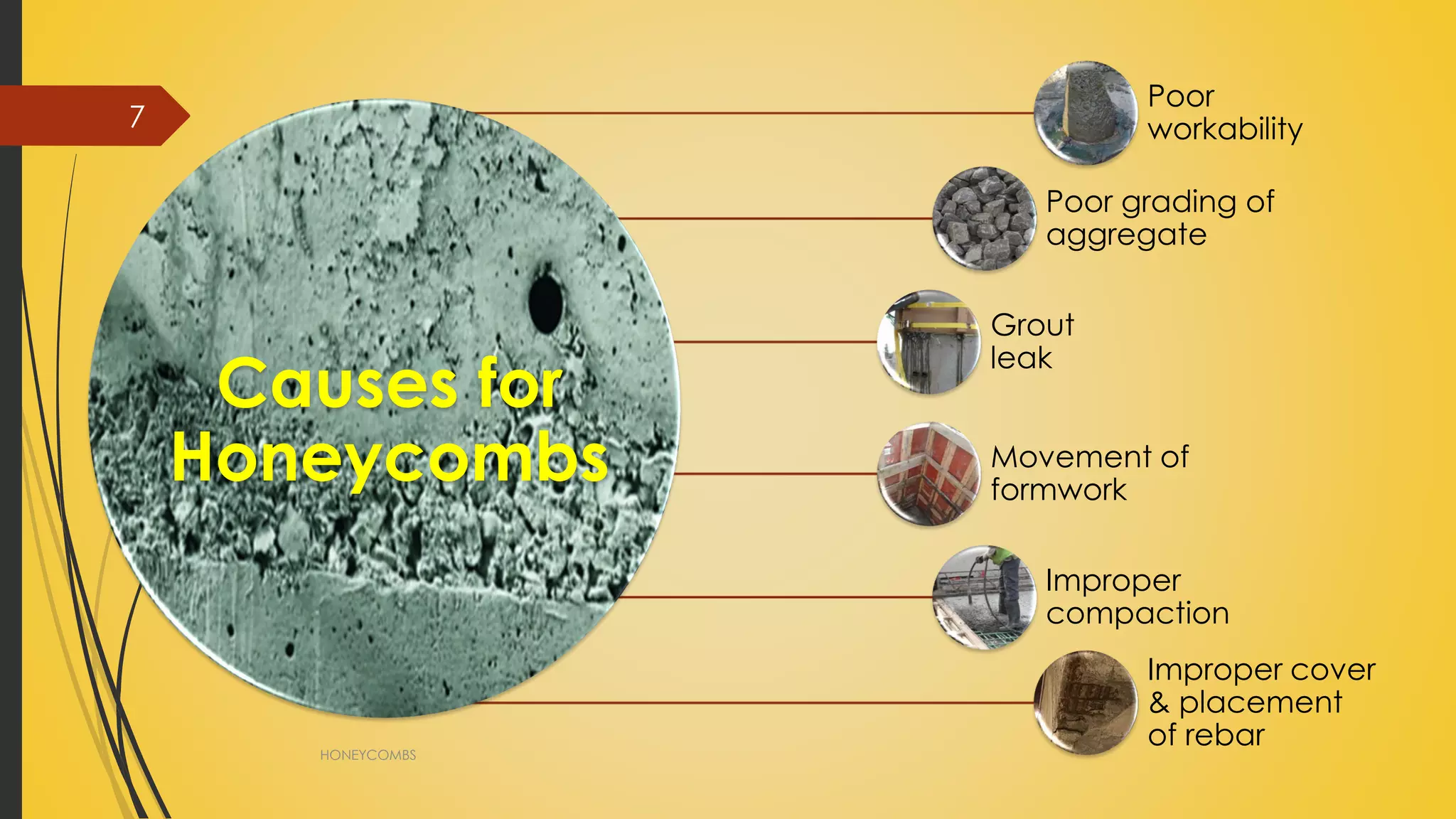
Causes for
Honeycombs
Poor
workability
Poor grading of
aggregate
Grout
leak
Movement of
formwork
Improper
compaction
Improper cover
& placement
of rebarHONEYCOMBS
7
Poor Workability8
 Slump Test can be used to find out the workability of concrete. If the slump is
less workability is less.
 Workability might be less because
 Low water content
 Finer cement particles
 High temperature
 Ratio of fine-to-coarse aggregate being low
Improper compaction9
 The purpose of compacting concrete by vibration is
the elimination of entrapped air and forcing the
particles in to a closer configuration that will
definitely build the more strength.
 Over vibration would make the concrete
segregated while under vibrated concrete would
have honeycombs in it.
 Poor concrete compaction occurs due to ineffective
vibration or rebar congestion.
Over vibration
Under vibration
Inserting at angles
Touching reinforcement
Touching formwork
Improper cover & placement of rebar
HONEYCOMBS
10
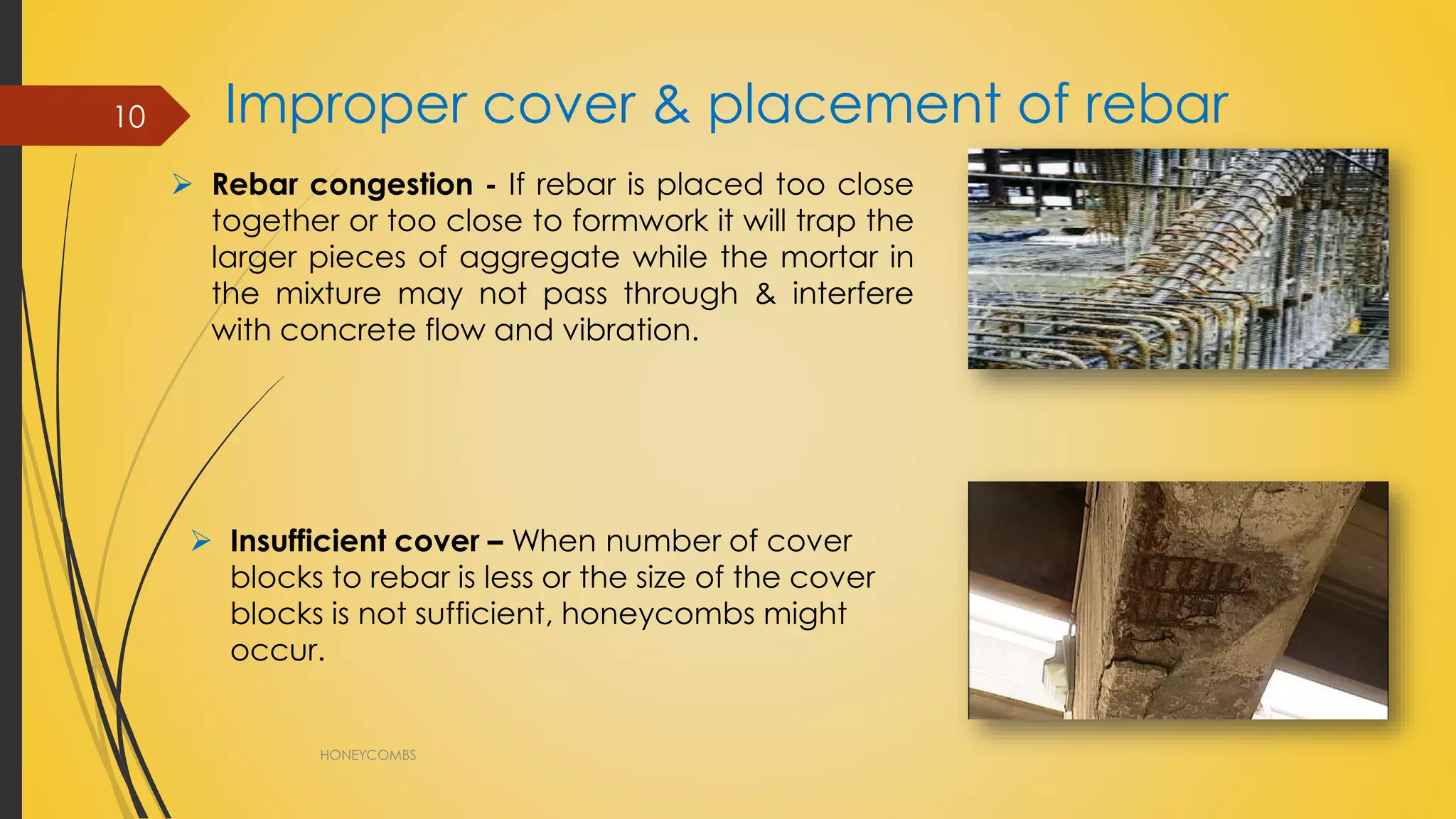
 Rebar congestion - If rebar is placed too close
together or too close to formwork it will trap the
larger pieces of aggregate while the mortar in
the mixture may not pass through & interfere
with concrete flow and vibration.
 Insufficient cover – When number of cover
blocks to rebar is less or the size of the cover
blocks is not sufficient, honeycombs might
occur.
Movement of Formwork & Grout leak
HONEYCOMBS
11
 When joints of formwork are loose there can be leakage of grout through these
joints. Honeycombs occur.
 Increased water content also results in bleeding, hence, increased water
content can also mean that cement slurry (grout) will escape through the joints
of the formwork.
 Presence of more percentage of bigger size of aggregate in
concrete also prevents concrete to fill narrow spaces between the
reinforcement rods.
 Voids often occur because aggregate is too large to pass through
a condensed area of reinforcement.
HONEYCOMBS
12 Poor grading of aggregate
Practices to minimize Honeycombing in
concrete
 Use a mix with appropriate workability for the situation in which it is to be
placed.
 Ensure the mix has sufficient fines to fill the voids between the coarse
aggregate.
HONEYCOMBS
13
Insert vertically
Vibrate by layers
Vibrate the whole depth of layer
Insert at intervals
HONEYCOMBS
14
 Use proper methods of compacting and ensure concrete is fully compacted
 Use proper methods of placing concrete
 Avoid segregation
 Avoid delays
 Pour by layers
 Proper cover block thickness should be
maintained for particular concrete
structures.(Eg : walls, columns, staircases –
25mm, slabs- 40mm, beams- 50mm, pile
caps- 75mm)
 Sufficient cover blocks should be
provided
 Rebar congestion can be minimized by
having larger (that is, lesser) rebar or by
increasing the sectional dimensions of
elements where possible.
 Ensure the reinforcement layout and the
section shape will permit the concrete to
flow around the reinforcement and
completely fill the forms.
HONEYCOMBS
15
Practices to minimize Honeycombing in
concrete
 Check that the formwork is rigid and well
braced, the joints are watertight and any
penetrations through the formwork. e.g.:
form ties are properly sealed.
 Provide enough supports to formwork
 Defective formworks and accessories
should be repaired or replaced to prevent
grout leakage during concreting.
HONEYCOMBS
16
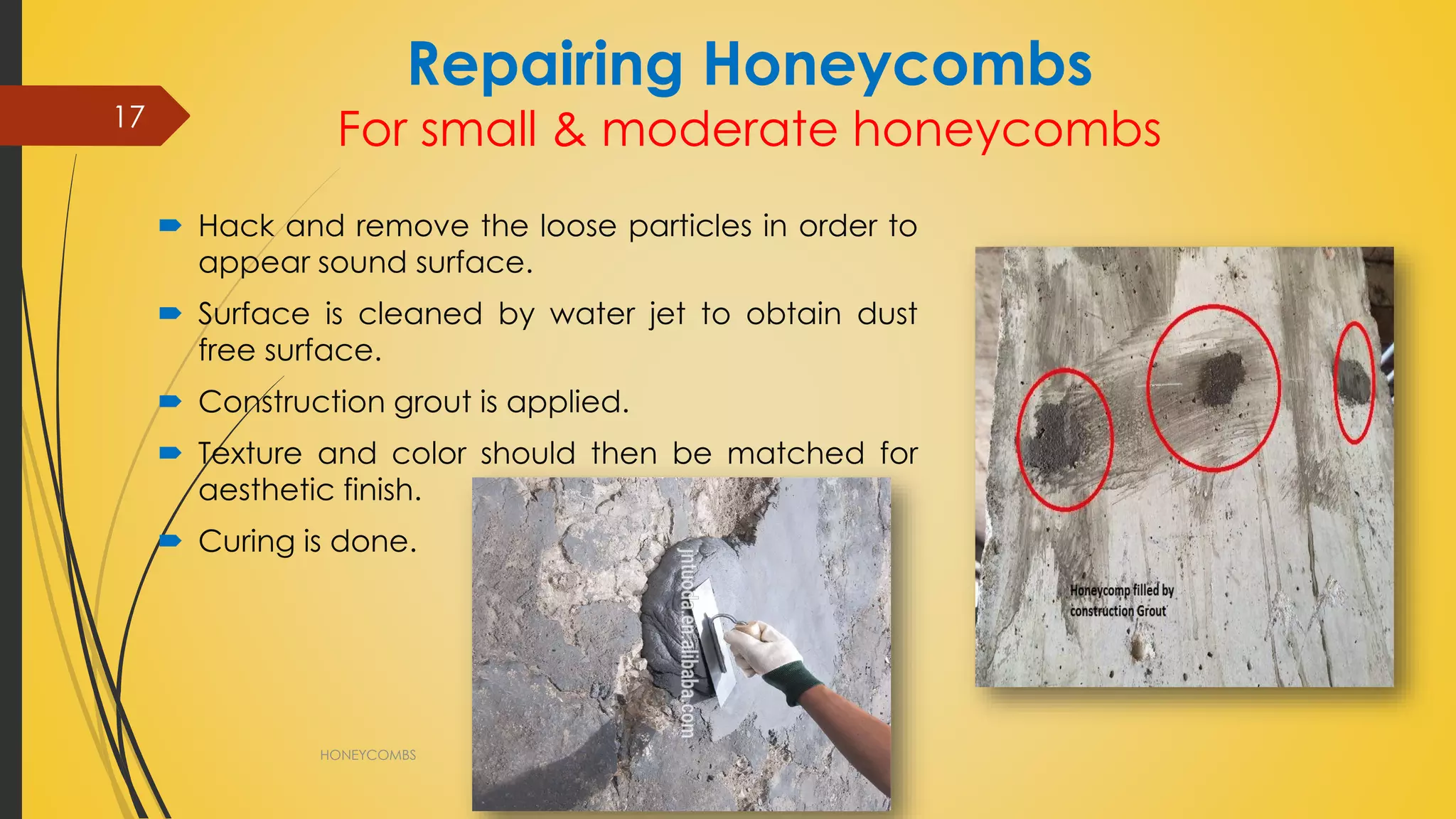
Repairing Honeycombs
For small & moderate honeycombs
 Hack and remove the loose particles in order to
appear sound surface.
 Surface is cleaned by water jet to obtain dust
free surface.
 Construction grout is applied.
 Texture and color should then be matched for
aesthetic finish.
 Curing is done.
HONEYCOMBS
17
For large Honeycombs
 Hack & remove the weak concrete to expose
sound concrete surface.
 To keep clearance around reinforcement 12mm
thick concrete layer is removed.
 By using water jet surface is cleaned
 Barra emulsion is used as a bonding agent.
 Over the wet surface barra emulsion is applied
and before drying, 1:2 cement mortar is applied
 After mortar has set sufficiently, final surface is
prepared by trowel.
 Texture and colour is matched for aesthetic finish.
 Curing is done.
HONEYCOMBS
18
Before
After

Concrete Honeycombs

  • 1.
  • 2.
    Group Members (G4) 2013/123 K.N.D.CHATHURANGA  2013/125 C.U.UDAGE  2013/127 M.A.R. AMEERUTHEEN  2013/128 M.H.A.S.D HETTIARACHCHI  2013/135 G.M.G.S. TILAKARATHNE  2013/136 P.M.C.S. BANDARA  2013/137 K.W.K.R. HELITHA  2013/138 I.P.S.C. KITHSIRI  2013/143 H.M.M. ROUSHEN  2013/147 M.W.M. IZMY HONEYCOMBS 2
  • 3.
    What are honeycombs? Honeycombs are the hollow spaces and cavities left in concrete mass on surface or inside the concrete mass which is caused by the mortar not filling the spaces between the coarse aggregate particles. HONEYCOMBS 3
  • 4.
    Types of Honeycombs HONEYCOMBS 4 SmallSize Honeycombs Depth is less than 25mm Moderate Size Honeycombs Deeper than 25mm but steel bars have not exposed Larger Size Honeycombs Deeper than 25mm & bars have come out
  • 5.
    Where can wefind Honeycombs?  Honeycombs which are on sides and bottoms are visible to naked eyes and can be detected when shuttering is removed. Honeycombs which are inside mass of concrete can only be detected by advanced techniques like ultrasonic testing etc. HONEYCOMBS 5
  • 6.
    Effects of Honeycombs Water and air enters inside  Rusting and corrosion of reinforcement  Reduce durability  Less structural strength  Reduces the load bearing capacity HONEYCOMBS 6
  • 7.
    Causes for Honeycombs Poor workability Poor gradingof aggregate Grout leak Movement of formwork Improper compaction Improper cover & placement of rebarHONEYCOMBS 7
  • 8.
    Poor Workability8  SlumpTest can be used to find out the workability of concrete. If the slump is less workability is less.  Workability might be less because  Low water content  Finer cement particles  High temperature  Ratio of fine-to-coarse aggregate being low
  • 9.
    Improper compaction9  Thepurpose of compacting concrete by vibration is the elimination of entrapped air and forcing the particles in to a closer configuration that will definitely build the more strength.  Over vibration would make the concrete segregated while under vibrated concrete would have honeycombs in it.  Poor concrete compaction occurs due to ineffective vibration or rebar congestion. Over vibration Under vibration Inserting at angles Touching reinforcement Touching formwork
  • 10.
    Improper cover &placement of rebar HONEYCOMBS 10  Rebar congestion - If rebar is placed too close together or too close to formwork it will trap the larger pieces of aggregate while the mortar in the mixture may not pass through & interfere with concrete flow and vibration.  Insufficient cover – When number of cover blocks to rebar is less or the size of the cover blocks is not sufficient, honeycombs might occur.
  • 11.
    Movement of Formwork& Grout leak HONEYCOMBS 11  When joints of formwork are loose there can be leakage of grout through these joints. Honeycombs occur.  Increased water content also results in bleeding, hence, increased water content can also mean that cement slurry (grout) will escape through the joints of the formwork.
  • 12.
     Presence ofmore percentage of bigger size of aggregate in concrete also prevents concrete to fill narrow spaces between the reinforcement rods.  Voids often occur because aggregate is too large to pass through a condensed area of reinforcement. HONEYCOMBS 12 Poor grading of aggregate
  • 13.
    Practices to minimizeHoneycombing in concrete  Use a mix with appropriate workability for the situation in which it is to be placed.  Ensure the mix has sufficient fines to fill the voids between the coarse aggregate. HONEYCOMBS 13
  • 14.
    Insert vertically Vibrate bylayers Vibrate the whole depth of layer Insert at intervals HONEYCOMBS 14  Use proper methods of compacting and ensure concrete is fully compacted  Use proper methods of placing concrete  Avoid segregation  Avoid delays  Pour by layers
  • 15.
     Proper coverblock thickness should be maintained for particular concrete structures.(Eg : walls, columns, staircases – 25mm, slabs- 40mm, beams- 50mm, pile caps- 75mm)  Sufficient cover blocks should be provided  Rebar congestion can be minimized by having larger (that is, lesser) rebar or by increasing the sectional dimensions of elements where possible.  Ensure the reinforcement layout and the section shape will permit the concrete to flow around the reinforcement and completely fill the forms. HONEYCOMBS 15
  • 16.
    Practices to minimizeHoneycombing in concrete  Check that the formwork is rigid and well braced, the joints are watertight and any penetrations through the formwork. e.g.: form ties are properly sealed.  Provide enough supports to formwork  Defective formworks and accessories should be repaired or replaced to prevent grout leakage during concreting. HONEYCOMBS 16
  • 17.
    Repairing Honeycombs For small& moderate honeycombs  Hack and remove the loose particles in order to appear sound surface.  Surface is cleaned by water jet to obtain dust free surface.  Construction grout is applied.  Texture and color should then be matched for aesthetic finish.  Curing is done. HONEYCOMBS 17
  • 18.
    For large Honeycombs Hack & remove the weak concrete to expose sound concrete surface.  To keep clearance around reinforcement 12mm thick concrete layer is removed.  By using water jet surface is cleaned  Barra emulsion is used as a bonding agent.  Over the wet surface barra emulsion is applied and before drying, 1:2 cement mortar is applied  After mortar has set sufficiently, final surface is prepared by trowel.  Texture and colour is matched for aesthetic finish.  Curing is done. HONEYCOMBS 18 Before After