INTRODUCTION OF DEVELOPMENT
Made By :- Devesh Prajapati
PGT Eco
HISTORY OF ECONOMIC DEVELOPMENT
OF INDIA
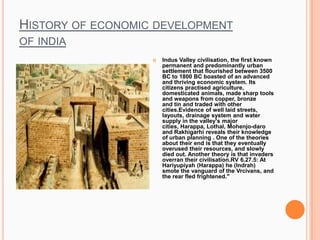
 Indus Valley civilisation, the first known
permanent and predominantly urban
settlement that flourished between 3500
BC to 1800 BC boasted of an advanced
and thriving economic system. Its
citizens practised agriculture,
domesticated animals, made sharp tools
and weapons from copper, bronze
and tin and traded with other
cities.Evidence of well laid streets,
layouts, drainage system and water
supply in the valley's major
cities, Harappa, Lothal, Mohenjo-daro
and Rakhigarhi reveals their knowledge
of urban planning . One of the theories
about their end is that they eventually
overused their resources, and slowly
died out. Another theory is that invaders
overran their civilisation.RV 6.27.5: At
Hariyupiyah (Harappa) he (Indrah)
smote the vanguard of the Vrcivans, and
the rear fled frightened."
HISTORY OF ECONOMICS
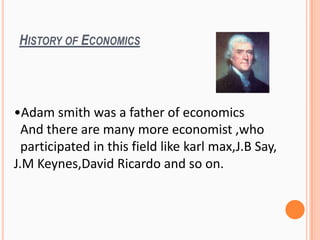
•Adam smith was a father of economics
And there are many more economist ,who
participated in this field like karl max,J.B Say,
J.M Keynes,David Ricardo and so on.
DEFINITION OF ECONOMICS
 It is derived form two greek
words :-
 Okios – a household
 Nemein ( nomos)-
Management
 Economics means ‘Home
Management’. The head of a
family faces the problem
of managing the unlimited
wants of the family members
within the limited income of
the
family. In fact, the same is
true for a society also. If we
consider the whole society as
a ‘family’,
then the society also faces
the problem of tackling
unlimited wants of the
members of the
society with the limited
resources available in that
society
MEANING OF DEVELOPMENT
 A branch of economics that focuses on improving
the economies of developing countries.
Development economics considers how to promote
economic growth in such countries by improving
factors like health, education, working conditions,
domestic and international policies and market
conditions. It examines both macroeconomic and
microeconomic factors relating to the structure of a
developing economy and how that economy can
create effective domestic and international growth.
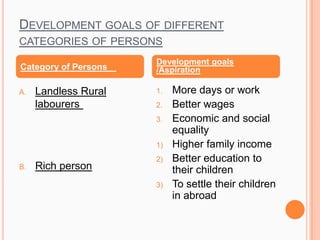
DEVELOPMENT GOALS OF DIFFERENT
CATEGORIES OF PERSONS
A. Landless Rural
labourers
B. Rich person
1. More days or work
2. Better wages
3. Economic and social
equality
1) Higher family income
2) Better education to
their children
3) To settle their children
in abroad
Category of Persons
Development goals
/Aspiration
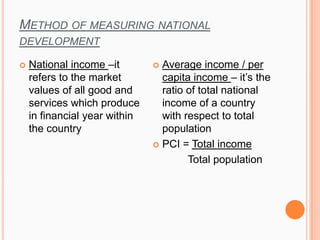
METHOD OF MEASURING NATIONAL
DEVELOPMENT
 National income –it
refers to the market
values of all good and
services which produce
in financial year within
the country
 Average income / per
capita income – it’s the
ratio of total national
income of a country
with respect to total
population
 PCI = Total income
Total population
NATIONAL DEVELOPMENT
 In the process of national development ,a heavy
industry is set up
 Or we can say that it’s a all round development of
nation
 Like – education, health,and national income
WORLD DEVELOPMENT REPORT
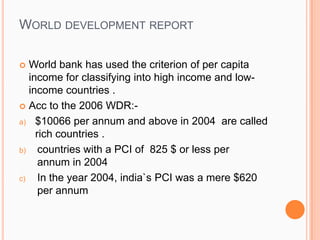
 World bank has used the criterion of per capita
income for classifying into high income and low-
income countries .
 Acc to the 2006 WDR:-
a) $10066 per annum and above in 2004 are called
rich countries .
b) countries with a PCI of 825 $ or less per
annum in 2004
c) In the year 2004, india`s PCI was a mere $620
per annum
LIMITATION OF PCI
COMPARISON OF TWO COUNTRIES
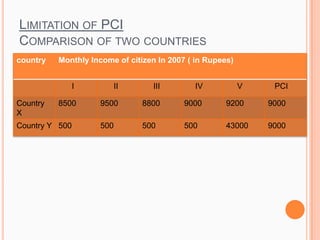
country Monthly Income of citizen In 2007 ( in Rupees)
I II III IV V PCI
Country
X
8500 9500 8800 9000 9200 9000
Country Y 500 500 500 500 43000 9000
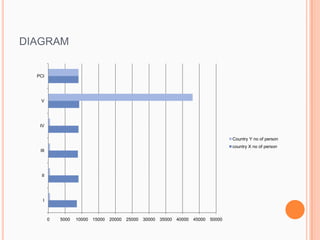
DIAGRAM
0 5000 10000 15000 20000 25000 30000 35000 40000 45000 50000
I
II
III
IV
V
PCI
Country Y no of person
country X no of person
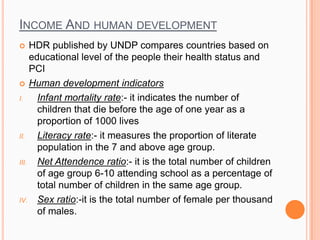
INCOME AND HUMAN DEVELOPMENT
 HDR published by UNDP compares countries based on
educational level of the people their health status and
PCI
 Human development indicators
I. Infant mortality rate:- it indicates the number of
children that die before the age of one year as a
proportion of 1000 lives
II. Literacy rate:- it measures the proportion of literate
population in the 7 and above age group.
III. Net Attendence ratio:- it is the total number of children
of age group 6-10 attending school as a percentage of
total number of children in the same age group.
IV. Sex ratio:-it is the total number of female per thousand
of males.
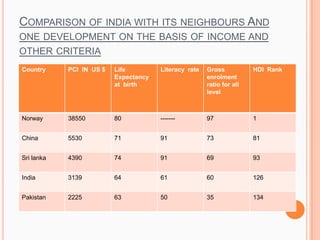
COMPARISON OF INDIA WITH ITS NEIGHBOURS AND
ONE DEVELOPMENT ON THE BASIS OF INCOME AND
OTHER CRITERIA
Country PCI IN US $ Life
Expectancy
at birth
Literacy rate Gross
enrolment
ratio for all
level
HDI Rank
Norway 38550 80 ------- 97 1
China 5530 71 91 73 81
Sri lanka 4390 74 91 69 93
India 3139 64 61 60 126
Pakistan 2225 63 50 35 134
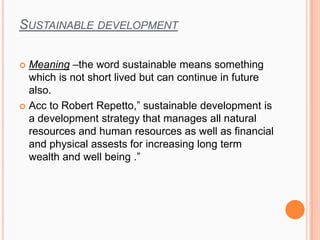
SUSTAINABLE DEVELOPMENT
 Meaning –the word sustainable means something
which is not short lived but can continue in future
also.
 Acc to Robert Repetto,” sustainable development is
a development strategy that manages all natural
resources and human resources as well as financial
and physical assests for increasing long term
wealth and well being .”
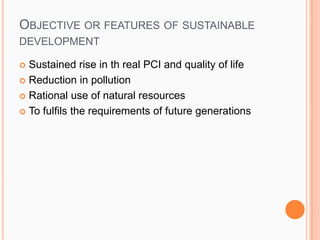
OBJECTIVE OR FEATURES OF SUSTAINABLE
DEVELOPMENT
 Sustained rise in th real PCI and quality of life
 Reduction in pollution
 Rational use of natural resources
 To fulfils the requirements of future generations
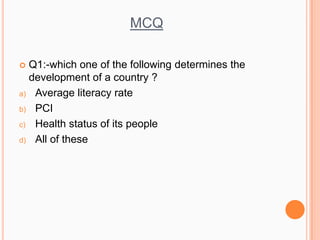
MCQ
 Q1:-which one of the following determines the
development of a country ?
a) Average literacy rate
b) PCI
c) Health status of its people
d) All of these
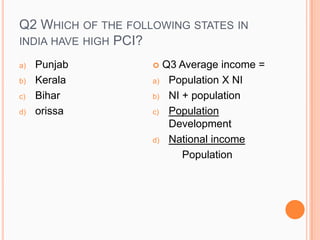
Q2 WHICH OF THE FOLLOWING STATES IN
INDIA HAVE HIGH PCI?
a) Punjab
b) Kerala
c) Bihar
d) orissa
 Q3 Average income =
a) Population X NI
b) NI + population
c) Population
Development
d) National income
Population
The end

Ppt on development for class 10

  • 1.
    INTRODUCTION OF DEVELOPMENT MadeBy :- Devesh Prajapati PGT Eco
  • 2.
    HISTORY OF ECONOMICDEVELOPMENT OF INDIA  Indus Valley civilisation, the first known permanent and predominantly urban settlement that flourished between 3500 BC to 1800 BC boasted of an advanced and thriving economic system. Its citizens practised agriculture, domesticated animals, made sharp tools and weapons from copper, bronze and tin and traded with other cities.Evidence of well laid streets, layouts, drainage system and water supply in the valley's major cities, Harappa, Lothal, Mohenjo-daro and Rakhigarhi reveals their knowledge of urban planning . One of the theories about their end is that they eventually overused their resources, and slowly died out. Another theory is that invaders overran their civilisation.RV 6.27.5: At Hariyupiyah (Harappa) he (Indrah) smote the vanguard of the Vrcivans, and the rear fled frightened."
  • 3.
    HISTORY OF ECONOMICS •Adamsmith was a father of economics And there are many more economist ,who participated in this field like karl max,J.B Say, J.M Keynes,David Ricardo and so on.
  • 4.
    DEFINITION OF ECONOMICS It is derived form two greek words :-  Okios – a household  Nemein ( nomos)- Management  Economics means ‘Home Management’. The head of a family faces the problem of managing the unlimited wants of the family members within the limited income of the family. In fact, the same is true for a society also. If we consider the whole society as a ‘family’, then the society also faces the problem of tackling unlimited wants of the members of the society with the limited resources available in that society
  • 5.
    MEANING OF DEVELOPMENT A branch of economics that focuses on improving the economies of developing countries. Development economics considers how to promote economic growth in such countries by improving factors like health, education, working conditions, domestic and international policies and market conditions. It examines both macroeconomic and microeconomic factors relating to the structure of a developing economy and how that economy can create effective domestic and international growth.
  • 6.
    DEVELOPMENT GOALS OFDIFFERENT CATEGORIES OF PERSONS A. Landless Rural labourers B. Rich person 1. More days or work 2. Better wages 3. Economic and social equality 1) Higher family income 2) Better education to their children 3) To settle their children in abroad Category of Persons Development goals /Aspiration
  • 7.
    METHOD OF MEASURINGNATIONAL DEVELOPMENT  National income –it refers to the market values of all good and services which produce in financial year within the country  Average income / per capita income – it’s the ratio of total national income of a country with respect to total population  PCI = Total income Total population
  • 8.
    NATIONAL DEVELOPMENT  Inthe process of national development ,a heavy industry is set up  Or we can say that it’s a all round development of nation  Like – education, health,and national income
  • 9.
    WORLD DEVELOPMENT REPORT World bank has used the criterion of per capita income for classifying into high income and low- income countries .  Acc to the 2006 WDR:- a) $10066 per annum and above in 2004 are called rich countries . b) countries with a PCI of 825 $ or less per annum in 2004 c) In the year 2004, india`s PCI was a mere $620 per annum
  • 10.
    LIMITATION OF PCI COMPARISONOF TWO COUNTRIES country Monthly Income of citizen In 2007 ( in Rupees) I II III IV V PCI Country X 8500 9500 8800 9000 9200 9000 Country Y 500 500 500 500 43000 9000
  • 11.
    DIAGRAM 0 5000 1000015000 20000 25000 30000 35000 40000 45000 50000 I II III IV V PCI Country Y no of person country X no of person
  • 12.
    INCOME AND HUMANDEVELOPMENT  HDR published by UNDP compares countries based on educational level of the people their health status and PCI  Human development indicators I. Infant mortality rate:- it indicates the number of children that die before the age of one year as a proportion of 1000 lives II. Literacy rate:- it measures the proportion of literate population in the 7 and above age group. III. Net Attendence ratio:- it is the total number of children of age group 6-10 attending school as a percentage of total number of children in the same age group. IV. Sex ratio:-it is the total number of female per thousand of males.
  • 13.
    COMPARISON OF INDIAWITH ITS NEIGHBOURS AND ONE DEVELOPMENT ON THE BASIS OF INCOME AND OTHER CRITERIA Country PCI IN US $ Life Expectancy at birth Literacy rate Gross enrolment ratio for all level HDI Rank Norway 38550 80 ------- 97 1 China 5530 71 91 73 81 Sri lanka 4390 74 91 69 93 India 3139 64 61 60 126 Pakistan 2225 63 50 35 134
  • 14.
    SUSTAINABLE DEVELOPMENT  Meaning–the word sustainable means something which is not short lived but can continue in future also.  Acc to Robert Repetto,” sustainable development is a development strategy that manages all natural resources and human resources as well as financial and physical assests for increasing long term wealth and well being .”
  • 15.
    OBJECTIVE OR FEATURESOF SUSTAINABLE DEVELOPMENT  Sustained rise in th real PCI and quality of life  Reduction in pollution  Rational use of natural resources  To fulfils the requirements of future generations
  • 16.
    MCQ  Q1:-which oneof the following determines the development of a country ? a) Average literacy rate b) PCI c) Health status of its people d) All of these
  • 17.
    Q2 WHICH OFTHE FOLLOWING STATES IN INDIA HAVE HIGH PCI? a) Punjab b) Kerala c) Bihar d) orissa  Q3 Average income = a) Population X NI b) NI + population c) Population Development d) National income Population
  • 18.