

By
Devendra kumar
(M.Sc. Ag. 2nd year)
To
Dr. D. Pratap
1. TERMINOLOGY
2. INTRODUCTION
3. PRINCIPLES OF EXPERIMENTAL DESIGN
4. APPLICATION OF EXPERIMENTAL DESIGN
5. TYPES OF EXPERIMENTAL DESIGN AND IT’S
CHARECTERSTICS, ADVANTAGE AND
DISADVANTAGE (RBD, LSD, CRD, etc.)
OVER VIEW POINT
Design:- Whenever an agriculture experiment is done by using
certain scientific (statistical) procedure then it is called design.
OR
Experimental design are various types of plot arrangement which are
used to test a set of treatments to draw a valid conclusions about a
particular problems.
Treatment:- The objective under comparison is called treatment.
Experimental material:- The material which is used in experiment
is known as experimental material . For example, a field, soil seeds
etc.
Experimental units:- Small plot of the block to which the treatment
can apply are called experimental unit.
Terminology
Experiment:- Experiment is a scientifically planned method. The
experiment is conducted draw a valid conclusion about a particular
problem. The conclusion is based on statically observation.
Experimental error:- The variation due to environmental factor or
due to uncontrolled factor is called experimental error.
Uniformity trail:- A uniformity trail consists in dividing the whole
field into so many small units of equal size. Uniformity trail are helps
as know the nature of soil fertility in agricultural/ experimental field.
Sampling unit :- The object that is measured in an experiment is
called the sampling unit. This may be different from the experimental
unit.
1. Developing new varieties
2. Problems with regard to the estimation of differences between
candidates and testing their significance are not considered.
3. Getting an answer to a question which the experimenter wants
to know.
4. The average value of all observations in a population.
5. Keep the design as simple as possible while satisfying the
required level of scientific soundness.
Why need experimental design in breeding?
Definition of Exp.design :- The choice of treatment, the
method assigning treatments to experimental units and
arrangement of experimental units in various pattern to suit
the requirements of particular problems are commonly known
as design of experiment.
Or
Experimental design is the process of planning and study to
meet a specific objectives.
Experimental design was developed by :- Prof. R. A. Fisher in
1920
INTRODUTION
Objectives:-
1. To increase precision of experiment
2. To reduce experimental error
3. In screening off various treatments
4. In partitioning of variation into different components
5. Used in proper interpretation of scientific results and drawing
valid conclusions
6. In reducing the soil heterogeneity
7. In assessment of variance and covariance
8. Shows the direction of better results
9. Includes the plan for analysis and reporting of the results
Principles of Experimental Design
There are three basic principles :
• Replication:- Repetition of the treatment under investigation Or To
provide an estimate of experimental error.
• Randomization:- The allocation of the treatment to the different
experimental units by a random process is known as randomization.
• Local control:- The principal of making use of greater homogeneity in
groups of experimental units for reducing experimental error.
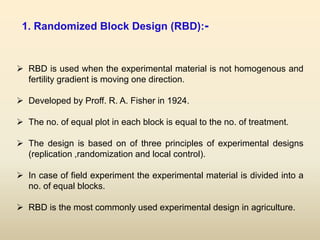
TYPES OF EXPERIMENTAL DESIGNS
1. Randomized Block Designs
2. Completely Randomized Designs
3. Latin Square Designs
4. Randomized Complete Block Designs
5. Split Plot Designs
6. Augmented Design
7. Lattice Designs (Alpha Lattice Design)
1. Randomized Block Design (RBD):-
 RBD is used when the experimental material is not homogenous and
fertility gradient is moving one direction.
 Developed by Proff. R. A. Fisher in 1924.
 The no. of equal plot in each block is equal to the no. of treatment.
 The design is based on of three principles of experimental designs
(replication ,randomization and local control).
 In case of field experiment the experimental material is divided into a
no. of equal blocks.
 RBD is the most commonly used experimental design in agriculture.
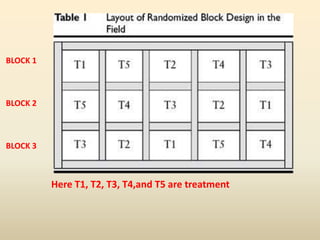
BLOCK 1
BLOCK 2
BLOCK 3
Here T1, T2, T3, T4,and T5 are treatment
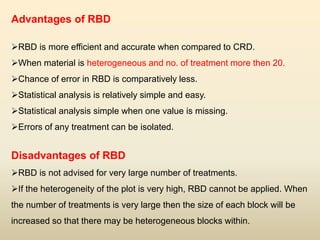
Advantages of RBD
RBD is more efficient and accurate when compared to CRD.
When material is heterogeneous and no. of treatment more then 20.
Chance of error in RBD is comparatively less.
Statistical analysis is relatively simple and easy.
Statistical analysis simple when one value is missing.
Errors of any treatment can be isolated.
Disadvantages of RBD
RBD is not advised for very large number of treatments.
If the heterogeneity of the plot is very high, RBD cannot be applied. When
the number of treatments is very large then the size of each block will be
increased so that there may be heterogeneous blocks within.
2. Completely Randomized Design (CRD):
 Developed by Proff. R. A. Fisher.
The design which is used when the experimental material is limited
and experimental units homogenous.
It is single factor design.
The principle of local control is not allow adopted in this design.
This design is specially used for pot culture experiments.
No. of plots = No. of replications + No. of treatments.
The design based on two principle of Experimental designs :-1.
Replication; 2. Randomization.
Characteristics of CRD
CRD is applicable only when the experimental material is
homogenous (Example: Homogenous soil condition in the field).
Usually in the field, the soil will be Homogenous.
Thus, CRD is not a preferable method in field experiments.
 CRD is generally applicable to the lab experimental conditions.
In labs, the environmental conditions can be easily controlled.
The concept of ‘Local-control’ is not used in CRD.
Advantages of CRD
CRD is easy to understand and calculate the variance.
Any no. of replication are used.
The number of replications can vary from treatment to treatment.
 CRD has high flexibility and thus any number of treatments can be used.
 Simple statistical analysis is required in the analysis of CRD.
CRD provides maximum number of degree of freedom.
Disadvantages of CRD
CRD can be applied only to homogenous experiments.
The principle of ‘Local-control’ is not used in CRD.
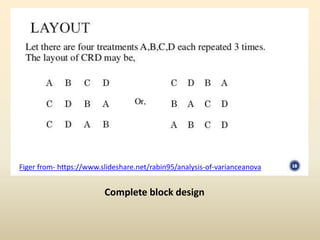
Complete block design
Figer from- https://www.slideshare.net/rabin95/analysis-of-varianceanova
3.Latin Square Design (LSD):
The experimental design which simultaneously controls the fertility
variation in two directions is called Latin square design (LSD).
It is two factor design( row may present to level of one factor and
column present the another factor.
The experimental material is divided into rows and columns.
Each having the same number of experimental units which is equal to
the number of treatments.
The treatments are allocated to the rows and the columns such that
each treatment occurs once and only once in the each row and in the
each column.
In other words, Latin square designs are adopted for eliminating the
variation of two factors which are generally called rows and columns.
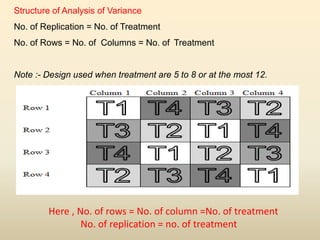
Here , No. of rows = No. of column =No. of treatment
No. of replication = no. of treatment
Structure of Analysis of Variance
No. of Replication = No. of Treatment
No. of Rows = No. of Columns = No. of Treatment
Note :- Design used when treatment are 5 to 8 or at the most 12.
A Latin square is called self conjugate if its arrangement in rows
and columns are the same.
Characteristics of LSD
LSD is a design where the experimental material is divided into
‘m’ rows' columns and ‘m’ treatments – assigned by
randomization method to rows and columns.
The randomization in such a way that each treatment occurs
only once in each row and in each column.
Application of LSD
Field experiment
Animal experiment
Experiments on a long strip of land
Advantages of LSD
Statistical analysis is relatively simple (complicated than CRD and RBD).
Statistical analysis is simple if one value is missing.
Most efficient design when compared to CRD and RBD.
Standard error less than 1%.
Disadvantages of LSD
 LSD is not suitable for agricultural experiments.
Statistical analysis is complicated when two or more values are missing.
Difficult when treatments are more than ten.
No. of treatment 5 to 12 no more treatment or less treatment.
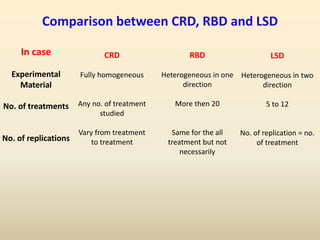
Comparison between CRD, RBD and LSD
CRD
Fully homogeneous
Any no. of treatment
studied
Vary from treatment
to treatment
RBD
Heterogeneous in one
direction
More then 20
Same for the all
treatment but not
necessarily
LSD
Heterogeneous in two
direction
5 to 12
No. of replication = no.
of treatment
In case
Experimental
Material
No. of treatments
No. of replications
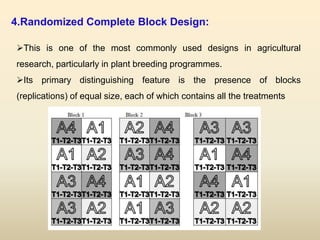
4.Randomized Complete Block Design:
This is one of the most commonly used designs in agricultural
research, particularly in plant breeding programmes.
Its primary distinguishing feature is the presence of blocks
(replications) of equal size, each of which contains all the treatments
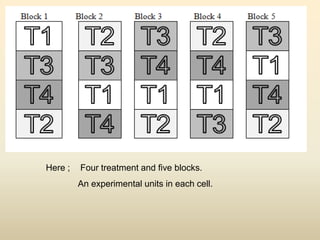
Here ; Four treatment and five blocks.
An experimental units in each cell.
Charecterstics of RCBD
The RCBD is the standard design for agricultural experiments
where similar experimental units are grouped into blocks or
replicates.
It is used to control variation in an experiment by accounting for
spatial effects in field or greenhouse.
e.g. variation in fertility or drainage differences in a field
Advantages of RCBD
Generally more precise than the CRD.
No restriction on the no. of treatment or replicates.
Some treatment may be replicated more items than others
Missing plots are easily estimated
Whole treatment or entire replicates may be deleted from the
analysis.
 if experimental error is heterogeneous ,valid comparison can still
be made.
Disadvantages of RCBD
Error DF is smaller than that for the CRD (problem with a small no. of
treatment).
If there is a larger variation between experimental units within a blocks , a
large error term may result ( this may be due too many treatment)
If there are missing data , a RCBD experiment may be less efficient than a CRD.
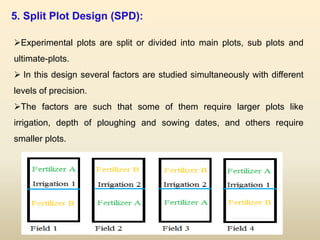
5. Split Plot Design (SPD):
Experimental plots are split or divided into main plots, sub plots and
ultimate-plots.
 In this design several factors are studied simultaneously with different
levels of precision.
The factors are such that some of them require larger plots like
irrigation, depth of ploughing and sowing dates, and others require
smaller plots.
Aplication of SPD
When all the factors are not of equal importance.
When some of the factors cannot be tasted on small amount of material and
require large one for the purpose
Advantages of SPD
Useful when all the factors are not equal importance, i.e., some of them required
larger plots and others require smaller plots.
When some of the factor have small amount of material, they can used as sub
plots or ultimate plots in this design.
Disadvantages of SPD
The layout and analysis more complicated as compared to that RBD and LSD.
To provides lesser degree of freedom for the estimation of error variance than
RBD.
6.Augmented Designs:
 Developed by Federer (1956).
This is an experimental design which is used to test a large number of
germplasm lines in a limited area and error estimate with help of checks
varieties.
to evaluate a large number of germplasm lines
This design is commonly used and other Designs are not appropriate
due to large number of entries.
In augmented designs the goal is to compare existing (control)
treatments with new treatments that have an experimental constraint of
"limited replication“.
 Experimental lines replicated once.
 Checks occur in each block.
 Checks used to estimate block effects.
 Checks provide error term.
 Need a mechanism to adjust for field variation
 Difficult to maintain homogeneous blocks when comparing so
many genotypes
Advantage of Augmented design
To evaluate more genotypes,Test in more environments .
Fewer check plots are required than for designs with systematic
repetition of a single check
Provide an estimate of standard error that can be used for
comparisons genotypes, Between new genotypes and check varieties
Observations on new genotypes can be adjusted for field
heterogeneity.
Flexible – blocks can be of unequal size
Disadvantage of Augmented Design
Considerable resources are spent on production and processing of control
plots
Relatively few degrees of freedom for experimental error, which reduces the
power to detect differences among treatments
Unreplicated experiments are inherently imprecise, no matter how
sophisticated the design
7.Lattice Designs
It is an incomplete-block design.
Developed by Yates.
Resolved if the blocks are grouped into larger blocks and the large
blocks form a complete-block design.
To provide for the elimination of soil differences by the use of two
different groupings of the same experimental plots.
Alpha lattices
Alpha-lattice designs are used when the large number of genotypes
(treatments) and small area.
There are no checks varieties for estimation error.
Error checks within the same varieties.
Alpha-lattices are used to reduce the effect of within-complete-block
variation.
They can provide risk- and cost-free increases in precision in trails.
They can also provide repeatability, particularly in trials.
The design permits removal of incomplete-block effects from the plot
residuals.
Maximizes the use of comparisons between genotypes in the same
incomplete-block.
Charecterstics of Alpha lattice
a) Resolvable incomplete block design
b) Work of any combination t=s*k
c) Useful for field trial
d) No. of treatments is fixed
e) more flexibility in choice of s and
Here ; t = number of treatments
k = number of units per block (block size)
b = total number of blocks in the experiment
r = number of replicates of each treatment
s = number of blocks in each complete replication
Advantages of alpha lattice design
This design allows the adjustment of treatment means fir block effects.
This in turn brings benefit from the small incomplete blocks which help
varietal comparisons under mere homogeneous condition.
This design also provides effective control within replicate variability.
Experimental design in Plant Breeding

Experimental design in Plant Breeding

  • 1.
    By Devendra kumar (M.Sc. Ag.2nd year) To Dr. D. Pratap
  • 2.
    1. TERMINOLOGY 2. INTRODUCTION 3.PRINCIPLES OF EXPERIMENTAL DESIGN 4. APPLICATION OF EXPERIMENTAL DESIGN 5. TYPES OF EXPERIMENTAL DESIGN AND IT’S CHARECTERSTICS, ADVANTAGE AND DISADVANTAGE (RBD, LSD, CRD, etc.) OVER VIEW POINT
  • 3.
    Design:- Whenever anagriculture experiment is done by using certain scientific (statistical) procedure then it is called design. OR Experimental design are various types of plot arrangement which are used to test a set of treatments to draw a valid conclusions about a particular problems. Treatment:- The objective under comparison is called treatment. Experimental material:- The material which is used in experiment is known as experimental material . For example, a field, soil seeds etc. Experimental units:- Small plot of the block to which the treatment can apply are called experimental unit. Terminology
  • 4.
    Experiment:- Experiment isa scientifically planned method. The experiment is conducted draw a valid conclusion about a particular problem. The conclusion is based on statically observation. Experimental error:- The variation due to environmental factor or due to uncontrolled factor is called experimental error. Uniformity trail:- A uniformity trail consists in dividing the whole field into so many small units of equal size. Uniformity trail are helps as know the nature of soil fertility in agricultural/ experimental field. Sampling unit :- The object that is measured in an experiment is called the sampling unit. This may be different from the experimental unit.
  • 5.
    1. Developing newvarieties 2. Problems with regard to the estimation of differences between candidates and testing their significance are not considered. 3. Getting an answer to a question which the experimenter wants to know. 4. The average value of all observations in a population. 5. Keep the design as simple as possible while satisfying the required level of scientific soundness. Why need experimental design in breeding?
  • 6.
    Definition of Exp.design:- The choice of treatment, the method assigning treatments to experimental units and arrangement of experimental units in various pattern to suit the requirements of particular problems are commonly known as design of experiment. Or Experimental design is the process of planning and study to meet a specific objectives. Experimental design was developed by :- Prof. R. A. Fisher in 1920 INTRODUTION
  • 7.
    Objectives:- 1. To increaseprecision of experiment 2. To reduce experimental error 3. In screening off various treatments 4. In partitioning of variation into different components 5. Used in proper interpretation of scientific results and drawing valid conclusions 6. In reducing the soil heterogeneity 7. In assessment of variance and covariance 8. Shows the direction of better results 9. Includes the plan for analysis and reporting of the results
  • 8.
    Principles of ExperimentalDesign There are three basic principles : • Replication:- Repetition of the treatment under investigation Or To provide an estimate of experimental error. • Randomization:- The allocation of the treatment to the different experimental units by a random process is known as randomization. • Local control:- The principal of making use of greater homogeneity in groups of experimental units for reducing experimental error.
  • 9.
    TYPES OF EXPERIMENTALDESIGNS 1. Randomized Block Designs 2. Completely Randomized Designs 3. Latin Square Designs 4. Randomized Complete Block Designs 5. Split Plot Designs 6. Augmented Design 7. Lattice Designs (Alpha Lattice Design)
  • 10.
    1. Randomized BlockDesign (RBD):-  RBD is used when the experimental material is not homogenous and fertility gradient is moving one direction.  Developed by Proff. R. A. Fisher in 1924.  The no. of equal plot in each block is equal to the no. of treatment.  The design is based on of three principles of experimental designs (replication ,randomization and local control).  In case of field experiment the experimental material is divided into a no. of equal blocks.  RBD is the most commonly used experimental design in agriculture.
  • 11.
    BLOCK 1 BLOCK 2 BLOCK3 Here T1, T2, T3, T4,and T5 are treatment
  • 12.
    Advantages of RBD RBDis more efficient and accurate when compared to CRD. When material is heterogeneous and no. of treatment more then 20. Chance of error in RBD is comparatively less. Statistical analysis is relatively simple and easy. Statistical analysis simple when one value is missing. Errors of any treatment can be isolated. Disadvantages of RBD RBD is not advised for very large number of treatments. If the heterogeneity of the plot is very high, RBD cannot be applied. When the number of treatments is very large then the size of each block will be increased so that there may be heterogeneous blocks within.
  • 13.
    2. Completely RandomizedDesign (CRD):  Developed by Proff. R. A. Fisher. The design which is used when the experimental material is limited and experimental units homogenous. It is single factor design. The principle of local control is not allow adopted in this design. This design is specially used for pot culture experiments. No. of plots = No. of replications + No. of treatments. The design based on two principle of Experimental designs :-1. Replication; 2. Randomization.
  • 14.
    Characteristics of CRD CRDis applicable only when the experimental material is homogenous (Example: Homogenous soil condition in the field). Usually in the field, the soil will be Homogenous. Thus, CRD is not a preferable method in field experiments.  CRD is generally applicable to the lab experimental conditions. In labs, the environmental conditions can be easily controlled. The concept of ‘Local-control’ is not used in CRD. Advantages of CRD CRD is easy to understand and calculate the variance. Any no. of replication are used. The number of replications can vary from treatment to treatment.  CRD has high flexibility and thus any number of treatments can be used.  Simple statistical analysis is required in the analysis of CRD. CRD provides maximum number of degree of freedom. Disadvantages of CRD CRD can be applied only to homogenous experiments. The principle of ‘Local-control’ is not used in CRD.
  • 15.
    Complete block design Figerfrom- https://www.slideshare.net/rabin95/analysis-of-varianceanova
  • 16.
    3.Latin Square Design(LSD): The experimental design which simultaneously controls the fertility variation in two directions is called Latin square design (LSD). It is two factor design( row may present to level of one factor and column present the another factor. The experimental material is divided into rows and columns. Each having the same number of experimental units which is equal to the number of treatments. The treatments are allocated to the rows and the columns such that each treatment occurs once and only once in the each row and in the each column. In other words, Latin square designs are adopted for eliminating the variation of two factors which are generally called rows and columns.
  • 17.
    Here , No.of rows = No. of column =No. of treatment No. of replication = no. of treatment Structure of Analysis of Variance No. of Replication = No. of Treatment No. of Rows = No. of Columns = No. of Treatment Note :- Design used when treatment are 5 to 8 or at the most 12.
  • 18.
    A Latin squareis called self conjugate if its arrangement in rows and columns are the same. Characteristics of LSD LSD is a design where the experimental material is divided into ‘m’ rows' columns and ‘m’ treatments – assigned by randomization method to rows and columns. The randomization in such a way that each treatment occurs only once in each row and in each column. Application of LSD Field experiment Animal experiment Experiments on a long strip of land
  • 19.
    Advantages of LSD Statisticalanalysis is relatively simple (complicated than CRD and RBD). Statistical analysis is simple if one value is missing. Most efficient design when compared to CRD and RBD. Standard error less than 1%. Disadvantages of LSD  LSD is not suitable for agricultural experiments. Statistical analysis is complicated when two or more values are missing. Difficult when treatments are more than ten. No. of treatment 5 to 12 no more treatment or less treatment.
  • 20.
    Comparison between CRD,RBD and LSD CRD Fully homogeneous Any no. of treatment studied Vary from treatment to treatment RBD Heterogeneous in one direction More then 20 Same for the all treatment but not necessarily LSD Heterogeneous in two direction 5 to 12 No. of replication = no. of treatment In case Experimental Material No. of treatments No. of replications
  • 21.
    4.Randomized Complete BlockDesign: This is one of the most commonly used designs in agricultural research, particularly in plant breeding programmes. Its primary distinguishing feature is the presence of blocks (replications) of equal size, each of which contains all the treatments
  • 22.
    Here ; Fourtreatment and five blocks. An experimental units in each cell.
  • 23.
    Charecterstics of RCBD TheRCBD is the standard design for agricultural experiments where similar experimental units are grouped into blocks or replicates. It is used to control variation in an experiment by accounting for spatial effects in field or greenhouse. e.g. variation in fertility or drainage differences in a field Advantages of RCBD Generally more precise than the CRD. No restriction on the no. of treatment or replicates. Some treatment may be replicated more items than others Missing plots are easily estimated Whole treatment or entire replicates may be deleted from the analysis.  if experimental error is heterogeneous ,valid comparison can still be made.
  • 24.
    Disadvantages of RCBD ErrorDF is smaller than that for the CRD (problem with a small no. of treatment). If there is a larger variation between experimental units within a blocks , a large error term may result ( this may be due too many treatment) If there are missing data , a RCBD experiment may be less efficient than a CRD.
  • 25.
    5. Split PlotDesign (SPD): Experimental plots are split or divided into main plots, sub plots and ultimate-plots.  In this design several factors are studied simultaneously with different levels of precision. The factors are such that some of them require larger plots like irrigation, depth of ploughing and sowing dates, and others require smaller plots.
  • 26.
    Aplication of SPD Whenall the factors are not of equal importance. When some of the factors cannot be tasted on small amount of material and require large one for the purpose Advantages of SPD Useful when all the factors are not equal importance, i.e., some of them required larger plots and others require smaller plots. When some of the factor have small amount of material, they can used as sub plots or ultimate plots in this design. Disadvantages of SPD The layout and analysis more complicated as compared to that RBD and LSD. To provides lesser degree of freedom for the estimation of error variance than RBD.
  • 27.
    6.Augmented Designs:  Developedby Federer (1956). This is an experimental design which is used to test a large number of germplasm lines in a limited area and error estimate with help of checks varieties. to evaluate a large number of germplasm lines This design is commonly used and other Designs are not appropriate due to large number of entries. In augmented designs the goal is to compare existing (control) treatments with new treatments that have an experimental constraint of "limited replication“.
  • 28.
     Experimental linesreplicated once.  Checks occur in each block.  Checks used to estimate block effects.  Checks provide error term.  Need a mechanism to adjust for field variation  Difficult to maintain homogeneous blocks when comparing so many genotypes Advantage of Augmented design To evaluate more genotypes,Test in more environments . Fewer check plots are required than for designs with systematic repetition of a single check Provide an estimate of standard error that can be used for comparisons genotypes, Between new genotypes and check varieties Observations on new genotypes can be adjusted for field heterogeneity. Flexible – blocks can be of unequal size
  • 29.
    Disadvantage of AugmentedDesign Considerable resources are spent on production and processing of control plots Relatively few degrees of freedom for experimental error, which reduces the power to detect differences among treatments Unreplicated experiments are inherently imprecise, no matter how sophisticated the design
  • 30.
    7.Lattice Designs It isan incomplete-block design. Developed by Yates. Resolved if the blocks are grouped into larger blocks and the large blocks form a complete-block design. To provide for the elimination of soil differences by the use of two different groupings of the same experimental plots.
  • 31.
    Alpha lattices Alpha-lattice designsare used when the large number of genotypes (treatments) and small area. There are no checks varieties for estimation error. Error checks within the same varieties. Alpha-lattices are used to reduce the effect of within-complete-block variation. They can provide risk- and cost-free increases in precision in trails. They can also provide repeatability, particularly in trials. The design permits removal of incomplete-block effects from the plot residuals. Maximizes the use of comparisons between genotypes in the same incomplete-block.
  • 32.
    Charecterstics of Alphalattice a) Resolvable incomplete block design b) Work of any combination t=s*k c) Useful for field trial d) No. of treatments is fixed e) more flexibility in choice of s and Here ; t = number of treatments k = number of units per block (block size) b = total number of blocks in the experiment r = number of replicates of each treatment s = number of blocks in each complete replication
  • 33.
    Advantages of alphalattice design This design allows the adjustment of treatment means fir block effects. This in turn brings benefit from the small incomplete blocks which help varietal comparisons under mere homogeneous condition. This design also provides effective control within replicate variability.