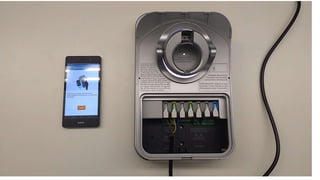
We will charge you. How to [b]reach
vendor’s internal network using
electric vehicle charging station
Dmitry Sklyar
@d_skljar
1
Whoami
2
• Application security specialist, Security Assessment
@kl_secservices
• Hardware research
• Reverse engineering
• IoT and ICS protocols
3
Entering the new era
4
Charge Point Home
5
Marketing style
6
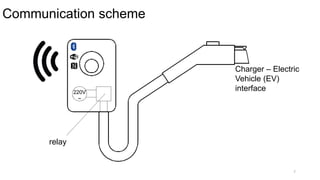
Communication scheme
7
Charger – Electric
Vehicle (EV)
interface220V
~
relay
Android application
8
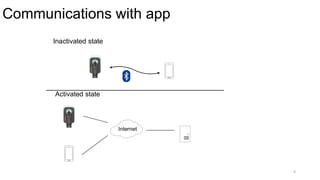
Communications with app
9
Internet
Inactivated state
Activated state
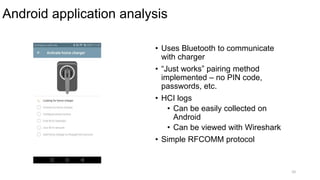
Android application analysis
10
• Uses Bluetooth to communicate
with charger
• “Just works” pairing method
implemented – no PIN code,
passwords, etc.
• HCI logs
• Can be easily collected on
Android
• Can be viewed with Wireshark
• Simple RFCOMM protocol
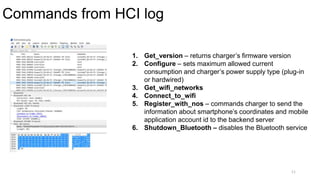
Commands from HCI log
11
1. Get_version – returns charger’s firmware version
2. Configure – sets maximum allowed current
consumption and charger’s power supply type (plug-in
or hardwired)
3. Get_wifi_networks
4. Connect_to_wifi
5. Register_with_nos – commands charger to send the
information about smartphone’s coordinates and mobile
application account id to the backend server
6. Shutdown_Bluetooth – disables the Bluetooth service
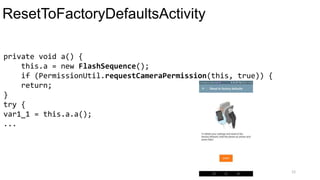
ResetToFactoryDefaultsActivity
12
private void a() {
this.a = new FlashSequence();
if (PermissionUtil.requestCameraPermission(this, true)) {
return;
}
try {
var1_1 = this.a.a();
...
13
Charger
14
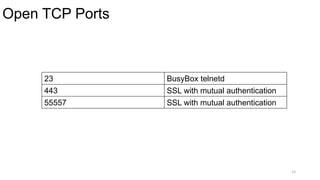
Open TCP Ports
15
23 BusyBox telnetd
443 SSL with mutual authentication
55557 SSL with mutual authentication
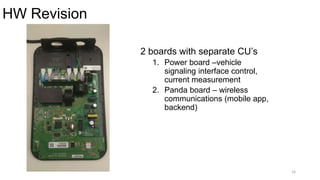
HW Revision
16
2 boards with separate CU’s
1. Power board –vehicle
signaling interface control,
current measurement
2. Panda board – wireless
communications (mobile app,
backend)
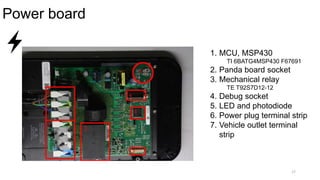
Power board
17
1. MCU, MSP430
TI 6BATG4MSP430 F67691
2. Panda board socket
3. Mechanical relay
TE T92S7D12-12
4. Debug socket
5. LED and photodiode
6. Power plug terminal strip
7. Vehicle outlet terminal
strip
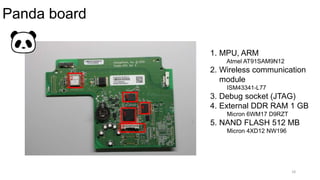
Panda board
18
1. MPU, ARM
Atmel AT91SAM9N12
2. Wireless communication
module
ISM43341-L77
3. Debug socket (JTAG)
4. External DDR RAM 1 GB
Micron 6WM17 D9RZT
5. NAND FLASH 512 MB
Micron 4XD12 NW196
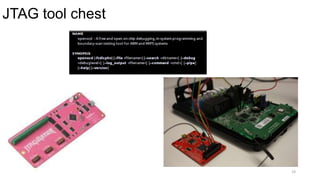
JTAG tool chest
19
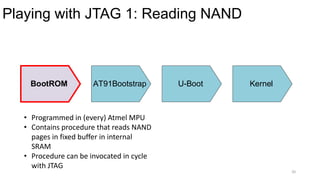
Playing with JTAG 1: Reading NAND
20
• Programmed in (every) Atmel MPU
• Contains procedure that reads NAND
pages in fixed buffer in internal
SRAM
• Procedure can be invocated in cycle
with JTAG
BootROM AT91Bootstrap U-Boot Kernel
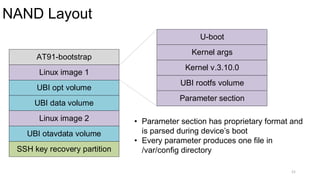
NAND Layout
21
• Parameter section has proprietary format and
is parsed during device’s boot
• Every parameter produces one file in
/var/config directory
AT91-bootstrap
Linux image 1
UBI opt volume
UBI data volume
Linux image 2
UBI otavdata volume
U-boot
Kernel args
SSH key recovery partition
Kernel v.3.10.0
UBI rootfs volume
Parameter section
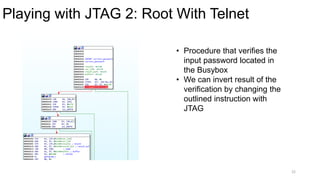
Playing with JTAG 2: Root With Telnet
22
• Procedure that verifies the
input password located in
the Busybox
• We can invert result of the
verification by changing the
outlined instruction with
JTAG
Wi-Fi
SSL (ports 443 and 55557)
23
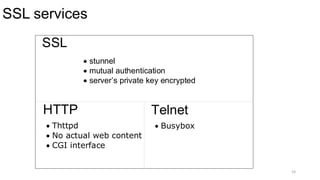
SSL services
24
SSL
HTTP
 stunnel
 mutual authentication
 server s private key encrypted
 Thttpd
 No actual web content
 CGI interface
Telnet
 Busybox
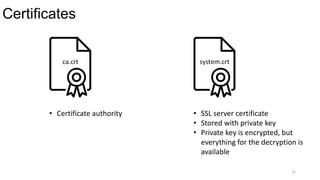
Certificates
25
system.crtca.crt
• Certificate authority • SSL server certificate
• Stored with private key
• Private key is encrypted, but
everything for the decryption is
available
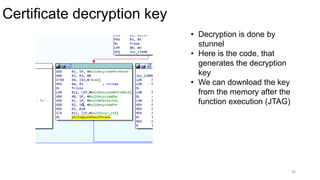
Certificate decryption key
26
• Decryption is done by
stunnel
• Here is the code, that
generates the decryption
key
• We can download the key
from the memory after the
function execution (JTAG)
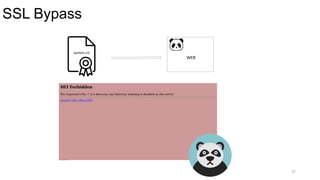
SSL Bypass
27
WEB
system.crt
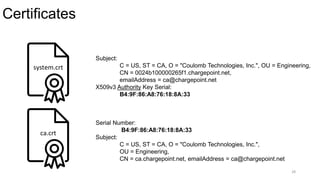
Certificates
28
system.crt
ca.crt
Subject:
C = US, ST = CA, O = "Coulomb Technologies, Inc.", OU = Engineering,
CN = 0024b100000265f1.chargepoint.net,
emailAddress = ca@chargepoint.net
X509v3 Authority Key Serial:
B4:9F:86:A8:76:18:8A:33
Serial Number:
B4:9F:86:A8:76:18:8A:33
Subject:
C = US, ST = CA, O = "Coulomb Technologies, Inc.",
OU = Engineering,
CN = ca.chargepoint.net, emailAddress = ca@chargepoint.net
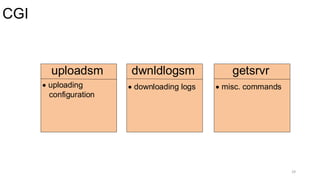
CGI
29
dwnldlogsm
 downloading logs
uploadsm
 uploading
configuration
getsrvr
 misc. commands
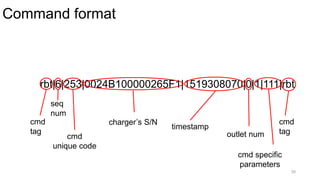
Command format
30
rbt|6|253|0024B100000265F1|1519308070|0|1|111|rbt
cmd
tag
seq
num
cmd
unique code
charger’s S/N
timestamp
outlet num
cmd specific
parameters
cmd
tag
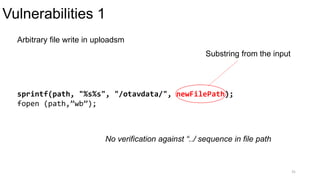
Vulnerabilities 1
31
Arbitrary file write in uploadsm
sprintf(path, "%s%s", "/otavdata/", newFilePath);
fopen (path,”wb”);
No verification against “../ sequence in file path
Substring from the input
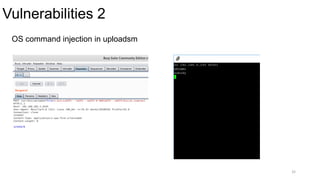
Vulnerabilities 2
32
OS command injection in uploadsm
Vulnerabilities 3
33
Stack buffer overflow in getsrvr and uploadsm
sscanf(&input,"%[^|]|%d|%d|%16s|%ld|%d|%d|%d|%[^|]|%[^|]|
%s",&v1,%v2,…,&v11)
Input commands are parsed without length checking
ASLR Bypass Details
34
• Stack is executable, but its position is randomized
• ~512 possible positions
• ~350 tries to guess position with 50% prob.
• 2 seconds per try
• 15 minutes in average for successful payload launch
Wi-Fi
SSL (ports 443 and 55557)
Communications with backend
35
Control server communications
36
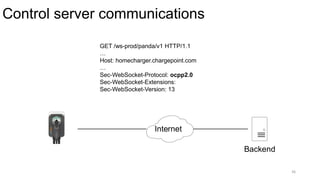
GET /ws-prod/panda/v1 HTTP/1.1
…
Host: homecharger.chargepoint.com
…
Sec-WebSocket-Protocol: ocpp2.0
Sec-WebSocket-Extensions:
Sec-WebSocket-Version: 13
Backend
Internet
OCPP2.0(ChargePoint edition)
37
• Based on OCPP1.6
• Messages are encapsulated into standard OCPP packets
• Uses encrypted connection (TLS)
• Device’s TLS certificate is the same, that is used as webserver’s
certificate (system.crt)
Stack buffer overflow
38
sscanf(input,"%[^|]|%d|%d|%16s|%ld|%d|%d|%16s|%s",&v1,&v2,&v
3,&v4,&v5,&v6,&v7,&v8,&v9);
Commands have the same format as in the CGI, that leads to
the same vulnerability
ASLR Bypass Details
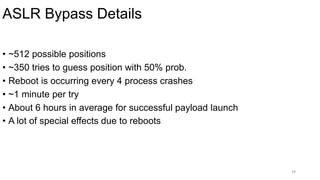
39
• ~512 possible positions
• ~350 tries to guess position with 50% prob.
• Reboot is occurring every 4 process crashes
• ~1 minute per try
• About 6 hours in average for successful payload launch
• A lot of special effects due to reboots
Wi-Fi
SSL (ports 443 and 55557)
Communications with backend
Way to the vendor’s network
40
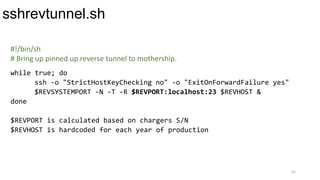
sshrevtunnel.sh
41
while true; do
ssh -o "StrictHostKeyChecking no" -o "ExitOnForwardFailure yes"
$REVSYSTEMPORT -N -T -R $REVPORT:localhost:23 $REVHOST &
done
$REVPORT is calculated based on chargers S/N
$REVHOST is hardcoded for each year of production
#!/bin/sh
# Bring up pinned up reverse tunnel to mothership.
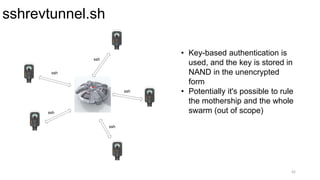
sshrevtunnel.sh
42
• Key-based authentication is
used, and the key is stored in
NAND in the unencrypted
form
• Potentially it's possible to rule
the mothership and the whole
swarm (out of scope)
ssh
ssh
ssh
ssh
ssh
Bluetooth
43
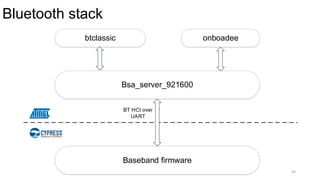
Bluetooth stack
44
btclassic onboadee
Bsa_server_921600
Baseband firmware
BT HCI over
UART
Vehicle interface
45
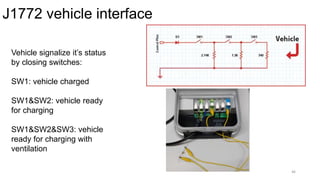
J1772 vehicle interface
46
Vehicle signalize it’s status
by closing switches:
SW1: vehicle charged
SW1&SW2: vehicle ready
for charging
SW1&SW2&SW3: vehicle
ready for charging with
ventilation
Disclosure timeline & vendor response
47
• 07-08-2018: We send all our findings to the vendor
• 21-08-2018: A detailed action plan was developed and discussed to
address the vulnerabilities found
• 14-09-2018: New firmware with all bugs fixed was released
© 2018 ChargePoint, Inc.
Information Security at ChargePoint
+ ChargePoint takes the security of our products and services seriously. We
dedicate significant resources to this area including:
• Following best practices for secure design and testing of our products
• Regular 3rd party penetration testing against our products and systems that store
sensitive data
+ Thank you Kaspersky for helping us enhance the security of our products!
• Your patience and persistence were helpful as these were the first externally-
detected vulnerabilities reported to us
• All the vulnerabilities identified have been patched
+ If you feel you have discovered a possible privacy or security vulnerability,
please contact us at security@chargepoint.com with a description of the issue.
48
Summary
49
• Several vulnerabilities in Wi-Fi and Bluetooth stacks were found
• Coordinated disclosure: all vulnerabilities were promptly fixed
• EV industry opens wide area for research:
• Transactions protocols
• EV-EVSE communication protocols
• …
Questions?
50
@kl_secservices
@d_sklyar

We will charge you. How to [b]reach vendor’s network using EV charging station.

  • 1.
    We will chargeyou. How to [b]reach vendor’s internal network using electric vehicle charging station Dmitry Sklyar @d_skljar 1
  • 2.
    Whoami 2 • Application securityspecialist, Security Assessment @kl_secservices • Hardware research • Reverse engineering • IoT and ICS protocols
  • 3.
  • 4.
  • 5.
  • 6.
  • 7.
    Communication scheme 7 Charger –Electric Vehicle (EV) interface220V ~ relay
  • 8.
  • 9.
  • 10.
    Android application analysis 10 •Uses Bluetooth to communicate with charger • “Just works” pairing method implemented – no PIN code, passwords, etc. • HCI logs • Can be easily collected on Android • Can be viewed with Wireshark • Simple RFCOMM protocol
  • 11.
    Commands from HCIlog 11 1. Get_version – returns charger’s firmware version 2. Configure – sets maximum allowed current consumption and charger’s power supply type (plug-in or hardwired) 3. Get_wifi_networks 4. Connect_to_wifi 5. Register_with_nos – commands charger to send the information about smartphone’s coordinates and mobile application account id to the backend server 6. Shutdown_Bluetooth – disables the Bluetooth service
  • 12.
    ResetToFactoryDefaultsActivity 12 private void a(){ this.a = new FlashSequence(); if (PermissionUtil.requestCameraPermission(this, true)) { return; } try { var1_1 = this.a.a(); ...
  • 13.
  • 14.
  • 15.
    Open TCP Ports 15 23BusyBox telnetd 443 SSL with mutual authentication 55557 SSL with mutual authentication
  • 16.
    HW Revision 16 2 boardswith separate CU’s 1. Power board –vehicle signaling interface control, current measurement 2. Panda board – wireless communications (mobile app, backend)
  • 17.
    Power board 17 1. MCU,MSP430 TI 6BATG4MSP430 F67691 2. Panda board socket 3. Mechanical relay TE T92S7D12-12 4. Debug socket 5. LED and photodiode 6. Power plug terminal strip 7. Vehicle outlet terminal strip
  • 18.
    Panda board 18 1. MPU,ARM Atmel AT91SAM9N12 2. Wireless communication module ISM43341-L77 3. Debug socket (JTAG) 4. External DDR RAM 1 GB Micron 6WM17 D9RZT 5. NAND FLASH 512 MB Micron 4XD12 NW196
  • 19.
  • 20.
    Playing with JTAG1: Reading NAND 20 • Programmed in (every) Atmel MPU • Contains procedure that reads NAND pages in fixed buffer in internal SRAM • Procedure can be invocated in cycle with JTAG BootROM AT91Bootstrap U-Boot Kernel
  • 21.
    NAND Layout 21 • Parametersection has proprietary format and is parsed during device’s boot • Every parameter produces one file in /var/config directory AT91-bootstrap Linux image 1 UBI opt volume UBI data volume Linux image 2 UBI otavdata volume U-boot Kernel args SSH key recovery partition Kernel v.3.10.0 UBI rootfs volume Parameter section
  • 22.
    Playing with JTAG2: Root With Telnet 22 • Procedure that verifies the input password located in the Busybox • We can invert result of the verification by changing the outlined instruction with JTAG
  • 23.
    Wi-Fi SSL (ports 443and 55557) 23
  • 24.
    SSL services 24 SSL HTTP  stunnel mutual authentication  server s private key encrypted  Thttpd  No actual web content  CGI interface Telnet  Busybox
  • 25.
    Certificates 25 system.crtca.crt • Certificate authority• SSL server certificate • Stored with private key • Private key is encrypted, but everything for the decryption is available
  • 26.
    Certificate decryption key 26 •Decryption is done by stunnel • Here is the code, that generates the decryption key • We can download the key from the memory after the function execution (JTAG)
  • 27.
  • 28.
    Certificates 28 system.crt ca.crt Subject: C = US,ST = CA, O = "Coulomb Technologies, Inc.", OU = Engineering, CN = 0024b100000265f1.chargepoint.net, emailAddress = ca@chargepoint.net X509v3 Authority Key Serial: B4:9F:86:A8:76:18:8A:33 Serial Number: B4:9F:86:A8:76:18:8A:33 Subject: C = US, ST = CA, O = "Coulomb Technologies, Inc.", OU = Engineering, CN = ca.chargepoint.net, emailAddress = ca@chargepoint.net
  • 29.
    CGI 29 dwnldlogsm  downloading logs uploadsm uploading configuration getsrvr  misc. commands
  • 30.
  • 31.
    Vulnerabilities 1 31 Arbitrary filewrite in uploadsm sprintf(path, "%s%s", "/otavdata/", newFilePath); fopen (path,”wb”); No verification against “../ sequence in file path Substring from the input
  • 32.
    Vulnerabilities 2 32 OS commandinjection in uploadsm
  • 33.
    Vulnerabilities 3 33 Stack bufferoverflow in getsrvr and uploadsm sscanf(&input,"%[^|]|%d|%d|%16s|%ld|%d|%d|%d|%[^|]|%[^|]| %s",&v1,%v2,…,&v11) Input commands are parsed without length checking
  • 34.
    ASLR Bypass Details 34 •Stack is executable, but its position is randomized • ~512 possible positions • ~350 tries to guess position with 50% prob. • 2 seconds per try • 15 minutes in average for successful payload launch
  • 35.
    Wi-Fi SSL (ports 443and 55557) Communications with backend 35
  • 36.
    Control server communications 36 GET/ws-prod/panda/v1 HTTP/1.1 … Host: homecharger.chargepoint.com … Sec-WebSocket-Protocol: ocpp2.0 Sec-WebSocket-Extensions: Sec-WebSocket-Version: 13 Backend Internet
  • 37.
    OCPP2.0(ChargePoint edition) 37 • Basedon OCPP1.6 • Messages are encapsulated into standard OCPP packets • Uses encrypted connection (TLS) • Device’s TLS certificate is the same, that is used as webserver’s certificate (system.crt)
  • 38.
  • 39.
    ASLR Bypass Details 39 •~512 possible positions • ~350 tries to guess position with 50% prob. • Reboot is occurring every 4 process crashes • ~1 minute per try • About 6 hours in average for successful payload launch • A lot of special effects due to reboots
  • 40.
    Wi-Fi SSL (ports 443and 55557) Communications with backend Way to the vendor’s network 40
  • 41.
    sshrevtunnel.sh 41 while true; do ssh-o "StrictHostKeyChecking no" -o "ExitOnForwardFailure yes" $REVSYSTEMPORT -N -T -R $REVPORT:localhost:23 $REVHOST & done $REVPORT is calculated based on chargers S/N $REVHOST is hardcoded for each year of production #!/bin/sh # Bring up pinned up reverse tunnel to mothership.
  • 42.
    sshrevtunnel.sh 42 • Key-based authenticationis used, and the key is stored in NAND in the unencrypted form • Potentially it's possible to rule the mothership and the whole swarm (out of scope) ssh ssh ssh ssh ssh
  • 43.
  • 44.
  • 45.
  • 46.
    J1772 vehicle interface 46 Vehiclesignalize it’s status by closing switches: SW1: vehicle charged SW1&SW2: vehicle ready for charging SW1&SW2&SW3: vehicle ready for charging with ventilation
  • 47.
    Disclosure timeline &vendor response 47 • 07-08-2018: We send all our findings to the vendor • 21-08-2018: A detailed action plan was developed and discussed to address the vulnerabilities found • 14-09-2018: New firmware with all bugs fixed was released
  • 48.
    © 2018 ChargePoint,Inc. Information Security at ChargePoint + ChargePoint takes the security of our products and services seriously. We dedicate significant resources to this area including: • Following best practices for secure design and testing of our products • Regular 3rd party penetration testing against our products and systems that store sensitive data + Thank you Kaspersky for helping us enhance the security of our products! • Your patience and persistence were helpful as these were the first externally- detected vulnerabilities reported to us • All the vulnerabilities identified have been patched + If you feel you have discovered a possible privacy or security vulnerability, please contact us at security@chargepoint.com with a description of the issue. 48
  • 49.
    Summary 49 • Several vulnerabilitiesin Wi-Fi and Bluetooth stacks were found • Coordinated disclosure: all vulnerabilities were promptly fixed • EV industry opens wide area for research: • Transactions protocols • EV-EVSE communication protocols • …
  • 50.