Predicate Logic
DAT911 - Foundations of Computer Science
Dario Garigliotti
March 9, 2016
Dario Garigliotti Predicate Logic
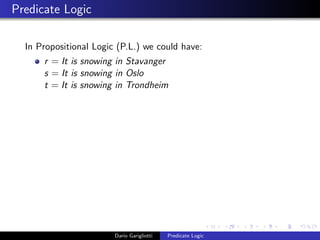
Predicate Logic
In Propositional Logic (P.L.) we could have:
r = It is snowing in Stavanger
s = It is snowing in Oslo
t = It is snowing in Trondheim
Dario Garigliotti Predicate Logic
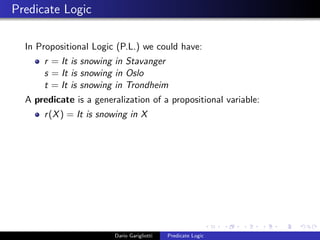
Predicate Logic
In Propositional Logic (P.L.) we could have:
r = It is snowing in Stavanger
s = It is snowing in Oslo
t = It is snowing in Trondheim
A predicate is a generalization of a propositional variable:
r(X) = It is snowing in X
Dario Garigliotti Predicate Logic
Predicate Logic
In Propositional Logic (P.L.) we could have:
r = It is snowing in Stavanger
s = It is snowing in Oslo
t = It is snowing in Trondheim
A predicate is a generalization of a propositional variable:
r(X) = It is snowing in X
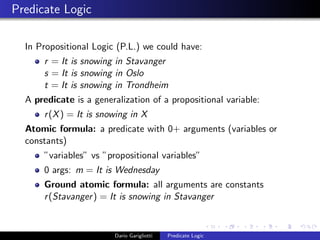
Atomic formula: a predicate with 0+ arguments (variables or
constants)
”variables” vs ”propositional variables”
0 args: m = It is Wednesday
Ground atomic formula: all arguments are constants
r(Stavanger) = It is snowing in Stavanger
Dario Garigliotti Predicate Logic
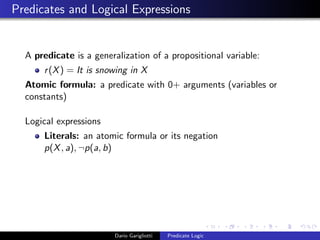
Predicates and Logical Expressions
A predicate is a generalization of a propositional variable:
r(X) = It is snowing in X
Atomic formula: a predicate with 0+ arguments (variables or
constants)
Logical expressions
Literals: an atomic formula or its negation
p(X, a), ¬p(a, b)
Dario Garigliotti Predicate Logic
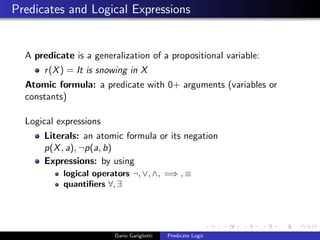
Predicates and Logical Expressions
A predicate is a generalization of a propositional variable:
r(X) = It is snowing in X
Atomic formula: a predicate with 0+ arguments (variables or
constants)
Logical expressions
Literals: an atomic formula or its negation
p(X, a), ¬p(a, b)
Expressions: by using
logical operators ¬, ∨, ∧, =⇒ , ≡
quantifiers ∀, ∃
Dario Garigliotti Predicate Logic
Quantifiers
For our predicate
r(X) = It is snowing in X
if we want to express: It is snowing in at least one city
r(Berlin) ∨ r(London) ∨ r(Paris) ∨ r(Rome) ∨ ...
we do it by
the existential quantifier: (∃X)r(X)
In the case of expressing For all the cities..., we use
the universal quantifier: (∀X)r(X)
Dario Garigliotti Predicate Logic
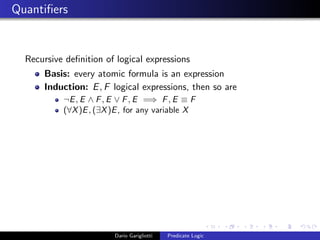
Quantifiers
Recursive definition of logical expressions
Basis: every atomic formula is an expression
Induction: E, F logical expressions, then so are
¬E, E ∧ F, E ∨ F, E =⇒ F, E ≡ F
(∀X)E, (∃X)E, for any variable X
Dario Garigliotti Predicate Logic
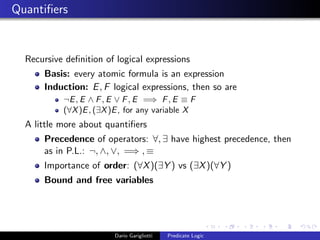
Quantifiers
Recursive definition of logical expressions
Basis: every atomic formula is an expression
Induction: E, F logical expressions, then so are
¬E, E ∧ F, E ∨ F, E =⇒ F, E ≡ F
(∀X)E, (∃X)E, for any variable X
A little more about quantifiers
Precedence of operators: ∀, ∃ have highest precedence, then
as in P.L.: ¬, ∧, ∨, =⇒ , ≡
Importance of order: (∀X)(∃Y ) vs (∃X)(∀Y )
Bound and free variables
Dario Garigliotti Predicate Logic
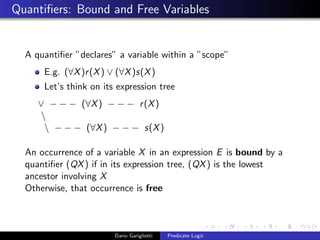
Quantifiers: Bound and Free Variables
A quantifier ”declares” a variable within a ”scope”
E.g. (∀X)r(X) ∨ (∀X)s(X)
Let’s think on its expression tree
∨ − − − (∀X) − − − r(X)

 − − − (∀X) − − − s(X)
An occurrence of a variable X in an expression E is bound by a
quantifier (QX) if in its expression tree, (QX) is the lowest
ancestor involving X
Otherwise, that occurrence is free
Dario Garigliotti Predicate Logic
Quantifiers: Bound and Free Occurrences of Variables
An occurrence of a variable X in an expression E is bound by a
quantifier (QX) if in its expression tree, (QX) is the lowest
ancestor involving X
Otherwise, that occurrence is free
Another example: r(X) ∨ (∃X)s(X)
∨ − − − r(X)

 − − − (∃X) − − − s(X)
Then we mean: bound and free occurrences of variables
Dario Garigliotti Predicate Logic
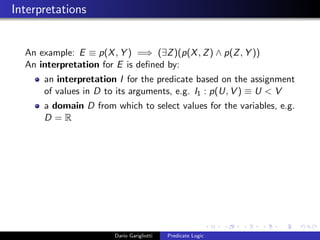
Interpretations
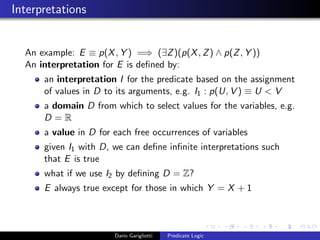
An example: E ≡ p(X, Y ) =⇒ (∃Z)(p(X, Z) ∧ p(Z, Y ))
An interpretation for E is defined by:
Dario Garigliotti Predicate Logic
Interpretations
An example: E ≡ p(X, Y ) =⇒ (∃Z)(p(X, Z) ∧ p(Z, Y ))
An interpretation for E is defined by:
an interpretation I for the predicate based on the assignment
of values in D to its arguments, e.g. I1 : p(U, V ) ≡ U < V
Dario Garigliotti Predicate Logic
Interpretations
An example: E ≡ p(X, Y ) =⇒ (∃Z)(p(X, Z) ∧ p(Z, Y ))
An interpretation for E is defined by:
an interpretation I for the predicate based on the assignment
of values in D to its arguments, e.g. I1 : p(U, V ) ≡ U < V
a domain D from which to select values for the variables, e.g.
D = R
Dario Garigliotti Predicate Logic
Interpretations
An example: E ≡ p(X, Y ) =⇒ (∃Z)(p(X, Z) ∧ p(Z, Y ))
An interpretation for E is defined by:
an interpretation I for the predicate based on the assignment
of values in D to its arguments, e.g. I1 : p(U, V ) ≡ U < V
a domain D from which to select values for the variables, e.g.
D = R
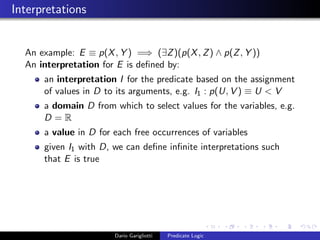
a value in D for each free occurrences of variables
Dario Garigliotti Predicate Logic
Interpretations
An example: E ≡ p(X, Y ) =⇒ (∃Z)(p(X, Z) ∧ p(Z, Y ))
An interpretation for E is defined by:
an interpretation I for the predicate based on the assignment
of values in D to its arguments, e.g. I1 : p(U, V ) ≡ U < V
a domain D from which to select values for the variables, e.g.
D = R
a value in D for each free occurrences of variables
given I1 with D, we can define infinite interpretations such
that E is true
Dario Garigliotti Predicate Logic
Interpretations
An example: E ≡ p(X, Y ) =⇒ (∃Z)(p(X, Z) ∧ p(Z, Y ))
An interpretation for E is defined by:
an interpretation I for the predicate based on the assignment
of values in D to its arguments, e.g. I1 : p(U, V ) ≡ U < V
a domain D from which to select values for the variables, e.g.
D = R
a value in D for each free occurrences of variables
given I1 with D, we can define infinite interpretations such
that E is true
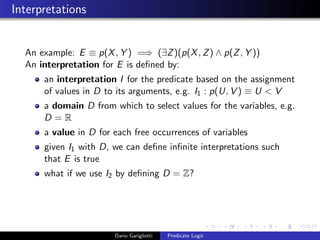
what if we use I2 by defining D = Z?
Dario Garigliotti Predicate Logic
Interpretations
An example: E ≡ p(X, Y ) =⇒ (∃Z)(p(X, Z) ∧ p(Z, Y ))
An interpretation for E is defined by:
an interpretation I for the predicate based on the assignment
of values in D to its arguments, e.g. I1 : p(U, V ) ≡ U < V
a domain D from which to select values for the variables, e.g.
D = R
a value in D for each free occurrences of variables
given I1 with D, we can define infinite interpretations such
that E is true
what if we use I2 by defining D = Z?
E always true except for those in which Y = X + 1
Dario Garigliotti Predicate Logic
Interpretations
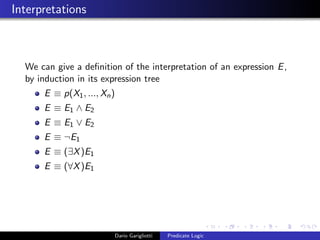
We can give a definition of the interpretation of an expression E,
by induction in its expression tree
E ≡ p(X1, ..., Xn)
E ≡ E1 ∧ E2
E ≡ E1 ∨ E2
E ≡ ¬E1
E ≡ (∃X)E1
E ≡ (∀X)E1
Dario Garigliotti Predicate Logic
Tautologies - Substitutions and Equivalences
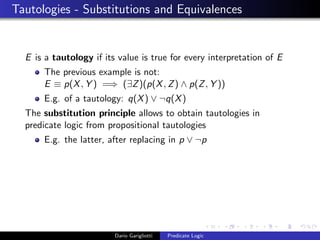
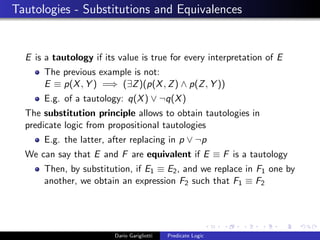
E is a tautology if its value is true for every interpretation of E
The previous example is not:
E ≡ p(X, Y ) =⇒ (∃Z)(p(X, Z) ∧ p(Z, Y ))
E.g. of a tautology: q(X) ∨ ¬q(X)
Dario Garigliotti Predicate Logic
Tautologies - Substitutions and Equivalences
E is a tautology if its value is true for every interpretation of E
The previous example is not:
E ≡ p(X, Y ) =⇒ (∃Z)(p(X, Z) ∧ p(Z, Y ))
E.g. of a tautology: q(X) ∨ ¬q(X)
The substitution principle allows to obtain tautologies in
predicate logic from propositional tautologies
E.g. the latter, after replacing in p ∨ ¬p
Dario Garigliotti Predicate Logic
Tautologies - Substitutions and Equivalences
E is a tautology if its value is true for every interpretation of E
The previous example is not:
E ≡ p(X, Y ) =⇒ (∃Z)(p(X, Z) ∧ p(Z, Y ))
E.g. of a tautology: q(X) ∨ ¬q(X)
The substitution principle allows to obtain tautologies in
predicate logic from propositional tautologies
E.g. the latter, after replacing in p ∨ ¬p
We can say that E and F are equivalent if E ≡ F is a tautology
Then, by substitution, if E1 ≡ E2, and we replace in F1 one by
another, we obtain an expression F2 such that F1 ≡ F2
Dario Garigliotti Predicate Logic
Tautologies Involving Quantifiers
Let’s describe two techniques for tautologies with quantifiers
1 Rectifying expressions
Variable renaming: (QX)E ≡ (QX)E , where E is obtained
from E by replacing all occurrences of bound X for a fresh
(not free in E) Y
Rectified expression by renaming it without repeating variables
Dario Garigliotti Predicate Logic
Tautologies Involving Quantifiers
Let’s describe two techniques for tautologies with quantifiers
1 Rectifying expressions
Variable renaming: (QX)E ≡ (QX)E , where E is obtained
from E by replacing all occurrences of bound X for a fresh
(not free in E) Y
Rectified expression by renaming it without repeating variables
2 Moving quantifiers outside
¬((∀X)E) ≡ (∃X)(¬E)
¬((∃X)E) ≡ (∀X)(¬E)
(E ∧ (QX)F) ≡ (QX)(E ∧ F) (X not free in E)
(E ∨ (QX)F) ≡ (QX)(E ∨ F) (X not free in E)
Dario Garigliotti Predicate Logic
Tautologies Involving Quantifiers
With those two steps, we can get an equivalent quantifier-free
expression (or prenex-form expression) of the shape
(Q1X1)(Q2X2)...(QkXk)E
E.g. from E ≡ (∀X)p(X) ∨ ¬(∀X)p(X)
Dario Garigliotti Predicate Logic
Tautologies Involving Quantifiers
With those two steps, we can get an equivalent quantifier-free
expression (or prenex-form expression) of the shape
(Q1X1)(Q2X2)...(QkXk)E
E.g. from E ≡ (∀X)p(X) ∨ ¬(∀X)p(X)
Rectifying expression: (∀X)p(X) ∨ ¬(∀Y )p(Y )
Dario Garigliotti Predicate Logic
Tautologies Involving Quantifiers
With those two steps, we can get an equivalent quantifier-free
expression (or prenex-form expression) of the shape
(Q1X1)(Q2X2)...(QkXk)E
E.g. from E ≡ (∀X)p(X) ∨ ¬(∀X)p(X)
Rectifying expression: (∀X)p(X) ∨ ¬(∀Y )p(Y )
Moving Qs outside: (∀X)p(X) ∨ (∃Y )¬p(Y )
Dario Garigliotti Predicate Logic
Tautologies Involving Quantifiers
With those two steps, we can get an equivalent quantifier-free
expression (or prenex-form expression) of the shape
(Q1X1)(Q2X2)...(QkXk)E
E.g. from E ≡ (∀X)p(X) ∨ ¬(∀X)p(X)
Rectifying expression: (∀X)p(X) ∨ ¬(∀Y )p(Y )
Moving Qs outside: (∀X)p(X) ∨ (∃Y )¬p(Y )
Moving Qs outside: (∀X)(∃Y )(p(X) ∨ ¬p(Y ))
Dario Garigliotti Predicate Logic
Proofs in Predicate Logic: Basics
Given some hypotheses E1, E2, ..., Ek, a proof is a sequence of
expressions such that each of them
either is one if the Ei ’s
or follows from 0+ previous expressions by some rule of
inference
A rule of inference is of the shape (F1 ∧ F2 ∧ ... ∧ Fn) =⇒ F
Then, the law of variable substitution: given E asserted,
E =⇒ sub(E) is a tautology
E.g. p(X, Y ) =⇒ p(U, V )
E.g. p(X, Y ) =⇒ p(1, 2)
Dario Garigliotti Predicate Logic
Proofs in Predicate Logic: From Rules and Facts
Two main kind of hypotheses:
Facts: ground atomic formulas, e.g. p(1)
Rules: ”if-then” expressions, with a body of subgoals and a
head, e.g. p(X) ∧ q(Y ) =⇒ r(X)
Dario Garigliotti Predicate Logic
Proofs in Predicate Logic: From Rules and Facts
Two main kind of hypotheses:
Facts: ground atomic formulas, e.g. p(1)
Rules: ”if-then” expressions, with a body of subgoals and a
head, e.g. p(X) ∧ q(Y ) =⇒ r(X)
Then, a proof can be build in this way, e.g.
1 p(X) ∧ q(Y ) =⇒ r(X) (Hypothesis: rule)
2 p(1) (Hypothesis: fact)
3 q(3) (Hypothesis: fact)
Dario Garigliotti Predicate Logic
Proofs in Predicate Logic: From Rules and Facts
Two main kind of hypotheses:
Facts: ground atomic formulas, e.g. p(1)
Rules: ”if-then” expressions, with a body of subgoals and a
head, e.g. p(X) ∧ q(Y ) =⇒ r(X)
Then, a proof can be build in this way, e.g.
1 p(X) ∧ q(Y ) =⇒ r(X) (Hypothesis: rule)
2 p(1) (Hypothesis: fact)
3 q(3) (Hypothesis: fact)
4 p(1) ∧ q(3)
Dario Garigliotti Predicate Logic
Proofs in Predicate Logic: From Rules and Facts
Two main kind of hypotheses:
Facts: ground atomic formulas, e.g. p(1)
Rules: ”if-then” expressions, with a body of subgoals and a
head, e.g. p(X) ∧ q(Y ) =⇒ r(X)
Then, a proof can be build in this way, e.g.
1 p(X) ∧ q(Y ) =⇒ r(X) (Hypothesis: rule)
2 p(1) (Hypothesis: fact)
3 q(3) (Hypothesis: fact)
4 p(1) ∧ q(3)
5 p(1) ∧ q(3) =⇒ r(1)
Dario Garigliotti Predicate Logic
Proofs in Predicate Logic: From Rules and Facts
Two main kind of hypotheses:
Facts: ground atomic formulas, e.g. p(1)
Rules: ”if-then” expressions, with a body of subgoals and a
head, e.g. p(X) ∧ q(Y ) =⇒ r(X)
Then, a proof can be build in this way, e.g.
1 p(X) ∧ q(Y ) =⇒ r(X) (Hypothesis: rule)
2 p(1) (Hypothesis: fact)
3 q(3) (Hypothesis: fact)
4 p(1) ∧ q(3)
5 p(1) ∧ q(3) =⇒ r(1)
6 r(1)
Dario Garigliotti Predicate Logic
Provability and Truth
Idea of model: an interpretation which makes an expression
true
Similarly, a model of a collection of expressions {E1, E2, ..., En}
Entailment or satisfaction: E1, E2, ..., En |= E if every model
for the collection is also a model for E
Provability: E1, E2, ..., En E
Consistency of a proof system: provability =⇒ entailment
Completeness of a proof system: entailment =⇒ provability
Dario Garigliotti Predicate Logic
Predicate Logic
Thanks!
Questions?
Dario Garigliotti Predicate Logic

Predicate Logic

  • 1.
    Predicate Logic DAT911 -Foundations of Computer Science Dario Garigliotti March 9, 2016 Dario Garigliotti Predicate Logic
  • 2.
    Predicate Logic In PropositionalLogic (P.L.) we could have: r = It is snowing in Stavanger s = It is snowing in Oslo t = It is snowing in Trondheim Dario Garigliotti Predicate Logic
  • 3.
    Predicate Logic In PropositionalLogic (P.L.) we could have: r = It is snowing in Stavanger s = It is snowing in Oslo t = It is snowing in Trondheim A predicate is a generalization of a propositional variable: r(X) = It is snowing in X Dario Garigliotti Predicate Logic
  • 4.
    Predicate Logic In PropositionalLogic (P.L.) we could have: r = It is snowing in Stavanger s = It is snowing in Oslo t = It is snowing in Trondheim A predicate is a generalization of a propositional variable: r(X) = It is snowing in X Atomic formula: a predicate with 0+ arguments (variables or constants) ”variables” vs ”propositional variables” 0 args: m = It is Wednesday Ground atomic formula: all arguments are constants r(Stavanger) = It is snowing in Stavanger Dario Garigliotti Predicate Logic
  • 5.
    Predicates and LogicalExpressions A predicate is a generalization of a propositional variable: r(X) = It is snowing in X Atomic formula: a predicate with 0+ arguments (variables or constants) Logical expressions Literals: an atomic formula or its negation p(X, a), ¬p(a, b) Dario Garigliotti Predicate Logic
  • 6.
    Predicates and LogicalExpressions A predicate is a generalization of a propositional variable: r(X) = It is snowing in X Atomic formula: a predicate with 0+ arguments (variables or constants) Logical expressions Literals: an atomic formula or its negation p(X, a), ¬p(a, b) Expressions: by using logical operators ¬, ∨, ∧, =⇒ , ≡ quantifiers ∀, ∃ Dario Garigliotti Predicate Logic
  • 7.
    Quantifiers For our predicate r(X)= It is snowing in X if we want to express: It is snowing in at least one city r(Berlin) ∨ r(London) ∨ r(Paris) ∨ r(Rome) ∨ ... we do it by the existential quantifier: (∃X)r(X) In the case of expressing For all the cities..., we use the universal quantifier: (∀X)r(X) Dario Garigliotti Predicate Logic
  • 8.
    Quantifiers Recursive definition oflogical expressions Basis: every atomic formula is an expression Induction: E, F logical expressions, then so are ¬E, E ∧ F, E ∨ F, E =⇒ F, E ≡ F (∀X)E, (∃X)E, for any variable X Dario Garigliotti Predicate Logic
  • 9.
    Quantifiers Recursive definition oflogical expressions Basis: every atomic formula is an expression Induction: E, F logical expressions, then so are ¬E, E ∧ F, E ∨ F, E =⇒ F, E ≡ F (∀X)E, (∃X)E, for any variable X A little more about quantifiers Precedence of operators: ∀, ∃ have highest precedence, then as in P.L.: ¬, ∧, ∨, =⇒ , ≡ Importance of order: (∀X)(∃Y ) vs (∃X)(∀Y ) Bound and free variables Dario Garigliotti Predicate Logic
  • 10.
    Quantifiers: Bound andFree Variables A quantifier ”declares” a variable within a ”scope” E.g. (∀X)r(X) ∨ (∀X)s(X) Let’s think on its expression tree ∨ − − − (∀X) − − − r(X) − − − (∀X) − − − s(X) An occurrence of a variable X in an expression E is bound by a quantifier (QX) if in its expression tree, (QX) is the lowest ancestor involving X Otherwise, that occurrence is free Dario Garigliotti Predicate Logic
  • 11.
    Quantifiers: Bound andFree Occurrences of Variables An occurrence of a variable X in an expression E is bound by a quantifier (QX) if in its expression tree, (QX) is the lowest ancestor involving X Otherwise, that occurrence is free Another example: r(X) ∨ (∃X)s(X) ∨ − − − r(X) − − − (∃X) − − − s(X) Then we mean: bound and free occurrences of variables Dario Garigliotti Predicate Logic
  • 12.
    Interpretations An example: E≡ p(X, Y ) =⇒ (∃Z)(p(X, Z) ∧ p(Z, Y )) An interpretation for E is defined by: Dario Garigliotti Predicate Logic
  • 13.
    Interpretations An example: E≡ p(X, Y ) =⇒ (∃Z)(p(X, Z) ∧ p(Z, Y )) An interpretation for E is defined by: an interpretation I for the predicate based on the assignment of values in D to its arguments, e.g. I1 : p(U, V ) ≡ U < V Dario Garigliotti Predicate Logic
  • 14.
    Interpretations An example: E≡ p(X, Y ) =⇒ (∃Z)(p(X, Z) ∧ p(Z, Y )) An interpretation for E is defined by: an interpretation I for the predicate based on the assignment of values in D to its arguments, e.g. I1 : p(U, V ) ≡ U < V a domain D from which to select values for the variables, e.g. D = R Dario Garigliotti Predicate Logic
  • 15.
    Interpretations An example: E≡ p(X, Y ) =⇒ (∃Z)(p(X, Z) ∧ p(Z, Y )) An interpretation for E is defined by: an interpretation I for the predicate based on the assignment of values in D to its arguments, e.g. I1 : p(U, V ) ≡ U < V a domain D from which to select values for the variables, e.g. D = R a value in D for each free occurrences of variables Dario Garigliotti Predicate Logic
  • 16.
    Interpretations An example: E≡ p(X, Y ) =⇒ (∃Z)(p(X, Z) ∧ p(Z, Y )) An interpretation for E is defined by: an interpretation I for the predicate based on the assignment of values in D to its arguments, e.g. I1 : p(U, V ) ≡ U < V a domain D from which to select values for the variables, e.g. D = R a value in D for each free occurrences of variables given I1 with D, we can define infinite interpretations such that E is true Dario Garigliotti Predicate Logic
  • 17.
    Interpretations An example: E≡ p(X, Y ) =⇒ (∃Z)(p(X, Z) ∧ p(Z, Y )) An interpretation for E is defined by: an interpretation I for the predicate based on the assignment of values in D to its arguments, e.g. I1 : p(U, V ) ≡ U < V a domain D from which to select values for the variables, e.g. D = R a value in D for each free occurrences of variables given I1 with D, we can define infinite interpretations such that E is true what if we use I2 by defining D = Z? Dario Garigliotti Predicate Logic
  • 18.
    Interpretations An example: E≡ p(X, Y ) =⇒ (∃Z)(p(X, Z) ∧ p(Z, Y )) An interpretation for E is defined by: an interpretation I for the predicate based on the assignment of values in D to its arguments, e.g. I1 : p(U, V ) ≡ U < V a domain D from which to select values for the variables, e.g. D = R a value in D for each free occurrences of variables given I1 with D, we can define infinite interpretations such that E is true what if we use I2 by defining D = Z? E always true except for those in which Y = X + 1 Dario Garigliotti Predicate Logic
  • 19.
    Interpretations We can givea definition of the interpretation of an expression E, by induction in its expression tree E ≡ p(X1, ..., Xn) E ≡ E1 ∧ E2 E ≡ E1 ∨ E2 E ≡ ¬E1 E ≡ (∃X)E1 E ≡ (∀X)E1 Dario Garigliotti Predicate Logic
  • 20.
    Tautologies - Substitutionsand Equivalences E is a tautology if its value is true for every interpretation of E The previous example is not: E ≡ p(X, Y ) =⇒ (∃Z)(p(X, Z) ∧ p(Z, Y )) E.g. of a tautology: q(X) ∨ ¬q(X) Dario Garigliotti Predicate Logic
  • 21.
    Tautologies - Substitutionsand Equivalences E is a tautology if its value is true for every interpretation of E The previous example is not: E ≡ p(X, Y ) =⇒ (∃Z)(p(X, Z) ∧ p(Z, Y )) E.g. of a tautology: q(X) ∨ ¬q(X) The substitution principle allows to obtain tautologies in predicate logic from propositional tautologies E.g. the latter, after replacing in p ∨ ¬p Dario Garigliotti Predicate Logic
  • 22.
    Tautologies - Substitutionsand Equivalences E is a tautology if its value is true for every interpretation of E The previous example is not: E ≡ p(X, Y ) =⇒ (∃Z)(p(X, Z) ∧ p(Z, Y )) E.g. of a tautology: q(X) ∨ ¬q(X) The substitution principle allows to obtain tautologies in predicate logic from propositional tautologies E.g. the latter, after replacing in p ∨ ¬p We can say that E and F are equivalent if E ≡ F is a tautology Then, by substitution, if E1 ≡ E2, and we replace in F1 one by another, we obtain an expression F2 such that F1 ≡ F2 Dario Garigliotti Predicate Logic
  • 23.
    Tautologies Involving Quantifiers Let’sdescribe two techniques for tautologies with quantifiers 1 Rectifying expressions Variable renaming: (QX)E ≡ (QX)E , where E is obtained from E by replacing all occurrences of bound X for a fresh (not free in E) Y Rectified expression by renaming it without repeating variables Dario Garigliotti Predicate Logic
  • 24.
    Tautologies Involving Quantifiers Let’sdescribe two techniques for tautologies with quantifiers 1 Rectifying expressions Variable renaming: (QX)E ≡ (QX)E , where E is obtained from E by replacing all occurrences of bound X for a fresh (not free in E) Y Rectified expression by renaming it without repeating variables 2 Moving quantifiers outside ¬((∀X)E) ≡ (∃X)(¬E) ¬((∃X)E) ≡ (∀X)(¬E) (E ∧ (QX)F) ≡ (QX)(E ∧ F) (X not free in E) (E ∨ (QX)F) ≡ (QX)(E ∨ F) (X not free in E) Dario Garigliotti Predicate Logic
  • 25.
    Tautologies Involving Quantifiers Withthose two steps, we can get an equivalent quantifier-free expression (or prenex-form expression) of the shape (Q1X1)(Q2X2)...(QkXk)E E.g. from E ≡ (∀X)p(X) ∨ ¬(∀X)p(X) Dario Garigliotti Predicate Logic
  • 26.
    Tautologies Involving Quantifiers Withthose two steps, we can get an equivalent quantifier-free expression (or prenex-form expression) of the shape (Q1X1)(Q2X2)...(QkXk)E E.g. from E ≡ (∀X)p(X) ∨ ¬(∀X)p(X) Rectifying expression: (∀X)p(X) ∨ ¬(∀Y )p(Y ) Dario Garigliotti Predicate Logic
  • 27.
    Tautologies Involving Quantifiers Withthose two steps, we can get an equivalent quantifier-free expression (or prenex-form expression) of the shape (Q1X1)(Q2X2)...(QkXk)E E.g. from E ≡ (∀X)p(X) ∨ ¬(∀X)p(X) Rectifying expression: (∀X)p(X) ∨ ¬(∀Y )p(Y ) Moving Qs outside: (∀X)p(X) ∨ (∃Y )¬p(Y ) Dario Garigliotti Predicate Logic
  • 28.
    Tautologies Involving Quantifiers Withthose two steps, we can get an equivalent quantifier-free expression (or prenex-form expression) of the shape (Q1X1)(Q2X2)...(QkXk)E E.g. from E ≡ (∀X)p(X) ∨ ¬(∀X)p(X) Rectifying expression: (∀X)p(X) ∨ ¬(∀Y )p(Y ) Moving Qs outside: (∀X)p(X) ∨ (∃Y )¬p(Y ) Moving Qs outside: (∀X)(∃Y )(p(X) ∨ ¬p(Y )) Dario Garigliotti Predicate Logic
  • 29.
    Proofs in PredicateLogic: Basics Given some hypotheses E1, E2, ..., Ek, a proof is a sequence of expressions such that each of them either is one if the Ei ’s or follows from 0+ previous expressions by some rule of inference A rule of inference is of the shape (F1 ∧ F2 ∧ ... ∧ Fn) =⇒ F Then, the law of variable substitution: given E asserted, E =⇒ sub(E) is a tautology E.g. p(X, Y ) =⇒ p(U, V ) E.g. p(X, Y ) =⇒ p(1, 2) Dario Garigliotti Predicate Logic
  • 30.
    Proofs in PredicateLogic: From Rules and Facts Two main kind of hypotheses: Facts: ground atomic formulas, e.g. p(1) Rules: ”if-then” expressions, with a body of subgoals and a head, e.g. p(X) ∧ q(Y ) =⇒ r(X) Dario Garigliotti Predicate Logic
  • 31.
    Proofs in PredicateLogic: From Rules and Facts Two main kind of hypotheses: Facts: ground atomic formulas, e.g. p(1) Rules: ”if-then” expressions, with a body of subgoals and a head, e.g. p(X) ∧ q(Y ) =⇒ r(X) Then, a proof can be build in this way, e.g. 1 p(X) ∧ q(Y ) =⇒ r(X) (Hypothesis: rule) 2 p(1) (Hypothesis: fact) 3 q(3) (Hypothesis: fact) Dario Garigliotti Predicate Logic
  • 32.
    Proofs in PredicateLogic: From Rules and Facts Two main kind of hypotheses: Facts: ground atomic formulas, e.g. p(1) Rules: ”if-then” expressions, with a body of subgoals and a head, e.g. p(X) ∧ q(Y ) =⇒ r(X) Then, a proof can be build in this way, e.g. 1 p(X) ∧ q(Y ) =⇒ r(X) (Hypothesis: rule) 2 p(1) (Hypothesis: fact) 3 q(3) (Hypothesis: fact) 4 p(1) ∧ q(3) Dario Garigliotti Predicate Logic
  • 33.
    Proofs in PredicateLogic: From Rules and Facts Two main kind of hypotheses: Facts: ground atomic formulas, e.g. p(1) Rules: ”if-then” expressions, with a body of subgoals and a head, e.g. p(X) ∧ q(Y ) =⇒ r(X) Then, a proof can be build in this way, e.g. 1 p(X) ∧ q(Y ) =⇒ r(X) (Hypothesis: rule) 2 p(1) (Hypothesis: fact) 3 q(3) (Hypothesis: fact) 4 p(1) ∧ q(3) 5 p(1) ∧ q(3) =⇒ r(1) Dario Garigliotti Predicate Logic
  • 34.
    Proofs in PredicateLogic: From Rules and Facts Two main kind of hypotheses: Facts: ground atomic formulas, e.g. p(1) Rules: ”if-then” expressions, with a body of subgoals and a head, e.g. p(X) ∧ q(Y ) =⇒ r(X) Then, a proof can be build in this way, e.g. 1 p(X) ∧ q(Y ) =⇒ r(X) (Hypothesis: rule) 2 p(1) (Hypothesis: fact) 3 q(3) (Hypothesis: fact) 4 p(1) ∧ q(3) 5 p(1) ∧ q(3) =⇒ r(1) 6 r(1) Dario Garigliotti Predicate Logic
  • 35.
    Provability and Truth Ideaof model: an interpretation which makes an expression true Similarly, a model of a collection of expressions {E1, E2, ..., En} Entailment or satisfaction: E1, E2, ..., En |= E if every model for the collection is also a model for E Provability: E1, E2, ..., En E Consistency of a proof system: provability =⇒ entailment Completeness of a proof system: entailment =⇒ provability Dario Garigliotti Predicate Logic
  • 36.