PREDICATE LOGIC
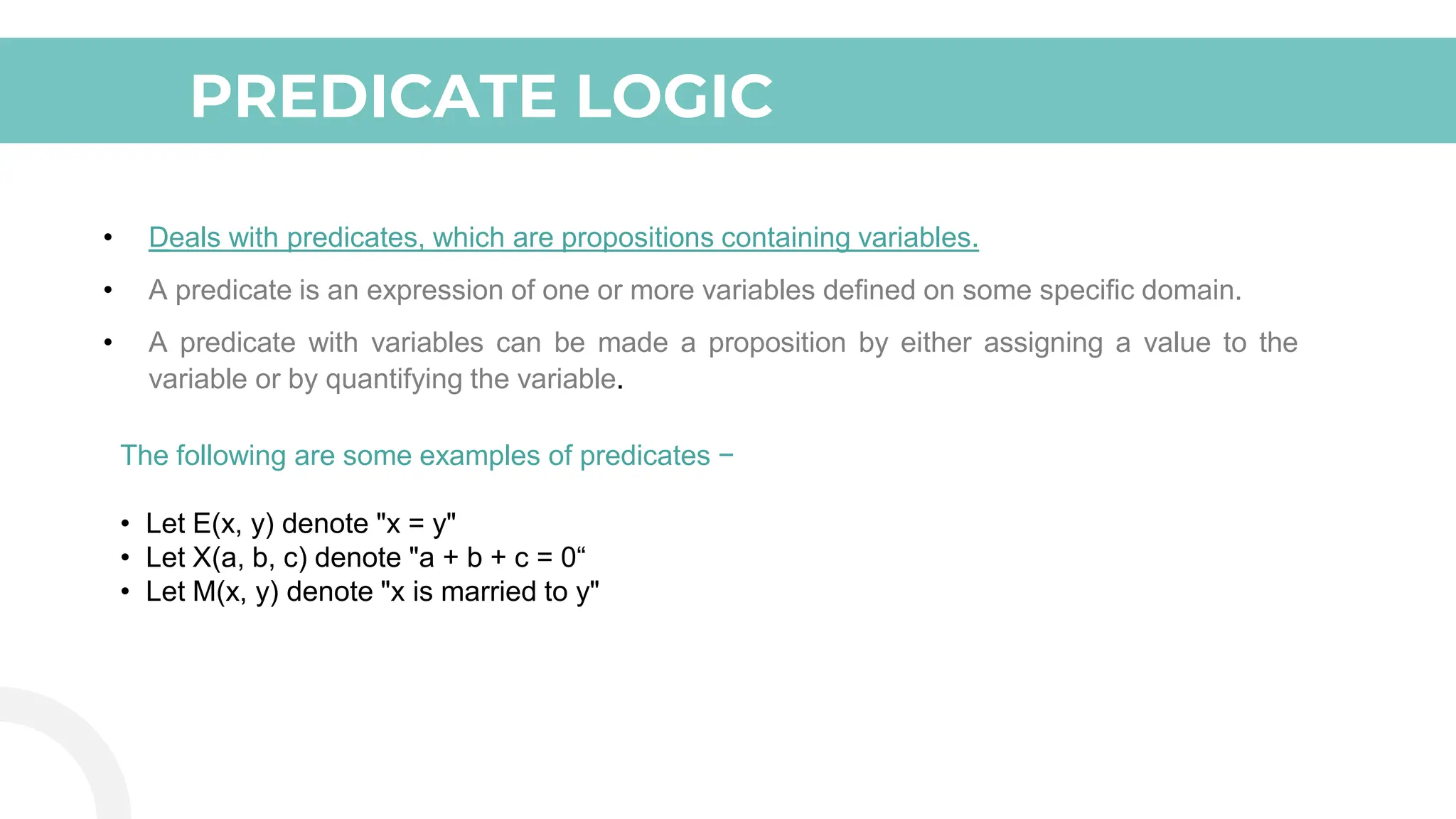
• Deals with predicates, which are propositions containing variables.
• A predicate is an expression of one or more variables defined on some specific domain.
• A predicate with variables can be made a proposition by either assigning a value to the
variable or by quantifying the variable.
The following are some examples of predicates −
• Let E(x, y) denote "x = y"
• Let X(a, b, c) denote "a + b + c = 0“
• Let M(x, y) denote "x is married to y"
WELL FORMED FORMULA
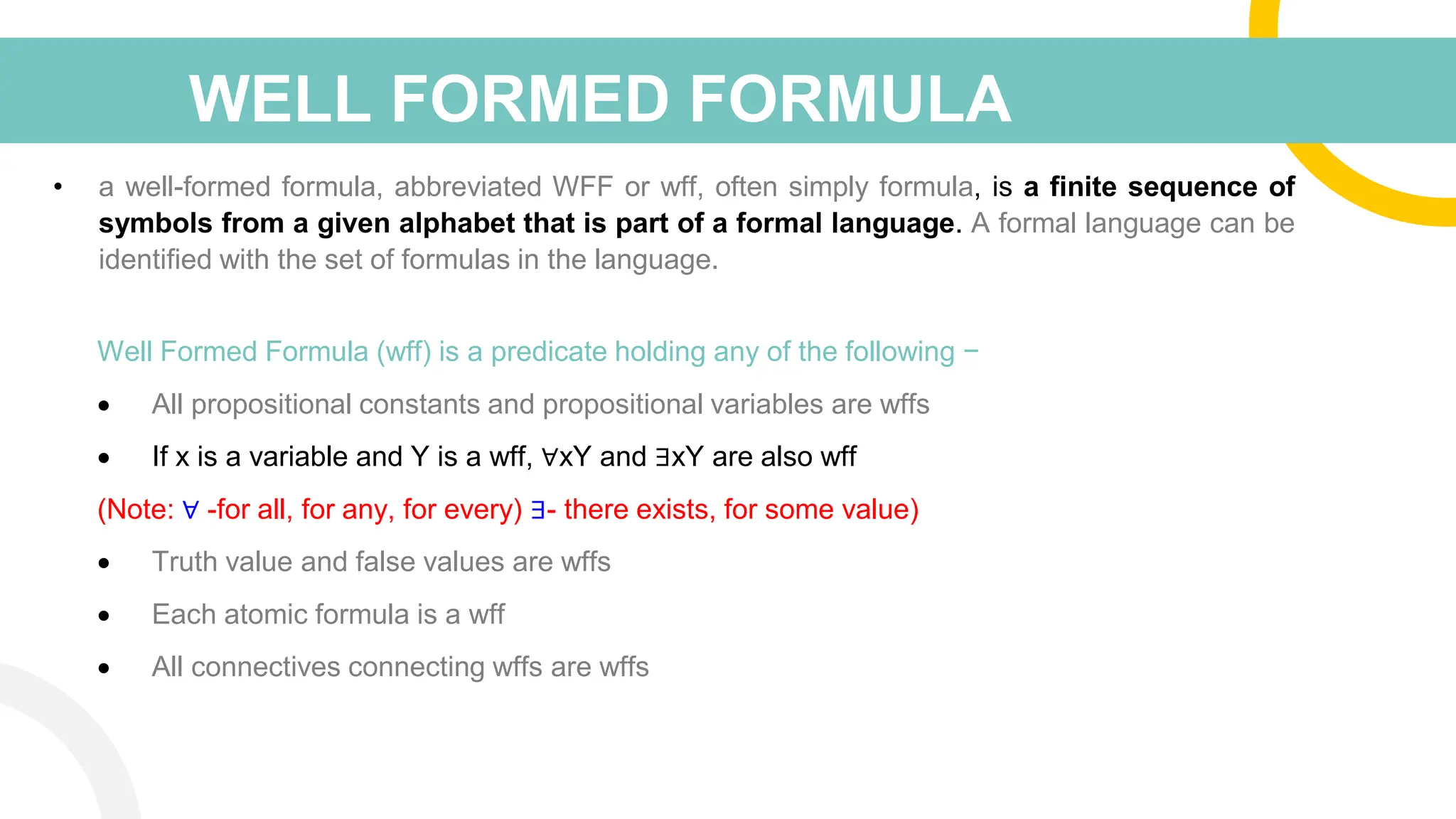
• a well-formed formula, abbreviated WFF or wff, often simply formula, is a finite sequence of
symbols from a given alphabet that is part of a formal language. A formal language can be
identified with the set of formulas in the language.
Well Formed Formula (wff) is a predicate holding any of the following −
 All propositional constants and propositional variables are wffs
 If x is a variable and Y is a wff, ∀xY and ∃xY are also wff
(Note: ∀ -for all, for any, for every) ∃- there exists, for some value)
 Truth value and false values are wffs
 Each atomic formula is a wff
 All connectives connecting wffs are wffs
QUANTIFIERS
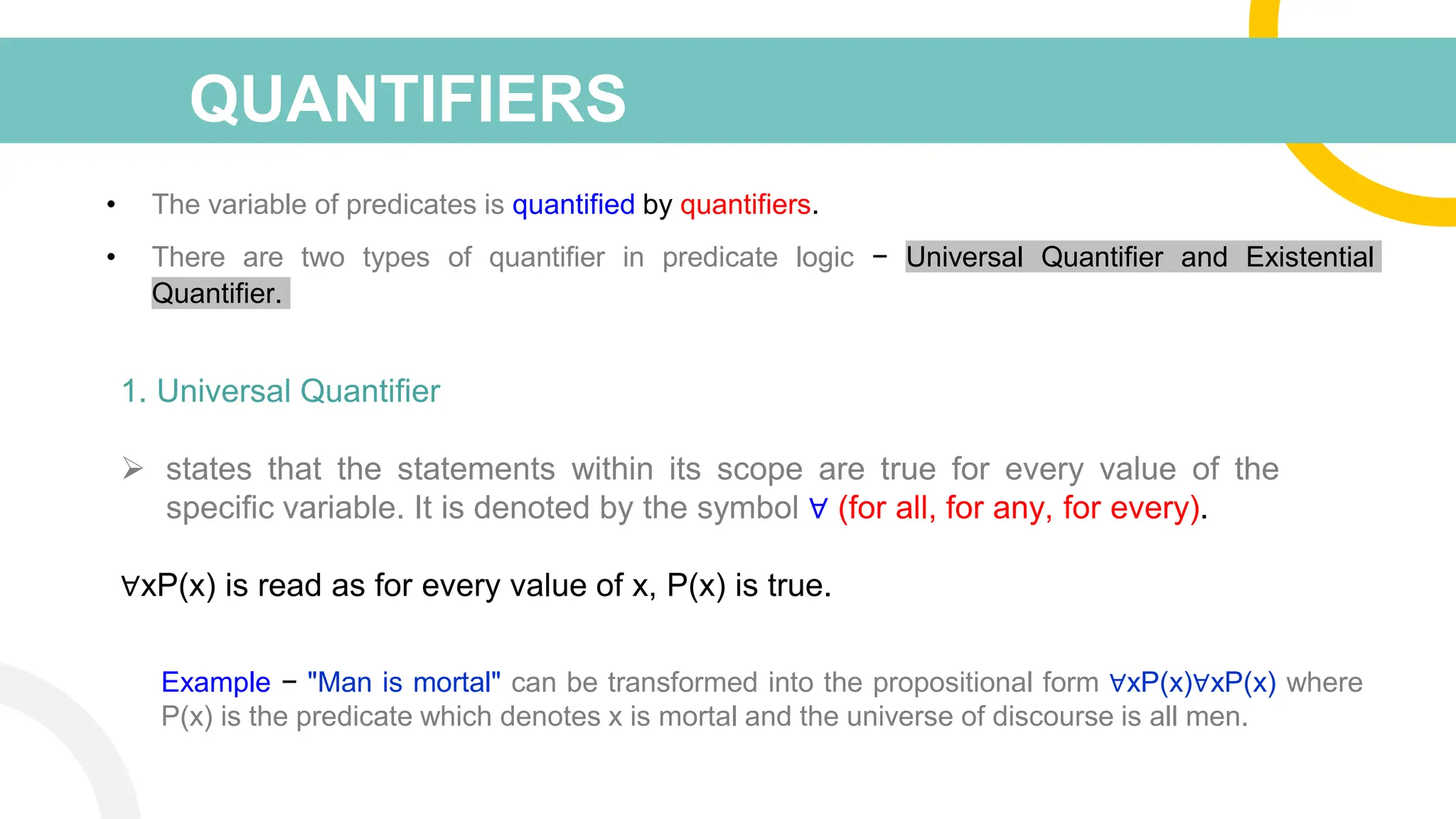
• The variable of predicates is quantified by quantifiers.
• There are two types of quantifier in predicate logic − Universal Quantifier and Existential
Quantifier.
1. Universal Quantifier
 states that the statements within its scope are true for every value of the
specific variable. It is denoted by the symbol ∀ (for all, for any, for every).
∀xP(x) is read as for every value of x, P(x) is true.
Example − "Man is mortal" can be transformed into the propositional form ∀xP(x)∀xP(x) where
P(x) is the predicate which denotes x is mortal and the universe of discourse is all men.
QUANTIFIERS
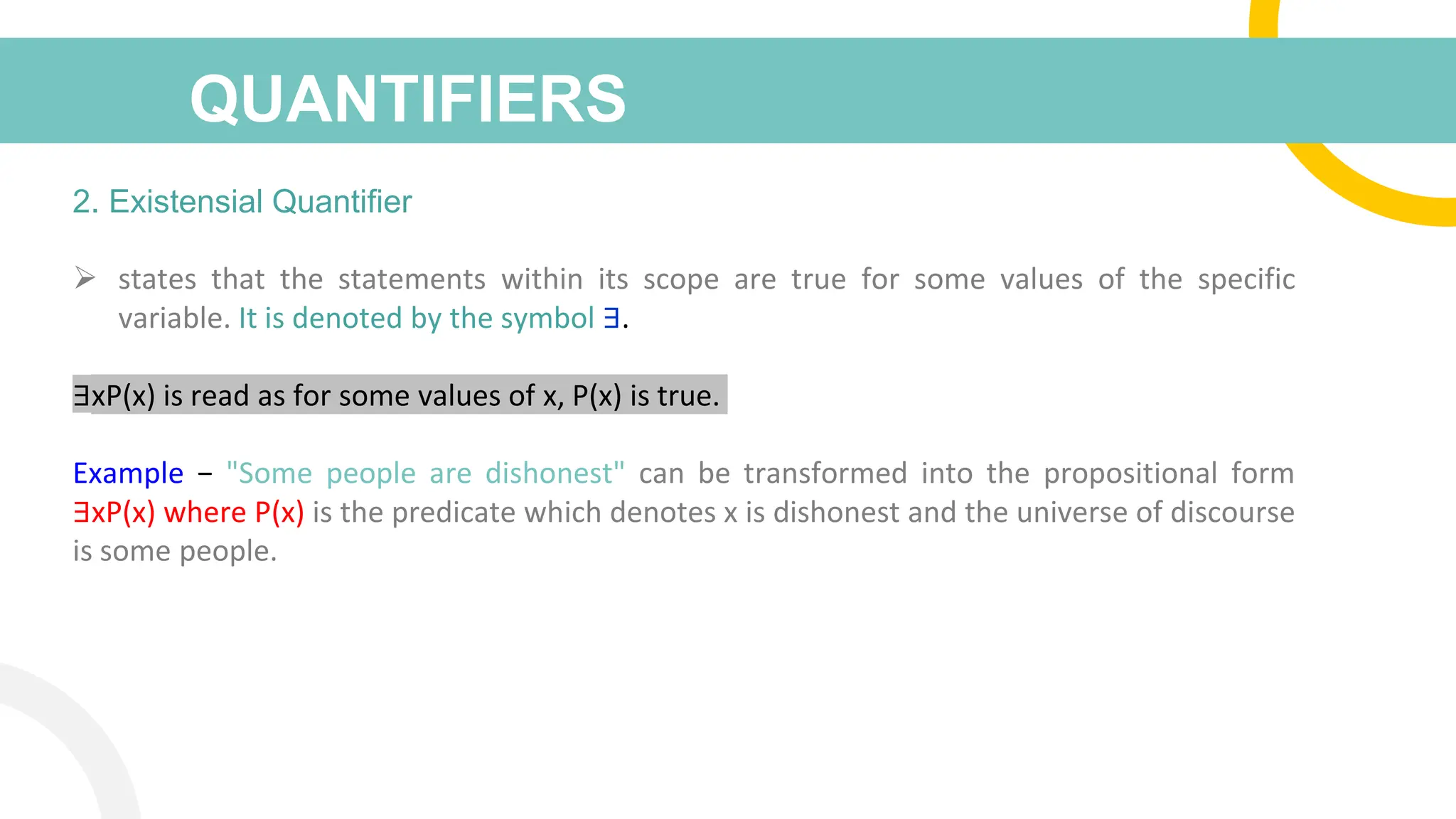
2. Existensial Quantifier
 states that the statements within its scope are true for some values of the specific
variable. It is denoted by the symbol ∃.
∃xP(x) is read as for some values of x, P(x) is true.
Example − "Some people are dishonest" can be transformed into the propositional form
∃xP(x) where P(x) is the predicate which denotes x is dishonest and the universe of discourse
is some people.
NESTED QUANTIFIERS
 If we use a quantifier that appears within the scope of another quantifier, it is called nested
quantifier.
Example
∀ a ∃b P(x,y) where P(a,b) denotes a+b=0
∀ a∀b∀cP(a,b,c) where P(a,b) denotes a+(b+c)=(a+b)+c
Note − ∀a∃bP(x,y)≠∃a∀bP(x,y)
Predicate Logic
https://www.youtube.com/watch?v=aqQj-3bSv7k
Quantifiers
https://www.youtube.com/watch?v=DpcUJrYTduc
Other Reference…pls watch
Lesson 4. Predicate Logic & Quantifiers.pptx

Lesson 4. Predicate Logic & Quantifiers.pptx

  • 1.
    PREDICATE LOGIC • Dealswith predicates, which are propositions containing variables. • A predicate is an expression of one or more variables defined on some specific domain. • A predicate with variables can be made a proposition by either assigning a value to the variable or by quantifying the variable. The following are some examples of predicates − • Let E(x, y) denote "x = y" • Let X(a, b, c) denote "a + b + c = 0“ • Let M(x, y) denote "x is married to y"
  • 2.
    WELL FORMED FORMULA •a well-formed formula, abbreviated WFF or wff, often simply formula, is a finite sequence of symbols from a given alphabet that is part of a formal language. A formal language can be identified with the set of formulas in the language. Well Formed Formula (wff) is a predicate holding any of the following −  All propositional constants and propositional variables are wffs  If x is a variable and Y is a wff, ∀xY and ∃xY are also wff (Note: ∀ -for all, for any, for every) ∃- there exists, for some value)  Truth value and false values are wffs  Each atomic formula is a wff  All connectives connecting wffs are wffs
  • 3.
    QUANTIFIERS • The variableof predicates is quantified by quantifiers. • There are two types of quantifier in predicate logic − Universal Quantifier and Existential Quantifier. 1. Universal Quantifier  states that the statements within its scope are true for every value of the specific variable. It is denoted by the symbol ∀ (for all, for any, for every). ∀xP(x) is read as for every value of x, P(x) is true. Example − "Man is mortal" can be transformed into the propositional form ∀xP(x)∀xP(x) where P(x) is the predicate which denotes x is mortal and the universe of discourse is all men.
  • 4.
    QUANTIFIERS 2. Existensial Quantifier states that the statements within its scope are true for some values of the specific variable. It is denoted by the symbol ∃. ∃xP(x) is read as for some values of x, P(x) is true. Example − "Some people are dishonest" can be transformed into the propositional form ∃xP(x) where P(x) is the predicate which denotes x is dishonest and the universe of discourse is some people.
  • 5.
    NESTED QUANTIFIERS  Ifwe use a quantifier that appears within the scope of another quantifier, it is called nested quantifier. Example ∀ a ∃b P(x,y) where P(a,b) denotes a+b=0 ∀ a∀b∀cP(a,b,c) where P(a,b) denotes a+(b+c)=(a+b)+c Note − ∀a∃bP(x,y)≠∃a∀bP(x,y)
  • 6.