Challenge
Predict future internal recruiting needs
Strategy
Internal talent analytics team
Solution
A model using data from finance, HR and the talent acquisition team to estimate hiring required.
TA performance management framework.
Interesting remark
Leap frog the maturity curve by finding quick wins.
Result
Predicted annul hiring requirement within 5% ; 15% under budget for the year and saved millions
Challenge
Enable recruiters to add strategic value and to find critical talent
Strategy
Operational reporting capability
Key findings
• Build a team that can translate their findings to the Business and drive real action
• Don’t forget to involve the employee and focus on how to get adoption of any new tools
Solution
Talent Cloud (talent insights, skill assessment, skills gap, strengths)
Result
High-level hires considerably under target cost-per-hire (source: Glassdoor)
Challenge
recruit 5,000 new constables in 18months by appointing higher numbers of female and minority ethnic recruits
Solution
• surveying to create buy-in and get a base
• visualize through dashboards with KPIs using “what was available” to find potential bias and significant drop-
out at certain stages;
Interesting findings
• Excel works even with over 100 steps in the recruitment process
• effectiveness between each data capture iteration allowed constantly assessing organizational needs and
usefulness for decision making
Challenge
The stack ranking system used for performance reviews creates an environment
that feeds unethical competition and kills morale
Solution
Check-ins. Managers set clear expectations and there is bi-directional
continuous feedback. Compensation is linked to goals.
Strategy
“But what if there is no bottom 10 percent to let go and everybody is
performing well, or if everyone just needs more opportunities to improve?”
Result
Voluntary attrition decreased by 30 percent and involuntary departures
increased by 50 percent
Challenge
They were the first to introduce People Analytics
Strategy
Internal analytics team
Results
• helped limit the number of interviews required (company analysis showed that more than
four interviewers didn’t lead to higher quality hiring),
• revealed the optimal organizational size and shape of various departments,
• shown how to better manage maternity leave resulting in a fifty percent reduction in
defections,
• created on-boarding agenda for an employee’s first four days of work that boosted
productivity by up to 15 percent
• and produced an algorithm to review rejected applications (Google gets over two million
applications every year) that has helped the company hire some talented engineers its
screening process would have otherwise missed
Challenge: Keeping a highly engaged workforce with smaller teams and a new vision of the presidential
administration.
Strategy: Given the complex dynamics that shape the culture of an organization as large and diverse as NASA,
the activities necessary to realize this vision cannot be rigidly predetermined, sequenced, and executed with the
precision of an engineering management plan. With that in mind, there are actions to guide NASA’s Human
Capital organizations in planning, mid-course adjustments, and measurement of the desired change.
Key drivers: building model supervisors and leaders relying on 360 assessment tools to measure impact on major
touch points.
Result: 78% engagement, highest for federal agencies
Challenge
the global sales teams not achieving their targets
Strategy
diagnose the hiring process through interviews and surveys
Key findings
A deep statistical analysis determined the behavioral and psychometric differences between their high
and low performers; the behaviors required for strong sales in one country were completely different
to those required in others
Solution
a low cost and simple recruitment process which only accepted applicants who demonstrated the high
performing sales behaviors for the specific country
Result
After one year, applicants recruited via the new system were selling 30% more than applicants
recruited under the old system
Strategy
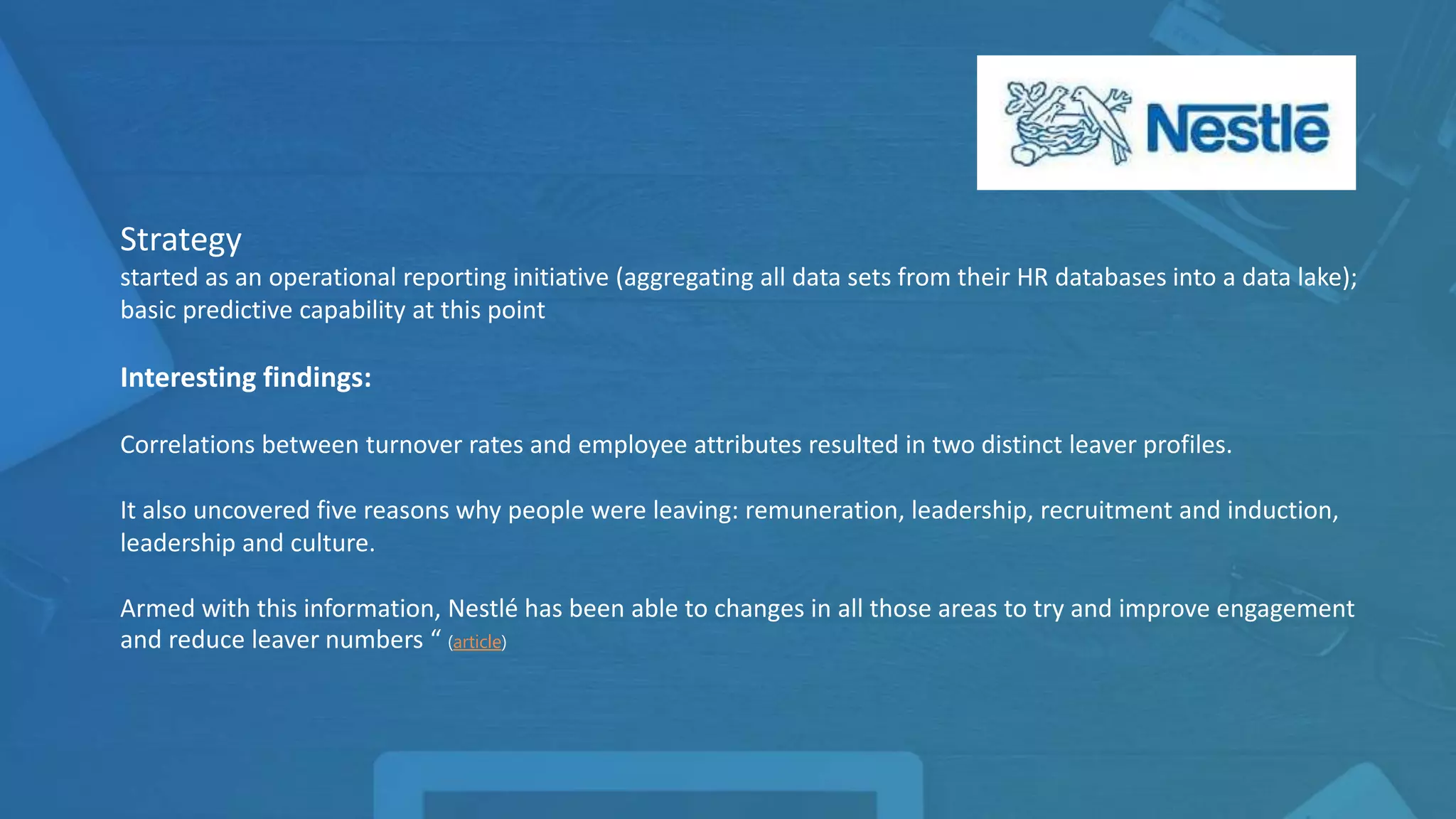
started as an operational reporting initiative (aggregating all data sets from their HR databases into a data lake);
basic predictive capability at this point
Interesting findings:
Correlations between turnover rates and employee attributes resulted in two distinct leaver profiles.
It also uncovered five reasons why people were leaving: remuneration, leadership, recruitment and induction,
leadership and culture.
Armed with this information, Nestlé has been able to changes in all those areas to try and improve engagement
and reduce leaver numbers “ (article)
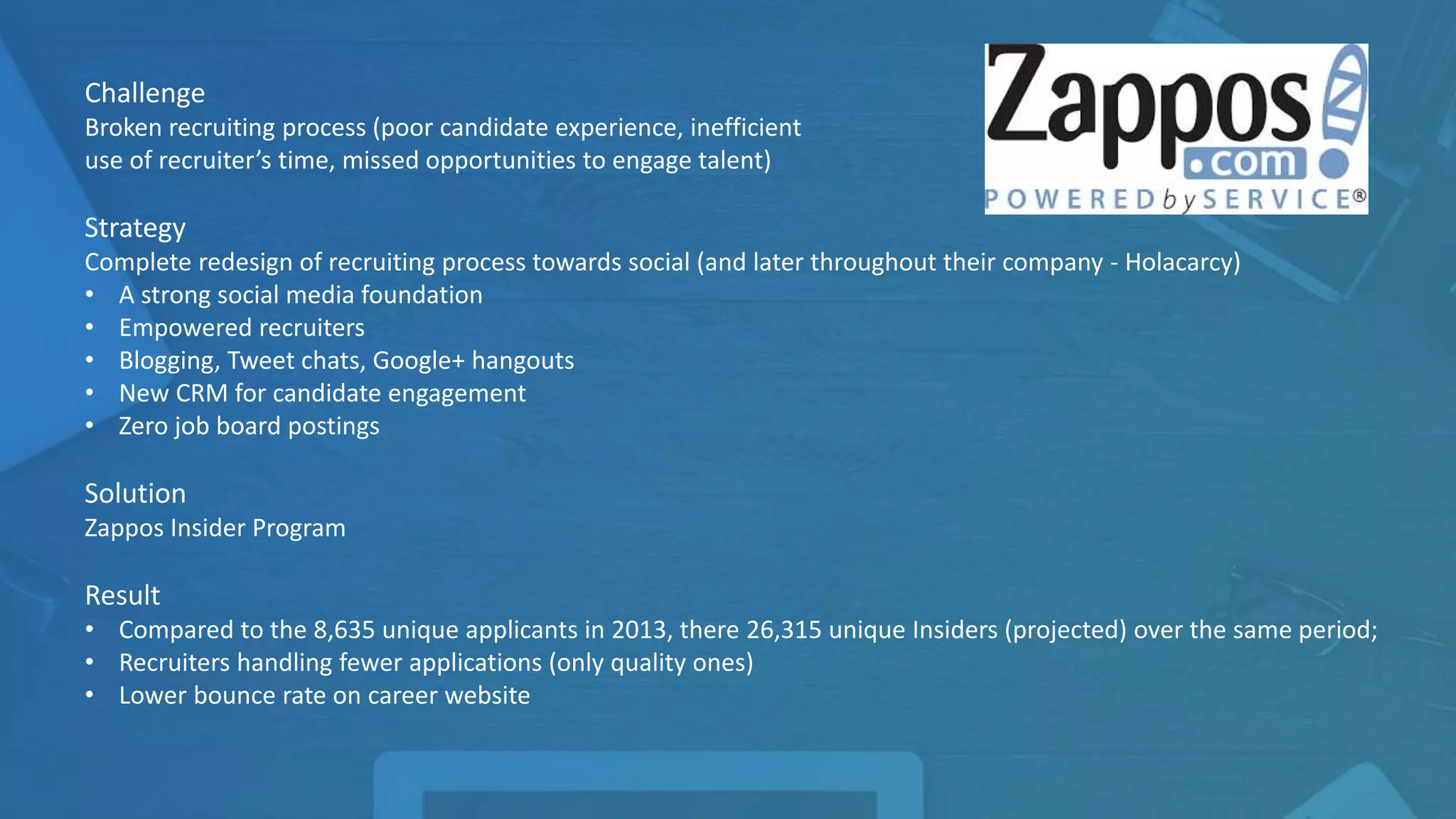
Challenge
Broken recruiting process (poor candidate experience, inefficient
use of recruiter’s time, missed opportunities to engage talent)
Strategy
Complete redesign of recruiting process towards social (and later throughout their company - Holacarcy)
• A strong social media foundation
• Empowered recruiters
• Blogging, Tweet chats, Google+ hangouts
• New CRM for candidate engagement
• Zero job board postings
Solution
Zappos Insider Program
Result
• Compared to the 8,635 unique applicants in 2013, there 26,315 unique Insiders (projected) over the same period;
• Recruiters handling fewer applications (only quality ones)
• Lower bounce rate on career website
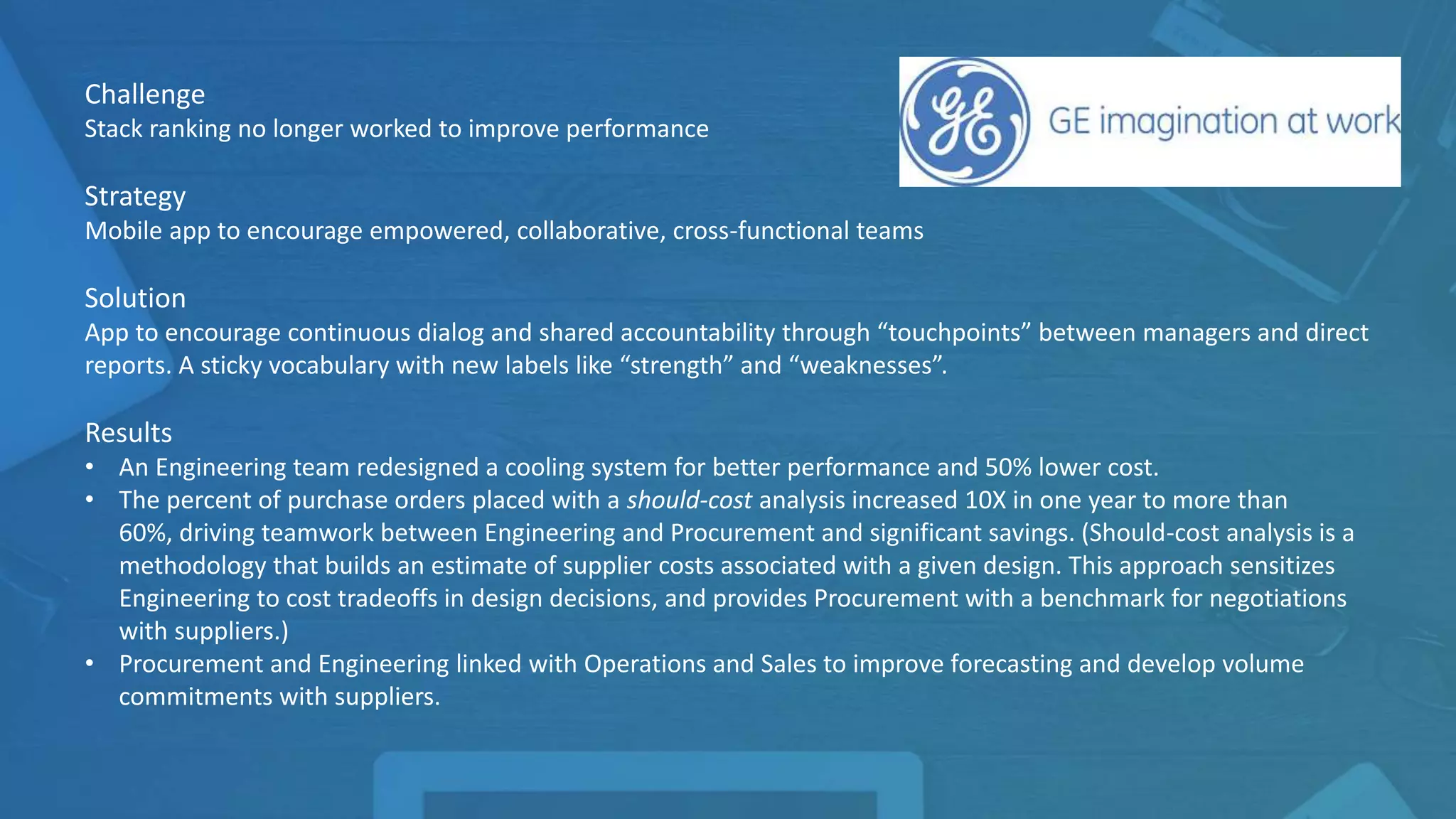
Challenge
Stack ranking no longer worked to improve performance
Strategy
Mobile app to encourage empowered, collaborative, cross-functional teams
Solution
App to encourage continuous dialog and shared accountability through “touchpoints” between managers and direct
reports. A sticky vocabulary with new labels like “strength” and “weaknesses”.
Results
• An Engineering team redesigned a cooling system for better performance and 50% lower cost.
• The percent of purchase orders placed with a should-cost analysis increased 10X in one year to more than
60%, driving teamwork between Engineering and Procurement and significant savings. (Should-cost analysis is a
methodology that builds an estimate of supplier costs associated with a given design. This approach sensitizes
Engineering to cost tradeoffs in design decisions, and provides Procurement with a benchmark for negotiations
with suppliers.)
• Procurement and Engineering linked with Operations and Sales to improve forecasting and develop volume
commitments with suppliers.
DAN@HRANALYTICS.EXPERT

10 examples of People Analytics projects

  • 2.
    Challenge Predict future internalrecruiting needs Strategy Internal talent analytics team Solution A model using data from finance, HR and the talent acquisition team to estimate hiring required. TA performance management framework. Interesting remark Leap frog the maturity curve by finding quick wins. Result Predicted annul hiring requirement within 5% ; 15% under budget for the year and saved millions
  • 3.
    Challenge Enable recruiters toadd strategic value and to find critical talent Strategy Operational reporting capability Key findings • Build a team that can translate their findings to the Business and drive real action • Don’t forget to involve the employee and focus on how to get adoption of any new tools Solution Talent Cloud (talent insights, skill assessment, skills gap, strengths) Result High-level hires considerably under target cost-per-hire (source: Glassdoor)
  • 4.
    Challenge recruit 5,000 newconstables in 18months by appointing higher numbers of female and minority ethnic recruits Solution • surveying to create buy-in and get a base • visualize through dashboards with KPIs using “what was available” to find potential bias and significant drop- out at certain stages; Interesting findings • Excel works even with over 100 steps in the recruitment process • effectiveness between each data capture iteration allowed constantly assessing organizational needs and usefulness for decision making
  • 5.
    Challenge The stack rankingsystem used for performance reviews creates an environment that feeds unethical competition and kills morale Solution Check-ins. Managers set clear expectations and there is bi-directional continuous feedback. Compensation is linked to goals. Strategy “But what if there is no bottom 10 percent to let go and everybody is performing well, or if everyone just needs more opportunities to improve?” Result Voluntary attrition decreased by 30 percent and involuntary departures increased by 50 percent
  • 6.
    Challenge They were thefirst to introduce People Analytics Strategy Internal analytics team Results • helped limit the number of interviews required (company analysis showed that more than four interviewers didn’t lead to higher quality hiring), • revealed the optimal organizational size and shape of various departments, • shown how to better manage maternity leave resulting in a fifty percent reduction in defections, • created on-boarding agenda for an employee’s first four days of work that boosted productivity by up to 15 percent • and produced an algorithm to review rejected applications (Google gets over two million applications every year) that has helped the company hire some talented engineers its screening process would have otherwise missed
  • 7.
    Challenge: Keeping ahighly engaged workforce with smaller teams and a new vision of the presidential administration. Strategy: Given the complex dynamics that shape the culture of an organization as large and diverse as NASA, the activities necessary to realize this vision cannot be rigidly predetermined, sequenced, and executed with the precision of an engineering management plan. With that in mind, there are actions to guide NASA’s Human Capital organizations in planning, mid-course adjustments, and measurement of the desired change. Key drivers: building model supervisors and leaders relying on 360 assessment tools to measure impact on major touch points. Result: 78% engagement, highest for federal agencies
  • 8.
    Challenge the global salesteams not achieving their targets Strategy diagnose the hiring process through interviews and surveys Key findings A deep statistical analysis determined the behavioral and psychometric differences between their high and low performers; the behaviors required for strong sales in one country were completely different to those required in others Solution a low cost and simple recruitment process which only accepted applicants who demonstrated the high performing sales behaviors for the specific country Result After one year, applicants recruited via the new system were selling 30% more than applicants recruited under the old system
  • 9.
    Strategy started as anoperational reporting initiative (aggregating all data sets from their HR databases into a data lake); basic predictive capability at this point Interesting findings: Correlations between turnover rates and employee attributes resulted in two distinct leaver profiles. It also uncovered five reasons why people were leaving: remuneration, leadership, recruitment and induction, leadership and culture. Armed with this information, Nestlé has been able to changes in all those areas to try and improve engagement and reduce leaver numbers “ (article)
  • 10.
    Challenge Broken recruiting process(poor candidate experience, inefficient use of recruiter’s time, missed opportunities to engage talent) Strategy Complete redesign of recruiting process towards social (and later throughout their company - Holacarcy) • A strong social media foundation • Empowered recruiters • Blogging, Tweet chats, Google+ hangouts • New CRM for candidate engagement • Zero job board postings Solution Zappos Insider Program Result • Compared to the 8,635 unique applicants in 2013, there 26,315 unique Insiders (projected) over the same period; • Recruiters handling fewer applications (only quality ones) • Lower bounce rate on career website
  • 11.
    Challenge Stack ranking nolonger worked to improve performance Strategy Mobile app to encourage empowered, collaborative, cross-functional teams Solution App to encourage continuous dialog and shared accountability through “touchpoints” between managers and direct reports. A sticky vocabulary with new labels like “strength” and “weaknesses”. Results • An Engineering team redesigned a cooling system for better performance and 50% lower cost. • The percent of purchase orders placed with a should-cost analysis increased 10X in one year to more than 60%, driving teamwork between Engineering and Procurement and significant savings. (Should-cost analysis is a methodology that builds an estimate of supplier costs associated with a given design. This approach sensitizes Engineering to cost tradeoffs in design decisions, and provides Procurement with a benchmark for negotiations with suppliers.) • Procurement and Engineering linked with Operations and Sales to improve forecasting and develop volume commitments with suppliers.
  • 12.