Data Analysis
        &
     Language
   Comparison
Spanish     English
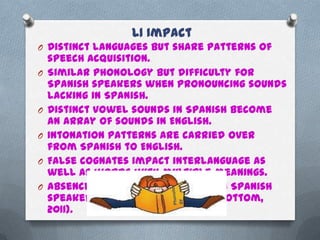
L1 Impact
O Distinct languages but share patterns of
    speech acquisition.
O   Similar phonology but difficulty for
    Spanish speakers when pronouncing sounds
    lacking in Spanish.
O   Distinct vowel sounds in Spanish become
    an array of sounds in English.
O   Intonation patterns are carried over
    from Spanish to English.
O   False cognates impact interlanguage as
    well as words with multiple meanings.
O   Absence of auxiliary verbs when Spanish
    speakers speak or write (Shoebottom,
    2011).
Examples of Jorge’s errors
DESCRIPTION OF ERROR               JORGE'S ERROR EXAMPLE
1. Omitted s on a plural noun      I am 23 year old.
2. Omission of a preposition       I from Texas.
3. No [k] pronunciation.           Texas (ˈtksəs)
                                            ɛ
4. Improper preposition            Now I live in Main Street.
5. Improper tense: needs past      In Mexico I graduate.
tense -ed
6. Improper tense: needs           I never have English.
irregular past tense.
7. Improper [ɪ] pronunciation      English
8. Preposition not needed/ or *ing I am work in the area.
to be added to verb to make a
gerund.
9. Omission of a preposition       I work the afternoon.
10. Omission of a preposition      I not so well
11. Added unnecessary -s to a verb I comes here.
12. Double subject                 My amigos, they help.
Errors continued
13. Substitution of English    My amigos, they help.
word
14. Improper [ð] pronunciation They help
15. Added unnecessary -s to a I likes work.
verb
16. Contraction is not         I don like cold.
completed
17. Contraction not completed.I don know snow.
18. Wrong word choice          I don't know snow.
19. Improper [ð] pronunciation They fun.
20. Missing verb               They fun.
21. Improper verb.             You is nice.
22. Contraction not completedYou welcome
As a beginning language learner,
Jorge had difficulty with
pronunciation. He could not
distinguish phonology between the
two languages. He did not hear a
difference between the pronunciation
of dare-there. They are phonetically
similar. He also stated several words
without the contractions. Spanish
speakers are not accustomed to
pronouncing the final “t”.
Instructional Implications
O Jorge will continue to learn through collaboration with
  English speakers (Garcia, 1991).
   O Discussion & conversation with friends & co-
     workers will help Jorge with pronunciation.
O An adult ELL course would be helpful in Jorge’s
  language acquisition.
O The most beneficial instruction will come through
  reading (Freeman and Freeman, 2004).
O He will learn vocabulary and consciously recognize
  words.
   O Reading the newspaper
References
O Bilinguistics Inc. (2007) Typical Development of Speech in Spanish in
  Comparison to English.            www.Bilinguistics.com.
O Freeman, D. and Freeman Y. (2004). Essential Linguistics: What You
  Need to Know to Teach Reading, ESL, Spelling, Phonics, and
  Grammar. Heinneman.
O Garcia, Eugene E.(1991). The Education of Linguistically and Culturally
  Diverse Students: Effective Instructional Practices. UC Berkeley:
  Center for Research on Education, Diversity and Excellence. Retrieved
  from: http://escholarship.org/uc/item/2793n11s
O Shoebottom, Paul. (2011) The Differences between Spanish and
  English. Retrieved from Lecture Notes Online Web site:
  http://www.esl.fis.edu/grammar/langdiff/spanish.htm

Data Analysis and Comparison

  • 1.
    Data Analysis & Language Comparison Spanish English
  • 4.
    L1 Impact O Distinctlanguages but share patterns of speech acquisition. O Similar phonology but difficulty for Spanish speakers when pronouncing sounds lacking in Spanish. O Distinct vowel sounds in Spanish become an array of sounds in English. O Intonation patterns are carried over from Spanish to English. O False cognates impact interlanguage as well as words with multiple meanings. O Absence of auxiliary verbs when Spanish speakers speak or write (Shoebottom, 2011).
  • 5.
    Examples of Jorge’serrors DESCRIPTION OF ERROR JORGE'S ERROR EXAMPLE 1. Omitted s on a plural noun I am 23 year old. 2. Omission of a preposition I from Texas. 3. No [k] pronunciation. Texas (ˈtksəs) ɛ 4. Improper preposition Now I live in Main Street. 5. Improper tense: needs past In Mexico I graduate. tense -ed 6. Improper tense: needs I never have English. irregular past tense. 7. Improper [ɪ] pronunciation English 8. Preposition not needed/ or *ing I am work in the area. to be added to verb to make a gerund. 9. Omission of a preposition I work the afternoon. 10. Omission of a preposition I not so well 11. Added unnecessary -s to a verb I comes here. 12. Double subject My amigos, they help.
  • 6.
    Errors continued 13. Substitutionof English My amigos, they help. word 14. Improper [ð] pronunciation They help 15. Added unnecessary -s to a I likes work. verb 16. Contraction is not I don like cold. completed 17. Contraction not completed.I don know snow. 18. Wrong word choice I don't know snow. 19. Improper [ð] pronunciation They fun. 20. Missing verb They fun. 21. Improper verb. You is nice. 22. Contraction not completedYou welcome
  • 7.
    As a beginninglanguage learner, Jorge had difficulty with pronunciation. He could not distinguish phonology between the two languages. He did not hear a difference between the pronunciation of dare-there. They are phonetically similar. He also stated several words without the contractions. Spanish speakers are not accustomed to pronouncing the final “t”.
  • 8.
    Instructional Implications O Jorgewill continue to learn through collaboration with English speakers (Garcia, 1991). O Discussion & conversation with friends & co- workers will help Jorge with pronunciation. O An adult ELL course would be helpful in Jorge’s language acquisition. O The most beneficial instruction will come through reading (Freeman and Freeman, 2004). O He will learn vocabulary and consciously recognize words. O Reading the newspaper
  • 9.
    References O Bilinguistics Inc.(2007) Typical Development of Speech in Spanish in Comparison to English. www.Bilinguistics.com. O Freeman, D. and Freeman Y. (2004). Essential Linguistics: What You Need to Know to Teach Reading, ESL, Spelling, Phonics, and Grammar. Heinneman. O Garcia, Eugene E.(1991). The Education of Linguistically and Culturally Diverse Students: Effective Instructional Practices. UC Berkeley: Center for Research on Education, Diversity and Excellence. Retrieved from: http://escholarship.org/uc/item/2793n11s O Shoebottom, Paul. (2011) The Differences between Spanish and English. Retrieved from Lecture Notes Online Web site: http://www.esl.fis.edu/grammar/langdiff/spanish.htm