Accommodative Esotropia
Dominick M. Maino, OD, MEd, FAAO, FCOVD-A
Professor of Pediatrics/Binocular Vision
Illinois Eye Institute/Illinois College of Optometry
Optometrist, Lyons Family Eye Care
What is Accommodative Esotropia?
…Accommodative Esotropia is a condition (strabismus) in
which a person is unable to align both eyes simultaneously
under normal viewing conditions. When both eyes do not
point at an object at the same time, it results in the
appearance of one eye "turning" inwards in relation to the
other. This eye turning may be constant, in which an eye
turns all the time, or it may be intermittent. It may also
alternate so that either eye turns at any given time
What causes an
Accommodative Esotropia?
…Accommodative Esotropia is caused by an overactive
focusing (accommodation) system. This may occur because
of a moderate to high amount of hyperopia (farsightedness).
When you try to compensate for the uncorrected
farsightedness by using your focusing system an eye turn
inwards results. Neurologically when you focus, your eyes
also turn in and conversely, when your eyes turns in, your
focusing system is activated as well.
What causes an
Accommodative Esotropia?
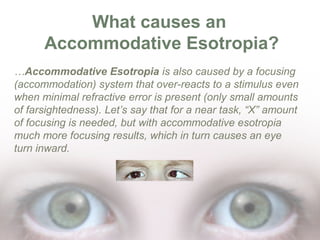
…Accommodative Esotropia is also caused by a focusing
(accommodation) system that over-reacts to a stimulus even
when minimal refractive error is present (only small amounts
of farsightedness). Let’s say that for a near task, “X” amount
of focusing is needed, but with accommodative esotropia
much more focusing results, which in turn causes an eye
turn inward.
What causes an
Accommodative Esotropia?
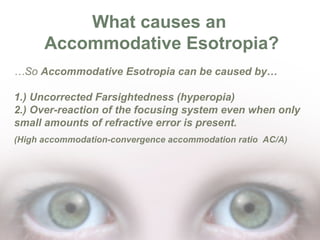
…So Accommodative Esotropia can be caused by…
1.) Uncorrected Farsightedness (hyperopia)
2.) Over-reaction of the focusing system even when only
small amounts of refractive error is present.
(High accommodation-convergence accommodation ratio AC/A)
When does Accommodative
Esotropia Occur?
…Accommodative Esotropia usually starts between the
ages of 2 and 4 years. It can appear intermittently
(occasionally) and then more and more frequently until
it becomes a constant inward eye turn.
What is a Pseudostrabismus?
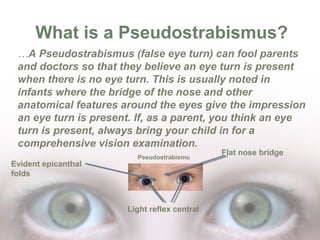
…A Pseudostrabismus (false eye turn) can fool parents
and doctors so that they believe an eye turn is present
when there is no eye turn. This is usually noted in
infants where the bridge of the nose and other
anatomical features around the eyes give the impression
an eye turn is present. If, as a parent, you think an eye
turn is present, always bring your child in for a
comprehensive vision examination.
Evident epicanthal
folds

Pseudostrabismu
s

Light reflex central

Flat nose bridge
What Symptoms are Associated
with Accommodative Esotropia?
…Accommodative Esotropia… is often associated with a
variety of symptoms, including seeing double (diplopia),
difficulty judging distances, eyestrain, headaches,
blurred vision, sleepiness, difficulty concentrating,
movement of print while reading, and loss of
comprehension after short periods of reading or
performing close activities. … A person with a constant
eye turn may only notice a few of these symptoms or
none at all…. Children do not always tell you if
symptoms are present.
What is the Prevalence of
Accommodative Esotropia?
…The estimated prevalence of strabismus in the general
population is from 2 to 5%
…5 to 15 million individuals in the United States may
have this condition
…..About 2% of the population has an accommodative
esotropia
At What Age Can You Treat
Strabismus?
Despite what you may hear from those who
have not kept up with the latest research,
strabismus can be treated AT ANY AGE!
Children, Adults and Seniors
may all benefit from treatment.
How Do You Treat Strabismus?
Treatment always starts with the best prescription
glasses possible. These glasses may include
bifocals and prism. Both can help the eye stay
straighter. This prescription may change over time
as the functional vision problems improve.
How Do You Treat Strabismus?

Optometric vision therapy
Vision therapy is a doctor-supervised, non-surgical, customized program
of therapeutic procedures designed to prevent, remediate, and/or enhance
vision problems and/or improve visual skills.
Vision therapy can include the use of lenses, prisms, filters, computerized
procedures and non-computerized instrumentation. The goal of vision
therapy is to treat vision problems that cannot usually be treated
successfully with eyeglasses, contact lenses and/or surgery alone, and help
individuals of all ages achieve single, clear, comfortable binocular (two-eyed)
vision using the scientific principles of neuroplasticity.
How Do You Treat Strabismus?
Surgery
Unfortunately, many doctors recommend surgical
intervention before trying other forms of treatment such
as glasses and vision therapy. Surgery is always an
option, but should usually be the last thing suggested
and not the first.
How Do You Treat Strabismus?
If surgery is recommended by your doctor, probably the best
approach is what is used by other specialties. If your doctor
was recommending a knee replacement, he would usually
have you do physical therapy and other pre-surgical
activities first, then the surgery and finally more physical
therapy. Unfortunately, this seldom happens when you have
strabismus surgery. Strabismus surgery, especially for
accommodative esotropia, should probably be the last
treatment option considered and not the first. The treatment
sequence should then be vision therapy, surgery (if needed),
and then post-op vision therapy.
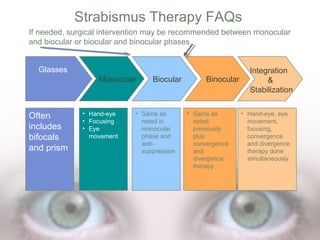
Strabismus Therapy FAQs
If needed, surgical intervention may be recommended between monocular
and biocular or biocular and binocular phases.
Glasses
Monocular

Often
includes
bifocals
and prism

• Hand-eye
• Focusing
• Eye
movement

Biocular

• Same as
noted in
monocular
phase and
antisuppression

Binocular

• Same as
noted
previously
plus
convergence
and
divergence
therapy

Integration
&
Stabilization
• Hand-eye, eye
movement,
focusing,
convergence
and divergence
therapy done
simultaneously
Vision Therapy FAQs
Tell me about home vision therapy
Home vision therapy can vary from doctor to
doctor. I recommend a minimum of 20 to 30
minutes per day, 5 days per week. Some doctors
do not prescribe home vision therapy, but I find
that the in office therapy program progresses at a
faster rate of speed if home therapy is conducted.
Vision Therapy FAQs
Tell me about in-office vision therapy
In-office vision therapy can also vary from
doctor to doctor. I recommend one
therapy session per week for 45 minutes.
National Institutes of Health, National Eye Institute
supported clinical trials have shown in-office vision
therapy to be the most successful therapy for binocular
vision problems.
Vision Therapy FAQs
What does vision therapy cost?
This will vary from office to office but is
comparable in cost to occupational, physical,
and/or speech/language therapy. Some offices
charge for each individual visit while others have
a “program” similar to that of having braces
applied by your dentist.
Vision Therapy FAQs
Does insurance cover the cost of vision therapy?
Yes. No. Maybe. Some time ago most insurance
would have picked up about 80% of the cost. Then
my impression was that the insurance companies
just seemed to stop reimbursement for therapy. Now
they are once again picking up some of the cost.
Know your insurance policy. Do not take “NO” for an
answer. Your doctor’s office will usually assist you
when it comes to insurance, but it is ultimately your
responsibility.
Strabismus FAQs
Where do I learn more about strabismus?
Go to:
American Optometric Association:
Care of the Patient with Strabismus: Esotropia and Exotropia
College of Optometrists in Vision Development:
STRABISMUS AND AMBLYOPIA; Esotropia
Vision Therapy FAQs
Where do I learn more about treatment, especially
from a parent’s or patient’s point of view?
Go to:

Parents Active in Vision Education
Vision Therapy Parents Unite!
Vision Therapy Changed My Life
Convergence Deficiency/Insufficiency
Living with Diplopia
Vision Therapy FAQs
Where can I get additional information on pediatrics,
binocular vision, vision therapy, children wearing
glasses and more?

MainosMemos
Vision Therapy at Lyons Family Eye Care
VisionHelp blog
COVD blog
Discovering Vision Therapy blog
Wow Vision Therapy blog
SOVOTO
Little Four Eyes
Vision FAQs
Strabismus Surgery Outcomes
What is convergence insufficiency?
What is lazy eye?
FAQs
Where can I get additional help?
Call or email us at Lyons Family Eye Care.
Lyons Family Eye Care
3250 N. Lincoln Ave.
Chicago, IL 60657
Click here to view a map of our location
Phone Number: 773-935-2020
Email: info@lyonsfamilyeyecare.com
“LIKE” us at Vision Therapy at Lyons Family Eye Care

This PowerPoint template was provided free by
www.presentationmagazine.com
LFEC FAQs
Where can I get additional help?
More information about Lyons Family Eye Care
Wild Chicago

Harlem Shake

Artists LFEC Jingle

“LIKE” us at Vision Therapy at Lyons Family Eye Care
“LIKE” us at Lyons Family Eye Care

This PowerPoint template was provided free by
www.presentationmagazine.com
About Dr. Stephanie Lyons
About Dominick M. Maino, OD, MEd, FAAO, FCOVD-A
About Megan Westergren, OD
What is Accommodative Esotropia?

What is Accommodative Esotropia?

  • 1.
    Accommodative Esotropia Dominick M.Maino, OD, MEd, FAAO, FCOVD-A Professor of Pediatrics/Binocular Vision Illinois Eye Institute/Illinois College of Optometry Optometrist, Lyons Family Eye Care
  • 2.
    What is AccommodativeEsotropia? …Accommodative Esotropia is a condition (strabismus) in which a person is unable to align both eyes simultaneously under normal viewing conditions. When both eyes do not point at an object at the same time, it results in the appearance of one eye "turning" inwards in relation to the other. This eye turning may be constant, in which an eye turns all the time, or it may be intermittent. It may also alternate so that either eye turns at any given time
  • 3.
    What causes an AccommodativeEsotropia? …Accommodative Esotropia is caused by an overactive focusing (accommodation) system. This may occur because of a moderate to high amount of hyperopia (farsightedness). When you try to compensate for the uncorrected farsightedness by using your focusing system an eye turn inwards results. Neurologically when you focus, your eyes also turn in and conversely, when your eyes turns in, your focusing system is activated as well.
  • 4.
    What causes an AccommodativeEsotropia? …Accommodative Esotropia is also caused by a focusing (accommodation) system that over-reacts to a stimulus even when minimal refractive error is present (only small amounts of farsightedness). Let’s say that for a near task, “X” amount of focusing is needed, but with accommodative esotropia much more focusing results, which in turn causes an eye turn inward.
  • 5.
    What causes an AccommodativeEsotropia? …So Accommodative Esotropia can be caused by… 1.) Uncorrected Farsightedness (hyperopia) 2.) Over-reaction of the focusing system even when only small amounts of refractive error is present. (High accommodation-convergence accommodation ratio AC/A)
  • 6.
    When does Accommodative EsotropiaOccur? …Accommodative Esotropia usually starts between the ages of 2 and 4 years. It can appear intermittently (occasionally) and then more and more frequently until it becomes a constant inward eye turn.
  • 7.
    What is aPseudostrabismus? …A Pseudostrabismus (false eye turn) can fool parents and doctors so that they believe an eye turn is present when there is no eye turn. This is usually noted in infants where the bridge of the nose and other anatomical features around the eyes give the impression an eye turn is present. If, as a parent, you think an eye turn is present, always bring your child in for a comprehensive vision examination. Evident epicanthal folds Pseudostrabismu s Light reflex central Flat nose bridge
  • 8.
    What Symptoms areAssociated with Accommodative Esotropia? …Accommodative Esotropia… is often associated with a variety of symptoms, including seeing double (diplopia), difficulty judging distances, eyestrain, headaches, blurred vision, sleepiness, difficulty concentrating, movement of print while reading, and loss of comprehension after short periods of reading or performing close activities. … A person with a constant eye turn may only notice a few of these symptoms or none at all…. Children do not always tell you if symptoms are present.
  • 9.
    What is thePrevalence of Accommodative Esotropia? …The estimated prevalence of strabismus in the general population is from 2 to 5% …5 to 15 million individuals in the United States may have this condition …..About 2% of the population has an accommodative esotropia
  • 10.
    At What AgeCan You Treat Strabismus? Despite what you may hear from those who have not kept up with the latest research, strabismus can be treated AT ANY AGE! Children, Adults and Seniors may all benefit from treatment.
  • 11.
    How Do YouTreat Strabismus? Treatment always starts with the best prescription glasses possible. These glasses may include bifocals and prism. Both can help the eye stay straighter. This prescription may change over time as the functional vision problems improve.
  • 12.
    How Do YouTreat Strabismus? Optometric vision therapy Vision therapy is a doctor-supervised, non-surgical, customized program of therapeutic procedures designed to prevent, remediate, and/or enhance vision problems and/or improve visual skills. Vision therapy can include the use of lenses, prisms, filters, computerized procedures and non-computerized instrumentation. The goal of vision therapy is to treat vision problems that cannot usually be treated successfully with eyeglasses, contact lenses and/or surgery alone, and help individuals of all ages achieve single, clear, comfortable binocular (two-eyed) vision using the scientific principles of neuroplasticity.
  • 13.
    How Do YouTreat Strabismus? Surgery Unfortunately, many doctors recommend surgical intervention before trying other forms of treatment such as glasses and vision therapy. Surgery is always an option, but should usually be the last thing suggested and not the first.
  • 14.
    How Do YouTreat Strabismus? If surgery is recommended by your doctor, probably the best approach is what is used by other specialties. If your doctor was recommending a knee replacement, he would usually have you do physical therapy and other pre-surgical activities first, then the surgery and finally more physical therapy. Unfortunately, this seldom happens when you have strabismus surgery. Strabismus surgery, especially for accommodative esotropia, should probably be the last treatment option considered and not the first. The treatment sequence should then be vision therapy, surgery (if needed), and then post-op vision therapy.
  • 15.
    Strabismus Therapy FAQs Ifneeded, surgical intervention may be recommended between monocular and biocular or biocular and binocular phases. Glasses Monocular Often includes bifocals and prism • Hand-eye • Focusing • Eye movement Biocular • Same as noted in monocular phase and antisuppression Binocular • Same as noted previously plus convergence and divergence therapy Integration & Stabilization • Hand-eye, eye movement, focusing, convergence and divergence therapy done simultaneously
  • 16.
    Vision Therapy FAQs Tellme about home vision therapy Home vision therapy can vary from doctor to doctor. I recommend a minimum of 20 to 30 minutes per day, 5 days per week. Some doctors do not prescribe home vision therapy, but I find that the in office therapy program progresses at a faster rate of speed if home therapy is conducted.
  • 17.
    Vision Therapy FAQs Tellme about in-office vision therapy In-office vision therapy can also vary from doctor to doctor. I recommend one therapy session per week for 45 minutes. National Institutes of Health, National Eye Institute supported clinical trials have shown in-office vision therapy to be the most successful therapy for binocular vision problems.
  • 18.
    Vision Therapy FAQs Whatdoes vision therapy cost? This will vary from office to office but is comparable in cost to occupational, physical, and/or speech/language therapy. Some offices charge for each individual visit while others have a “program” similar to that of having braces applied by your dentist.
  • 19.
    Vision Therapy FAQs Doesinsurance cover the cost of vision therapy? Yes. No. Maybe. Some time ago most insurance would have picked up about 80% of the cost. Then my impression was that the insurance companies just seemed to stop reimbursement for therapy. Now they are once again picking up some of the cost. Know your insurance policy. Do not take “NO” for an answer. Your doctor’s office will usually assist you when it comes to insurance, but it is ultimately your responsibility.
  • 20.
    Strabismus FAQs Where doI learn more about strabismus? Go to: American Optometric Association: Care of the Patient with Strabismus: Esotropia and Exotropia College of Optometrists in Vision Development: STRABISMUS AND AMBLYOPIA; Esotropia
  • 21.
    Vision Therapy FAQs Wheredo I learn more about treatment, especially from a parent’s or patient’s point of view? Go to: Parents Active in Vision Education Vision Therapy Parents Unite! Vision Therapy Changed My Life Convergence Deficiency/Insufficiency Living with Diplopia
  • 22.
    Vision Therapy FAQs Wherecan I get additional information on pediatrics, binocular vision, vision therapy, children wearing glasses and more? MainosMemos Vision Therapy at Lyons Family Eye Care VisionHelp blog COVD blog Discovering Vision Therapy blog Wow Vision Therapy blog SOVOTO Little Four Eyes
  • 23.
    Vision FAQs Strabismus SurgeryOutcomes What is convergence insufficiency? What is lazy eye?
  • 24.
    FAQs Where can Iget additional help? Call or email us at Lyons Family Eye Care. Lyons Family Eye Care 3250 N. Lincoln Ave. Chicago, IL 60657 Click here to view a map of our location Phone Number: 773-935-2020 Email: info@lyonsfamilyeyecare.com “LIKE” us at Vision Therapy at Lyons Family Eye Care This PowerPoint template was provided free by www.presentationmagazine.com
  • 25.
    LFEC FAQs Where canI get additional help? More information about Lyons Family Eye Care Wild Chicago Harlem Shake Artists LFEC Jingle “LIKE” us at Vision Therapy at Lyons Family Eye Care “LIKE” us at Lyons Family Eye Care This PowerPoint template was provided free by www.presentationmagazine.com
  • 26.
  • 27.
    About Dominick M.Maino, OD, MEd, FAAO, FCOVD-A
  • 28.