Data Mining for Internet of Things: A Survey
Cristian Consonni
Data Mining for Internet of Things: A Survey
C.-W. Tsai, C.-F. Lai, M.-C. Chang, and L. T. Yang
Communications Surveys & Tutorials, IEEE 16.1 (2014): 77-97.
url: http://ieeexplore.ieee.org/xpls/abs_all.jsp?arnumber=6674155.
Cristian Consonni Data Mining for Internet of Things: A Survey 2 / 67
Outline
1 Introduction
2 Data from IoT
3 Data Mining for IoT
Basic Idea of Using Data Mining for IoT
Clustering for IoT
Classification for IoT
Frequent Pattern Mining for IoT
Summary
4 Discussions
Changes Caused by IoT
Potentials of Using IoT
Open Issues of IoT
5 Conclusions
Cristian Consonni Data Mining for Internet of Things: A Survey 3 / 67
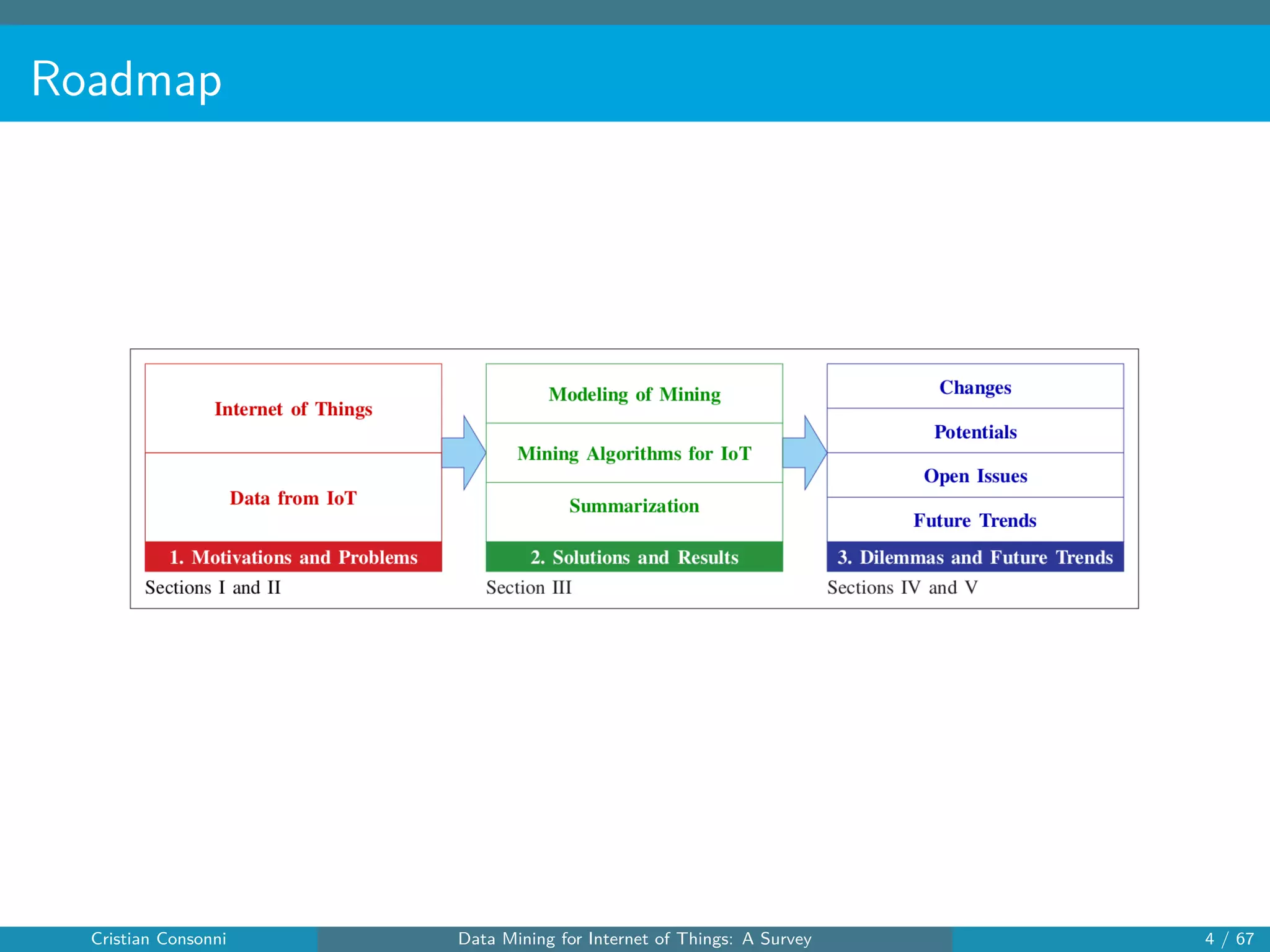
Roadmap
Cristian Consonni Data Mining for Internet of Things: A Survey 4 / 67
Outline for section 1
1 Introduction
2 Data from IoT
3 Data Mining for IoT
Basic Idea of Using Data Mining for IoT
Clustering for IoT
Classification for IoT
Frequent Pattern Mining for IoT
Summary
4 Discussions
Changes Caused by IoT
Potentials of Using IoT
Open Issues of IoT
5 Conclusions
Cristian Consonni Data Mining for Internet of Things: A Survey 5 / 67
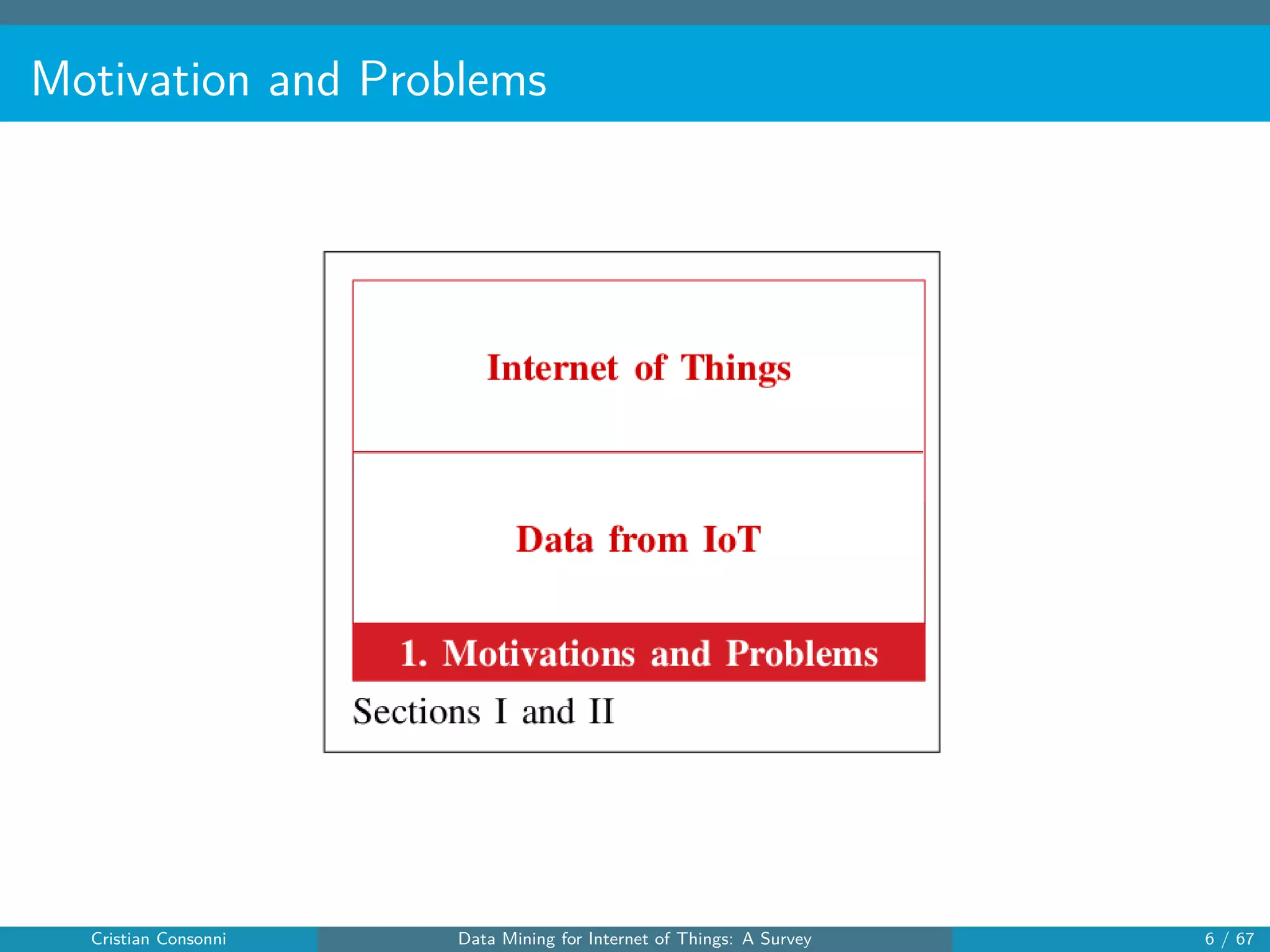
Motivation and Problems
Cristian Consonni Data Mining for Internet of Things: A Survey 6 / 67
Motivation
1 What is the Internet of Things
2 Internet of Things → Big Data (data from IoT, data for IoT)
3 we need mining technologies
4 Data generated or captured by IoT are considered having highly
useful and valuable information
5 Changes, Potentials, Open Issues, and Future Trends
Cristian Consonni Data Mining for Internet of Things: A Survey 7 / 67
Internet of Things: Definition (I)
Definition
Technology for seamlessly integrating classical networks and networked
objects
Cristian Consonni Data Mining for Internet of Things: A Survey 8 / 67
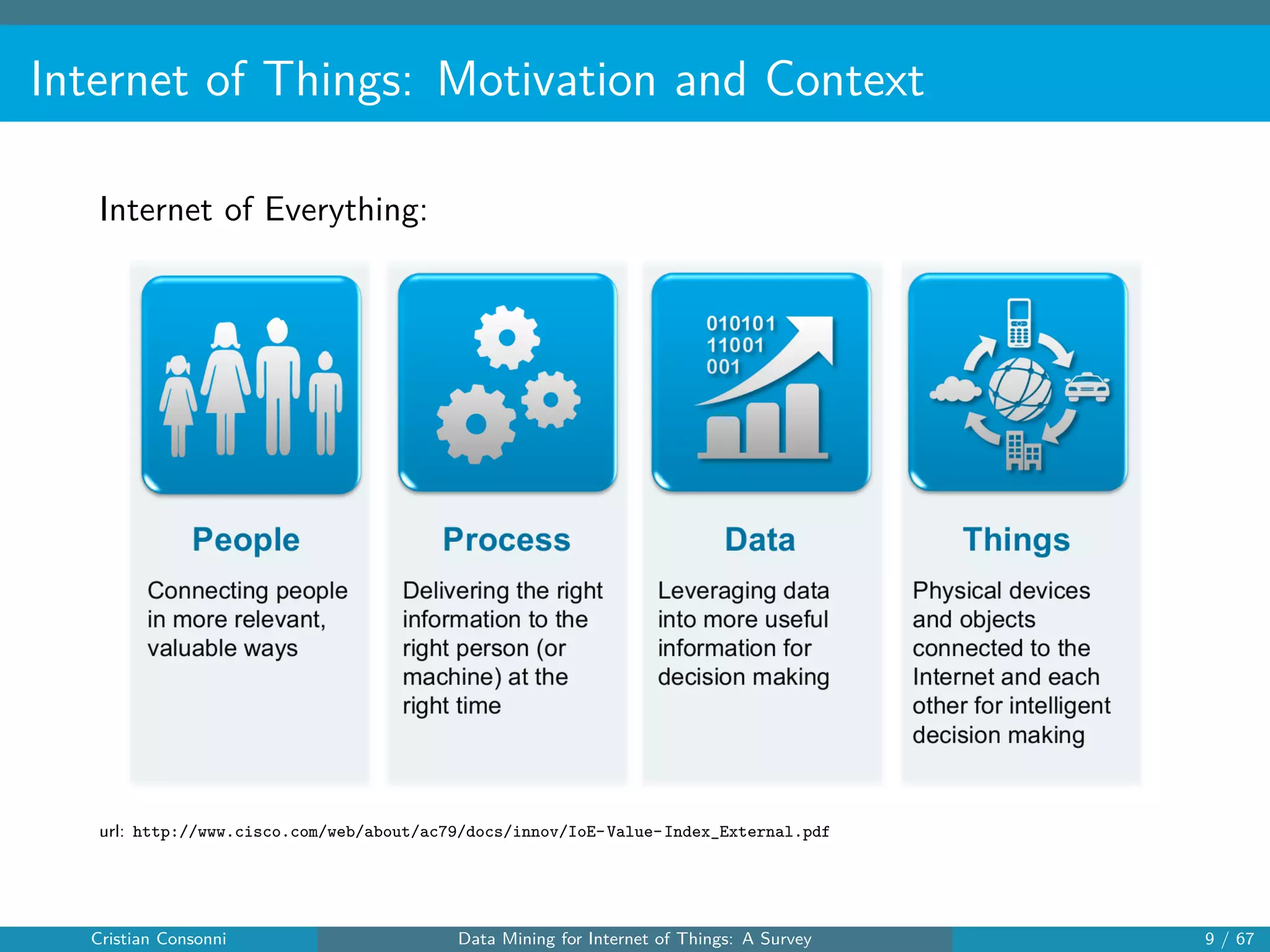
Internet of Things: Motivation and Context
Internet of Everything:
url: http://www.cisco.com/web/about/ac79/docs/innov/IoE-Value-Index_External.pdf
Cristian Consonni Data Mining for Internet of Things: A Survey 9 / 67
Internet of Things: Definition (II)
Cristian Consonni Data Mining for Internet of Things: A Survey 10 / 67
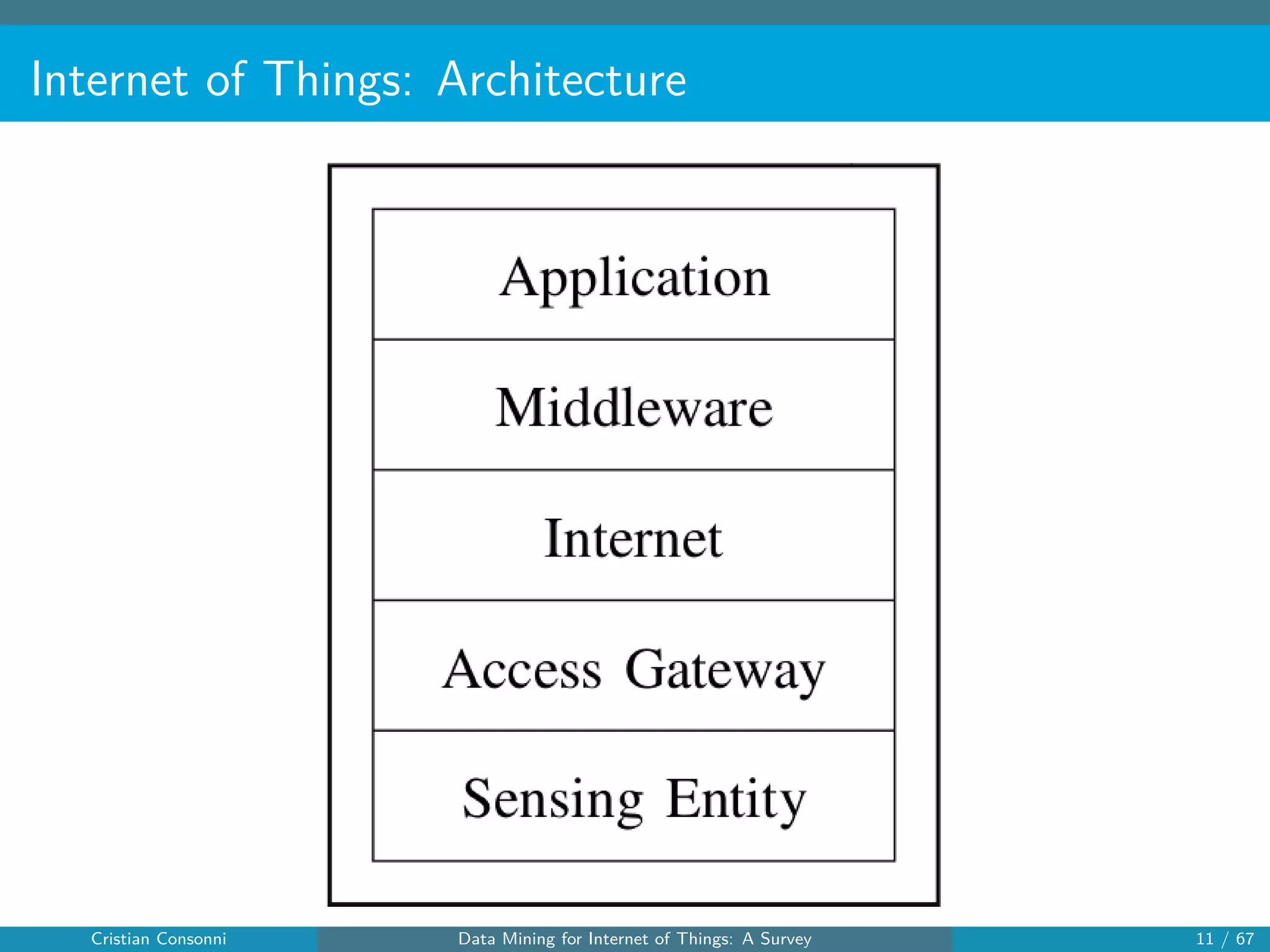
Internet of Things: Architecture
Cristian Consonni Data Mining for Internet of Things: A Survey 11 / 67
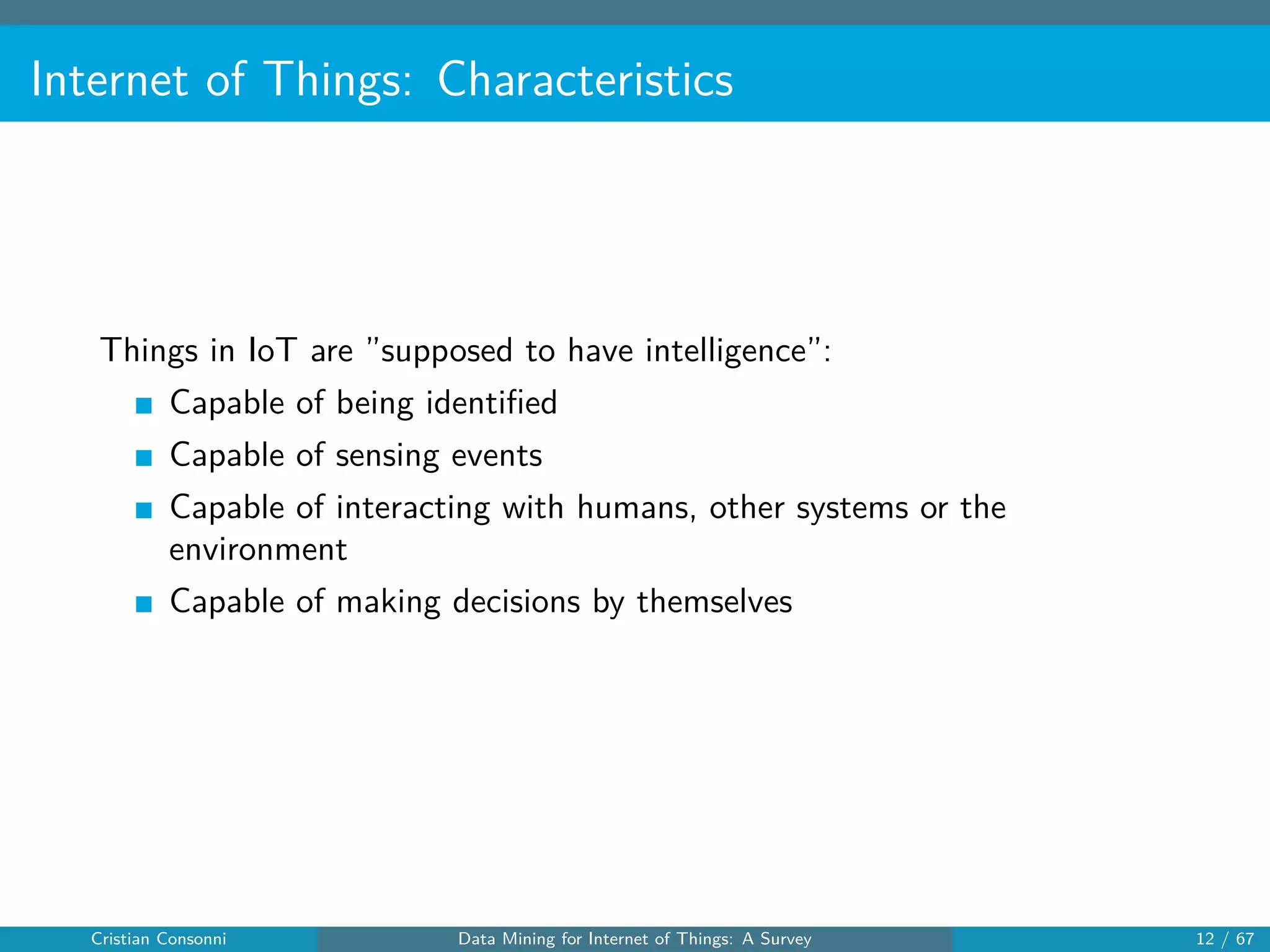
Internet of Things: Characteristics
Things in IoT are ”supposed to have intelligence”:
Capable of being identified
Capable of sensing events
Capable of interacting with humans, other systems or the
environment
Capable of making decisions by themselves
Cristian Consonni Data Mining for Internet of Things: A Survey 12 / 67
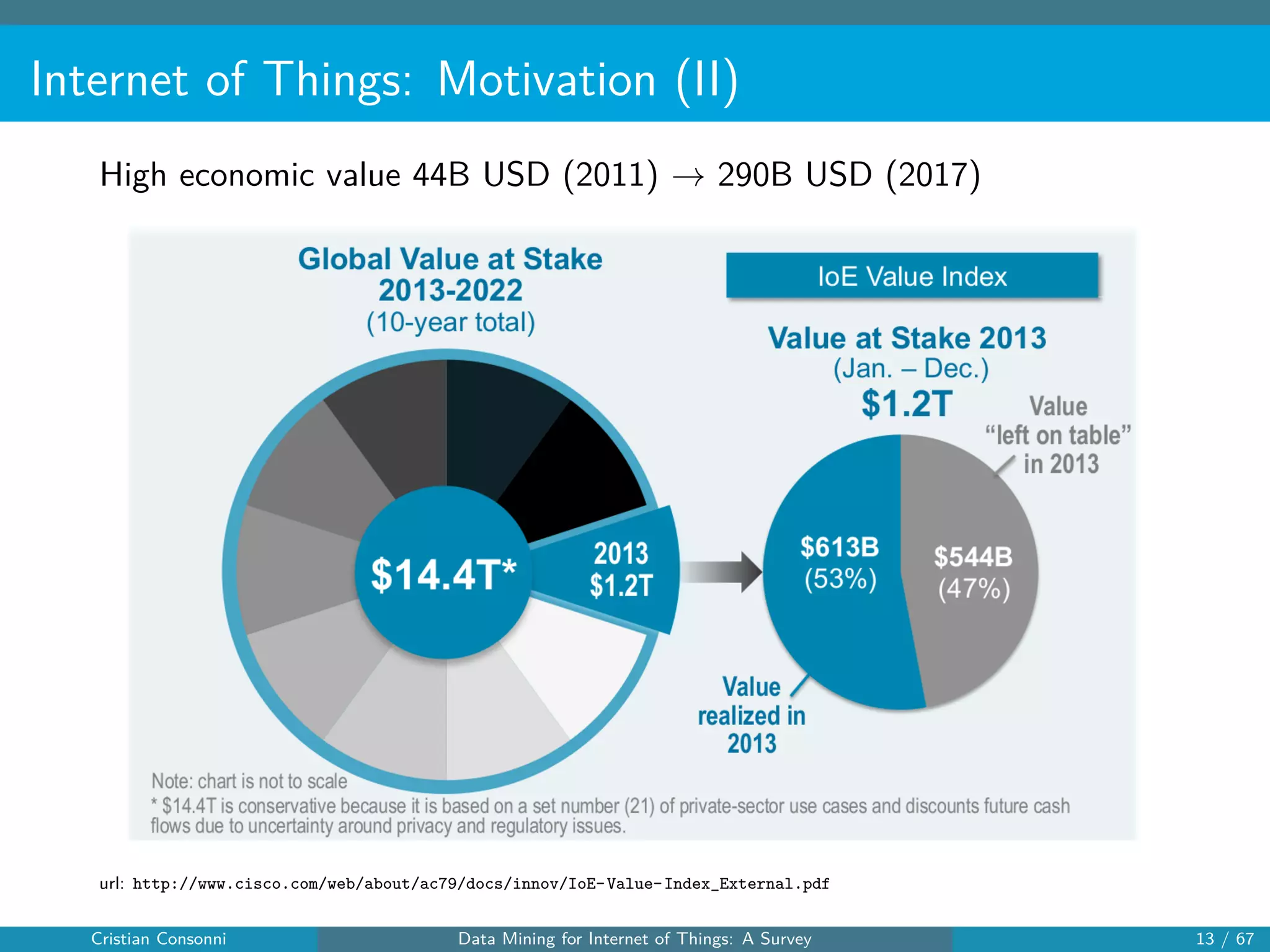
Internet of Things: Motivation (II)
High economic value 44B USD (2011) → 290B USD (2017)
url: http://www.cisco.com/web/about/ac79/docs/innov/IoE-Value-Index_External.pdf
Cristian Consonni Data Mining for Internet of Things: A Survey 13 / 67
Internet of Things: Problem Statement
Problem
How do we trasform data collected by IoT in knowledge for people?
Big Data and IoT Data are interesting for companies because they
provide a competitive advantage
Cristian Consonni Data Mining for Internet of Things: A Survey 14 / 67
Internet of Things: Problem Statement
Solution
With knowledge Discovery in Databases (KDD) and Data Mining
Cristian Consonni Data Mining for Internet of Things: A Survey 15 / 67
Internet of Things: Motivation and Context (III)
We want to find out hidden information in the data of IoT to:
enhance the performance of the system
improve the quality of the services provided
Cristian Consonni Data Mining for Internet of Things: A Survey 16 / 67
Outline for section 2
1 Introduction
2 Data from IoT
3 Data Mining for IoT
Basic Idea of Using Data Mining for IoT
Clustering for IoT
Classification for IoT
Frequent Pattern Mining for IoT
Summary
4 Discussions
Changes Caused by IoT
Potentials of Using IoT
Open Issues of IoT
5 Conclusions
Cristian Consonni Data Mining for Internet of Things: A Survey 17 / 67
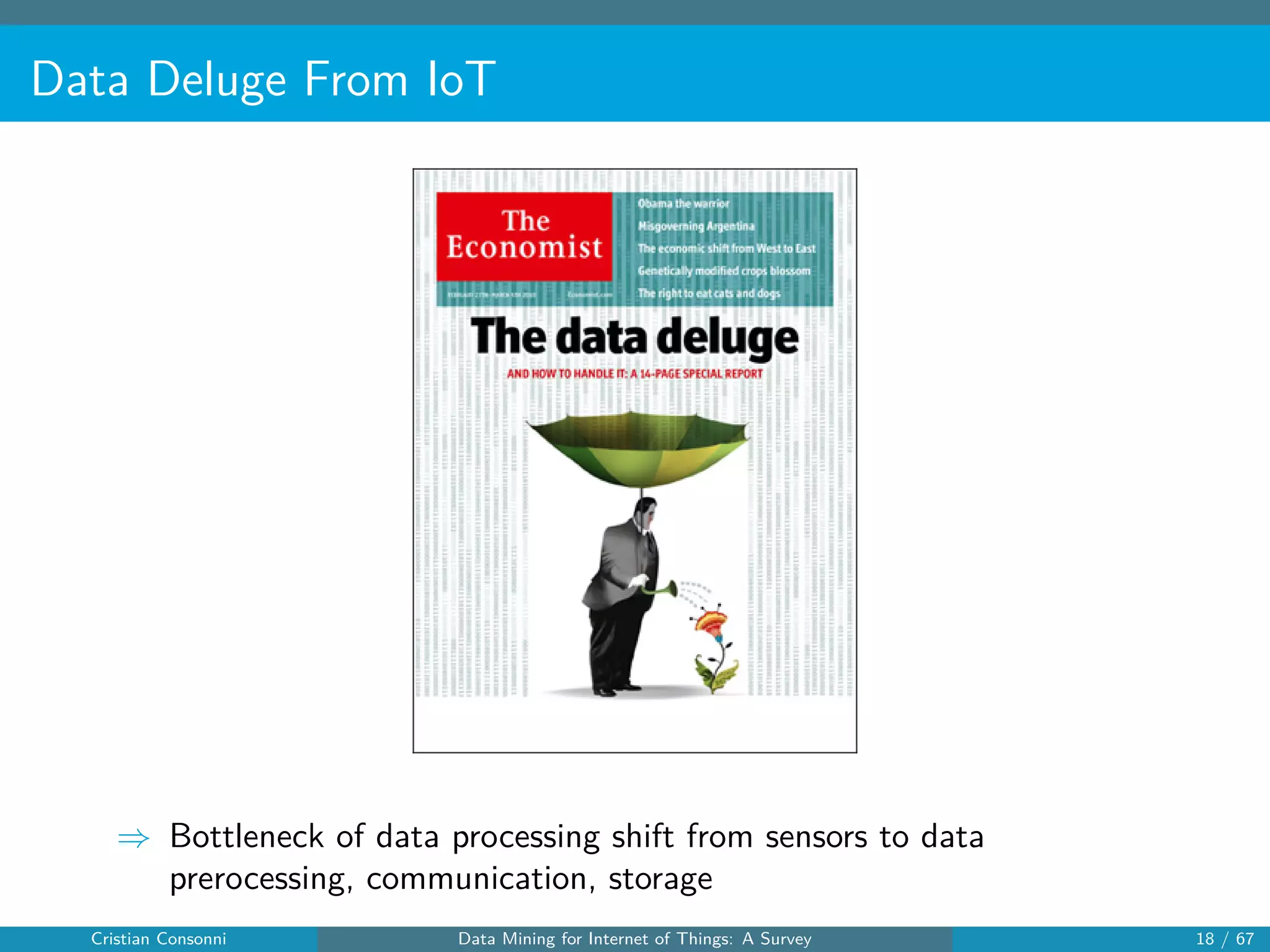
Data Deluge From IoT
⇒ Bottleneck of data processing shift from sensors to data
prerocessing, communication, storage
Cristian Consonni Data Mining for Internet of Things: A Survey 18 / 67
A Taxonomy for Data From IoT
Simple taxonomy for data from IoT:
”data about things”: data that describe the things themselves
(state, location, identity, ...)
→ can be used to optimize the performance of the structure/system
”data generated by things”: data captured or sensed by the things
as the result of the interaction between humans, things and humans,
things and things, ...
→ can be used to enhance the service provided by IoT
Cristian Consonni Data Mining for Internet of Things: A Survey 19 / 67
How To Face the Data Deluge
There are several approaches to handle Big Data from IoT:
Reduce the size of data: random sampling, acquire only the
interesting data (pre-processing on the sensor using PCA or other
dimensionality reduction), data condensation, feature selection
Reduce the computational needs: divide and conquer,
incremental learning
Scale Out Computing Power: distributed computing, cloud
computing
Cristian Consonni Data Mining for Internet of Things: A Survey 20 / 67
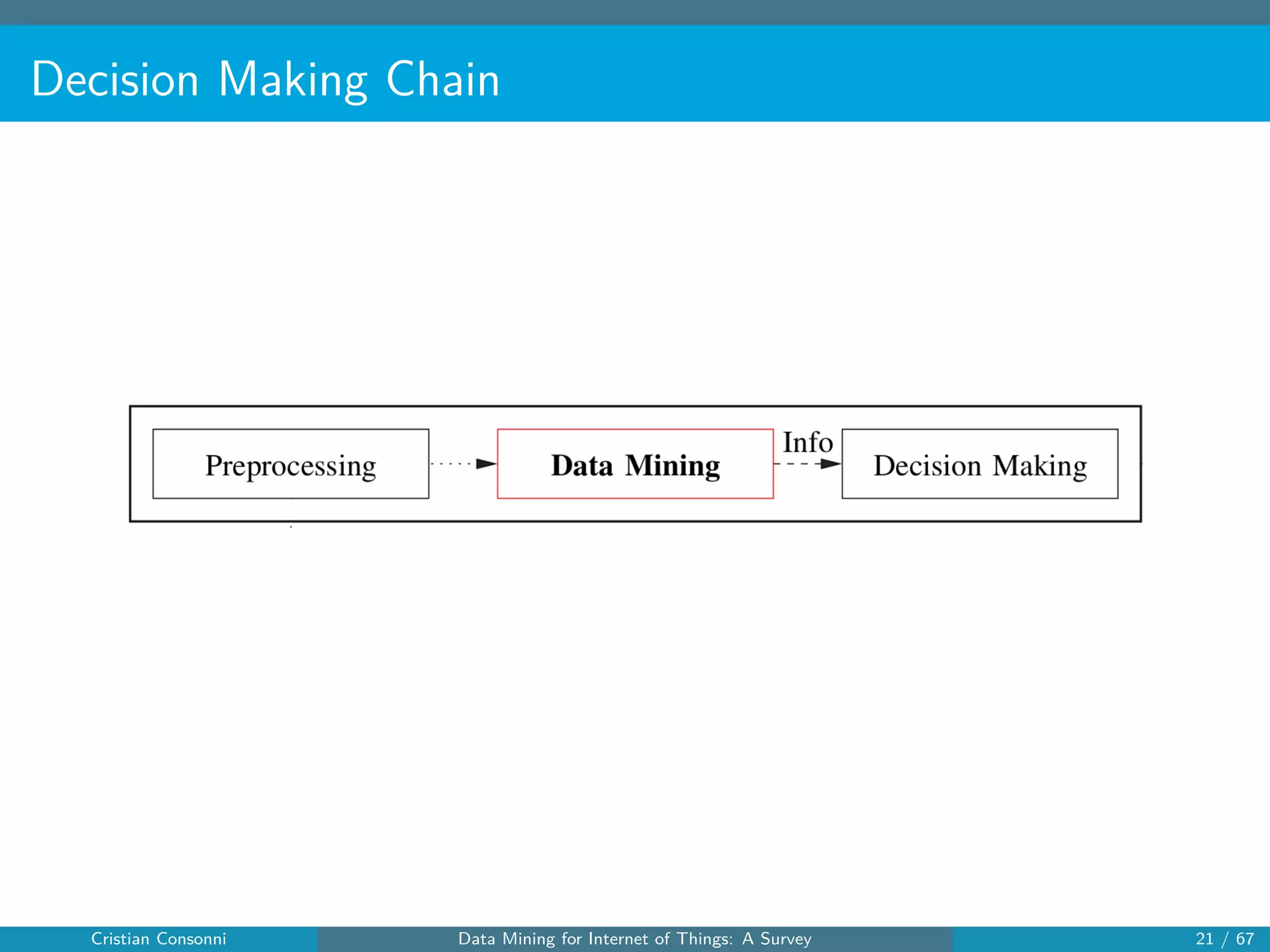
Decision Making Chain
Cristian Consonni Data Mining for Internet of Things: A Survey 21 / 67
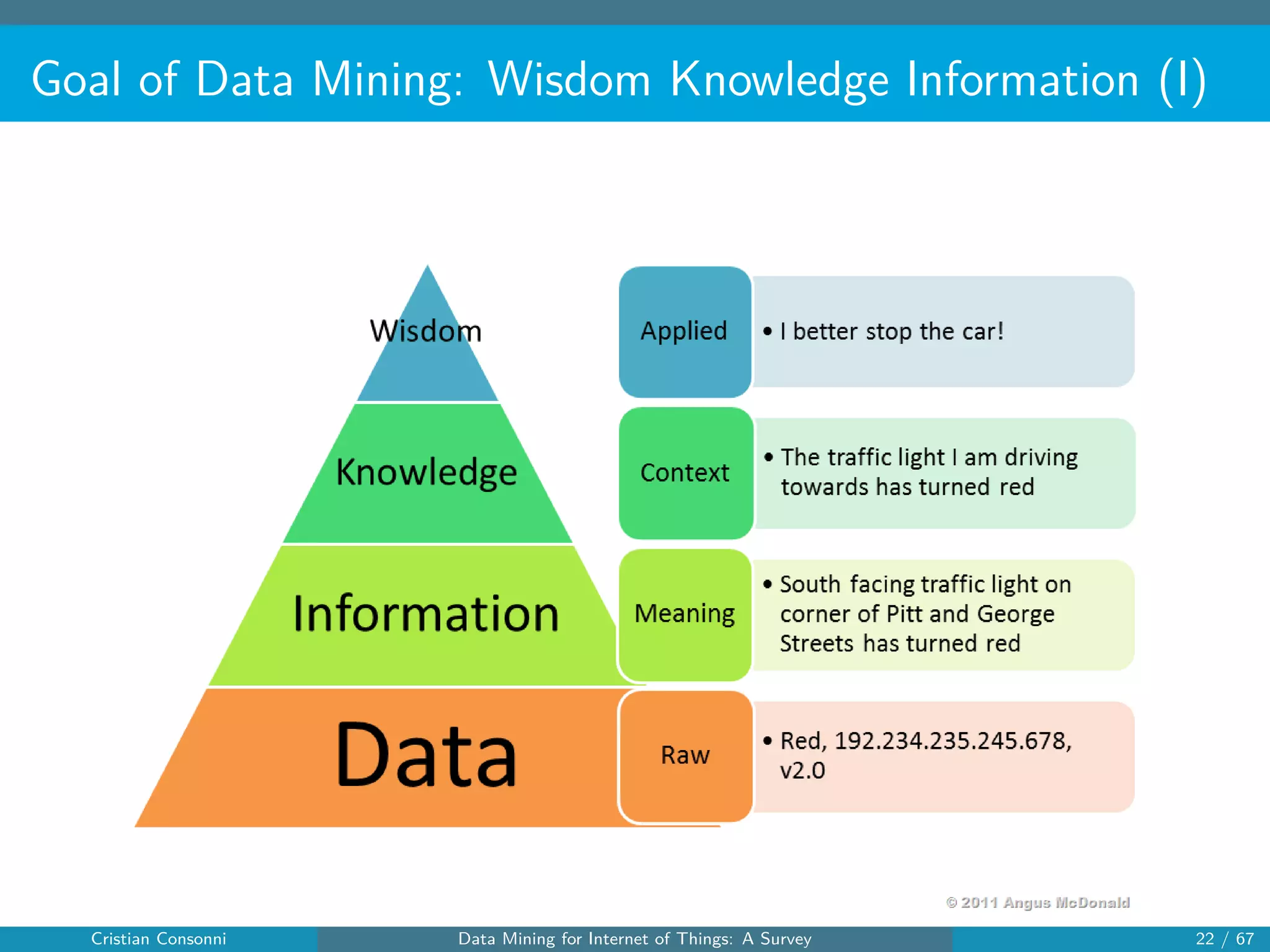
Goal of Data Mining: Wisdom Knowledge Information (I)
Cristian Consonni Data Mining for Internet of Things: A Survey 22 / 67
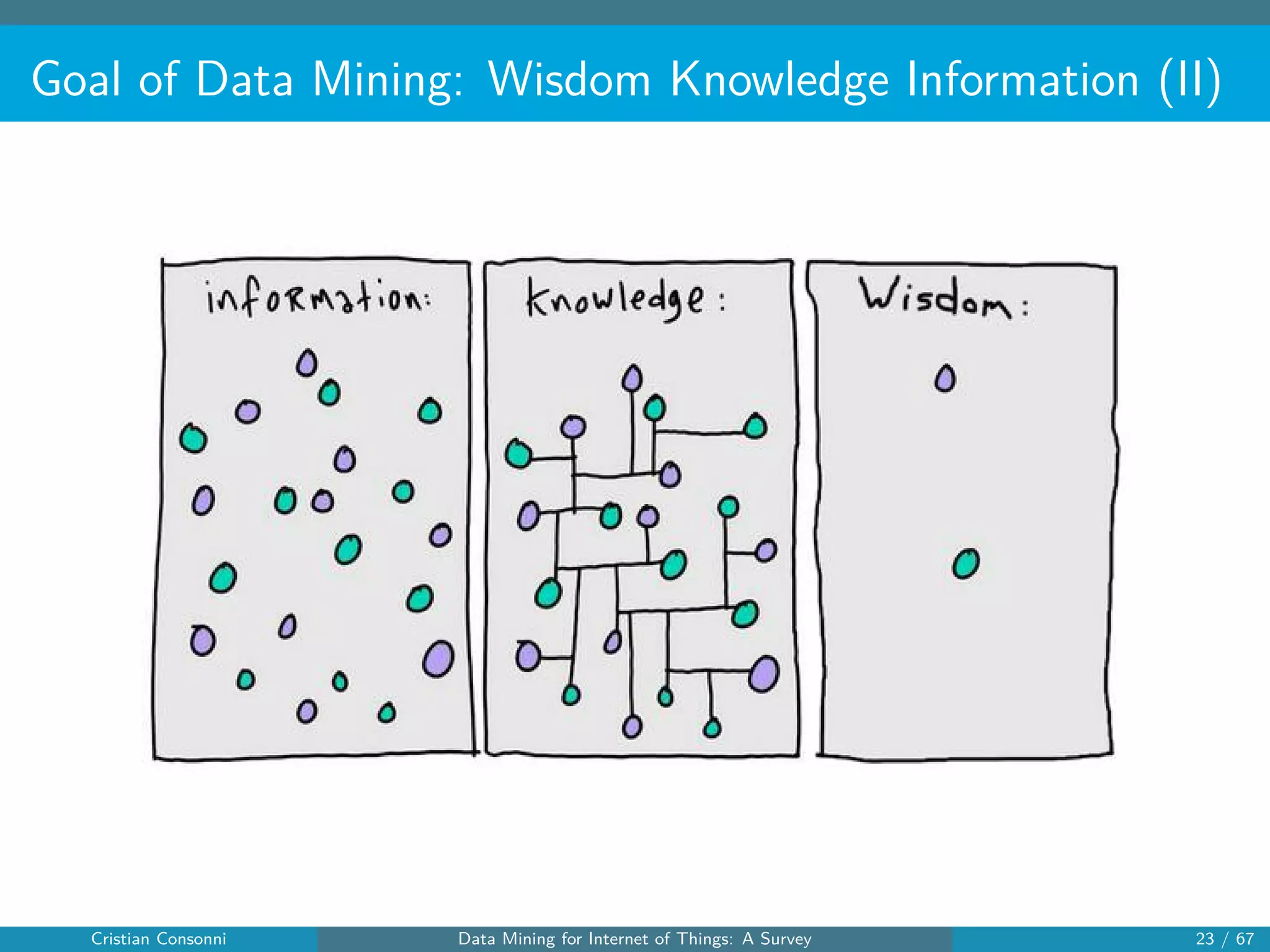
Goal of Data Mining: Wisdom Knowledge Information (II)
Cristian Consonni Data Mining for Internet of Things: A Survey 23 / 67
Caveats about Data Mining for Knowledge Discovery
data fusion, large scale data, data transmission, and decentralized
computing issues may have a stronger impact on the system
0performance than KDD or data mining algorithms
more data win over better algorithms:
1 “More data usually beats better algorithms”
(http://bit.ly/datawocky-1)
2 “More data usually beats better algorithms, Part 2”
(http://bit.ly/datawocky-2)
3 “More data beats better algorithm at predicting Google earnings”
(http://bit.ly/datawocky-3)
→ by Stanford University professor Anand Rajaraman
Cristian Consonni Data Mining for Internet of Things: A Survey 24 / 67
Outline for section 3
1 Introduction
2 Data from IoT
3 Data Mining for IoT
Basic Idea of Using Data Mining for IoT
Clustering for IoT
Classification for IoT
Frequent Pattern Mining for IoT
Summary
4 Discussions
Changes Caused by IoT
Potentials of Using IoT
Open Issues of IoT
5 Conclusions
Cristian Consonni Data Mining for Internet of Things: A Survey 25 / 67
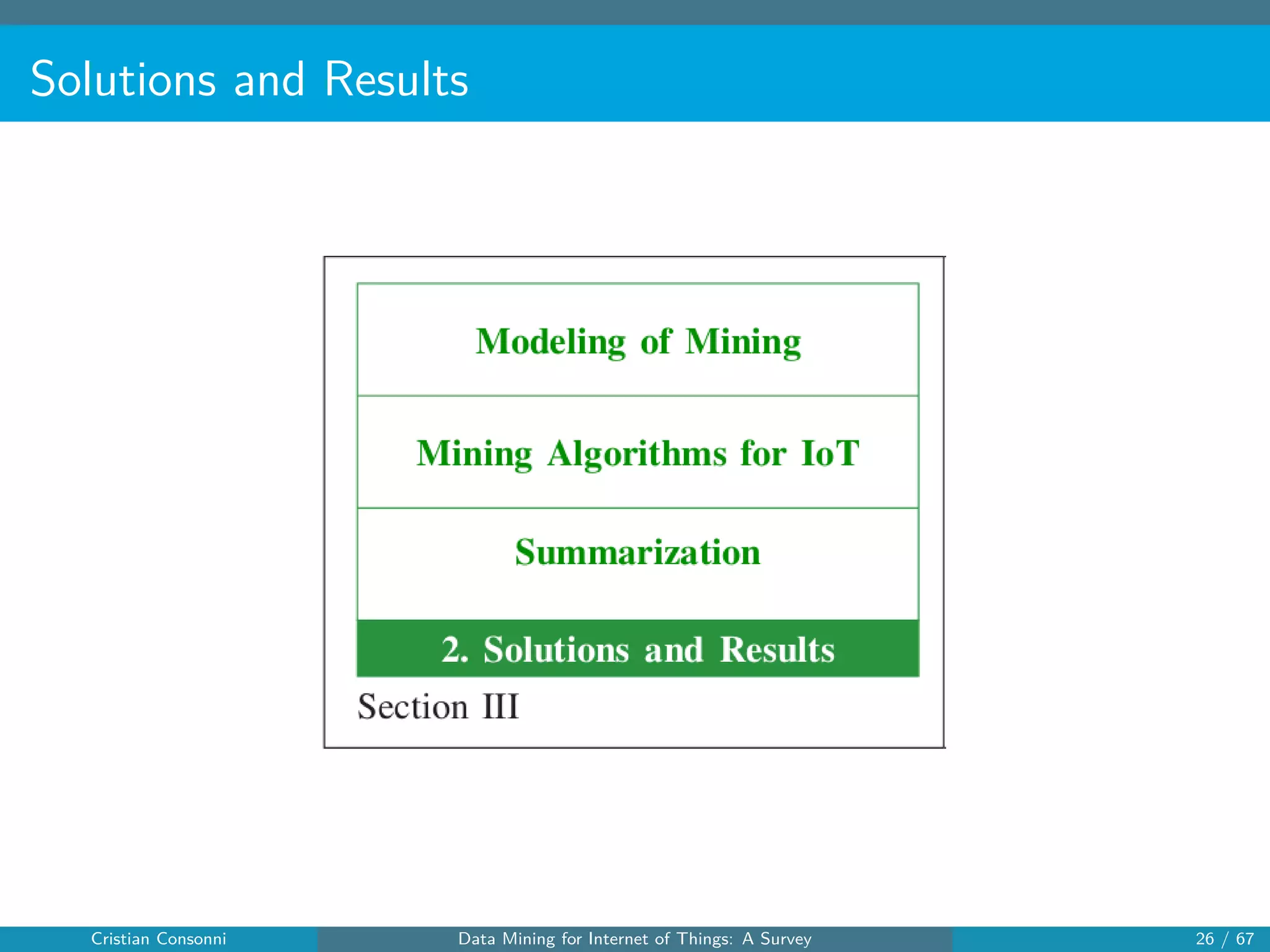
Solutions and Results
Cristian Consonni Data Mining for Internet of Things: A Survey 26 / 67
Problem Formalization
Most mining technologies are designed to work on a single system,
traditional algorithm cannot be applied to Big Data.
Considerations when choosing the applicable mining technology:
Objective (O): problem definition, assumption, limitations
Data (D): characteristics of data (size, distribution, representation)
Mining algorithm (A)
→ wireless sensor network have to count for the load of clustering
algorithm, which is usually ignored
Cristian Consonni Data Mining for Internet of Things: A Survey 27 / 67
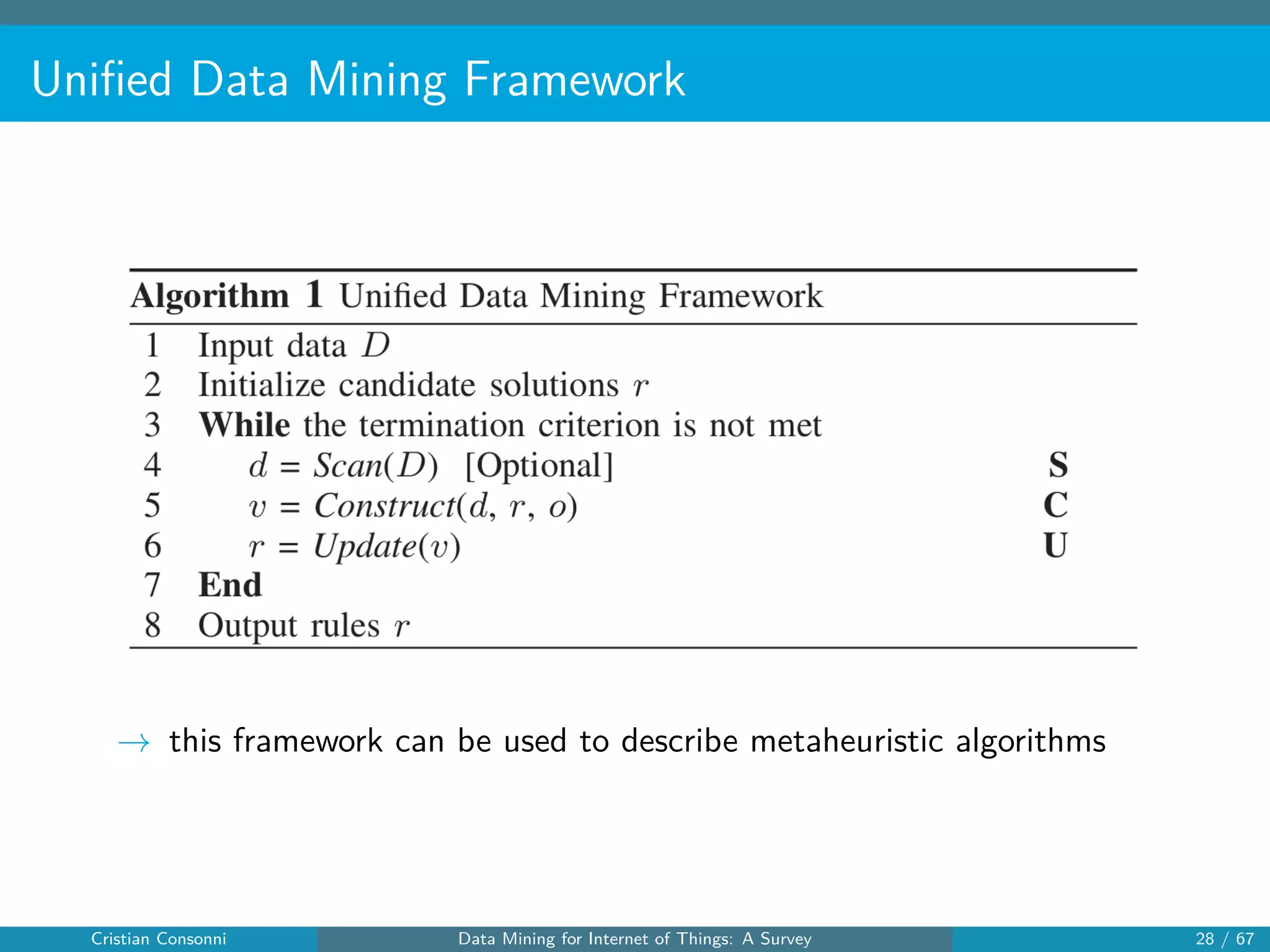
Unified Data Mining Framework
→ this framework can be used to describe metaheuristic algorithms
Cristian Consonni Data Mining for Internet of Things: A Survey 28 / 67
Clustering
Clustering
Cristian Consonni Data Mining for Internet of Things: A Survey 29 / 67
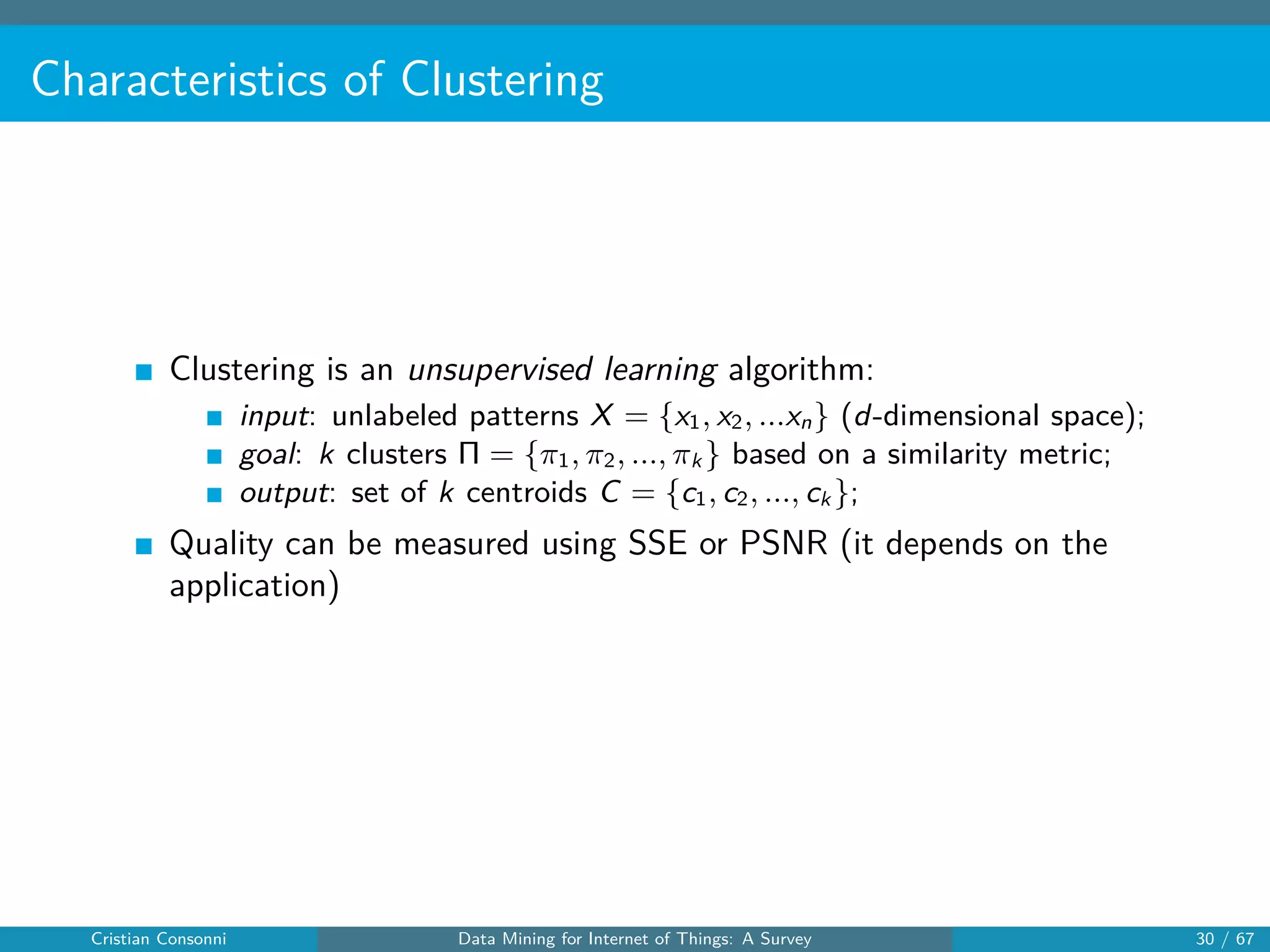
Characteristics of Clustering
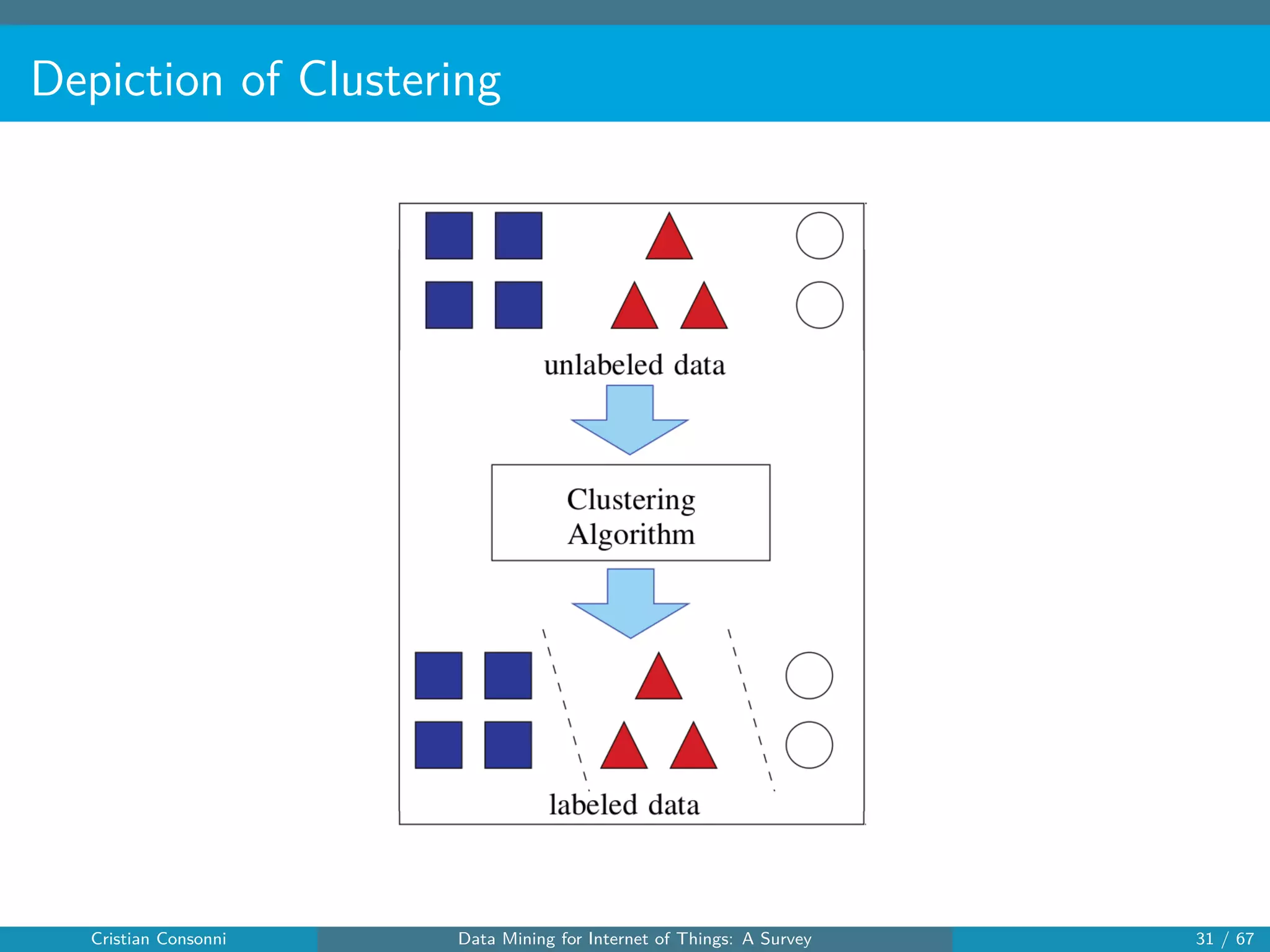
Clustering is an unsupervised learning algorithm:
input: unlabeled patterns X = {x1, x2, ...xn} (d-dimensional space);
goal: k clusters Π = {π1, π2, ..., πk } based on a similarity metric;
output: set of k centroids C = {c1, c2, ..., ck };
Quality can be measured using SSE or PSNR (it depends on the
application)
Cristian Consonni Data Mining for Internet of Things: A Survey 30 / 67
Depiction of Clustering
Cristian Consonni Data Mining for Internet of Things: A Survey 31 / 67
k-means
k-means examples:
1 http://bit.ly/kmeans-1
2 http://bit.ly/kmeans-2
Cristian Consonni Data Mining for Internet of Things: A Survey 32 / 67
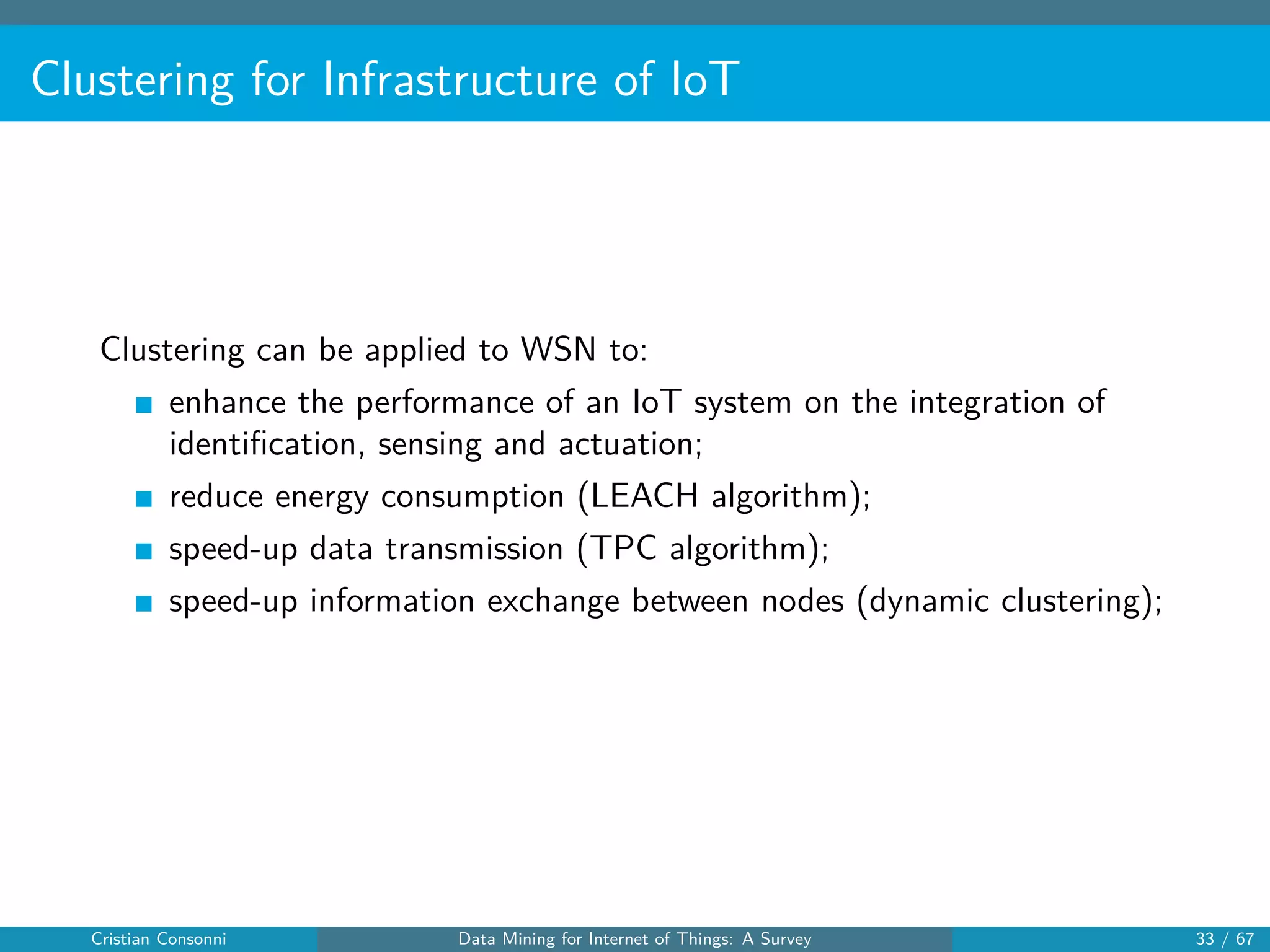
Clustering for Infrastructure of IoT
Clustering can be applied to WSN to:
enhance the performance of an IoT system on the integration of
identification, sensing and actuation;
reduce energy consumption (LEACH algorithm);
speed-up data transmission (TPC algorithm);
speed-up information exchange between nodes (dynamic clustering);
Cristian Consonni Data Mining for Internet of Things: A Survey 33 / 67
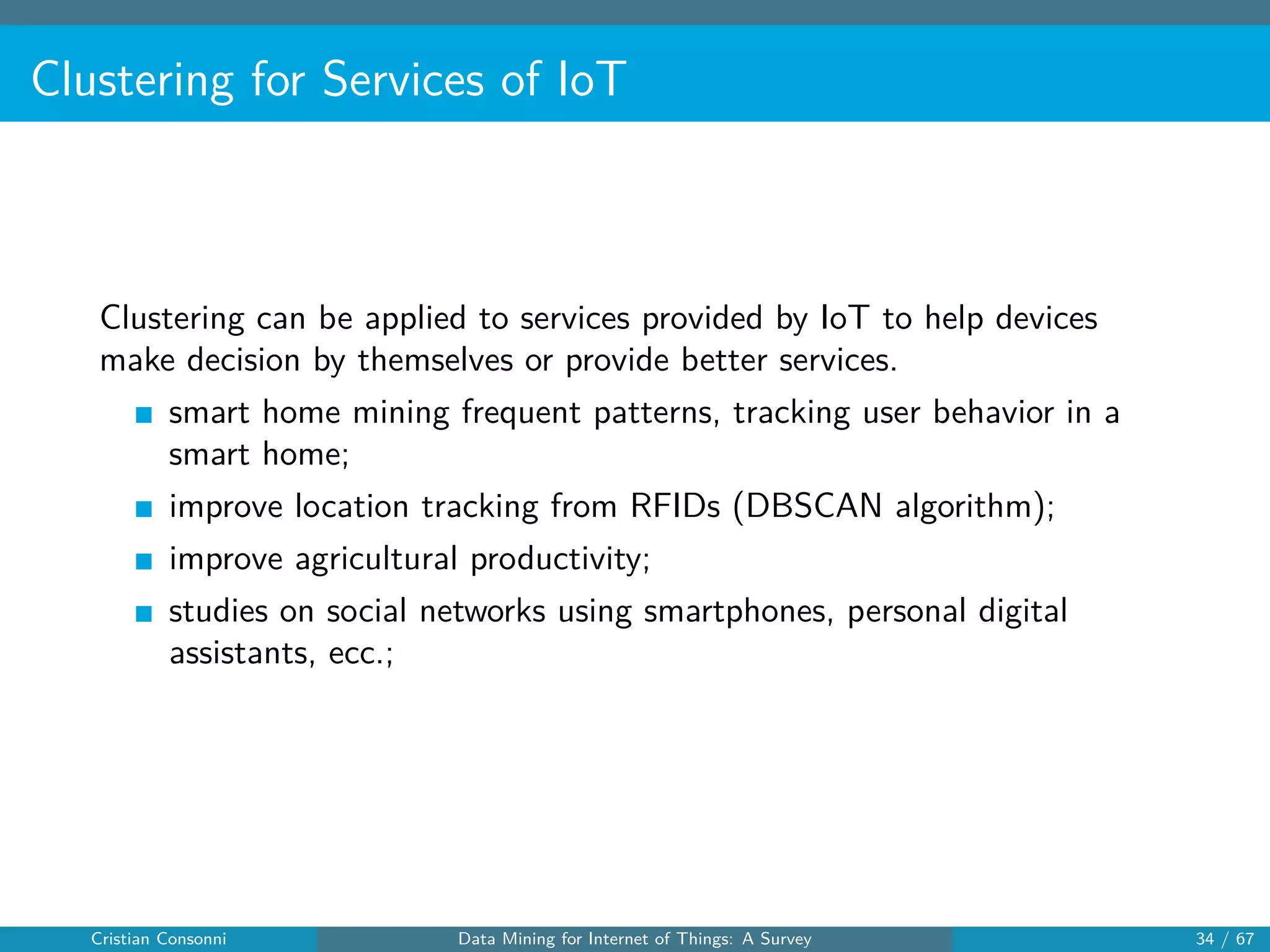
Clustering for Services of IoT
Clustering can be applied to services provided by IoT to help devices
make decision by themselves or provide better services.
smart home mining frequent patterns, tracking user behavior in a
smart home;
improve location tracking from RFIDs (DBSCAN algorithm);
improve agricultural productivity;
studies on social networks using smartphones, personal digital
assistants, ecc.;
Cristian Consonni Data Mining for Internet of Things: A Survey 34 / 67
Classification
Classification
Cristian Consonni Data Mining for Internet of Things: A Survey 35 / 67
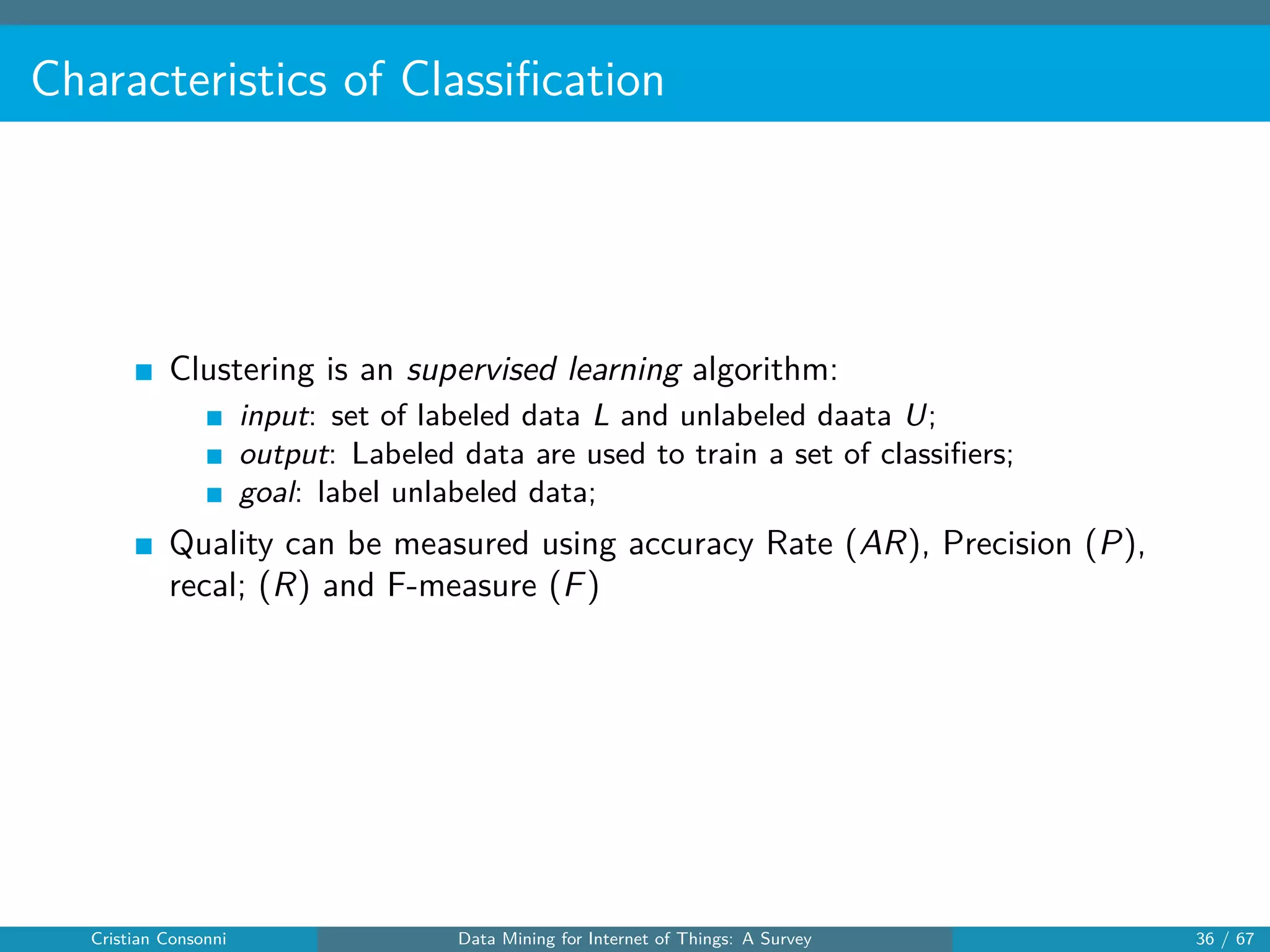
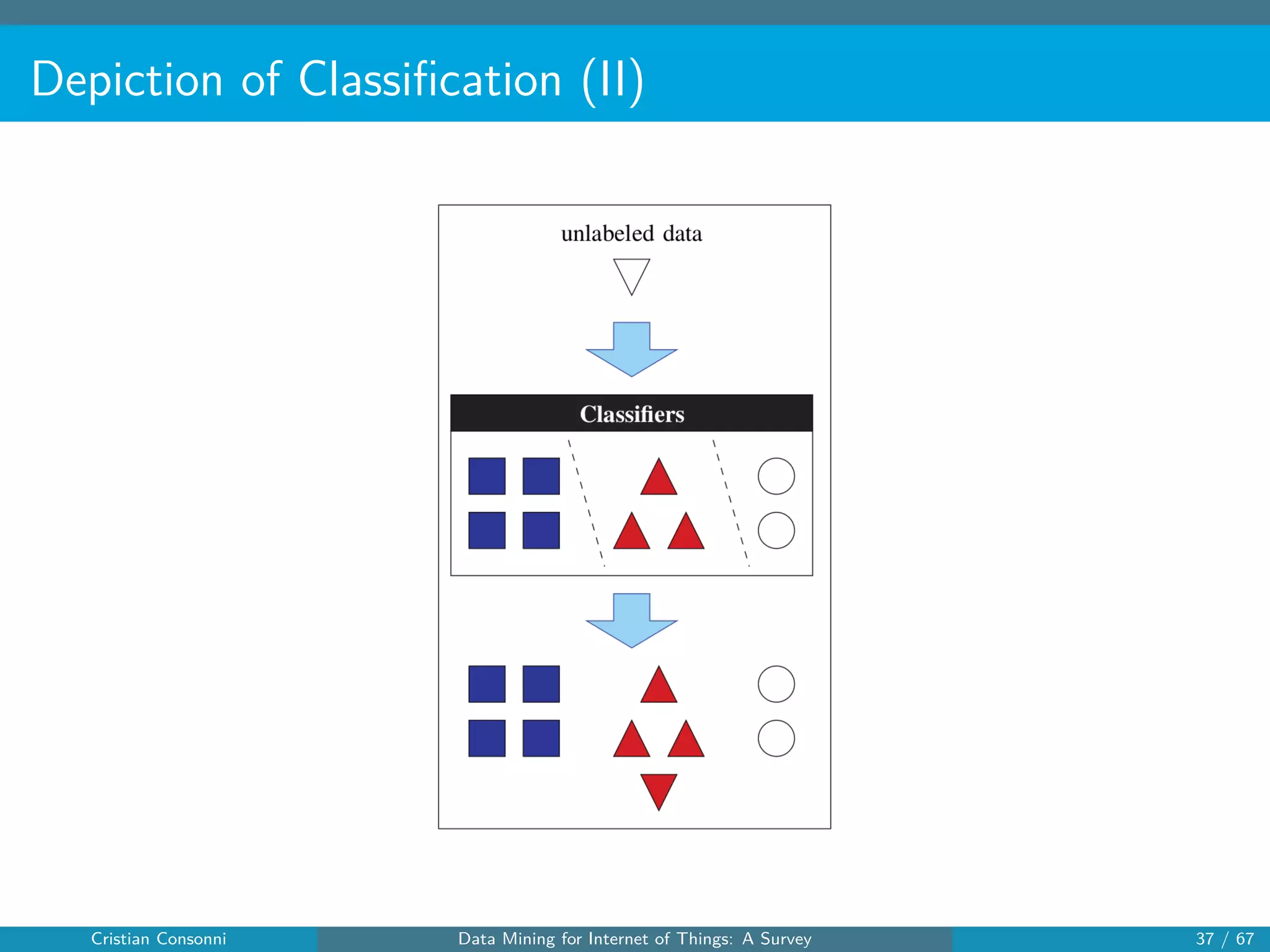
Characteristics of Classification
Clustering is an supervised learning algorithm:
input: set of labeled data L and unlabeled daata U;
output: Labeled data are used to train a set of classifiers;
goal: label unlabeled data;
Quality can be measured using accuracy Rate (AR), Precision (P),
recal; (R) and F-measure (F)
Cristian Consonni Data Mining for Internet of Things: A Survey 36 / 67
Depiction of Classification (II)
Cristian Consonni Data Mining for Internet of Things: A Survey 37 / 67
Classification Algorithms
Several algorithms can be used as classifiers
Decision trees:
k-nearest neighbor:
Naive Bayes classification:
adaboost
Support Vector Machine (SVM) (note: non-linear):
Cristian Consonni Data Mining for Internet of Things: A Survey 38 / 67
Classification for Infrastructure of Iot
Classification algorithms are applied to the problem of identification of
devices:
Unique Item Identifier (UII):
Several standards have been idenpendently developed:
lots of UII queries (more than current DNS queries):
Cristian Consonni Data Mining for Internet of Things: A Survey 39 / 67
Classification for Infrastructure of Iot
Classification can be applied to:
outdoor tasks:
traffic jam problem: traffic forecasting services, accident detection,
detecting traffic information from social netwrks;
parking problem: passive infra-red sensor;
indoor tasks:
healtcare and smart home systems:
infrared presence sensors, microphones, wearable kinematic sensors
definition of activities: bathing, dressing, etc.
detect posture and falling event
avoid suddend death events
replace ECG in hospital with home systems
other tasks
object identification
face recognition
facial expression classification
Note: especially indoor system raise important privacy concerns.
Cristian Consonni Data Mining for Internet of Things: A Survey 40 / 67
Frequent Pattern Mining
Cristian Consonni Data Mining for Internet of Things: A Survey 41 / 67
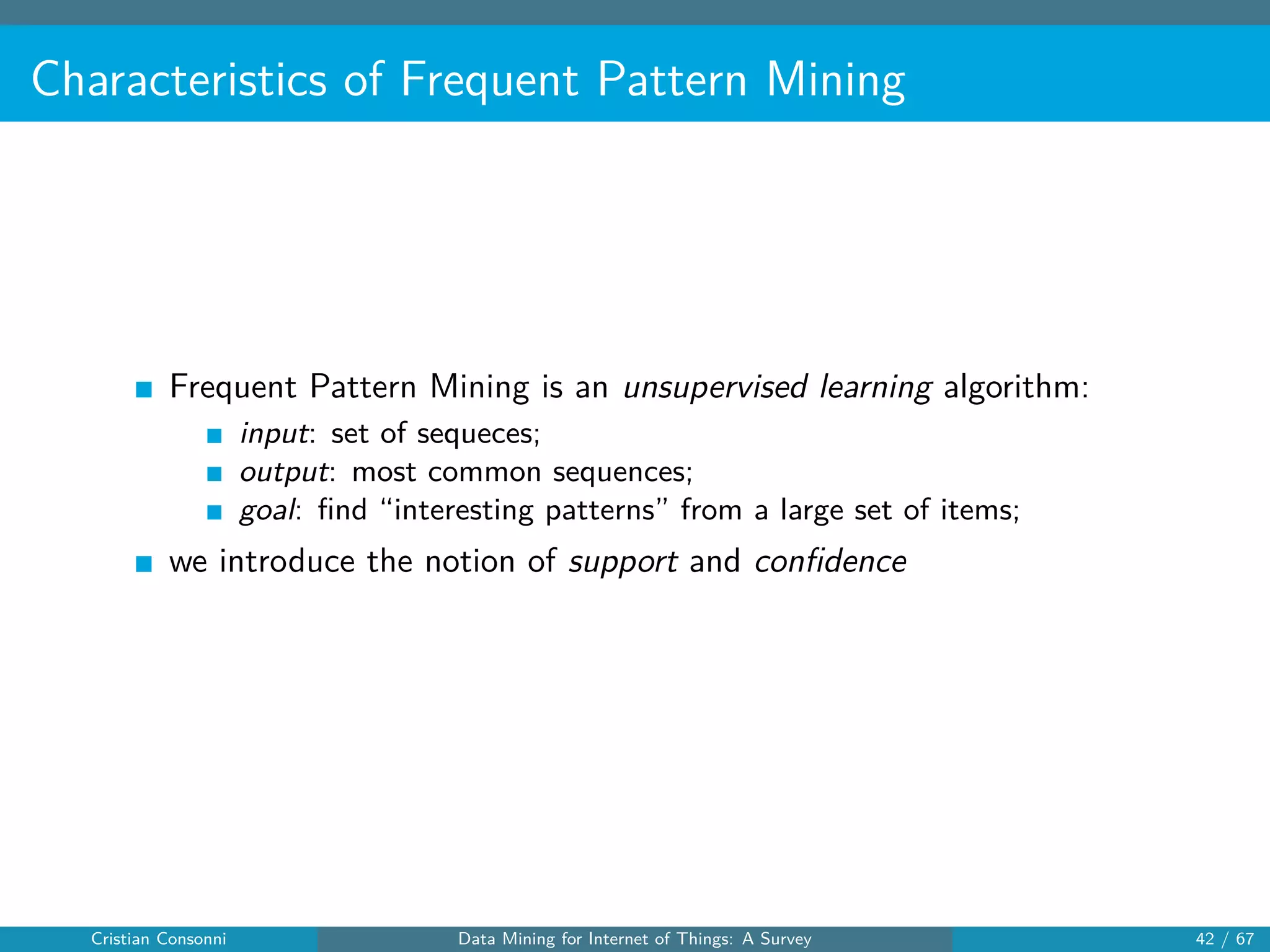
Characteristics of Frequent Pattern Mining
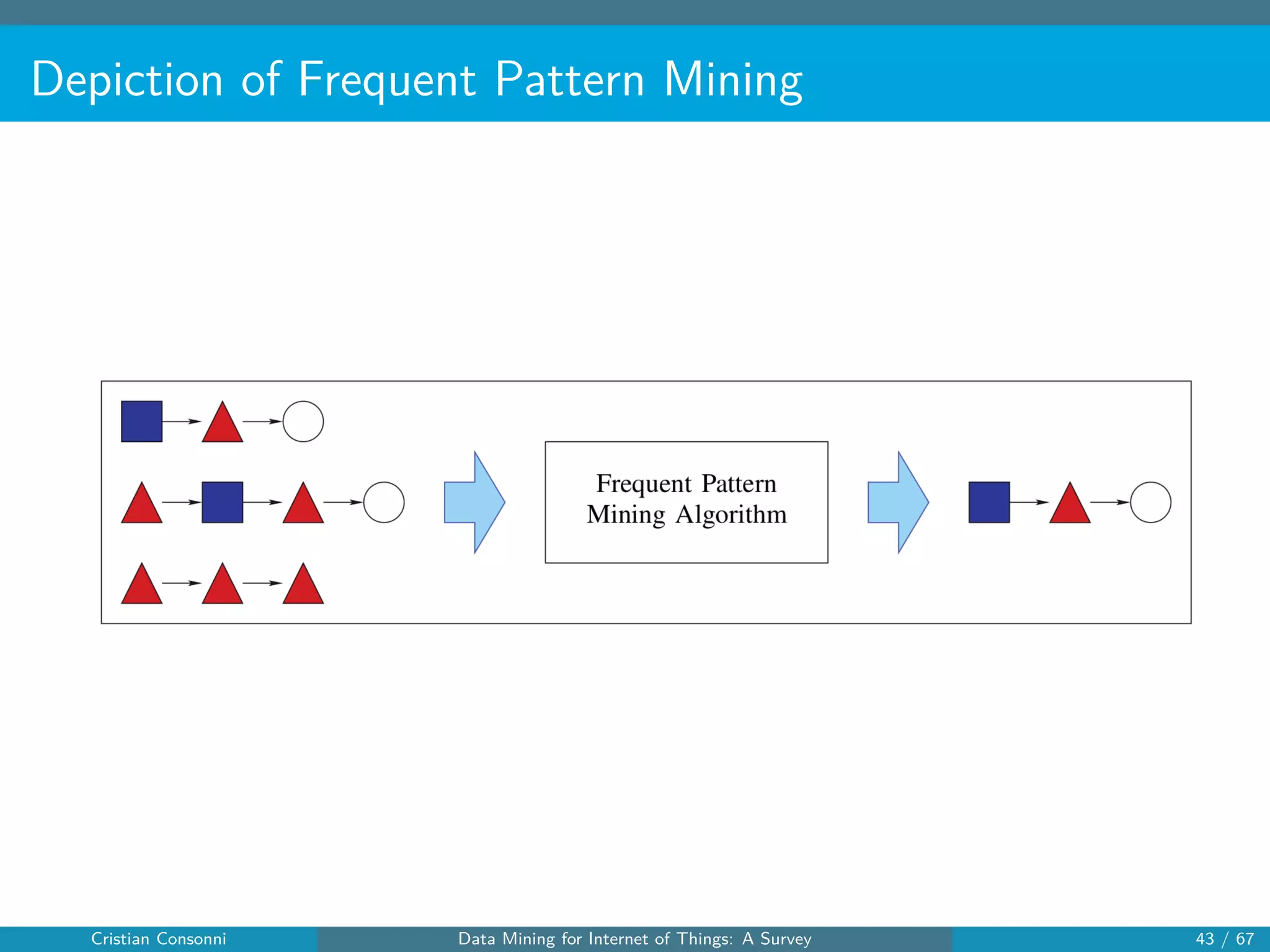
Frequent Pattern Mining is an unsupervised learning algorithm:
input: set of sequeces;
output: most common sequences;
goal: find “interesting patterns” from a large set of items;
we introduce the notion of support and confidence
Cristian Consonni Data Mining for Internet of Things: A Survey 42 / 67
Depiction of Frequent Pattern Mining
Cristian Consonni Data Mining for Internet of Things: A Survey 43 / 67
Frequent Pattern Mining for Infrastructure of IoT
Several application of Frequent Pattern Mining for Infrastructure of IoT:
temporal data mining, privacy preserving on IoT, web usage mining,
bionformatics, intrusion detection:
90% of the data crreated today is born in electronic form
manage RFID events, spatial collocation mining in GIS
Cristian Consonni Data Mining for Internet of Things: A Survey 44 / 67
Frequent Pattern for Services of IoT
Frequent Pattern Mining can be used to provide better services to IoT
users:
analyze purchase behavior is classic but still active:
help customer find products they are looking for quickly (customer
specific rules, category-based rules, association rules)
Cristian Consonni Data Mining for Internet of Things: A Survey 45 / 67
Summary
Summary of Mining
Technologies
Cristian Consonni Data Mining for Internet of Things: A Survey 46 / 67
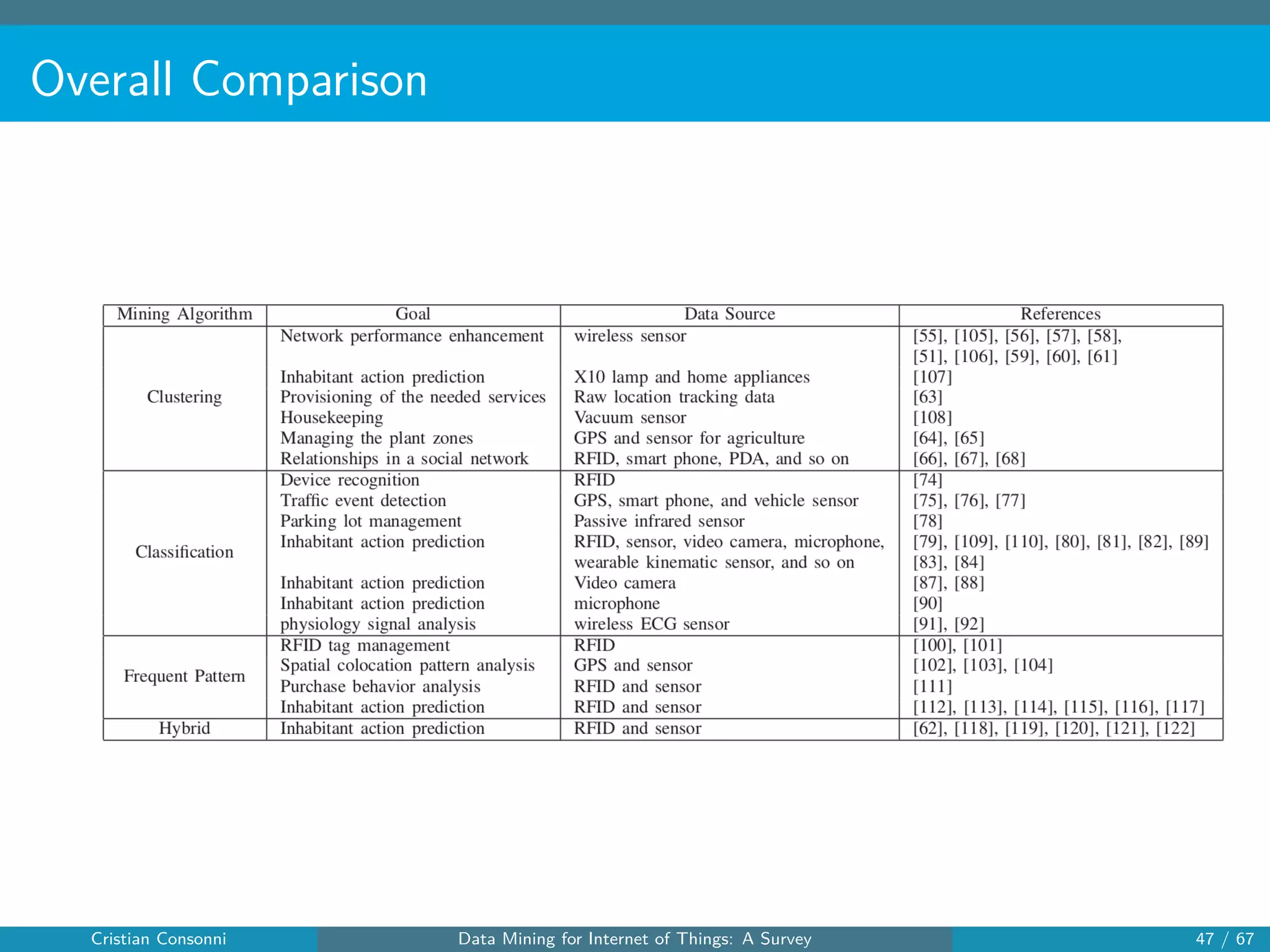
Overall Comparison
Cristian Consonni Data Mining for Internet of Things: A Survey 47 / 67
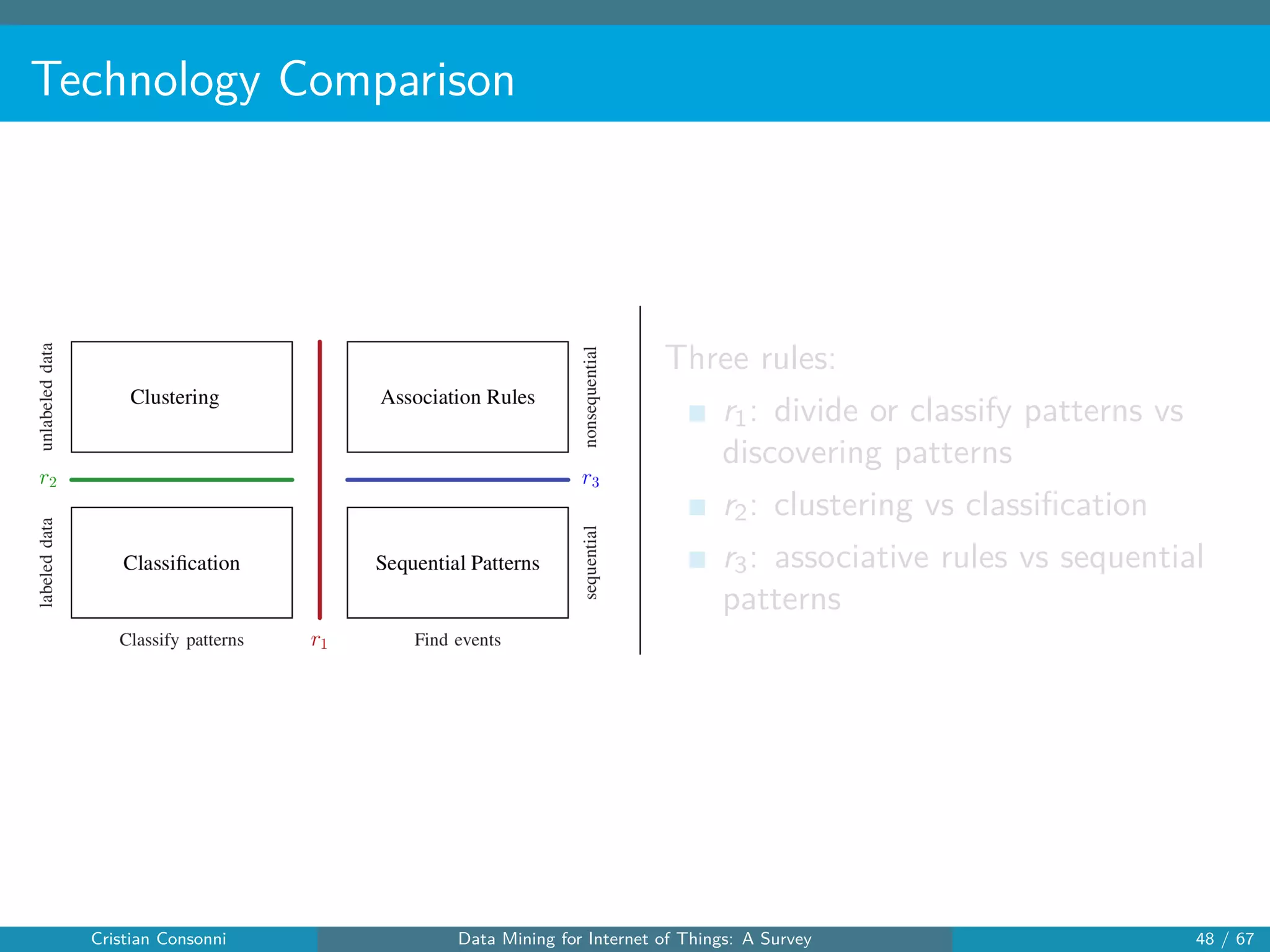
Technology Comparison
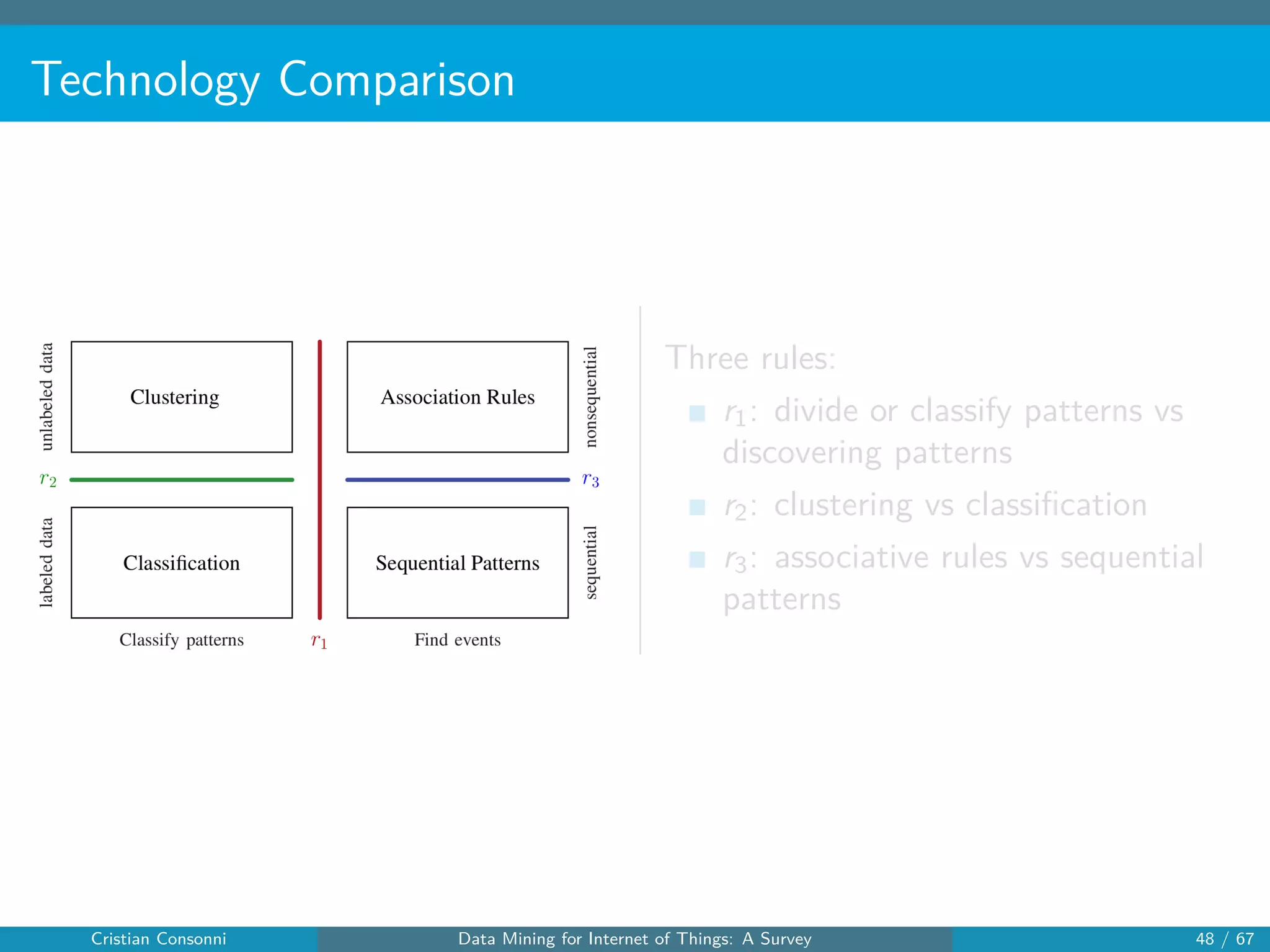
Three rules:
r1: divide or classify patterns vs
discovering patterns
r2: clustering vs classification
r3: associative rules vs sequential
patterns
Cristian Consonni Data Mining for Internet of Things: A Survey 48 / 67
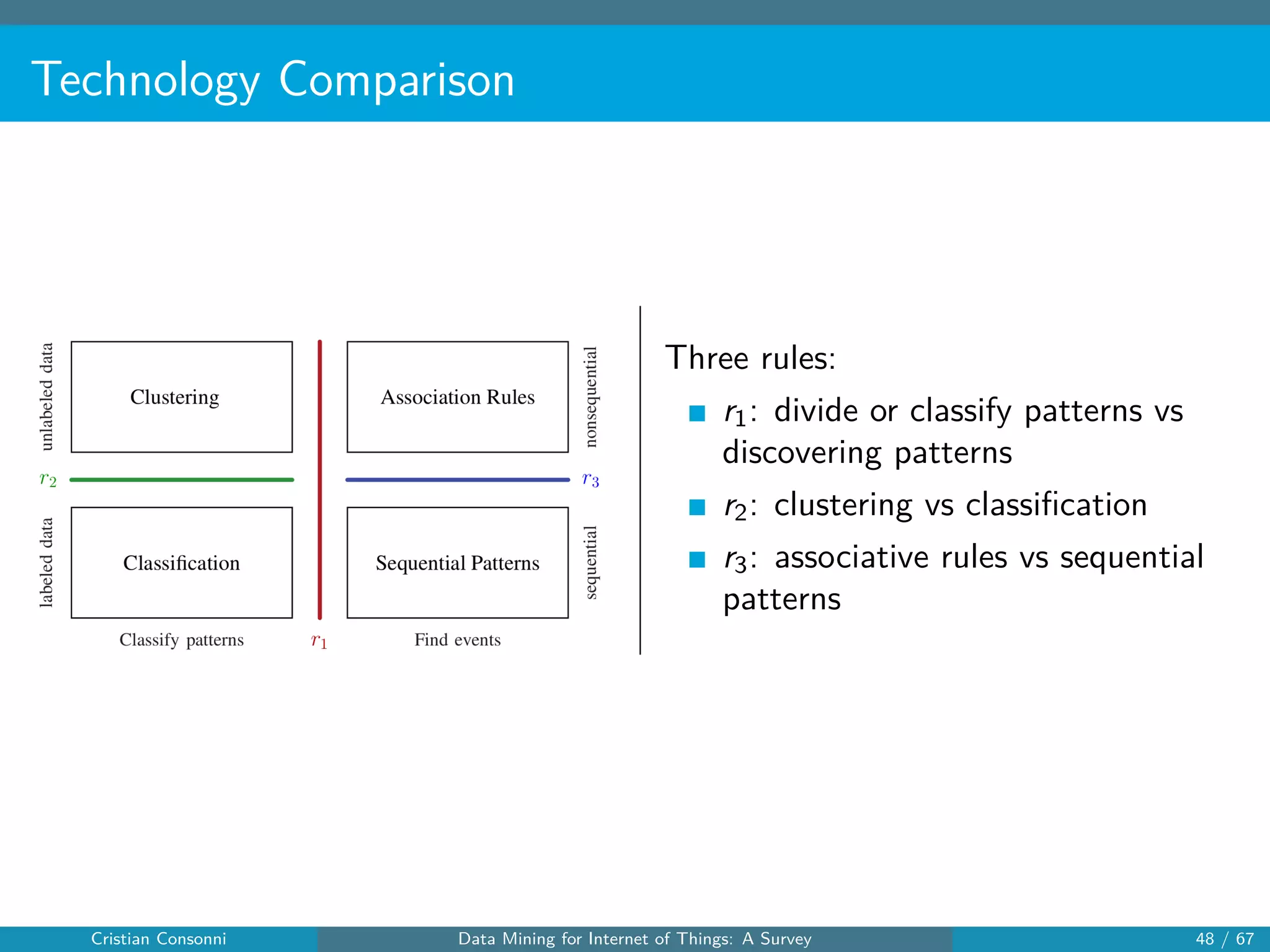
Technology Comparison
Three rules:
r1: divide or classify patterns vs
discovering patterns
r2: clustering vs classification
r3: associative rules vs sequential
patterns
Cristian Consonni Data Mining for Internet of Things: A Survey 48 / 67
Technology Comparison
Three rules:
r1: divide or classify patterns vs
discovering patterns
r2: clustering vs classification
r3: associative rules vs sequential
patterns
Cristian Consonni Data Mining for Internet of Things: A Survey 48 / 67
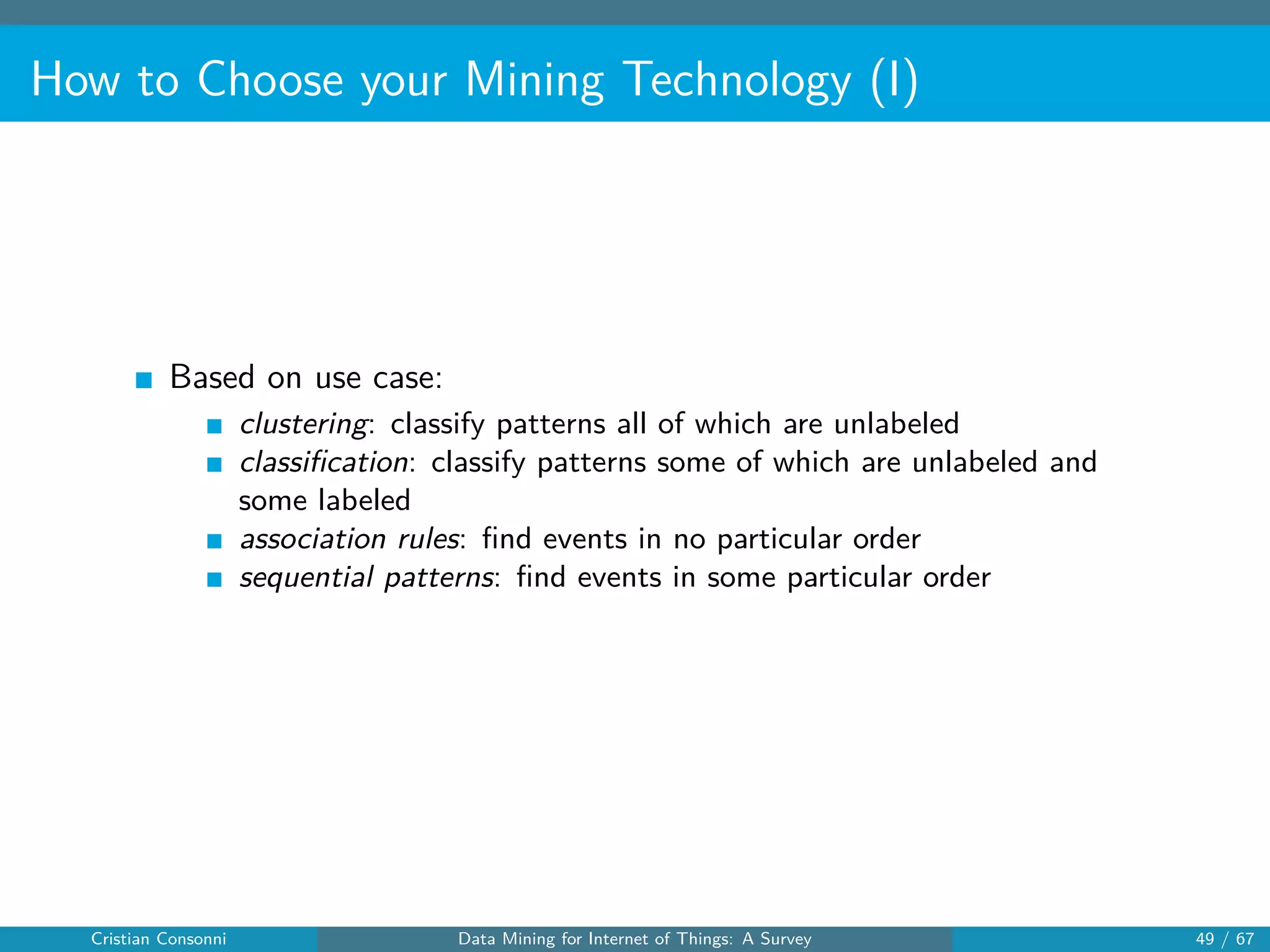
How to Choose your Mining Technology (I)
Based on use case:
clustering: classify patterns all of which are unlabeled
classification: classify patterns some of which are unlabeled and
some labeled
association rules: find events in no particular order
sequential patterns: find events in some particular order
Cristian Consonni Data Mining for Internet of Things: A Survey 49 / 67
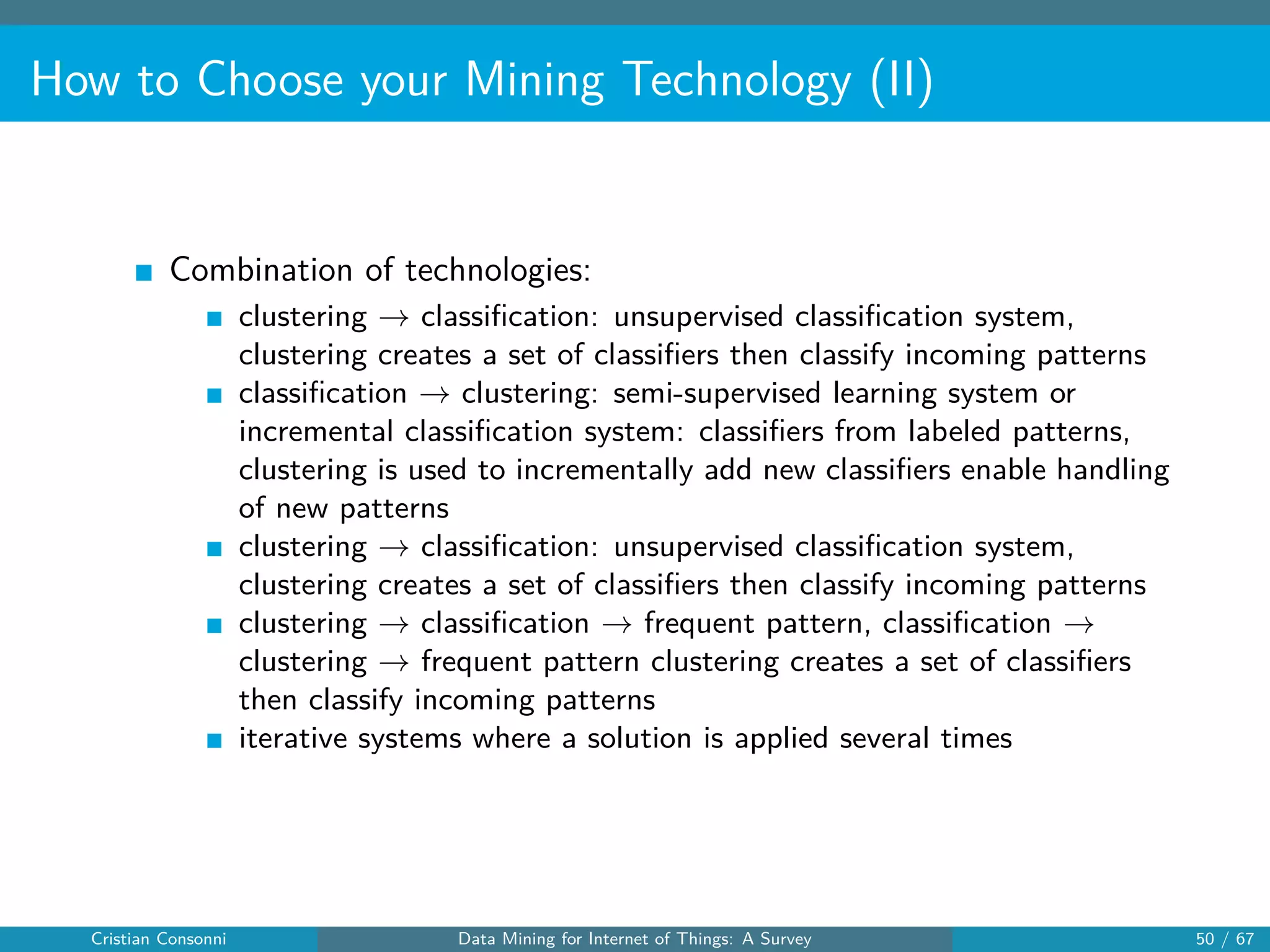
How to Choose your Mining Technology (II)
Combination of technologies:
clustering → classification: unsupervised classification system,
clustering creates a set of classifiers then classify incoming patterns
classification → clustering: semi-supervised learning system or
incremental classification system: classifiers from labeled patterns,
clustering is used to incrementally add new classifiers enable handling
of new patterns
clustering → classification: unsupervised classification system,
clustering creates a set of classifiers then classify incoming patterns
clustering → classification → frequent pattern, classification →
clustering → frequent pattern clustering creates a set of classifiers
then classify incoming patterns
iterative systems where a solution is applied several times
Cristian Consonni Data Mining for Internet of Things: A Survey 50 / 67
Outline for section 4
1 Introduction
2 Data from IoT
3 Data Mining for IoT
Basic Idea of Using Data Mining for IoT
Clustering for IoT
Classification for IoT
Frequent Pattern Mining for IoT
Summary
4 Discussions
Changes Caused by IoT
Potentials of Using IoT
Open Issues of IoT
5 Conclusions
Cristian Consonni Data Mining for Internet of Things: A Survey 51 / 67
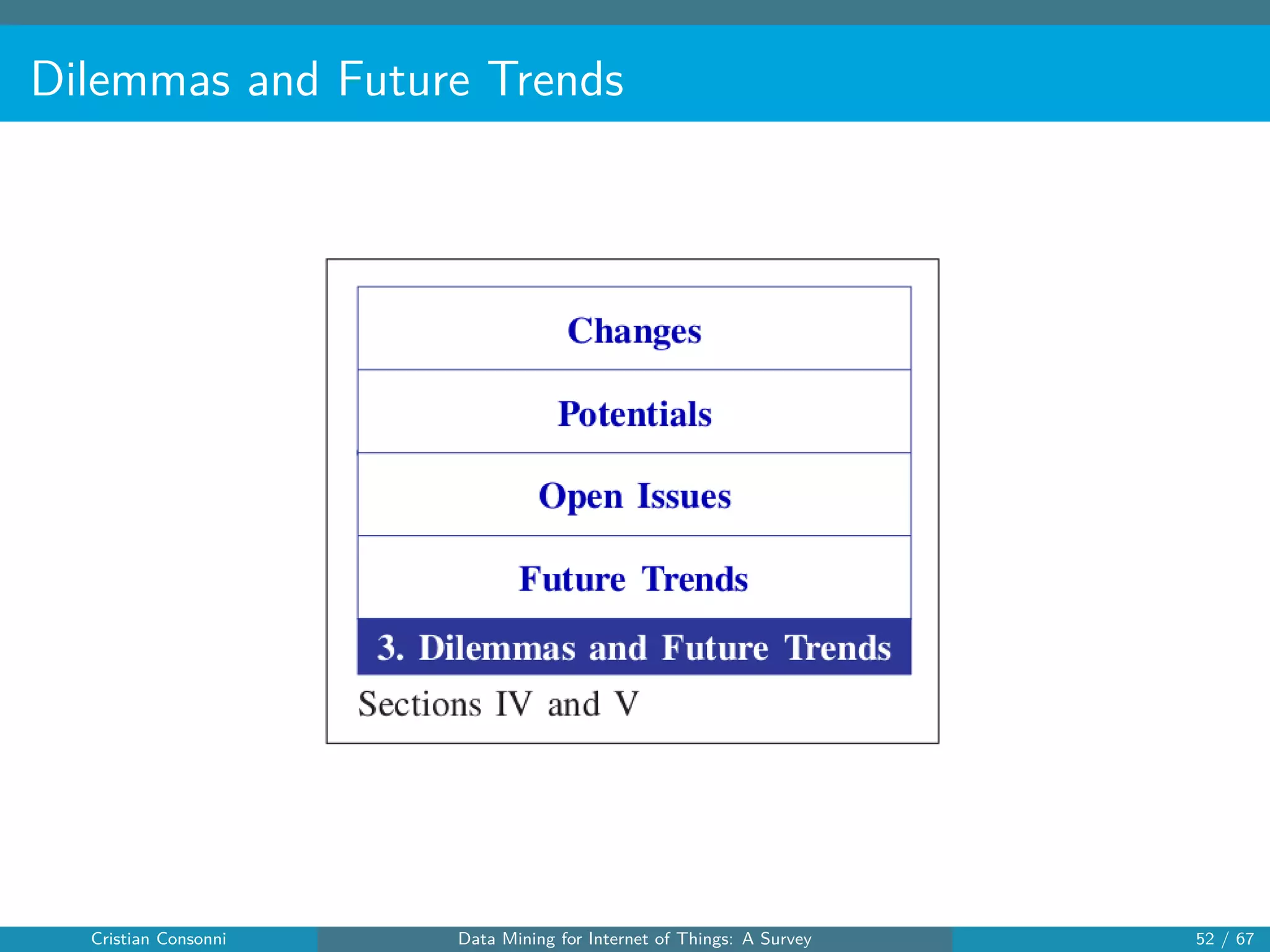
Dilemmas and Future Trends
Cristian Consonni Data Mining for Internet of Things: A Survey 52 / 67
Changes Caused by IoT
Cristian Consonni Data Mining for Internet of Things: A Survey 53 / 67
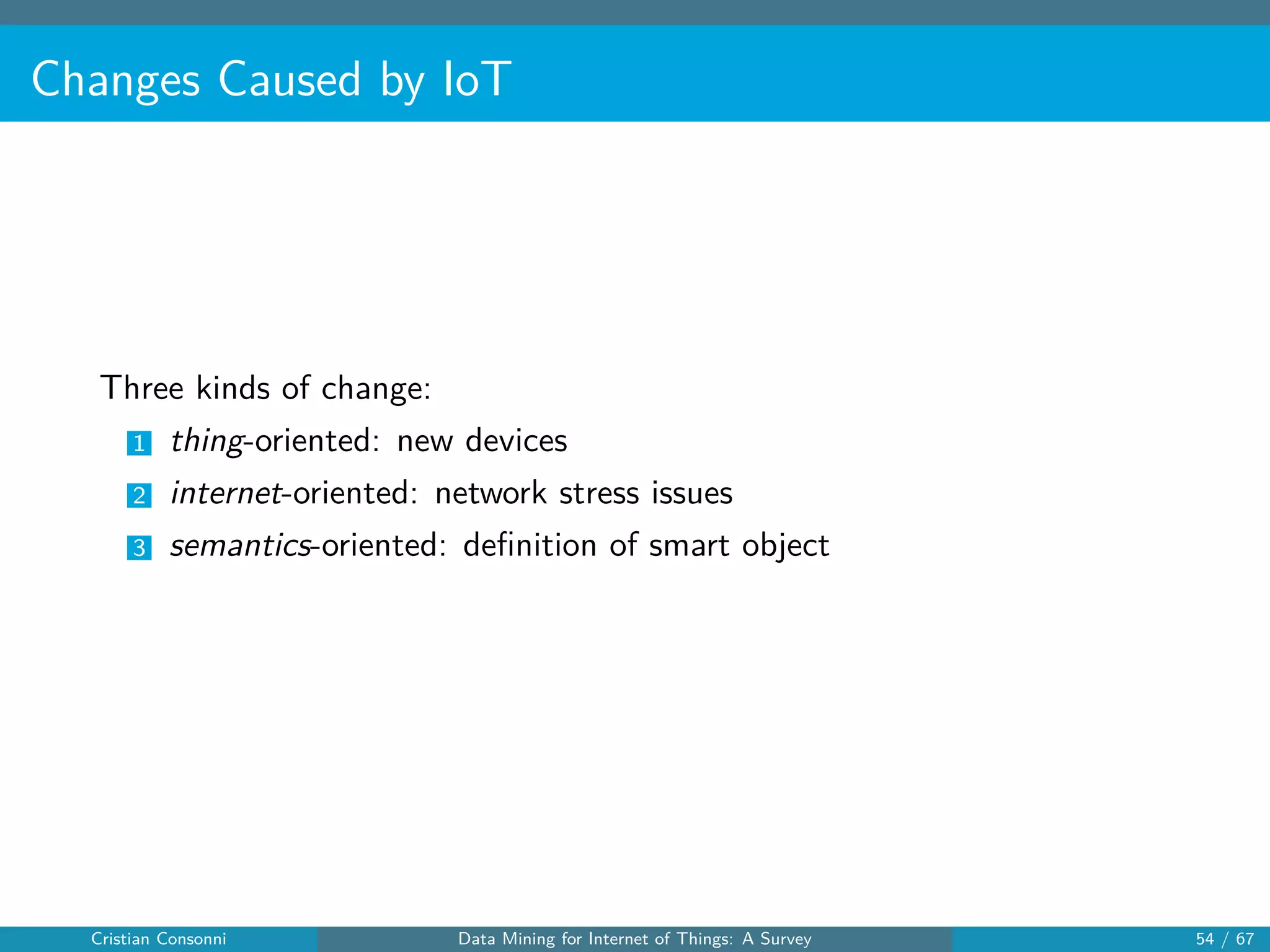
Changes Caused by IoT
Three kinds of change:
1 thing-oriented: new devices
2 internet-oriented: network stress issues
3 semantics-oriented: definition of smart object
Cristian Consonni Data Mining for Internet of Things: A Survey 54 / 67
Potentials of Using IoT
Cristian Consonni Data Mining for Internet of Things: A Survey 55 / 67
Potentials of Using IoT
IoT can be applied to several things
1 people-oriented: recommendations, support for decision making
2 self-oriented: enhance performace, automatic filtering of redundant
data
3 things-oriented: enhance machine-2-machine exchange of data
Cristian Consonni Data Mining for Internet of Things: A Survey 56 / 67
Open Issues of IoT
Open Issues of IoT
Cristian Consonni Data Mining for Internet of Things: A Survey 57 / 67
Infrastructure Perspective
Two main issues:
1 decentralization
2 heterogeneity
Cristian Consonni Data Mining for Internet of Things: A Survey 58 / 67
Data Perspective
Three main issues:
1 velocity
2 variety
3 velocity
→ determiny what needs to remain on the sensor is hard
Cristian Consonni Data Mining for Internet of Things: A Survey 59 / 67
Algorithm Perspective
Two main issues:
1 Flexibility
2 Dynamicity
* additional issue of how to combine mining technologies, becaise we
need smarter systems
Cristian Consonni Data Mining for Internet of Things: A Survey 60 / 67
Open Issues on Privacy and Security
ioT introducces many challenges about privacy and secutity:
1 sensors collect data that can be sensitive (e.g. video images, heealth
data)
2 concentration of data in big companies
3 how to protect access to sensors and data
Cristian Consonni Data Mining for Internet of Things: A Survey 61 / 67
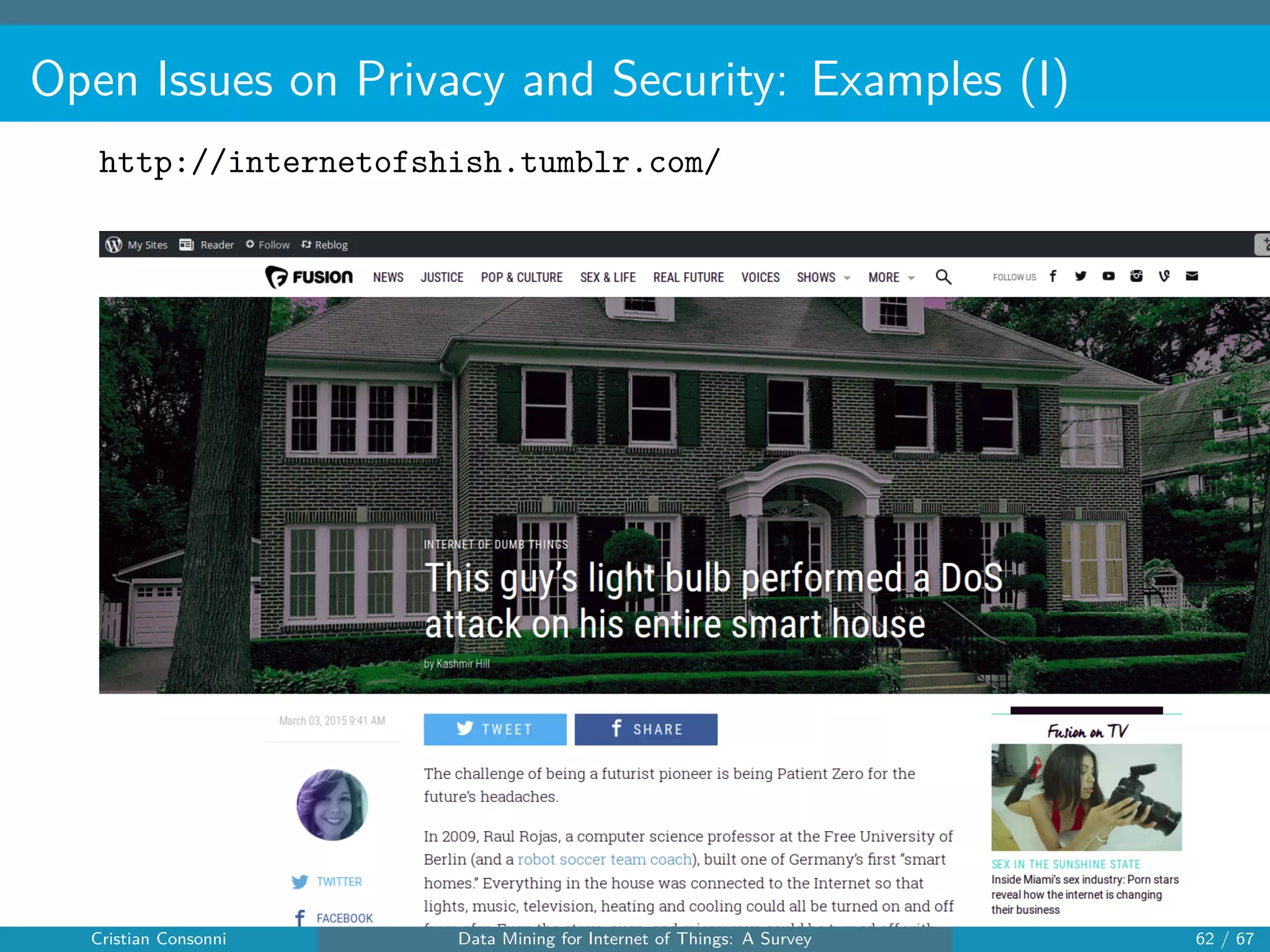
Open Issues on Privacy and Security: Examples (I)
http://internetofshish.tumblr.com/
Cristian Consonni Data Mining for Internet of Things: A Survey 62 / 67
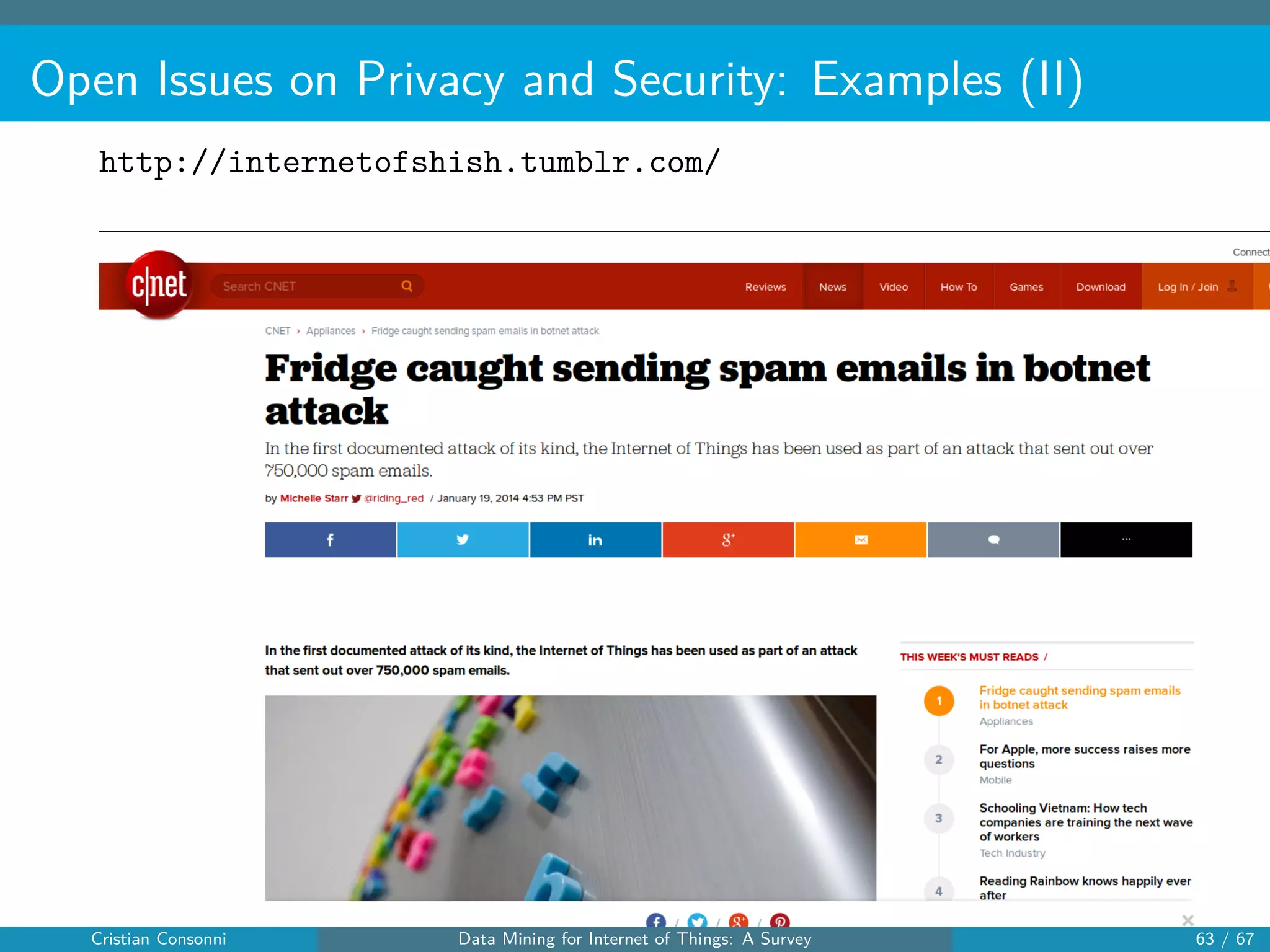
Open Issues on Privacy and Security: Examples (II)
http://internetofshish.tumblr.com/
Cristian Consonni Data Mining for Internet of Things: A Survey 63 / 67
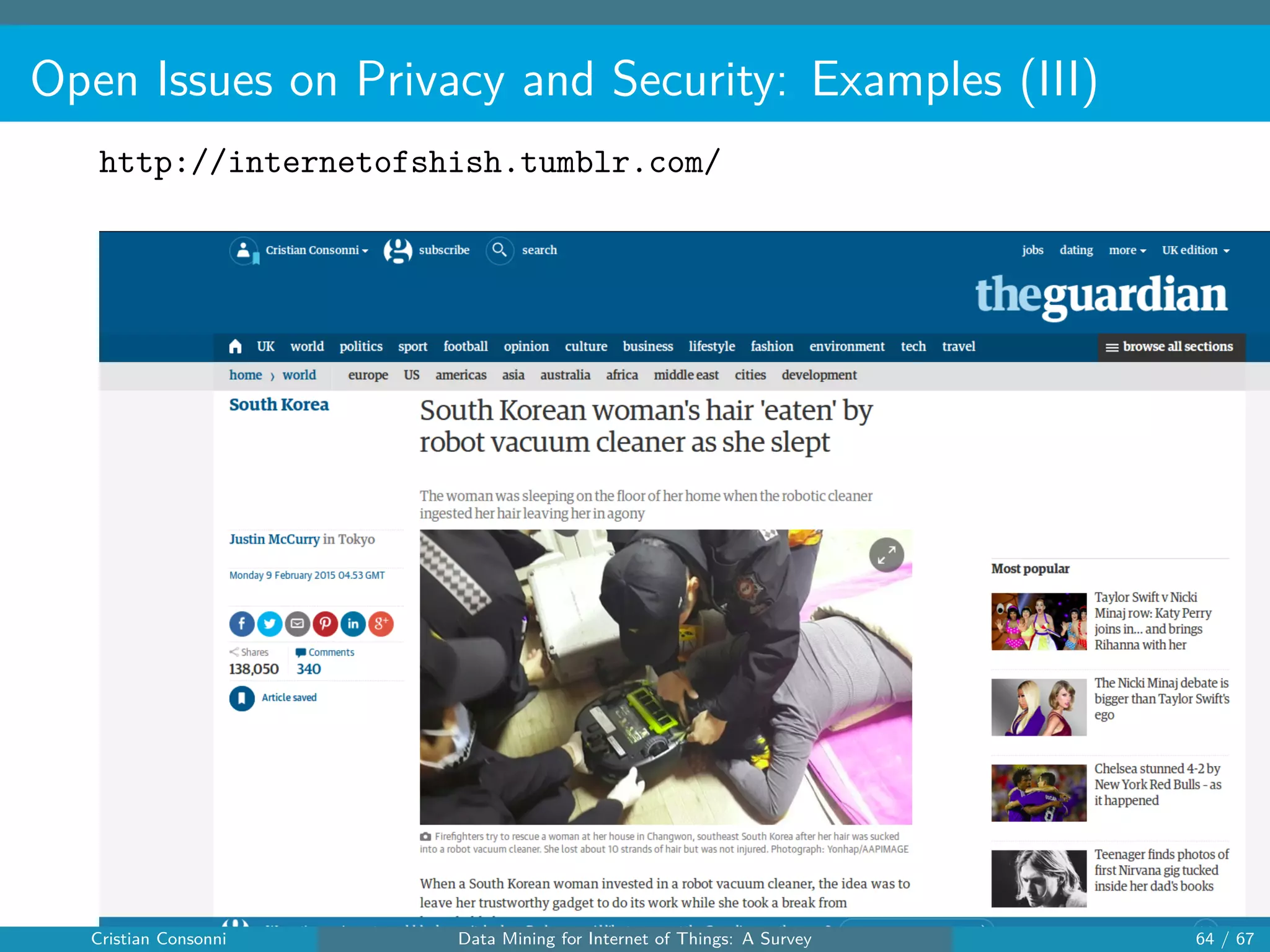
Open Issues on Privacy and Security: Examples (III)
http://internetofshish.tumblr.com/
Cristian Consonni Data Mining for Internet of Things: A Survey 64 / 67
Outline for section 5
1 Introduction
2 Data from IoT
3 Data Mining for IoT
Basic Idea of Using Data Mining for IoT
Clustering for IoT
Classification for IoT
Frequent Pattern Mining for IoT
Summary
4 Discussions
Changes Caused by IoT
Potentials of Using IoT
Open Issues of IoT
5 Conclusions
Cristian Consonni Data Mining for Internet of Things: A Survey 65 / 67
Conclusions
1 IoT and Big Data are trend of the future years;
2 Ontology and semantics can help solve the issue of dealing with Big
Data;
3 IoT, Big Data, Smart Grids, Cloud computing will impact our life at
the same time ⇒ we need to approach them together;
Cristian Consonni Data Mining for Internet of Things: A Survey 66 / 67
Thank you
Thank you!
Cristian Consonni Data Mining for Internet of Things: A Survey 67 / 67
Backup
Cristian Consonni Data Mining for Internet of Things: A Survey 1 / 5
Activities and Tasks
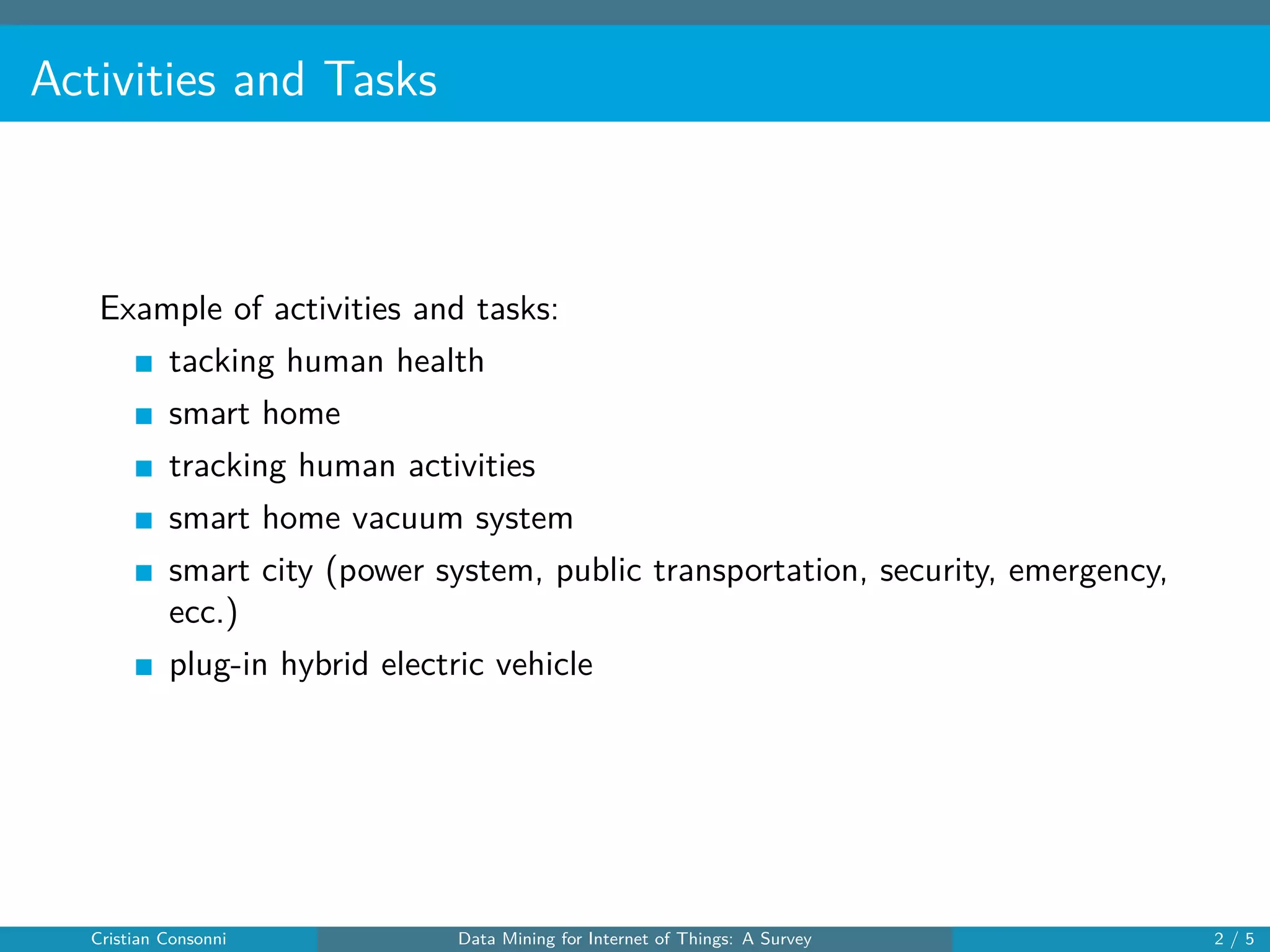
Example of activities and tasks:
tacking human health
smart home
tracking human activities
smart home vacuum system
smart city (power system, public transportation, security, emergency,
ecc.)
plug-in hybrid electric vehicle
Cristian Consonni Data Mining for Internet of Things: A Survey 2 / 5
Activities and Tasks
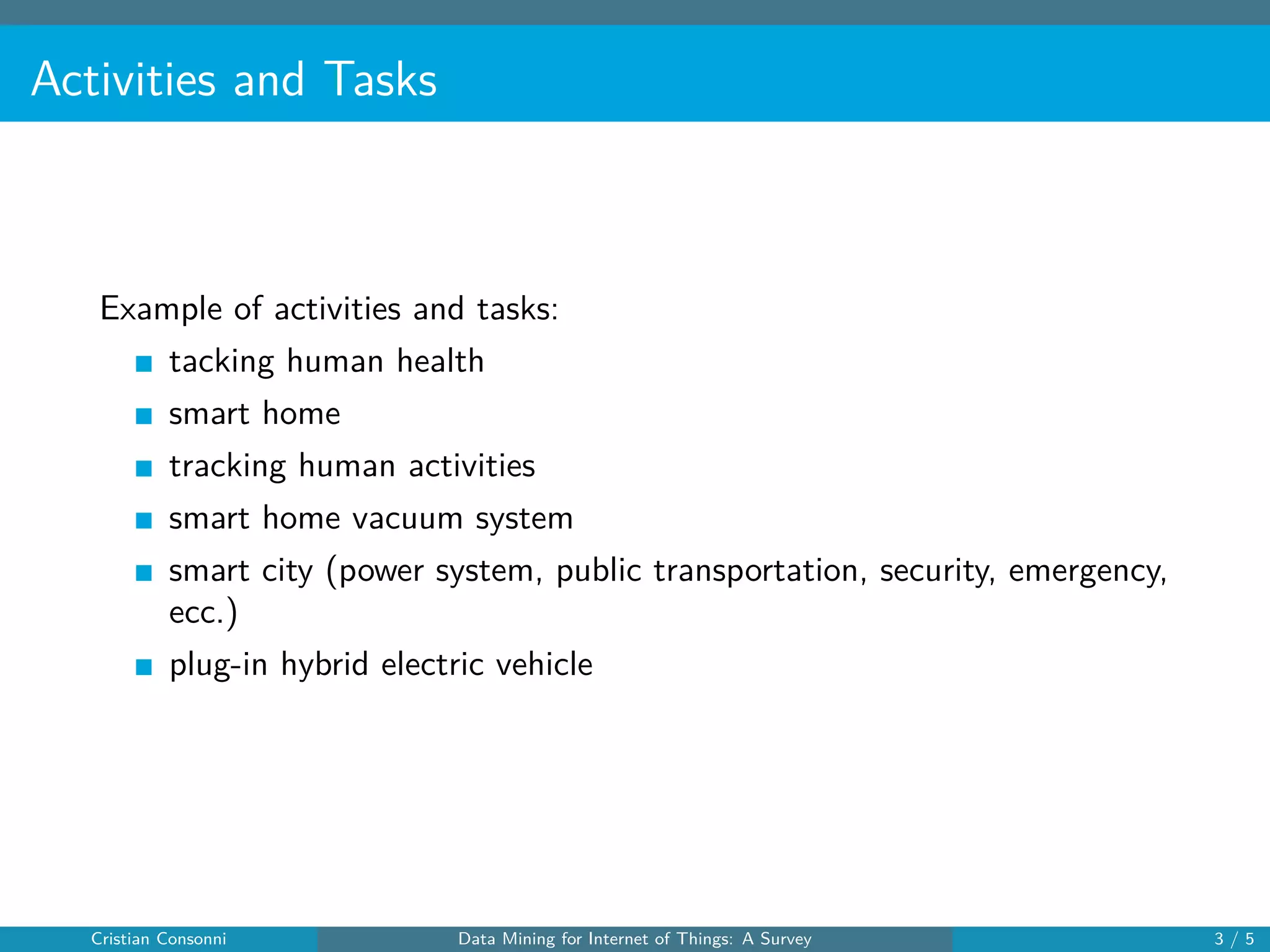
Example of activities and tasks:
tacking human health
smart home
tracking human activities
smart home vacuum system
smart city (power system, public transportation, security, emergency,
ecc.)
plug-in hybrid electric vehicle
Cristian Consonni Data Mining for Internet of Things: A Survey 3 / 5
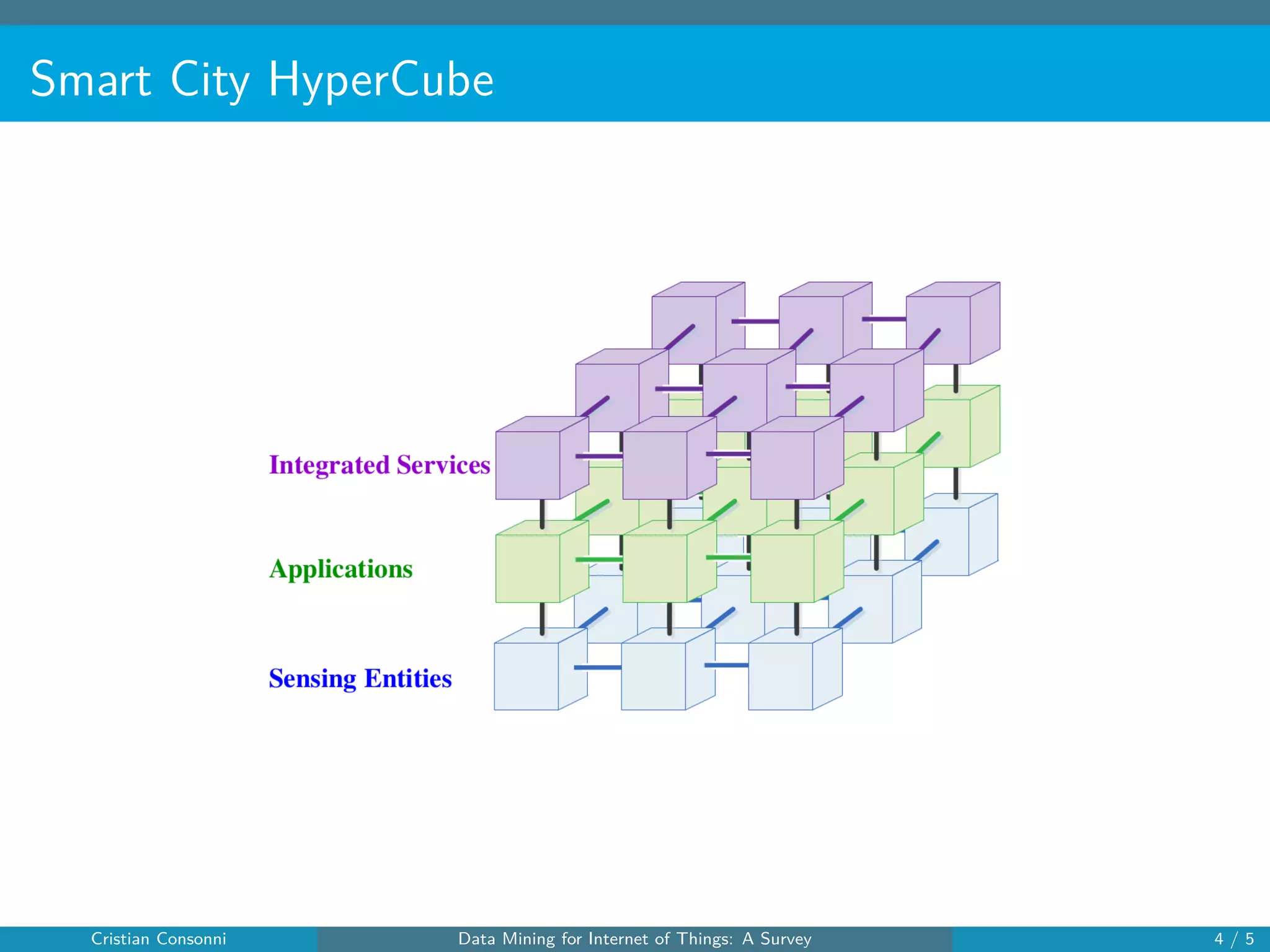
Smart City HyperCube
Cristian Consonni Data Mining for Internet of Things: A Survey 4 / 5
Credits
Superman image:
https://dgeiu3fz282x5.cloudfront.net/g/l/lgCV95054.jpg
Cristian Consonni Data Mining for Internet of Things: A Survey 5 / 5

Cloud computing and networking course: paper presentation -Data Mining for Internet of Things: A Survey

  • 1.
    Data Mining forInternet of Things: A Survey Cristian Consonni
  • 2.
    Data Mining forInternet of Things: A Survey C.-W. Tsai, C.-F. Lai, M.-C. Chang, and L. T. Yang Communications Surveys & Tutorials, IEEE 16.1 (2014): 77-97. url: http://ieeexplore.ieee.org/xpls/abs_all.jsp?arnumber=6674155. Cristian Consonni Data Mining for Internet of Things: A Survey 2 / 67
  • 3.
    Outline 1 Introduction 2 Datafrom IoT 3 Data Mining for IoT Basic Idea of Using Data Mining for IoT Clustering for IoT Classification for IoT Frequent Pattern Mining for IoT Summary 4 Discussions Changes Caused by IoT Potentials of Using IoT Open Issues of IoT 5 Conclusions Cristian Consonni Data Mining for Internet of Things: A Survey 3 / 67
  • 4.
    Roadmap Cristian Consonni DataMining for Internet of Things: A Survey 4 / 67
  • 5.
    Outline for section1 1 Introduction 2 Data from IoT 3 Data Mining for IoT Basic Idea of Using Data Mining for IoT Clustering for IoT Classification for IoT Frequent Pattern Mining for IoT Summary 4 Discussions Changes Caused by IoT Potentials of Using IoT Open Issues of IoT 5 Conclusions Cristian Consonni Data Mining for Internet of Things: A Survey 5 / 67
  • 6.
    Motivation and Problems CristianConsonni Data Mining for Internet of Things: A Survey 6 / 67
  • 7.
    Motivation 1 What isthe Internet of Things 2 Internet of Things → Big Data (data from IoT, data for IoT) 3 we need mining technologies 4 Data generated or captured by IoT are considered having highly useful and valuable information 5 Changes, Potentials, Open Issues, and Future Trends Cristian Consonni Data Mining for Internet of Things: A Survey 7 / 67
  • 8.
    Internet of Things:Definition (I) Definition Technology for seamlessly integrating classical networks and networked objects Cristian Consonni Data Mining for Internet of Things: A Survey 8 / 67
  • 9.
    Internet of Things:Motivation and Context Internet of Everything: url: http://www.cisco.com/web/about/ac79/docs/innov/IoE-Value-Index_External.pdf Cristian Consonni Data Mining for Internet of Things: A Survey 9 / 67
  • 10.
    Internet of Things:Definition (II) Cristian Consonni Data Mining for Internet of Things: A Survey 10 / 67
  • 11.
    Internet of Things:Architecture Cristian Consonni Data Mining for Internet of Things: A Survey 11 / 67
  • 12.
    Internet of Things:Characteristics Things in IoT are ”supposed to have intelligence”: Capable of being identified Capable of sensing events Capable of interacting with humans, other systems or the environment Capable of making decisions by themselves Cristian Consonni Data Mining for Internet of Things: A Survey 12 / 67
  • 13.
    Internet of Things:Motivation (II) High economic value 44B USD (2011) → 290B USD (2017) url: http://www.cisco.com/web/about/ac79/docs/innov/IoE-Value-Index_External.pdf Cristian Consonni Data Mining for Internet of Things: A Survey 13 / 67
  • 14.
    Internet of Things:Problem Statement Problem How do we trasform data collected by IoT in knowledge for people? Big Data and IoT Data are interesting for companies because they provide a competitive advantage Cristian Consonni Data Mining for Internet of Things: A Survey 14 / 67
  • 15.
    Internet of Things:Problem Statement Solution With knowledge Discovery in Databases (KDD) and Data Mining Cristian Consonni Data Mining for Internet of Things: A Survey 15 / 67
  • 16.
    Internet of Things:Motivation and Context (III) We want to find out hidden information in the data of IoT to: enhance the performance of the system improve the quality of the services provided Cristian Consonni Data Mining for Internet of Things: A Survey 16 / 67
  • 17.
    Outline for section2 1 Introduction 2 Data from IoT 3 Data Mining for IoT Basic Idea of Using Data Mining for IoT Clustering for IoT Classification for IoT Frequent Pattern Mining for IoT Summary 4 Discussions Changes Caused by IoT Potentials of Using IoT Open Issues of IoT 5 Conclusions Cristian Consonni Data Mining for Internet of Things: A Survey 17 / 67
  • 18.
    Data Deluge FromIoT ⇒ Bottleneck of data processing shift from sensors to data prerocessing, communication, storage Cristian Consonni Data Mining for Internet of Things: A Survey 18 / 67
  • 19.
    A Taxonomy forData From IoT Simple taxonomy for data from IoT: ”data about things”: data that describe the things themselves (state, location, identity, ...) → can be used to optimize the performance of the structure/system ”data generated by things”: data captured or sensed by the things as the result of the interaction between humans, things and humans, things and things, ... → can be used to enhance the service provided by IoT Cristian Consonni Data Mining for Internet of Things: A Survey 19 / 67
  • 20.
    How To Facethe Data Deluge There are several approaches to handle Big Data from IoT: Reduce the size of data: random sampling, acquire only the interesting data (pre-processing on the sensor using PCA or other dimensionality reduction), data condensation, feature selection Reduce the computational needs: divide and conquer, incremental learning Scale Out Computing Power: distributed computing, cloud computing Cristian Consonni Data Mining for Internet of Things: A Survey 20 / 67
  • 21.
    Decision Making Chain CristianConsonni Data Mining for Internet of Things: A Survey 21 / 67
  • 22.
    Goal of DataMining: Wisdom Knowledge Information (I) Cristian Consonni Data Mining for Internet of Things: A Survey 22 / 67
  • 23.
    Goal of DataMining: Wisdom Knowledge Information (II) Cristian Consonni Data Mining for Internet of Things: A Survey 23 / 67
  • 24.
    Caveats about DataMining for Knowledge Discovery data fusion, large scale data, data transmission, and decentralized computing issues may have a stronger impact on the system 0performance than KDD or data mining algorithms more data win over better algorithms: 1 “More data usually beats better algorithms” (http://bit.ly/datawocky-1) 2 “More data usually beats better algorithms, Part 2” (http://bit.ly/datawocky-2) 3 “More data beats better algorithm at predicting Google earnings” (http://bit.ly/datawocky-3) → by Stanford University professor Anand Rajaraman Cristian Consonni Data Mining for Internet of Things: A Survey 24 / 67
  • 25.
    Outline for section3 1 Introduction 2 Data from IoT 3 Data Mining for IoT Basic Idea of Using Data Mining for IoT Clustering for IoT Classification for IoT Frequent Pattern Mining for IoT Summary 4 Discussions Changes Caused by IoT Potentials of Using IoT Open Issues of IoT 5 Conclusions Cristian Consonni Data Mining for Internet of Things: A Survey 25 / 67
  • 26.
    Solutions and Results CristianConsonni Data Mining for Internet of Things: A Survey 26 / 67
  • 27.
    Problem Formalization Most miningtechnologies are designed to work on a single system, traditional algorithm cannot be applied to Big Data. Considerations when choosing the applicable mining technology: Objective (O): problem definition, assumption, limitations Data (D): characteristics of data (size, distribution, representation) Mining algorithm (A) → wireless sensor network have to count for the load of clustering algorithm, which is usually ignored Cristian Consonni Data Mining for Internet of Things: A Survey 27 / 67
  • 28.
    Unified Data MiningFramework → this framework can be used to describe metaheuristic algorithms Cristian Consonni Data Mining for Internet of Things: A Survey 28 / 67
  • 29.
    Clustering Clustering Cristian Consonni DataMining for Internet of Things: A Survey 29 / 67
  • 30.
    Characteristics of Clustering Clusteringis an unsupervised learning algorithm: input: unlabeled patterns X = {x1, x2, ...xn} (d-dimensional space); goal: k clusters Π = {π1, π2, ..., πk } based on a similarity metric; output: set of k centroids C = {c1, c2, ..., ck }; Quality can be measured using SSE or PSNR (it depends on the application) Cristian Consonni Data Mining for Internet of Things: A Survey 30 / 67
  • 31.
    Depiction of Clustering CristianConsonni Data Mining for Internet of Things: A Survey 31 / 67
  • 32.
    k-means k-means examples: 1 http://bit.ly/kmeans-1 2http://bit.ly/kmeans-2 Cristian Consonni Data Mining for Internet of Things: A Survey 32 / 67
  • 33.
    Clustering for Infrastructureof IoT Clustering can be applied to WSN to: enhance the performance of an IoT system on the integration of identification, sensing and actuation; reduce energy consumption (LEACH algorithm); speed-up data transmission (TPC algorithm); speed-up information exchange between nodes (dynamic clustering); Cristian Consonni Data Mining for Internet of Things: A Survey 33 / 67
  • 34.
    Clustering for Servicesof IoT Clustering can be applied to services provided by IoT to help devices make decision by themselves or provide better services. smart home mining frequent patterns, tracking user behavior in a smart home; improve location tracking from RFIDs (DBSCAN algorithm); improve agricultural productivity; studies on social networks using smartphones, personal digital assistants, ecc.; Cristian Consonni Data Mining for Internet of Things: A Survey 34 / 67
  • 35.
    Classification Classification Cristian Consonni DataMining for Internet of Things: A Survey 35 / 67
  • 36.
    Characteristics of Classification Clusteringis an supervised learning algorithm: input: set of labeled data L and unlabeled daata U; output: Labeled data are used to train a set of classifiers; goal: label unlabeled data; Quality can be measured using accuracy Rate (AR), Precision (P), recal; (R) and F-measure (F) Cristian Consonni Data Mining for Internet of Things: A Survey 36 / 67
  • 37.
    Depiction of Classification(II) Cristian Consonni Data Mining for Internet of Things: A Survey 37 / 67
  • 38.
    Classification Algorithms Several algorithmscan be used as classifiers Decision trees: k-nearest neighbor: Naive Bayes classification: adaboost Support Vector Machine (SVM) (note: non-linear): Cristian Consonni Data Mining for Internet of Things: A Survey 38 / 67
  • 39.
    Classification for Infrastructureof Iot Classification algorithms are applied to the problem of identification of devices: Unique Item Identifier (UII): Several standards have been idenpendently developed: lots of UII queries (more than current DNS queries): Cristian Consonni Data Mining for Internet of Things: A Survey 39 / 67
  • 40.
    Classification for Infrastructureof Iot Classification can be applied to: outdoor tasks: traffic jam problem: traffic forecasting services, accident detection, detecting traffic information from social netwrks; parking problem: passive infra-red sensor; indoor tasks: healtcare and smart home systems: infrared presence sensors, microphones, wearable kinematic sensors definition of activities: bathing, dressing, etc. detect posture and falling event avoid suddend death events replace ECG in hospital with home systems other tasks object identification face recognition facial expression classification Note: especially indoor system raise important privacy concerns. Cristian Consonni Data Mining for Internet of Things: A Survey 40 / 67
  • 41.
    Frequent Pattern Mining FrequentPattern Mining Cristian Consonni Data Mining for Internet of Things: A Survey 41 / 67
  • 42.
    Characteristics of FrequentPattern Mining Frequent Pattern Mining is an unsupervised learning algorithm: input: set of sequeces; output: most common sequences; goal: find “interesting patterns” from a large set of items; we introduce the notion of support and confidence Cristian Consonni Data Mining for Internet of Things: A Survey 42 / 67
  • 43.
    Depiction of FrequentPattern Mining Cristian Consonni Data Mining for Internet of Things: A Survey 43 / 67
  • 44.
    Frequent Pattern Miningfor Infrastructure of IoT Several application of Frequent Pattern Mining for Infrastructure of IoT: temporal data mining, privacy preserving on IoT, web usage mining, bionformatics, intrusion detection: 90% of the data crreated today is born in electronic form manage RFID events, spatial collocation mining in GIS Cristian Consonni Data Mining for Internet of Things: A Survey 44 / 67
  • 45.
    Frequent Pattern forServices of IoT Frequent Pattern Mining can be used to provide better services to IoT users: analyze purchase behavior is classic but still active: help customer find products they are looking for quickly (customer specific rules, category-based rules, association rules) Cristian Consonni Data Mining for Internet of Things: A Survey 45 / 67
  • 46.
    Summary Summary of Mining Technologies CristianConsonni Data Mining for Internet of Things: A Survey 46 / 67
  • 47.
    Overall Comparison Cristian ConsonniData Mining for Internet of Things: A Survey 47 / 67
  • 48.
    Technology Comparison Three rules: r1:divide or classify patterns vs discovering patterns r2: clustering vs classification r3: associative rules vs sequential patterns Cristian Consonni Data Mining for Internet of Things: A Survey 48 / 67
  • 49.
    Technology Comparison Three rules: r1:divide or classify patterns vs discovering patterns r2: clustering vs classification r3: associative rules vs sequential patterns Cristian Consonni Data Mining for Internet of Things: A Survey 48 / 67
  • 50.
    Technology Comparison Three rules: r1:divide or classify patterns vs discovering patterns r2: clustering vs classification r3: associative rules vs sequential patterns Cristian Consonni Data Mining for Internet of Things: A Survey 48 / 67
  • 51.
    How to Chooseyour Mining Technology (I) Based on use case: clustering: classify patterns all of which are unlabeled classification: classify patterns some of which are unlabeled and some labeled association rules: find events in no particular order sequential patterns: find events in some particular order Cristian Consonni Data Mining for Internet of Things: A Survey 49 / 67
  • 52.
    How to Chooseyour Mining Technology (II) Combination of technologies: clustering → classification: unsupervised classification system, clustering creates a set of classifiers then classify incoming patterns classification → clustering: semi-supervised learning system or incremental classification system: classifiers from labeled patterns, clustering is used to incrementally add new classifiers enable handling of new patterns clustering → classification: unsupervised classification system, clustering creates a set of classifiers then classify incoming patterns clustering → classification → frequent pattern, classification → clustering → frequent pattern clustering creates a set of classifiers then classify incoming patterns iterative systems where a solution is applied several times Cristian Consonni Data Mining for Internet of Things: A Survey 50 / 67
  • 53.
    Outline for section4 1 Introduction 2 Data from IoT 3 Data Mining for IoT Basic Idea of Using Data Mining for IoT Clustering for IoT Classification for IoT Frequent Pattern Mining for IoT Summary 4 Discussions Changes Caused by IoT Potentials of Using IoT Open Issues of IoT 5 Conclusions Cristian Consonni Data Mining for Internet of Things: A Survey 51 / 67
  • 54.
    Dilemmas and FutureTrends Cristian Consonni Data Mining for Internet of Things: A Survey 52 / 67
  • 55.
    Changes Caused byIoT Changes Caused by IoT Cristian Consonni Data Mining for Internet of Things: A Survey 53 / 67
  • 56.
    Changes Caused byIoT Three kinds of change: 1 thing-oriented: new devices 2 internet-oriented: network stress issues 3 semantics-oriented: definition of smart object Cristian Consonni Data Mining for Internet of Things: A Survey 54 / 67
  • 57.
    Potentials of UsingIoT Potentials of Using IoT Cristian Consonni Data Mining for Internet of Things: A Survey 55 / 67
  • 58.
    Potentials of UsingIoT IoT can be applied to several things 1 people-oriented: recommendations, support for decision making 2 self-oriented: enhance performace, automatic filtering of redundant data 3 things-oriented: enhance machine-2-machine exchange of data Cristian Consonni Data Mining for Internet of Things: A Survey 56 / 67
  • 59.
    Open Issues ofIoT Open Issues of IoT Cristian Consonni Data Mining for Internet of Things: A Survey 57 / 67
  • 60.
    Infrastructure Perspective Two mainissues: 1 decentralization 2 heterogeneity Cristian Consonni Data Mining for Internet of Things: A Survey 58 / 67
  • 61.
    Data Perspective Three mainissues: 1 velocity 2 variety 3 velocity → determiny what needs to remain on the sensor is hard Cristian Consonni Data Mining for Internet of Things: A Survey 59 / 67
  • 62.
    Algorithm Perspective Two mainissues: 1 Flexibility 2 Dynamicity * additional issue of how to combine mining technologies, becaise we need smarter systems Cristian Consonni Data Mining for Internet of Things: A Survey 60 / 67
  • 63.
    Open Issues onPrivacy and Security ioT introducces many challenges about privacy and secutity: 1 sensors collect data that can be sensitive (e.g. video images, heealth data) 2 concentration of data in big companies 3 how to protect access to sensors and data Cristian Consonni Data Mining for Internet of Things: A Survey 61 / 67
  • 64.
    Open Issues onPrivacy and Security: Examples (I) http://internetofshish.tumblr.com/ Cristian Consonni Data Mining for Internet of Things: A Survey 62 / 67
  • 65.
    Open Issues onPrivacy and Security: Examples (II) http://internetofshish.tumblr.com/ Cristian Consonni Data Mining for Internet of Things: A Survey 63 / 67
  • 66.
    Open Issues onPrivacy and Security: Examples (III) http://internetofshish.tumblr.com/ Cristian Consonni Data Mining for Internet of Things: A Survey 64 / 67
  • 67.
    Outline for section5 1 Introduction 2 Data from IoT 3 Data Mining for IoT Basic Idea of Using Data Mining for IoT Clustering for IoT Classification for IoT Frequent Pattern Mining for IoT Summary 4 Discussions Changes Caused by IoT Potentials of Using IoT Open Issues of IoT 5 Conclusions Cristian Consonni Data Mining for Internet of Things: A Survey 65 / 67
  • 68.
    Conclusions 1 IoT andBig Data are trend of the future years; 2 Ontology and semantics can help solve the issue of dealing with Big Data; 3 IoT, Big Data, Smart Grids, Cloud computing will impact our life at the same time ⇒ we need to approach them together; Cristian Consonni Data Mining for Internet of Things: A Survey 66 / 67
  • 69.
    Thank you Thank you! CristianConsonni Data Mining for Internet of Things: A Survey 67 / 67
  • 70.
    Backup Cristian Consonni DataMining for Internet of Things: A Survey 1 / 5
  • 71.
    Activities and Tasks Exampleof activities and tasks: tacking human health smart home tracking human activities smart home vacuum system smart city (power system, public transportation, security, emergency, ecc.) plug-in hybrid electric vehicle Cristian Consonni Data Mining for Internet of Things: A Survey 2 / 5
  • 72.
    Activities and Tasks Exampleof activities and tasks: tacking human health smart home tracking human activities smart home vacuum system smart city (power system, public transportation, security, emergency, ecc.) plug-in hybrid electric vehicle Cristian Consonni Data Mining for Internet of Things: A Survey 3 / 5
  • 73.
    Smart City HyperCube CristianConsonni Data Mining for Internet of Things: A Survey 4 / 5
  • 74.