Use the following information to
help you complete your Early
African Civilizations Booklet
Mansa Musa ruled Mali from 1312 to 1337. He expanded its empire to twice
its original size and also gained control of trade routes throughout Africa. Mali’s two
most valuable trade goods, gold and salt, reached the ends of the continent on these
routes. In 1324 Mansa Musa, who was a Muslim, decided to go on a pilgrimage, or
hajj, to Makkah. The king assembled a huge caravan that traveled with him on his
journey. This caravan helped Mansa Musa establish an important position for
himself and Mali in the Muslim world.
Mansa Musa’s caravan included thousands of soldiers and servants, along with
80 camels carrying over two tons of gold. On his way to Makkah, Mansa Musa
stopped in Cairo he spent large sums of money and gave many gifts of gold. He
brought so much gold with him that he made the value of gold fall. Mansa Musa
then continued on to Makkah. The sights he saw in Makkah inspired him to create
great mosques, libraries, and universities in Mali. When Mansa Musa returned to
Mali, he brought back many Arab scholars, architects, and poets who helped build his
home city of Timbuktu into a center for Islamic studies.
Sundiata
• The griots of West Africa still tell the 700-year-old story of a sickly boy named
Sundiata, who grew up to become a great warrior, defeated a brutal enemy, and
united the Mandinka people.
• Sundiata was one of twelve sons of a Mandinka warrior. Samanguru killed all of
Sundiata’s brothers, but spared the future warrior. Samanguru believed the
young Sundiata was sickly and would soon die anyway. That mistake would lead
to Samanguru’s downfall. The ill child recovered and eventually assembled an
army to confront Samanguru. Sundiata’s forces killed Samanguru and destroyed
his forces in the Battle of Kirina in 1235. Sundiata then became mansa, or king, of
a new empire that we know today as Mali. Mali means “where the king resides.”
• He also worked to improve agriculture and introduced cotton.
• Video
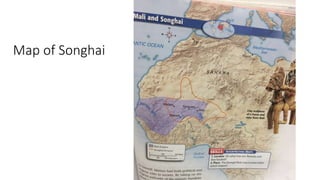
Map of Songhai
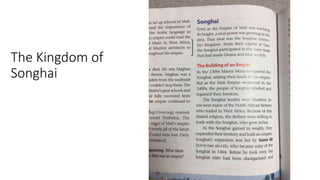
The Kingdom of
Songhai
More Songhai
Askia the Great
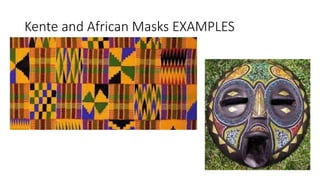
Kente and African Masks EXAMPLES

Booklet information

  • 1.
    Use the followinginformation to help you complete your Early African Civilizations Booklet
  • 2.
    Mansa Musa ruledMali from 1312 to 1337. He expanded its empire to twice its original size and also gained control of trade routes throughout Africa. Mali’s two most valuable trade goods, gold and salt, reached the ends of the continent on these routes. In 1324 Mansa Musa, who was a Muslim, decided to go on a pilgrimage, or hajj, to Makkah. The king assembled a huge caravan that traveled with him on his journey. This caravan helped Mansa Musa establish an important position for himself and Mali in the Muslim world. Mansa Musa’s caravan included thousands of soldiers and servants, along with 80 camels carrying over two tons of gold. On his way to Makkah, Mansa Musa stopped in Cairo he spent large sums of money and gave many gifts of gold. He brought so much gold with him that he made the value of gold fall. Mansa Musa then continued on to Makkah. The sights he saw in Makkah inspired him to create great mosques, libraries, and universities in Mali. When Mansa Musa returned to Mali, he brought back many Arab scholars, architects, and poets who helped build his home city of Timbuktu into a center for Islamic studies.
  • 3.
    Sundiata • The griotsof West Africa still tell the 700-year-old story of a sickly boy named Sundiata, who grew up to become a great warrior, defeated a brutal enemy, and united the Mandinka people. • Sundiata was one of twelve sons of a Mandinka warrior. Samanguru killed all of Sundiata’s brothers, but spared the future warrior. Samanguru believed the young Sundiata was sickly and would soon die anyway. That mistake would lead to Samanguru’s downfall. The ill child recovered and eventually assembled an army to confront Samanguru. Sundiata’s forces killed Samanguru and destroyed his forces in the Battle of Kirina in 1235. Sundiata then became mansa, or king, of a new empire that we know today as Mali. Mali means “where the king resides.” • He also worked to improve agriculture and introduced cotton. • Video
  • 4.
  • 5.
  • 6.
  • 7.
  • 8.
    Kente and AfricanMasks EXAMPLES