PRESENT PERFECT  TENSE Have you  ever...
When to use Present Perfect Tense? 1) We use the Present Perfect Tense to talk about  experiences . It is important if we have done it in our lives or not.  It is not important when we did it. Examples      I have been abroad two times.     Anna has never broken a leg.     Have you ever eaten sushi?  Tip!   We often use  never  and  ever  with the Present Perfect Tense to talk about experience.
2) We use the Present Perfect Tense to talk about an  action which started in the past and continuous up to now . Examples      I have been a teacher for more than ten years.     We haven't seen Janine since Friday.     How long have you been at this school?  Tip!  We often use  since  and  for  to say how long the action has lasted.
3) We also use the Present Perfect Tense to talk about a  past action that has the result in the present . Examples     I have lost my wallet. = I don't have it now.     Jimmy has gone to South America. = He isn't here now.     Have you finished your homework? = Is your homework ready?  Tip!   We often use  just ,  already  and  yet  with the Present Perfect Tense for an action in the past with the result in the present.
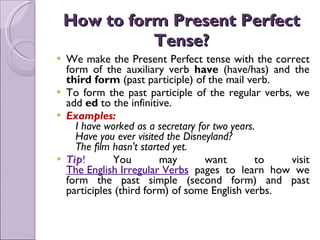
How to form Present Perfect Tense? We make the Present Perfect tense with the correct form of the auxiliary verb  have  (have/has) and the  third form  (past participle) of the mail verb. To form the past participle of the regular verbs, we add  ed  to the infinitive. Examples:    I have worked as a secretary for two years.    Have you ever visited the Disneyland?    The film hasn't started yet. Tip !  You may want to visit  The English Irregular Verbs   pages to learn how we form the past simple (second form) and past participles (third form) of some English verbs.
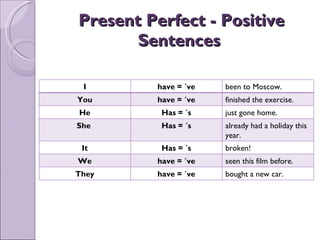
Present Perfect - Positive Sentences  I have = ´ve been to Moscow. You have = ´ve finished the exercise. He Has = ´s just gone home. She   Has = ´s already had a holiday this year. It Has = ´s broken! We have = ´ve seen this film before. They have = ´ve bought a new car.
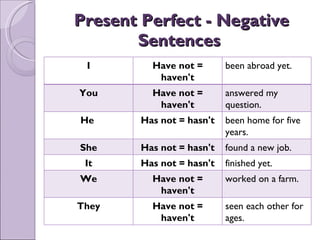
Present Perfect - Negative Sentences  I Have not = haven't been abroad yet. You Have not = haven't answered my question. He  Has not = hasn't been home for five years. She Has not = hasn't found a new job. It Has not = hasn't finished yet. We Have not = haven't worked on a farm. They Have not = haven't seen each other for ages.
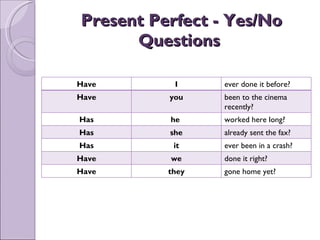
Present Perfect - Yes/No Questions  Have I ever done it before? Have you been to the cinema recently? Has he  worked here long? Has she already sent the fax? Has it ever been in a crash? Have we done it right? Have they gone home yet?
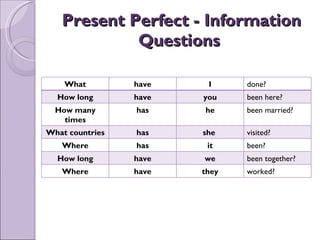
Present Perfect - Information Questions  What have I done? How long have you been here? How many times has he been married? What countries has she  visited? Where has it been? How long have we been together? Where have they worked?
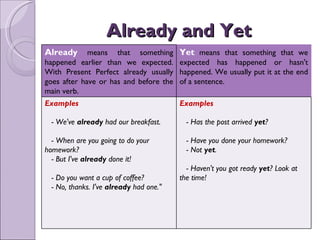
Already and Yet  Already   means that something happened earlier than we expected. With Present Perfect already usually goes after have or has and before the main verb. Yet  means that something that we expected has happened or hasn't happened. We usually put it at the end of a sentence. Examples     - We've  already  had our breakfast.     - When are you going to do your homework?    - But I've  already  done it!     - Do you want a cup of coffee?    - No, thanks. I've  already  had one."  Examples     - Has the post arrived  yet ?     - Have you done your homework?    - Not  yet .    - Haven't you got ready  yet ? Look at the time!
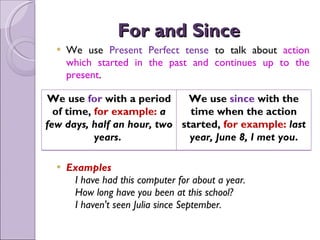
For and Since  We use  Present Perfect tense  to talk about  action which started in the past and continues up to the present . Examples     I have had this computer for about a year.     How long have you been at this school?     I haven't seen Julia since September.  We use  for  with a period of time,  for example:  a few days, half an hour, two years .  We use  since  with the time when the action started,  for example:  last year, June 8, I met you .

PRESENT PERFECT TENSE

  • 1.
    PRESENT PERFECT TENSE Have you ever...
  • 2.
    When to usePresent Perfect Tense? 1) We use the Present Perfect Tense to talk about experiences . It is important if we have done it in our lives or not. It is not important when we did it. Examples    I have been abroad two times.    Anna has never broken a leg.    Have you ever eaten sushi? Tip! We often use never and ever with the Present Perfect Tense to talk about experience.
  • 3.
    2) We usethe Present Perfect Tense to talk about an action which started in the past and continuous up to now . Examples    I have been a teacher for more than ten years.    We haven't seen Janine since Friday.    How long have you been at this school? Tip! We often use since and for to say how long the action has lasted.
  • 4.
    3) We alsouse the Present Perfect Tense to talk about a past action that has the result in the present . Examples    I have lost my wallet. = I don't have it now.    Jimmy has gone to South America. = He isn't here now.    Have you finished your homework? = Is your homework ready? Tip! We often use just , already and yet with the Present Perfect Tense for an action in the past with the result in the present.
  • 5.
    How to formPresent Perfect Tense? We make the Present Perfect tense with the correct form of the auxiliary verb have (have/has) and the third form (past participle) of the mail verb. To form the past participle of the regular verbs, we add ed to the infinitive. Examples:    I have worked as a secretary for two years.    Have you ever visited the Disneyland?    The film hasn't started yet. Tip ! You may want to visit The English Irregular Verbs pages to learn how we form the past simple (second form) and past participles (third form) of some English verbs.
  • 6.
    Present Perfect -Positive Sentences I have = ´ve been to Moscow. You have = ´ve finished the exercise. He Has = ´s just gone home. She Has = ´s already had a holiday this year. It Has = ´s broken! We have = ´ve seen this film before. They have = ´ve bought a new car.
  • 7.
    Present Perfect -Negative Sentences I Have not = haven't been abroad yet. You Have not = haven't answered my question. He Has not = hasn't been home for five years. She Has not = hasn't found a new job. It Has not = hasn't finished yet. We Have not = haven't worked on a farm. They Have not = haven't seen each other for ages.
  • 8.
    Present Perfect -Yes/No Questions Have I ever done it before? Have you been to the cinema recently? Has he worked here long? Has she already sent the fax? Has it ever been in a crash? Have we done it right? Have they gone home yet?
  • 9.
    Present Perfect -Information Questions What have I done? How long have you been here? How many times has he been married? What countries has she visited? Where has it been? How long have we been together? Where have they worked?
  • 10.
    Already and Yet Already means that something happened earlier than we expected. With Present Perfect already usually goes after have or has and before the main verb. Yet means that something that we expected has happened or hasn't happened. We usually put it at the end of a sentence. Examples    - We've already had our breakfast.    - When are you going to do your homework?    - But I've already done it!    - Do you want a cup of coffee?    - No, thanks. I've already had one." Examples    - Has the post arrived yet ?    - Have you done your homework?    - Not yet .    - Haven't you got ready yet ? Look at the time!
  • 11.
    For and Since We use Present Perfect tense to talk about action which started in the past and continues up to the present . Examples    I have had this computer for about a year.    How long have you been at this school?    I haven't seen Julia since September. We use for with a period of time, for example: a few days, half an hour, two years . We use since with the time when the action started, for example: last year, June 8, I met you .