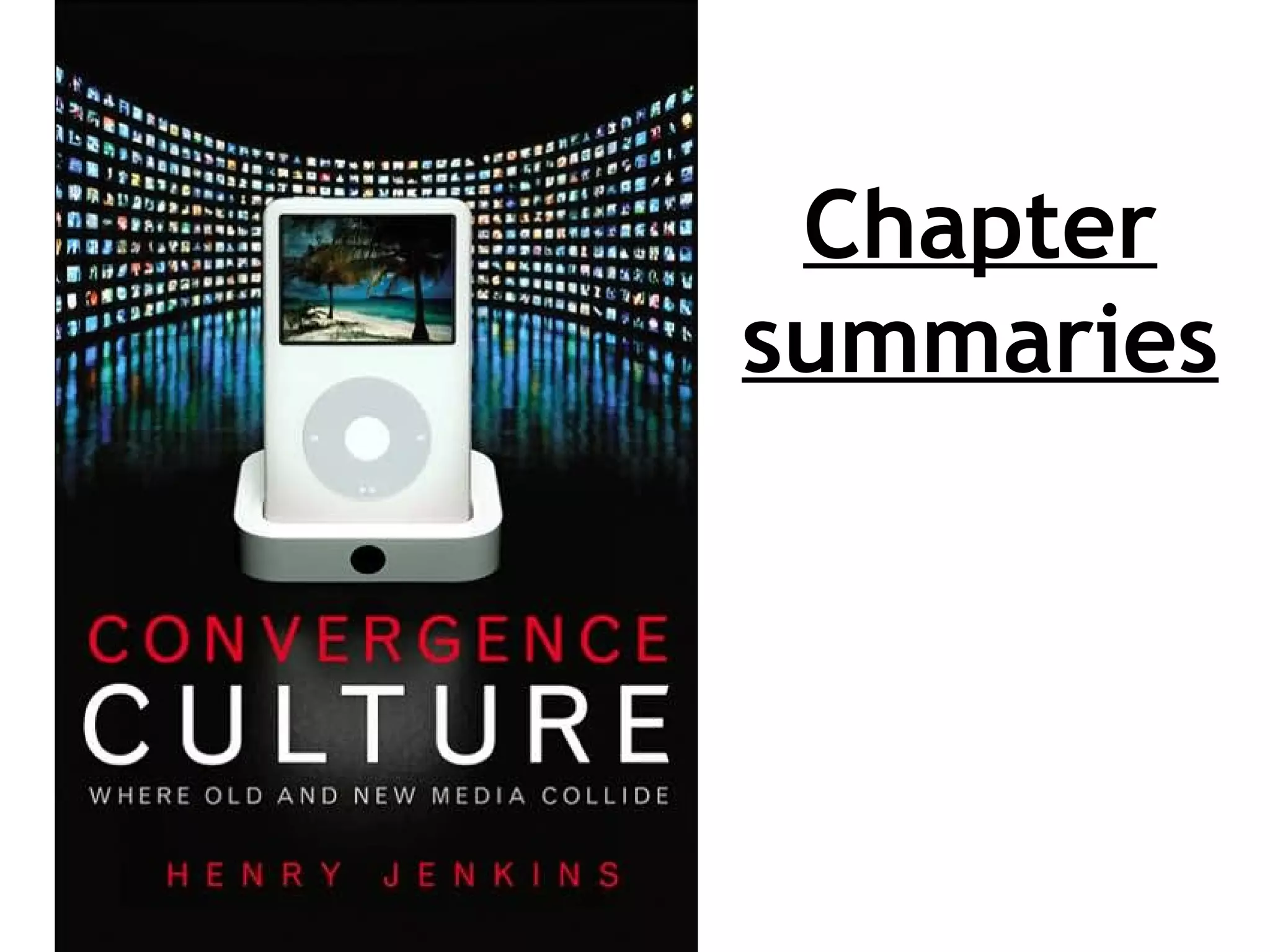
Chapter summaries
Chapter 1: Survivor The first of which begins in his first chapter, Spoiling Survivor, where he outlines the impact of a communal reception of the TV show "Survivor." By looking at one of the most democratic uses of the Internet (message boards), Jenkins analyzes Survivor fans' interactions with "spoilers" of the show, calling it "collective intelligence in practice" (p.28). Here, he explains the idea that while not one person knows everything, everyone knows something and can bring some small bit of relevance to the discussion to, in this case, find a solution. In addition, Jenkins evaluates how this type of "bottom-up" collaboration can be both helpful and detrimental to brands and franchises.
Chapter 2: American Idol Jenkins explores the grassroots culture of the Internet more in his second chapter where he discusses American Idol, a TV show made for audience participation. He begins the chapter by explaining the power of marketing brands via multiple "transactions," instead of using traditionally isolated mediums. He writes, "The experience should not be contained within a single media platform, but should extend across as many media as possible" (p.69). This method allows for advertisers, like Coca Cola, to be more than intellectual property; they are emotional capital. And in such a participant-oriented show that allows viewers to text in their votes, fans become more involved with the brand and may even become "brand advocates" (p.73). Jenkins explains, "Participation within such communities does not simply reaffirm their brand affiliation but also empowers these groups to assert their own demands on the company" (p.80).
Chapter 3: The Matrix In his third chapter, Jenkins looks at how the Matrix franchise uses several platforms to reach its multifaceted fan base, and considers it "entertainment for the age of media convergence, integrating multiple texts to create a narrative so large that it cannot be contained within a single medium" (p.96). As he explains how the transmedia story flows across different media forums, he illustrates how each medium brings a "distinctive and valuable contribution to the whole" (p.98). This way, the story may stretch far beyond the original plot, and the user creates it, and Jenkins explains that the convergence of media has allowed for such occurrences. However, Jenkins says that when creators have their hands in developing the other mediums, like video games, interactive Web creations and such, the stories are more likely to gain a following and develop further. His key point in the chapter was that while not all users will choose to "go deep" with the material, creators must allow the option.
Chapter 4: Star Wars Jenkins then explains the success of the Star Wars franchise and how users have become co-creators, or participants, in the stories via the Web and the onset of the digital age. Here, he explains the difference between participation and interactivity. Jenkins writes, "Interactivity refers to the ways that new technologies have been designed to be more responsive to consumer feedback...Participation, on the other hand, is shaped by the cultural and social protocols" (p.137). So, while the creators decide interactivity, and users may interact with what is given, participation allows users to become creators of the story. However, this blurring of creation on the Web has caused both problems and new directions. Jenkins explores two schools of thought on this issue: prohibitionists, who are usually characterized by traditional media, that try to limit all creation outside the originators, and collaborationists, who are usually led by "new media" and digital groups, that allow grassroots intermediaries to help promote the franchised. Jenkins likens this dichotomy with the battle between folk culture (grassroots campaigns) and mass culture (commercialism), as he cites several examples of how specific Star Wars spoofs and recreations have faired with George Lucas and the commercial media in terms of copyright infringement.
Chapter 5: Harry Potter Moving beyond the television and silver screen, Jenkins then discusses the Harry Potter franchise in light of new media. Besides explaining some of the campaigns and movements against its content by conservative groups, Jenkins explores whether schools are doing a well enough job in educating students in media, and whether or not they are using media to teach. Using one young girl who created her own website around the Harry Potter series as an example of the power of the online forum, Jenkins analyzes the power of collaboration in teaching and using the Web to allow for a fuller experience from which one can learn. Jenkins writes, "In a participatory culture, the entire community takes on some responsibility for helping newbies find their way," in contrast to a classroom where only a teacher is the guide. He then explores the traditional idea of fair use, and wonders if the notion should be revisited in the digital age.
Chapter 6: Politics In his final example of media convergence, Jenkins visits the political realm and focuses on the "changes in communications systems and cultural norms" of the media and the democratization of the Web (p.219) in relation to the 2004 presidential election. In his discussion, Jenkins cites Howard Dean's (and later, John Kerry's) use of the Web to raise funds, and that his early Internet success was a "tipping point" for how we view media. Instead of the television (a broad, "top-down" medium) reigning, the Internet (a niche-oriented, "bottom-up" medium) finally had become the dominant forum. Jenkins says that using tools like Photoshop, fans and activists are more able to manipulate images to make a political statement .

Convergence culture chapters

  • 1.
  • 2.
    Chapter 1: SurvivorThe first of which begins in his first chapter, Spoiling Survivor, where he outlines the impact of a communal reception of the TV show "Survivor." By looking at one of the most democratic uses of the Internet (message boards), Jenkins analyzes Survivor fans' interactions with "spoilers" of the show, calling it "collective intelligence in practice" (p.28). Here, he explains the idea that while not one person knows everything, everyone knows something and can bring some small bit of relevance to the discussion to, in this case, find a solution. In addition, Jenkins evaluates how this type of "bottom-up" collaboration can be both helpful and detrimental to brands and franchises.
  • 3.
    Chapter 2: AmericanIdol Jenkins explores the grassroots culture of the Internet more in his second chapter where he discusses American Idol, a TV show made for audience participation. He begins the chapter by explaining the power of marketing brands via multiple "transactions," instead of using traditionally isolated mediums. He writes, "The experience should not be contained within a single media platform, but should extend across as many media as possible" (p.69). This method allows for advertisers, like Coca Cola, to be more than intellectual property; they are emotional capital. And in such a participant-oriented show that allows viewers to text in their votes, fans become more involved with the brand and may even become "brand advocates" (p.73). Jenkins explains, "Participation within such communities does not simply reaffirm their brand affiliation but also empowers these groups to assert their own demands on the company" (p.80).
  • 4.
    Chapter 3: TheMatrix In his third chapter, Jenkins looks at how the Matrix franchise uses several platforms to reach its multifaceted fan base, and considers it "entertainment for the age of media convergence, integrating multiple texts to create a narrative so large that it cannot be contained within a single medium" (p.96). As he explains how the transmedia story flows across different media forums, he illustrates how each medium brings a "distinctive and valuable contribution to the whole" (p.98). This way, the story may stretch far beyond the original plot, and the user creates it, and Jenkins explains that the convergence of media has allowed for such occurrences. However, Jenkins says that when creators have their hands in developing the other mediums, like video games, interactive Web creations and such, the stories are more likely to gain a following and develop further. His key point in the chapter was that while not all users will choose to "go deep" with the material, creators must allow the option.
  • 5.
    Chapter 4: StarWars Jenkins then explains the success of the Star Wars franchise and how users have become co-creators, or participants, in the stories via the Web and the onset of the digital age. Here, he explains the difference between participation and interactivity. Jenkins writes, "Interactivity refers to the ways that new technologies have been designed to be more responsive to consumer feedback...Participation, on the other hand, is shaped by the cultural and social protocols" (p.137). So, while the creators decide interactivity, and users may interact with what is given, participation allows users to become creators of the story. However, this blurring of creation on the Web has caused both problems and new directions. Jenkins explores two schools of thought on this issue: prohibitionists, who are usually characterized by traditional media, that try to limit all creation outside the originators, and collaborationists, who are usually led by "new media" and digital groups, that allow grassroots intermediaries to help promote the franchised. Jenkins likens this dichotomy with the battle between folk culture (grassroots campaigns) and mass culture (commercialism), as he cites several examples of how specific Star Wars spoofs and recreations have faired with George Lucas and the commercial media in terms of copyright infringement.
  • 6.
    Chapter 5: HarryPotter Moving beyond the television and silver screen, Jenkins then discusses the Harry Potter franchise in light of new media. Besides explaining some of the campaigns and movements against its content by conservative groups, Jenkins explores whether schools are doing a well enough job in educating students in media, and whether or not they are using media to teach. Using one young girl who created her own website around the Harry Potter series as an example of the power of the online forum, Jenkins analyzes the power of collaboration in teaching and using the Web to allow for a fuller experience from which one can learn. Jenkins writes, "In a participatory culture, the entire community takes on some responsibility for helping newbies find their way," in contrast to a classroom where only a teacher is the guide. He then explores the traditional idea of fair use, and wonders if the notion should be revisited in the digital age.
  • 7.
    Chapter 6: PoliticsIn his final example of media convergence, Jenkins visits the political realm and focuses on the "changes in communications systems and cultural norms" of the media and the democratization of the Web (p.219) in relation to the 2004 presidential election. In his discussion, Jenkins cites Howard Dean's (and later, John Kerry's) use of the Web to raise funds, and that his early Internet success was a "tipping point" for how we view media. Instead of the television (a broad, "top-down" medium) reigning, the Internet (a niche-oriented, "bottom-up" medium) finally had become the dominant forum. Jenkins says that using tools like Photoshop, fans and activists are more able to manipulate images to make a political statement .