Graph Search
Outline
Introduction to Graph Search
Traditional Search Engine
Graph Search Concept
Natural Language Search
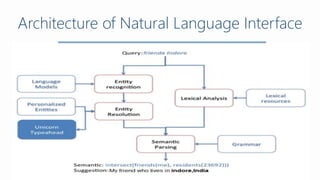
Architecture of Natural Language Interface
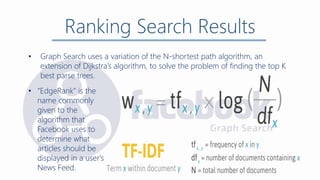
Ranking Search Results
What is Graph Search ?
• Graph Search is a semantic search engine introduced by
Facebook in March 2013.
• It is designed to give answers to user natural language queries
rather than a list of links.
• Can be used for,
– Find more of the people, places and things you’re looking for.
– Discover new connections based on what others have shared with you
on Facebook.
• The Graph Search engine is built upon highly structured data
in the form of a graph, representing hundreds of types of
nodes and thousands of types of edges.
• Facebook's technology for finding people and things that are
socially connected.
What is Graph Search ?
Traditional Search Engine [PPS]
• Search using Keywords.
• Adding Typeahead features.
• Nearby Tagging within Posts.
• Location Tagging of photos and Post
• But, keyword-based system has not been the best choice.
• For example, “friends Facebook” can mean “friends on
Facebook,” “friends who work at Facebook Inc.,” or “friends
who like Facebook the Page.”.
Graph Search Concept
• The Facebook graph is the collection of entities and their
relationships on Facebook.
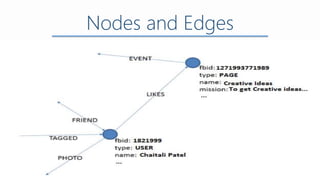
• Entities are the nodes and the relationships are the edges.
• Every user, page, place, photo, post, etc. are nodes in the
graph.
• Edges between nodes represent friendships, check-ins, tags,
relationships, ownership, attributes, etc.
Nodes and Edges
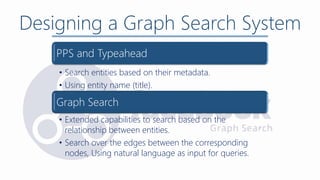
Designing a Graph Search System
PPS and Typeahead
• Search entities based on their metadata.
• Using entity name (title).
Graph Search
• Extended capabilities to search based on the
relationship between entities.
• Search over the edges between the corresponding
nodes, Using natural language as input for queries.
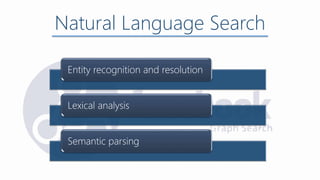
Natural Language Search
Entity recognition and resolution
Lexical analysis
Semantic parsing
Architecture of Natural Language Interface
Ranking Search Results
• Graph Search uses a variation of the N-shortest path algorithm, an
extension of Dijkstra’s algorithm, to solve the problem of finding the top K
best parse trees.
• “EdgeRank” is the
name commonly
given to the
algorithm that
Facebook uses to
determine what
articles should be
displayed in a user's
News Feed.
Message From Graph Search Developers
References
• http://whatisgraphsearch.com/
• https://www.facebook.com/notes/facebook-
engineering/
• http://searchengineland.com/
• https://www.facebook.com/about/graphsearch/privacy
• http://www.socialmediaexaminer.com/facebook-
graph-search-review/
Presented by :
Chaitali Patel
Thank You..!!

Graph Search

  • 1.
  • 2.
    Outline Introduction to GraphSearch Traditional Search Engine Graph Search Concept Natural Language Search Architecture of Natural Language Interface Ranking Search Results
  • 3.
    What is GraphSearch ? • Graph Search is a semantic search engine introduced by Facebook in March 2013. • It is designed to give answers to user natural language queries rather than a list of links. • Can be used for, – Find more of the people, places and things you’re looking for. – Discover new connections based on what others have shared with you on Facebook.
  • 4.
    • The GraphSearch engine is built upon highly structured data in the form of a graph, representing hundreds of types of nodes and thousands of types of edges. • Facebook's technology for finding people and things that are socially connected. What is Graph Search ?
  • 5.
    Traditional Search Engine[PPS] • Search using Keywords. • Adding Typeahead features. • Nearby Tagging within Posts. • Location Tagging of photos and Post • But, keyword-based system has not been the best choice. • For example, “friends Facebook” can mean “friends on Facebook,” “friends who work at Facebook Inc.,” or “friends who like Facebook the Page.”.
  • 6.
    Graph Search Concept •The Facebook graph is the collection of entities and their relationships on Facebook. • Entities are the nodes and the relationships are the edges. • Every user, page, place, photo, post, etc. are nodes in the graph. • Edges between nodes represent friendships, check-ins, tags, relationships, ownership, attributes, etc.
  • 7.
  • 8.
    Designing a GraphSearch System PPS and Typeahead • Search entities based on their metadata. • Using entity name (title). Graph Search • Extended capabilities to search based on the relationship between entities. • Search over the edges between the corresponding nodes, Using natural language as input for queries.
  • 9.
    Natural Language Search Entityrecognition and resolution Lexical analysis Semantic parsing
  • 10.
    Architecture of NaturalLanguage Interface
  • 11.
    Ranking Search Results •Graph Search uses a variation of the N-shortest path algorithm, an extension of Dijkstra’s algorithm, to solve the problem of finding the top K best parse trees. • “EdgeRank” is the name commonly given to the algorithm that Facebook uses to determine what articles should be displayed in a user's News Feed.
  • 12.
    Message From GraphSearch Developers
  • 13.
    References • http://whatisgraphsearch.com/ • https://www.facebook.com/notes/facebook- engineering/ •http://searchengineland.com/ • https://www.facebook.com/about/graphsearch/privacy • http://www.socialmediaexaminer.com/facebook- graph-search-review/
  • 14.
    Presented by : ChaitaliPatel Thank You..!!