Badenes-Olmedo, Carlos
Redondo Garcia, Jose Luís
Corcho, Oscar
Ontology Engineering Group (OEG)
Universidad Politécnica de Madrid (UPM)
cbadenes@fi.upm.es
@carbadol
github.com/librairy
oeg-upm.net
Efficient Clustering
from Distributions
over Topics
K-CAP 2017
Knowledge Capture

December 4th-6th, 2017

Austin, Texas, United States
2
source: emages.eventshigh.com
3
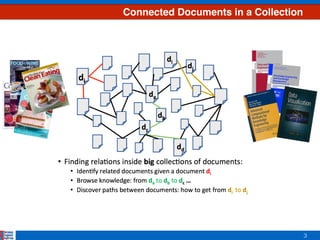
Connected Documents in a Collection
4
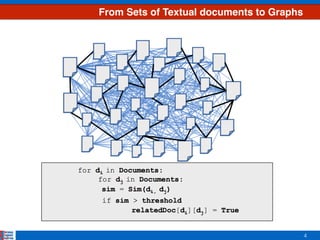
From Sets of Textual documents to Graphs
5
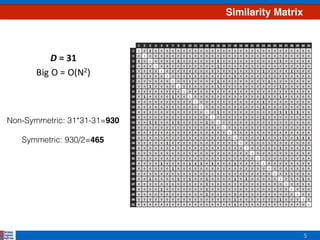
Similarity Matrix
Non-Symmetric: 31*31-31=930
Symmetric: 930/2=465
6
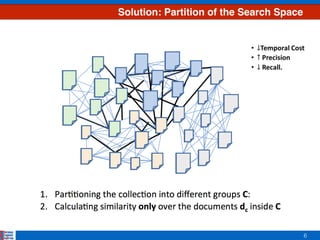
Solution: Partition of the Search Space
7
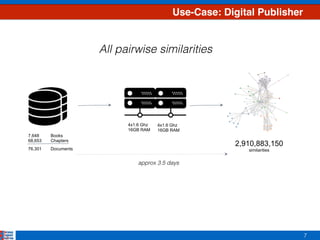
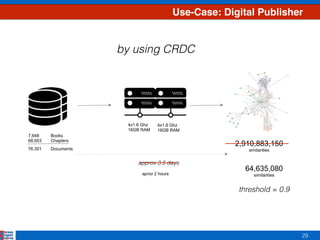
Use-Case: Digital Publisher
7,648 Books
68,653 Chapters
4x1.6 Ghz
16GB RAM
4x1.6 Ghz
16GB RAM
2,910,883,150
similarities
aprox 8 hours
76,301 Documents
All pairwise similarities
approx 3.5 days
8
Hypothesis
Topic	1	
Topic	2	
Topic	3	
Topic	4	
LDA	
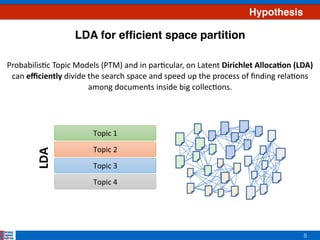
LDA for efficient space partition
Probabilis)c	Topic	Models	(PTM)	and	in	par)cular,	on	Latent	Dirichlet	Alloca-on	(LDA)	
can	efficiently	divide	the	search	space	and	speed	up	the	process	of	finding	rela)ons	
among	documents	inside	big	collec)ons.
9
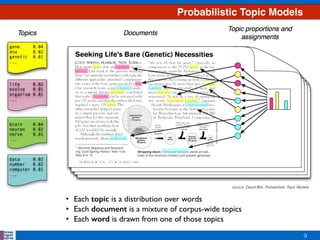
• Each topic is a distribution over words
• Each document is a mixture of corpus-wide topics
• Each word is drawn from one of those topics
Probabilistic Topic Models
source: David Blei, Probabilistic Topic Models
10
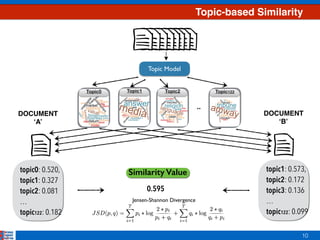
Topic Model
Similarity Valuetopic0: 0.520,
topic1: 0.327
topic2: 0.081
…
topic122: 0.182
topic1: 0.573,
topic2: 0.172
topic3: 0.136
…
topic122: 0.099
0.595
..
Topic0 Topic1 Topic2 Topic122
DOCUMENT
‘A’
DOCUMENT
‘B’
Topic-based Similarity
Jensen-Shannon Divergence
11
Scenario
[ 0.243, 0.145, 0.600, 0.022]
corpus Prob. Topic Model
Topic 1
Topic 2
Topic 3
Dirichlet Distribution
• Exponential family distribution over the simplex, 

i.e. positive vectors that sum to one
Approach 1: TDC
12
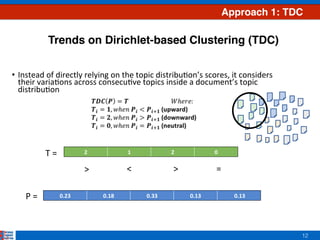
•  Instead	of	directly	relying	on	the	topic	distribu5on’s	scores,	it	considers	
their	varia5ons	across	consecu5ve	topics	inside	a	document’s	topic	
distribu5on	


0.23	 0.18	 0.33	 0.13	 	0.13	P	=		
>	 <	 =	>	
2	 1	 2	 0	T	=		
Trends on Dirichlet-based Clustering (TDC)
13
Approach 2: RDC
Ranking on Dirichlet-based Clustering (RDC)
•  Only	considering	the	top	n	topics	from	the	ranked	list	of	probability	distribu7ons	[29]	
•  Based	on	the	assump7on	that	the	highest	weighted	topics	have	a	high	influence	in	the	
rest	of	topics	when	calcula7ng	distances		


0.23	 0.18	 0.33	 0.13	 	0.13	n=2,	P	=		
2	 0	R	=		
1	0	 2	 3	 4
14
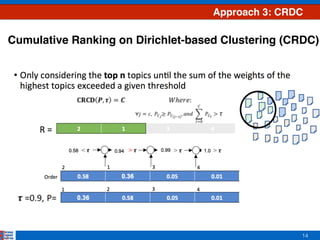
Approach 3: CRDC
Cumulative Ranking on Dirichlet-based Clustering (CRDC)
15
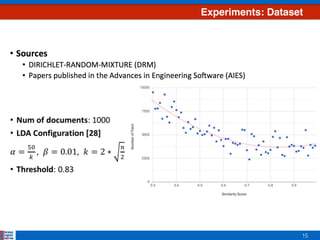
Experiments: Dataset
16
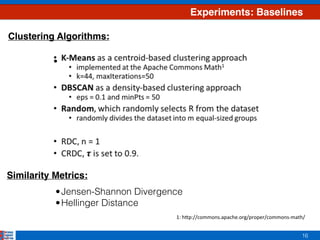
Experiments: Baselines
•  		
1:	h%p://commons.apache.org/proper/commons-math/		
	
Similarity Metrics:
•Jensen-Shannon Divergence
•Hellinger Distance
Clustering Algorithms:
17
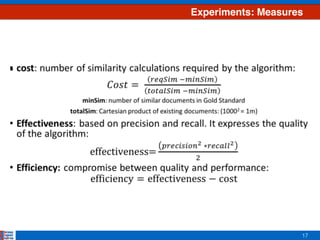
Experiments: Measures
18
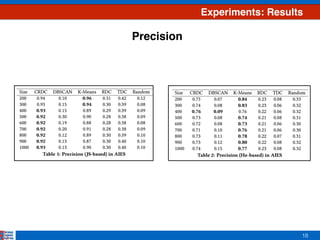
Experiments: Results
Precision
19
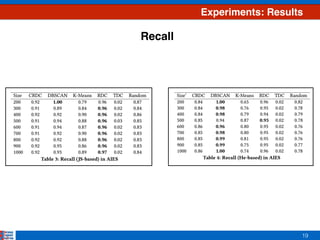
Experiments: Results
Recall
20
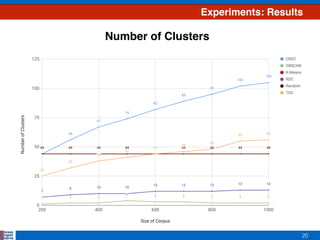
Experiments: Results
Number of Clusters
21
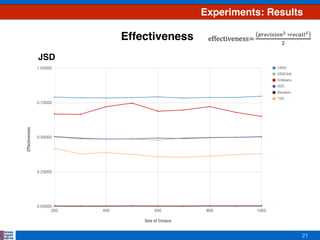
Experiments: Results
Effectiveness
JSD
22
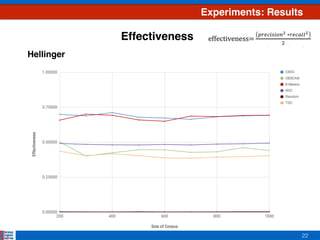
Experiments: Results
Effectiveness
Hellinger
23
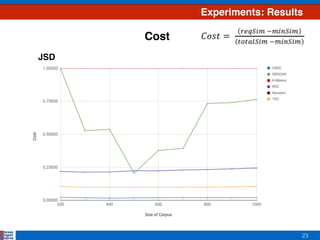
Experiments: Results
Cost
JSD
24
Experiments: Results
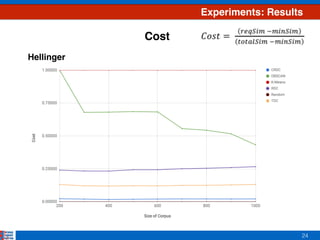
Cost
Hellinger
25
Experiments: Results
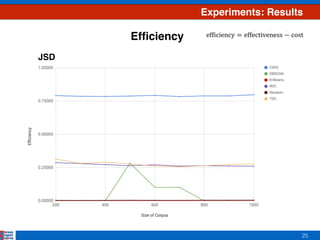
Efficiency
JSD
26
Experiments: Results
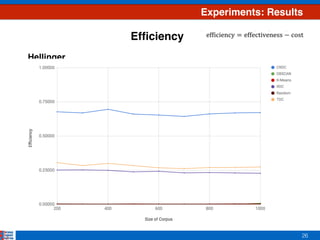
Efficiency
Hellinger
27
Conclusions
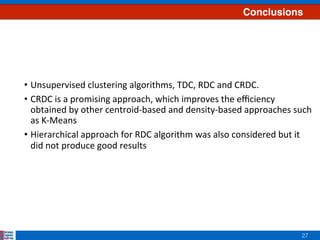
•  Unsupervised	clustering	algorithms,	TDC,	RDC	and	CRDC.	
•  CRDC	is	a	promising	approach,	which	improves	the	efficiency	
obtained	by	other	centroid-based	and	density-based	approaches	such	
as	K-Means	
•  Hierarchical	approach	for	RDC	algorithm	was	also	considered	but	it	
did	not	produce	good	results
28
Future Work
•  Hybrid	methods	combining	some	of	these	novel	approaches	with	
exis8ng	techniques	will	be	performed	in	future	work	on	the	same	line	
•  Nearest	neighbors	as	baseline
29
Use-Case: Digital Publisher
7,648 Books
68,653 Chapters
4x1.6 Ghz
16GB RAM
4x1.6 Ghz
16GB RAM
2,910,883,150
similarities
aprox 8 hours
76,301 Documents
by using CRDC
aprox 2 hours
64,635,080
similarities
threshold = 0.9
approx 3.5 days
K-CAP 2017
Knowledge Capture

December 4th-6th, 2017

Austin, Texas, United States
Badenes-Olmedo, Carlos
Redondo Garcia, Jose Luís
Corcho, Oscar
Ontology Engineering Group (OEG)
Universidad Politécnica de Madrid (UPM)
Efficient Clustering
from Distributions
over Topics
cbadenes@fi.upm.es
@carbadol
github.com/librairy
oeg-upm.net

Efficient Clustering from Distributions over Topics