MINISTRY OF ENVIRONMENT ANDMINISTRY OF ENVIRONMENT AND
FORESTRYFORESTRY
Dr. Ir. Bambang Supriyanto, M.Sc.
Director General of Social Forestry and Environmental Partnership
1
MAP OF INDONESIA FOREST
FUNCTIONS
Forest Area:
63% of total
land
Total forest is
120.65 million ha
12.81 million Ha
26.79 million Ha
27.43 million Ha
10,62%
24,24%
22,21%
24,60%
18,33%
HPK
HP
HPT
HL
KSA/KPA
29.25 million Ha
29.68 million Ha
FOREST IN INDONESIA: CHALLENGES
• Forest cover in Indonesia is 120.7 million Ha (63.09% of
total land in Indonesia)
In which 42.2 million ha forest in Indonesia is allocated for
timber concension, industrial plantation, and environmental
services. It consists 40.5 million ha (95.8%) managed by
private sectors while 1.7 million ha (4.2%) managed by
community.
• Total of human population under poverty surrounding/inside
forest is 10.2 million (36.73% of total of human population
under poverty in Indonesia)
• To alleviate poverty in Indonesia, Government of Indonesia
commits to increase 1.7 million ha (4.2%) to 12.7 million ha
(30%) to be managed by community
3
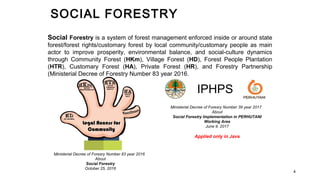
Social Forestry is a system of forest management enforced inside or around state
forest/forest rights/customary forest by local community/customary people as main
actor to improve prosperity, environmental balance, and social-culture dynamics
through Community Forest (HKm), Village Forest (HD), Forest People Plantation
(HTR), Customary Forest (HA), Private Forest (HR), and Forestry Partnership
(Ministerial Decree of Forestry Number 83 year 2016.
Legal Access forLegal Access for
CommunityCommunity
Ministerial Decree of Foresry Number 83 year 2016
About
Social Forestry
October 25, 2016
IPHPS
Ministerial Decree of Foresry Number 39 year 2017
About
Social Forestry Implementation in PERHUTANI
Working Area
June 9, 2017
Applied only in Java
SOCIAL FORESTRY
4
SMART OBJECTIVE Increasing land allocation for
community to gain right in managing forest up to 10% of forest total in Indonesia
(equal to 12.7 million ha) through Social Forestry
SHORT-TERM OUTCOMES 1. System development
and adaptation, enable to provide indicator of management area and
development of social forestry business process; 2. Development of social
capital; 3. Development of community access to microfinance institutions
(BLU), community guidance, and market access for products
MID-TERM OUTCOMES 1. Production centre of forest
product; 2. alleviation of tenure conflict; 3. forest sustainability
LONG-TERM OUTCOMES Establishing more than 10
thousands production centres of forest product community –based aims to
increase employment rate and decrease poverty rate in 10 thousands villages
around and inside forest
Social Forestry Objectives
5
Social Forestry Addressed to Poverty and
Unemployement Alleviation
Forest People
Plantation
Private
Forest
Community Forest
SOCIAL FORESTRY
Village/Nagari
Forest
Forestry
Partnership
Customary
Forest
ELEMENTS DESCRIPTION
ULTIMATE GOALS Keywords : Multiuse forest to decrease inequality
INDICATORS 1) Gross Margin of Community/household
2) Employment
3) Economic Growth in Local Area and Gini Ratio
MEANS 1) Forest management access, in form of licencing and partnership of capacity building to
Forest Farmer Group
2) Investation
VALUES 1) Forest utilization to improve welfare (Timber Forest Product, Non Timber Forest Product,
Environmental Service)
2) Community participation
3) Respect to ecology, function of nature
4) Forest ponservation and protection, succession, and balance/homeostasis
5) Awareness of preservation, restoration, and rehabilitation
IMPLEMENTATION Business Chain
1) Environmental
Services/Ecotourism/Water
Management
2) Agroforestry: paddy, corn, soybean,
sugarcane
3) Silvoparture
4) Silvofishery
5) Biomass and Bioenergy (sunan
hazelnut, sugarpalm, eucalyptus,
calliandra, nyamplung, etc.)
6) NTFP: honey, rattan, root, etc.
7) Timber Industry
Consequences (Investation, Technology, Community
Institutional)
1)Permit and Legitimacy (requirements and the do’s
and dont’s)
2)Territorial arrangement (conflict : use and status)/
tenure
3)Infrastructure
4)Revitalization of farmer group
5)Investation (State and Private)
6)Area review (limited)
7)Activist guidance
8)Apparatus monitoring
6
Total SF
2.5312.531..277277,,1313 HaHa
±± 601.892601.892 KKKK
55..454454 Unit SKUnit SK
PermitPermit
Updated January 31, 2019
TARGET &TARGET &
ACHIEVEMENTACHIEVEMENT
7
1 HD 1.280.479,18
2 HKM 641.157,82
3 HTR 331.993,68
4
A. KULIN KK 223.876,52
B. IPHPS 25.483,59
5 HA 28.286,34
2.531.277,13
KEMITRAAN KEHUTANAN
JUMLAH
NO SKEMA LUAS (HA)
Criteria Indicator
Input Output
Institutional set-up Farmer group Cooperative/village
enterprises
Forest
Management
Long-term
Development Plan
Increased of forest
cover
Business
Development
• Business plan
• Village center
production
• Increased
income
• Poverty
alleviation
8
• Subsistance and in traditional way of thinking, so
that community is set up as object instead of
subject of development
• Low business orientation
• Institutional Forest Management
• Sustainable Forest Management
• Social enterpreneur
Facilitators
Mindset Change of Farmer - Facilitators
Before
Social Forestry
Social Forestry
Process
Social Forestry
Outcome
9
• Accelerating Social Forestry permit issuance  “Kerja
bersama Jemput Bola”/working together to pick up
community Social Forestry Proposal
• Improving economic business and market access for Social
Forestry Groups (Financial: Micro Economic, offtaker) 
Facilitation and Link to Banks and market
• Improving monitoring system android-based  through
development of Social Forestry Navigation and Information
System (Sistem Navigasi dan Informasi Perhutanan Sosial-
SiNaV)-Samsung  SiNav (Public Participation; decision
making)
10
ROLE MODEL OF SOCIAL
FORESTRY
11
AGROFORESTRY (i) - TUBAN
Applying simple technology by postponing harvest for a month to result 1.5 higher price (wet corn: Rp
2,800/kg; dry corn: Rp 3,600/kg) 12
AGROFORESTRY (ii) - TUBAN
Joy of a farmer in Tuban, East java “Sujiyem” at corn harvesting moment. She is supported microfinance
aid from BNI about Rp 7 million/ha. She sells 5 tons for Rp 15 million. Her net income is Rp 8 million/3
months or Rp 2.67 million/month
13
AGROFORESTRY (iii) - TUBAN
Saving from Teak Timber Product 14
SILVOFISHERIES (i) – LUBUK KERTANG
Northern Part of Sumatera Island
•Tenure conflict -> illegal cutting for palm oil by corporation (coastal countermeasures)
•Community movement as a response of tidal flood which impacts to crops and infrastructure
•Rehabilitation in 700 ha coastal area using mangrove 15
SILVOFISHERIES (ii) – LUBUK KERTANG
• Healthy mangrove for shrimp, fish, and crab production -> applying local wisdom: harvest season, fish trap
(bubu) using to harvest big fish only
• Community is allowed to create pond with maximum size is 0.08 ha/household 16
SILVOFISHERIES (iii) – LUBUK KERTANG
• Village fund to construct tourism’s infractructure
17
SILVOFISHERIES – PADANG TIKAR
Kelulut honey is harvested 21 days along the year. Price: Rp 120,000/kg
18
SAATNYA UNTUK RAKYAT
Gd. Manggala Wanabhakti Lantai 11
Jl. Gatot Subroto, Jakarta Pusat 102270
pskl.menlhk.go.id 021-5737945 2018
19

Social forestry in 4 years

  • 1.
    MINISTRY OF ENVIRONMENTANDMINISTRY OF ENVIRONMENT AND FORESTRYFORESTRY Dr. Ir. Bambang Supriyanto, M.Sc. Director General of Social Forestry and Environmental Partnership 1
  • 2.
    MAP OF INDONESIAFOREST FUNCTIONS Forest Area: 63% of total land Total forest is 120.65 million ha 12.81 million Ha 26.79 million Ha 27.43 million Ha 10,62% 24,24% 22,21% 24,60% 18,33% HPK HP HPT HL KSA/KPA 29.25 million Ha 29.68 million Ha
  • 3.
    FOREST IN INDONESIA:CHALLENGES • Forest cover in Indonesia is 120.7 million Ha (63.09% of total land in Indonesia) In which 42.2 million ha forest in Indonesia is allocated for timber concension, industrial plantation, and environmental services. It consists 40.5 million ha (95.8%) managed by private sectors while 1.7 million ha (4.2%) managed by community. • Total of human population under poverty surrounding/inside forest is 10.2 million (36.73% of total of human population under poverty in Indonesia) • To alleviate poverty in Indonesia, Government of Indonesia commits to increase 1.7 million ha (4.2%) to 12.7 million ha (30%) to be managed by community 3
  • 4.
    Social Forestry isa system of forest management enforced inside or around state forest/forest rights/customary forest by local community/customary people as main actor to improve prosperity, environmental balance, and social-culture dynamics through Community Forest (HKm), Village Forest (HD), Forest People Plantation (HTR), Customary Forest (HA), Private Forest (HR), and Forestry Partnership (Ministerial Decree of Forestry Number 83 year 2016. Legal Access forLegal Access for CommunityCommunity Ministerial Decree of Foresry Number 83 year 2016 About Social Forestry October 25, 2016 IPHPS Ministerial Decree of Foresry Number 39 year 2017 About Social Forestry Implementation in PERHUTANI Working Area June 9, 2017 Applied only in Java SOCIAL FORESTRY 4
  • 5.
    SMART OBJECTIVE Increasingland allocation for community to gain right in managing forest up to 10% of forest total in Indonesia (equal to 12.7 million ha) through Social Forestry SHORT-TERM OUTCOMES 1. System development and adaptation, enable to provide indicator of management area and development of social forestry business process; 2. Development of social capital; 3. Development of community access to microfinance institutions (BLU), community guidance, and market access for products MID-TERM OUTCOMES 1. Production centre of forest product; 2. alleviation of tenure conflict; 3. forest sustainability LONG-TERM OUTCOMES Establishing more than 10 thousands production centres of forest product community –based aims to increase employment rate and decrease poverty rate in 10 thousands villages around and inside forest Social Forestry Objectives 5
  • 6.
    Social Forestry Addressedto Poverty and Unemployement Alleviation Forest People Plantation Private Forest Community Forest SOCIAL FORESTRY Village/Nagari Forest Forestry Partnership Customary Forest ELEMENTS DESCRIPTION ULTIMATE GOALS Keywords : Multiuse forest to decrease inequality INDICATORS 1) Gross Margin of Community/household 2) Employment 3) Economic Growth in Local Area and Gini Ratio MEANS 1) Forest management access, in form of licencing and partnership of capacity building to Forest Farmer Group 2) Investation VALUES 1) Forest utilization to improve welfare (Timber Forest Product, Non Timber Forest Product, Environmental Service) 2) Community participation 3) Respect to ecology, function of nature 4) Forest ponservation and protection, succession, and balance/homeostasis 5) Awareness of preservation, restoration, and rehabilitation IMPLEMENTATION Business Chain 1) Environmental Services/Ecotourism/Water Management 2) Agroforestry: paddy, corn, soybean, sugarcane 3) Silvoparture 4) Silvofishery 5) Biomass and Bioenergy (sunan hazelnut, sugarpalm, eucalyptus, calliandra, nyamplung, etc.) 6) NTFP: honey, rattan, root, etc. 7) Timber Industry Consequences (Investation, Technology, Community Institutional) 1)Permit and Legitimacy (requirements and the do’s and dont’s) 2)Territorial arrangement (conflict : use and status)/ tenure 3)Infrastructure 4)Revitalization of farmer group 5)Investation (State and Private) 6)Area review (limited) 7)Activist guidance 8)Apparatus monitoring 6
  • 7.
    Total SF 2.5312.531..277277,,1313 HaHa ±±601.892601.892 KKKK 55..454454 Unit SKUnit SK PermitPermit Updated January 31, 2019 TARGET &TARGET & ACHIEVEMENTACHIEVEMENT 7 1 HD 1.280.479,18 2 HKM 641.157,82 3 HTR 331.993,68 4 A. KULIN KK 223.876,52 B. IPHPS 25.483,59 5 HA 28.286,34 2.531.277,13 KEMITRAAN KEHUTANAN JUMLAH NO SKEMA LUAS (HA)
  • 8.
    Criteria Indicator Input Output Institutionalset-up Farmer group Cooperative/village enterprises Forest Management Long-term Development Plan Increased of forest cover Business Development • Business plan • Village center production • Increased income • Poverty alleviation 8
  • 9.
    • Subsistance andin traditional way of thinking, so that community is set up as object instead of subject of development • Low business orientation • Institutional Forest Management • Sustainable Forest Management • Social enterpreneur Facilitators Mindset Change of Farmer - Facilitators Before Social Forestry Social Forestry Process Social Forestry Outcome 9
  • 10.
    • Accelerating SocialForestry permit issuance  “Kerja bersama Jemput Bola”/working together to pick up community Social Forestry Proposal • Improving economic business and market access for Social Forestry Groups (Financial: Micro Economic, offtaker)  Facilitation and Link to Banks and market • Improving monitoring system android-based  through development of Social Forestry Navigation and Information System (Sistem Navigasi dan Informasi Perhutanan Sosial- SiNaV)-Samsung  SiNav (Public Participation; decision making) 10
  • 11.
    ROLE MODEL OFSOCIAL FORESTRY 11
  • 12.
    AGROFORESTRY (i) -TUBAN Applying simple technology by postponing harvest for a month to result 1.5 higher price (wet corn: Rp 2,800/kg; dry corn: Rp 3,600/kg) 12
  • 13.
    AGROFORESTRY (ii) -TUBAN Joy of a farmer in Tuban, East java “Sujiyem” at corn harvesting moment. She is supported microfinance aid from BNI about Rp 7 million/ha. She sells 5 tons for Rp 15 million. Her net income is Rp 8 million/3 months or Rp 2.67 million/month 13
  • 14.
    AGROFORESTRY (iii) -TUBAN Saving from Teak Timber Product 14
  • 15.
    SILVOFISHERIES (i) –LUBUK KERTANG Northern Part of Sumatera Island •Tenure conflict -> illegal cutting for palm oil by corporation (coastal countermeasures) •Community movement as a response of tidal flood which impacts to crops and infrastructure •Rehabilitation in 700 ha coastal area using mangrove 15
  • 16.
    SILVOFISHERIES (ii) –LUBUK KERTANG • Healthy mangrove for shrimp, fish, and crab production -> applying local wisdom: harvest season, fish trap (bubu) using to harvest big fish only • Community is allowed to create pond with maximum size is 0.08 ha/household 16
  • 17.
    SILVOFISHERIES (iii) –LUBUK KERTANG • Village fund to construct tourism’s infractructure 17
  • 18.
    SILVOFISHERIES – PADANGTIKAR Kelulut honey is harvested 21 days along the year. Price: Rp 120,000/kg 18
  • 19.
    SAATNYA UNTUK RAKYAT Gd.Manggala Wanabhakti Lantai 11 Jl. Gatot Subroto, Jakarta Pusat 102270 pskl.menlhk.go.id 021-5737945 2018 19

Editor's Notes

  • #3 Tambah angka luas kawasan hutan per fungsi, Penetapan kawasan hutan (luas dan persen)