Ani Adiwinata Nawir (CIFOR) presentation in
‘Course on Governance of Landscapes, Forests and People’
(Amazon Room, CIFOR Campus Bogor, 27 August 2015)
This PPT is protected by CIFOR Intellectual Property Right Policy,
proper citation is required for any use(s) partially or all of the information provided here
Public-Private Partnership in Forestry Management:
Case of partnership scheme in forestry management
in Indonesia
Ani Adiwinata Nawir, PhD
Socioeconomics Scientist, Forests and Livelihoods Research (LIV Portfolio)
Center for International Forestry Research (CIFOR)
Presented in Course on Governance of Landscapes, Forests and People
Amazon Room, CIFOR Campus Bogor, 27 August, 2014
Scope of presentation:
1. Public-Private Partnership (PPP) –
some understandings
2. Why does Public-Private Partnership
Scheme become an option?
3. Effectiveness of the partnership
4. Trade-offs & challenges to consider
5. Ensuring the effectiveness of
public-private partnership
at the landscape level
1. Public-Private Partnership (PPP) – some understandings
1. There is no overarching definition for public-private partnerships:
PPP is an umbrella notion covering a wide range of economic activity and
is in constant evolution
(Source: Speech by Commissioner Frits Bolkenstein, DG Internal Market)
2. PPP is the private sector’s involvement in developing/managing facilities &
services for the economy & society to function (Yescombe, 2007)
3. Such partnerships are characterized by the sharing of investment, risk,
responsibility and reward between the partners.
4. PPP ≈ Privatization
5. More common in infrastructure development (e.g. roads, public water
facilities)
6. Less developed in natural resources management (including forests)
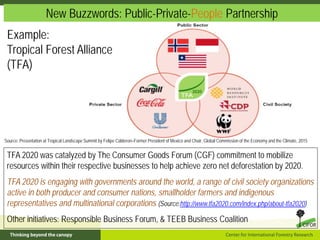
TFA 2020 was catalyzed by The Consumer Goods Forum (CGF) commitment to mobilize
resources within their respective businesses to help achieve zero net deforestation by 2020.
TFA 2020 is engaging with governments around the world, a range of civil society organizations
active in both producer and consumer nations, smallholder farmers and indigenous
representatives and multinational corporations (Source:http://www.tfa2020.com/index.php/about-tfa2020)
Other initiatives: Responsible Business Forum, & TEEB Business Coalition
Example:
Tropical Forest Alliance
(TFA)
New Buzzwords: Public-Private-People Partnership
Source: Presentation at Tropical Landscape Summit by Felipe Calderon–Former President of Mexico and Chair, Global Commission of the Economy and the Climate, 2015
Case of community-company partnership scheme in
forestry plantation management
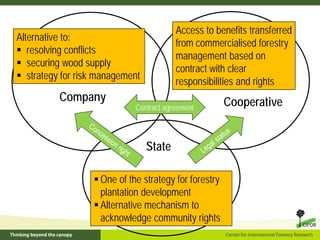
 One of the strategy for forestry
plantation development
 Alternative mechanism to
acknowledge community rights
Access to benefits transferred
from commercialised forestry
management based on
contract with clear
responsibilities and rights
Cooperative
Alternative to:
 resolving conflicts
 securing wood supply
 strategy for risk management
Company
State
Contract agreement
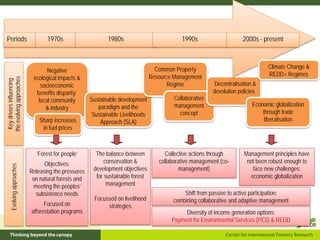
2. Why does Public-Private Partnership Scheme become an option?
(1) An alternative approach in CF responding to governance failures
in forest management
Negative
ecological impacts &
socioeconomic
benefits disparity:
local community
& industry
Sharp increases
in fuel prices
Sustainable development
paradigm and the
Sustainable Livelihoods
Approach (SLA)
Common Property
Resource Management
Regime
Collaborative
management
concept
Decentralisation &
devolution policies
Economic globalization
through trade
liberalisation
‘Forest for people’
Objectives:
Releasing the pressures
on natural forests and
meeting the peoples’
subsistence needs
Focused on
afforestation programs
The balance between
conservation &
development objectives
for sustainable forest
management
Focussed on livelihood
strategies
Shift from passive to active participation:
combining collaborative and adaptive management
Management principles have
not been robust enough to
face new challenges:
economic globalization
Collective actions through
collaborative management (co-
management)
Diversity of income generation options:
Payment for Environmental Services (PES) & REDD
Keydriversinfluencing
theevolvingapproaches
Evolvingapproaches
1970s 1980s 1990s 2000s - presentPeriods
Climate Change &
REDD+ Regimes
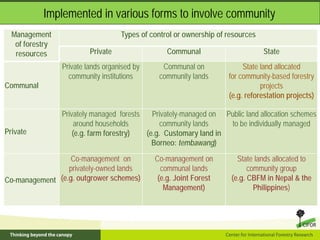
Implemented in various forms to involve community
Management
of forestry
resources
Types of control or ownership of resources
Private Communal State
Communal
Private lands organised by
community institutions
Communal on
community lands
State land allocated
for community-based forestry
projects
(e.g. reforestation projects)
Private
Privately managed forests
around households
(e.g. farm forestry)
Privately-managed on
community lands
(e.g. Customary land in
Borneo: tembawang)
Public land allocation schemes
to be individually managed
Co-management
Co-management on
privately-owned lands
(e.g. outgrower schemes)
Co-management on
communal lands
(e.g. Joint Forest
Management)
State lands allocated to
community group
(e.g. CBFM in Nepal & the
Philippines)
2. Why does Public-Private Partnership Scheme become an option?
(2) As an approach in conflict resolution
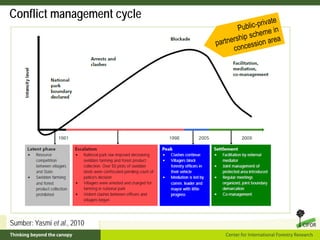
Conflict management cycle
Sumber: Yasmi et al., 2010
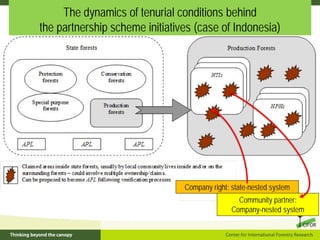
The dynamics of tenurial conditions behind
the partnership scheme initiatives (case of Indonesia)
Company right: state-nested system
Community partner:
Company-nested system
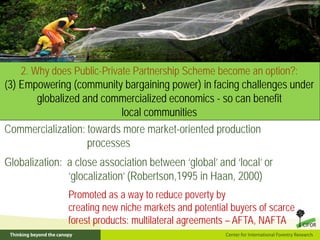
Commercialization: towards more market-oriented production
processes
Globalization: a close association between ‘global’ and ‘local’ or
‘glocalization’ (Robertson,1995 in Haan, 2000)
Promoted as a way to reduce poverty by
creating new niche markets and potential buyers of scarce
forest products: multilateral agreements – AFTA, NAFTA
2. Why does Public-Private Partnership Scheme become an option?:
(3) Empowering (community bargaining power) in facing challenges under
globalized and commercialized economics - so can benefit
local communities
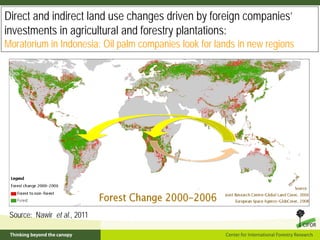
Direct and indirect land use changes driven by foreign companies’
investments in agricultural and forestry plantations:
Moratorium in Indonesia: Oil palm companies look for lands in new regions
Source: Nawir et al., 2011
CF management principles have not been robust enough
to face the new challenges coming from trade liberalisation
The slow pace of development for community empowerment,
communities involved in CF do not have:
 adequate management and financial capacity
 the business knowledge and skills required to deal with
international investors and traders
Impacts of globalisation & trade liberalisation – which partnership with
company might be crucial
 local products cannot compete with imported mass-produced
products
 a drop in prices and profits received by local producers;
 increased pressure on forests:
they have to switch to unsustainable practices to compensate
the decreasing returns from the drop in price and profits
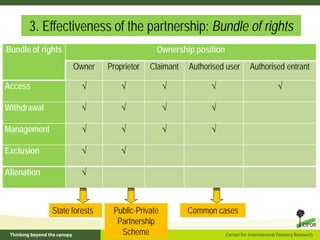
Bundle of rights Ownership position
Owner Proprietor Claimant Authorised user Authorised entrant
Access √ √ √ √ √
Withdrawal √ √ √ √
Management √ √ √ √
Exclusion √ √
Alienation √
State forests Public-Private
Partnership
Scheme
Common cases
3. Effectiveness of the partnership: Bundle of rights
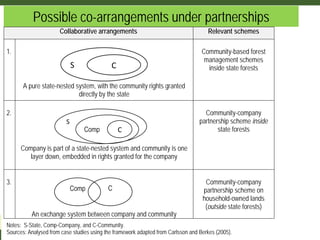
Collaborative arrangements Relevant schemes
1.
A pure state-nested system, with the community rights granted
directly by the state
Community-based forest
management schemes
inside state forests
2.
Company is part of a state-nested system and community is one
layer down, embedded in rights granted for the company
Community-company
partnership scheme inside
state forests
3.
An exchange system between company and community
Community-company
partnership scheme on
household-owned lands
(outside state forests)
Notes: S-State, Comp-Company, and C-Community.
Sources: Analysed from case studies using the framework adapted from Carlsson and Berkes (2005).
S C
S
C
Possible co-arrangements under partnerships
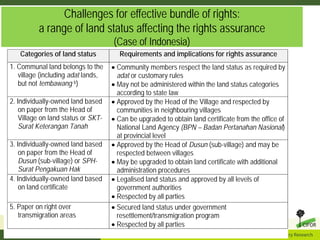
Categories of land status Requirements and implications for rights assurance
1. Communal land belongs to the
village (including adat lands,
but not tembawang b)
• Community members respect the land status as required by
adat or customary rules
• May not be administered within the land status categories
according to state law
2. Individually-owned land based
on paper from the Head of
Village on land status or SKT-
Surat Keterangan Tanah
• Approved by the Head of the Village and respected by
communities in neighbouring villages
• Can be upgraded to obtain land certificate from the office of
National Land Agency (BPN – Badan Pertanahan Nasional)
at provincial level
3. Individually-owned land based
on paper from the Head of
Dusun (sub-village) or SPH-
Surat Pengakuan Hak
• Approved by the Head of Dusun (sub-village) and may be
respected between villages
• May be upgraded to obtain land certificate with additional
administration procedures
4. Individually-owned land based
on land certificate
• Legalised land status and approved by all levels of
government authorities
• Respected by all parties
5. Paper on right over
transmigration areas
• Secured land status under government
resettlement/transmigration program
• Respected by all parties
Challenges for effective bundle of rights:
a range of land status affecting the rights assurance
(Case of Indonesia)
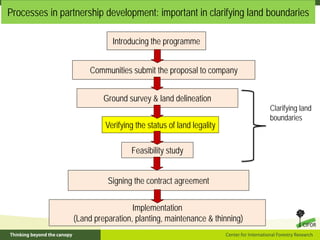
Introducing the programme
Ground survey & land delineation
Communities submit the proposal to company
Verifying the status of land legality
Signing the contract agreement
Implementation
(Land preparation, planting, maintenance & thinning)
Feasibility study
Processes in partnership development: important in clarifying land boundaries
Clarifying land
boundaries
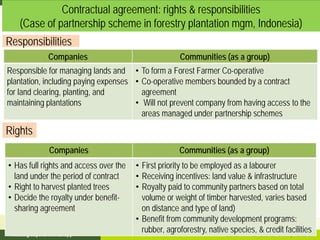
Contractual agreement: rights & responsibilities
(Case of partnership scheme in forestry plantation mgm, Indonesia)
Companies Communities (as a group)
Responsible for managing lands and
plantation, including paying expenses
for land clearing, planting, and
maintaining plantations
• To form a Forest Farmer Co-operative
• Co-operative members bounded by a contract
agreement
• Will not prevent company from having access to the
areas managed under partnership schemes
Companies Communities (as a group)
• Has full rights and access over the
land under the period of contract
• Right to harvest planted trees
• Decide the royalty under benefit-
sharing agreement
• First priority to be employed as a labourer
• Receiving incentives: land value & infrastructure
• Royalty paid to community partners based on total
volume or weight of timber harvested, varies based
on distance and type of land)
• Benefit from community development programs:
rubber, agroforestry, native species, & credit facilities
Responsibilities
Rights
4. Trade-offs & challenges to consider
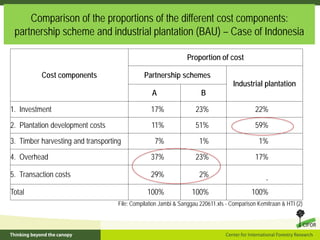
Comparison of the proportions of the different cost components:
partnership scheme and industrial plantation (BAU) – Case of Indonesia
Cost components
Proportion of cost
Partnership schemes
Industrial plantation
A B
1. Investment 17% 23% 22%
2. Plantation development costs 11% 51% 59%
3. Timber harvesting and transporting 7% 1% 1%
4. Overhead 37% 23% 17%
5. Transaction costs 29% 2%
-
Total 100% 100% 100%
File: Compilation Jambi & Sanggau 220611.xls - Comparison Kemitraan & HTI (2)
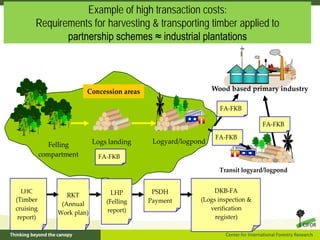
Example of high transaction costs:
Requirements for harvesting & transporting timber applied to
partnership schemes ≈ industrial plantations
Transit logyard/logpond
Logs landing Logyard/logpondFelling
compartment
Concession areas
FA-FKB
FA-FKB
FA-FKB
DKB-FA
(Logs inspection &
verification
register)
PSDH
Payment
LHP
(Felling
report)
FA-FKB
RKT
(Annual
Work plan)
LHC
(Timber
cruising
report)
Wood based primary industry
5. Ensuring the effectiveness of public-private partnership at the
landscape level:
(1) Identifying & dealing with the complexities of problems
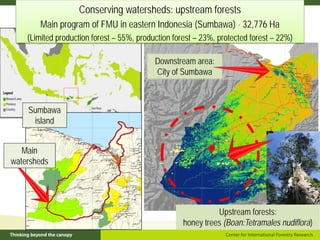
Upstream forests:
honey trees (Boan:Tetramales nudiflora)
Downstream area:
City of Sumbawa
Sumbawa
island
Conserving watersheds: upstream forests
Main program of FMU in eastern Indonesia (Sumbawa) - 32,776 Ha
(Limited production forest – 55%, production forest – 23%, protected forest – 22%)
Main
watersheds
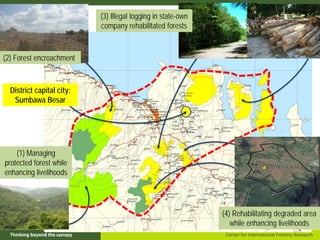
(1) Managing
protected forest while
enhancing livelihoods
(4) Rehabilitating degraded area
while enhancing livelihoods
District capital city:
Sumbawa Besar
(3) Illegal logging in state-own
company rehabilitated forests
(2) Forest encroachment
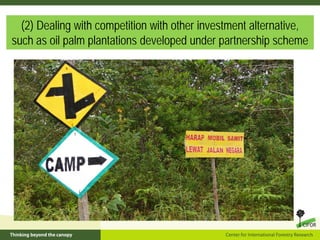
(2) Dealing with competition with other investment alternative,
such as oil palm plantations developed under partnership scheme
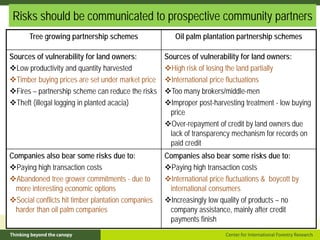
Tree growing partnership schemes Oil palm plantation partnership schemes
Sources of vulnerability for land owners:
Low productivity and quantity harvested
Timber buying prices are set under market price
Fires – partnership scheme can reduce the risks
Theft (illegal logging in planted acacia)
Sources of vulnerability for land owners:
High risk of losing the land partially
International price fluctuations
Too many brokers/middle-men
Improper post-harvesting treatment - low buying
price
Over-repayment of credit by land owners due
lack of transparency mechanism for records on
paid credit
Companies also bear some risks due to:
Paying high transaction costs
Abandoned tree grower commitments - due to
more interesting economic options
Social conflicts hit timber plantation companies
harder than oil palm companies
Companies also bear some risks due to:
Paying high transaction costs
International price fluctuations & boycott by
international consumers
Increasingly low quality of products – no
company assistance, mainly after credit
payments finish
Risks should be communicated to prospective community partners
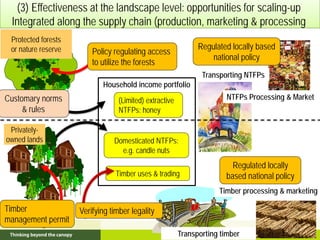
Household income portfolio
Timber uses & trading
Privately-
owned lands
Protected forests
or nature reserve
Domesticated NTFPs:
e.g. candle nuts
Policy regulating access
to utilize the forests
(Limited) extractive
NTFPs: honey
Timber
management permit
Verifying timber legality
NTFPs Processing & Market
Timber processing & marketing
Transporting timber
Transporting NTFPs
Regulated locally based
national policy
Customary norms
& rules
Regulated locally
based national policy
(3) Effectiveness at the landscape level: opportunities for scaling-up
Integrated along the supply chain (production, marketing & processing
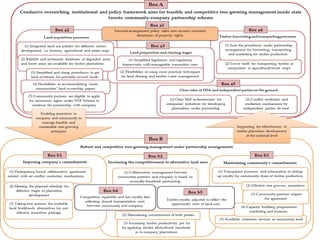
(4) Ensuring the effectiveness at the landscape level:
A framework for strengthening policy and economic incentives
(Case of community-company partnership scheme for timber
plantation development in Indonesia)
Terima kasih

Public private partnership in forestry management

  • 1.
    Ani Adiwinata Nawir(CIFOR) presentation in ‘Course on Governance of Landscapes, Forests and People’ (Amazon Room, CIFOR Campus Bogor, 27 August 2015) This PPT is protected by CIFOR Intellectual Property Right Policy, proper citation is required for any use(s) partially or all of the information provided here
  • 2.
    Public-Private Partnership inForestry Management: Case of partnership scheme in forestry management in Indonesia Ani Adiwinata Nawir, PhD Socioeconomics Scientist, Forests and Livelihoods Research (LIV Portfolio) Center for International Forestry Research (CIFOR) Presented in Course on Governance of Landscapes, Forests and People Amazon Room, CIFOR Campus Bogor, 27 August, 2014
  • 3.
    Scope of presentation: 1.Public-Private Partnership (PPP) – some understandings 2. Why does Public-Private Partnership Scheme become an option? 3. Effectiveness of the partnership 4. Trade-offs & challenges to consider 5. Ensuring the effectiveness of public-private partnership at the landscape level
  • 4.
    1. Public-Private Partnership(PPP) – some understandings 1. There is no overarching definition for public-private partnerships: PPP is an umbrella notion covering a wide range of economic activity and is in constant evolution (Source: Speech by Commissioner Frits Bolkenstein, DG Internal Market) 2. PPP is the private sector’s involvement in developing/managing facilities & services for the economy & society to function (Yescombe, 2007) 3. Such partnerships are characterized by the sharing of investment, risk, responsibility and reward between the partners. 4. PPP ≈ Privatization 5. More common in infrastructure development (e.g. roads, public water facilities) 6. Less developed in natural resources management (including forests)
  • 5.
    TFA 2020 wascatalyzed by The Consumer Goods Forum (CGF) commitment to mobilize resources within their respective businesses to help achieve zero net deforestation by 2020. TFA 2020 is engaging with governments around the world, a range of civil society organizations active in both producer and consumer nations, smallholder farmers and indigenous representatives and multinational corporations (Source:http://www.tfa2020.com/index.php/about-tfa2020) Other initiatives: Responsible Business Forum, & TEEB Business Coalition Example: Tropical Forest Alliance (TFA) New Buzzwords: Public-Private-People Partnership Source: Presentation at Tropical Landscape Summit by Felipe Calderon–Former President of Mexico and Chair, Global Commission of the Economy and the Climate, 2015
  • 6.
    Case of community-companypartnership scheme in forestry plantation management
  • 7.
     One ofthe strategy for forestry plantation development  Alternative mechanism to acknowledge community rights Access to benefits transferred from commercialised forestry management based on contract with clear responsibilities and rights Cooperative Alternative to:  resolving conflicts  securing wood supply  strategy for risk management Company State Contract agreement
  • 8.
    2. Why doesPublic-Private Partnership Scheme become an option? (1) An alternative approach in CF responding to governance failures in forest management
  • 9.
    Negative ecological impacts & socioeconomic benefitsdisparity: local community & industry Sharp increases in fuel prices Sustainable development paradigm and the Sustainable Livelihoods Approach (SLA) Common Property Resource Management Regime Collaborative management concept Decentralisation & devolution policies Economic globalization through trade liberalisation ‘Forest for people’ Objectives: Releasing the pressures on natural forests and meeting the peoples’ subsistence needs Focused on afforestation programs The balance between conservation & development objectives for sustainable forest management Focussed on livelihood strategies Shift from passive to active participation: combining collaborative and adaptive management Management principles have not been robust enough to face new challenges: economic globalization Collective actions through collaborative management (co- management) Diversity of income generation options: Payment for Environmental Services (PES) & REDD Keydriversinfluencing theevolvingapproaches Evolvingapproaches 1970s 1980s 1990s 2000s - presentPeriods Climate Change & REDD+ Regimes
  • 10.
    Implemented in variousforms to involve community Management of forestry resources Types of control or ownership of resources Private Communal State Communal Private lands organised by community institutions Communal on community lands State land allocated for community-based forestry projects (e.g. reforestation projects) Private Privately managed forests around households (e.g. farm forestry) Privately-managed on community lands (e.g. Customary land in Borneo: tembawang) Public land allocation schemes to be individually managed Co-management Co-management on privately-owned lands (e.g. outgrower schemes) Co-management on communal lands (e.g. Joint Forest Management) State lands allocated to community group (e.g. CBFM in Nepal & the Philippines)
  • 11.
    2. Why doesPublic-Private Partnership Scheme become an option? (2) As an approach in conflict resolution
  • 12.
  • 13.
    The dynamics oftenurial conditions behind the partnership scheme initiatives (case of Indonesia) Company right: state-nested system Community partner: Company-nested system
  • 14.
    Commercialization: towards moremarket-oriented production processes Globalization: a close association between ‘global’ and ‘local’ or ‘glocalization’ (Robertson,1995 in Haan, 2000) Promoted as a way to reduce poverty by creating new niche markets and potential buyers of scarce forest products: multilateral agreements – AFTA, NAFTA 2. Why does Public-Private Partnership Scheme become an option?: (3) Empowering (community bargaining power) in facing challenges under globalized and commercialized economics - so can benefit local communities
  • 15.
    Direct and indirectland use changes driven by foreign companies’ investments in agricultural and forestry plantations: Moratorium in Indonesia: Oil palm companies look for lands in new regions Source: Nawir et al., 2011
  • 16.
    CF management principleshave not been robust enough to face the new challenges coming from trade liberalisation The slow pace of development for community empowerment, communities involved in CF do not have:  adequate management and financial capacity  the business knowledge and skills required to deal with international investors and traders Impacts of globalisation & trade liberalisation – which partnership with company might be crucial  local products cannot compete with imported mass-produced products  a drop in prices and profits received by local producers;  increased pressure on forests: they have to switch to unsustainable practices to compensate the decreasing returns from the drop in price and profits
  • 17.
    Bundle of rightsOwnership position Owner Proprietor Claimant Authorised user Authorised entrant Access √ √ √ √ √ Withdrawal √ √ √ √ Management √ √ √ √ Exclusion √ √ Alienation √ State forests Public-Private Partnership Scheme Common cases 3. Effectiveness of the partnership: Bundle of rights
  • 18.
    Collaborative arrangements Relevantschemes 1. A pure state-nested system, with the community rights granted directly by the state Community-based forest management schemes inside state forests 2. Company is part of a state-nested system and community is one layer down, embedded in rights granted for the company Community-company partnership scheme inside state forests 3. An exchange system between company and community Community-company partnership scheme on household-owned lands (outside state forests) Notes: S-State, Comp-Company, and C-Community. Sources: Analysed from case studies using the framework adapted from Carlsson and Berkes (2005). S C S C Possible co-arrangements under partnerships
  • 19.
    Categories of landstatus Requirements and implications for rights assurance 1. Communal land belongs to the village (including adat lands, but not tembawang b) • Community members respect the land status as required by adat or customary rules • May not be administered within the land status categories according to state law 2. Individually-owned land based on paper from the Head of Village on land status or SKT- Surat Keterangan Tanah • Approved by the Head of the Village and respected by communities in neighbouring villages • Can be upgraded to obtain land certificate from the office of National Land Agency (BPN – Badan Pertanahan Nasional) at provincial level 3. Individually-owned land based on paper from the Head of Dusun (sub-village) or SPH- Surat Pengakuan Hak • Approved by the Head of Dusun (sub-village) and may be respected between villages • May be upgraded to obtain land certificate with additional administration procedures 4. Individually-owned land based on land certificate • Legalised land status and approved by all levels of government authorities • Respected by all parties 5. Paper on right over transmigration areas • Secured land status under government resettlement/transmigration program • Respected by all parties Challenges for effective bundle of rights: a range of land status affecting the rights assurance (Case of Indonesia)
  • 20.
    Introducing the programme Groundsurvey & land delineation Communities submit the proposal to company Verifying the status of land legality Signing the contract agreement Implementation (Land preparation, planting, maintenance & thinning) Feasibility study Processes in partnership development: important in clarifying land boundaries Clarifying land boundaries
  • 21.
    Contractual agreement: rights& responsibilities (Case of partnership scheme in forestry plantation mgm, Indonesia) Companies Communities (as a group) Responsible for managing lands and plantation, including paying expenses for land clearing, planting, and maintaining plantations • To form a Forest Farmer Co-operative • Co-operative members bounded by a contract agreement • Will not prevent company from having access to the areas managed under partnership schemes Companies Communities (as a group) • Has full rights and access over the land under the period of contract • Right to harvest planted trees • Decide the royalty under benefit- sharing agreement • First priority to be employed as a labourer • Receiving incentives: land value & infrastructure • Royalty paid to community partners based on total volume or weight of timber harvested, varies based on distance and type of land) • Benefit from community development programs: rubber, agroforestry, native species, & credit facilities Responsibilities Rights
  • 22.
    4. Trade-offs &challenges to consider
  • 23.
    Comparison of theproportions of the different cost components: partnership scheme and industrial plantation (BAU) – Case of Indonesia Cost components Proportion of cost Partnership schemes Industrial plantation A B 1. Investment 17% 23% 22% 2. Plantation development costs 11% 51% 59% 3. Timber harvesting and transporting 7% 1% 1% 4. Overhead 37% 23% 17% 5. Transaction costs 29% 2% - Total 100% 100% 100% File: Compilation Jambi & Sanggau 220611.xls - Comparison Kemitraan & HTI (2)
  • 24.
    Example of hightransaction costs: Requirements for harvesting & transporting timber applied to partnership schemes ≈ industrial plantations Transit logyard/logpond Logs landing Logyard/logpondFelling compartment Concession areas FA-FKB FA-FKB FA-FKB DKB-FA (Logs inspection & verification register) PSDH Payment LHP (Felling report) FA-FKB RKT (Annual Work plan) LHC (Timber cruising report) Wood based primary industry
  • 25.
    5. Ensuring theeffectiveness of public-private partnership at the landscape level: (1) Identifying & dealing with the complexities of problems
  • 26.
    Upstream forests: honey trees(Boan:Tetramales nudiflora) Downstream area: City of Sumbawa Sumbawa island Conserving watersheds: upstream forests Main program of FMU in eastern Indonesia (Sumbawa) - 32,776 Ha (Limited production forest – 55%, production forest – 23%, protected forest – 22%) Main watersheds
  • 27.
    (1) Managing protected forestwhile enhancing livelihoods (4) Rehabilitating degraded area while enhancing livelihoods District capital city: Sumbawa Besar (3) Illegal logging in state-own company rehabilitated forests (2) Forest encroachment
  • 28.
    (2) Dealing withcompetition with other investment alternative, such as oil palm plantations developed under partnership scheme
  • 29.
    Tree growing partnershipschemes Oil palm plantation partnership schemes Sources of vulnerability for land owners: Low productivity and quantity harvested Timber buying prices are set under market price Fires – partnership scheme can reduce the risks Theft (illegal logging in planted acacia) Sources of vulnerability for land owners: High risk of losing the land partially International price fluctuations Too many brokers/middle-men Improper post-harvesting treatment - low buying price Over-repayment of credit by land owners due lack of transparency mechanism for records on paid credit Companies also bear some risks due to: Paying high transaction costs Abandoned tree grower commitments - due to more interesting economic options Social conflicts hit timber plantation companies harder than oil palm companies Companies also bear some risks due to: Paying high transaction costs International price fluctuations & boycott by international consumers Increasingly low quality of products – no company assistance, mainly after credit payments finish Risks should be communicated to prospective community partners
  • 30.
    Household income portfolio Timberuses & trading Privately- owned lands Protected forests or nature reserve Domesticated NTFPs: e.g. candle nuts Policy regulating access to utilize the forests (Limited) extractive NTFPs: honey Timber management permit Verifying timber legality NTFPs Processing & Market Timber processing & marketing Transporting timber Transporting NTFPs Regulated locally based national policy Customary norms & rules Regulated locally based national policy (3) Effectiveness at the landscape level: opportunities for scaling-up Integrated along the supply chain (production, marketing & processing
  • 31.
    (4) Ensuring theeffectiveness at the landscape level: A framework for strengthening policy and economic incentives (Case of community-company partnership scheme for timber plantation development in Indonesia)
  • 33.