Overview 
 Early days of attention to people in forests 
 Rare but encouraging recent examples – 
toward sustainability 
 Importance of addressing gender 
 Some methodological considerations 
 Concluding with ‘why bother?’ 
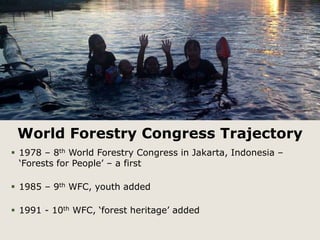
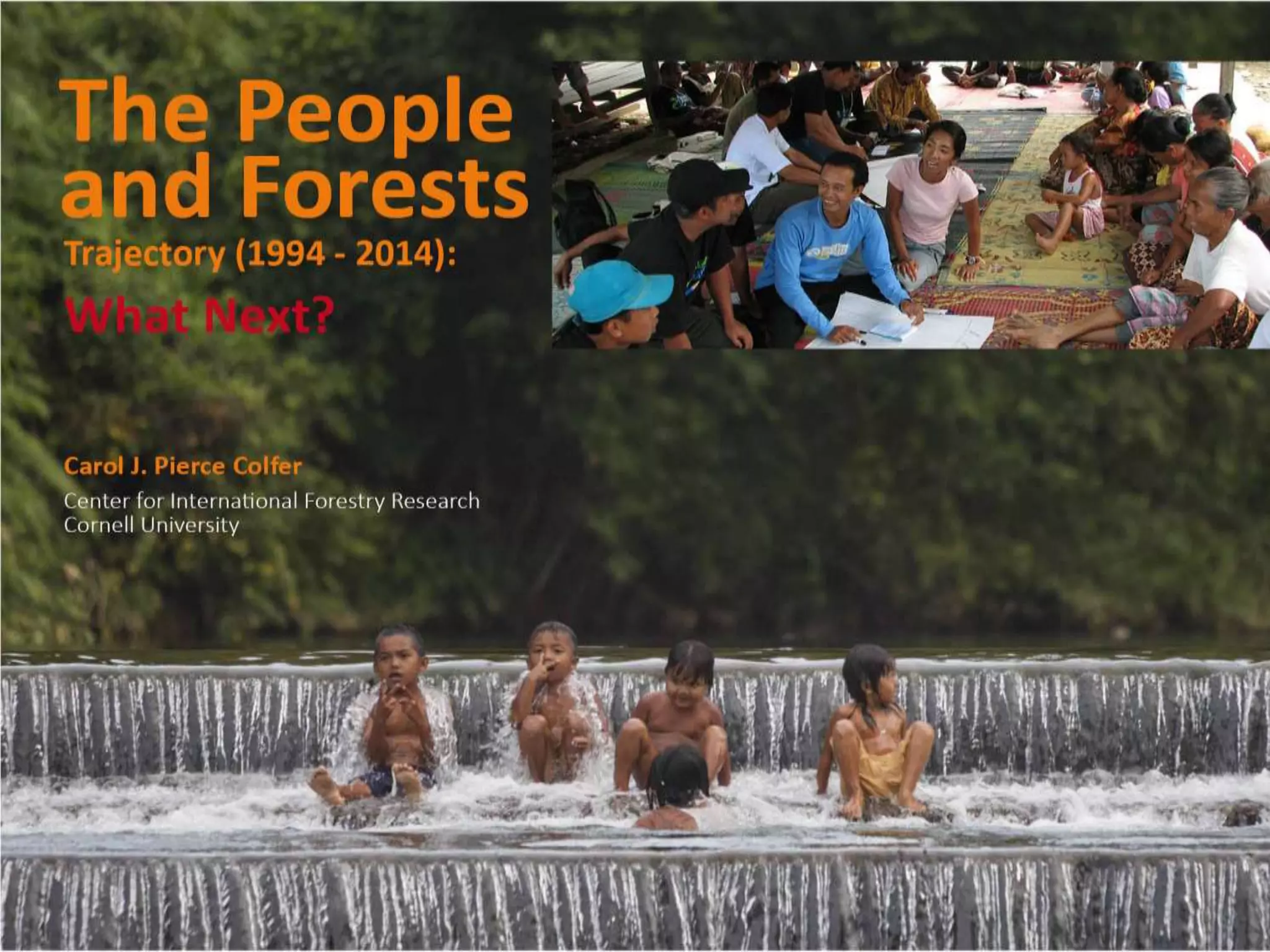
[Photos by Colfer & Anastasia Widyaningsih]
World Forestry Congress Trajectory 
 1978 – 8th World Forestry Congress in Jakarta, Indonesia – 
‘Forests for People’ – a first 
 1985 – 9th WFC, youth added 
 1991 - 10th WFC, ‘forest heritage’ added
A New Era: 
Aiming for 
Broader Sustainability 
By 2003 - 12th WFC, included three 
main themes: 
• Forests for people 
• Forests for the planet 
• People and forests in harmony 
 For 2015: Forests and People: 
Investing in a Sustainable Future
CIFOR Trajectory: 
Sadly, an Atypical Example 
Started in 1993, CIFOR began with several important 
commitments: 
• Policy-oriented 
• Interdisciplinary teamwork 
• Research at all scales (int’l to field-based) 
• Addressing both human and ecological, as well as strictly 
forest concerns
Sample ‘People-Forests Research’ 
from CIFOR & its Partners (1) 
Attention to human well being 
• criteria and indicators for sustainable forest management 
• poverty and environment network 
Working collaboratively with communities and their 
subgroups 
 adaptive collaborative management of forests 
 Some REDD+ work
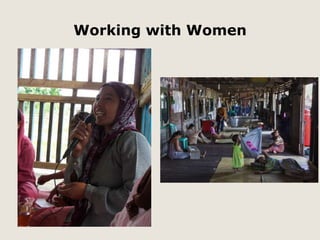
Working with Women
Sample ‘People-Forests Research’ 
from CIFOR & its Partners (2) 
Attention to people’s knowledge about forests 
 indigenous knowledge (IK, ITK, IEK, etc.) 
 non timber forest products 
A focus on power relations 
 ethnic and gender studies 
 decentralization and devolution studies
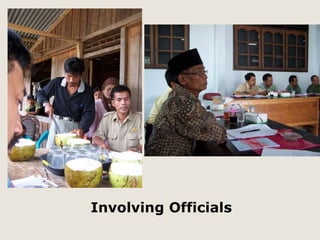
Involving Officials
A More Controversial Set 
From CIFOR & Partners 
Swidden agriculture – as a complex and sometimes 
sustainable system 
Human health – looking at the interactions with forests and 
their management 
Nutrition – identifying nutritional implications of forest use 
and management 
Population – Recognizing the key roles birth control can play 
in life chances
But attention to these issues 
has NOT been typical 
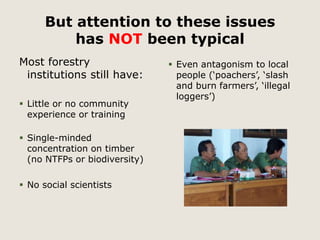
Most forestry 
institutions still have: 
 Little or no community 
experience or training 
 Single-minded 
concentration on timber 
(no NTFPs or biodiversity) 
 No social scientists 
 Even antagonism to local 
people (‘poachers’, ‘slash 
and burn farmers’, ‘illegal 
loggers’)
And What Results 
Have we Attained? 
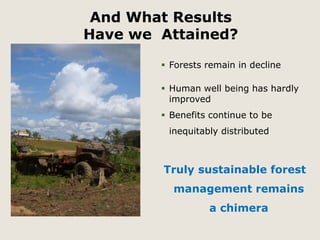
 Forests remain in decline 
 Human well being has hardly 
improved 
 Benefits continue to be 
inequitably distributed 
Truly sustainable forest 
management remains 
a chimera
Women and Forests 
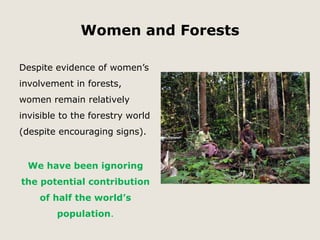
Despite evidence of women’s 
involvement in forests, 
women remain relatively 
invisible to the forestry world 
(despite encouraging signs). 
We have been ignoring 
the potential contribution 
of half the world’s 
population.
Versus Gender and Forests 
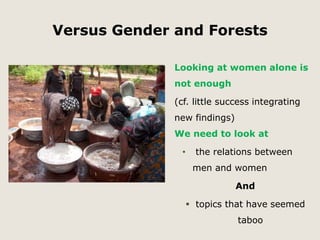
Looking at women alone is 
not enough 
(cf. little success integrating 
new findings) 
We need to look at 
• the relations between 
men and women 
And 
 topics that have seemed 
taboo
Elephant in the Room No. 1 
Population 
 Local population 
growth is a big 
problem for forests 
 women without access 
to birth control, have 
limited options 
[A rare win-win issue]
Elephant in the Room No. 2 
“Engaging men in 
care-giving … 
is nothing less than a 
fundamental 
reworking of our 
work–life balance 
and our beliefs in the 
purpose of our lives 
and 
relationships.” 
[Gary Barker 2014] 
The ‘Domestic’ 
(Reproductive) 
If women 
enter new fields 
their existing 
work must be 
reduced by 
men’s greater 
involvement at 
home
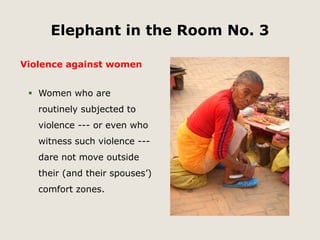
Elephant in the Room No. 3 
Violence against women 
 Women who are 
routinely subjected to 
violence --- or even who 
witness such violence --- 
dare not move outside 
their (and their spouses’) 
comfort zones.
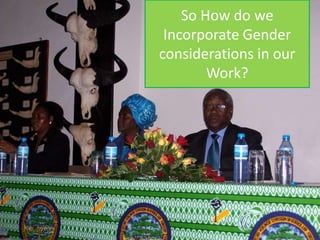
So How do we 
Incorporate Gender 
considerations in our 
Work?
Methodologically Complex Topics 
Not subject to conventional experimental designs, but they 
are studied by social scientists: 
• Culture – a complex whole (knowledge, belief, art, 
morals, law, custom and other learned capabilities and 
habits, Tylor 1871) 
• Norms - a standard or pattern, especially of social 
behavior, that is typical or expected of a group. 
• Values - a person's principles or standards of behavior; 
one's judgment of what is important in life.
Examples 1 & 2 
A variety of site-specific and intangible, but powerful cultural 
topics (e.g., from ongoing governance work in Sulawesi): 
• Bugis-Makassar: concept of ‘honor’ has powerful inhibiting 
effects on behaviour… 
Δ Reducing women’s forest options. 
• Makassar & Tolaki: women, rather than men, are accepted 
as the legitimate managers of household income. 
Δ Women have cash to invest (in forests?).
Examples 3 & 4 
• Women speak up publicly to varying degrees, but some 
groups report near gender equality. 
Δ Women may have unrecognized power. 
 Tolaki: These ‘primitive’ people manifest a strong sense of 
everyone’s right to be involved in decision-making. 
Δ The people could provide a more gender-equitable 
example for managing forests democratically.
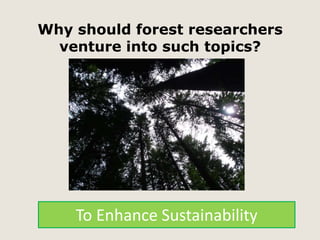
Why should forest researchers 
venture into such topics? 
To Enhance Sustainability
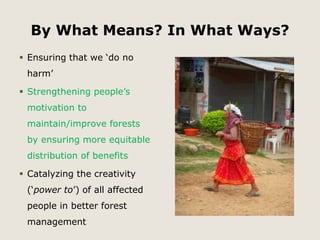
By What Means? In What Ways? 
 Ensuring that we ‘do no 
harm’ 
 Strengthening people’s 
motivation to 
maintain/improve forests 
by ensuring more equitable 
distribution of benefits 
 Catalyzing the creativity 
(‘power to’) of all affected 
people in better forest 
management
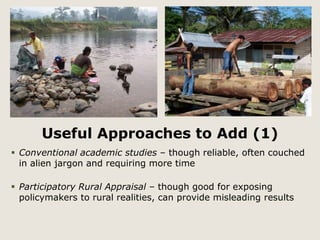
Useful Approaches to Add (1) 
 Conventional academic studies – though reliable, often couched 
in alien jargon and requiring more time 
 Participatory Rural Appraisal – though good for exposing 
policymakers to rural realities, can provide misleading results
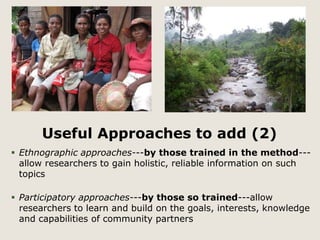
Useful Approaches to add (2) 
 Ethnographic approaches---by those trained in the method--- 
allow researchers to gain holistic, reliable information on such 
topics 
 Participatory approaches---by those so trained---allow 
researchers to learn and build on the goals, interests, knowledge 
and capabilities of community partners
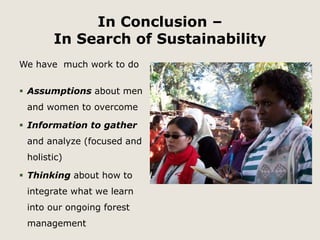
In Conclusion – 
In Search of Sustainability 
We have much work to do 
 Assumptions about men 
and women to overcome 
 Information to gather 
and analyze (focused and 
holistic) 
 Thinking about how to 
integrate what we learn 
into our ongoing forest 
management
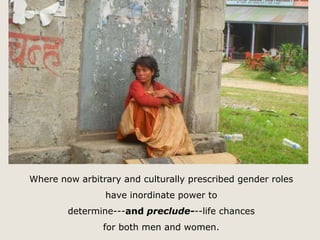
Where now arbitrary and culturally prescribed gender roles 
have inordinate power to 
determine---and preclude---life chances 
for both men and women.
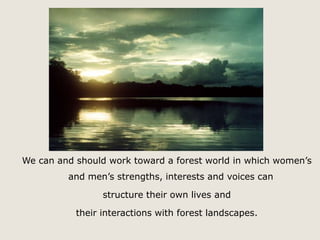
We can and should work toward a forest world in which women’s 
and men’s strengths, interests and voices can 
structure their own lives and 
their interactions with forest landscapes.
The result should be worth the effort!

People and forests trajectory

  • 2.
    Overview  Earlydays of attention to people in forests  Rare but encouraging recent examples – toward sustainability  Importance of addressing gender  Some methodological considerations  Concluding with ‘why bother?’ [Photos by Colfer & Anastasia Widyaningsih]
  • 3.
    World Forestry CongressTrajectory  1978 – 8th World Forestry Congress in Jakarta, Indonesia – ‘Forests for People’ – a first  1985 – 9th WFC, youth added  1991 - 10th WFC, ‘forest heritage’ added
  • 4.
    A New Era: Aiming for Broader Sustainability By 2003 - 12th WFC, included three main themes: • Forests for people • Forests for the planet • People and forests in harmony  For 2015: Forests and People: Investing in a Sustainable Future
  • 5.
    CIFOR Trajectory: Sadly,an Atypical Example Started in 1993, CIFOR began with several important commitments: • Policy-oriented • Interdisciplinary teamwork • Research at all scales (int’l to field-based) • Addressing both human and ecological, as well as strictly forest concerns
  • 6.
    Sample ‘People-Forests Research’ from CIFOR & its Partners (1) Attention to human well being • criteria and indicators for sustainable forest management • poverty and environment network Working collaboratively with communities and their subgroups  adaptive collaborative management of forests  Some REDD+ work
  • 7.
  • 8.
    Sample ‘People-Forests Research’ from CIFOR & its Partners (2) Attention to people’s knowledge about forests  indigenous knowledge (IK, ITK, IEK, etc.)  non timber forest products A focus on power relations  ethnic and gender studies  decentralization and devolution studies
  • 9.
  • 10.
    A More ControversialSet From CIFOR & Partners Swidden agriculture – as a complex and sometimes sustainable system Human health – looking at the interactions with forests and their management Nutrition – identifying nutritional implications of forest use and management Population – Recognizing the key roles birth control can play in life chances
  • 11.
    But attention tothese issues has NOT been typical Most forestry institutions still have:  Little or no community experience or training  Single-minded concentration on timber (no NTFPs or biodiversity)  No social scientists  Even antagonism to local people (‘poachers’, ‘slash and burn farmers’, ‘illegal loggers’)
  • 12.
    And What Results Have we Attained?  Forests remain in decline  Human well being has hardly improved  Benefits continue to be inequitably distributed Truly sustainable forest management remains a chimera
  • 13.
    Women and Forests Despite evidence of women’s involvement in forests, women remain relatively invisible to the forestry world (despite encouraging signs). We have been ignoring the potential contribution of half the world’s population.
  • 14.
    Versus Gender andForests Looking at women alone is not enough (cf. little success integrating new findings) We need to look at • the relations between men and women And  topics that have seemed taboo
  • 15.
    Elephant in theRoom No. 1 Population  Local population growth is a big problem for forests  women without access to birth control, have limited options [A rare win-win issue]
  • 16.
    Elephant in theRoom No. 2 “Engaging men in care-giving … is nothing less than a fundamental reworking of our work–life balance and our beliefs in the purpose of our lives and relationships.” [Gary Barker 2014] The ‘Domestic’ (Reproductive) If women enter new fields their existing work must be reduced by men’s greater involvement at home
  • 17.
    Elephant in theRoom No. 3 Violence against women  Women who are routinely subjected to violence --- or even who witness such violence --- dare not move outside their (and their spouses’) comfort zones.
  • 18.
    So How dowe Incorporate Gender considerations in our Work?
  • 19.
    Methodologically Complex Topics Not subject to conventional experimental designs, but they are studied by social scientists: • Culture – a complex whole (knowledge, belief, art, morals, law, custom and other learned capabilities and habits, Tylor 1871) • Norms - a standard or pattern, especially of social behavior, that is typical or expected of a group. • Values - a person's principles or standards of behavior; one's judgment of what is important in life.
  • 20.
    Examples 1 &2 A variety of site-specific and intangible, but powerful cultural topics (e.g., from ongoing governance work in Sulawesi): • Bugis-Makassar: concept of ‘honor’ has powerful inhibiting effects on behaviour… Δ Reducing women’s forest options. • Makassar & Tolaki: women, rather than men, are accepted as the legitimate managers of household income. Δ Women have cash to invest (in forests?).
  • 21.
    Examples 3 &4 • Women speak up publicly to varying degrees, but some groups report near gender equality. Δ Women may have unrecognized power.  Tolaki: These ‘primitive’ people manifest a strong sense of everyone’s right to be involved in decision-making. Δ The people could provide a more gender-equitable example for managing forests democratically.
  • 22.
    Why should forestresearchers venture into such topics? To Enhance Sustainability
  • 23.
    By What Means?In What Ways?  Ensuring that we ‘do no harm’  Strengthening people’s motivation to maintain/improve forests by ensuring more equitable distribution of benefits  Catalyzing the creativity (‘power to’) of all affected people in better forest management
  • 24.
    Useful Approaches toAdd (1)  Conventional academic studies – though reliable, often couched in alien jargon and requiring more time  Participatory Rural Appraisal – though good for exposing policymakers to rural realities, can provide misleading results
  • 25.
    Useful Approaches toadd (2)  Ethnographic approaches---by those trained in the method--- allow researchers to gain holistic, reliable information on such topics  Participatory approaches---by those so trained---allow researchers to learn and build on the goals, interests, knowledge and capabilities of community partners
  • 26.
    In Conclusion – In Search of Sustainability We have much work to do  Assumptions about men and women to overcome  Information to gather and analyze (focused and holistic)  Thinking about how to integrate what we learn into our ongoing forest management
  • 27.
    Where now arbitraryand culturally prescribed gender roles have inordinate power to determine---and preclude---life chances for both men and women.
  • 28.
    We can andshould work toward a forest world in which women’s and men’s strengths, interests and voices can structure their own lives and their interactions with forest landscapes.
  • 29.
    The result shouldbe worth the effort!

Editor's Notes

  • #3 Layout: Content with Portrait Picture Variation: none
  • #4 Layout: Content with Horizontal Picture Variation: none
  • #5 Layout: Content with Portrait Picture Variation: none
  • #6 Layout: Title and Content Variation: none
  • #7 Layout: Title and Content 2 Variation: none
  • #11 Layout: Section Header Variation: none
  • #13 Layout: Content with Potrait Picture. Variation: alter the position and size of the picture
  • #30 Layout: Content with Horizontal Picture Variation: none