3D Printer Wars:
An Industry
Primer
Black Arbs: Research
09/12/2013
1
Table of Contents
• Concept (3)
• The Process Explained (4)
• The Market Ecosystem (5)
• 3d Printing Applications (6)
• Industries using 3d Printing Applications (7)
• Organizations utilizing 3d Printing (8)
• 3d Printing Methods (9-13)
• Market Size (14)
• Market Share (15)
• 3d Printing Industry in Context (16)
• Conclusion (17)
2
BLACK ARBS
Concept
To create 3-dimensional objects using an additive
process. This process builds the object by stacking
individual layers. Layers are thinly sliced horizontal
cross sections composed of various powders, metals,
plastics and alloys.
3
BLACK ARBS
The Process Explained
1. It begins with a digital computer aided design (CAD)
file created in software or scanned using input from
3d scanner(s). The software then formats the
design into the object layers to be sent to the
printer.
2. A 3d printer then constructs the object by stacking
the previously designed object layers. This is called
“additive manufacturing”. Compare that to
traditional subtractive processes including, cutting,
drilling, milling or machining.
4
BLACK ARBS
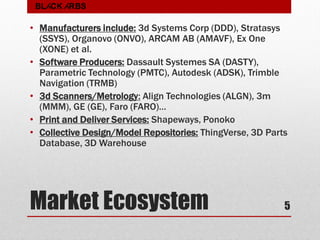
Market Ecosystem
• Manufacturers include: 3d Systems Corp (DDD), Stratasys
(SSYS), Organovo (ONVO), ARCAM AB (AMAVF), Ex One
(XONE) et al.
• Software Producers: Dassault Systemes SA (DASTY),
Parametric Technology (PMTC), Autodesk (ADSK), Trimble
Navigation (TRMB)
• 3d Scanners/Metrology: Align Technologies (ALGN), 3m
(MMM), GE (GE), Faro (FARO)…
• Print and Deliver Services: Shapeways, Ponoko
• Collective Design/Model Repositories: ThingVerse, 3D Parts
Database, 3D Warehouse
5
BLACK ARBS
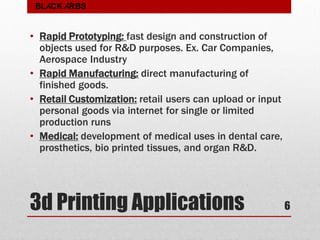
3d Printing Applications
• Rapid Prototyping: fast design and construction of
objects used for R&D purposes. Ex. Car Companies,
Aerospace Industry
• Rapid Manufacturing: direct manufacturing of
finished goods.
• Retail Customization: retail users can upload or input
personal goods via internet for single or limited
production runs
• Medical: development of medical uses in dental care,
prosthetics, bio printed tissues, and organ R&D.
6
BLACK ARBS
Industries using 3d
Printing Applications
• Aerospace/Defense
• Architecture/Geo
• Arts/Entertainment
• Automotive
• Consumer
• Culinary
• Education
• Energy
• Healthcare
• Hobbyist
• Jewelry
7
BLACK ARBS
Organizations utilizing 3d
Printing
• NASA
• GE
• Nike
• Ford
• Mattel
• MIT
• European Union
• Southampton University
(U.K.)
• NYU
• U.S. Army
• Boeing
• Xerox
• UPS
• Harvard
• North Carolina State
• Pfizer
• Knight Cancer Institute
• United Therapeutics
• University of Oxford
• Deloitte
• Et al…
8
BLACK ARBS
3d Printing Methods
• Stereolithography (SLA) – Invented by 3d systems
founder Charles Hull in 1986.
• SLA works by concentrating a beam of ultraviolet light
focused on surface of a Vat.
• Vat is filled with liquid photocurable photopolymer
(resin).
• UV laser beam draws out the 3d model layer by layer,
hardening the slice as light hits the resin.
9
BLACK ARBS
3d Printing Methods
• Fused Deposition Modeling (FDM) – Invented by
Stratasys founder Scott Crump, late 1980’s.
• Object is produced by an extrusion nozzle extruding
small beads of melted thermoplastic material to form
layers that harden immediately.
• Most FDM printers print with ABS plastic, ex. Legos
which uses type PLA (Polylactic acid) which is
biodegradable.
• FDM and “Fused Deposition Modeling” are trademarked
terms.
10
BLACK ARBS
3d Printing Methods
• Fused Filament Fabrication (FFF) – RepRap process
similar to FDM but slightly different to avoid
trademark issues.
• Material is fed via filament from a spool of the material.
• Via filament FFF is able to construct the object
11
BLACK ARBS
3d Printing Methods
• Selective Laser Sintering (SLS) – Process developed
by Carl Deckard et al in the 1980’s.
• Uses powdered materials: polystyrene, ceramics, glass,
nylon, steel, titanium, aluminum, silver.
• When a laser hits the powder it is fused at that point
(sintered). All un-sintered powder remains available for
the next print job.
12
BLACK ARBS
3d Printing Methods -
Variations
• Selective Laser Melting (SLM) – similar to SLS but
fully melts the powder instead of fusing via a lower
temp
• Electron Beam Melting (EBM) – uses an electron
beam instead of the UV laser used in SLS process.
• Laminated Object Manufacturing (LOM) – layers of
adhesive coated paper, plastic, or metal laminates are
successively glued together and cut to shape with a
knife or laser cutter.
13
BLACK ARBS
Market Size
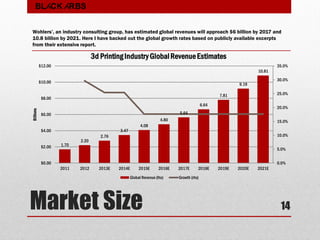
1.70
2.20
2.76
3.47
4.08
4.80
5.64
6.64
7.81
9.19
10.81
0.0%
5.0%
10.0%
15.0%
20.0%
25.0%
30.0%
35.0%
$0.00
$2.00
$4.00
$6.00
$8.00
$10.00
$12.00
2011 2012 2013E 2014E 2015E 2016E 2017E 2018E 2019E 2020E 2021E
Billions
3d PrintingIndustryGlobalRevenueEstimates
Global Revenue (lhs) Growth (rhs)
Wohlers’, an industry consulting group, has estimated global revenues will approach $6 billion by 2017 and
10.8 billion by 2021. Here I have backed out the global growth rates based on publicly available excerpts
from their extensive report.
14
BLACK ARBS
Market Share
DDD
16%
SSYS
10%
XONE
1%
Arcam
1%Others
72%
3d Printer MarketShare est.
DDD
SSYS
XONE
Arcam
Others
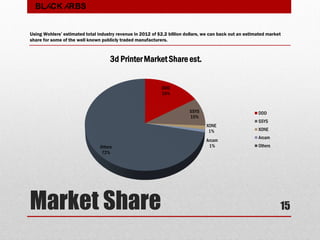
Using Wohlers’ estimated total industry revenue in 2012 of $2.2 billion dollars, we can back out an estimated market
share for some of the well known publicly traded manufacturers.
15
BLACK ARBS
3d Printing Industry in
Context
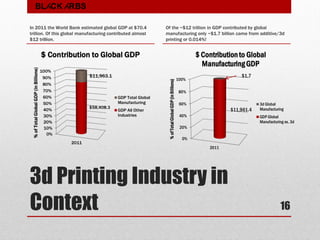
In 2011 the World Bank estimated global GDP at $70.4
trillion. Of this global manufacturing contributed almost
$12 trillion.
Of the ~$12 trillion in GDP contributed by global
manufacturing only ~$1.7 billion came from additive/3d
printing or 0.014%!
0%
10%
20%
30%
40%
50%
60%
70%
80%
90%
100%
2011
$58,408.3
$11,963.1
%ofTotalGlobalGDP(inBillions)
$ Contribution to Global GDP
GDP Total Global
Manufacturing
GDP All Other
Industries
0%
20%
40%
60%
80%
100%
2011
$11,961.4
$1.7
%ofTotalGlobalGDP(inBillions)
$ Contributionto Global
ManufacturingGDP
3d Global
Manufacturing
GDP Global
Manufacturing ex. 3d
16
BLACK ARBS
Wrap-up
• The industry has existed for almost 30 years but recent advances in technology have led to rapid
innovation in retail, commercial, and medical applications that have the industry poised to almost
triple by 2017 (Wohlers).
• Two firms dominate the industry based on sales – 3d Systems (16% market share), Stratasys (10%).
But there are many other firms contributing to the 3d printing ecosystem that may or may not be
public, and may or may not be exclusive to the 3d printing industry.
• Currently manufacturers are looking to find ways to integrate additive manufacturing in their
production process as they have found significant cost reductions in prototyping, industrial design,
custom orders, and some direct production of finished goods.
• The industry is in its infancy and has immense potential for growth on an absolute and relative basis.
As a percentage of global manufacturing GDP, 3d printing contributed a paltry 0.014% in 2011. As
new applications are discovered and old processes refined a hypothetical increase to 1% of global
manufacturing GDP would grow the market to $119 billion or 70x larger than it was in 2011.
• 3d printing has the manufacturing sector’s support due to its actualized and unrealized potential to
reduce production and time costs; to innovate, customize, and prototype; to create previously
impossible design structures, and this presents a tailwind to a secular growth opportunity similar to
the pc revolution.
• Perhaps the greatest commercial opportunity lies within the healthcare sector. Currently researchers
at universities, firms, and public institutions are collaborating to develop 3d printers capable of
replicating the native structure and processes of cells and eventually organs. The potential in this
area to improve the human condition cannot be overstated.
17
BLACK ARBS
BLACK ARBS
Brian Christopher
BCR@BlackArbs.com
BlackArbs.com
617.642.9211
Disclaimer: This report is provided for informational, educational, and discussion purposes only. Under no
circumstances do any statements within this report represent a recommendation or advice to buy or sell
securities and make an investment of any kind. You are responsible for your own due diligence. Black Arbs llc
does not provide investment advice nor make claims or promises that information provided will lead to any
specific result of profit or loss.

3d Printer Wars - An Industry Primer

  • 1.
    3D Printer Wars: AnIndustry Primer Black Arbs: Research 09/12/2013 1
  • 2.
    Table of Contents •Concept (3) • The Process Explained (4) • The Market Ecosystem (5) • 3d Printing Applications (6) • Industries using 3d Printing Applications (7) • Organizations utilizing 3d Printing (8) • 3d Printing Methods (9-13) • Market Size (14) • Market Share (15) • 3d Printing Industry in Context (16) • Conclusion (17) 2 BLACK ARBS
  • 3.
    Concept To create 3-dimensionalobjects using an additive process. This process builds the object by stacking individual layers. Layers are thinly sliced horizontal cross sections composed of various powders, metals, plastics and alloys. 3 BLACK ARBS
  • 4.
    The Process Explained 1.It begins with a digital computer aided design (CAD) file created in software or scanned using input from 3d scanner(s). The software then formats the design into the object layers to be sent to the printer. 2. A 3d printer then constructs the object by stacking the previously designed object layers. This is called “additive manufacturing”. Compare that to traditional subtractive processes including, cutting, drilling, milling or machining. 4 BLACK ARBS
  • 5.
    Market Ecosystem • Manufacturersinclude: 3d Systems Corp (DDD), Stratasys (SSYS), Organovo (ONVO), ARCAM AB (AMAVF), Ex One (XONE) et al. • Software Producers: Dassault Systemes SA (DASTY), Parametric Technology (PMTC), Autodesk (ADSK), Trimble Navigation (TRMB) • 3d Scanners/Metrology: Align Technologies (ALGN), 3m (MMM), GE (GE), Faro (FARO)… • Print and Deliver Services: Shapeways, Ponoko • Collective Design/Model Repositories: ThingVerse, 3D Parts Database, 3D Warehouse 5 BLACK ARBS
  • 6.
    3d Printing Applications •Rapid Prototyping: fast design and construction of objects used for R&D purposes. Ex. Car Companies, Aerospace Industry • Rapid Manufacturing: direct manufacturing of finished goods. • Retail Customization: retail users can upload or input personal goods via internet for single or limited production runs • Medical: development of medical uses in dental care, prosthetics, bio printed tissues, and organ R&D. 6 BLACK ARBS
  • 7.
    Industries using 3d PrintingApplications • Aerospace/Defense • Architecture/Geo • Arts/Entertainment • Automotive • Consumer • Culinary • Education • Energy • Healthcare • Hobbyist • Jewelry 7 BLACK ARBS
  • 8.
    Organizations utilizing 3d Printing •NASA • GE • Nike • Ford • Mattel • MIT • European Union • Southampton University (U.K.) • NYU • U.S. Army • Boeing • Xerox • UPS • Harvard • North Carolina State • Pfizer • Knight Cancer Institute • United Therapeutics • University of Oxford • Deloitte • Et al… 8 BLACK ARBS
  • 9.
    3d Printing Methods •Stereolithography (SLA) – Invented by 3d systems founder Charles Hull in 1986. • SLA works by concentrating a beam of ultraviolet light focused on surface of a Vat. • Vat is filled with liquid photocurable photopolymer (resin). • UV laser beam draws out the 3d model layer by layer, hardening the slice as light hits the resin. 9 BLACK ARBS
  • 10.
    3d Printing Methods •Fused Deposition Modeling (FDM) – Invented by Stratasys founder Scott Crump, late 1980’s. • Object is produced by an extrusion nozzle extruding small beads of melted thermoplastic material to form layers that harden immediately. • Most FDM printers print with ABS plastic, ex. Legos which uses type PLA (Polylactic acid) which is biodegradable. • FDM and “Fused Deposition Modeling” are trademarked terms. 10 BLACK ARBS
  • 11.
    3d Printing Methods •Fused Filament Fabrication (FFF) – RepRap process similar to FDM but slightly different to avoid trademark issues. • Material is fed via filament from a spool of the material. • Via filament FFF is able to construct the object 11 BLACK ARBS
  • 12.
    3d Printing Methods •Selective Laser Sintering (SLS) – Process developed by Carl Deckard et al in the 1980’s. • Uses powdered materials: polystyrene, ceramics, glass, nylon, steel, titanium, aluminum, silver. • When a laser hits the powder it is fused at that point (sintered). All un-sintered powder remains available for the next print job. 12 BLACK ARBS
  • 13.
    3d Printing Methods- Variations • Selective Laser Melting (SLM) – similar to SLS but fully melts the powder instead of fusing via a lower temp • Electron Beam Melting (EBM) – uses an electron beam instead of the UV laser used in SLS process. • Laminated Object Manufacturing (LOM) – layers of adhesive coated paper, plastic, or metal laminates are successively glued together and cut to shape with a knife or laser cutter. 13 BLACK ARBS
  • 14.
    Market Size 1.70 2.20 2.76 3.47 4.08 4.80 5.64 6.64 7.81 9.19 10.81 0.0% 5.0% 10.0% 15.0% 20.0% 25.0% 30.0% 35.0% $0.00 $2.00 $4.00 $6.00 $8.00 $10.00 $12.00 2011 20122013E 2014E 2015E 2016E 2017E 2018E 2019E 2020E 2021E Billions 3d PrintingIndustryGlobalRevenueEstimates Global Revenue (lhs) Growth (rhs) Wohlers’, an industry consulting group, has estimated global revenues will approach $6 billion by 2017 and 10.8 billion by 2021. Here I have backed out the global growth rates based on publicly available excerpts from their extensive report. 14 BLACK ARBS
  • 15.
    Market Share DDD 16% SSYS 10% XONE 1% Arcam 1%Others 72% 3d PrinterMarketShare est. DDD SSYS XONE Arcam Others Using Wohlers’ estimated total industry revenue in 2012 of $2.2 billion dollars, we can back out an estimated market share for some of the well known publicly traded manufacturers. 15 BLACK ARBS
  • 16.
    3d Printing Industryin Context In 2011 the World Bank estimated global GDP at $70.4 trillion. Of this global manufacturing contributed almost $12 trillion. Of the ~$12 trillion in GDP contributed by global manufacturing only ~$1.7 billion came from additive/3d printing or 0.014%! 0% 10% 20% 30% 40% 50% 60% 70% 80% 90% 100% 2011 $58,408.3 $11,963.1 %ofTotalGlobalGDP(inBillions) $ Contribution to Global GDP GDP Total Global Manufacturing GDP All Other Industries 0% 20% 40% 60% 80% 100% 2011 $11,961.4 $1.7 %ofTotalGlobalGDP(inBillions) $ Contributionto Global ManufacturingGDP 3d Global Manufacturing GDP Global Manufacturing ex. 3d 16 BLACK ARBS
  • 17.
    Wrap-up • The industryhas existed for almost 30 years but recent advances in technology have led to rapid innovation in retail, commercial, and medical applications that have the industry poised to almost triple by 2017 (Wohlers). • Two firms dominate the industry based on sales – 3d Systems (16% market share), Stratasys (10%). But there are many other firms contributing to the 3d printing ecosystem that may or may not be public, and may or may not be exclusive to the 3d printing industry. • Currently manufacturers are looking to find ways to integrate additive manufacturing in their production process as they have found significant cost reductions in prototyping, industrial design, custom orders, and some direct production of finished goods. • The industry is in its infancy and has immense potential for growth on an absolute and relative basis. As a percentage of global manufacturing GDP, 3d printing contributed a paltry 0.014% in 2011. As new applications are discovered and old processes refined a hypothetical increase to 1% of global manufacturing GDP would grow the market to $119 billion or 70x larger than it was in 2011. • 3d printing has the manufacturing sector’s support due to its actualized and unrealized potential to reduce production and time costs; to innovate, customize, and prototype; to create previously impossible design structures, and this presents a tailwind to a secular growth opportunity similar to the pc revolution. • Perhaps the greatest commercial opportunity lies within the healthcare sector. Currently researchers at universities, firms, and public institutions are collaborating to develop 3d printers capable of replicating the native structure and processes of cells and eventually organs. The potential in this area to improve the human condition cannot be overstated. 17 BLACK ARBS
  • 18.
    BLACK ARBS Brian Christopher BCR@BlackArbs.com BlackArbs.com 617.642.9211 Disclaimer:This report is provided for informational, educational, and discussion purposes only. Under no circumstances do any statements within this report represent a recommendation or advice to buy or sell securities and make an investment of any kind. You are responsible for your own due diligence. Black Arbs llc does not provide investment advice nor make claims or promises that information provided will lead to any specific result of profit or loss.