Tips for Paper 2
Based on the SE
Agenda
‱ How SE grades differ from what you can expect from the IB
‱ Review of criteria against your performance
‱ Review of questions against your performance
‱ Things to think about
‱ Review of past paper 2 questions for trends
‱ Last minute notes
VWO SE vs IB grading
‱ All papers marked against IB SL rubric
‱ Criteria A: if context not mentioned, highest possible = 3; IB will be 2
at HL
‱ Criteria C: if effects on reader not mentioned, highest possible = 3; IB
will be 2
‱ Criteria E: same for HL and SL; 3 on IB/VWO = acceptable;
4 and 5 is softer for VWO than for IB
What went right
‱ Good use of quotes
‱ Well-organized paragraphs (albeit sometimes repetitive)
Pitfalls: Criteria A – knowledge and
understanding
‱ Context: Don’t mistake “setting” for “context” – make deliberate
reference to the context!
‱ How much is enough context? How much is too little context?
‱ I don’t know
 this is often discussed at IB meetings, with no definitive answer
‱ Depending also on question
‱ Knowledge of the book: one example does not necessarily
demonstrate reliable knowledge; two is better or quickly
mention others.
Pitfalls: Criteria B: Response to the question
‱ Pre-written essays  trying to fit to the question can be unnatural and if it
is suspected causes dislike
‱ In framing your answer, make sure you frame it to the question
‱ Example: juxtaposing the jungle to O’Brien’s hometown as urban vs rural: label it as
what you’re doing
‱ Rural – hometown vs Urban: Cairo / jungle was only one option
‱ Rural (village) vs Cairo vs rural (jungle) vs hometown another
‱ No urban present in TTTC another option
‱ Unpack the question, highlight every key word and
make sure all are addressed in your essay
‱ Re-read the question and your thesis statement: Is your thesis an answer to
the question?
Pitfalls: Criteria C: Stylistic features
‱ Incorrectly labelling features: Get them right!
‱ Don’t forget to discuss effect on the reader
‱ Be more specific than “this makes the reader understand 
” or “causes the
reader to empathize” : understand what? Feel what?
‱ Discussing things that are not stylistic features as if they were
‱ Not discussing stylistic features at all
‱ Distinguish between the author’s tone and the character’s
tone.
‱ Distinguish between the author’s tone and the reader’s
mood
Pitfalls: Criteria D: Organization
‱ No clear thesis: “In this essay I will answer the question by discussing
WAPZ and TTTC” is not an answer to the question, and leads to weak
organization because you are not supporting a strong point with three
reasons, you are giving 3 answers without a clear direction
‱ Restating the question as a statement can also lead to muddy
organization
‱ Simple linking phrases and transitions
‱ Forgetting to conclude
‱ Conclusions that just summarize: wider significance!
Pitfalls: Criteria E Language
‱ Repetition of the same words or phrases
‱ Grammar: area’s vs areas, the boy his dog vs the boy’s dog
‱ Books have readers, not audiences!
‱ Be consistent in your use of tense: discuss the plot either in past tense or present, but
don’t mix it up
‱ Lack of variation in sentence construction – especially when paragraphs all follow the PEE
or PEAL models.
‱ Lack of academic terms, in particular labels for stylistic features
‱ Misuse of academic terms, in particular labels for stylistic features
‱ If you are going to abbreviate “WAPZ” and “TTTC” introduce them
‱ Register!!!! (both too informal and too formal)
‱ Even if you got a 5 for language on the SE, you may get a 3 on Paper 2 (difference VWO
expectations / IB expectations)
Question 1: Discuss the significance of the
rural and/or the urban (9 papers)
‱ Pitfall: Juxtaposing rural vs urban in both books: the villages of childhood
(rural) vs city/jungle (jungle is not “urban”)
‱ Context: largely ignored
‱ Egypt: the setting is the context – Egypt in transition from a traditional, rural society
to a more modern one, while traditions stay firmly entrenched. Needs to be made
explicit
‱ Vietnam: the context of the book is not the setting of most stories,
but the 1980s, when it became possible to look back at the
Vietnam war. There was a need to come to terms with what the
country went through. The rural setting represents the innocence
with which we went into Vietnam.
‱ Consider: If Firdaus or Tim had grown up in cities, would their innocence
and nostalgia have been as strong?
Question 2: Analyse the techniques used by the
authors to evoke an emotional response in the
reader. (3 papers)
‱ Pitfall: Discussing techniques in detail but glossing over the response in the
reader
‱ Context: Largely ignored
‱ TTTC needs the 20 years distance from the war, as America needed to come to terms
with its trauma. The book is very much about that trauma. The story-telling aspect
including all the doubt is meant to force us to come to terms.
‱ WAPZ deals with problems existing in Egyptian society then and still today. Things
like the motif of eyes are meant to draw attention to the oppressive nature of life for
women in Egypt.
‱ Consider:
‱ Consider O’Brien’s generation: how would the pro-war reader
respond to “On the Rainy River”? How would the anti-war
reader respond if that story were not present?
‱ The oppressive nature of the motif of eyes in WAPZ help create a feeling of
oppression in Firdaus that justify perhaps even to male readers her crime.
Question 4: How are challenges to authority
presented, and what impact have such challenges
had on readers or audiences? (2 papers)
‱ Pitfall: Forgetting to discuss the impact of the challenges in the books on
readers, or discussing them superficially.
‱ Context: largely ignored.
‱ WAPZ is a manifesto, decrying the treatment of women in Egypt. Therefore,
Firdaus’s rebellion is meant as a call to action
‱ TTTC is a memoir, meant to explain how these actions could have
happened. Therefore, the challenge to ‘authority’ is not in the
plot but in the author’s questioning of truth
‱ Consider: Firdaus constantly challenges authority – her drive to go to
school, her sexual explorations with Mohammadain, becoming a
prostitute, and the murder of the pimp are just a few. Tim is less rebellious
– his greatest act or rebellion is thinking of running away to Canada, but in
the end he doesn’t. All other rebelliousness takes place in his head.
Question 5: The personal history of an author can have a
significant influence on the way meaning is constructed
in his/her writing. Comment on specific instances of
such influence. (1 paper) /SDR – Most papers
‱ Pitfall: Not paying enough attention to stylistic devices
‱ Context: adequate coverage inherent in the question
‱ Consider:
‱ In TTTC, stylistic features such as the reoccurence of events in
different stories, but with a different angle, reflect the author’s
own struggle to come to terms with his past.
‱ In WAPZ, Sadaawi presents two women, the Psychiatrist and Firdaus, both of
whom she has given aspects from her own life, and both of whom present
paradigms of women who do not fit into Egyptian traditions. As if to say that
she herself just as easily could have ended up like Firdaus.
Question 6: Examine the presentation of male and
female views of the central concerns or issues,
and discuss the ways in which these views differ. (3
papers)
‱ Pitfalls
‱ Discussing how the presentation of the views differ rather than the views themselves
‱ Discussing how society looks at men and women, instead of how men and women look at society
‱ Context: largely ignored
‱ The Vietnam war was largely an issue for the men who served or might have to serve. Therefore, women are
largely absent or are unaware of what the men are going through.
‱ WAPZ’s male characters are largely one—dimensional, they are the enemy. Sadaawi writes this as a manifesto
for women and a confrontational, direct challenge to men.
‱ Consider:
‱ In WAPZ the eyes might represent danger to women and safety to men
‱ In TTTC Tim goes to war out of duty; Mary Anne for excitement. Men are driven out of a sense of loyalty and
duty, women make their choices based on what is best for them (all the women who break up with their
boyfriends). O’Brien does not condemn the women but he does question the wisdom of the male choices
‱ El Sadaawi has Firdaus kill her pimp without remorse, a reaction that fits more with society’s expectations for
men. O’Brien, on the other hand, shows how the character Tim kills a man and is ridden with remorse, which
is more to be expected of women. In both cases, the authors reverse our expectations to make us question
how we normally view events.
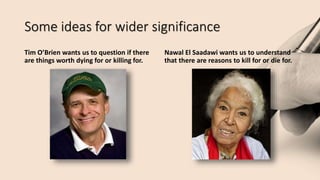
Some ideas for wider significance
Tim O’Brien wants us to question if there
are things worth dying for or killing for.
Nawal El Saadawi wants us to understand
that there are reasons to kill for or die for.
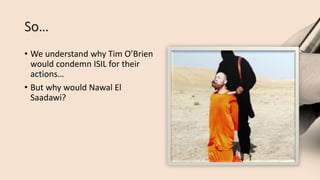
So

‱ We understand why Tim O’Brien
would condemn ISIL for their
actions

‱ But why would Nawal El
Saadawi?
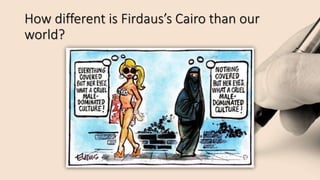
How different is Firdaus’s Cairo than our
world?
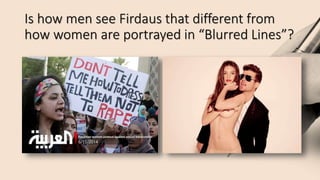
Is how men see Firdaus that different from
how women are portrayed in “Blurred Lines”?
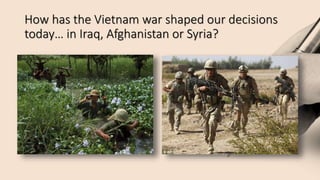
How has the Vietnam war shaped our decisions
today
 in Iraq, Afghanistan or Syria?
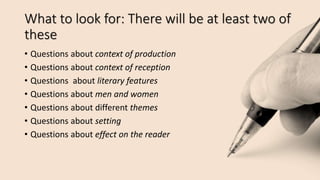
What to look for: There will be at least two of
these
‱ Questions about context of production
‱ Questions about context of reception
‱ Questions about literary features
‱ Questions about men and women
‱ Questions about different themes
‱ Questions about setting
‱ Questions about effect on the reader
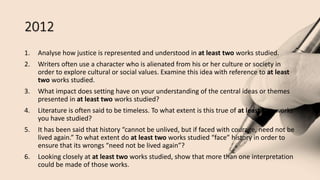
2012
1. Analyse how justice is represented and understood in at least two works studied.
2. Writers often use a character who is alienated from his or her culture or society in
order to explore cultural or social values. Examine this idea with reference to at least
two works studied.
3. What impact does setting have on your understanding of the central ideas or themes
presented in at least two works studied?
4. Literature is often said to be timeless. To what extent is this true of at least two works
you have studied?
5. It has been said that history “cannot be unlived, but if faced with courage, need not be
lived again.” To what extent do at least two works studied “face” history in order to
ensure that its wrongs “need not be lived again”?
6. Looking closely at at least two works studied, show that more than one interpretation
could be made of those works.
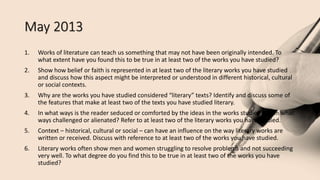
May 2013
1. Works of literature can teach us something that may not have been originally intended. To
what extent have you found this to be true in at least two of the works you have studied?
2. Show how belief or faith is represented in at least two of the literary works you have studied
and discuss how this aspect might be interpreted or understood in different historical, cultural
or social contexts.
3. Why are the works you have studied considered “literary” texts? Identify and discuss some of
the features that make at least two of the texts you have studied literary.
4. In what ways is the reader seduced or comforted by the ideas in the works studied and in what
ways challenged or alienated? Refer to at least two of the literary works you have studied.
5. Context – historical, cultural or social – can have an influence on the way literary works are
written or received. Discuss with reference to at least two of the works you have studied.
6. Literary works often show men and women struggling to resolve problems and not succeeding
very well. To what degree do you find this to be true in at least two of the works you have
studied?
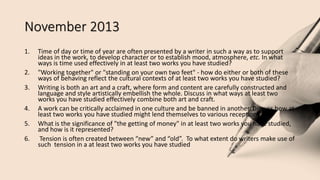
November 2013
1. Time of day or time of year are often presented by a writer in such a way as to support
ideas in the work, to develop character or to establish mood, atmosphere, etc. In what
ways is time used effectively in at least two works you have studied?
2. "Working together" or "standing on your own two feet" - how do either or both of these
ways of behaving reflect the cultural contexts of at least two works you have studied?
3. Writing is both an art and a craft, where form and content are carefully constructed and
language and style artistically embellish the whole. Discuss in what ways at least two
works you have studied effectively combine both art and craft.
4. A work can be critically acclaimed in one culture and be banned in another. Discuss how at
least two works you have studied might lend themselves to various receptions.
5. What is the significance of "the getting of money" in at least two works you have studied,
and how is it represented?
6. Tension is often created between “new” and “old”. To what extent do writers make use of
such tension in a at least two works you have studied
May 2014
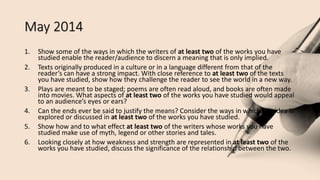
1. Show some of the ways in which the writers of at least two of the works you have
studied enable the reader/audience to discern a meaning that is only implied.
2. Texts originally produced in a culture or in a language different from that of the
reader’s can have a strong impact. With close reference to at least two of the texts
you have studied, show how they challenge the reader to see the world in a new way.
3. Plays are meant to be staged; poems are often read aloud, and books are often made
into movies. What aspects of at least two of the works you have studied would appeal
to an audience’s eyes or ears?
4. Can the ends ever be said to justify the means? Consider the ways in which this idea is
explored or discussed in at least two of the works you have studied.
5. Show how and to what effect at least two of the writers whose works you have
studied make use of myth, legend or other stories and tales.
6. Looking closely at how weakness and strength are represented in at least two of the
works you have studied, discuss the significance of the relationship between the two.
November 2014
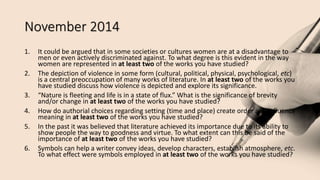
1. It could be argued that in some societies or cultures women are at a disadvantage to
men or even actively discriminated against. To what degree is this evident in the way
women are represented in at least two of the works you have studied?
2. The depiction of violence in some form (cultural, political, physical, psychological, etc)
is a central preoccupation of many works of literature. In at least two of the works you
have studied discuss how violence is depicted and explore its significance.
3. “Nature is fleeting and life is in a state of flux.” What is the significance of brevity
and/or change in at least two of the works you have studied?
4. How do authorial choices regarding setting (time and place) create order and influence
meaning in at least two of the works you have studied?
5. In the past it was believed that literature achieved its importance due to its ability to
show people the way to goodness and virtue. To what extent can this be said of the
importance of at least two of the works you have studied?
6. Symbols can help a writer convey ideas, develop characters, establish atmosphere, etc.
To what effect were symbols employed in at least two of the works you have studied?
May 2015
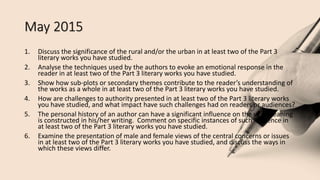
1. Discuss the significance of the rural and/or the urban in at least two of the Part 3
literary works you have studied.
2. Analyse the techniques used by the authors to evoke an emotional response in the
reader in at least two of the Part 3 literary works you have studied.
3. Show how sub-plots or secondary themes contribute to the reader’s understanding of
the works as a whole in at least two of the Part 3 literary works you have studied.
4. How are challenges to authority presented in at least two of the Part 3 literary works
you have studied, and what impact have such challenges had on readers or audiences?
5. The personal history of an author can have a significant influence on the way meaning
is constructed in his/her writing. Comment on specific instances of such influence in
at least two of the Part 3 literary works you have studied.
6. Examine the presentation of male and female views of the central concerns or issues
in at least two of the Part 3 literary works you have studied, and discuss the ways in
which these views differ.
Remember!
‱ SL: you had 120 minutes to write your SE; you will only have 90
minutes for Paper 2 on May 3rd
‱ SL and HL: you may not use any dictionaries
‱ Double-space and clearly mark paragraphs
‱ Much of this applies to Paper 1 too

Tips for paper 2

  • 1.
    Tips for Paper2 Based on the SE
  • 2.
    Agenda ‱ How SEgrades differ from what you can expect from the IB ‱ Review of criteria against your performance ‱ Review of questions against your performance ‱ Things to think about ‱ Review of past paper 2 questions for trends ‱ Last minute notes
  • 3.
    VWO SE vsIB grading ‱ All papers marked against IB SL rubric ‱ Criteria A: if context not mentioned, highest possible = 3; IB will be 2 at HL ‱ Criteria C: if effects on reader not mentioned, highest possible = 3; IB will be 2 ‱ Criteria E: same for HL and SL; 3 on IB/VWO = acceptable; 4 and 5 is softer for VWO than for IB
  • 4.
    What went right ‱Good use of quotes ‱ Well-organized paragraphs (albeit sometimes repetitive)
  • 5.
    Pitfalls: Criteria A– knowledge and understanding ‱ Context: Don’t mistake “setting” for “context” – make deliberate reference to the context! ‱ How much is enough context? How much is too little context? ‱ I don’t know
 this is often discussed at IB meetings, with no definitive answer ‱ Depending also on question ‱ Knowledge of the book: one example does not necessarily demonstrate reliable knowledge; two is better or quickly mention others.
  • 6.
    Pitfalls: Criteria B:Response to the question ‱ Pre-written essays  trying to fit to the question can be unnatural and if it is suspected causes dislike ‱ In framing your answer, make sure you frame it to the question ‱ Example: juxtaposing the jungle to O’Brien’s hometown as urban vs rural: label it as what you’re doing ‱ Rural – hometown vs Urban: Cairo / jungle was only one option ‱ Rural (village) vs Cairo vs rural (jungle) vs hometown another ‱ No urban present in TTTC another option ‱ Unpack the question, highlight every key word and make sure all are addressed in your essay ‱ Re-read the question and your thesis statement: Is your thesis an answer to the question?
  • 7.
    Pitfalls: Criteria C:Stylistic features ‱ Incorrectly labelling features: Get them right! ‱ Don’t forget to discuss effect on the reader ‱ Be more specific than “this makes the reader understand 
” or “causes the reader to empathize” : understand what? Feel what? ‱ Discussing things that are not stylistic features as if they were ‱ Not discussing stylistic features at all ‱ Distinguish between the author’s tone and the character’s tone. ‱ Distinguish between the author’s tone and the reader’s mood
  • 8.
    Pitfalls: Criteria D:Organization ‱ No clear thesis: “In this essay I will answer the question by discussing WAPZ and TTTC” is not an answer to the question, and leads to weak organization because you are not supporting a strong point with three reasons, you are giving 3 answers without a clear direction ‱ Restating the question as a statement can also lead to muddy organization ‱ Simple linking phrases and transitions ‱ Forgetting to conclude ‱ Conclusions that just summarize: wider significance!
  • 9.
    Pitfalls: Criteria ELanguage ‱ Repetition of the same words or phrases ‱ Grammar: area’s vs areas, the boy his dog vs the boy’s dog ‱ Books have readers, not audiences! ‱ Be consistent in your use of tense: discuss the plot either in past tense or present, but don’t mix it up ‱ Lack of variation in sentence construction – especially when paragraphs all follow the PEE or PEAL models. ‱ Lack of academic terms, in particular labels for stylistic features ‱ Misuse of academic terms, in particular labels for stylistic features ‱ If you are going to abbreviate “WAPZ” and “TTTC” introduce them ‱ Register!!!! (both too informal and too formal) ‱ Even if you got a 5 for language on the SE, you may get a 3 on Paper 2 (difference VWO expectations / IB expectations)
  • 10.
    Question 1: Discussthe significance of the rural and/or the urban (9 papers) ‱ Pitfall: Juxtaposing rural vs urban in both books: the villages of childhood (rural) vs city/jungle (jungle is not “urban”) ‱ Context: largely ignored ‱ Egypt: the setting is the context – Egypt in transition from a traditional, rural society to a more modern one, while traditions stay firmly entrenched. Needs to be made explicit ‱ Vietnam: the context of the book is not the setting of most stories, but the 1980s, when it became possible to look back at the Vietnam war. There was a need to come to terms with what the country went through. The rural setting represents the innocence with which we went into Vietnam. ‱ Consider: If Firdaus or Tim had grown up in cities, would their innocence and nostalgia have been as strong?
  • 11.
    Question 2: Analysethe techniques used by the authors to evoke an emotional response in the reader. (3 papers) ‱ Pitfall: Discussing techniques in detail but glossing over the response in the reader ‱ Context: Largely ignored ‱ TTTC needs the 20 years distance from the war, as America needed to come to terms with its trauma. The book is very much about that trauma. The story-telling aspect including all the doubt is meant to force us to come to terms. ‱ WAPZ deals with problems existing in Egyptian society then and still today. Things like the motif of eyes are meant to draw attention to the oppressive nature of life for women in Egypt. ‱ Consider: ‱ Consider O’Brien’s generation: how would the pro-war reader respond to “On the Rainy River”? How would the anti-war reader respond if that story were not present? ‱ The oppressive nature of the motif of eyes in WAPZ help create a feeling of oppression in Firdaus that justify perhaps even to male readers her crime.
  • 12.
    Question 4: Howare challenges to authority presented, and what impact have such challenges had on readers or audiences? (2 papers) ‱ Pitfall: Forgetting to discuss the impact of the challenges in the books on readers, or discussing them superficially. ‱ Context: largely ignored. ‱ WAPZ is a manifesto, decrying the treatment of women in Egypt. Therefore, Firdaus’s rebellion is meant as a call to action ‱ TTTC is a memoir, meant to explain how these actions could have happened. Therefore, the challenge to ‘authority’ is not in the plot but in the author’s questioning of truth ‱ Consider: Firdaus constantly challenges authority – her drive to go to school, her sexual explorations with Mohammadain, becoming a prostitute, and the murder of the pimp are just a few. Tim is less rebellious – his greatest act or rebellion is thinking of running away to Canada, but in the end he doesn’t. All other rebelliousness takes place in his head.
  • 13.
    Question 5: Thepersonal history of an author can have a significant influence on the way meaning is constructed in his/her writing. Comment on specific instances of such influence. (1 paper) /SDR – Most papers ‱ Pitfall: Not paying enough attention to stylistic devices ‱ Context: adequate coverage inherent in the question ‱ Consider: ‱ In TTTC, stylistic features such as the reoccurence of events in different stories, but with a different angle, reflect the author’s own struggle to come to terms with his past. ‱ In WAPZ, Sadaawi presents two women, the Psychiatrist and Firdaus, both of whom she has given aspects from her own life, and both of whom present paradigms of women who do not fit into Egyptian traditions. As if to say that she herself just as easily could have ended up like Firdaus.
  • 14.
    Question 6: Examinethe presentation of male and female views of the central concerns or issues, and discuss the ways in which these views differ. (3 papers) ‱ Pitfalls ‱ Discussing how the presentation of the views differ rather than the views themselves ‱ Discussing how society looks at men and women, instead of how men and women look at society ‱ Context: largely ignored ‱ The Vietnam war was largely an issue for the men who served or might have to serve. Therefore, women are largely absent or are unaware of what the men are going through. ‱ WAPZ’s male characters are largely one—dimensional, they are the enemy. Sadaawi writes this as a manifesto for women and a confrontational, direct challenge to men. ‱ Consider: ‱ In WAPZ the eyes might represent danger to women and safety to men ‱ In TTTC Tim goes to war out of duty; Mary Anne for excitement. Men are driven out of a sense of loyalty and duty, women make their choices based on what is best for them (all the women who break up with their boyfriends). O’Brien does not condemn the women but he does question the wisdom of the male choices ‱ El Sadaawi has Firdaus kill her pimp without remorse, a reaction that fits more with society’s expectations for men. O’Brien, on the other hand, shows how the character Tim kills a man and is ridden with remorse, which is more to be expected of women. In both cases, the authors reverse our expectations to make us question how we normally view events.
  • 15.
    Some ideas forwider significance Tim O’Brien wants us to question if there are things worth dying for or killing for. Nawal El Saadawi wants us to understand that there are reasons to kill for or die for.
  • 16.
    So
 ‱ We understandwhy Tim O’Brien would condemn ISIL for their actions
 ‱ But why would Nawal El Saadawi?
  • 17.
    How different isFirdaus’s Cairo than our world?
  • 18.
    Is how mensee Firdaus that different from how women are portrayed in “Blurred Lines”?
  • 19.
    How has theVietnam war shaped our decisions today
 in Iraq, Afghanistan or Syria?
  • 20.
    What to lookfor: There will be at least two of these ‱ Questions about context of production ‱ Questions about context of reception ‱ Questions about literary features ‱ Questions about men and women ‱ Questions about different themes ‱ Questions about setting ‱ Questions about effect on the reader
  • 21.
    2012 1. Analyse howjustice is represented and understood in at least two works studied. 2. Writers often use a character who is alienated from his or her culture or society in order to explore cultural or social values. Examine this idea with reference to at least two works studied. 3. What impact does setting have on your understanding of the central ideas or themes presented in at least two works studied? 4. Literature is often said to be timeless. To what extent is this true of at least two works you have studied? 5. It has been said that history “cannot be unlived, but if faced with courage, need not be lived again.” To what extent do at least two works studied “face” history in order to ensure that its wrongs “need not be lived again”? 6. Looking closely at at least two works studied, show that more than one interpretation could be made of those works.
  • 22.
    May 2013 1. Worksof literature can teach us something that may not have been originally intended. To what extent have you found this to be true in at least two of the works you have studied? 2. Show how belief or faith is represented in at least two of the literary works you have studied and discuss how this aspect might be interpreted or understood in different historical, cultural or social contexts. 3. Why are the works you have studied considered “literary” texts? Identify and discuss some of the features that make at least two of the texts you have studied literary. 4. In what ways is the reader seduced or comforted by the ideas in the works studied and in what ways challenged or alienated? Refer to at least two of the literary works you have studied. 5. Context – historical, cultural or social – can have an influence on the way literary works are written or received. Discuss with reference to at least two of the works you have studied. 6. Literary works often show men and women struggling to resolve problems and not succeeding very well. To what degree do you find this to be true in at least two of the works you have studied?
  • 23.
    November 2013 1. Timeof day or time of year are often presented by a writer in such a way as to support ideas in the work, to develop character or to establish mood, atmosphere, etc. In what ways is time used effectively in at least two works you have studied? 2. "Working together" or "standing on your own two feet" - how do either or both of these ways of behaving reflect the cultural contexts of at least two works you have studied? 3. Writing is both an art and a craft, where form and content are carefully constructed and language and style artistically embellish the whole. Discuss in what ways at least two works you have studied effectively combine both art and craft. 4. A work can be critically acclaimed in one culture and be banned in another. Discuss how at least two works you have studied might lend themselves to various receptions. 5. What is the significance of "the getting of money" in at least two works you have studied, and how is it represented? 6. Tension is often created between “new” and “old”. To what extent do writers make use of such tension in a at least two works you have studied
  • 24.
    May 2014 1. Showsome of the ways in which the writers of at least two of the works you have studied enable the reader/audience to discern a meaning that is only implied. 2. Texts originally produced in a culture or in a language different from that of the reader’s can have a strong impact. With close reference to at least two of the texts you have studied, show how they challenge the reader to see the world in a new way. 3. Plays are meant to be staged; poems are often read aloud, and books are often made into movies. What aspects of at least two of the works you have studied would appeal to an audience’s eyes or ears? 4. Can the ends ever be said to justify the means? Consider the ways in which this idea is explored or discussed in at least two of the works you have studied. 5. Show how and to what effect at least two of the writers whose works you have studied make use of myth, legend or other stories and tales. 6. Looking closely at how weakness and strength are represented in at least two of the works you have studied, discuss the significance of the relationship between the two.
  • 25.
    November 2014 1. Itcould be argued that in some societies or cultures women are at a disadvantage to men or even actively discriminated against. To what degree is this evident in the way women are represented in at least two of the works you have studied? 2. The depiction of violence in some form (cultural, political, physical, psychological, etc) is a central preoccupation of many works of literature. In at least two of the works you have studied discuss how violence is depicted and explore its significance. 3. “Nature is fleeting and life is in a state of flux.” What is the significance of brevity and/or change in at least two of the works you have studied? 4. How do authorial choices regarding setting (time and place) create order and influence meaning in at least two of the works you have studied? 5. In the past it was believed that literature achieved its importance due to its ability to show people the way to goodness and virtue. To what extent can this be said of the importance of at least two of the works you have studied? 6. Symbols can help a writer convey ideas, develop characters, establish atmosphere, etc. To what effect were symbols employed in at least two of the works you have studied?
  • 26.
    May 2015 1. Discussthe significance of the rural and/or the urban in at least two of the Part 3 literary works you have studied. 2. Analyse the techniques used by the authors to evoke an emotional response in the reader in at least two of the Part 3 literary works you have studied. 3. Show how sub-plots or secondary themes contribute to the reader’s understanding of the works as a whole in at least two of the Part 3 literary works you have studied. 4. How are challenges to authority presented in at least two of the Part 3 literary works you have studied, and what impact have such challenges had on readers or audiences? 5. The personal history of an author can have a significant influence on the way meaning is constructed in his/her writing. Comment on specific instances of such influence in at least two of the Part 3 literary works you have studied. 6. Examine the presentation of male and female views of the central concerns or issues in at least two of the Part 3 literary works you have studied, and discuss the ways in which these views differ.
  • 27.
    Remember! ‱ SL: youhad 120 minutes to write your SE; you will only have 90 minutes for Paper 2 on May 3rd ‱ SL and HL: you may not use any dictionaries ‱ Double-space and clearly mark paragraphs ‱ Much of this applies to Paper 1 too