H Gill
Source Based Made
Simple
H Gill
SIMPLE INFERENCE
 SIMPLE INFERENCE-5MKS
 For the WHAT QUESTION & WHY QUESTION
 TO PREVENT GOING OUT OF POINT ALWAYS
REPEAT THE KEY WORDS OF THE QUESTION IN
YOUR OPENING LINE.
 Make 3 inferences from the supporting evidence
 Make sure you follow the Infer-Support pattern
 Make sure your Inferences do not describe the picture/
cartoon / text
 An Inference must be in your own words
 It is a conclusion that you draw based on the evidence
that you see or read
 It cannot be seen or read in the source directly- it is
implied
H Gill
SIMPLE INFERENCE
 For the WHY QUESTION/ WHAT IS THE
MESSAGE ?
 You also need to include the PURPOSE
together with 2 INFERENCES
 Make sure your supporting evidence is
correctly chosen and supports your
Inference
 Do not spend more than 7 mins on this
question
H Gill
COMPARE & CONTRAST-7mks
How different is Source A from Source B….
 Levels of Comparison
 The higher the level the more complex your thinking and
higher the marks awarded!
 Nevertheless, include all levels in your answer. This is
because, in case you do not manage to hit the highest
level, you will fall into the next best level.
 L1 Comparison of Provenance
 L2 Comparison of Content
 L3 Comparison of Tone
 L4 Comparison of Purpose
H Gill
COMPARE & CONTRAST
 TIP Remember to answer the question first!
 EG The 2 sources are quite different/ Not so different
 Remember to follow the comparison patterns
 TIP-Did you establish a Common Factor before
comparing?
 USE the overlying IssueIssue to help you this will help you to
MATCH
 If you are highlighting a difference- They must be exact
opposites
 For eg if one source is FOR something/some body
 then the other source must be AGAINST some
thing /or someone-
H Gill
Comparison Patterns
 SIMILARITY- BOTH Sources-Infer
Support-Source A
Support-Source B
DIFFERENCE- Infer-Support Source A
BUT Infer-Support Source B
H Gill
Comparison PatternsComparison Patterns
 For EG-Similarity
 BOTH I-Source A & B are about
the state of IRA’s efforts to
bring peace to N Ireland
 S- Source A- headlines “ peace
deal falters”
 S- Source B- “ ensure that
weapons remain silent”
H Gill
COMPARE & CONTRAST
 1 Similarity & 1 Diff already earns you 5
mks
 Go on quickly to compare Tone & Purpose
if there is any.
 Refer to the later slides on Tone &Purpose
 If there is no Tone do not try and create
one! Move on to Purpose.
H Gill
COMPARE & CONTRAST
 LIST OF POSSIBLE WORDS FOR
COMPARISON OF TONE
 For Differences
a) Remember when you compare tone you need
to MATCH the tone words when identifying
differences.
b) Infer & Support-You also need to support by
quoting “relevant phrases” from the passage that
show the tone you have identified . You need to
give an example of the author’s choice of words.
c) When comparing if you only identify the tone
of one source and forget to identify the tone of
the other source you will not get any marks!
H Gill
Matching Tone
1) Negative tone VS Positive tone
2) Critical Tone VS Tone of Admiration
3) Critical Tone VS Defensive tone
4) Supportive Tone/ Praising VS
Disapproving/ Condemning Tone
5) Sympathetic Tone VS Condemning Tone
6) Optimistic Tone VS Pessimistic Tone
Follow the above list
H Gill
COMPARE & CONTRAST
 If you are able try and reach the highest level-
explicit comparison of sources
 E.g-The two sources differ greatly as they
represent 2 very different viewpoints on the Irish
conflict- as one blames the Protestants but the
other blames the Catholics
 however-they are similar in their purpose to
influence readers in trying to gain support for
their own cause and…
H Gill
Reliability
 How much can we believe or trust the
source about an issue
 How accurate or dependable/believable is
the source about some issue
 This skill involves investigating whether a
given source is trustworthy
 Here it is also important to think about the
motive or purpose of the source as this
directly affects the reliability of the source
H Gill
Reliability
 Types of Reliability Question
 Does Source A prove that ….
 Can you believe what Source A says about….
 Can you trust Source A’s explanation of….
 How reliable is Source A about ….
 How acceptable is Source A when it says…
 How accurate is the source…..
H Gill
 Answer the question first
 Remember to repeat the key words….
 You have to show BOTH sides the parts
that are reliable and the parts that are not.
 So a good answer is –The source is
reliable in some ways OR It is reliable in
many ways
H Gill
RELIABILITY Levels of Response (PCTPC)
 The higher the level the more complex your
thinking and higher the marks awarded!
 Nevertheless, include all levels in your answer.
This is because, in case you do not manage to
hit the highest level, you will fall into the next
best level.
 L1 Answers based on TYPICALITY
 L2 Answers based on PROVENANCE
 L3 Answers based on CONTENT of source
 L4 Answers CROSS-REFER to background
knowledge or other sources
H Gill
RELIABILITY
 Some times Provenance helps greatly to show
the reliability of the source so do not ignore it
totally when it comes to reliability.
 The nationality and race of the writer can help
you to detect bias.
 Especially note that a source is highly reliable if
the writer who is supposed to support his own
side DOES NOT do so.
 E.g- In one year, a source was given to show an
Irish Catholic- criticising the IRA-
 This made the source highly reliable as it is not
usual for a Catholic to criticise his own people- it
is likely he is trying to tell the truth to stop the
violence (Refer 2002 ‘O’ level exam paper Q1b)
H Gill
Reliability
 Here are some more questions you can ask
yourself to check for reliability:
CONTENT
 Is the source presenting a fact or an opinion?
Are there words like ‘obviously’, ‘terribly’ which
reflect opinions.
 Is the content presented one-sided/balanced?
 Is there anything that is exaggerated?
 Are there any sweeping statement or
generalizations?
 All these will make the source less reliable OR
more reliable
H Gill
What is
TONETONE ?
the general atmosphere of a situation, &
the effect that it has on people; the way of
wording/expressing things that shows a
certain ATTITUDE / FEELING;ATTITUDE / FEELING; not directly
stated by the author.
Why is it important to note
the TONETONE of a source?
The tone of the writing can help determine:
- an author's viewpoint & intentions
- the reasons for certain interpretations as
opposed to others thus affecting relaibility
http://www.learn.co.uk/default.asp?WCI=Unit&WCU=1772
http://litmuse.maconstate.edu/article.php?story=20040217080823237
H Gill
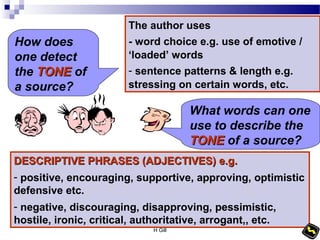
What words can one
use to describe the
TONETONE of a source?
DESCRIPTIVE PHRASES (ADJECTIVES) e.g.DESCRIPTIVE PHRASES (ADJECTIVES) e.g.
- positive, encouraging, supportive, approving, optimistic
defensive etc.
- negative, discouraging, disapproving, pessimistic,
hostile, ironic, critical, authoritative, arrogant,, etc.
How does
one detect
the TONETONE of
a source?
The author uses
- word choice e.g. use of emotive /
‘loaded’ words
- sentence patterns & length e.g.
stressing on certain words, etc.
H Gill
RELIABILITY
 A source that has a very strong TONE can
be linked to PURPOSE as it suggests that
the writer may have a motive
 A strongly emotional source may become
less reliable if there is a hidden motive
 But if there is no link to be made- then do
not mention TONE
H Gill
RELIABILITY
 For E.g
 b) The purpose of a source that is very critical
in tone could be to convince the reader that a
policy is bad/ not good and to get people to go
against it/ not support it or to push that it
should be done away with or stopped. For eg
the streaming policy.
 c) On the other hand, the purpose of a source
that is very defensive in tone may be trying to
justify to the reader why a policy is good and to
get people to support it/ so that it can be
continued. Same example the streaming policy.
H Gill
RELIABILITY
 SO What is PURPOSE ?PURPOSE ?
 It refers to what one plans to get or do;
the reason for writing the source-
MOTIVE
 Always look at the “Issue” before you
decide on PURPOSE. It will help you.
 Provenance, Tone and Purpose are
closely connected . You can do it one
after the other
H Gill
RELIABILITY
Remember! Closely related to purpose is
the idea of Audience. This is an
analysis of how the reliability of a
source might be affected by the
audience at which it is directed.
H Gill
RELIABILITY
 Purpose IS the end result that the author
wishes to achieve through the message – it
is the impact the MESSAGE will have on
someone else
 In Other words what ACTION does the writer
want the reader to take after reading the
source
 You must include the Message, Audience &
Action in purpose
 If there is a strong purpose it makes the
source less reliable
H Gill
RELIABILITY
 ) Remember PURPOSE must include the Action that
the writer wants the reader to take.Some good words to
remember for PURPOSE are:
 Justify
 Gain support/
 Prove
 Condemn
 Influence
 To go against
 To blame
 To change
 To stir up opposition against..
H Gill
 EG5: Source B is not reliable because
the people who drew it were trying to
persuade Catholics to hate the British
and go against them…..
H Gill
Reliability
CROSS- REF
 Is there a contradiction in what the
source says and what you know from
either your background knowledge or
other sources given (Cross-Referencing)?
 This will make the source less reliable
 OR are there other sources supporting
the original source and saying the same
thing
 This will make the source more reliable
H Gill
Reliability
 CROSS- REF
 Do not forget to make 2 Cross – Refs as this is one of
the BEST ways to prove reliability
 Make your Cross Ref BY
1st Identifying exactly which part of the original source
you want to prove is correct OR NOT correct
Pick a specific part of the original Source ( EG Source
A )you want to show reliability of.
Then select another suitable source
(EG Source B) you want to cross ref to
MATCH the part of Source B you want to use to show
reliability of Source A- the original source.
H Gill
 Source A is true because Source B supports it.
 Source A is true because Source B says the
same.
 Source A is reliable because it agrees with my
own knowledge.
 I can believe Source A because this is the kind
of thing that was going on then.
NoneNone of these
generalisations
would be allowed as
a cross-reference!
H Gill
How Useful?
 The How Useful ? skill usually asks a specific question
 e.g How useful is source D to help you understand the
reasons for Spore’s slow population growth?
 STEP 1
 The key words are very important so you need to take note of
the key words and repeat them in your answer.
 The basic pattern is Infer – Support
 STEP 2
 No source is completely Useful OR Useless.
 No source can give you all the reasons for Singapore’s slow
population growth. There will definitely be some info left out.
 So you need to look for aspects of the source that are USEFUL
to help you understand the reasons AND aspects of the source
that are NOT USEFUL and have MISSING INFORMATION
H Gill
How Useful?
 STEP 3
 Infer at least 2 to 3 useful points from
the source with supporting evidence
 PATTERN-
 It is Useful because it tells me the
reasons for slow popn growth were:
 I------------ S
 I-------------S
H Gill
How Useful?
 STEP 4
 To highlight the NOT USEFUL aspects
of the source you will need to CROSS-
REF to either your background
knowledge OR the other sources.
 Make at least 2 CROSS REFs
H Gill
How Useful?
 STEP 5
 EG-
 It is , however, NOT completely USEFUL because
several reasons are missing from the source
 When I cross ref to source C it implies that people
do not have children also because of……….. I
 The evidence is “………….” S
 This reason is NOT MENTIONED in Source C making
it less useful.
 Also when I cross ref to my background knowledge,
I learnt that the slow popn growth is also caused
by…………..
 Remember to give specific and detailed info when
CROSS REF to your background.
H Gill
How Useful?
 STEP 6
 To reach the highest level you need to consider the
extent of the usefulness .
 Is it more useful than NOT USEFUL ???
 Mention aspects such as the source only mentions
Economic reasons and NOT the Political and Social
reasons for Spore’s slow popn growth and it has not
highlighted some of the key reasons… as it only
seems to focus on a personal point of view…. Etc
 Do not mix this skill up with reliability THEY ARE
NOT THE SAME.
 A less reliable source that is very negative or
prejudiced does become less useful to help us
understand something BUT it can still help us
understand issues around the key words.
H Gill

Source based made simple

  • 1.
  • 2.
    H Gill SIMPLE INFERENCE SIMPLE INFERENCE-5MKS  For the WHAT QUESTION & WHY QUESTION  TO PREVENT GOING OUT OF POINT ALWAYS REPEAT THE KEY WORDS OF THE QUESTION IN YOUR OPENING LINE.  Make 3 inferences from the supporting evidence  Make sure you follow the Infer-Support pattern  Make sure your Inferences do not describe the picture/ cartoon / text  An Inference must be in your own words  It is a conclusion that you draw based on the evidence that you see or read  It cannot be seen or read in the source directly- it is implied
  • 3.
    H Gill SIMPLE INFERENCE For the WHY QUESTION/ WHAT IS THE MESSAGE ?  You also need to include the PURPOSE together with 2 INFERENCES  Make sure your supporting evidence is correctly chosen and supports your Inference  Do not spend more than 7 mins on this question
  • 4.
    H Gill COMPARE &CONTRAST-7mks How different is Source A from Source B….  Levels of Comparison  The higher the level the more complex your thinking and higher the marks awarded!  Nevertheless, include all levels in your answer. This is because, in case you do not manage to hit the highest level, you will fall into the next best level.  L1 Comparison of Provenance  L2 Comparison of Content  L3 Comparison of Tone  L4 Comparison of Purpose
  • 5.
    H Gill COMPARE &CONTRAST  TIP Remember to answer the question first!  EG The 2 sources are quite different/ Not so different  Remember to follow the comparison patterns  TIP-Did you establish a Common Factor before comparing?  USE the overlying IssueIssue to help you this will help you to MATCH  If you are highlighting a difference- They must be exact opposites  For eg if one source is FOR something/some body  then the other source must be AGAINST some thing /or someone-
  • 6.
    H Gill Comparison Patterns SIMILARITY- BOTH Sources-Infer Support-Source A Support-Source B DIFFERENCE- Infer-Support Source A BUT Infer-Support Source B
  • 7.
    H Gill Comparison PatternsComparisonPatterns  For EG-Similarity  BOTH I-Source A & B are about the state of IRA’s efforts to bring peace to N Ireland  S- Source A- headlines “ peace deal falters”  S- Source B- “ ensure that weapons remain silent”
  • 8.
    H Gill COMPARE &CONTRAST  1 Similarity & 1 Diff already earns you 5 mks  Go on quickly to compare Tone & Purpose if there is any.  Refer to the later slides on Tone &Purpose  If there is no Tone do not try and create one! Move on to Purpose.
  • 9.
    H Gill COMPARE &CONTRAST  LIST OF POSSIBLE WORDS FOR COMPARISON OF TONE  For Differences a) Remember when you compare tone you need to MATCH the tone words when identifying differences. b) Infer & Support-You also need to support by quoting “relevant phrases” from the passage that show the tone you have identified . You need to give an example of the author’s choice of words. c) When comparing if you only identify the tone of one source and forget to identify the tone of the other source you will not get any marks!
  • 10.
    H Gill Matching Tone 1)Negative tone VS Positive tone 2) Critical Tone VS Tone of Admiration 3) Critical Tone VS Defensive tone 4) Supportive Tone/ Praising VS Disapproving/ Condemning Tone 5) Sympathetic Tone VS Condemning Tone 6) Optimistic Tone VS Pessimistic Tone Follow the above list
  • 11.
    H Gill COMPARE &CONTRAST  If you are able try and reach the highest level- explicit comparison of sources  E.g-The two sources differ greatly as they represent 2 very different viewpoints on the Irish conflict- as one blames the Protestants but the other blames the Catholics  however-they are similar in their purpose to influence readers in trying to gain support for their own cause and…
  • 12.
    H Gill Reliability  Howmuch can we believe or trust the source about an issue  How accurate or dependable/believable is the source about some issue  This skill involves investigating whether a given source is trustworthy  Here it is also important to think about the motive or purpose of the source as this directly affects the reliability of the source
  • 13.
    H Gill Reliability  Typesof Reliability Question  Does Source A prove that ….  Can you believe what Source A says about….  Can you trust Source A’s explanation of….  How reliable is Source A about ….  How acceptable is Source A when it says…  How accurate is the source…..
  • 14.
    H Gill  Answerthe question first  Remember to repeat the key words….  You have to show BOTH sides the parts that are reliable and the parts that are not.  So a good answer is –The source is reliable in some ways OR It is reliable in many ways
  • 15.
    H Gill RELIABILITY Levelsof Response (PCTPC)  The higher the level the more complex your thinking and higher the marks awarded!  Nevertheless, include all levels in your answer. This is because, in case you do not manage to hit the highest level, you will fall into the next best level.  L1 Answers based on TYPICALITY  L2 Answers based on PROVENANCE  L3 Answers based on CONTENT of source  L4 Answers CROSS-REFER to background knowledge or other sources
  • 16.
    H Gill RELIABILITY  Sometimes Provenance helps greatly to show the reliability of the source so do not ignore it totally when it comes to reliability.  The nationality and race of the writer can help you to detect bias.  Especially note that a source is highly reliable if the writer who is supposed to support his own side DOES NOT do so.  E.g- In one year, a source was given to show an Irish Catholic- criticising the IRA-  This made the source highly reliable as it is not usual for a Catholic to criticise his own people- it is likely he is trying to tell the truth to stop the violence (Refer 2002 ‘O’ level exam paper Q1b)
  • 17.
    H Gill Reliability  Hereare some more questions you can ask yourself to check for reliability: CONTENT  Is the source presenting a fact or an opinion? Are there words like ‘obviously’, ‘terribly’ which reflect opinions.  Is the content presented one-sided/balanced?  Is there anything that is exaggerated?  Are there any sweeping statement or generalizations?  All these will make the source less reliable OR more reliable
  • 18.
    H Gill What is TONETONE? the general atmosphere of a situation, & the effect that it has on people; the way of wording/expressing things that shows a certain ATTITUDE / FEELING;ATTITUDE / FEELING; not directly stated by the author. Why is it important to note the TONETONE of a source? The tone of the writing can help determine: - an author's viewpoint & intentions - the reasons for certain interpretations as opposed to others thus affecting relaibility http://www.learn.co.uk/default.asp?WCI=Unit&WCU=1772 http://litmuse.maconstate.edu/article.php?story=20040217080823237
  • 19.
    H Gill What wordscan one use to describe the TONETONE of a source? DESCRIPTIVE PHRASES (ADJECTIVES) e.g.DESCRIPTIVE PHRASES (ADJECTIVES) e.g. - positive, encouraging, supportive, approving, optimistic defensive etc. - negative, discouraging, disapproving, pessimistic, hostile, ironic, critical, authoritative, arrogant,, etc. How does one detect the TONETONE of a source? The author uses - word choice e.g. use of emotive / ‘loaded’ words - sentence patterns & length e.g. stressing on certain words, etc.
  • 20.
    H Gill RELIABILITY  Asource that has a very strong TONE can be linked to PURPOSE as it suggests that the writer may have a motive  A strongly emotional source may become less reliable if there is a hidden motive  But if there is no link to be made- then do not mention TONE
  • 21.
    H Gill RELIABILITY  ForE.g  b) The purpose of a source that is very critical in tone could be to convince the reader that a policy is bad/ not good and to get people to go against it/ not support it or to push that it should be done away with or stopped. For eg the streaming policy.  c) On the other hand, the purpose of a source that is very defensive in tone may be trying to justify to the reader why a policy is good and to get people to support it/ so that it can be continued. Same example the streaming policy.
  • 22.
    H Gill RELIABILITY  SOWhat is PURPOSE ?PURPOSE ?  It refers to what one plans to get or do; the reason for writing the source- MOTIVE  Always look at the “Issue” before you decide on PURPOSE. It will help you.  Provenance, Tone and Purpose are closely connected . You can do it one after the other
  • 23.
    H Gill RELIABILITY Remember! Closelyrelated to purpose is the idea of Audience. This is an analysis of how the reliability of a source might be affected by the audience at which it is directed.
  • 24.
    H Gill RELIABILITY  PurposeIS the end result that the author wishes to achieve through the message – it is the impact the MESSAGE will have on someone else  In Other words what ACTION does the writer want the reader to take after reading the source  You must include the Message, Audience & Action in purpose  If there is a strong purpose it makes the source less reliable
  • 25.
    H Gill RELIABILITY  )Remember PURPOSE must include the Action that the writer wants the reader to take.Some good words to remember for PURPOSE are:  Justify  Gain support/  Prove  Condemn  Influence  To go against  To blame  To change  To stir up opposition against..
  • 26.
    H Gill  EG5:Source B is not reliable because the people who drew it were trying to persuade Catholics to hate the British and go against them…..
  • 27.
    H Gill Reliability CROSS- REF Is there a contradiction in what the source says and what you know from either your background knowledge or other sources given (Cross-Referencing)?  This will make the source less reliable  OR are there other sources supporting the original source and saying the same thing  This will make the source more reliable
  • 28.
    H Gill Reliability  CROSS-REF  Do not forget to make 2 Cross – Refs as this is one of the BEST ways to prove reliability  Make your Cross Ref BY 1st Identifying exactly which part of the original source you want to prove is correct OR NOT correct Pick a specific part of the original Source ( EG Source A )you want to show reliability of. Then select another suitable source (EG Source B) you want to cross ref to MATCH the part of Source B you want to use to show reliability of Source A- the original source.
  • 29.
    H Gill  SourceA is true because Source B supports it.  Source A is true because Source B says the same.  Source A is reliable because it agrees with my own knowledge.  I can believe Source A because this is the kind of thing that was going on then. NoneNone of these generalisations would be allowed as a cross-reference!
  • 30.
    H Gill How Useful? The How Useful ? skill usually asks a specific question  e.g How useful is source D to help you understand the reasons for Spore’s slow population growth?  STEP 1  The key words are very important so you need to take note of the key words and repeat them in your answer.  The basic pattern is Infer – Support  STEP 2  No source is completely Useful OR Useless.  No source can give you all the reasons for Singapore’s slow population growth. There will definitely be some info left out.  So you need to look for aspects of the source that are USEFUL to help you understand the reasons AND aspects of the source that are NOT USEFUL and have MISSING INFORMATION
  • 31.
    H Gill How Useful? STEP 3  Infer at least 2 to 3 useful points from the source with supporting evidence  PATTERN-  It is Useful because it tells me the reasons for slow popn growth were:  I------------ S  I-------------S
  • 32.
    H Gill How Useful? STEP 4  To highlight the NOT USEFUL aspects of the source you will need to CROSS- REF to either your background knowledge OR the other sources.  Make at least 2 CROSS REFs
  • 33.
    H Gill How Useful? STEP 5  EG-  It is , however, NOT completely USEFUL because several reasons are missing from the source  When I cross ref to source C it implies that people do not have children also because of……….. I  The evidence is “………….” S  This reason is NOT MENTIONED in Source C making it less useful.  Also when I cross ref to my background knowledge, I learnt that the slow popn growth is also caused by…………..  Remember to give specific and detailed info when CROSS REF to your background.
  • 34.
    H Gill How Useful? STEP 6  To reach the highest level you need to consider the extent of the usefulness .  Is it more useful than NOT USEFUL ???  Mention aspects such as the source only mentions Economic reasons and NOT the Political and Social reasons for Spore’s slow popn growth and it has not highlighted some of the key reasons… as it only seems to focus on a personal point of view…. Etc  Do not mix this skill up with reliability THEY ARE NOT THE SAME.  A less reliable source that is very negative or prejudiced does become less useful to help us understand something BUT it can still help us understand issues around the key words.
  • 35.