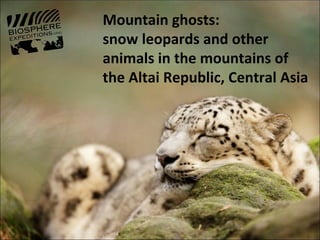
Mountain ghosts:
snow leopards and other
animals in the mountains of
the Altai Republic, Central Asia
• Facts about snow
  leopards &
  conservation goals

• Threats to snow
  leopards

• Types of surveys to
  monitor snow
  leopards
Snow leopards ( Panthera uncia ) occur in the high mountains of
Central Asia. Their range covers 2 million square km. The
population is an estimated 4080 – 6590 snow leopards across 12
countries
                                       AREA OF HABITAT
                         COUNTRY            (km²)        ESTIMATED POPULATION
                         Afghanistan       80.000              100 - 200
                          Bhutan           10.000                 100
                           China           400.000            2.000 - 2.500
                            India          95.000              200 - 600
                          Mongolia         130.000               1.000
                           Nepal           30.000              350 - 500
                          Pakistan         80.000              250 - 420
                           Russia          131.000              50 - 150
                         Kazakhstan        71.000              180 - 200
                         Kyrgyzstan        126.000            800 - 1.400
                          Tajikistan       78.000            120 -300 (650)
                         Uzbekistan        14.000                10 -50


 Smirnov et al. (1990 ) estimated about 80 snow
 leopards in southern Siberia. These southern
 Siberian snow leopards seem to be isolated from
 those of Central Asia. Former estimations of the
 mean density per 100 km² were about 0.75 to 1.5
Estimated snow leopard population by country.
The elusive nature of the species makes it difficult to
obtain an accurate population count.
The IUCN classified the snow leopard as

                             „endangered species“
                                              ( high risk of extinction in the wild)


       To actually survey the status of this elusive
              animal is a big challenge as

 „the snow leopard inhabits the world‘s highest
and perhaps most forbidding terrain, with difficult
on the ground access and additionally plagued by
small sample size.“


IUCN (International Union for Conservation of Nature)
OUR MAIN GOAL:

To ensure and promote the snow leopard‘s long-
term conservation:

E) a system of protected areas

G) elimination wild herbivore competition through

    increasing livestock herds

C) mitigation of the conflict with herders as a
   result of depredation

Evaluation of WWF‘s SL conservation activities
Snow leopard appearance:

dense and wully fur          ♂   30 % larger than   ♀            thick furry tail for
with white yellowish
grey pattern                                                     balancing and keeping
surrounded by dark                                               warm when resting
spots or rosettes


                                                                35 – 55 kg
                                                                up to 60 cm tall
                                                                1.8 – 2.3 m long (head to
                                                                tip of tail )


  large paws to
  walk on snow


                                   short forelimbs, long hind
                                   limbs (for steep terrain)          enlarged nasal
  Powerful lungs to get                                               cavity to warm
  enough oxygen at high                                               cold breathing air
  altitude
Snow leopard appearance:


SL can’t roar, ( new studies show that the ability to roar is due to
morphological features, especially of the larynx, which are absent in
the snow leopard.)
Snow leopard vocalisations: hisses, chuffing, mews, growls, and
wailing.


Unusually among cats, their eyes are pale
green or gray in colour.


         can leap up to 6x its body height
Sexually mature 2- 3 years

Mate in late winter, marked by a noticeable increase in marking and calling.

Gestation period 90–100 days, cubs are born between April -June


Give birth in a rocky den or crevice lined with fur shed from mother’s underside.
1- 5 (2.2) cubs with black spots (turn into rosettes when they grow up) weaned by
10 weeks

Cubs leave den at 2- 4 month

Remain with mother until 18–22 months.
(then disperse over considerable distances, even crossing wide expanses of flat
terrain to seek out new hunting grounds to reduce inbreeding)
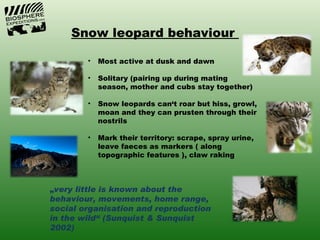
Snow leopard behaviour

        •   Most active at dusk and dawn

        •   Solitary (pairing up during mating
            season, mother and cubs stay together)

        •   Snow leopards can‘t roar but hiss, growl,
            moan and they can prusten through their
            nostrils

        •   Mark their territory: scrape, spray urine,
            leave faeces as markers ( along
            topographic features ), claw raking


„very little is known about the
behaviour, movements, home range,
social organisation and reproduction
in the wild“ (Sunquist & Sunquist
2002)
Snow leopard prey


       IBEX                       ARGALI
   (Capra sibirica)               (Ovis ammun)


                                                 BLUE SHEEP
                                                 (Pseudois nayaur)


  ROE DEER
(Capreolus capreolus)
Smaller prey such as


PIKA               MARMOT                    HARE


       PARTRIDGE                  SNOWCOCK
Threats to snow leopards
• Poaching:
 snow leopards are poached for their valuable pelt, bones
 and body parts, which are used in traditional Chinese
 medicine

  (but fur trade has declined due to international regulations)
• Retribution killing from herders


               5. Habitat and prey loss


4. Insufficient
  conservation due to
  lack of awareness,
  policy and money
Human/
herders pushing
further into
mountain areas


                  Overgrazing
                  fragmentation
                  of the land


                                  Less food for
                                  wild prey
                                  animals


                                                  More predation
                                                  on livestock
Video über schneeleos


Save the Snow Leopard_2kurz.wmv
To really judge the effectiveness of conservation
investments, it is essential to monitor the target species,
prey animal population and the quality of their habitat.


1990 the „Snow Leopard Trust“ developed a standardised field survey method


                                „SLIMS“
    (snow leopard information management system)


a computerised database on SL populations, protected areas and key habitat
attributes
Types of surveys to monitor snow
             leopards


What kind of information do we want
to gather?

       • SL distribution pattern
       • SL behaviour
       • SL home range
       • SL social organisation
       • SL reproduction
       • SL movements
3 methods to survey SL population

• Presence/absence


• Relative abundance
        due to „sign transects“


• Absolute abundance
     with camera trapping
   and genotyping (scat/ hair)
• Presence/absence
                  (detection/non detection)


•Establishes the presence or absence of SL and prey (indirect
signs)

•Identifies habitat types

•Undertakes a basic assessment of conservation needs

•Wide ranging investigations


i.e. presence/absence is used to find out if a given area (national park,…) is
      populated by SL at all

It is based on searching for indirect signs and interviewing locals

     Determing the presence of snow leopards
     Establishing the absence of snow leopards
b) Relative abundance
            based on „sign transect“

• Is used to monitor SL abundance in a particular area

• Provides detailed information about SL, its prey and habitat

• Gains data about status, relative abundance, distribution of SL

• Intensive, quantitative, time-consuming investigations

• SL signs are detected along transects (within representative
  sections of an area)

• Concurrently recording signs of ungulates (primary prey species)
Grafik Seite 19 Conservation Handbook 1
c) Absolute abundance
         camera trapping and DNA
           genotyping (scat/hair)


• Detects and distinguishes individuals from each other

• Assesses population‘s genetic variability

• Evaluates what proportion of an area is occupied

• Determines abundance in different areas or within
  a given area over time

• Evaluates the impacts of prey or habitat change on SL
  presence, relative abundance or density
What we will do:

•Walk transects and record:
   signs of SL
   habitat
   signs of prey

•Install and check camera traps

•Interview locals

•Collect scat

Snow leopard background

  • 1.
    Mountain ghosts: snow leopardsand other animals in the mountains of the Altai Republic, Central Asia
  • 2.
    • Facts aboutsnow leopards & conservation goals • Threats to snow leopards • Types of surveys to monitor snow leopards
  • 3.
    Snow leopards (Panthera uncia ) occur in the high mountains of Central Asia. Their range covers 2 million square km. The population is an estimated 4080 – 6590 snow leopards across 12 countries AREA OF HABITAT COUNTRY (km²) ESTIMATED POPULATION Afghanistan 80.000 100 - 200 Bhutan 10.000 100 China 400.000 2.000 - 2.500 India 95.000 200 - 600 Mongolia 130.000 1.000 Nepal 30.000 350 - 500 Pakistan 80.000 250 - 420 Russia 131.000 50 - 150 Kazakhstan 71.000 180 - 200 Kyrgyzstan 126.000 800 - 1.400 Tajikistan 78.000 120 -300 (650) Uzbekistan 14.000 10 -50 Smirnov et al. (1990 ) estimated about 80 snow leopards in southern Siberia. These southern Siberian snow leopards seem to be isolated from those of Central Asia. Former estimations of the mean density per 100 km² were about 0.75 to 1.5
  • 4.
    Estimated snow leopardpopulation by country. The elusive nature of the species makes it difficult to obtain an accurate population count.
  • 5.
    The IUCN classifiedthe snow leopard as „endangered species“ ( high risk of extinction in the wild) To actually survey the status of this elusive animal is a big challenge as „the snow leopard inhabits the world‘s highest and perhaps most forbidding terrain, with difficult on the ground access and additionally plagued by small sample size.“ IUCN (International Union for Conservation of Nature)
  • 6.
    OUR MAIN GOAL: Toensure and promote the snow leopard‘s long- term conservation: E) a system of protected areas G) elimination wild herbivore competition through increasing livestock herds C) mitigation of the conflict with herders as a result of depredation Evaluation of WWF‘s SL conservation activities
  • 7.
    Snow leopard appearance: denseand wully fur ♂ 30 % larger than ♀ thick furry tail for with white yellowish grey pattern balancing and keeping surrounded by dark warm when resting spots or rosettes 35 – 55 kg up to 60 cm tall 1.8 – 2.3 m long (head to tip of tail ) large paws to walk on snow short forelimbs, long hind limbs (for steep terrain) enlarged nasal Powerful lungs to get cavity to warm enough oxygen at high cold breathing air altitude
  • 8.
    Snow leopard appearance: SLcan’t roar, ( new studies show that the ability to roar is due to morphological features, especially of the larynx, which are absent in the snow leopard.) Snow leopard vocalisations: hisses, chuffing, mews, growls, and wailing. Unusually among cats, their eyes are pale green or gray in colour. can leap up to 6x its body height
  • 9.
    Sexually mature 2-3 years Mate in late winter, marked by a noticeable increase in marking and calling. Gestation period 90–100 days, cubs are born between April -June Give birth in a rocky den or crevice lined with fur shed from mother’s underside. 1- 5 (2.2) cubs with black spots (turn into rosettes when they grow up) weaned by 10 weeks Cubs leave den at 2- 4 month Remain with mother until 18–22 months. (then disperse over considerable distances, even crossing wide expanses of flat terrain to seek out new hunting grounds to reduce inbreeding)
  • 10.
    Snow leopard behaviour • Most active at dusk and dawn • Solitary (pairing up during mating season, mother and cubs stay together) • Snow leopards can‘t roar but hiss, growl, moan and they can prusten through their nostrils • Mark their territory: scrape, spray urine, leave faeces as markers ( along topographic features ), claw raking „very little is known about the behaviour, movements, home range, social organisation and reproduction in the wild“ (Sunquist & Sunquist 2002)
  • 11.
    Snow leopard prey IBEX ARGALI (Capra sibirica) (Ovis ammun) BLUE SHEEP (Pseudois nayaur) ROE DEER (Capreolus capreolus)
  • 12.
    Smaller prey suchas PIKA MARMOT HARE PARTRIDGE SNOWCOCK
  • 13.
    Threats to snowleopards • Poaching: snow leopards are poached for their valuable pelt, bones and body parts, which are used in traditional Chinese medicine (but fur trade has declined due to international regulations)
  • 14.
    • Retribution killingfrom herders 5. Habitat and prey loss 4. Insufficient conservation due to lack of awareness, policy and money
  • 15.
    Human/ herders pushing further into mountainareas Overgrazing fragmentation of the land Less food for wild prey animals More predation on livestock
  • 16.
    Video über schneeleos Savethe Snow Leopard_2kurz.wmv
  • 17.
    To really judgethe effectiveness of conservation investments, it is essential to monitor the target species, prey animal population and the quality of their habitat. 1990 the „Snow Leopard Trust“ developed a standardised field survey method „SLIMS“ (snow leopard information management system) a computerised database on SL populations, protected areas and key habitat attributes
  • 18.
    Types of surveysto monitor snow leopards What kind of information do we want to gather? • SL distribution pattern • SL behaviour • SL home range • SL social organisation • SL reproduction • SL movements
  • 19.
    3 methods tosurvey SL population • Presence/absence • Relative abundance due to „sign transects“ • Absolute abundance with camera trapping and genotyping (scat/ hair)
  • 20.
    • Presence/absence (detection/non detection) •Establishes the presence or absence of SL and prey (indirect signs) •Identifies habitat types •Undertakes a basic assessment of conservation needs •Wide ranging investigations i.e. presence/absence is used to find out if a given area (national park,…) is populated by SL at all It is based on searching for indirect signs and interviewing locals Determing the presence of snow leopards Establishing the absence of snow leopards
  • 21.
    b) Relative abundance based on „sign transect“ • Is used to monitor SL abundance in a particular area • Provides detailed information about SL, its prey and habitat • Gains data about status, relative abundance, distribution of SL • Intensive, quantitative, time-consuming investigations • SL signs are detected along transects (within representative sections of an area) • Concurrently recording signs of ungulates (primary prey species)
  • 22.
    Grafik Seite 19Conservation Handbook 1
  • 23.
    c) Absolute abundance camera trapping and DNA genotyping (scat/hair) • Detects and distinguishes individuals from each other • Assesses population‘s genetic variability • Evaluates what proportion of an area is occupied • Determines abundance in different areas or within a given area over time • Evaluates the impacts of prey or habitat change on SL presence, relative abundance or density
  • 24.
    What we willdo: •Walk transects and record: signs of SL habitat signs of prey •Install and check camera traps •Interview locals •Collect scat