ANIMAL CONSERVATION
PROJECTS IN INDIA
Submitted by: Submitted to:
Deeksha Sharma Dr. Shailja K.
Juneja
M.Sc Sem II
PROJECT ELEPHANT
INTRODUCTION
 Elephant (Elephas maximus indicus) is the largest
terrestrial mammal of India.
 Elephant being wide ranging animal requires large
areas.
 The requirement of food and water for elephants
are very high and therefore their population can be
supported only by forests that are under optimal
conditions.
 Asian elephants were believed to be widely
distributed, however current distribution of wild
elephant in India is confined to South India; North
East including North West Bengal; Central Indian
states of Orissa , South WB and Jharkhand; and
North West India in Uttarakhand and UP.
Cont.
 The Asian elephant can weigh up to 5400 kg.
 It currently occupies forested habitats in hilly or
mountainous terrain, up to about 3600 m.
 An adult eats approximately 150 kg (330 lb) per
day - mainly grasses but also leaves, twigs and
bark.
 It feeds during the morning, evening and night and
rests during the middle of the day, requiring shade
during the hot season to keep from overheating.
 Elephants cannot go for long without water (they
require 70-90 litres (19-24 gal) of fluid/day) and
sometimes must travel long distances each day
between their water supplies and feeding areas .
STATUS
1970’s-1996: Endangered
1996-2008: Endangered(criteria:A2c)
(IUCN2017)
Source: http://wwf.panda.org/what_we_do/endangered_species/elephants/asian_elephants/
http://www.iucnredlist.org
THREATS
 Habitat loss and fragmentation
 Human-Wildlife conflict
 Poaching and capture
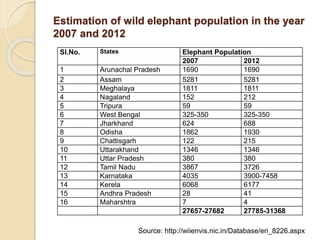
Estimation of wild elephant population in the year
2007 and 2012
Sl.No. States Elephant Population
2007 2012
1 Arunachal Pradesh 1690 1690
2 Assam 5281 5281
3 Meghalaya 1811 1811
4 Nagaland 152 212
5 Tripura 59 59
6 West Bengal 325-350 325-350
7 Jharkhand 624 688
8 Odisha 1862 1930
9 Chattisgarh 122 215
10 Uttarakhand 1346 1346
11 Uttar Pradesh 380 380
12 Tamil Nadu 3867 3726
13 Karnataka 4035 3900-7458
14 Kerela 6068 6177
15 Andhra Pradesh 28 41
16 Maharshtra 7 4
27657-27682 27785-31368
Source: http://wiienvis.nic.in/Database/eri_8226.aspx
Project Elephant (PE) was launched by
the Government of India in the year
1992 as a Centrally Sponsored Scheme.
Objectives:
1.To protect elephants, their habitat &
corridors.
2.To address issues of man-animal conflict.
3.Welfare of captive elephants
It is a Central sponsored scheme to provide
financial and Technical support are being
provided to major elephant bearing States in
the country.
 The Project is being mainly implemented in 13 States /
UTs:
• Andhra Pradesh
• Arunachal Pradesh
• Assam
• Jharkhand
• Karnataka
• Kerala
• Meghalaya
• Nagaland
• Orissa
• Tamil Nadu
• Uttaranchal
• Uttar Pradesh
• West Bengal.
Main activities under the Project are as
follows:
 Ecological restoration of existing natural habitats
and migratory routes of elephants.
 Conservation of elephant habitats and viable
population of wild Asiatic elephants in India.
 Promotion of measures for mitigation of man
elephant conflict
 Protection of wild elephants from poachers and
unnatural causes of death
 Public education and awareness programmes
 Improved veterinary care
 Elephant rehabilitation/rescue centers
ELEPHANT RESERVE
 Till now 32 Elephant Reserves (ERs) extending
over about 69,582.80 sq km have been formally
notified by various State Governments.
S.No. Reserve Name Range State
Total area
(km²)
1 Mayurjharna East-Central West Bengal 414
2 Singhbhum East-Central Jharkhand 4,530
3 Mayurbhanj East-Central Orissa 3,214
4 Mahanadi East-Central Orissa 1,038
5 Sambalpur East-Central Orissa 427
6 Baitarni East-Central Orissa 1,755
7 South Orissa East-Central Orissa 1,049
8 Lemru East-Central Chhattisgarh 450
9
Badalkhol-
Tamorpingla
East-Central Chhattisgarh 4,216
10 Kameng Kameng-Sonitpur
Arunachal
Pradesh
1,892
11 Sonitpur Kameng-Sonitpur Assam 1,420
12 Dihing-Patkai Eastern-south Assam 937
13 South Arunachal Eastern-South
Arunachal
Pradesh
900+
14
Kaziranga-Karbi
Anglong
Kaziranga Assam 3,270
15
Dhansiri-
Lungding
Kaziranga Assam 2,740
16 Intanki Kaziranga Nagaland 202
17 Chirang-Ripu
North Bengal-
Greater Manas
Assam 2,600
18 Eastern Dooars
North Bengal-
Greater Manas
West Bengal 978
19 Garo Hills Meghalaya Meghalaya 3,500
20 Khasi Hills Meghalaya Meghalaya 1,331
21 Mysore
Brahmagiri-Nilgiri-
Eastern Ghats
Karnataka 6,724
22 Wayanad
Brahmagiri-Nilgiri-
Eastern Ghats
Kerala 1,200
23 Nilgiri
Brahmagiri-Nilgiri-Eastern
Ghats
Karnataka 4,663
24 Rayala
Brahmagiri-Nilgiri-Eastern
Ghats
Andhra
Pradesh
766
25 Nilambur
Brahmagiri-Nilgiri-Eastern
Ghats
Kerala 1,419
26 Coimbatore
Brahmagiri-Nilgiri-Eastern
Ghats
Tamil Nadu 566
27 Anamalai
Anamalai-Nelliampathy-High
Range
Tamil Nadu 1,457
28 Anamudi
Anamalai-Nelliampathy-High
Range
Kerala 3,728
29 Periyar Periyar-Agasthyamalai Kerala 3,742
30 Srivilliputtur Periyar-Agasthyamalai Tamil Nadu 1,249
31 Shivalik North-Western Uttarakhand 5,405
32 Uttar Pradesh North-Western
Uttar
Pradesh
744
Project
Elephant
Total 69,583
(Source: Elephant Task Force Report of MoEF, August
Monitoring of Illegal Killing of Elephants (
MIKE ) Programme
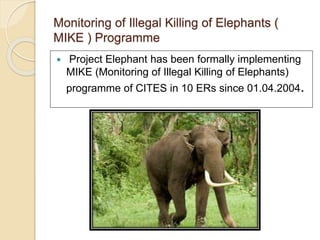
 Project Elephant has been formally implementing
MIKE (Monitoring of Illegal Killing of Elephants)
programme of CITES in 10 ERs since 01.04.2004.
MAIN OBJECTIVES OF MIKE ARE:
 To measure levels and trends in the
illegal hunting of elephants.
 To determine changes in these illegal
hunting trends over time.
 To determine the factors causing
these changes.
MIKE SITES IN INDIA
• Chirang Ripu (Assam)
• Dhang Patki (Assam)
• Eastern Dooars(WB)
• Deomali (Arunachal
Pradesh)
• Garo Hills(Meghalaya)
• Mayurbhanj (Orissa)
• Mysore (Karnataka)
• Nilgiri (Tamil Nadu)
• Shivalik (Uttarakhand)
• Wayanad (Kerala)
PROJECT LION
https://en.wikipedia.org/wiki/Gir_Forest_National_Park
ASIATIC LION
 The Asiatic lion (Panthera leo persica) is
a lion population in Gujarat India.
 Since 2010, the lion population in and around Gir
Forest National Park has steadily increased.
 There are estimated to be 350-400 lions left.
 In August 2017, the Asiatic Lion Census revealed
650 wild individuals.
 The Asiatic lion is one of seven sub-species of lion.
 The Asian Lion population represents only 1.7% of
lions on Earth.
STATUS
1970’s-1996: Endangered
1996-2008: Endangered(criteria:D)
IUCN 2017
http://www.iucnredlist.org
THREATS
 Hunting and
poaching
 Man-wildlife
conflict
 Human pressure
 Open wells
 Forest fires
Objectives
 Asiatic lions, rescued from near
extinction, now need a new home.
 Conservation of Asiatic lion
population.
 Plea to protect Asiatic lions.
WORK
 The 1,600 km area is secured as national park
for Gir lions.
 In 1963 with 285 lions the populations reached to
523 lions in 2015.
 PROJECT GIR LION is one of most successful
project.
Five protected areas currently
exist to protect the Asiatic lion:
1. Gir Sanctuary
2. Gir National Park
3. Pania Sanctuary
4. Mitiyala Sanctuary
5. Girnar Sanctuary.
Asiatic Lion Reintroduction
Project
 An initiative of the Indian Government to
provide safeguards to the Asiatic lion from
extinction in the wild by means of
reintroduction
 The project aims to establish a second
independent population of Asiatic Lions at
the Kuno Wildlife Sanctuary in the Indian
state of Madhya Pradesh.
 But the project was unsuccessful because
of opposition of Gujarat government and
many other reasons.
OPERATION RHINO
Rhinoceros Conservation in India
 The Indian rhinoceros (Rhinoceros
unicornis), also called the greater one-
horned rhinoceros and Indian one-horned
rhinoceros.
 Listed as a vulnerable species, the large
mammal is primarily found in north-eastern
India's Assam and in protected areas in the
Terai of Nepal
 The rhino's single horn is present in both
males and females, but not on newborn
young.
There are only approximately 3,333 Greater one-
horned rhinos left in the world (as at 31 December
2012), with about 75% of those found in the Indian
state of Assam
•In early 1900s,
Assam had about 200
rhino only.
• In 2007, 2,515 of
which are found in
India's Assam alone,
an increase by 27
percent since 2006
STATUS
1970’s-1996: Endangered
1996-2008: Vulnerable (criteria:ab(iii))
(IUCN2017)
http://www.iucnredlist.org
THREATS
 Illegal hunting and poaching for its
horn and other products used in
Traditional Chinese Medicine.
 Habitat loss and degradation
 Increased human population
 Rhino-human conflict
Population
In 2007, the total population was estimated to
be 2,575 individuals, of which 2,200 lived in
Indian protected areas:
 in Kaziranga National Park: 1,855
 in Jaldapara National Park: 108
 in Pobitora Wildlife Sanctuary: 81
 in Orang National Park: 68
 in Gorumara: 27
 in Dudhwa National Park: 21
 in Manas National Park: 19
 in Katarniaghat Wildlife Sanctuary: 2
 After decades of successful efforts, the species
increased to 3,500 in India and Nepal by mid-2015.
Indian Rhino Vision 2020
Overview
 IRV 2020 is a partnership between the
Assam Forest Department, the Bodoland
Territorial Council, WWF, IRF, and the US
Fish and Wildlife Service.
The programme aims to:
 Increase the total rhino population in Assam
to about 3000 by the year 2020.
IRV 2020 is an ambitious rhino range and population
expansion programme.
THANKYOU
 https://en.m.wikipedia.org/wiki/Project_Elephant
 http://wiienvis.nic.in/Database/eri_8226.aspx
 http://wwf.panda.org/what_we_do/endangered_s
pecies/elephants/asian_elephants/
 http://www.iucnredlist.org/details/summary/7140/
0
 http://www.moef.nic.in/division/introduction-4
 http://www.iucnredlist.org/details/15952/0
 https://en.wikipedia.org/wiki/Asiatic_lion
 http://www.iucnredlist.org/details/19496/0
 http://wwf.panda.org/what_we_do/endangered_s
pecies/rhinoceros/asian_rhinos/indian_rhinocero
s/
 https://en.wikipedia.org/wiki/Indian_rhinoceros

Animal conservation projects in india

  • 1.
    ANIMAL CONSERVATION PROJECTS ININDIA Submitted by: Submitted to: Deeksha Sharma Dr. Shailja K. Juneja M.Sc Sem II
  • 2.
  • 3.
    INTRODUCTION  Elephant (Elephasmaximus indicus) is the largest terrestrial mammal of India.  Elephant being wide ranging animal requires large areas.  The requirement of food and water for elephants are very high and therefore their population can be supported only by forests that are under optimal conditions.  Asian elephants were believed to be widely distributed, however current distribution of wild elephant in India is confined to South India; North East including North West Bengal; Central Indian states of Orissa , South WB and Jharkhand; and North West India in Uttarakhand and UP.
  • 4.
    Cont.  The Asianelephant can weigh up to 5400 kg.  It currently occupies forested habitats in hilly or mountainous terrain, up to about 3600 m.  An adult eats approximately 150 kg (330 lb) per day - mainly grasses but also leaves, twigs and bark.  It feeds during the morning, evening and night and rests during the middle of the day, requiring shade during the hot season to keep from overheating.  Elephants cannot go for long without water (they require 70-90 litres (19-24 gal) of fluid/day) and sometimes must travel long distances each day between their water supplies and feeding areas .
  • 5.
    STATUS 1970’s-1996: Endangered 1996-2008: Endangered(criteria:A2c) (IUCN2017) Source:http://wwf.panda.org/what_we_do/endangered_species/elephants/asian_elephants/ http://www.iucnredlist.org
  • 6.
    THREATS  Habitat lossand fragmentation  Human-Wildlife conflict  Poaching and capture
  • 7.
    Estimation of wildelephant population in the year 2007 and 2012 Sl.No. States Elephant Population 2007 2012 1 Arunachal Pradesh 1690 1690 2 Assam 5281 5281 3 Meghalaya 1811 1811 4 Nagaland 152 212 5 Tripura 59 59 6 West Bengal 325-350 325-350 7 Jharkhand 624 688 8 Odisha 1862 1930 9 Chattisgarh 122 215 10 Uttarakhand 1346 1346 11 Uttar Pradesh 380 380 12 Tamil Nadu 3867 3726 13 Karnataka 4035 3900-7458 14 Kerela 6068 6177 15 Andhra Pradesh 28 41 16 Maharshtra 7 4 27657-27682 27785-31368 Source: http://wiienvis.nic.in/Database/eri_8226.aspx
  • 8.
    Project Elephant (PE)was launched by the Government of India in the year 1992 as a Centrally Sponsored Scheme. Objectives: 1.To protect elephants, their habitat & corridors. 2.To address issues of man-animal conflict. 3.Welfare of captive elephants
  • 9.
    It is aCentral sponsored scheme to provide financial and Technical support are being provided to major elephant bearing States in the country.  The Project is being mainly implemented in 13 States / UTs: • Andhra Pradesh • Arunachal Pradesh • Assam • Jharkhand • Karnataka • Kerala • Meghalaya • Nagaland • Orissa • Tamil Nadu • Uttaranchal • Uttar Pradesh • West Bengal.
  • 10.
    Main activities underthe Project are as follows:  Ecological restoration of existing natural habitats and migratory routes of elephants.  Conservation of elephant habitats and viable population of wild Asiatic elephants in India.  Promotion of measures for mitigation of man elephant conflict  Protection of wild elephants from poachers and unnatural causes of death  Public education and awareness programmes  Improved veterinary care  Elephant rehabilitation/rescue centers
  • 11.
    ELEPHANT RESERVE  Tillnow 32 Elephant Reserves (ERs) extending over about 69,582.80 sq km have been formally notified by various State Governments.
  • 12.
    S.No. Reserve NameRange State Total area (km²) 1 Mayurjharna East-Central West Bengal 414 2 Singhbhum East-Central Jharkhand 4,530 3 Mayurbhanj East-Central Orissa 3,214 4 Mahanadi East-Central Orissa 1,038 5 Sambalpur East-Central Orissa 427 6 Baitarni East-Central Orissa 1,755 7 South Orissa East-Central Orissa 1,049 8 Lemru East-Central Chhattisgarh 450 9 Badalkhol- Tamorpingla East-Central Chhattisgarh 4,216 10 Kameng Kameng-Sonitpur Arunachal Pradesh 1,892 11 Sonitpur Kameng-Sonitpur Assam 1,420
  • 13.
    12 Dihing-Patkai Eastern-southAssam 937 13 South Arunachal Eastern-South Arunachal Pradesh 900+ 14 Kaziranga-Karbi Anglong Kaziranga Assam 3,270 15 Dhansiri- Lungding Kaziranga Assam 2,740 16 Intanki Kaziranga Nagaland 202 17 Chirang-Ripu North Bengal- Greater Manas Assam 2,600 18 Eastern Dooars North Bengal- Greater Manas West Bengal 978 19 Garo Hills Meghalaya Meghalaya 3,500 20 Khasi Hills Meghalaya Meghalaya 1,331 21 Mysore Brahmagiri-Nilgiri- Eastern Ghats Karnataka 6,724 22 Wayanad Brahmagiri-Nilgiri- Eastern Ghats Kerala 1,200
  • 14.
    23 Nilgiri Brahmagiri-Nilgiri-Eastern Ghats Karnataka 4,663 24Rayala Brahmagiri-Nilgiri-Eastern Ghats Andhra Pradesh 766 25 Nilambur Brahmagiri-Nilgiri-Eastern Ghats Kerala 1,419 26 Coimbatore Brahmagiri-Nilgiri-Eastern Ghats Tamil Nadu 566 27 Anamalai Anamalai-Nelliampathy-High Range Tamil Nadu 1,457 28 Anamudi Anamalai-Nelliampathy-High Range Kerala 3,728 29 Periyar Periyar-Agasthyamalai Kerala 3,742 30 Srivilliputtur Periyar-Agasthyamalai Tamil Nadu 1,249 31 Shivalik North-Western Uttarakhand 5,405 32 Uttar Pradesh North-Western Uttar Pradesh 744 Project Elephant Total 69,583 (Source: Elephant Task Force Report of MoEF, August
  • 15.
    Monitoring of IllegalKilling of Elephants ( MIKE ) Programme  Project Elephant has been formally implementing MIKE (Monitoring of Illegal Killing of Elephants) programme of CITES in 10 ERs since 01.04.2004.
  • 16.
    MAIN OBJECTIVES OFMIKE ARE:  To measure levels and trends in the illegal hunting of elephants.  To determine changes in these illegal hunting trends over time.  To determine the factors causing these changes.
  • 17.
    MIKE SITES ININDIA • Chirang Ripu (Assam) • Dhang Patki (Assam) • Eastern Dooars(WB) • Deomali (Arunachal Pradesh) • Garo Hills(Meghalaya) • Mayurbhanj (Orissa) • Mysore (Karnataka) • Nilgiri (Tamil Nadu) • Shivalik (Uttarakhand) • Wayanad (Kerala)
  • 18.
  • 19.
    ASIATIC LION  TheAsiatic lion (Panthera leo persica) is a lion population in Gujarat India.  Since 2010, the lion population in and around Gir Forest National Park has steadily increased.  There are estimated to be 350-400 lions left.  In August 2017, the Asiatic Lion Census revealed 650 wild individuals.  The Asiatic lion is one of seven sub-species of lion.  The Asian Lion population represents only 1.7% of lions on Earth.
  • 20.
  • 21.
    THREATS  Hunting and poaching Man-wildlife conflict  Human pressure  Open wells  Forest fires
  • 22.
    Objectives  Asiatic lions,rescued from near extinction, now need a new home.  Conservation of Asiatic lion population.  Plea to protect Asiatic lions.
  • 23.
    WORK  The 1,600km area is secured as national park for Gir lions.  In 1963 with 285 lions the populations reached to 523 lions in 2015.  PROJECT GIR LION is one of most successful project.
  • 24.
    Five protected areascurrently exist to protect the Asiatic lion: 1. Gir Sanctuary 2. Gir National Park 3. Pania Sanctuary 4. Mitiyala Sanctuary 5. Girnar Sanctuary.
  • 25.
    Asiatic Lion Reintroduction Project An initiative of the Indian Government to provide safeguards to the Asiatic lion from extinction in the wild by means of reintroduction  The project aims to establish a second independent population of Asiatic Lions at the Kuno Wildlife Sanctuary in the Indian state of Madhya Pradesh.  But the project was unsuccessful because of opposition of Gujarat government and many other reasons.
  • 26.
  • 27.
    Rhinoceros Conservation inIndia  The Indian rhinoceros (Rhinoceros unicornis), also called the greater one- horned rhinoceros and Indian one-horned rhinoceros.  Listed as a vulnerable species, the large mammal is primarily found in north-eastern India's Assam and in protected areas in the Terai of Nepal  The rhino's single horn is present in both males and females, but not on newborn young.
  • 28.
    There are onlyapproximately 3,333 Greater one- horned rhinos left in the world (as at 31 December 2012), with about 75% of those found in the Indian state of Assam •In early 1900s, Assam had about 200 rhino only. • In 2007, 2,515 of which are found in India's Assam alone, an increase by 27 percent since 2006
  • 29.
    STATUS 1970’s-1996: Endangered 1996-2008: Vulnerable(criteria:ab(iii)) (IUCN2017) http://www.iucnredlist.org
  • 30.
    THREATS  Illegal huntingand poaching for its horn and other products used in Traditional Chinese Medicine.  Habitat loss and degradation  Increased human population  Rhino-human conflict
  • 31.
    Population In 2007, thetotal population was estimated to be 2,575 individuals, of which 2,200 lived in Indian protected areas:  in Kaziranga National Park: 1,855  in Jaldapara National Park: 108  in Pobitora Wildlife Sanctuary: 81  in Orang National Park: 68  in Gorumara: 27  in Dudhwa National Park: 21  in Manas National Park: 19  in Katarniaghat Wildlife Sanctuary: 2  After decades of successful efforts, the species increased to 3,500 in India and Nepal by mid-2015.
  • 32.
    Indian Rhino Vision2020 Overview  IRV 2020 is a partnership between the Assam Forest Department, the Bodoland Territorial Council, WWF, IRF, and the US Fish and Wildlife Service. The programme aims to:  Increase the total rhino population in Assam to about 3000 by the year 2020. IRV 2020 is an ambitious rhino range and population expansion programme.
  • 33.
  • 34.
     https://en.m.wikipedia.org/wiki/Project_Elephant  http://wiienvis.nic.in/Database/eri_8226.aspx http://wwf.panda.org/what_we_do/endangered_s pecies/elephants/asian_elephants/  http://www.iucnredlist.org/details/summary/7140/ 0  http://www.moef.nic.in/division/introduction-4  http://www.iucnredlist.org/details/15952/0  https://en.wikipedia.org/wiki/Asiatic_lion  http://www.iucnredlist.org/details/19496/0  http://wwf.panda.org/what_we_do/endangered_s pecies/rhinoceros/asian_rhinos/indian_rhinocero s/  https://en.wikipedia.org/wiki/Indian_rhinoceros