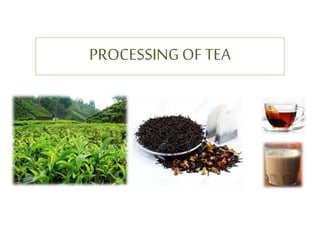
PROCESSING OF TEA
TEA
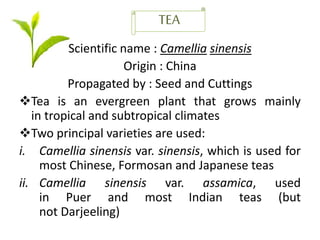
Scientific name : Camellia sinensis
Origin : China
Propagated by : Seed and Cuttings
Tea is an evergreen plant that grows mainly
in tropical and subtropical climates
Two principal varieties are used:
i. Camellia sinensis var. sinensis, which is used for
most Chinese, Formosan and Japanese teas
ii. Camellia sinensis var. assamica, used
in Puer and most Indian teas (but
not Darjeeling)
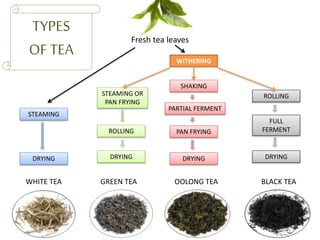
WHITE TEA
TYPES
OF TEA
ROLLING
Fresh tea leaves
ROLLING
SHAKING
STEAMING OR
PAN FRYING
WITHERING
DRYING
STEAMING
PARTIAL FERMENT
DRYING
FULL
FERMENT
DRYING DRYING
PAN FRYING
GREEN TEA OOLONG TEA BLACK TEA
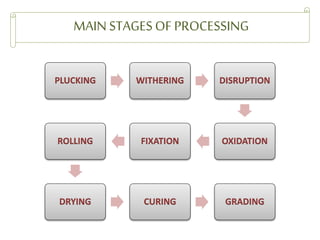
MAIN STAGESOF PROCESSING
PLUCKING WITHERING DISRUPTION
OXIDATIONFIXATIONROLLING
DRYING CURING GRADING
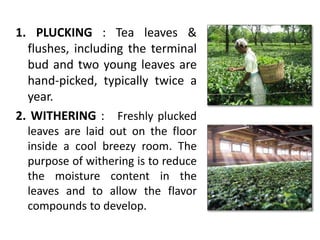
1. PLUCKING : Tea leaves &
flushes, including the terminal
bud and two young leaves are
hand-picked, typically twice a
year.
2. WITHERING : Freshly plucked
leaves are laid out on the floor
inside a cool breezy room. The
purpose of withering is to reduce
the moisture content in the
leaves and to allow the flavor
compounds to develop.
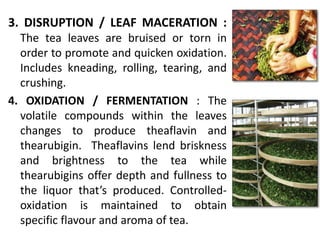
3. DISRUPTION / LEAF MACERATION :
The tea leaves are bruised or torn in
order to promote and quicken oxidation.
Includes kneading, rolling, tearing, and
crushing.
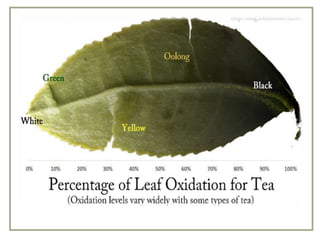
4. OXIDATION / FERMENTATION : The
volatile compounds within the leaves
changes to produce theaflavin and
thearubigin. Theaflavins lend briskness
and brightness to the tea while
thearubigins offer depth and fullness to
the liquor that’s produced. Controlled-
oxidation is maintained to obtain
specific flavour and aroma of tea.
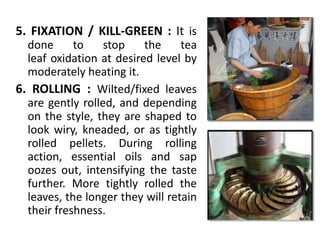
5. FIXATION / KILL-GREEN : It is
done to stop the tea
leaf oxidation at desired level by
moderately heating it.
6. ROLLING : Wilted/fixed leaves
are gently rolled, and depending
on the style, they are shaped to
look wiry, kneaded, or as tightly
rolled pellets. During rolling
action, essential oils and sap
oozes out, intensifying the taste
further. More tightly rolled the
leaves, the longer they will retain
their freshness.
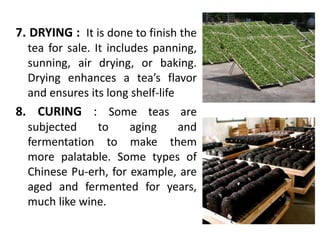
7. DRYING : It is done to finish the
tea for sale. It includes panning,
sunning, air drying, or baking.
Drying enhances a tea’s flavor
and ensures its long shelf-life
8. CURING : Some teas are
subjected to aging and
fermentation to make them
more palatable. Some types of
Chinese Pu-erh, for example, are
aged and fermented for years,
much like wine.
THANKYOU

Processing of Tea

  • 1.
  • 2.
    TEA Scientific name :Camellia sinensis Origin : China Propagated by : Seed and Cuttings Tea is an evergreen plant that grows mainly in tropical and subtropical climates Two principal varieties are used: i. Camellia sinensis var. sinensis, which is used for most Chinese, Formosan and Japanese teas ii. Camellia sinensis var. assamica, used in Puer and most Indian teas (but not Darjeeling)
  • 3.
    WHITE TEA TYPES OF TEA ROLLING Freshtea leaves ROLLING SHAKING STEAMING OR PAN FRYING WITHERING DRYING STEAMING PARTIAL FERMENT DRYING FULL FERMENT DRYING DRYING PAN FRYING GREEN TEA OOLONG TEA BLACK TEA
  • 5.
    MAIN STAGESOF PROCESSING PLUCKINGWITHERING DISRUPTION OXIDATIONFIXATIONROLLING DRYING CURING GRADING
  • 6.
    1. PLUCKING :Tea leaves & flushes, including the terminal bud and two young leaves are hand-picked, typically twice a year. 2. WITHERING : Freshly plucked leaves are laid out on the floor inside a cool breezy room. The purpose of withering is to reduce the moisture content in the leaves and to allow the flavor compounds to develop.
  • 7.
    3. DISRUPTION /LEAF MACERATION : The tea leaves are bruised or torn in order to promote and quicken oxidation. Includes kneading, rolling, tearing, and crushing. 4. OXIDATION / FERMENTATION : The volatile compounds within the leaves changes to produce theaflavin and thearubigin. Theaflavins lend briskness and brightness to the tea while thearubigins offer depth and fullness to the liquor that’s produced. Controlled- oxidation is maintained to obtain specific flavour and aroma of tea.
  • 8.
    5. FIXATION /KILL-GREEN : It is done to stop the tea leaf oxidation at desired level by moderately heating it. 6. ROLLING : Wilted/fixed leaves are gently rolled, and depending on the style, they are shaped to look wiry, kneaded, or as tightly rolled pellets. During rolling action, essential oils and sap oozes out, intensifying the taste further. More tightly rolled the leaves, the longer they will retain their freshness.
  • 9.
    7. DRYING :It is done to finish the tea for sale. It includes panning, sunning, air drying, or baking. Drying enhances a tea’s flavor and ensures its long shelf-life 8. CURING : Some teas are subjected to aging and fermentation to make them more palatable. Some types of Chinese Pu-erh, for example, are aged and fermented for years, much like wine.
  • 11.