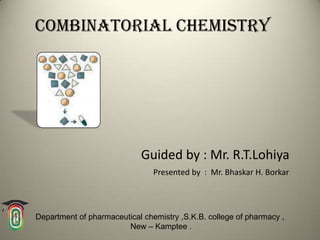
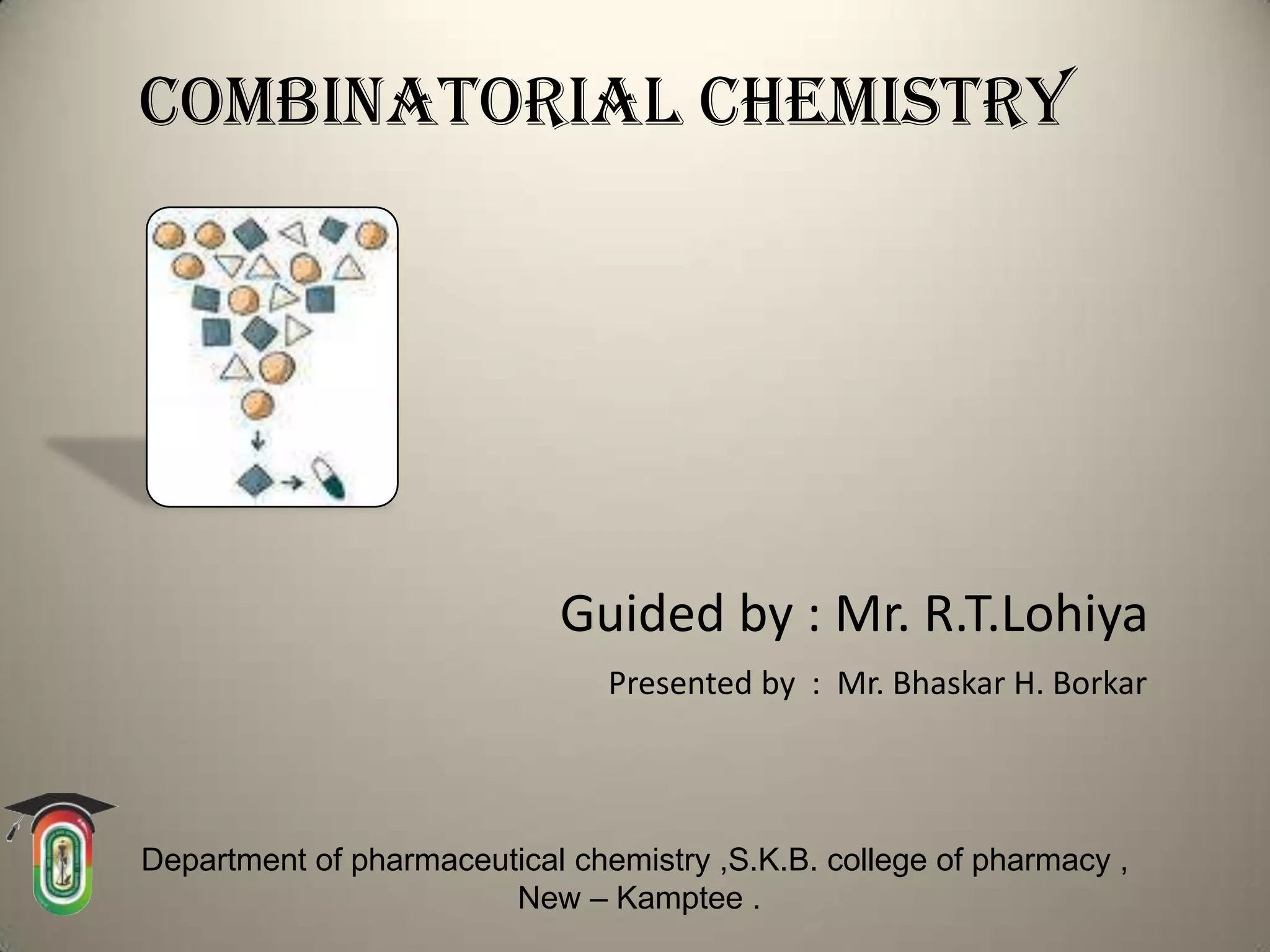
Combinatorial chemistry


                            Guided by : Mr. R.T.Lohiya
                                Presented by : Mr. Bhaskar H. Borkar


Department of pharmaceutical chemistry ,S.K.B. college of pharmacy ,
                        New – Kamptee .
CONTENTs
Introduction
Background
Basic concepts
Combinatorial synthesis
Combinatorial synthesis & Traditional synthesis
Techniques
Isolation/Detection/Purification /Analysis
Chemical Diversity & Liabrary Design
Application & limitation
Recent & Future Prospect
References
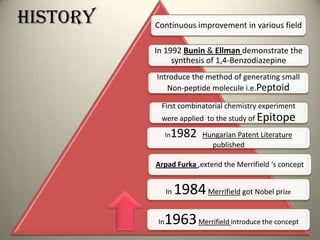
history   Continuous improvement in various field

          In 1992 Bunin & Ellman demonstrate the
               synthesis of 1,4-Benzodiazepine
          Introduce the method of generating small
             Non-peptide molecule i.e.Peptoid

           First combinatorial chemistry experiment
           were applied to the study of Epitope

               In   1982   Hungarian Patent Literature
                             published

          Arpad Furka ,extend the Merrifield ‘s concept


               In   1984 Merrifield got Nobel prize
          In   1963 Merrifield introduce the concept
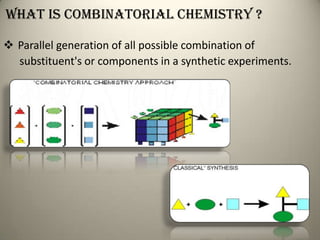
What is combinatorial chemistry ?

 Parallel generation of all possible combination of
  substituent's or components in a synthetic experiments.
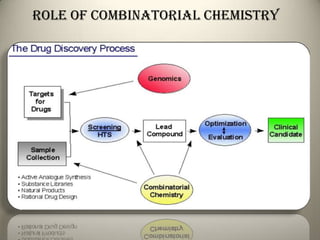
Role of combinatorial chemistry
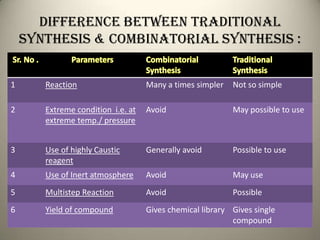
Difference Between Traditional
    Synthesis & Combinatorial Synthesis :


1      Reaction                    Many a times simpler   Not so simple

2      Extreme condition i.e. at   Avoid                  May possible to use
       extreme temp./ pressure


3      Use of highly Caustic       Generally avoid        Possible to use
       reagent
4      Use of Inert atmosphere     Avoid                  May use
5      Multistep Reaction          Avoid                  Possible
6      Yield of compound           Gives chemical library Gives single
                                                          compound
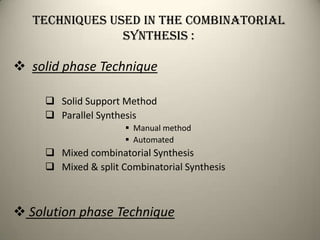
Techniques used in the combinatorial
                synthesis :

 solid phase Technique

      Solid Support Method
      Parallel Synthesis
                       Manual method
                       Automated
      Mixed combinatorial Synthesis
      Mixed & split Combinatorial Synthesis


 Solution phase Technique
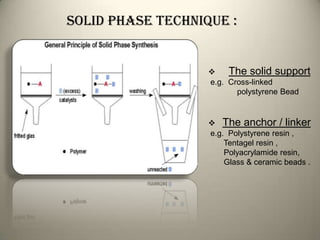
Solid phase technique :


                       The solid support
                   e.g. Cross-linked
                          polystyrene Bead


                    The anchor / linker
                   e.g. Polystyrene resin ,
                       Tentagel resin ,
                       Polyacrylamide resin,
                       Glass & ceramic beads .
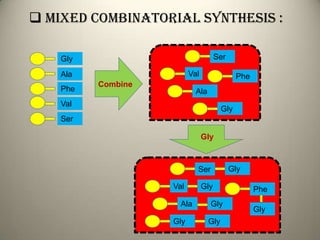
 Mixed combinatorial synthesis :

    Gly                            Ser

    Ala                   Val                 Phe
          Combine
    Phe                     Ala
    Val
                                        Gly
    Ser

                                Gly


                            Ser          Gly

                    Val     Gly
                            Phe                     Phe
                      Ala         Gly
                                                    Gly
                    Gly           Gly
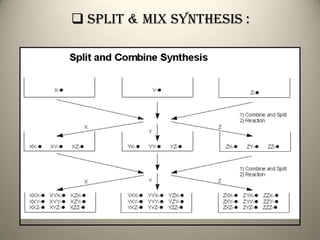
 Split & Mix Synthesis :
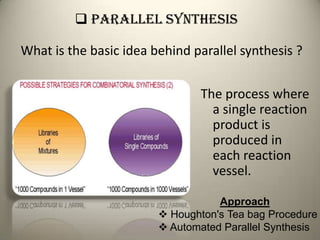
 Parallel synthesis

What is the basic idea behind parallel synthesis ?


                                The process where
                                  a single reaction
                                  product is
                                  produced in
                                  each reaction
                                  vessel.

                                   Approach
                         Houghton's Tea bag Procedure
                         Automated Parallel Synthesis
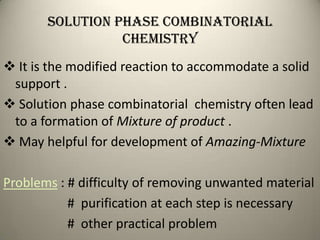
Solution phase combinatorial
                 chemistry
 It is the modified reaction to accommodate a solid
 support .
 Solution phase combinatorial chemistry often lead
 to a formation of Mixture of product .
 May helpful for development of Amazing-Mixture

Problems : # difficulty of removing unwanted material
           # purification at each step is necessary
           # other practical problem
Comparison between solid phase & solution
            phase chemistry :
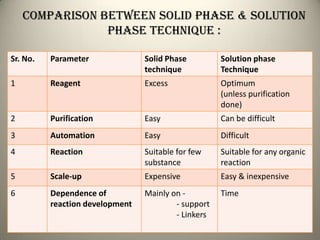
Comparison between solid phase & solution
                phase technique :

Sr. No.   Parameter              Solid Phase         Solution phase
                                 technique           Technique
1         Reagent                Excess              Optimum
                                                     (unless purification
                                                     done)
2         Purification           Easy                Can be difficult
3         Automation             Easy                Difficult
4         Reaction               Suitable for few    Suitable for any organic
                                 substance           reaction
5         Scale-up               Expensive           Easy & inexpensive
6         Dependence of          Mainly on -         Time
          reaction development           - support
                                         - Linkers
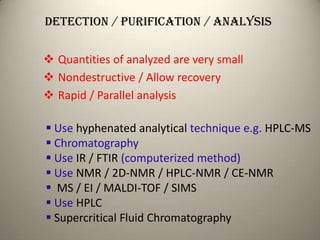
Detection / Purification / Analysis


 Quantities of analyzed are very small
 Nondestructive / Allow recovery
 Rapid / Parallel analysis

 Use hyphenated analytical technique e.g. HPLC-MS
 Chromatography
 Use IR / FTIR (computerized method)
 Use NMR / 2D-NMR / HPLC-NMR / CE-NMR
 MS / EI / MALDI-TOF / SIMS
 Use HPLC
 Supercritical Fluid Chromatography
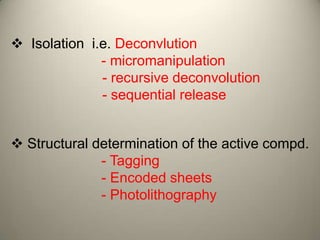
 Isolation i.e. Deconvlution
              - micromanipulation
              - recursive deconvolution
              - sequential release


 Structural determination of the active compd.
              - Tagging
              - Encoded sheets
              - Photolithography
Chemical diversity & Libraries :

It has been suggested that effectiveness of
  combinatorial chemistry could be improved by
  enhancing the chemical diversity of screening
  libraries .


  Two more important features :
                - Chirality
                - Rigidity
Limitation of combinatorial chemistry


 How many beads will be required for
 combinatorial synthesis ?

 Probability of finding sample ………….?

 Requirement of practical details of weight &
 volume.
Example of combinatorial chemistry

 Early work carried on peptides
 Next work done on peptoid
 Now researcher get concentrated on the
  heterocyclic combinatorial libraries
e.g.- 1,4-Benzodiazepine
 All common reaction ,moisture sensitive &
  organometallic reactions
e.g. Aldol reaction ,Dibal Reduction, Wittig
  reaction etc.
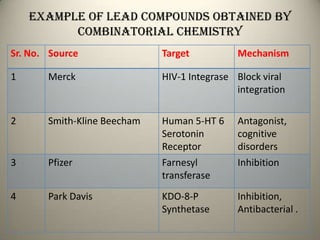
Example of lead compounds obtained by
          combinatorial chemistry
Sr. No. Source               Target          Mechanism

1      Merck                 HIV-1 Integrase Block viral
                                             integration

2      Smith-Kline Beecham   Human 5-HT 6    Antagonist,
                             Serotonin       cognitive
                             Receptor        disorders
3      Pfizer                Farnesyl        Inhibition
                             transferase
4      Park Davis            KDO-8-P         Inhibition,
                             Synthetase      Antibacterial .
Miniaturization
                                              Dynamic combinatorial
                                                   chemistry
      chemoinformatics


                                                         Use of advanced
Targeted & diversified                                  software & robotics
       libraries


      Agro-Chemical
                                              Computational
          sector                                                      QSPR
                                                chemistry
                             Advances in
                          solution phase &
                             Solid phase
                          organic synthesis               QSAR
References
 Douglas R Henry ; Wilson & Gisvold‘s Textbook of Organic
 Medicinal chemistry ; 11th edition ;Lippincott William &
 Wilkins Publication ; 2004 ;Page No. 43-63 .
Grahm L. Patrick ; Introduction To Medicinal Chemistry ;
 2nd Edition ; Oxford publication ; 2003 ;Page No. 289-318
Gareth Thomas ; Medicinal Chemistry –An Introduction ;
 Willey publication ; 2000 ; Page No. 69-90 .
 R.B.Silverman ; Organic chemistry of drug design & Drug
 Action ; 2nd Edition ;Elsevier publication ;2004 ; Page
 No.35-43 .
www.netsci.org/science/Combichem/feature02.html
 www.biotech.nature.com ; NATURE BIOTECHNOLOGY ;
 Vol 18 ; Supplement 2000.
Combinatorial chemistry

Combinatorial chemistry

  • 1.
    Combinatorial chemistry Guided by : Mr. R.T.Lohiya Presented by : Mr. Bhaskar H. Borkar Department of pharmaceutical chemistry ,S.K.B. college of pharmacy , New – Kamptee .
  • 2.
    CONTENTs Introduction Background Basic concepts Combinatorial synthesis Combinatorialsynthesis & Traditional synthesis Techniques Isolation/Detection/Purification /Analysis Chemical Diversity & Liabrary Design Application & limitation Recent & Future Prospect References
  • 3.
    history Continuous improvement in various field In 1992 Bunin & Ellman demonstrate the synthesis of 1,4-Benzodiazepine Introduce the method of generating small Non-peptide molecule i.e.Peptoid First combinatorial chemistry experiment were applied to the study of Epitope In 1982 Hungarian Patent Literature published Arpad Furka ,extend the Merrifield ‘s concept In 1984 Merrifield got Nobel prize In 1963 Merrifield introduce the concept
  • 4.
    What is combinatorialchemistry ?  Parallel generation of all possible combination of substituent's or components in a synthetic experiments.
  • 5.
  • 6.
    Difference Between Traditional Synthesis & Combinatorial Synthesis : 1 Reaction Many a times simpler Not so simple 2 Extreme condition i.e. at Avoid May possible to use extreme temp./ pressure 3 Use of highly Caustic Generally avoid Possible to use reagent 4 Use of Inert atmosphere Avoid May use 5 Multistep Reaction Avoid Possible 6 Yield of compound Gives chemical library Gives single compound
  • 7.
    Techniques used inthe combinatorial synthesis :  solid phase Technique  Solid Support Method  Parallel Synthesis  Manual method  Automated  Mixed combinatorial Synthesis  Mixed & split Combinatorial Synthesis  Solution phase Technique
  • 8.
    Solid phase technique:  The solid support e.g. Cross-linked polystyrene Bead  The anchor / linker e.g. Polystyrene resin , Tentagel resin , Polyacrylamide resin, Glass & ceramic beads .
  • 9.
     Mixed combinatorialsynthesis : Gly Ser Ala Val Phe Combine Phe Ala Val Gly Ser Gly Ser Gly Val Gly Phe Phe Ala Gly Gly Gly Gly
  • 10.
     Split &Mix Synthesis :
  • 11.
     Parallel synthesis Whatis the basic idea behind parallel synthesis ? The process where a single reaction product is produced in each reaction vessel. Approach  Houghton's Tea bag Procedure  Automated Parallel Synthesis
  • 12.
    Solution phase combinatorial chemistry  It is the modified reaction to accommodate a solid support .  Solution phase combinatorial chemistry often lead to a formation of Mixture of product .  May helpful for development of Amazing-Mixture Problems : # difficulty of removing unwanted material # purification at each step is necessary # other practical problem
  • 13.
    Comparison between solidphase & solution phase chemistry :
  • 14.
    Comparison between solidphase & solution phase technique : Sr. No. Parameter Solid Phase Solution phase technique Technique 1 Reagent Excess Optimum (unless purification done) 2 Purification Easy Can be difficult 3 Automation Easy Difficult 4 Reaction Suitable for few Suitable for any organic substance reaction 5 Scale-up Expensive Easy & inexpensive 6 Dependence of Mainly on - Time reaction development - support - Linkers
  • 15.
    Detection / Purification/ Analysis  Quantities of analyzed are very small  Nondestructive / Allow recovery  Rapid / Parallel analysis  Use hyphenated analytical technique e.g. HPLC-MS  Chromatography  Use IR / FTIR (computerized method)  Use NMR / 2D-NMR / HPLC-NMR / CE-NMR  MS / EI / MALDI-TOF / SIMS  Use HPLC  Supercritical Fluid Chromatography
  • 16.
     Isolation i.e.Deconvlution - micromanipulation - recursive deconvolution - sequential release  Structural determination of the active compd. - Tagging - Encoded sheets - Photolithography
  • 17.
    Chemical diversity &Libraries : It has been suggested that effectiveness of combinatorial chemistry could be improved by enhancing the chemical diversity of screening libraries . Two more important features : - Chirality - Rigidity
  • 18.
    Limitation of combinatorialchemistry  How many beads will be required for combinatorial synthesis ?  Probability of finding sample ………….?  Requirement of practical details of weight & volume.
  • 19.
    Example of combinatorialchemistry  Early work carried on peptides  Next work done on peptoid  Now researcher get concentrated on the heterocyclic combinatorial libraries e.g.- 1,4-Benzodiazepine  All common reaction ,moisture sensitive & organometallic reactions e.g. Aldol reaction ,Dibal Reduction, Wittig reaction etc.
  • 20.
    Example of leadcompounds obtained by combinatorial chemistry Sr. No. Source Target Mechanism 1 Merck HIV-1 Integrase Block viral integration 2 Smith-Kline Beecham Human 5-HT 6 Antagonist, Serotonin cognitive Receptor disorders 3 Pfizer Farnesyl Inhibition transferase 4 Park Davis KDO-8-P Inhibition, Synthetase Antibacterial .
  • 21.
    Miniaturization Dynamic combinatorial chemistry chemoinformatics Use of advanced Targeted & diversified software & robotics libraries Agro-Chemical Computational sector QSPR chemistry Advances in solution phase & Solid phase organic synthesis QSAR
  • 22.
    References  Douglas RHenry ; Wilson & Gisvold‘s Textbook of Organic Medicinal chemistry ; 11th edition ;Lippincott William & Wilkins Publication ; 2004 ;Page No. 43-63 . Grahm L. Patrick ; Introduction To Medicinal Chemistry ; 2nd Edition ; Oxford publication ; 2003 ;Page No. 289-318 Gareth Thomas ; Medicinal Chemistry –An Introduction ; Willey publication ; 2000 ; Page No. 69-90 .  R.B.Silverman ; Organic chemistry of drug design & Drug Action ; 2nd Edition ;Elsevier publication ;2004 ; Page No.35-43 . www.netsci.org/science/Combichem/feature02.html  www.biotech.nature.com ; NATURE BIOTECHNOLOGY ; Vol 18 ; Supplement 2000.

Editor's Notes