BEHZAD BEHDANI
D E L F T U N I V E R S I T Y O F T E C H N O L O G Y
T R A N S P O R T & P L A N N I N G D E P A R T M E N T
SYNCHROMODAL FREIGHT
TRANSPORT SYSTEM
What is discussed here
2
 Intermodal freight transport
 Challenges for intermodal freight transport
 What is synchromodal freight transport?
 Challenges in synchromodal transport
 Hierarchy of decision problems in a synchromodal
freight transport system
Intermodal freight transport
3
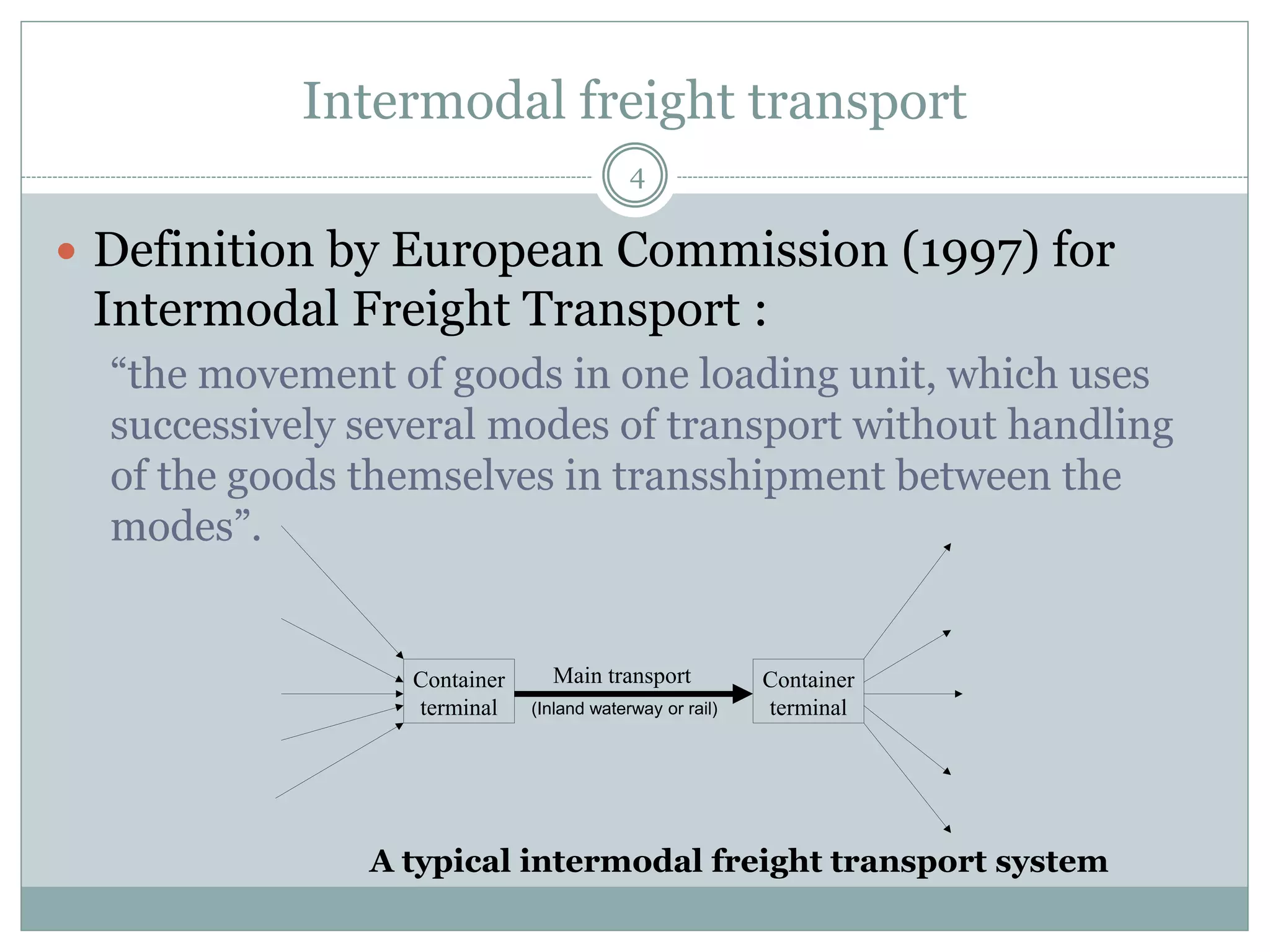
 Definition by European Commission (1997) for
Intermodal Freight Transport :
“the movement of goods in one loading unit, which uses
successively several modes of transport without handling
of the goods themselves in transshipment between the
modes”.
Container
terminal
Container
terminal
Main transport
(Inland waterway or rail)
A typical intermodal freight transport system
Challenges for intermodal transport
4
 Single-mode road transport is the dominant transport
mode in Europe with a market share of about 80% (in
terms on tonne-kms).
 Advantages: flexibility (e.g., in case of disturbances),
door-to-door transport solutions, competitive pricing,
customer-made solutions, reliability, speed, gets more
sustainable as compared to rail and IWW transport,
and high accessibility
 Disadvantages: congestion, negative external effects,
less safe than rail and IWW transport, increasing costs
due to inclusion of external costs into price of road
freight transport, and less scale economies than rail
and IWW transport
Source: Bart Wiegmans (2012) Intermodalism: Competition or Cooperation?
Environmental impact of road transport
5
 Although heavy good vehicles only make up 3% of
the European vehicle fleet and 7% of driven
kilometres, they account for almost a quarter of
road transport CO2 emissions, or about 6% of total
EU greenhouse gas emissions (European
Commission, 2013). This is expected to rise to 8%
by 2020.
 Lorries are also responsible for 20% of road
congestion in the EU. The road congestion is even
more important around port areas as it has an
adverse effect on the competitive position of a port
as a location for logistics businesses.
Source: European Commission (2013). Climate Action Plan
Barriers for intermodal transport
6
1. Operational problems, for example:
 Train decoupling
 Use of rail infra for both passenger/freight transport
 Terminal opening hours
2. Organizational problems, for example:
 Co-ordinations between multiple partners and timing of
road haulage
3. Economical problems , for example
 High transshipment cost
Source: Wichser, J. (2001). Technical and operational developments needed for a better market success of
intermodal freight transport.
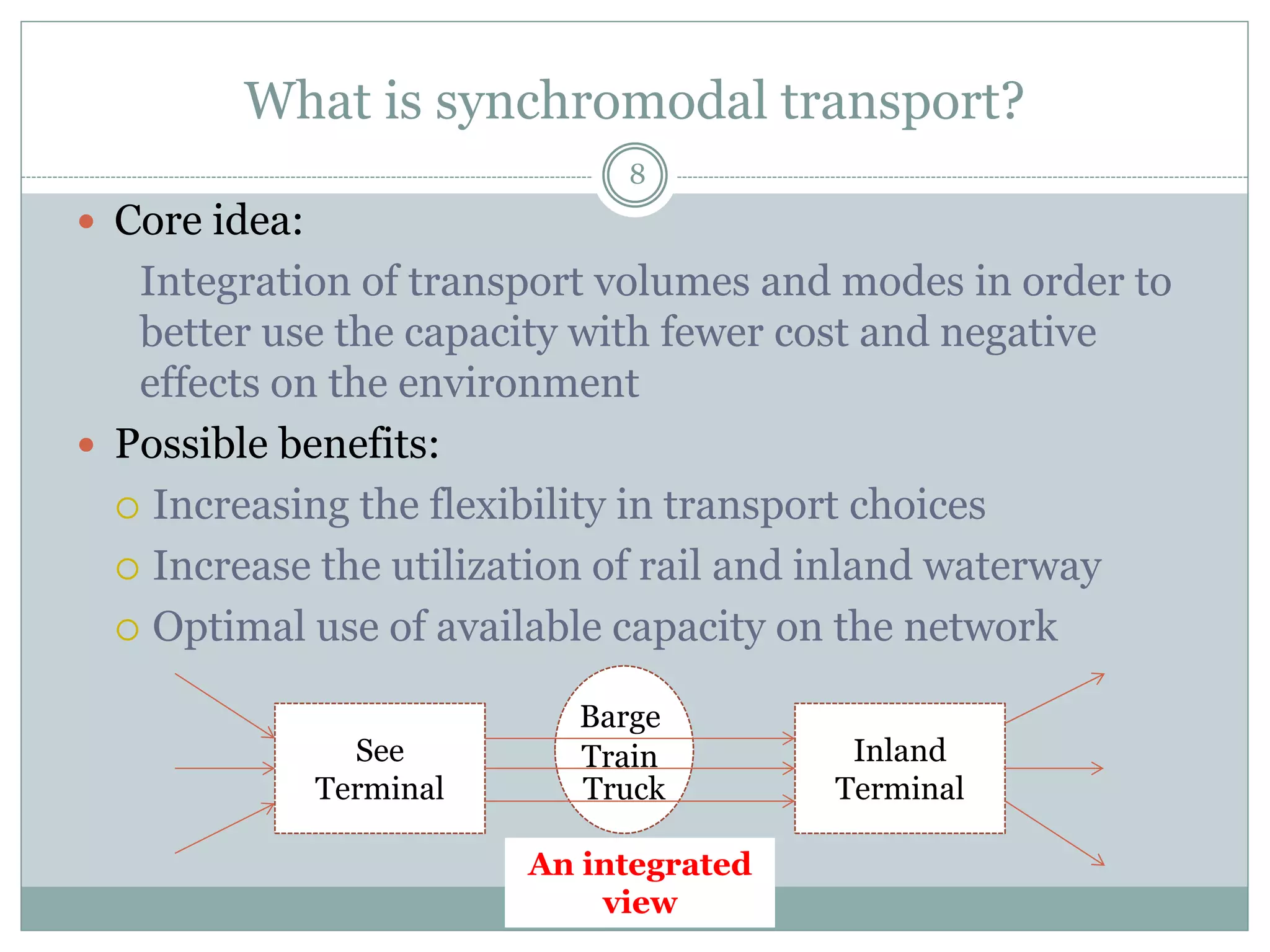
What is synchromodal transport?
7
 Core idea:
Integration of transport volumes and modes in order to
better use the capacity with fewer cost and negative
effects on the environment
 Possible benefits:
 Increasing the flexibility in transport choices
 Increase the utilization of rail and inland waterway
 Optimal use of available capacity on the network
Sea
Terminal
Inland
Terminal
Barge
Train
Truck
Integrated view
What is synchromodal transport?
8
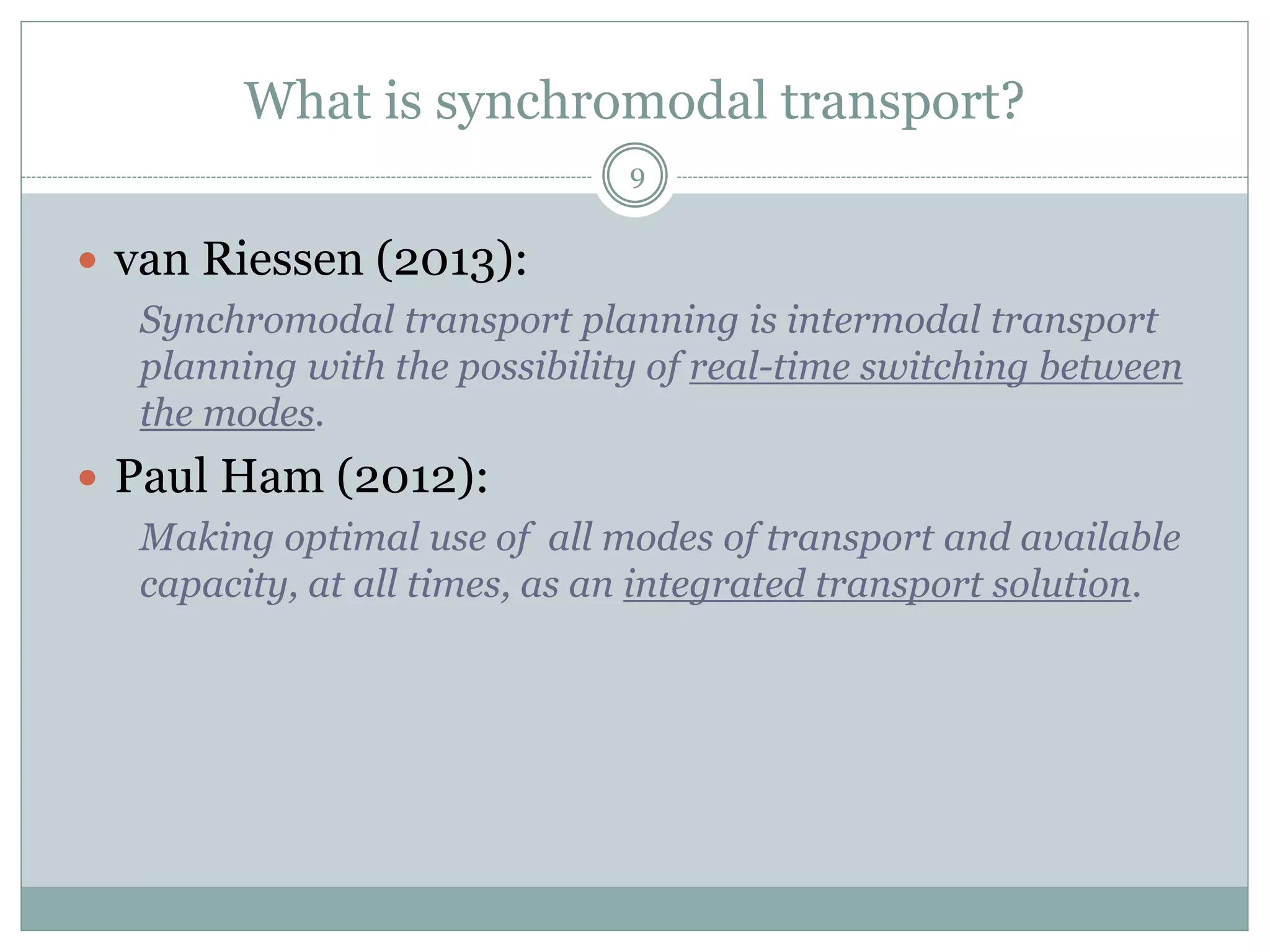
 Paul Ham (2012):
Making optimal use of all modes of transport and available
capacity, at all times, as an integrated transport solution.
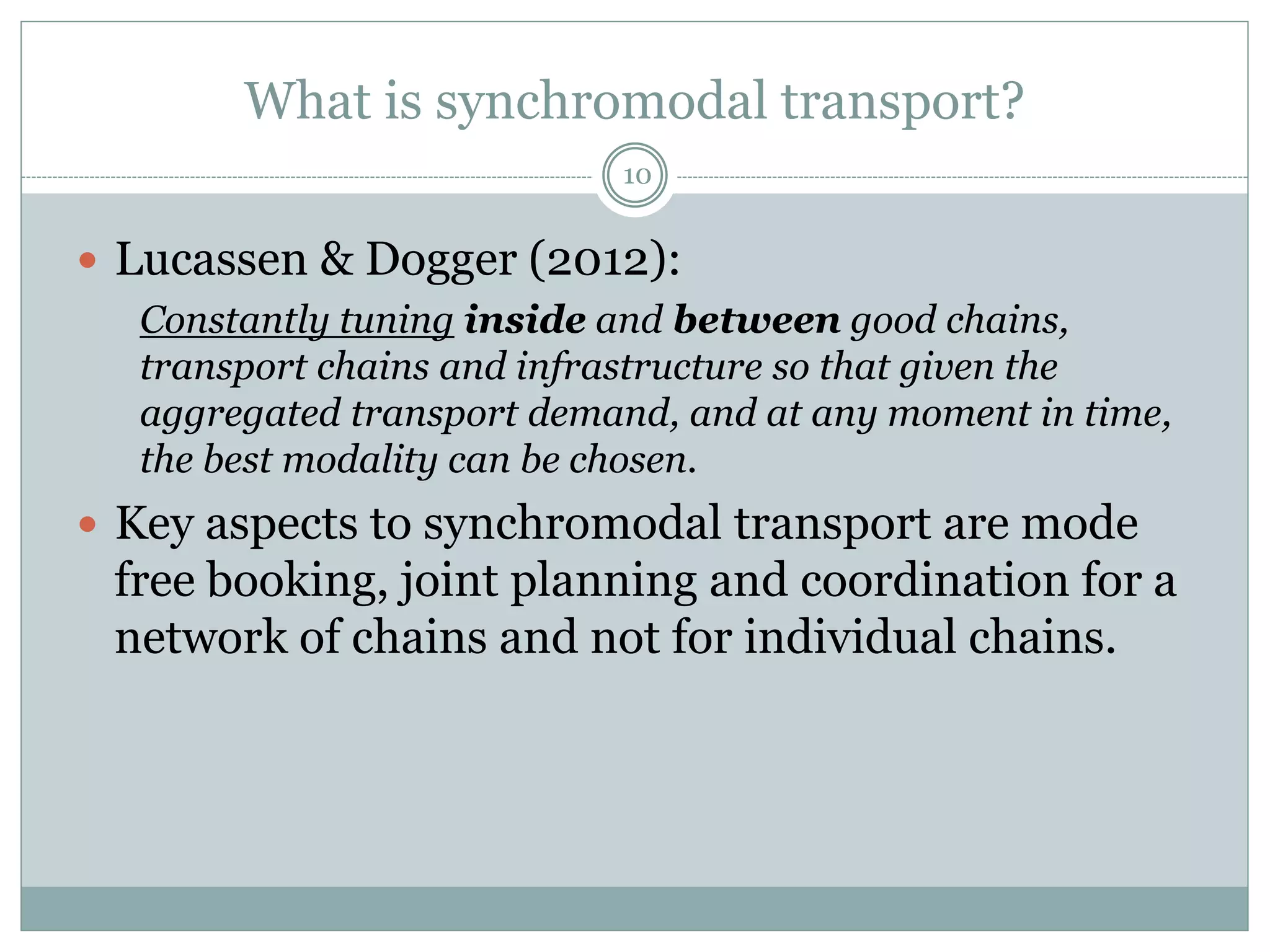
 Lucassen & Dogger (2012):
Constantly tuning inside and between good chains,
transport chains and infrastructure so that given the
aggregated transport demand, and at any moment in time,
the best modality can be chosen.
 van Riessen (2013):
Synchromodal transport planning is intermodal transport
planning with the possibility of real-time switching between
the modes.
What is synchromodal transport?
9
 Key aspects to synchromodal transport are:
 Mode-free booking
 Joint planning and coordination for a network of
chains and not for individual chains
 Bundling of flows and services
 Flexible switching between modalities
 Visibility, situational awareness and information sharing
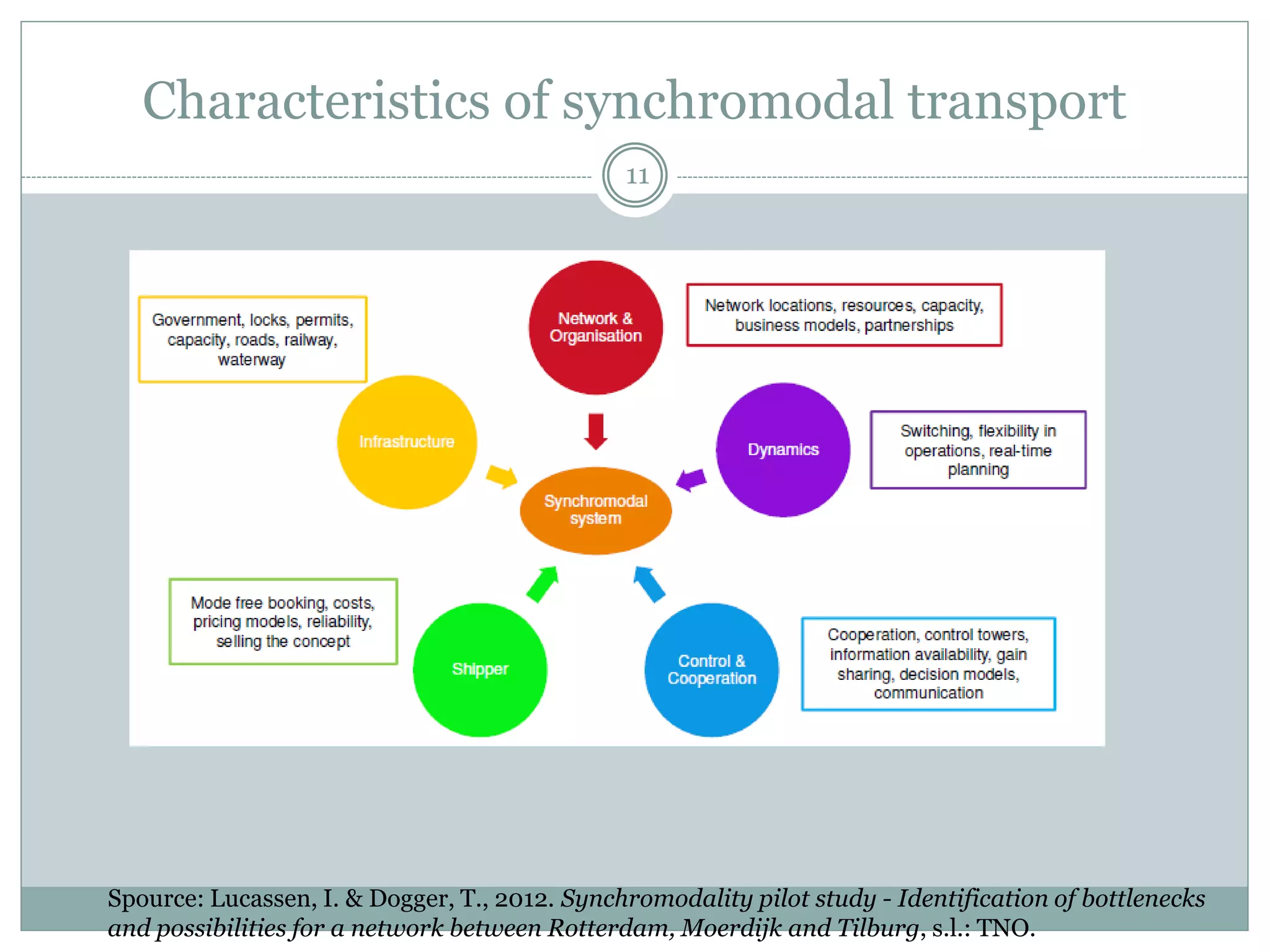
Characteristics of synchromodal transport
10
Source: Lucassen, I. & Dogger, T. (2012). Synchromodality pilot study - Identification of bottlenecks and
possibilities for a network between Rotterdam, Moerdijk and Tilburg, s.l.: TNO.
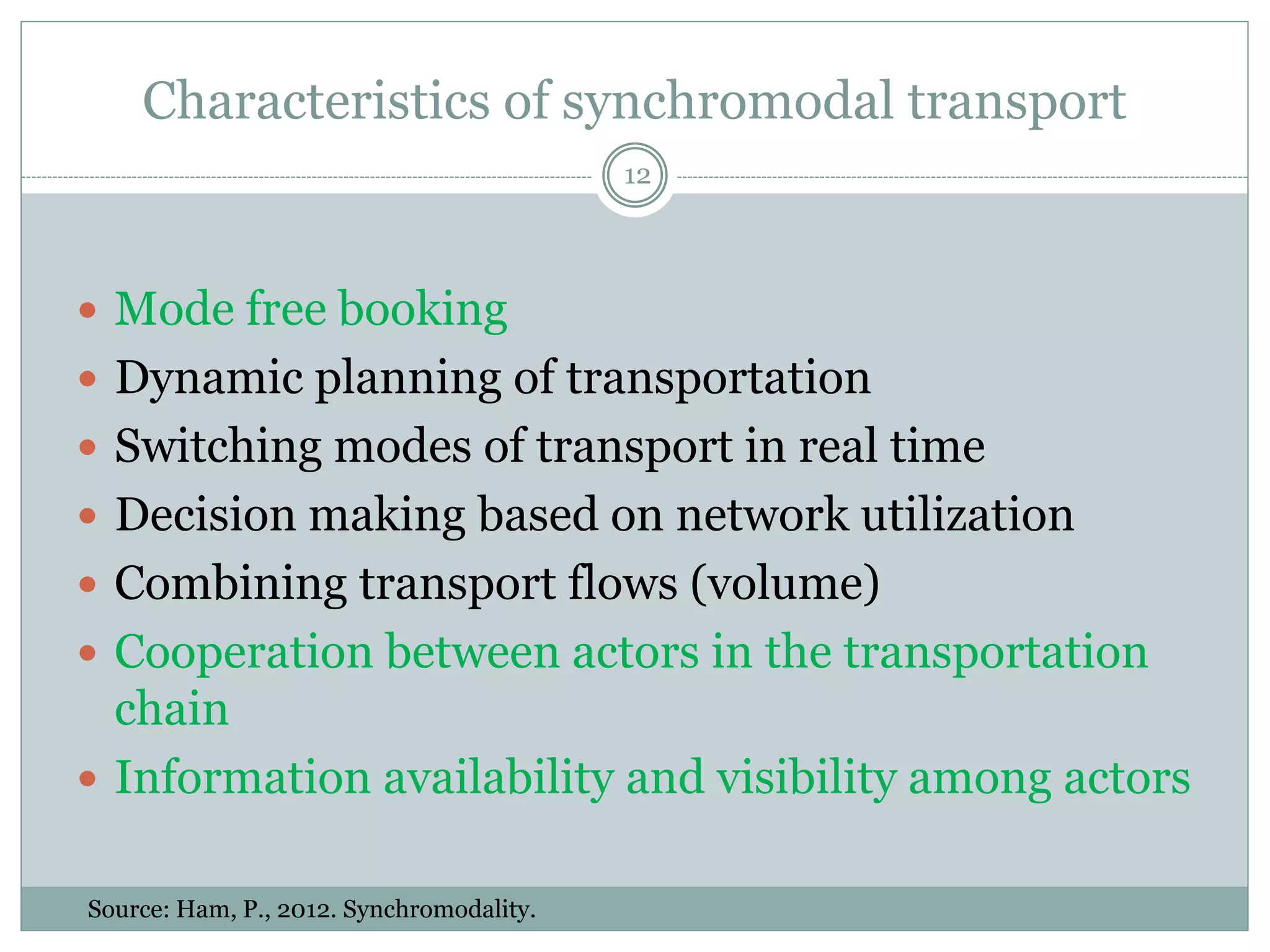
Characteristics of synchromodal transport
11
 Mode free booking
 Dynamic planning of transportation
 Switching modes of transport in real time
 Decision making based on network utilization
 Combining transport flows (volume)
 Cooperation between actors in the transportation
chain
 Information availability and visibility among actors
Source: Ham, P. (2012). Synchromodality.
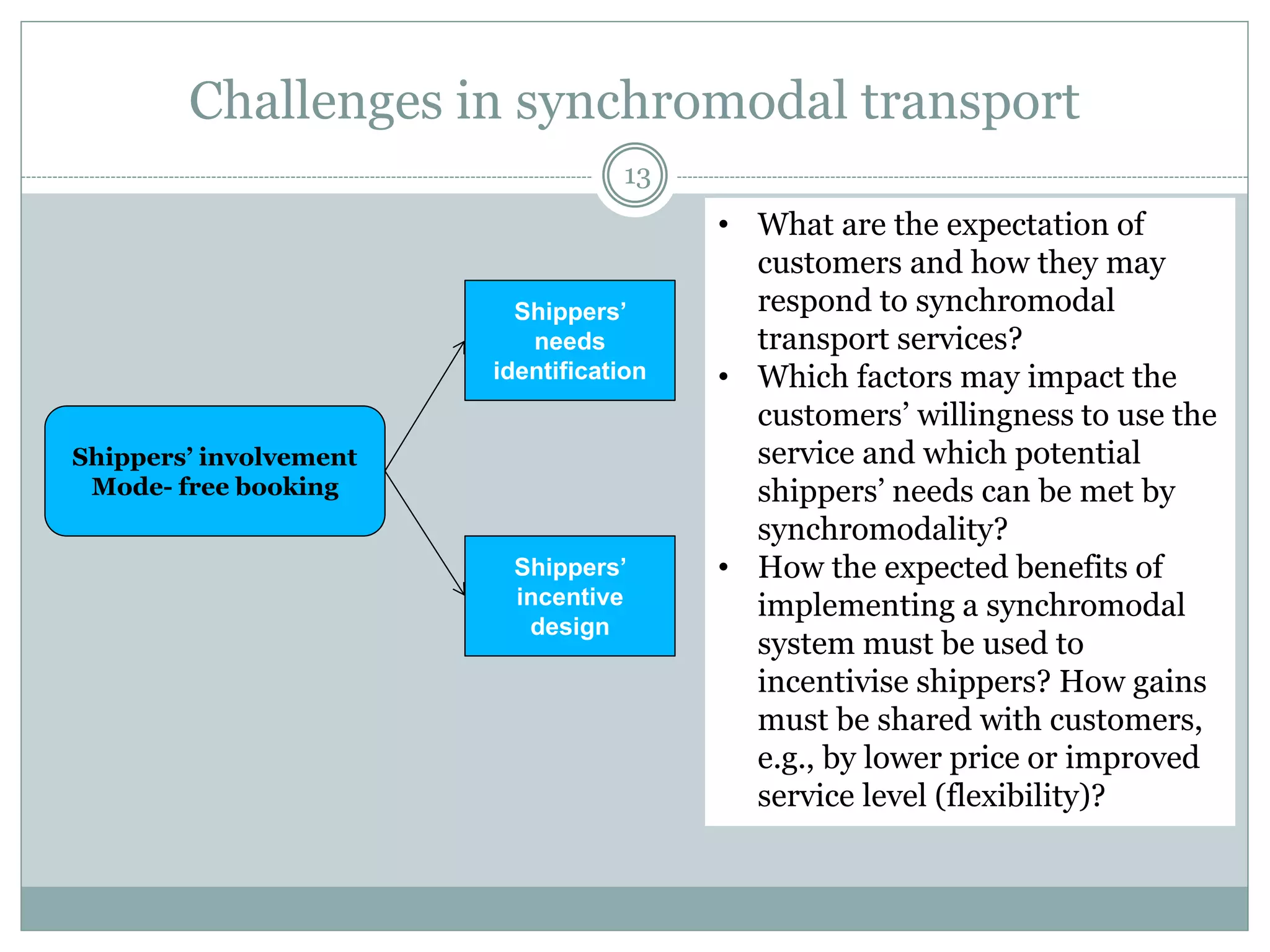
Challenges in synchromodal transport
12
Shippers’ involvement
Mode- free booking
Shippers’
needs
identification
Shippers’
incentive
design
• What are the expectation of
customers and how they may
respond to synchromodal
transport services?
• Which factors may impact the
customers’ willingness to use the
service and which potential
shippers’ needs can be met by
synchromodality?
• How the expected benefits of
implementing a synchromodal
system must be used to
incentivise shippers? How gains
must be shared with customers,
e.g., by lower price or improved
service level (flexibility)?
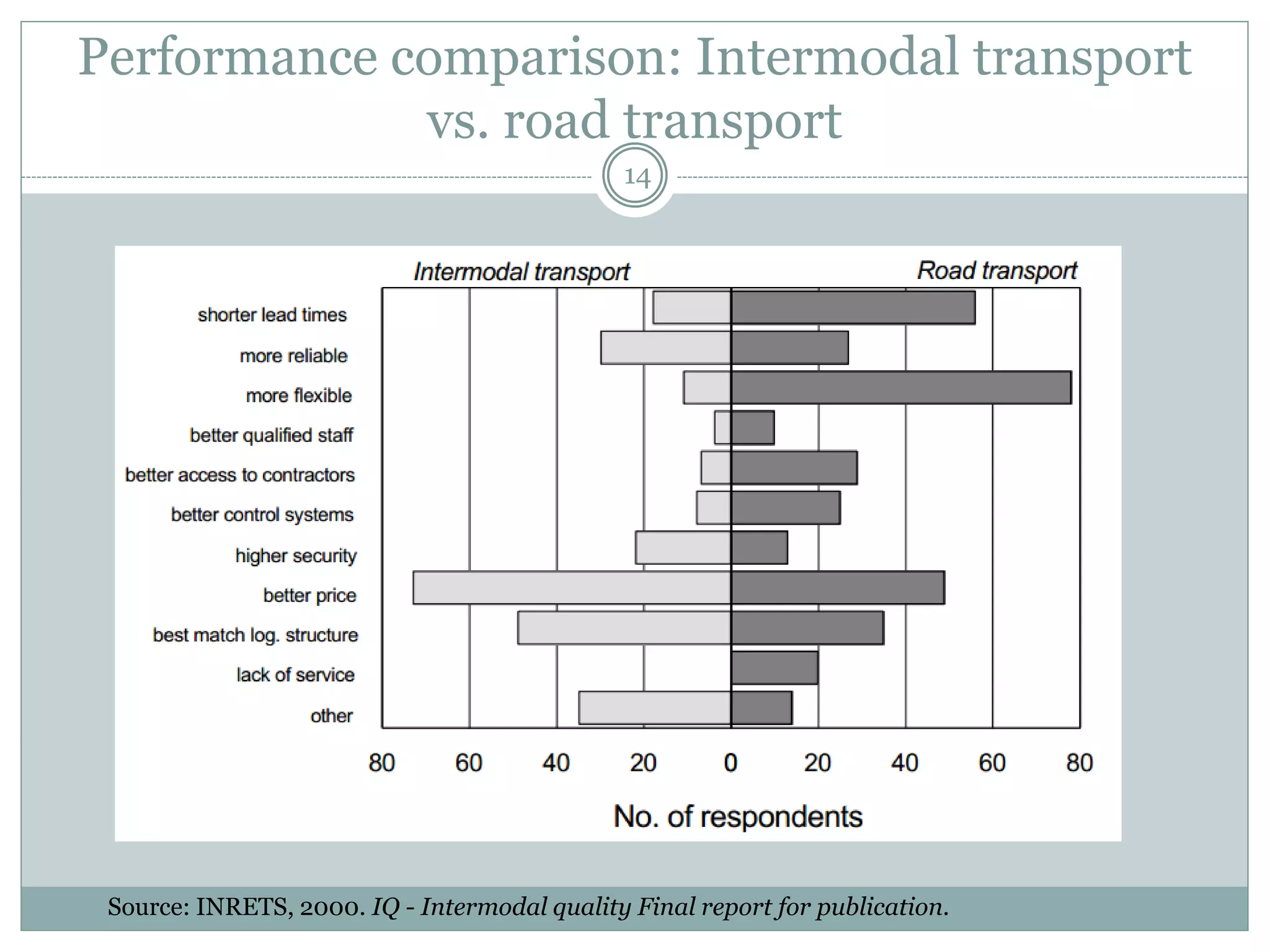
Performance comparison: Intermodal transport
vs. road transport
13
Source: INRETS (2000). IQ - Intermodal quality Final report for publication.
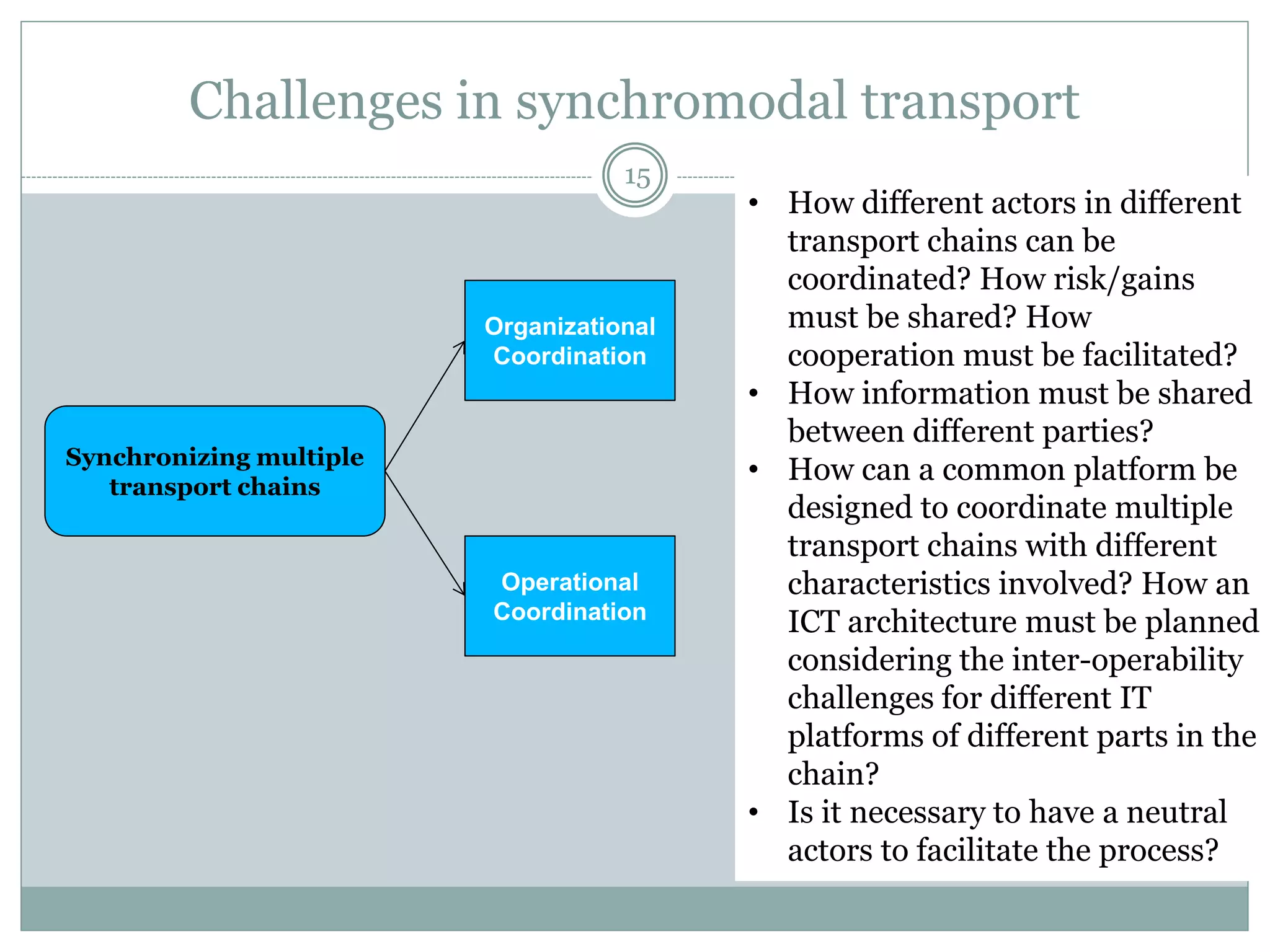
Challenges in synchromodal transport
14
Synchronizing multiple
transport chains
Organizational
Coordination
Operational
Coordination
• How different actors in different
transport chains can be
coordinated? How risk/gains
must be shared? How
cooperation must be facilitated?
• How information must be shared
between different parties?
• How can a common platform be
designed to coordinate multiple
transport chains with different
characteristics involved? How an
ICT architecture must be planned
considering the inter-operability
challenges for different IT
platforms of different parts in the
chain?
• Is it necessary to have a neutral
actors to facilitate the process?
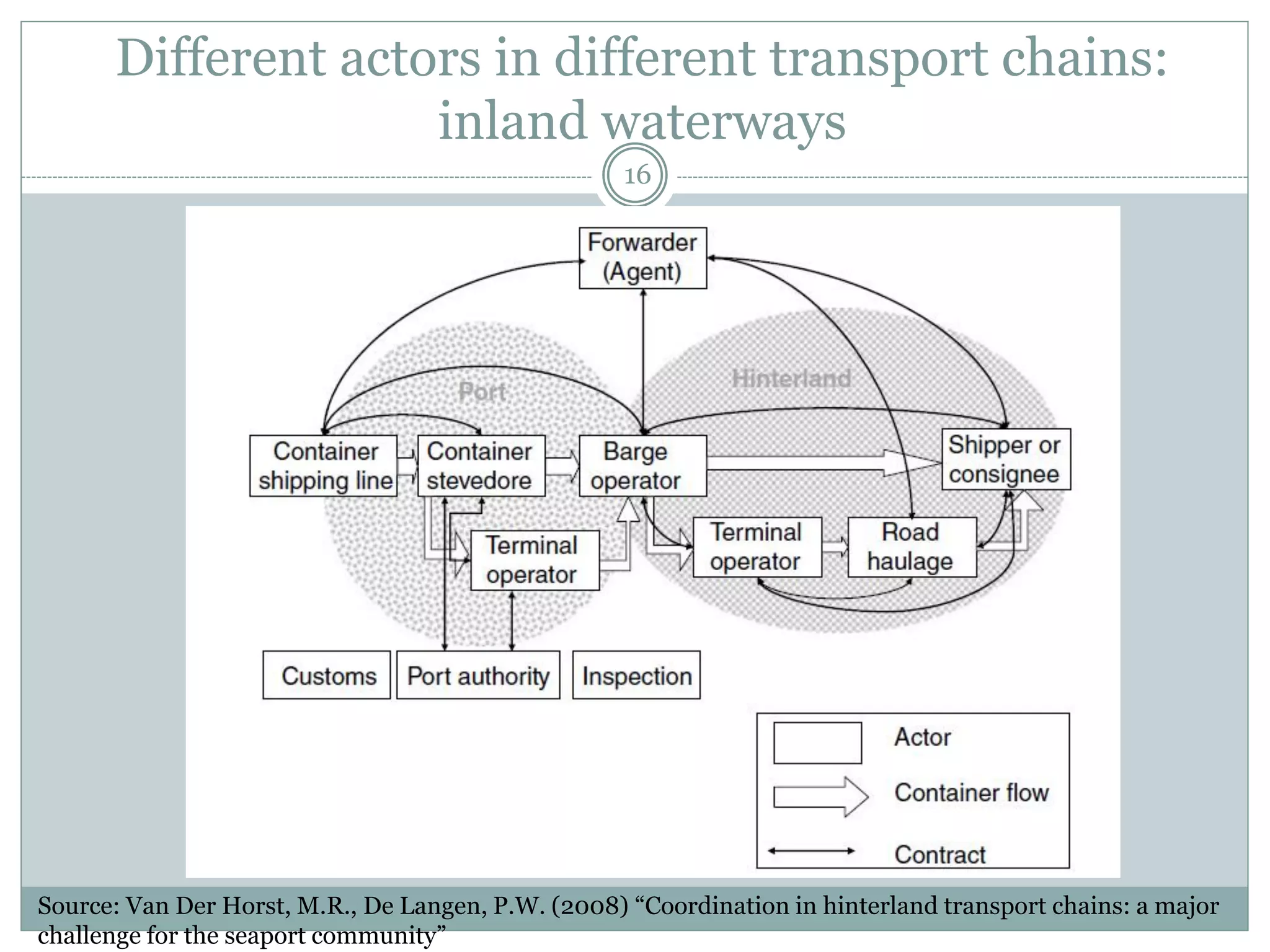
Different actors in different transport chains:
inland waterways
15
Source: Van Der Horst, M.R., De Langen, P.W. (2008) “Coordination in hinterland transport chains: a major
challenge for the seaport community”, Maritime Economics and Logistics 10 (1–2), 108–129
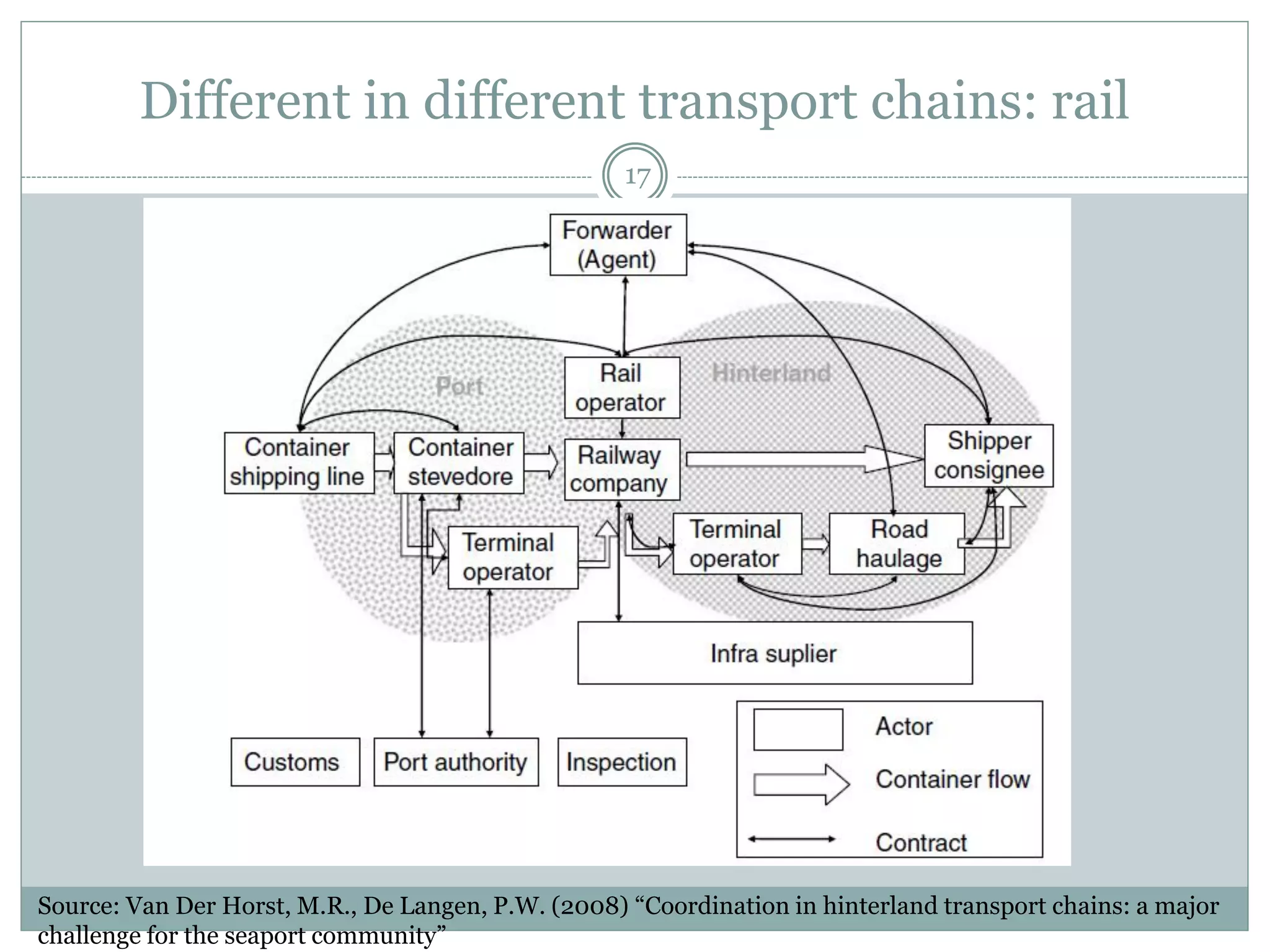
Different actors in different transport chains: rail
16
Source: Van Der Horst, M.R., De Langen, P.W. (2008) “Coordination in hinterland transport chains: a major
challenge for the seaport community”, Maritime Economics and Logistics 10 (1–2), 108–129
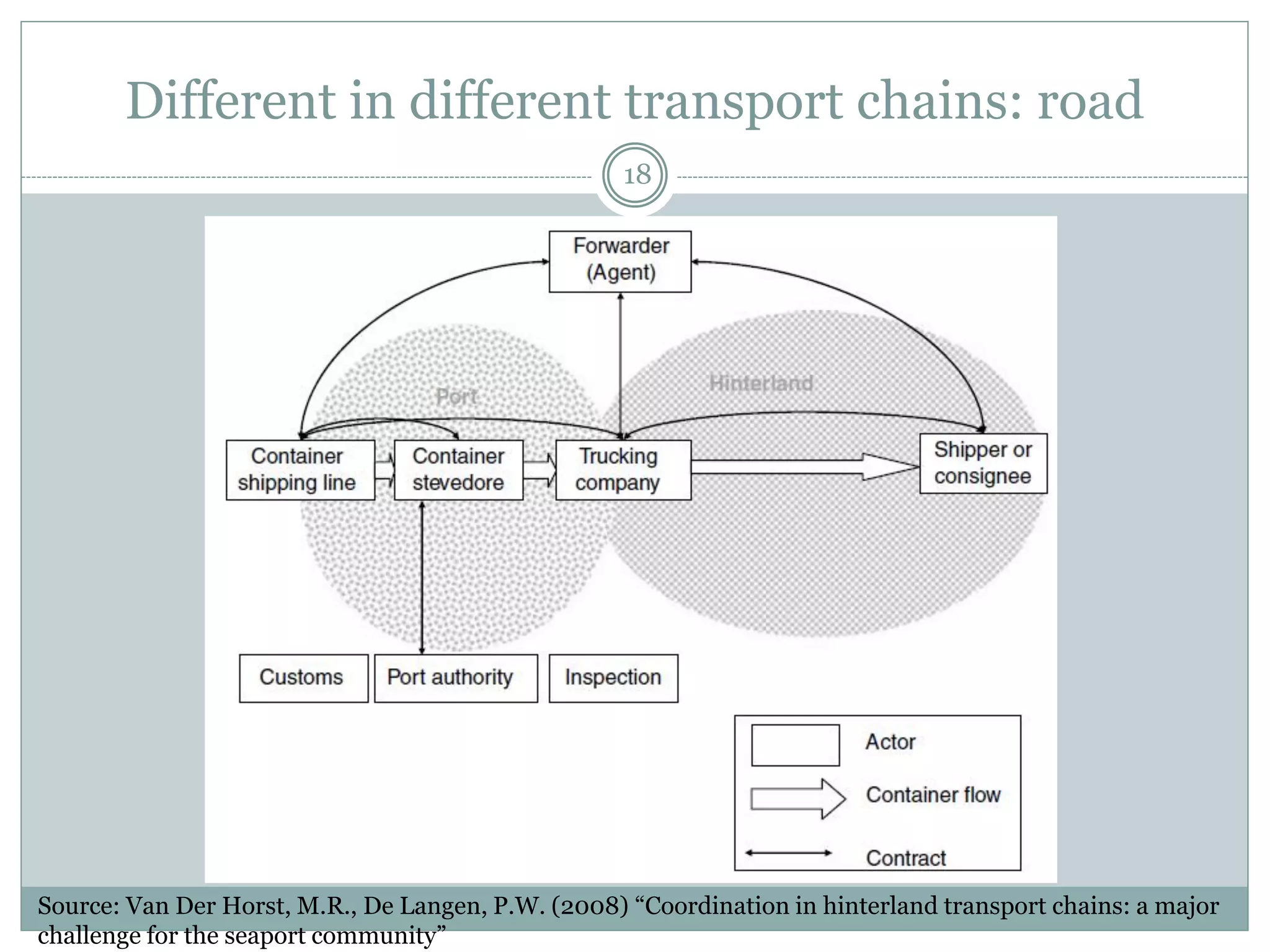
Different actors in different transport chains: road
17
Source: Van Der Horst, M.R., De Langen, P.W. (2008) “Coordination in hinterland transport chains: a major
challenge for the seaport community”, Maritime Economics and Logistics 10 (1–2), 108–129
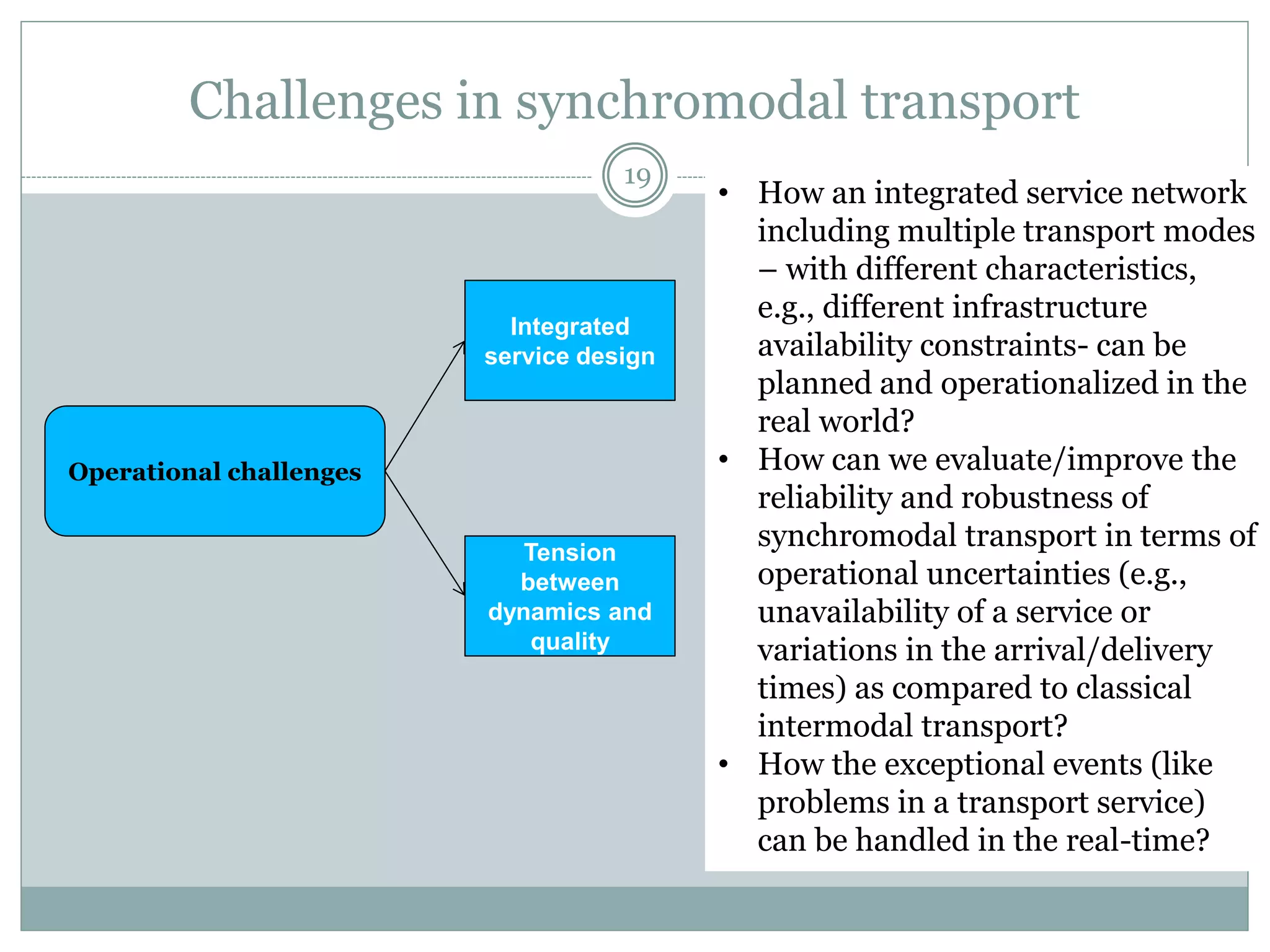
Challenges in synchromodal transport
18
Operational challenges
Integrated
service design
Tension
between
dynamics and
quality
• How an integrated service network
including multiple transport modes
– with different characteristics,
e.g., different infrastructure
availability constraints- can be
planned and operationalized in the
real world?
• How can we evaluate/improve the
reliability and robustness of
synchromodal transport in terms of
operational uncertainties (e.g.,
unavailability of a service or
variations in the arrival/delivery
times) as compared to classical
intermodal transport?
• How the exceptional events (like
problems in a transport service)
can be handled in the real-time?
Horizontal and vertical collaboration in
hinterland transport
Horizontal collaboration
Inter-modality
Synchro-
modality
Uni-modality
Multi-
modality
Verticalcollaboration
19
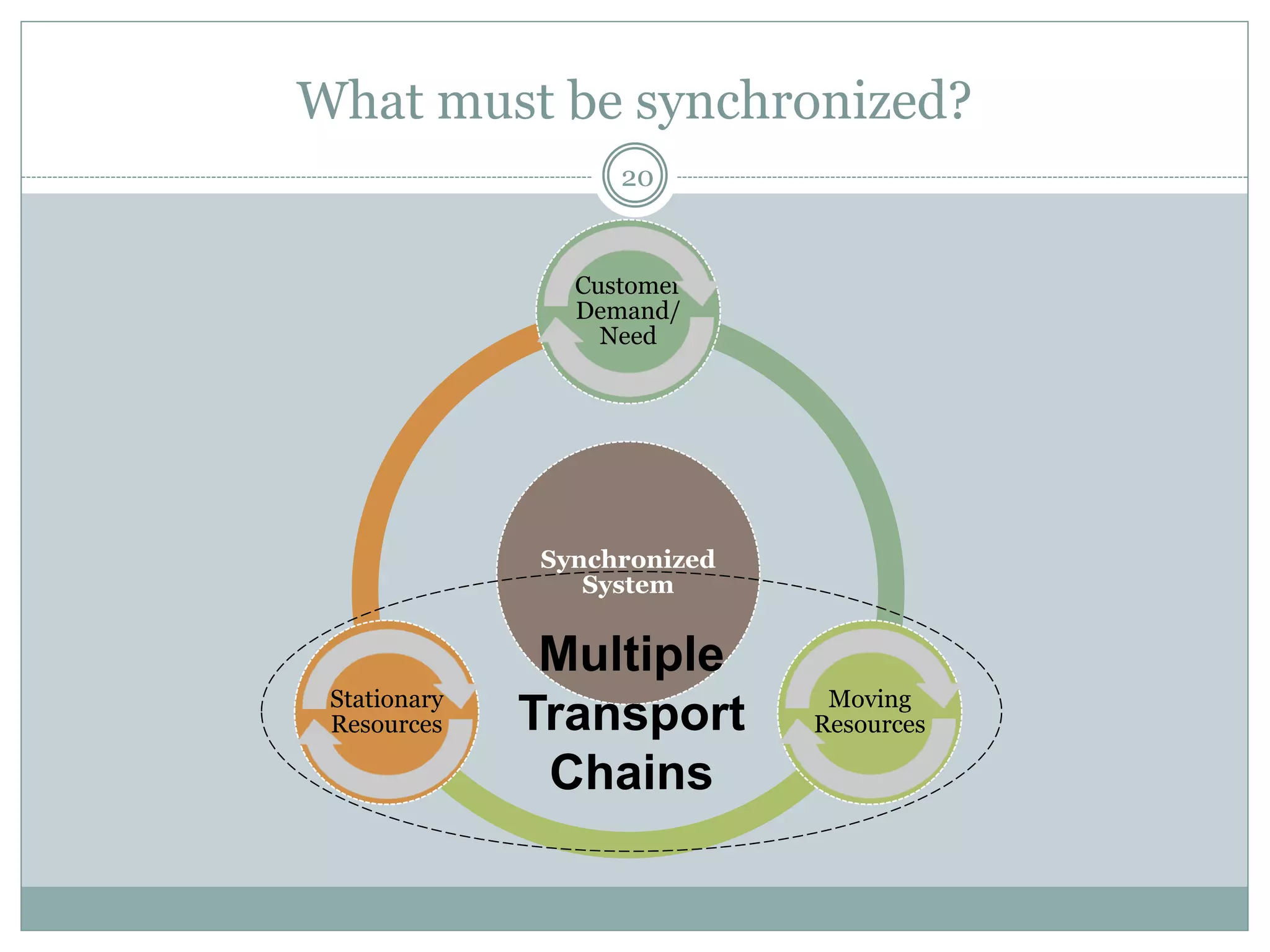
Synchronized
System
Customer
Demand/
Need
Moving
Resources
Stationary
Resources
20
Multiple
Transport
Chains
What must be synchronized?
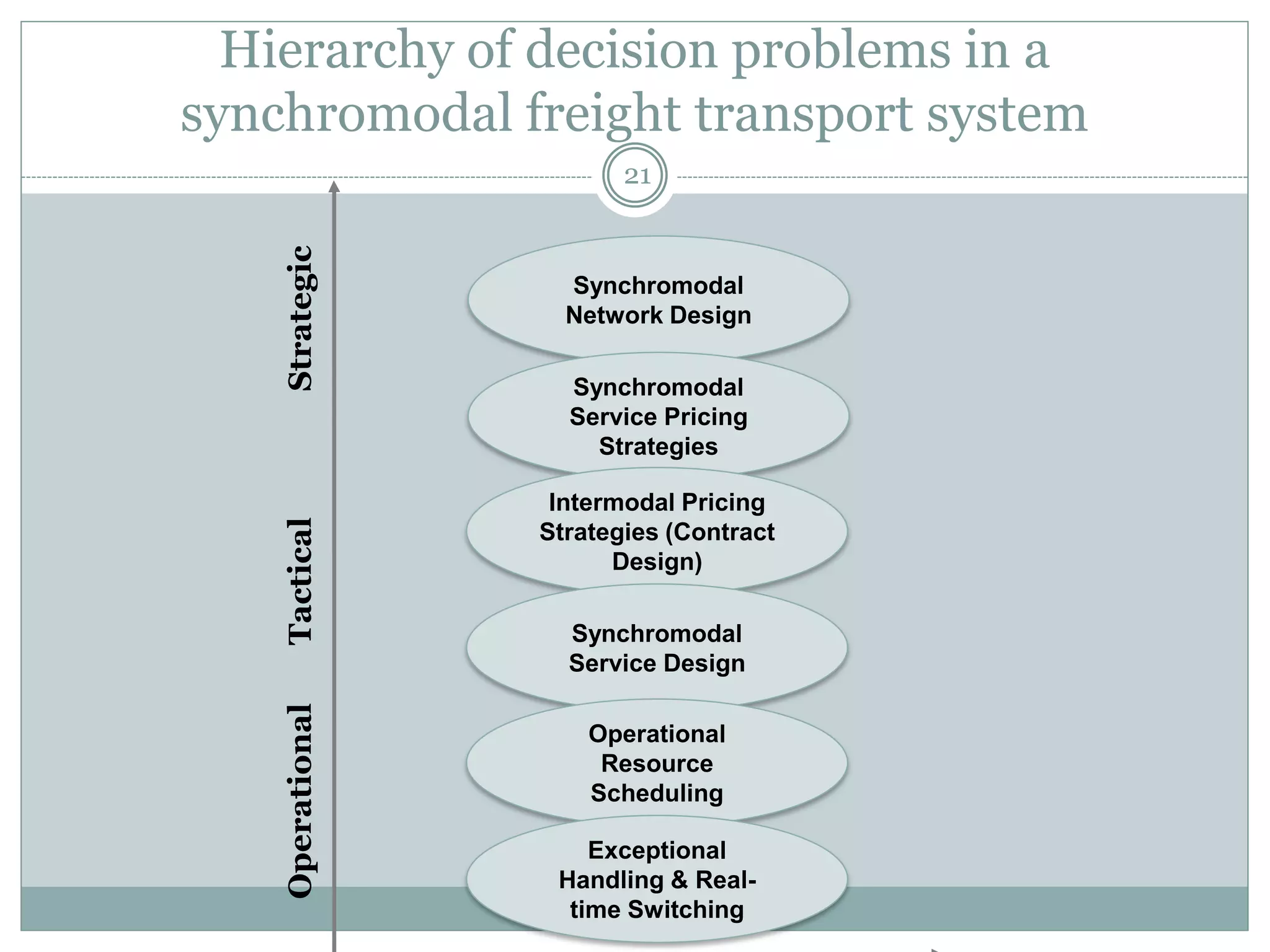
Hierarchy of decision problems in a
synchromodal freight transport system
21
Synchromodal
Network Design
Synchromodal
Service Pricing
Strategies
Intermodal Pricing
Strategies (Contract
Design)
Synchromodal
Service Design
Operational
Resource
Scheduling
Exceptional
Handling & Real-
time Switching
OperationalTacticalStrategic
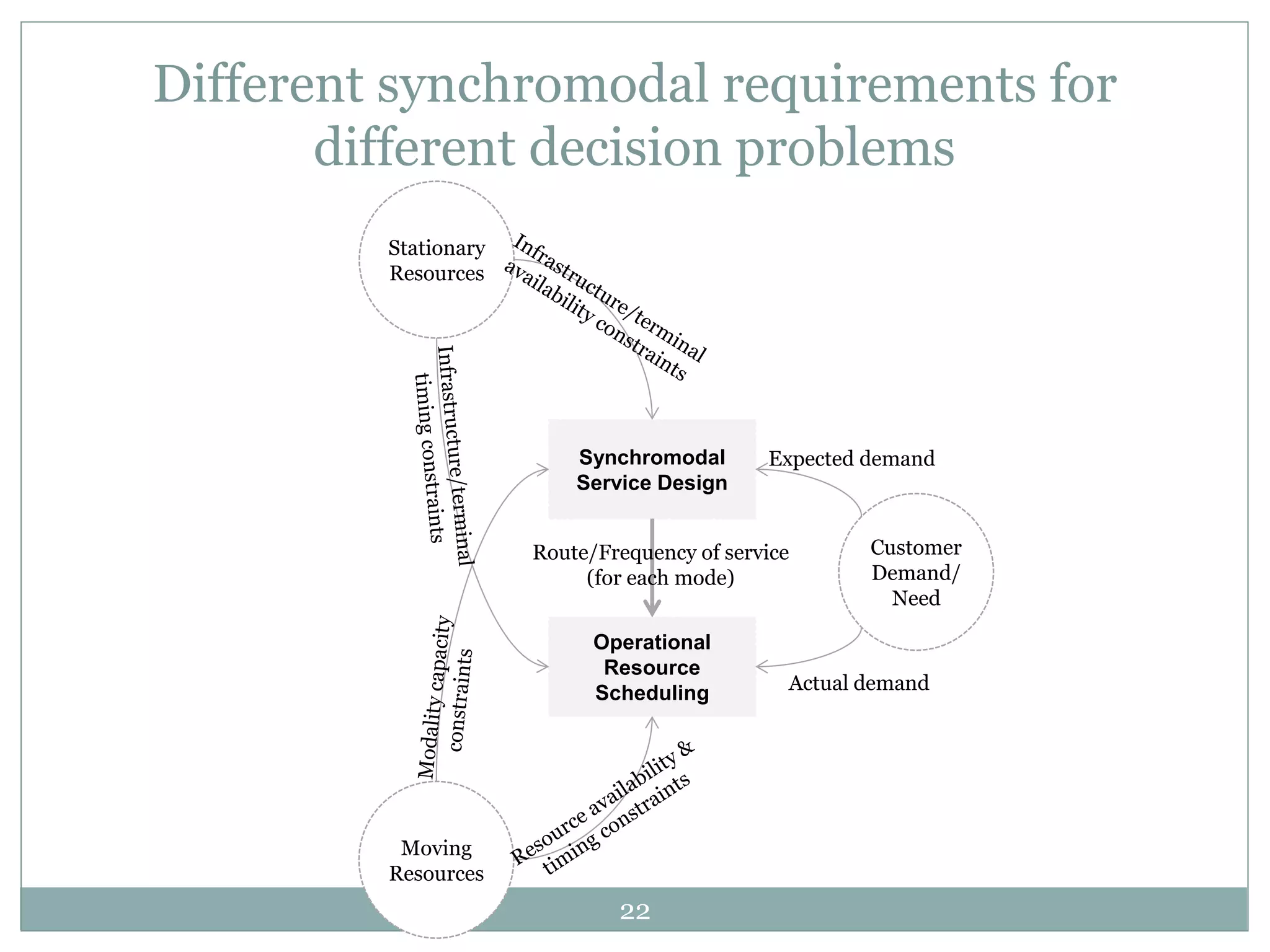
22
Synchromodal
Service Design
Operational
Resource
Scheduling
Customer
Demand/
Need
Stationary
Resources
Moving
Resources
Expected demand
Actual demand
Route/Frequency of service
(for each mode)
Different synchromodal requirements for
different decision problems
Suggested readings
23
 Lucassen, I. & Dogger, T., 2012. Synchromodality pilot study -
Identification of bottlenecks and possibilities for a network
between Rotterdam, Moerdijk and Tilburg, s.l.: TNO.
 Ham, P., 2012. Synchromodality. www. havenupdate.com/
index.php/download_file/view/1375/429/
 Behdani, B., Fan, Y. Wiegmans, B. and Zuidwijk, R., Multimodal
Schedule Design for Synchromodal Freight Transport Systems,
http://papers.ssrn.com/sol3/papers.cfm?abstract_id=2438851
 van Riessen, B., Negenborn, R. R., Dekker, R. & Lodewijks, G.,
2013. Service network design for an intermodal container
network with flexible due dates/times and the possibility of
using subcontracted transport. Available at:
http://www.synchromodaliteit.nl/wp-content/uploads/2013/
09/Preprint-Bart-van-Riessen.pdf
24
Thanks for your attention.
For any questions or comments and if you
would like to have more information about
the content of this work, please contact me
at the following e-mail address:
B.Behdani@tudelft.nl

SYNCHROMODAL FREIGHT TRANSPORT SYSTEM

  • 1.
    BEHZAD BEHDANI D EL F T U N I V E R S I T Y O F T E C H N O L O G Y T R A N S P O R T & P L A N N I N G D E P A R T M E N T SYNCHROMODAL FREIGHT TRANSPORT SYSTEM
  • 2.
    What is discussedhere 2  Intermodal freight transport  Challenges for intermodal freight transport  What is synchromodal freight transport?  Challenges in synchromodal transport  Hierarchy of decision problems in a synchromodal freight transport system
  • 3.
    Intermodal freight transport 3 Definition by European Commission (1997) for Intermodal Freight Transport : “the movement of goods in one loading unit, which uses successively several modes of transport without handling of the goods themselves in transshipment between the modes”. Container terminal Container terminal Main transport (Inland waterway or rail) A typical intermodal freight transport system
  • 4.
    Challenges for intermodaltransport 4  Single-mode road transport is the dominant transport mode in Europe with a market share of about 80% (in terms on tonne-kms).  Advantages: flexibility (e.g., in case of disturbances), door-to-door transport solutions, competitive pricing, customer-made solutions, reliability, speed, gets more sustainable as compared to rail and IWW transport, and high accessibility  Disadvantages: congestion, negative external effects, less safe than rail and IWW transport, increasing costs due to inclusion of external costs into price of road freight transport, and less scale economies than rail and IWW transport Source: Bart Wiegmans (2012) Intermodalism: Competition or Cooperation?
  • 5.
    Environmental impact ofroad transport 5  Although heavy good vehicles only make up 3% of the European vehicle fleet and 7% of driven kilometres, they account for almost a quarter of road transport CO2 emissions, or about 6% of total EU greenhouse gas emissions (European Commission, 2013). This is expected to rise to 8% by 2020.  Lorries are also responsible for 20% of road congestion in the EU. The road congestion is even more important around port areas as it has an adverse effect on the competitive position of a port as a location for logistics businesses. Source: European Commission (2013). Climate Action Plan
  • 6.
    Barriers for intermodaltransport 6 1. Operational problems, for example:  Train decoupling  Use of rail infra for both passenger/freight transport  Terminal opening hours 2. Organizational problems, for example:  Co-ordinations between multiple partners and timing of road haulage 3. Economical problems , for example  High transshipment cost Source: Wichser, J. (2001). Technical and operational developments needed for a better market success of intermodal freight transport.
  • 7.
    What is synchromodaltransport? 7  Core idea: Integration of transport volumes and modes in order to better use the capacity with fewer cost and negative effects on the environment  Possible benefits:  Increasing the flexibility in transport choices  Increase the utilization of rail and inland waterway  Optimal use of available capacity on the network Sea Terminal Inland Terminal Barge Train Truck Integrated view
  • 8.
    What is synchromodaltransport? 8  Paul Ham (2012): Making optimal use of all modes of transport and available capacity, at all times, as an integrated transport solution.  Lucassen & Dogger (2012): Constantly tuning inside and between good chains, transport chains and infrastructure so that given the aggregated transport demand, and at any moment in time, the best modality can be chosen.  van Riessen (2013): Synchromodal transport planning is intermodal transport planning with the possibility of real-time switching between the modes.
  • 9.
    What is synchromodaltransport? 9  Key aspects to synchromodal transport are:  Mode-free booking  Joint planning and coordination for a network of chains and not for individual chains  Bundling of flows and services  Flexible switching between modalities  Visibility, situational awareness and information sharing
  • 10.
    Characteristics of synchromodaltransport 10 Source: Lucassen, I. & Dogger, T. (2012). Synchromodality pilot study - Identification of bottlenecks and possibilities for a network between Rotterdam, Moerdijk and Tilburg, s.l.: TNO.
  • 11.
    Characteristics of synchromodaltransport 11  Mode free booking  Dynamic planning of transportation  Switching modes of transport in real time  Decision making based on network utilization  Combining transport flows (volume)  Cooperation between actors in the transportation chain  Information availability and visibility among actors Source: Ham, P. (2012). Synchromodality.
  • 12.
    Challenges in synchromodaltransport 12 Shippers’ involvement Mode- free booking Shippers’ needs identification Shippers’ incentive design • What are the expectation of customers and how they may respond to synchromodal transport services? • Which factors may impact the customers’ willingness to use the service and which potential shippers’ needs can be met by synchromodality? • How the expected benefits of implementing a synchromodal system must be used to incentivise shippers? How gains must be shared with customers, e.g., by lower price or improved service level (flexibility)?
  • 13.
    Performance comparison: Intermodaltransport vs. road transport 13 Source: INRETS (2000). IQ - Intermodal quality Final report for publication.
  • 14.
    Challenges in synchromodaltransport 14 Synchronizing multiple transport chains Organizational Coordination Operational Coordination • How different actors in different transport chains can be coordinated? How risk/gains must be shared? How cooperation must be facilitated? • How information must be shared between different parties? • How can a common platform be designed to coordinate multiple transport chains with different characteristics involved? How an ICT architecture must be planned considering the inter-operability challenges for different IT platforms of different parts in the chain? • Is it necessary to have a neutral actors to facilitate the process?
  • 15.
    Different actors indifferent transport chains: inland waterways 15 Source: Van Der Horst, M.R., De Langen, P.W. (2008) “Coordination in hinterland transport chains: a major challenge for the seaport community”, Maritime Economics and Logistics 10 (1–2), 108–129
  • 16.
    Different actors indifferent transport chains: rail 16 Source: Van Der Horst, M.R., De Langen, P.W. (2008) “Coordination in hinterland transport chains: a major challenge for the seaport community”, Maritime Economics and Logistics 10 (1–2), 108–129
  • 17.
    Different actors indifferent transport chains: road 17 Source: Van Der Horst, M.R., De Langen, P.W. (2008) “Coordination in hinterland transport chains: a major challenge for the seaport community”, Maritime Economics and Logistics 10 (1–2), 108–129
  • 18.
    Challenges in synchromodaltransport 18 Operational challenges Integrated service design Tension between dynamics and quality • How an integrated service network including multiple transport modes – with different characteristics, e.g., different infrastructure availability constraints- can be planned and operationalized in the real world? • How can we evaluate/improve the reliability and robustness of synchromodal transport in terms of operational uncertainties (e.g., unavailability of a service or variations in the arrival/delivery times) as compared to classical intermodal transport? • How the exceptional events (like problems in a transport service) can be handled in the real-time?
  • 19.
    Horizontal and verticalcollaboration in hinterland transport Horizontal collaboration Inter-modality Synchro- modality Uni-modality Multi- modality Verticalcollaboration 19
  • 20.
  • 21.
    Hierarchy of decisionproblems in a synchromodal freight transport system 21 Synchromodal Network Design Synchromodal Service Pricing Strategies Intermodal Pricing Strategies (Contract Design) Synchromodal Service Design Operational Resource Scheduling Exceptional Handling & Real- time Switching OperationalTacticalStrategic
  • 22.
    22 Synchromodal Service Design Operational Resource Scheduling Customer Demand/ Need Stationary Resources Moving Resources Expected demand Actualdemand Route/Frequency of service (for each mode) Different synchromodal requirements for different decision problems
  • 23.
    Suggested readings 23  Lucassen,I. & Dogger, T., 2012. Synchromodality pilot study - Identification of bottlenecks and possibilities for a network between Rotterdam, Moerdijk and Tilburg, s.l.: TNO.  Ham, P., 2012. Synchromodality. www. havenupdate.com/ index.php/download_file/view/1375/429/  Behdani, B., Fan, Y. Wiegmans, B. and Zuidwijk, R., Multimodal Schedule Design for Synchromodal Freight Transport Systems, http://papers.ssrn.com/sol3/papers.cfm?abstract_id=2438851  van Riessen, B., Negenborn, R. R., Dekker, R. & Lodewijks, G., 2013. Service network design for an intermodal container network with flexible due dates/times and the possibility of using subcontracted transport. Available at: http://www.synchromodaliteit.nl/wp-content/uploads/2013/ 09/Preprint-Bart-van-Riessen.pdf
  • 24.
    24 Thanks for yourattention. For any questions or comments and if you would like to have more information about the content of this work, please contact me at the following e-mail address: B.Behdani@tudelft.nl