This document provides an analysis of neocolonialism in Ngugi wa Thiong'o's novel Petals of Blood. It begins with an introduction of the author and overview of the novel. It then defines neocolonialism and discusses how it is depicted in the novel through the modernization of the village of Ilmorog which destroys its culture and exploits the land. The characters come to oppose the new elite class that maintains connections with former colonizers. The document concludes that the novel critically examines neo-colonialism and its negative impacts in post-independence Kenya.
Table of Content
●Author's Introduction
● Introduction of the Novel
● What is Neocolonialism ?
● Neocolonialism in Petals of Blood
● Conclusion
● Citation
4.
● Ngugi waThiong’o is a Kenyan writer and
academic who writes primarily in Gikuyu
andwhoformerlywroteinEnglish.
● His work includes novels, plays, short stories,
and essays, ranging from literary and social
criticismtochildren'sliterature.
● He is the founder and editor of the Gikuyu-
languagejournalMũtĩiri.
● His famous works : The Black Hermit, Weep
Not Child, The River Between, A Grain of
Wheat, Decolonising the Mind, Devil on the
Earth,WizardoftheCrow,Matigari
Author's Introduction
Ngugi wa Thiong'o
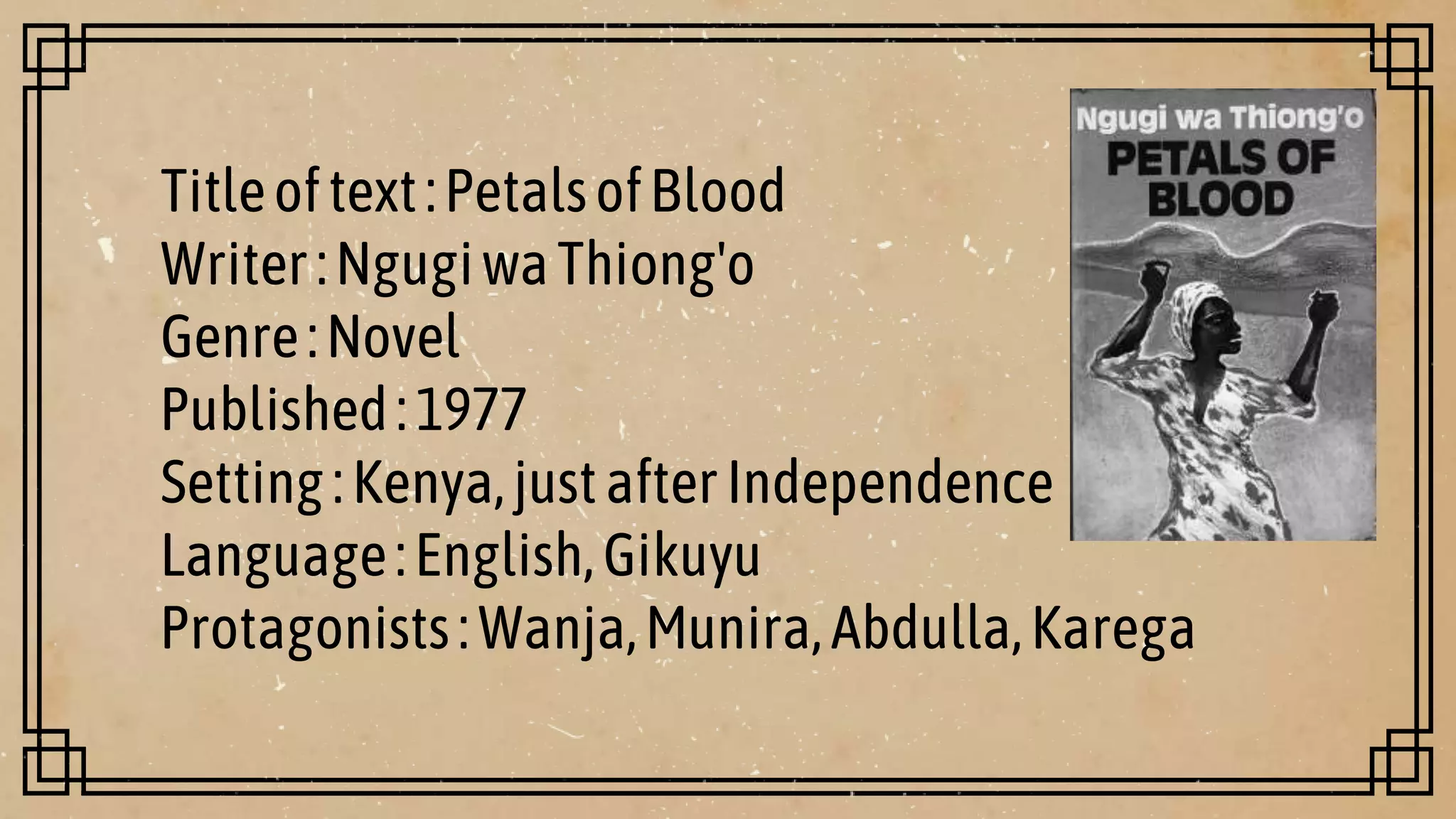
● The storyfollows four characters – Munira, Abdulla, Wanja, and Karega –
whoselivesareintertwinedduetotheMauMaurebellion.
● In order to escape city life, each retreats to the small, pastoral village of
Ilmorog.
● As the novel progresses, the characters deal with the repercussions of the Mau
Maurebellionaswellaswithanew,rapidlywesternizingKenya.
● The novel largely deals with the scepticism of change after Kenya's
independence from colonial rule, questioning to what extent free Kenya
merely emulates, and subsequently perpetuates, the oppression found during
itstimeasacolony.
● Other themes include the challenges of capitalism, politics, and the effects of
westernization.
● Education, schools, and the Mau Mau rebellion are also used to unite the
characters,whoshareacommonhistorywithoneanother.
8.
❖ It isa policy of a strong nation in seeking political and economic hegemony over
an independent nation or extended geographical area without necessarily
reducingthesubordinatenationorareatothelegalstatusofacolony
❖ The term neocolonialism was first used In 1965, by Kwame Nkrumah after World
War II to refer to the continuing dependence of former colonies on foreign
countries
❖ RolandFuhgaveasimpledefinitionofNeocolonialismthat,
“Neo-colonialismcanbedefinedastheindirectcontroloftheeconomic,
politicalandsocio-culturallifeofAfricancountriesbytheirformercolonial
masters.Unlikecolonialismwhich wasdirectcontrol,neo-colonialismoperates
indirectlyandsecretly.”
(Fuh,RolandSuh)
What is Neocolonialism ?
9.
❖ In Neo-Colonialism,the Last Stage of Imperialism Nkrumah has
offeredanin-depthcritiqueofneocolonialism.
❖ He argued that neocolonialism is the final and the most perilous stage
of imperialism. Since the old-fashioned ways of colonization no more
exists, the imperialist powers direct their domination indirectly on the
economic system, politics and cultural base of a decolonized nation.
(Nkrumah,Kwame)
❖ As Sourav Kumar Nag said in his article, To use the term
“neocolonialism” is to accept the perpetuation of the imperialist
oppression and colonialist domination in a different and essentially
new format even after the achievement of independence. (Nag,
SouravKumar)
10.
● The novelstarts with the news of murder of : Mzigo, Chui and Kimeria.
Wanja,Munira, KaregaandAbdullaaresuspected.
● Ilmorog has grown from a traditional Kenyan village to a modern
industrial town.
● According to Josephine Sitwala, The modernisation of the area brings
changes which Ngugi regards as examples ofneo-colonisation. He does
not accept the urbanisation of Ilmorog because it has destroyed its
original beauty and, as such, brought suffering to its inhabitants. ‘The
focus of neo-colonialism in Petals of Blood is land and is based on
social abuse, oppression, exploitation and injustice.’ (Sitwala,
Josephine Ntelamo)
Neocolonialism in Petals of Blood
11.
● Thenovel showsthefailureoftherulingelitetomeetthemasses’needsconceringland
ownershipadequately.
● The elite still maintain their connections with the departed colonisers, thus, creating a
riftbetweenthemiddleclassandthebourgeoisie.
● A speech given by Nyakinyua contrasts the working class and the elite; this motivates
hertoagreetomakeatriptoNairobi:
“I think we should go. It is our time to make things happen. There was a time when things
happened the way we in Ilmorog wanted them to happen. We had power over the movement
of our limbs. We made up our own words and sang them and we danced to them. But there
came a time when this power was taken from us. We danced yes, but somebody else called
out the words and the song. They ate our forest. Then they sent for our young men. They went
on swallowing our youth. Ours is only to bear in order for the city to take … that is why
Ilmorog must go there and see this Ndamathia that only takes but never gives back.” (Ngugi,
1977,pp115-116)
12.
● In Writersin Politics (1981) Thiong‟o made a significant comment regarding his
novelPetalsofBlood:
“No country, no people can be truly independent for as long as their economy and
culture are dominated by foreigners! … This was what I was trying to show in Petals
of Blood: that imperialism can never develop our country or develop us, Kenyans”
(WaThiong'oNgugi).
● Startedestablishingtheirowngovernmentandcontrolovereconomy.
● As Weiping and Zhang said, Ngugi also adopted the collective African voices to
demonstrate the general opinions of the African people towards the neocolonial
activities. With the building of the Trans-Africa road, Ilmorog was put into the
agenda of fast development and modernization. The Land was taken from the
people; shopping centers, tourist centers and other infrastructure were
constructed; machines and measuring instruments of different kinds were in use to
promotetheeconomy.(Li,Weiping,andXiuliZhang)
13.
● females' beingoppressed by males and African's being exploited by the
colonists havethesameideological basis.
● Women were described as "oppressed" because they were exploited and
dominated.Subalternnations,too, were oppressed onthesamebasis:they
wereexploitedanddominatedbycolonial and/or imperialpowers.
● Wanja = Kenya, Africa. What money wanted was body, just like the
imperialists desiredfortheAfricanland.
● Weiping and Zhang said that, as objects of sexual desires, both Wanja's
mature body and the fertile African land were exploited. By narrating
Wanja's past, Ngugi expressed his harsh criticism against the imperialists'
control anddomination ofAfrica.
● Politician Nderi wa Riera - he is only concerned with the votes of Ilmorog
atelectionsand heignores thesocialand economicneeds of remoteareas
suchasIlmorog.
● WanjaandAbdullalostBaarandmoney
14.
Conclusion
● The terriblesituation after African independence, they show sharply different
views towards theimperialists' newwayofexploiting andcontrolling Africa.
● The narrators allow different Africans voice, their own stories, their plight and
rebellionagainst thepower.
● For Ngugi, the African females were driven to be prostitutes directly because of the
imperialists' exploitation; however, these females, like other proletariats, would
takeactions tofight.
● The conflicting narrative of Ngugi reflect his oppositions concerning neo-
colonialism, one as an insider opposing it, while the other as an outsider standing
byit.
● Ngugi has catapulted caustic criticism against the middle class of Africa who
derived power from the common people during the anti-colonial struggles and
after independence derived it to “form a cozy relationship with the western
bourgeoisie.
15.
Citation
❏ Fuh, RolandSuh. “What Is Neo-Colonialism? How It Is Manifested and
What Can Be Done?” LtEconomyBlog, 16 Nov. 2019,
http://www.lteconomy.it/blog/2019/11/16/what-is-neo-colonialism-how-it-
is-manifested-and-what-can-be-done/.
❏ Li, Weiping, and Xiuli Zhang. “Conflicting Neo-Colonialist Narratives in
the Representation of Africa in Ngugi and Naipaul's Novels.” CLCWeb:
Comparative Literature and Culture, vol. 20, no. 7, 2018,
https://doi.org/10.7771/1481-4374.3331.
❏ Nag, Sourav Kumar. “Fighting Neocolonialism: A Case Study of the
Selected Novels of Ngugi Wa Thiong’o.” Epiphany, vol. 6, no. 1, 2013,
https://doi.org/10.21533/epiphany.v6i1.57.
16.
Citation
❏ Nkrumah, Kwame.Neo-Colonialism: The Last Stage of Imperialism.
New York: International Publishers, 1980. 1 March 2022.
❏ Sitwala, Josephine Ntelamo. “Neo-Colonial Elitism and Its Influence
in Kenya: A Case Study of Ngugi Wa Thiong'o's Petals of Blood,
Devil on the Cross and Matigari.” Neo-Colonial Elitism and Its
Influence in Kenya: A Case Study of Ngugi Wa Thiong'o's Petals of
Blood, Devil on the Cross and Matigari, University of Namibia, 2018,
http://hdl.handle.net/11070/2213.
❏ Wa Thiong’o, Ngugi. Petals of Blood. New York, NY: E.P Dutton,
1977. 1 March 2022.
❏ Wa Thiong'o Ngugi. Writers in Politics: Studies in African Literature.
USA: Heinemann, 1981. 1 March 2022.