Blood
Grouping
Presented by: Yeshwant Rao B
Table of contents
Objective of the Internship ABO System
Introduction
• What are blood groups?
• What is blood grouping?
How to perform a blood
group test?
● The primary objective of this Internship is to learn to perform blood
grouping tests, and why blood grouping is necessary.
● Witnessing the impact that blood grouping has on patient care and
outcomes.
● Determining the blood type of an individual in order to ensure
compatibility between the donor and recipient in medical procedures
such as blood transfusions and organ transplantation.
Objective of the Internship
Introduction
• What are blood groups?
• What is blood grouping?
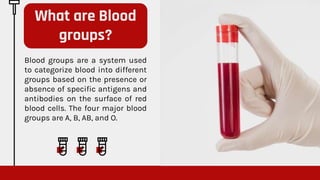
Blood groups are a system used
to categorize blood into different
groups based on the presence or
absence of specific antigens and
antibodies on the surface of red
blood cells. The four major blood
groups are A, B, AB, and O.
What are Blood
groups?
● Blood grouping is a system that categorizes blood into different
groups based on the presence or absence of specific antigens and
antibodies on the surface of red blood cells.
● Blood grouping is important for transfusion purposes to ensure
compatibility between the donor and the recipient.
● In transfusions, the donor's blood must be compatible with the
recipient's blood to prevent an immune reaction that can be life-
threatening.
Blood Grouping
● These antigens may be proteins, carbohydrates,
glycoproteins, or glycolipids, depending on the blood group
system.
● The ABO blood group system is the most important blood type
system (or blood group system) in blood transfusion.
● ABO blood grouping is not the only factor considered in
transfusion compatibility, as other antigens on red blood
cells such as Rh factor must also be considered.
● Blood grouping is an important tool in modern medicine and
has led to improved safety and efficacy in transfusions and
other medical procedures.
Blood group
Identification
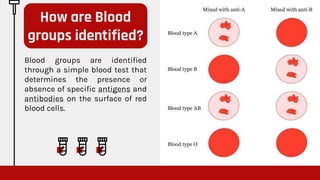
Blood groups are identified
through a simple blood test that
determines the presence or
absence of specific antigens and
antibodies on the surface of red
blood cells.
How are Blood
groups identified?
ABO System
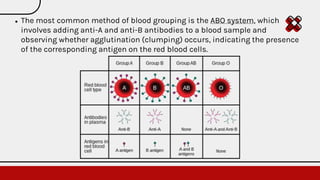
● The most common method of blood grouping is the ABO system, which
involves adding anti-A and anti-B antibodies to a blood sample and
observing whether agglutination (clumping) occurs, indicating the presence
of the corresponding antigen on the red blood cells.
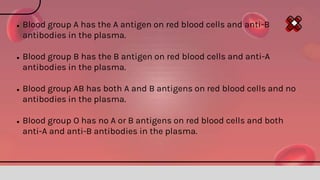
● Blood group A has the A antigen on red blood cells and anti-B
antibodies in the plasma.
● Blood group B has the B antigen on red blood cells and anti-A
antibodies in the plasma.
● Blood group AB has both A and B antigens on red blood cells and no
antibodies in the plasma.
● Blood group O has no A or B antigens on red blood cells and both
anti-A and anti-B antibodies in the plasma.
How to perform a
blood group test?
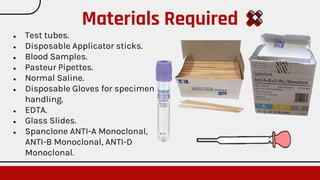
● Test tubes.
● Disposable Applicator sticks.
● Blood Samples.
● Pasteur Pipettes.
● Normal Saline.
● Disposable Gloves for specimen
handling.
● EDTA.
● Glass Slides.
● Spanclone ANTI-A Monoclonal,
ANTI-B Monoclonal, ANTI-D
Monoclonal.
Materials Required
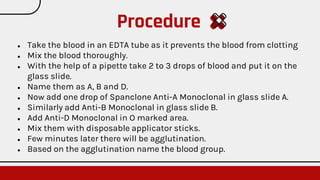
● Take the blood in an EDTA tube as it prevents the blood from clotting
● Mix the blood thoroughly.
● With the help of a pipette take 2 to 3 drops of blood and put it on the
glass slide.
● Name them as A, B and D.
● Now add one drop of Spanclone Anti-A Monoclonal in glass slide A.
● Similarly add Anti-B Monoclonal in glass slide B.
● Add Anti-D Monoclonal in O marked area.
● Mix them with disposable applicator sticks.
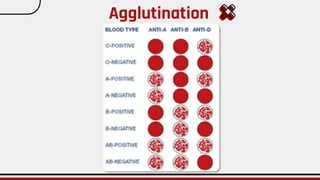
● Few minutes later there will be agglutination.
● Based on the agglutination name the blood group.
Procedure
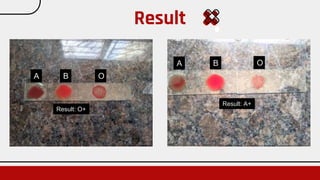
Result
A B O
A B O
Result: O+
Result: A+
Agglutination
THANKYOU!

Blood Grouping.pptx

  • 1.
  • 2.
    Table of contents Objectiveof the Internship ABO System Introduction • What are blood groups? • What is blood grouping? How to perform a blood group test?
  • 3.
    ● The primaryobjective of this Internship is to learn to perform blood grouping tests, and why blood grouping is necessary. ● Witnessing the impact that blood grouping has on patient care and outcomes. ● Determining the blood type of an individual in order to ensure compatibility between the donor and recipient in medical procedures such as blood transfusions and organ transplantation. Objective of the Internship
  • 4.
    Introduction • What areblood groups? • What is blood grouping?
  • 5.
    Blood groups area system used to categorize blood into different groups based on the presence or absence of specific antigens and antibodies on the surface of red blood cells. The four major blood groups are A, B, AB, and O. What are Blood groups?
  • 6.
    ● Blood groupingis a system that categorizes blood into different groups based on the presence or absence of specific antigens and antibodies on the surface of red blood cells. ● Blood grouping is important for transfusion purposes to ensure compatibility between the donor and the recipient. ● In transfusions, the donor's blood must be compatible with the recipient's blood to prevent an immune reaction that can be life- threatening. Blood Grouping
  • 7.
    ● These antigensmay be proteins, carbohydrates, glycoproteins, or glycolipids, depending on the blood group system. ● The ABO blood group system is the most important blood type system (or blood group system) in blood transfusion. ● ABO blood grouping is not the only factor considered in transfusion compatibility, as other antigens on red blood cells such as Rh factor must also be considered. ● Blood grouping is an important tool in modern medicine and has led to improved safety and efficacy in transfusions and other medical procedures.
  • 8.
  • 9.
    Blood groups areidentified through a simple blood test that determines the presence or absence of specific antigens and antibodies on the surface of red blood cells. How are Blood groups identified?
  • 10.
  • 11.
    ● The mostcommon method of blood grouping is the ABO system, which involves adding anti-A and anti-B antibodies to a blood sample and observing whether agglutination (clumping) occurs, indicating the presence of the corresponding antigen on the red blood cells.
  • 12.
    ● Blood groupA has the A antigen on red blood cells and anti-B antibodies in the plasma. ● Blood group B has the B antigen on red blood cells and anti-A antibodies in the plasma. ● Blood group AB has both A and B antigens on red blood cells and no antibodies in the plasma. ● Blood group O has no A or B antigens on red blood cells and both anti-A and anti-B antibodies in the plasma.
  • 13.
    How to performa blood group test?
  • 14.
    ● Test tubes. ●Disposable Applicator sticks. ● Blood Samples. ● Pasteur Pipettes. ● Normal Saline. ● Disposable Gloves for specimen handling. ● EDTA. ● Glass Slides. ● Spanclone ANTI-A Monoclonal, ANTI-B Monoclonal, ANTI-D Monoclonal. Materials Required
  • 15.
    ● Take theblood in an EDTA tube as it prevents the blood from clotting ● Mix the blood thoroughly. ● With the help of a pipette take 2 to 3 drops of blood and put it on the glass slide. ● Name them as A, B and D. ● Now add one drop of Spanclone Anti-A Monoclonal in glass slide A. ● Similarly add Anti-B Monoclonal in glass slide B. ● Add Anti-D Monoclonal in O marked area. ● Mix them with disposable applicator sticks. ● Few minutes later there will be agglutination. ● Based on the agglutination name the blood group. Procedure
  • 16.
    Result A B O AB O Result: O+ Result: A+
  • 17.
  • 18.