C O' Brien Chanel College
Learning Targets
What are the factors of production?


Primary, Secondary and Tertiary sectors


Changes and Trends in these sectors

               C O' Brien Chanel College
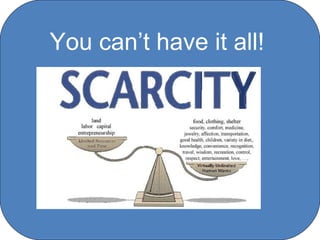
You can’t have it all!


        C O' Brien Chanel College
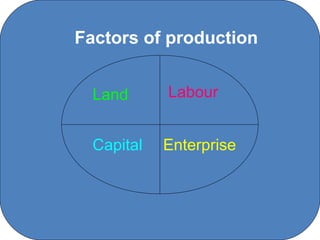
Factors of production


  Land                   Labour


  Capital             Enterprise


         C O' Brien Chanel College
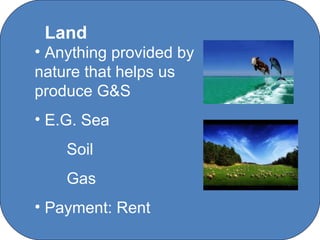
Land
• Anything provided by
nature that helps us
produce G&S
• E.G. Sea
    Soil
    Gas
• Payment: Rent
             C O' Brien Chanel College
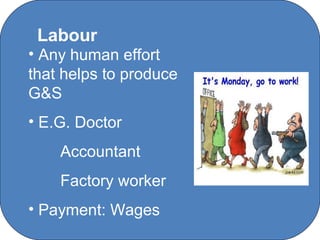
Labour
• Any human effort
that helps to produce
G&S
• E.G. Doctor
    Accountant
    Factory worker
• Payment: Wages
                C O' Brien Chanel College
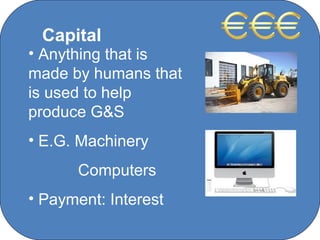
Capital
• Anything that is
made by humans that
is used to help
produce G&S
• E.G. Machinery
      Computers
• Payment: Interest
              C O' Brien Chanel College
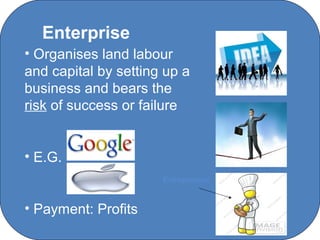
Enterprise
• Organises land labour
and capital by setting up a
business and bears the
risk of success or failure


• E.G.
                              Entrepreneur


• Payment: Profits
                 C O' Brien Chanel College
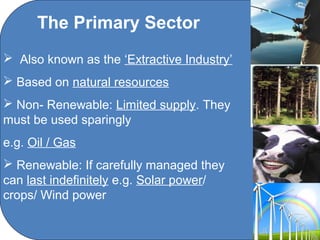
The Primary Sector
 Also known as the ‘Extractive Industry’
 Based on natural resources
 Non- Renewable: Limited supply. They
must be used sparingly
e.g. Oil / Gas
 Renewable: If carefully managed they
can last indefinitely e.g. Solar power/
crops/ Wind power

                       C O' Brien Chanel College
Agriculture
Facts:
 It accounts for 7.7% employment in Ireland


 It makes up 10.5% of Ireland’s total
exports


 80% of agriculture produce is exported


                C O' Brien Chanel College
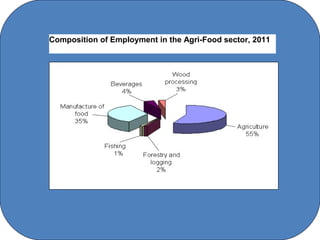
Composition of Employment in the Agri-Food sector, 2011


                    C O' Brien Chanel College
Problems:
 Decline in EU Grants/payments:
Instead of receiving many different grants and
payments farmers just receive one single farm
payment regardless of how much output is
produced in a year
 Consumer confidence:
Has declined in recent years due to excessive
use of pesticides/ development of diseases e.g.
Mad cow disease. We need to protect ‘Green’
image.
                   C O' Brien Chanel College
 Weather:
The IFA estimated that the bad weather
this year cost farmers about €160m in
extra animal farm feed and lost output.
 Competition:
Small farmers find it difficult to remain
competitive and need to cease
opportunities of taking over new farms or
diversifying their product range.

              C O' Brien Chanel College
Trends:
 Beef & milk are increasing in price as demand
is increasing due global population growth
 Continued growth in organic food production.
Positive effect on Ireland’s ‘Green’ image
 Food product traceability is necessary to
reassure customers of quality


                    C O' Brien Chanel College
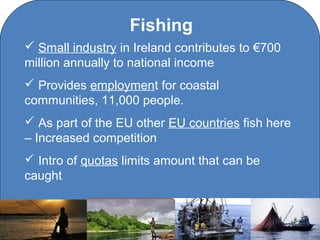
Fishing
 Small industry in Ireland contributes to €700
million annually to national income
 Provides employment for coastal
communities, 11,000 people.
 As part of the EU other EU countries fish here
– Increased competition
 Intro of quotas limits amount that can be
caught


                   C O' Brien Chanel College
Problems/ Trends:
 Restrictions: EU has imposed fishing
quotas on the size of fish catches which
restricts development in the industry


 Size of boats: Most of the fishing fleet in
Ireland is comprised of small boats. They are
not equipped to travel long distances to find
big catches
 Overfishing: Stocks of some fish species
is very low
                C O' Brien Chanel College
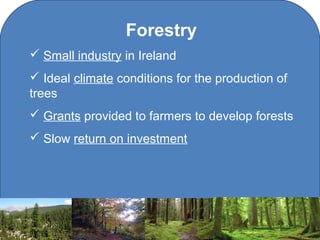
Forestry
 Small industry in Ireland
 Ideal climate conditions for the production of
trees
 Grants provided to farmers to develop forests
 Slow return on investment


                   C O' Brien Chanel College
Problems/ Trends

 Slow return on investment

 Grants available to farmers to plant forests

Coillte, state company own and run most of
the forests in Ireland


                  C O' Brien Chanel College
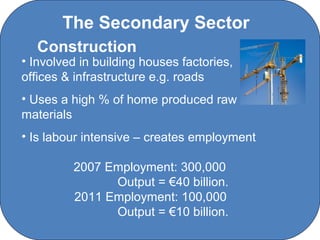
The Secondary Sector
  Construction
• Involved in building houses factories,
offices & infrastructure e.g. roads
• Uses a high % of home produced raw
materials
• Is labour intensive – creates employment

         2007 Employment: 300,000
               Output = €40 billion.
         2011 Employment: 100,000
               Output = €10 billion.
                     C O' Brien Chanel College
Problems/ Trends:


• Economic fluctuations: Low economic activity
resulting in decrease in demand for construction
industry – decrease in employment
• Regulations: New laws have been introduced
which places increased responsibility on the
construction industry with regards to their builds


                      C O' Brien Chanel College
C O' Brien Chanel College
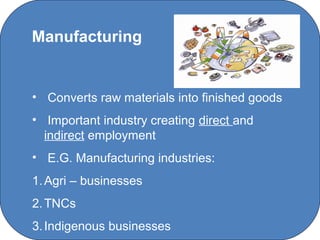
Manufacturing


• Converts raw materials into finished goods
• Important industry creating direct and
  indirect employment
• E.G. Manufacturing industries:
1. Agri – businesses
2. TNCs
3. Indigenous businesses College
                  C O' Brien Chanel
Problems/ Trends:

• Employment: Decreasing significantly in
this industry. Cheaper labour abroad.
• Knowledge economy: Increased focus on
marketing Ireland as a knowledge based
highly technical workforce to encourage
foreign investment
• New Technology: Move towards ICT and
robotics for production


                C O' Brien Chanel College
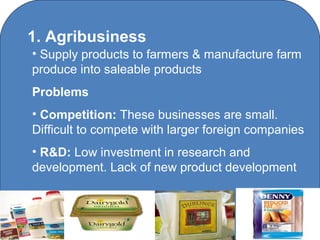
1. Agribusiness
• Supply products to farmers & manufacture farm
produce into saleable products
Problems
• Competition: These businesses are small.
Difficult to compete with larger foreign companies
• R&D: Low investment in research and
development. Lack of new product development


                  C O' Brien Chanel College
Trends:
•.Mergers: Agribusinesses have merged
which allows them to compete more
effectively. e.g. Glanbia


                C O' Brien Chanel College
TNCs:
• Multinational company
• Head office in one country but operate in a
number of countries (subsidiary)
• Employs over 100,000 in Ireland
• IDA responsible for attracting TNCs to Ireland


                    C O' Brien Chanel College
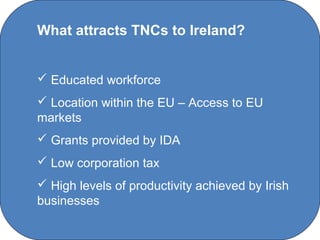
What attracts TNCs to Ireland?


 Educated workforce
 Location within the EU – Access to EU
markets
 Grants provided by IDA
 Low corporation tax
 High levels of productivity achieved by Irish
businesses

                 C O' Brien Chanel College
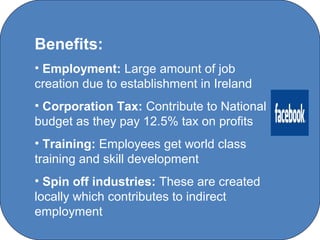
Benefits:
• Employment: Large amount of job
creation due to establishment in Ireland
• Corporation Tax: Contribute to National
budget as they pay 12.5% tax on profits
• Training: Employees get world class
training and skill development
• Spin off industries: These are created
locally which contributes to indirect
employment
                  C O' Brien Chanel College
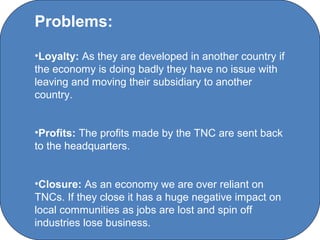
Problems:

•Loyalty: As they are developed in another country if
the economy is doing badly they have no issue with
leaving and moving their subsidiary to another
country.


•Profits: The profits made by the TNC are sent back
to the headquarters.


•Closure: As an economy we are over reliant on
TNCs. If they close it has a huge negative impact on
local communities as jobs are lost and spin off
industries lose business. Chanel College
                      C O' Brien
Indigenous Firms:

•Businesses that are Irish owned and produce G&S
in Ireland

•Enterprise Ireland* government agency that
supports and encourages development of Irish
businesses

•Most indigenous firms are SMEs – Small medium
Enterprises


                    C O' Brien Chanel College
• They provide assistance and capital to firms at
  start up stage

• They provide advice & support to start up
  businesses

• They assist firms with product and process
  development

• Support and encourage firms to export their G&S

                     C O' Brien Chanel College
Benefits:

•Loyalty: Irish firms are loyal, unlikely to relocate
somewhere else.
 E.G.         Group opening new science &
innovation centre in Kildare. This will create 900
jobs.

•Support: Purchase raw materials and supplies
from local businesses

•Profits: Reinvested back into Ireland & contribute
to revenue for the government
                       C O' Brien Chanel College
Problems:

•Export market: Only a small no. of Irish brands are
recognised abroad reducing their selling power in
foreign markets

•Wages: High wages expectations in Ireland result in
some manufacturing firms to locate abroad to avail of
lower costs of production

•R&D: Not enough investment compared to
competitors
                     C O' Brien Chanel College
Trends:
• World class manufacturing: Has developed
in Ireland as valuable training is provided.
• R&D: Investment is growing. Required for
growth and expansion of product range of
business
• Technology: Big emphasis on technological
based industries in the future


                 C O' Brien Chanel College
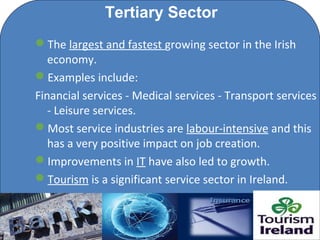
Tertiary Sector
The largest and fastest growing sector in the Irish
   economy.
Examples include:
Financial services - Medical services - Transport services
   - Leisure services.
Most service industries are labour-intensive and this
   has a very positive impact on job creation.
Improvements in IT have also led to growth.
Tourism is a significant service sector in Ireland.

                    C O' Brien Chanel College
Trends:

• ICT: Increase in investment in broadband and
social media

• Telecentres: Opened to deal with after sales
services

• Childcare: Increase in childcare services in line
with population growth


                      C O' Brien Chanel College
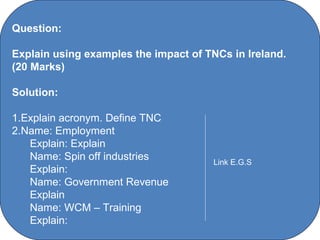
Question:

Explain using examples the impact of TNCs in Ireland.
(20 Marks)

Solution:

1.Explain acronym. Define TNC
2.Name: Employment
   Explain: Explain
   Name: Spin off industries                       Link E.G.S
   Explain:
   Name: Government Revenue
   Explain
   Name: WCM – Training
   Explain:
                       C O' Brien Chanel College

Categories of industry

  • 1.
    C O' BrienChanel College
  • 2.
    Learning Targets What arethe factors of production? Primary, Secondary and Tertiary sectors Changes and Trends in these sectors C O' Brien Chanel College
  • 3.
    You can’t haveit all! C O' Brien Chanel College
  • 4.
    Factors of production Land Labour Capital Enterprise C O' Brien Chanel College
  • 5.
    Land • Anything providedby nature that helps us produce G&S • E.G. Sea Soil Gas • Payment: Rent C O' Brien Chanel College
  • 6.
    Labour • Any humaneffort that helps to produce G&S • E.G. Doctor Accountant Factory worker • Payment: Wages C O' Brien Chanel College
  • 7.
    Capital • Anything thatis made by humans that is used to help produce G&S • E.G. Machinery Computers • Payment: Interest C O' Brien Chanel College
  • 8.
    Enterprise • Organises landlabour and capital by setting up a business and bears the risk of success or failure • E.G. Entrepreneur • Payment: Profits C O' Brien Chanel College
  • 9.
    The Primary Sector Also known as the ‘Extractive Industry’  Based on natural resources  Non- Renewable: Limited supply. They must be used sparingly e.g. Oil / Gas  Renewable: If carefully managed they can last indefinitely e.g. Solar power/ crops/ Wind power C O' Brien Chanel College
  • 10.
    Agriculture Facts:  It accountsfor 7.7% employment in Ireland  It makes up 10.5% of Ireland’s total exports  80% of agriculture produce is exported C O' Brien Chanel College
  • 11.
    Composition of Employmentin the Agri-Food sector, 2011 C O' Brien Chanel College
  • 12.
    Problems:  Decline inEU Grants/payments: Instead of receiving many different grants and payments farmers just receive one single farm payment regardless of how much output is produced in a year  Consumer confidence: Has declined in recent years due to excessive use of pesticides/ development of diseases e.g. Mad cow disease. We need to protect ‘Green’ image. C O' Brien Chanel College
  • 13.
     Weather: The IFAestimated that the bad weather this year cost farmers about €160m in extra animal farm feed and lost output.  Competition: Small farmers find it difficult to remain competitive and need to cease opportunities of taking over new farms or diversifying their product range. C O' Brien Chanel College
  • 14.
    Trends:  Beef &milk are increasing in price as demand is increasing due global population growth  Continued growth in organic food production. Positive effect on Ireland’s ‘Green’ image  Food product traceability is necessary to reassure customers of quality C O' Brien Chanel College
  • 15.
    Fishing  Small industryin Ireland contributes to €700 million annually to national income  Provides employment for coastal communities, 11,000 people.  As part of the EU other EU countries fish here – Increased competition  Intro of quotas limits amount that can be caught C O' Brien Chanel College
  • 16.
    Problems/ Trends:  Restrictions:EU has imposed fishing quotas on the size of fish catches which restricts development in the industry  Size of boats: Most of the fishing fleet in Ireland is comprised of small boats. They are not equipped to travel long distances to find big catches  Overfishing: Stocks of some fish species is very low C O' Brien Chanel College
  • 17.
    Forestry  Small industryin Ireland  Ideal climate conditions for the production of trees  Grants provided to farmers to develop forests  Slow return on investment C O' Brien Chanel College
  • 18.
    Problems/ Trends  Slowreturn on investment  Grants available to farmers to plant forests Coillte, state company own and run most of the forests in Ireland C O' Brien Chanel College
  • 19.
    The Secondary Sector Construction • Involved in building houses factories, offices & infrastructure e.g. roads • Uses a high % of home produced raw materials • Is labour intensive – creates employment 2007 Employment: 300,000 Output = €40 billion. 2011 Employment: 100,000 Output = €10 billion. C O' Brien Chanel College
  • 20.
    Problems/ Trends: • Economicfluctuations: Low economic activity resulting in decrease in demand for construction industry – decrease in employment • Regulations: New laws have been introduced which places increased responsibility on the construction industry with regards to their builds C O' Brien Chanel College
  • 21.
    C O' BrienChanel College
  • 22.
    Manufacturing • Converts rawmaterials into finished goods • Important industry creating direct and indirect employment • E.G. Manufacturing industries: 1. Agri – businesses 2. TNCs 3. Indigenous businesses College C O' Brien Chanel
  • 23.
    Problems/ Trends: • Employment:Decreasing significantly in this industry. Cheaper labour abroad. • Knowledge economy: Increased focus on marketing Ireland as a knowledge based highly technical workforce to encourage foreign investment • New Technology: Move towards ICT and robotics for production C O' Brien Chanel College
  • 24.
    1. Agribusiness • Supplyproducts to farmers & manufacture farm produce into saleable products Problems • Competition: These businesses are small. Difficult to compete with larger foreign companies • R&D: Low investment in research and development. Lack of new product development C O' Brien Chanel College
  • 25.
    Trends: •.Mergers: Agribusinesses havemerged which allows them to compete more effectively. e.g. Glanbia C O' Brien Chanel College
  • 26.
    TNCs: • Multinational company •Head office in one country but operate in a number of countries (subsidiary) • Employs over 100,000 in Ireland • IDA responsible for attracting TNCs to Ireland C O' Brien Chanel College
  • 27.
    What attracts TNCsto Ireland?  Educated workforce  Location within the EU – Access to EU markets  Grants provided by IDA  Low corporation tax  High levels of productivity achieved by Irish businesses C O' Brien Chanel College
  • 28.
    Benefits: • Employment: Largeamount of job creation due to establishment in Ireland • Corporation Tax: Contribute to National budget as they pay 12.5% tax on profits • Training: Employees get world class training and skill development • Spin off industries: These are created locally which contributes to indirect employment C O' Brien Chanel College
  • 29.
    Problems: •Loyalty: As theyare developed in another country if the economy is doing badly they have no issue with leaving and moving their subsidiary to another country. •Profits: The profits made by the TNC are sent back to the headquarters. •Closure: As an economy we are over reliant on TNCs. If they close it has a huge negative impact on local communities as jobs are lost and spin off industries lose business. Chanel College C O' Brien
  • 30.
    Indigenous Firms: •Businesses thatare Irish owned and produce G&S in Ireland •Enterprise Ireland* government agency that supports and encourages development of Irish businesses •Most indigenous firms are SMEs – Small medium Enterprises C O' Brien Chanel College
  • 31.
    • They provideassistance and capital to firms at start up stage • They provide advice & support to start up businesses • They assist firms with product and process development • Support and encourage firms to export their G&S C O' Brien Chanel College
  • 32.
    Benefits: •Loyalty: Irish firmsare loyal, unlikely to relocate somewhere else. E.G. Group opening new science & innovation centre in Kildare. This will create 900 jobs. •Support: Purchase raw materials and supplies from local businesses •Profits: Reinvested back into Ireland & contribute to revenue for the government C O' Brien Chanel College
  • 33.
    Problems: •Export market: Onlya small no. of Irish brands are recognised abroad reducing their selling power in foreign markets •Wages: High wages expectations in Ireland result in some manufacturing firms to locate abroad to avail of lower costs of production •R&D: Not enough investment compared to competitors C O' Brien Chanel College
  • 34.
    Trends: • World classmanufacturing: Has developed in Ireland as valuable training is provided. • R&D: Investment is growing. Required for growth and expansion of product range of business • Technology: Big emphasis on technological based industries in the future C O' Brien Chanel College
  • 35.
    Tertiary Sector The largestand fastest growing sector in the Irish economy. Examples include: Financial services - Medical services - Transport services - Leisure services. Most service industries are labour-intensive and this has a very positive impact on job creation. Improvements in IT have also led to growth. Tourism is a significant service sector in Ireland. C O' Brien Chanel College
  • 36.
    Trends: • ICT: Increasein investment in broadband and social media • Telecentres: Opened to deal with after sales services • Childcare: Increase in childcare services in line with population growth C O' Brien Chanel College
  • 37.
    Question: Explain using examplesthe impact of TNCs in Ireland. (20 Marks) Solution: 1.Explain acronym. Define TNC 2.Name: Employment Explain: Explain Name: Spin off industries Link E.G.S Explain: Name: Government Revenue Explain Name: WCM – Training Explain: C O' Brien Chanel College