ASTIGMATISM
Case history
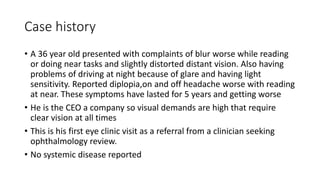
• A 36 year old presented with complaints of blur worse while reading
or doing near tasks and slightly distorted distant vision. Also having
problems of driving at night because of glare and having light
sensitivity. Reported diplopia,on and off headache worse with reading
at near. These symptoms have lasted for 5 years and getting worse
• He is the CEO a company so visual demands are high that require
clear vision at all times
• This is his first eye clinic visit as a referral from a clinician seeking
ophthalmology review.
• No systemic disease reported
Clinical findings
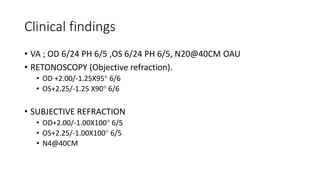
• VA ; OD 6/24 PH 6/5 ,OS 6/24 PH 6/5, N20@40CM OAU
• RETONOSCOPY (Objective refraction).
• OD +2.00/-1.25X95 6/6
• OS+2.25/-1.25 X90 6/6
• SUBJECTIVE REFRACTION
• OD+2.00/-1.00X100 6/5
• OS+2.25/-1.00X100 6/5
• N4@40CM
DIAGNOSIS AND DDX
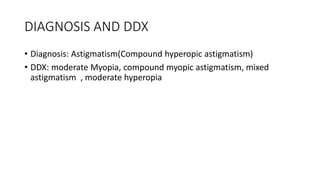
• Diagnosis: Astigmatism(Compound hyperopic astigmatism)
• DDX: moderate Myopia, compound myopic astigmatism, mixed
astigmatism , moderate hyperopia
Management
• Spectacle with spherocylindrical lens power for clear and comfortable
vision
Discussion
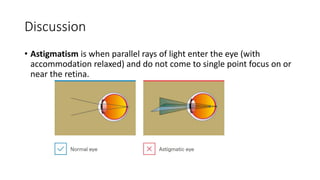
• Astigmatism is when parallel rays of light enter the eye (with
accommodation relaxed) and do not come to single point focus on or
near the retina.
Optics of Astigmatism
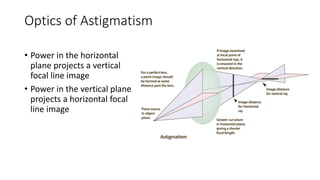
• Power in the horizontal
plane projects a vertical
focal line image
• Power in the vertical plane
projects a horizontal focal
line image
Prevalence
• Age
• Infants are born with ATR astigmatism, where the cornea is the source of
astigmatism
• Preschool children have little or no astigmatism
• Teenage children demonstrate a shift towards WTR astigmatism
• Older adults demonstrate a shift towards ATR astigmatism
Prevalence cont’
• Gender
• In general ,there are no significant differences between males and female
• Ethnicity
• Higher prevalence in north Americans , Latinos.
• Asian infants tend to be WTR astigmatism
• Caucasian infants tend to ATR astigmatism
Incidence
• General trend
• For older adults , the rate of change towards ATR astigmatism is less
than or equal to 0.25D every 10 years
Visual acuity
• Clinically , if astigmatism is small( less than 0.5DC) the patient may
not notice blur
• Simple or compound myopic astigmatism.
Accommodation may make the retinal image even more blurry
• Simple or compound hyperopic
Accommodation may improve VA to some extent
• Mixed astigmatism
VA is relatively good
May not need much accommodation
Etiology
• Its due to a distortion of the cornea
and/ or crystalline lens
• Cornea
• The cornea has unequal(irregular)
curvature on its anterior surface.
• Lens
• The crystalline lens has
unequal(irregular) curvature on its
surface or in its layers . Subluxation
and malposition of the lens.
• The refracting power is not uniform
in all the meridians of both lens or
cornea.
• The principal meridians are the
meridians of greatest and least
refracting power.
• The amount of astigmatism is
equal to the difference in refracting
power of the two principal
meridian.
Classification of astigmatism
• Based on etiology
• Based on relationship between principal meridian
• Based on orientation of meridian axis
• Based on focal point relative to the retina
• Based on relative locations of the principal meridians or axes when
comparing the two eyes
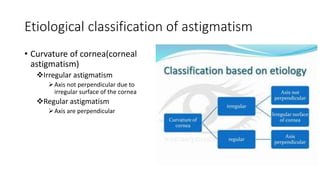
Etiological classification of astigmatism
• Curvature of cornea(corneal
astigmatism)
Irregular astigmatism
Axis not perpendicular due to
irregular surface of the cornea
Regular astigmatism
Axis are perpendicular
Etiological classification cont’
• Lenticular astigmatism
Irregular crystalline lens
curvatures eg in lenticonus
Subluxation or malposition of lens
• Retinal astigmatism .
Very rare
Due to oblique placement of
macula
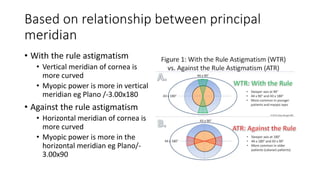
Based on relationship between principal
meridian
• With the rule astigmatism
• Vertical meridian of cornea is
more curved
• Myopic power is more in vertical
meridian eg Plano /-3.00x180
• Against the rule astigmatism
• Horizontal meridian of cornea is
more curved
• Myopic power is more in the
horizontal meridian eg Plano/-
3.00x90
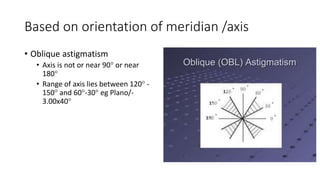
Based on orientation of meridian /axis
• Oblique astigmatism
• Axis is not or near 90 or near
180
• Range of axis lies between 120 -
150 and 60-30 eg Plano/-
3.00x40
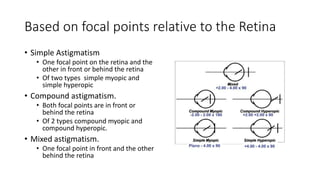
Based on focal points relative to the Retina
• Simple Astigmatism
• One focal point on the retina and the
other in front or behind the retina
• Of two types simple myopic and
simple hyperopic
• Compound astigmatism.
• Both focal points are in front or
behind the retina
• Of 2 types compound myopic and
compound hyperopic.
• Mixed astigmatism.
• One focal point in front and the other
behind the retina
Based on the relative location of the principal
meridian or axes when comparing the meridians
or axes when comparing 2 eyes
• Symmetrical Astigmatism
• Example
• OD: pl/-1.00x180
• OS: pl/-1.00x05
• Asymmetrical astigmatism.
• Example
• OD: pl/-1.00x180
• OS: pl/-1.00x90
Signs and symptoms
• Distorted vision at distance and near
• Letter confusion
• Asthenopia
• Headaches
• squinting
Clinical test for astigmatism
• VA test at Distance and Near
• Autorefraction
• Keratometry
• Retinoscopy
• Monocular subjective refraction
• Jackson cross cylinder refraction
 refining astigmatism.
JCC
Astigmatic fan
Clock dial
Stenopic slit
Management of astigmatism
• Spectacles
Cylindrical lenses and spherocylindrical lenses in spectacles
• Contact lenses
Toric soft contact lenses
Rigid gas permeable (RGP)contact lenses.
• Refractive surgery
• Photorefractive keratotomy (PRK)
• Laser in –situ keratomileus(LASIK)

MUGABI ON ASTIGMATISM.pptx

  • 1.
  • 2.
    Case history • A36 year old presented with complaints of blur worse while reading or doing near tasks and slightly distorted distant vision. Also having problems of driving at night because of glare and having light sensitivity. Reported diplopia,on and off headache worse with reading at near. These symptoms have lasted for 5 years and getting worse • He is the CEO a company so visual demands are high that require clear vision at all times • This is his first eye clinic visit as a referral from a clinician seeking ophthalmology review. • No systemic disease reported
  • 3.
    Clinical findings • VA; OD 6/24 PH 6/5 ,OS 6/24 PH 6/5, N20@40CM OAU • RETONOSCOPY (Objective refraction). • OD +2.00/-1.25X95 6/6 • OS+2.25/-1.25 X90 6/6 • SUBJECTIVE REFRACTION • OD+2.00/-1.00X100 6/5 • OS+2.25/-1.00X100 6/5 • N4@40CM
  • 4.
    DIAGNOSIS AND DDX •Diagnosis: Astigmatism(Compound hyperopic astigmatism) • DDX: moderate Myopia, compound myopic astigmatism, mixed astigmatism , moderate hyperopia
  • 5.
    Management • Spectacle withspherocylindrical lens power for clear and comfortable vision
  • 6.
    Discussion • Astigmatism iswhen parallel rays of light enter the eye (with accommodation relaxed) and do not come to single point focus on or near the retina.
  • 7.
    Optics of Astigmatism •Power in the horizontal plane projects a vertical focal line image • Power in the vertical plane projects a horizontal focal line image
  • 8.
    Prevalence • Age • Infantsare born with ATR astigmatism, where the cornea is the source of astigmatism • Preschool children have little or no astigmatism • Teenage children demonstrate a shift towards WTR astigmatism • Older adults demonstrate a shift towards ATR astigmatism
  • 9.
    Prevalence cont’ • Gender •In general ,there are no significant differences between males and female • Ethnicity • Higher prevalence in north Americans , Latinos. • Asian infants tend to be WTR astigmatism • Caucasian infants tend to ATR astigmatism
  • 10.
    Incidence • General trend •For older adults , the rate of change towards ATR astigmatism is less than or equal to 0.25D every 10 years
  • 11.
    Visual acuity • Clinically, if astigmatism is small( less than 0.5DC) the patient may not notice blur • Simple or compound myopic astigmatism. Accommodation may make the retinal image even more blurry • Simple or compound hyperopic Accommodation may improve VA to some extent • Mixed astigmatism VA is relatively good May not need much accommodation
  • 12.
    Etiology • Its dueto a distortion of the cornea and/ or crystalline lens • Cornea • The cornea has unequal(irregular) curvature on its anterior surface. • Lens • The crystalline lens has unequal(irregular) curvature on its surface or in its layers . Subluxation and malposition of the lens. • The refracting power is not uniform in all the meridians of both lens or cornea. • The principal meridians are the meridians of greatest and least refracting power. • The amount of astigmatism is equal to the difference in refracting power of the two principal meridian.
  • 13.
    Classification of astigmatism •Based on etiology • Based on relationship between principal meridian • Based on orientation of meridian axis • Based on focal point relative to the retina • Based on relative locations of the principal meridians or axes when comparing the two eyes
  • 14.
    Etiological classification ofastigmatism • Curvature of cornea(corneal astigmatism) Irregular astigmatism Axis not perpendicular due to irregular surface of the cornea Regular astigmatism Axis are perpendicular
  • 15.
    Etiological classification cont’ •Lenticular astigmatism Irregular crystalline lens curvatures eg in lenticonus Subluxation or malposition of lens • Retinal astigmatism . Very rare Due to oblique placement of macula
  • 16.
    Based on relationshipbetween principal meridian • With the rule astigmatism • Vertical meridian of cornea is more curved • Myopic power is more in vertical meridian eg Plano /-3.00x180 • Against the rule astigmatism • Horizontal meridian of cornea is more curved • Myopic power is more in the horizontal meridian eg Plano/- 3.00x90
  • 17.
    Based on orientationof meridian /axis • Oblique astigmatism • Axis is not or near 90 or near 180 • Range of axis lies between 120 - 150 and 60-30 eg Plano/- 3.00x40
  • 18.
    Based on focalpoints relative to the Retina • Simple Astigmatism • One focal point on the retina and the other in front or behind the retina • Of two types simple myopic and simple hyperopic • Compound astigmatism. • Both focal points are in front or behind the retina • Of 2 types compound myopic and compound hyperopic. • Mixed astigmatism. • One focal point in front and the other behind the retina
  • 19.
    Based on therelative location of the principal meridian or axes when comparing the meridians or axes when comparing 2 eyes • Symmetrical Astigmatism • Example • OD: pl/-1.00x180 • OS: pl/-1.00x05 • Asymmetrical astigmatism. • Example • OD: pl/-1.00x180 • OS: pl/-1.00x90
  • 20.
    Signs and symptoms •Distorted vision at distance and near • Letter confusion • Asthenopia • Headaches • squinting
  • 21.
    Clinical test forastigmatism • VA test at Distance and Near • Autorefraction • Keratometry • Retinoscopy • Monocular subjective refraction • Jackson cross cylinder refraction  refining astigmatism. JCC Astigmatic fan Clock dial Stenopic slit
  • 22.
    Management of astigmatism •Spectacles Cylindrical lenses and spherocylindrical lenses in spectacles • Contact lenses Toric soft contact lenses Rigid gas permeable (RGP)contact lenses. • Refractive surgery • Photorefractive keratotomy (PRK) • Laser in –situ keratomileus(LASIK)