HUMAN RESOURCE
MANAGEMENT
PRESENTED BY
K.BALASRI PRASAD
B.Sc(KU), M.B.A(OU), NET(UGC)
ASSOCIATE PROFESSOR IN MANAGEMENT
Introduction
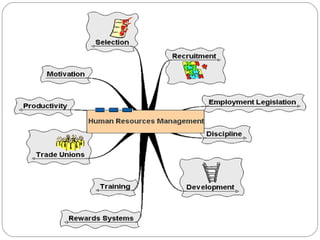
Human Resource Management is the
organizational function that deals with issues
related to people such as compensation, hiring,
performance management, organization
development, safety, wellness, benefits, employee
motivation, communication, administration, and
training.
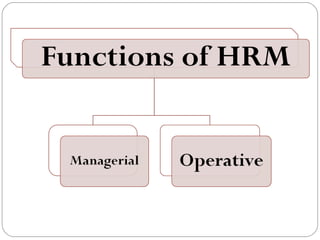
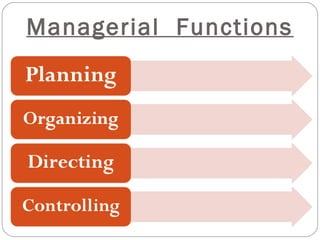
Managerial Functions
Planning
Planning is necessary to give the organization its
goals and directions to establish best procedure to
reach the goals.
Planning staff levels requires that an assessment
of present and future needs of the organization be
compared with present resources and future
predicted resources. Appropriate steps then be
planned to bring demand and supply into balance.
Organizing
After objectives have been established and plans been
developed then HR manager must design and develop
organisation structure to carry out various operations. Such
as-
Grouping of personnel activities
Assignment of different groups of activities to different
individuals
Delegation according to task assigned
Co-ordination of activities of different individuals.
Directing
The directing function of the HR manager involves
encouraging people to work willingly and effectively for
the goals of the organization.
The efforts of all the employees have to directed
towards achieving Organizational goals.
Controlling
Controlling helps to evaluate and control the
performance of the department in terms of various
operative functions.
 The errors and mistakes of the employees have to be
resolved by providing appropriate solution. The same
mistake should not be repeated next time in the
Organization.
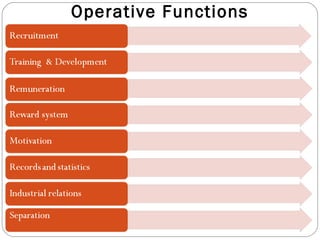
Operative Functions
Recruitment
The process by which a job vacancy is identified and
potential employees are notified.
The nature of the recruitment process is regulated and
subject to employment law.
Main forms of recruitment through advertising in
newspapers, magazines, trade papers and internal
vacancy lists.
Training and Development
Provides new skills for the employee
Keeps the employee up to date with changes in
the field.
Aims to improve efficiency.
Remuneration
Concern with determination and equitable
remuneration of employees in the organisation to the
goals.
Reward system
The system of pay and benefits used by the firm to
reward workers
Money not the only method
Fringe benefits
Flexibility at work
Holidays, etc.
Motivation
To retain good staff and to encourage them to give of
their best while at work requires attention to the
financial and psychological and even physiological
rewards offered by the organization as a continuous
exercise.
Records and statistics
Keeps employee training records
Achievement records
Transfer and promotion records
Absenteeism and labour turnover records
Industrial relations
Separation
Ensure the release of retirement benefits
Requirements of the employee like Experience
certificate, Appreciation letter etc.
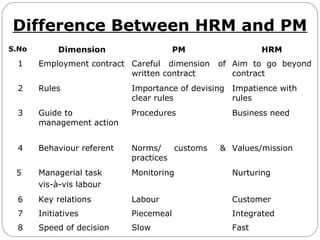
Difference Between HRM and PM
S.No Dimension PM HRM
1 Employment contract Careful dimension of
written contract
Aim to go beyond
contract
2 Rules Importance of devising
clear rules
Impatience with
rules
3 Guide to
management action
Procedures Business need
4 Behaviour referent Norms/ customs &
practices
Values/mission
5 Managerial task
vis-à-vis labour
Monitoring Nurturing
6 Key relations Labour Customer
7 Initiatives Piecemeal Integrated
8 Speed of decision Slow Fast
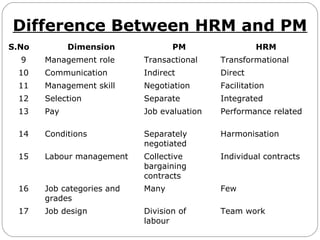
Difference Between HRM and PM
S.No Dimension PM HRM
9 Management role Transactional Transformational
10 Communication Indirect Direct
11 Management skill Negotiation Facilitation
12 Selection Separate Integrated
13 Pay Job evaluation Performance related
14 Conditions Separately
negotiated
Harmonisation
15 Labour management Collective
bargaining
contracts
Individual contracts
16 Job categories and
grades
Many Few
17 Job design Division of
labour
Team work
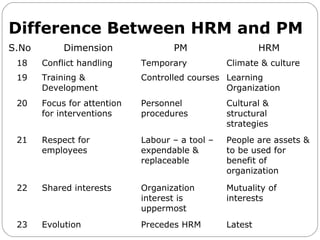
Difference Between HRM and PM
S.No Dimension PM HRM
18 Conflict handling Temporary Climate & culture
19 Training &
Development
Controlled courses Learning
Organization
20 Focus for attention
for interventions
Personnel
procedures
Cultural &
structural
strategies
21 Respect for
employees
Labour – a tool –
expendable &
replaceable
People are assets &
to be used for
benefit of
organization
22 Shared interests Organization
interest is
uppermost
Mutuality of
interests
23 Evolution Precedes HRM Latest
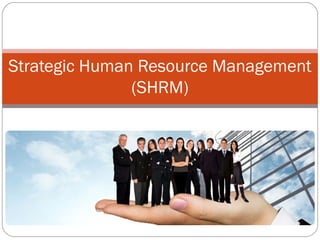
Strategic Human Resource Management
(SHRM)
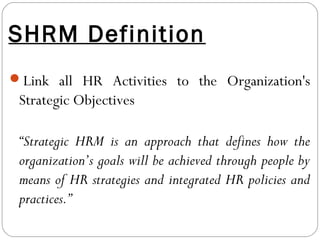
SHRM Definition
Link all HR Activities to the Organization's
Strategic Objectives
“Strategic HRM is an approach that defines how the
organization’s goals will be achieved through people by
means of HR strategies and integrated HR policies and
practices.”
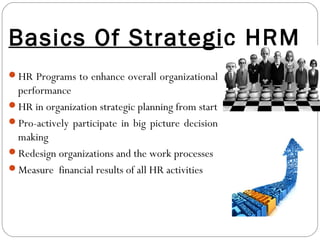
Basics Of Strategic HRM
HR Programs to enhance overall organizational
performance
HR in organization strategic planning from start
Pro-actively participate in big picture decision
making
Redesign organizations and the work processes
Measure financial results of all HR activities
Roles of the HR Manager
Four key roles for HR managers:
(1)Strategic Partner
(2)Administrative Expert
(3)Employee Advocate
(4)Change Agent
(1)Strategic Partner
Ability to translate business strategy into action
HRM part of the business team
Know the business: The Bottom-Line
 Add value
Measure performance
Provide Professional advise
Make the line managers job easier
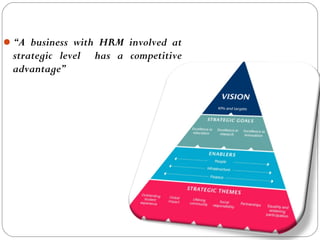
“A business with HRM involved at
strategic level has a competitive
advantage”
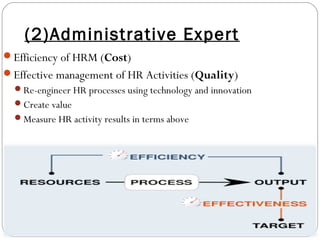
(2)Administrative Expert
Efficiency of HRM (Cost)
Effective management of HR Activities (Quality)
Re-engineer HR processes using technology and innovation
Create value
Measure HR activity results in terms above
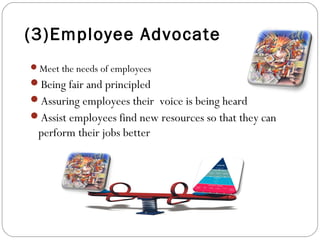
(3)Employee Advocate
Meet the needs of employees
Being fair and principled
Assuring employees their voice is being heard
Assist employees find new resources so that they can
perform their jobs better
(4)Change agent
Agent for change & cultural transformation - Catalyst for
change
Leading Change (Including in HR)
Problem Solving
Communication
Influencing and convincing skills
Cultural Transformation
Culture of excellence
Excellent leadership, planning, processes, people, customer satisfaction,
measurement and analysis
Other inter-related roles
Legal Expert
HR functional expert
Talent manager
Organization ambassador
Board & senior executive resource
Role of Globalization in HR Policy and Practice
The Globalization is defined as the process of moving resources
like Technology, People, Finance, Products, Services etc.,
beyond national scale to other countries or to other markets
around the globe.
The HR policies and practices in the globalized world need to
have a cohesive and coherent strategy.
Ethnocentric staffing involves using parent country nationals
to staff higher level foreign positions.
Polycentric staffing uses host-country nationals throughout
the organization.
Geocentric staffing focuses on best among the host-country
nationals, parent country nationals and third country nationals to
fit into the position.
Manpower hiring has transformed into Polycentric in
nature to exploit the markets as they believe local talent
have the better understanding of local market
requirements.
It is very important for HR manager to understand the
Political and Legal frame to start a business operation in
any country as it will help to draft the policies in
accordance with the rules and regulations.
Issues arising about Remuneration at local talent differ
from parent country where it is headquartered.
Human Resources Management notes-Unitt-I-BBA-III-SEM-Osmania University

Human Resources Management notes-Unitt-I-BBA-III-SEM-Osmania University

  • 1.
    HUMAN RESOURCE MANAGEMENT PRESENTED BY K.BALASRIPRASAD B.Sc(KU), M.B.A(OU), NET(UGC) ASSOCIATE PROFESSOR IN MANAGEMENT
  • 2.
    Introduction Human Resource Managementis the organizational function that deals with issues related to people such as compensation, hiring, performance management, organization development, safety, wellness, benefits, employee motivation, communication, administration, and training.
  • 5.
  • 6.
    Planning Planning is necessaryto give the organization its goals and directions to establish best procedure to reach the goals. Planning staff levels requires that an assessment of present and future needs of the organization be compared with present resources and future predicted resources. Appropriate steps then be planned to bring demand and supply into balance.
  • 7.
    Organizing After objectives havebeen established and plans been developed then HR manager must design and develop organisation structure to carry out various operations. Such as- Grouping of personnel activities Assignment of different groups of activities to different individuals Delegation according to task assigned Co-ordination of activities of different individuals.
  • 8.
    Directing The directing functionof the HR manager involves encouraging people to work willingly and effectively for the goals of the organization. The efforts of all the employees have to directed towards achieving Organizational goals.
  • 9.
    Controlling Controlling helps toevaluate and control the performance of the department in terms of various operative functions.  The errors and mistakes of the employees have to be resolved by providing appropriate solution. The same mistake should not be repeated next time in the Organization.
  • 10.
  • 11.
    Recruitment The process bywhich a job vacancy is identified and potential employees are notified. The nature of the recruitment process is regulated and subject to employment law. Main forms of recruitment through advertising in newspapers, magazines, trade papers and internal vacancy lists.
  • 12.
    Training and Development Providesnew skills for the employee Keeps the employee up to date with changes in the field. Aims to improve efficiency.
  • 13.
    Remuneration Concern with determinationand equitable remuneration of employees in the organisation to the goals.
  • 14.
    Reward system The systemof pay and benefits used by the firm to reward workers Money not the only method Fringe benefits Flexibility at work Holidays, etc.
  • 15.
    Motivation To retain goodstaff and to encourage them to give of their best while at work requires attention to the financial and psychological and even physiological rewards offered by the organization as a continuous exercise.
  • 16.
    Records and statistics Keepsemployee training records Achievement records Transfer and promotion records Absenteeism and labour turnover records
  • 17.
  • 18.
    Separation Ensure the releaseof retirement benefits Requirements of the employee like Experience certificate, Appreciation letter etc.
  • 19.
    Difference Between HRMand PM S.No Dimension PM HRM 1 Employment contract Careful dimension of written contract Aim to go beyond contract 2 Rules Importance of devising clear rules Impatience with rules 3 Guide to management action Procedures Business need 4 Behaviour referent Norms/ customs & practices Values/mission 5 Managerial task vis-à-vis labour Monitoring Nurturing 6 Key relations Labour Customer 7 Initiatives Piecemeal Integrated 8 Speed of decision Slow Fast
  • 20.
    Difference Between HRMand PM S.No Dimension PM HRM 9 Management role Transactional Transformational 10 Communication Indirect Direct 11 Management skill Negotiation Facilitation 12 Selection Separate Integrated 13 Pay Job evaluation Performance related 14 Conditions Separately negotiated Harmonisation 15 Labour management Collective bargaining contracts Individual contracts 16 Job categories and grades Many Few 17 Job design Division of labour Team work
  • 21.
    Difference Between HRMand PM S.No Dimension PM HRM 18 Conflict handling Temporary Climate & culture 19 Training & Development Controlled courses Learning Organization 20 Focus for attention for interventions Personnel procedures Cultural & structural strategies 21 Respect for employees Labour – a tool – expendable & replaceable People are assets & to be used for benefit of organization 22 Shared interests Organization interest is uppermost Mutuality of interests 23 Evolution Precedes HRM Latest
  • 22.
    Strategic Human ResourceManagement (SHRM)
  • 23.
    SHRM Definition Link allHR Activities to the Organization's Strategic Objectives “Strategic HRM is an approach that defines how the organization’s goals will be achieved through people by means of HR strategies and integrated HR policies and practices.”
  • 24.
    Basics Of StrategicHRM HR Programs to enhance overall organizational performance HR in organization strategic planning from start Pro-actively participate in big picture decision making Redesign organizations and the work processes Measure financial results of all HR activities
  • 25.
    Roles of theHR Manager Four key roles for HR managers: (1)Strategic Partner (2)Administrative Expert (3)Employee Advocate (4)Change Agent
  • 26.
    (1)Strategic Partner Ability totranslate business strategy into action HRM part of the business team Know the business: The Bottom-Line  Add value Measure performance Provide Professional advise Make the line managers job easier
  • 27.
    “A business withHRM involved at strategic level has a competitive advantage”
  • 28.
    (2)Administrative Expert Efficiency ofHRM (Cost) Effective management of HR Activities (Quality) Re-engineer HR processes using technology and innovation Create value Measure HR activity results in terms above
  • 29.
    (3)Employee Advocate Meet theneeds of employees Being fair and principled Assuring employees their voice is being heard Assist employees find new resources so that they can perform their jobs better
  • 30.
    (4)Change agent Agent forchange & cultural transformation - Catalyst for change Leading Change (Including in HR) Problem Solving Communication Influencing and convincing skills Cultural Transformation Culture of excellence Excellent leadership, planning, processes, people, customer satisfaction, measurement and analysis
  • 31.
    Other inter-related roles LegalExpert HR functional expert Talent manager Organization ambassador Board & senior executive resource
  • 32.
    Role of Globalizationin HR Policy and Practice The Globalization is defined as the process of moving resources like Technology, People, Finance, Products, Services etc., beyond national scale to other countries or to other markets around the globe. The HR policies and practices in the globalized world need to have a cohesive and coherent strategy. Ethnocentric staffing involves using parent country nationals to staff higher level foreign positions. Polycentric staffing uses host-country nationals throughout the organization. Geocentric staffing focuses on best among the host-country nationals, parent country nationals and third country nationals to fit into the position.
  • 33.
    Manpower hiring hastransformed into Polycentric in nature to exploit the markets as they believe local talent have the better understanding of local market requirements. It is very important for HR manager to understand the Political and Legal frame to start a business operation in any country as it will help to draft the policies in accordance with the rules and regulations. Issues arising about Remuneration at local talent differ from parent country where it is headquartered.

Editor's Notes

  • #23 Welcome! We’re here today to review the important subject of Strategic Human Resource Management (SHRM) More specifically we’re going to examine the Roles and Activities of HR Management as they relate to Strategy...
  • #24 Strategic HRM focuses on the linking of all HR activities with overall organisations’ strategic objectives. “Strategic HRM is an approach that defines how the organization’s goals will be achieved through people by means of HR strategies and integrated HR policies and practices.”
  • #25 Human Resource managers must: Focus on developing HR programs that enhance organizational performance Involve HR in Big Picture organizational strategic planning from start Pro-actively participate in big picture decision making on mergers, acquisitions, and downsizing Redesign organizations and the work processes to enhance overall organizational performance Measure and document the financial results of all HR activities
  • #26 HR Managers have many many roles to play in an organisation, however the 4 KEY roles are Strategic Partner Administrative Expert Employee Champion Change Agent Let us run through these roles in a little more detail and discuss.
  • #27 Where the HR Manager has gained a seat at the management table and adds value through direct impact on quantifiable business objectives. Every HR decision, plan, or process has to be aligned with the core business strategy. The HR Manager needs to quickly develop business acumen, must be able to add value to the organization’s overall strategic objectives by employing a shared mind-set and accountability to key performance indicators. To add value, HR must innovate and continue to step outside of traditional roles and proactively seek out opportunities to learn the business. To participate and contribute in business discussions, HR business partners must not only ensure smooth systems and processes, but consider the strategic impacts of talent and organization choices. It is all about creating and delivering value aligned with the organization’s objectives. HR must first be strategic business partners who just happen to manage the most valuable assets of the organization—its human capital.
  • #28 “A business with HRM involved at strategic level has a competitive advantage”
  • #29 The difference between efficient and effective is that efficiency refers to how well you do something, whereas effectiveness refers to how useful it is. For example, if a company is not doing well and they decide to train their workforce on a new technology. The training goes really well - they train all their employees in record time and tests show they have absorbed the training well. But overall productivity doesn't improve. In this case the company's strategy was efficient but not effective.
  • #30 To be an Employee Champion requires the HR Manager to be the employees voice in management decisions The HR Manager needs to be on “everyone’s” side An approach to be Fair & Principled is needed Good employee relationships will help and keep HRM’s finger on the pulse and consider Employee responses to any changes It is a tricky balance to achieve, but is critical to the organisation’s health
  • #31 A change agent is a person who acts as a catalyst for change within the organisation Start by leading change within the HR Department and Function itself Develop new Problem Solving Communication & Influence Skills The HR FUNCTION MUST CHANGE, AND LEAD THE CHANGE The HR Function must change to be more critical & more strategic The HR Manager needs to lead the Organisation’s Cultural Transformation and have a transformational effect on the organizations workplace culture
  • #32 To ensure we don’t limit ourselves to just these 4 key roles we must be aware of the other roles such as these…
  • #33 To ensure we don’t limit ourselves to just these 4 key roles we must be aware of the other roles such as these…
  • #34 To ensure we don’t limit ourselves to just these 4 key roles we must be aware of the other roles such as these…