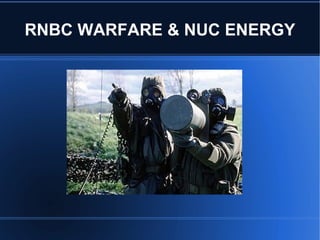
RNBC WARFARE & NUC ENERGY
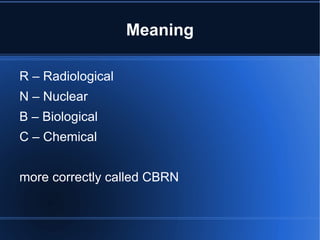
Meaning R – Radiological
N – Nuclear
B – Biological
C – Chemical
more correctly called CBRN
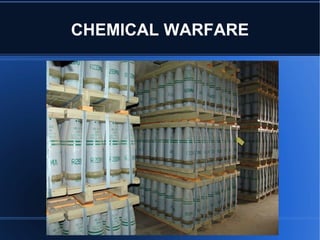
CHEMICAL WARFARE
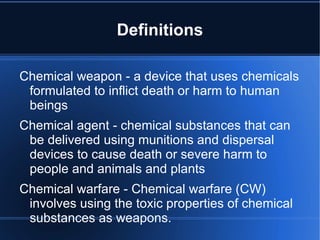
Definitions Chemical weapon - a device that uses chemicals formulated to inflict death or harm to human beings
Chemical agent - chemical substances that can be delivered using munitions and dispersal devices to cause death or severe harm to people and animals and plants
Chemical warfare - Chemical warfare (CW) involves using the toxic properties of chemical substances as weapons.
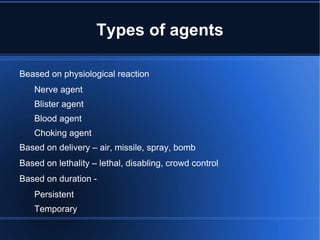
Types of agents Beased on physiological reaction Nerve agent
Blister agent
Blood agent
Choking agent Based on delivery – air, missile, spray, bomb
Based on lethality – lethal, disabling, crowd control
Based on duration -  Persistent
Temporary
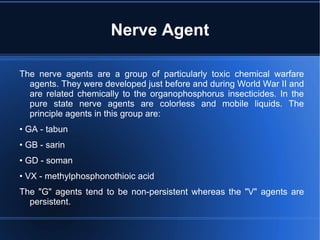
Nerve Agent The nerve agents are a group of particularly toxic chemical warfare agents. They were developed just before and during World War II and are related chemically to the organophosphorus insecticides.  In the pure state nerve agents are colorless and mobile liquids.  The principle agents in this group are: •  GA - tabun •  GB - sarin •  GD - soman •  VX - methylphosphonothioic acid The "G" agents tend to be non-persistent whereas the "V" agents are persistent.
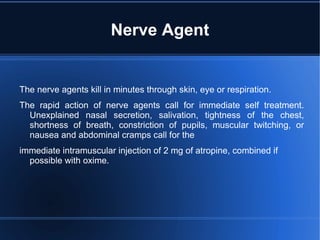
Nerve Agent The nerve agents kill in minutes through skin, eye or respiration. The rapid action of nerve agents call for immediate self treatment. Unexplained nasal secretion, salivation, tightness of the chest, shortness of breath, constriction of pupils, muscular twitching, or nausea and abdominal cramps call for the immediate intramuscular injection of 2 mg of atropine, combined if possible with oxime.
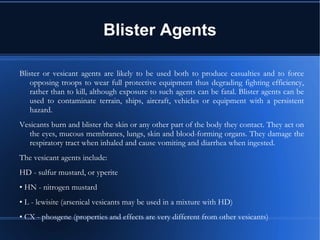
Blister Agents Blister or vesicant agents are likely to be used both to produce casualties and to force opposing troops to wear full protective equipment thus degrading fighting efficiency, rather than to kill, although exposure to such agents can be fatal. Blister agents can be used to contaminate terrain, ships, aircraft, vehicles or equipment with a persistent hazard. Vesicants burn and blister the skin or any other part of the body they contact. They act on the eyes, mucous membranes, lungs, skin and blood-forming organs. They damage the respiratory tract when inhaled and cause vomiting and diarrhea when ingested. The vesicant agents include: HD - sulfur mustard, or yperite • HN - nitrogen mustard • L - lewisite (arsenical vesicants may be used in a mixture with HD) • CX - phosgene (properties and effects are very different from other vesicants)
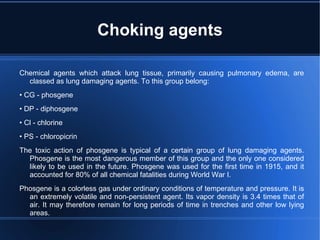
Choking agents Chemical agents which attack lung tissue, primarily causing pulmonary edema, are classed as lung damaging agents. To this group belong: •  CG - phosgene •  DP - diphosgene •  Cl - chlorine •  PS - chloropicrin The toxic action of phosgene is typical of a certain group of lung damaging agents. Phosgene is the most dangerous member of this group and the only one considered likely to be used in the future. Phosgene was used for the first time in 1915, and it accounted for 80% of all chemical fatalities during World War I. Phosgene is a colorless gas under ordinary conditions of temperature and pressure. It is an extremely volatile and non-persistent agent. Its vapor density is 3.4 times that of air. It may therefore remain for long periods of time in trenches and other low lying areas.
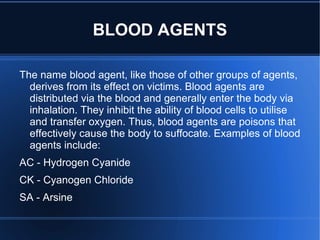
BLOOD AGENTS The name blood agent, like those of other groups of agents, derives from its effect on victims. Blood agents are distributed via the blood and generally enter the body via inhalation. They inhibit the ability of blood cells to utilise and transfer oxygen. Thus, blood agents are poisons that effectively cause the body to suffocate. Examples of blood agents include:  AC - Hydrogen Cyanide
CK - Cyanogen Chloride
SA - Arsine
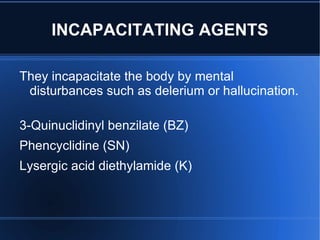
INCAPACITATING AGENTS They incapacitate the body by mental disturbances such as delerium or hallucination.  3-Quinuclidinyl benzilate (BZ)
Phencyclidine (SN)
Lysergic acid diethylamide (K)
RIOT CONTROL AGENTS Tear gas
Laughter gas
CS
CHEMICAL WARFARE CONVENTION Convention on the Prohibition of the Development, Production, Stockpiling and Use of Chemical Weapons and on their Destruction (usually referred to as the Chemical Weapons Convention)
Signed in 1993 in Paris & New York
165 states signed

CBRN

  • 1.
    RNBC WARFARE &NUC ENERGY
  • 2.
    Meaning R –Radiological
  • 3.
  • 4.
  • 5.
  • 6.
  • 7.
  • 8.
    Definitions Chemical weapon- a device that uses chemicals formulated to inflict death or harm to human beings
  • 9.
    Chemical agent -chemical substances that can be delivered using munitions and dispersal devices to cause death or severe harm to people and animals and plants
  • 10.
    Chemical warfare -Chemical warfare (CW) involves using the toxic properties of chemical substances as weapons.
  • 11.
    Types of agentsBeased on physiological reaction Nerve agent
  • 12.
  • 13.
  • 14.
    Choking agent Basedon delivery – air, missile, spray, bomb
  • 15.
    Based on lethality– lethal, disabling, crowd control
  • 16.
    Based on duration- Persistent
  • 17.
  • 18.
    Nerve Agent Thenerve agents are a group of particularly toxic chemical warfare agents. They were developed just before and during World War II and are related chemically to the organophosphorus insecticides. In the pure state nerve agents are colorless and mobile liquids. The principle agents in this group are: • GA - tabun • GB - sarin • GD - soman • VX - methylphosphonothioic acid The "G" agents tend to be non-persistent whereas the "V" agents are persistent.
  • 19.
    Nerve Agent Thenerve agents kill in minutes through skin, eye or respiration. The rapid action of nerve agents call for immediate self treatment. Unexplained nasal secretion, salivation, tightness of the chest, shortness of breath, constriction of pupils, muscular twitching, or nausea and abdominal cramps call for the immediate intramuscular injection of 2 mg of atropine, combined if possible with oxime.
  • 20.
    Blister Agents Blisteror vesicant agents are likely to be used both to produce casualties and to force opposing troops to wear full protective equipment thus degrading fighting efficiency, rather than to kill, although exposure to such agents can be fatal. Blister agents can be used to contaminate terrain, ships, aircraft, vehicles or equipment with a persistent hazard. Vesicants burn and blister the skin or any other part of the body they contact. They act on the eyes, mucous membranes, lungs, skin and blood-forming organs. They damage the respiratory tract when inhaled and cause vomiting and diarrhea when ingested. The vesicant agents include: HD - sulfur mustard, or yperite • HN - nitrogen mustard • L - lewisite (arsenical vesicants may be used in a mixture with HD) • CX - phosgene (properties and effects are very different from other vesicants)
  • 21.
    Choking agents Chemicalagents which attack lung tissue, primarily causing pulmonary edema, are classed as lung damaging agents. To this group belong: • CG - phosgene • DP - diphosgene • Cl - chlorine • PS - chloropicrin The toxic action of phosgene is typical of a certain group of lung damaging agents. Phosgene is the most dangerous member of this group and the only one considered likely to be used in the future. Phosgene was used for the first time in 1915, and it accounted for 80% of all chemical fatalities during World War I. Phosgene is a colorless gas under ordinary conditions of temperature and pressure. It is an extremely volatile and non-persistent agent. Its vapor density is 3.4 times that of air. It may therefore remain for long periods of time in trenches and other low lying areas.
  • 22.
    BLOOD AGENTS Thename blood agent, like those of other groups of agents, derives from its effect on victims. Blood agents are distributed via the blood and generally enter the body via inhalation. They inhibit the ability of blood cells to utilise and transfer oxygen. Thus, blood agents are poisons that effectively cause the body to suffocate. Examples of blood agents include: AC - Hydrogen Cyanide
  • 23.
    CK - CyanogenChloride
  • 24.
  • 25.
    INCAPACITATING AGENTS Theyincapacitate the body by mental disturbances such as delerium or hallucination. 3-Quinuclidinyl benzilate (BZ)
  • 26.
  • 27.
  • 28.
  • 29.
  • 30.
  • 31.
    CHEMICAL WARFARE CONVENTIONConvention on the Prohibition of the Development, Production, Stockpiling and Use of Chemical Weapons and on their Destruction (usually referred to as the Chemical Weapons Convention)
  • 32.
    Signed in 1993in Paris & New York
  • 33.