Ashok
Mpharm. 1st Year
210121210013
GUIDED BY :-
Dr. MANOJ MEDAL
Dept. of Pharmaceutical Sciences
GJUS&THisar
Histamine
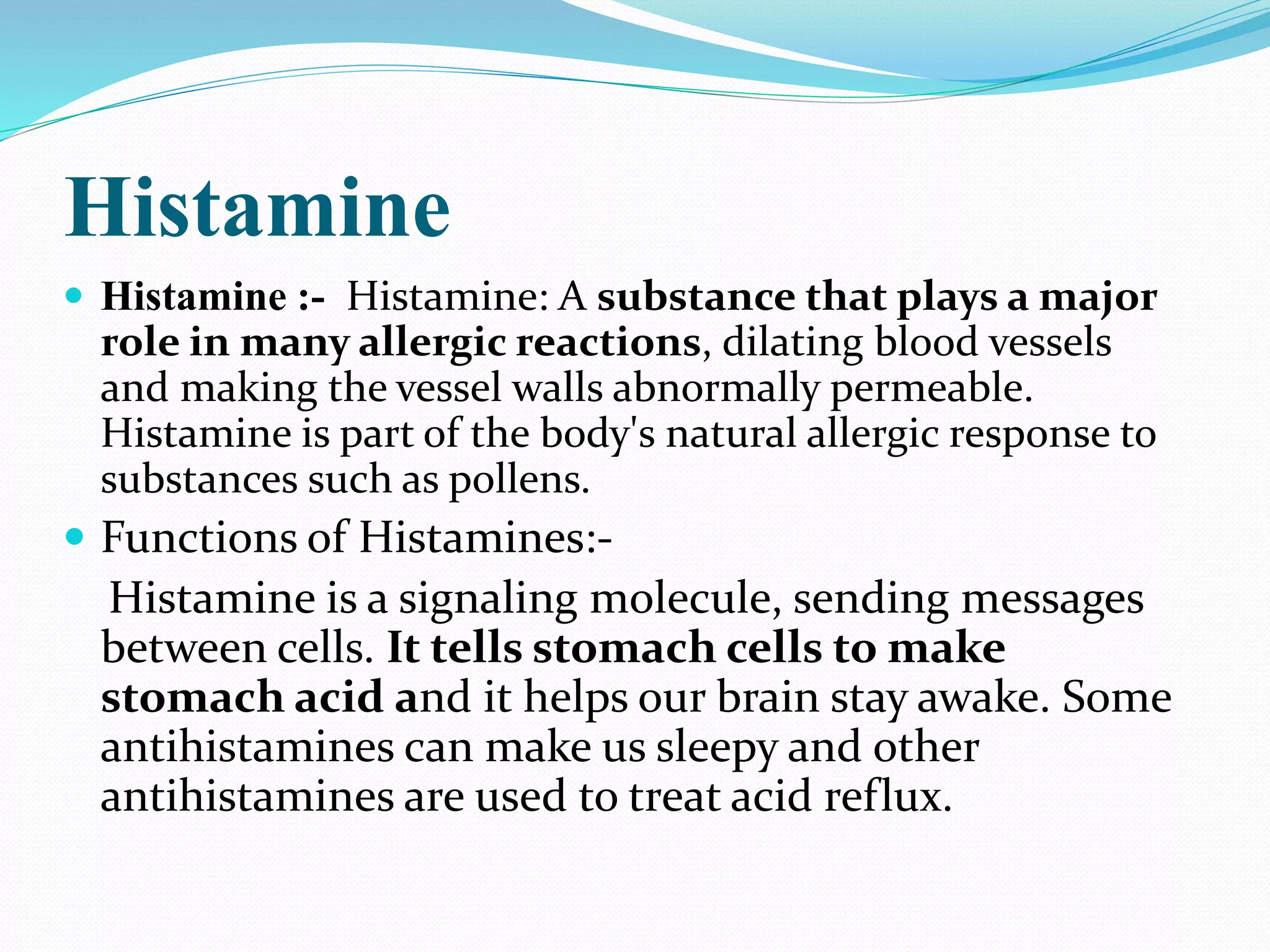
 Histamine :- Histamine: A substance that plays a major
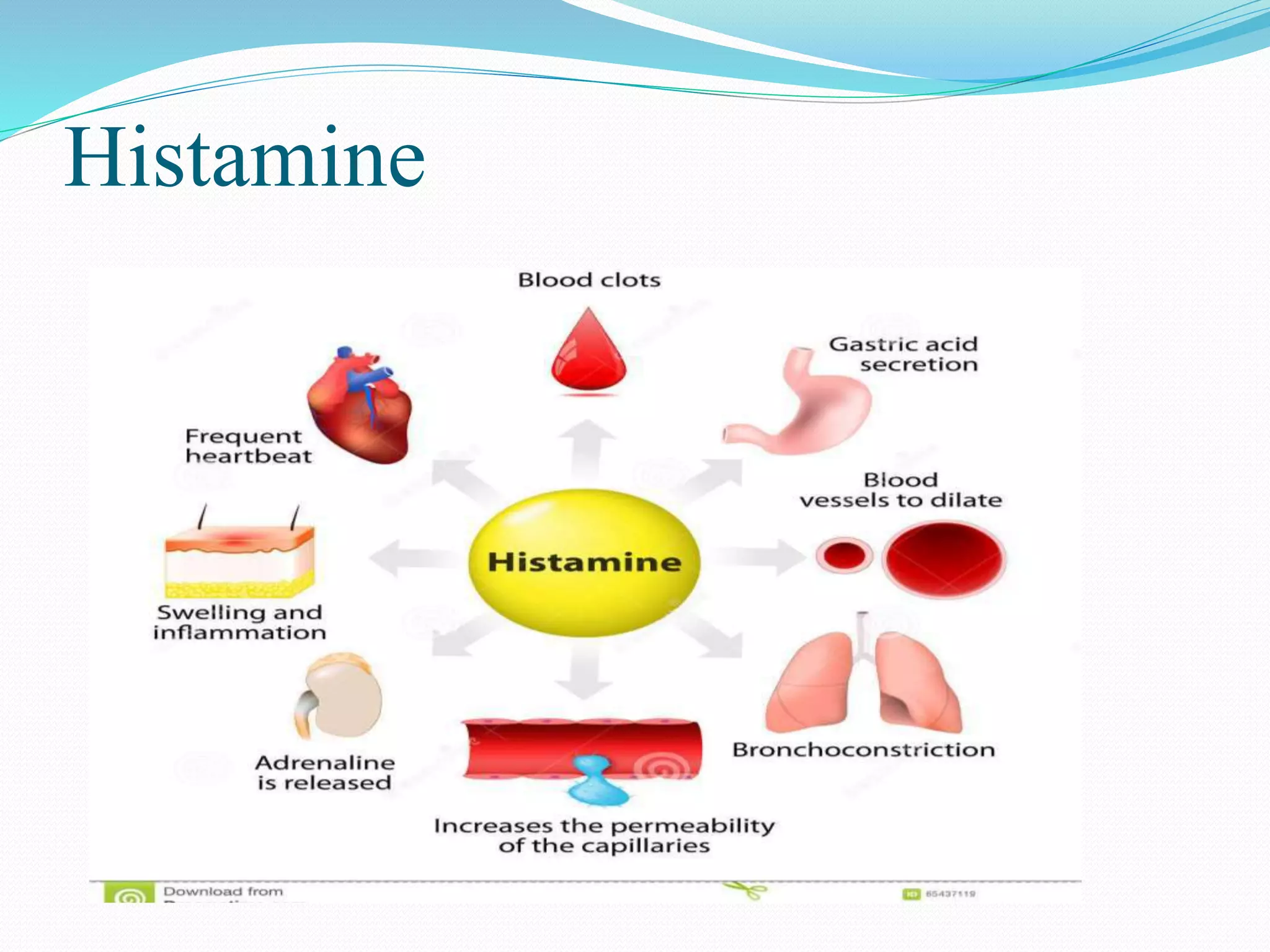
role in many allergic reactions, dilating blood vessels
and making the vessel walls abnormally permeable.
Histamine is part of the body's natural allergic response to
substances such as pollens.
 Functions of Histamines:-
Histamine is a signaling molecule, sending messages
between cells. It tells stomach cells to make
stomach acid and it helps our brain stay awake. Some
antihistamines can make us sleepy and other
antihistamines are used to treat acid reflux.
Histamine
Formation of Histamine in Body
Histamine
 English scientists George Barger and Henry H. Dale
first isolated histamine from the plant fungus ergot in
1910, and in 1911 they isolated the substance from animal
tissues.
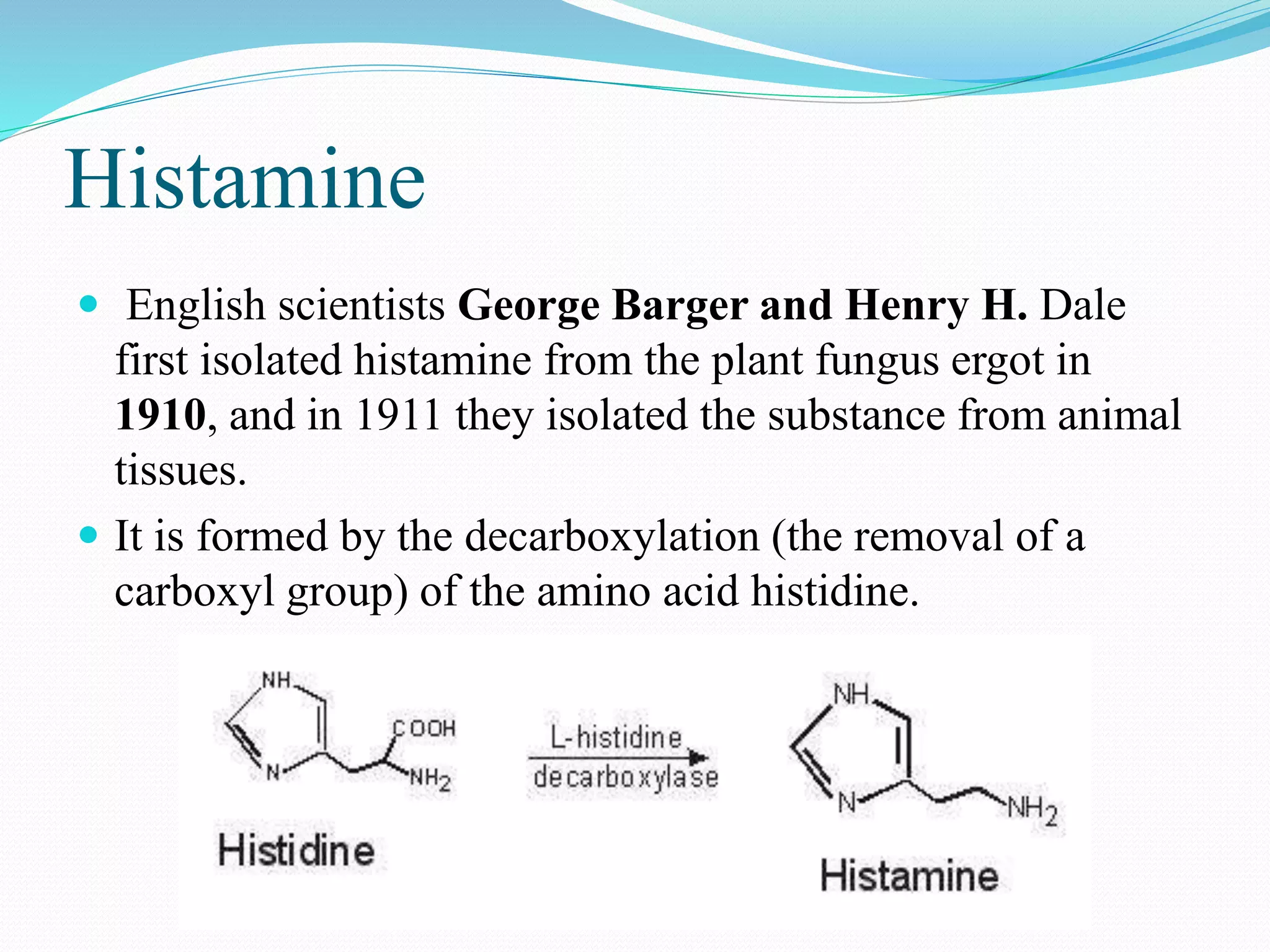
 It is formed by the decarboxylation (the removal of a
carboxyl group) of the amino acid histidine.
Histamine Receptors and Their
Distribution
 Almost all mammalian tissues contains histamine.
 Widely distributed in skin, GIT, mucosa, lungs, brain and
bone- merrow .
 It is also component of some venoms, Sting secreation,
bacteria and plants .
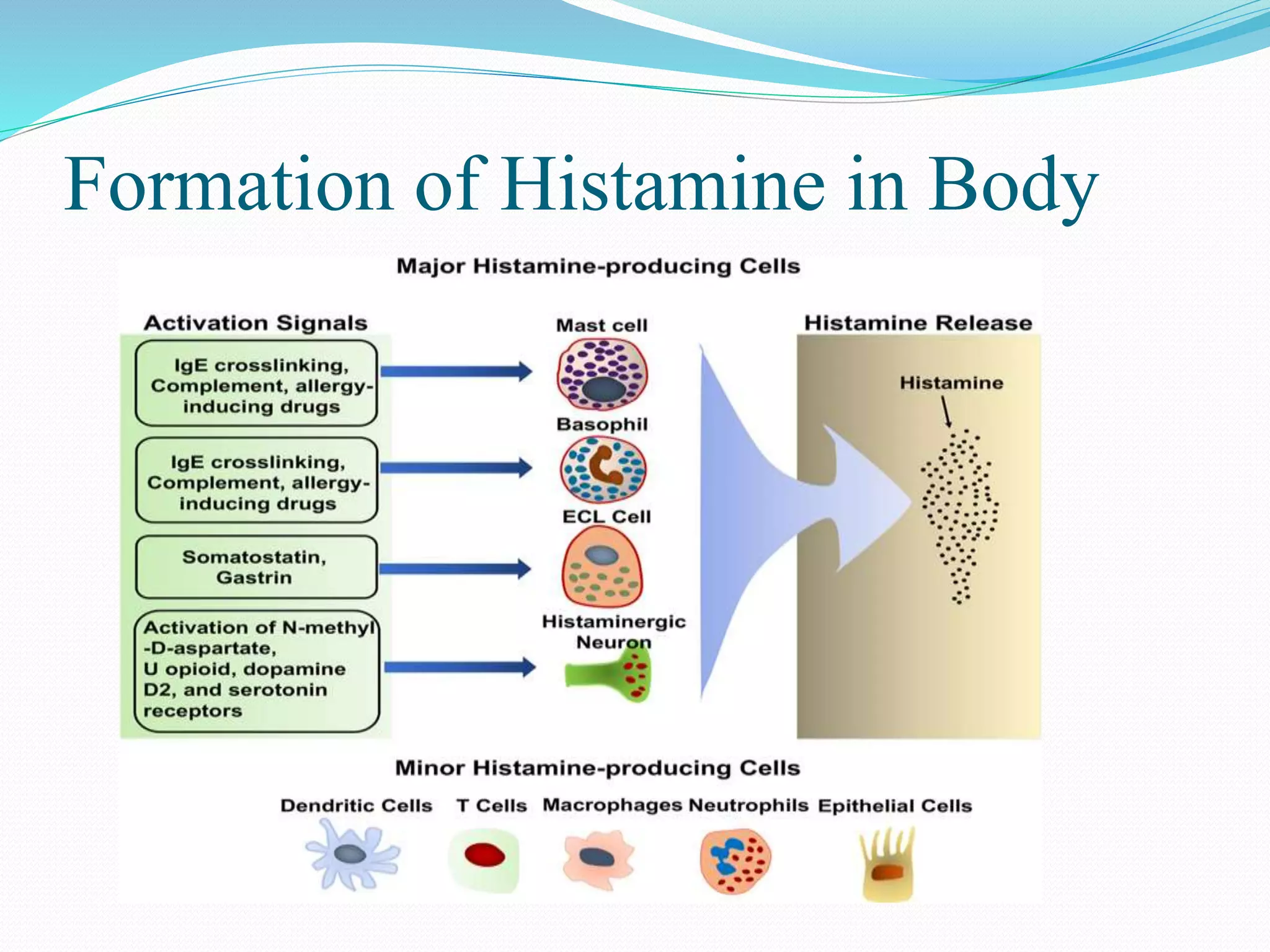
 The mast cell is predominant storage site for histamine in
most tissues.
 The concentration of histamine is particularly high in
tissue that contain large members of most cells such as
skin , bronchial tree mucosa and intestinal mucosa.
HISTAMINE AND ITS
RECEPTORS
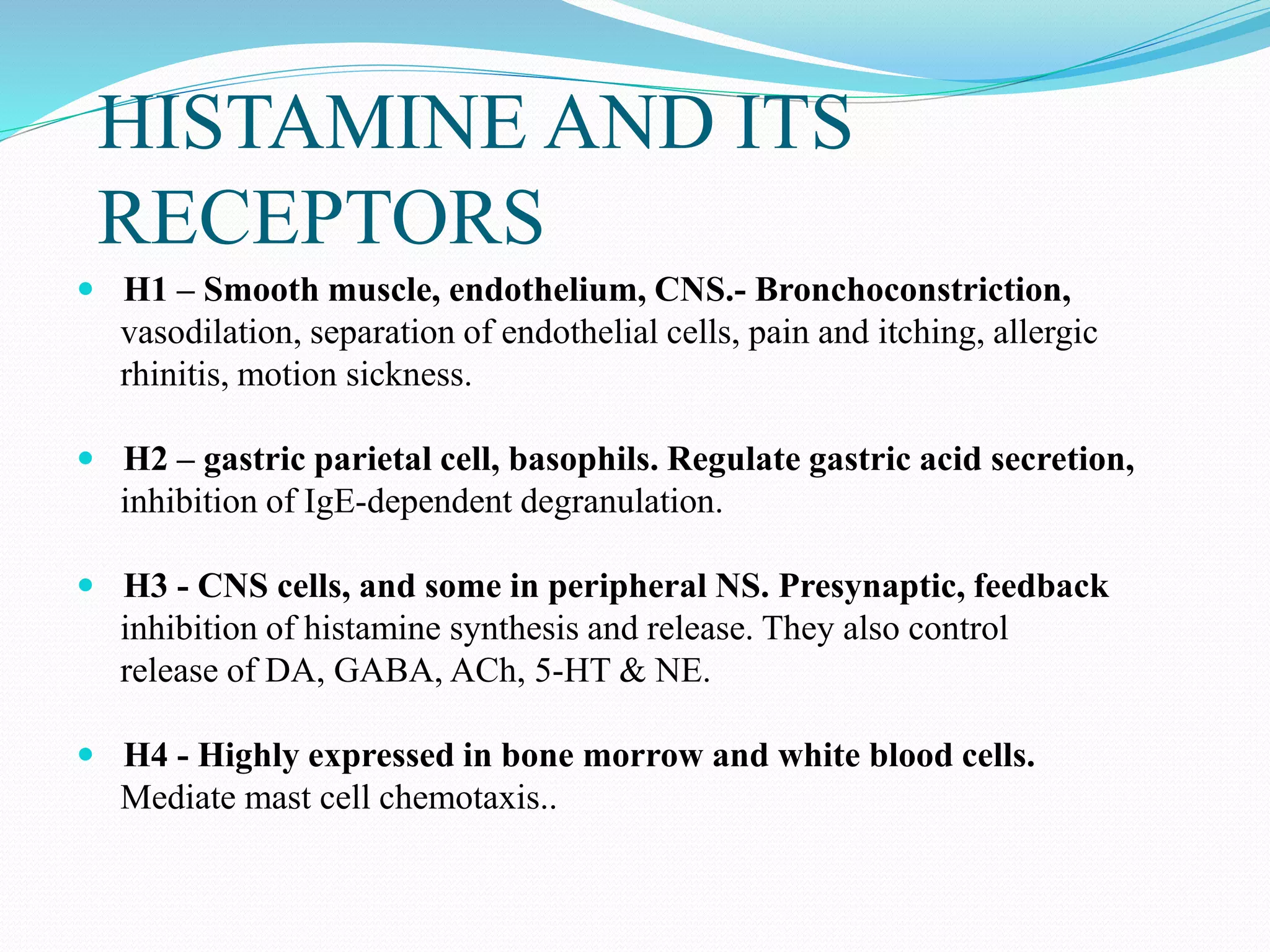
 H1 – Smooth muscle, endothelium, CNS.- Bronchoconstriction,
vasodilation, separation of endothelial cells, pain and itching, allergic
rhinitis, motion sickness.
 H2 – gastric parietal cell, basophils. Regulate gastric acid secretion,
inhibition of IgE-dependent degranulation.
 H3 - CNS cells, and some in peripheral NS. Presynaptic, feedback
inhibition of histamine synthesis and release. They also control
release of DA, GABA, ACh, 5-HT & NE.
 H4 - Highly expressed in bone morrow and white blood cells.
Mediate mast cell chemotaxis..
Classification of Hisatamine
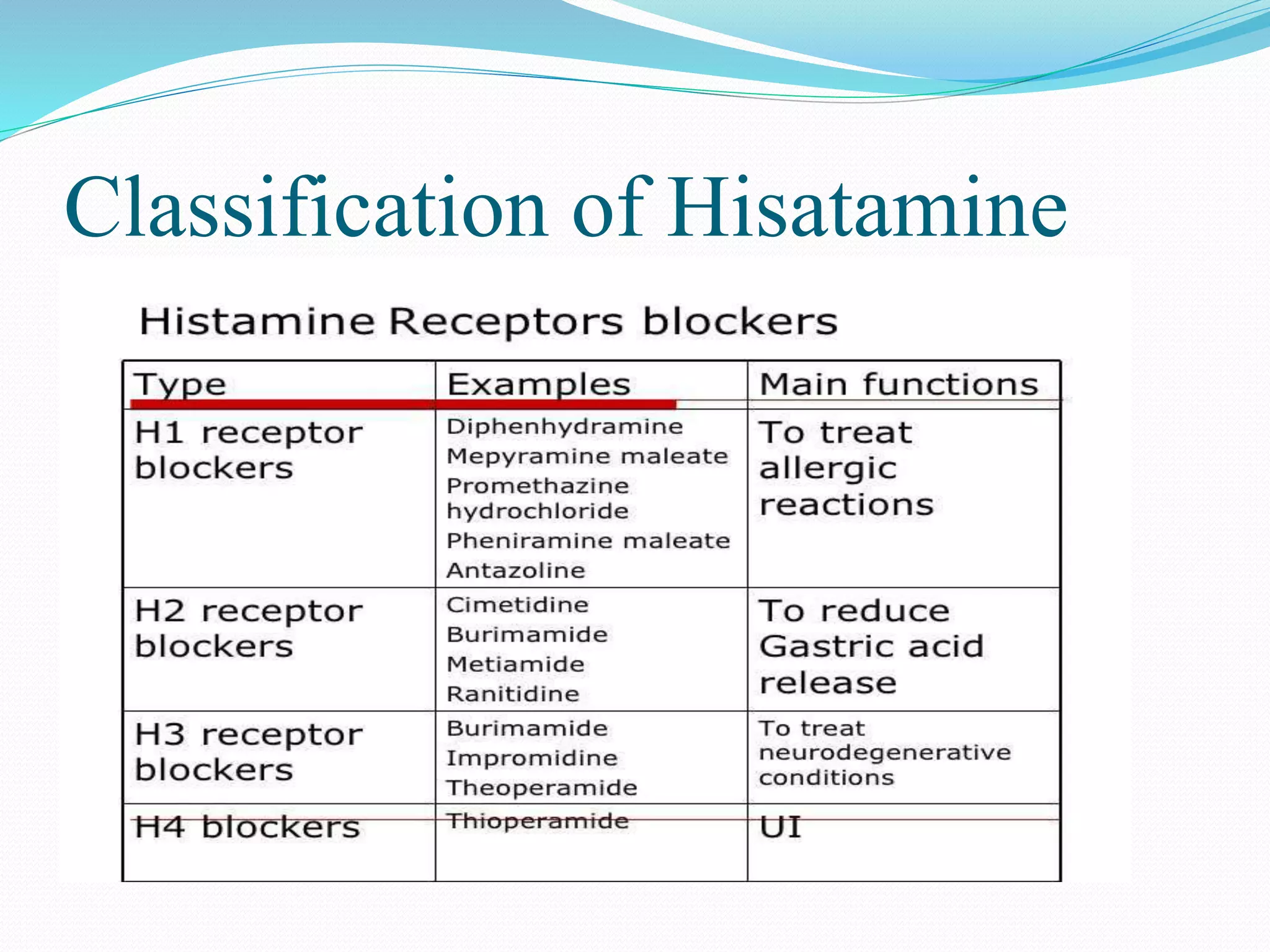
H1 RECEPTOR BLOCKERS
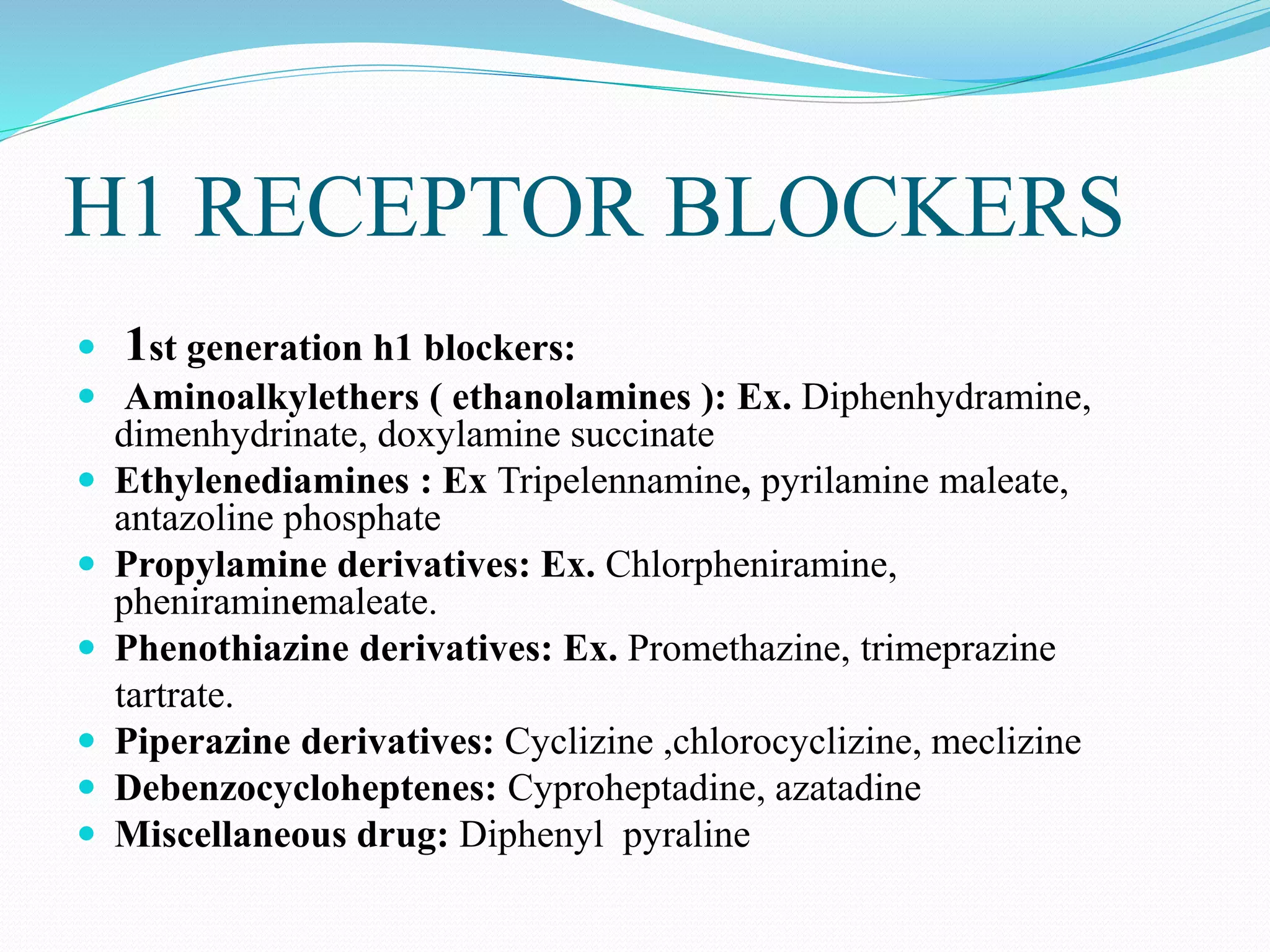
 1st generation h1 blockers:
 Aminoalkylethers ( ethanolamines ): Ex. Diphenhydramine,
dimenhydrinate, doxylamine succinate
 Ethylenediamines : Ex Tripelennamine, pyrilamine maleate,
antazoline phosphate
 Propylamine derivatives: Ex. Chlorpheniramine,
pheniraminemaleate.
 Phenothiazine derivatives: Ex. Promethazine, trimeprazine
tartrate.
 Piperazine derivatives: Cyclizine ,chlorocyclizine, meclizine
 Debenzocycloheptenes: Cyproheptadine, azatadine
 Miscellaneous drug: Diphenyl pyraline
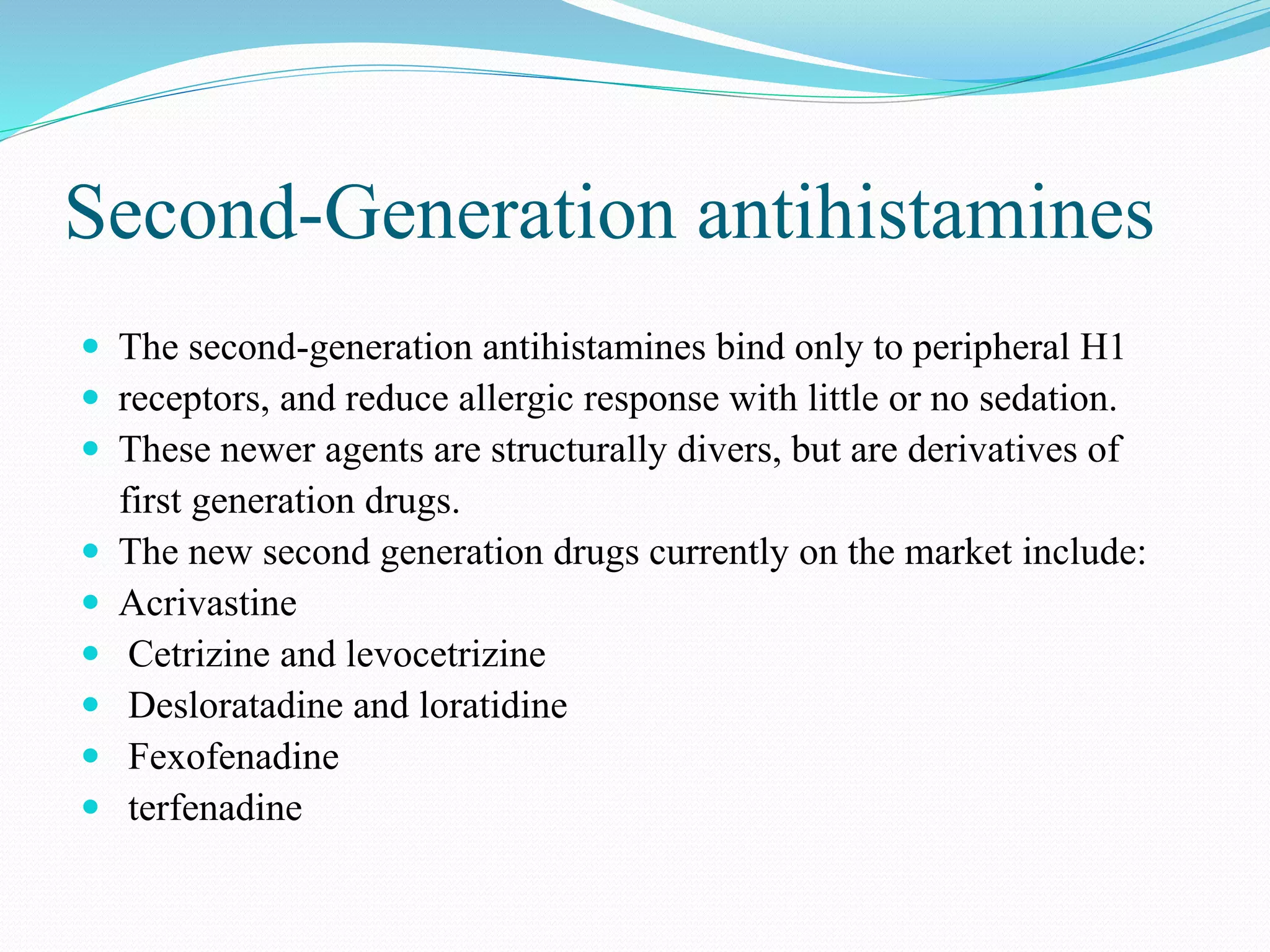
Second-Generation antihistamines
 The second-generation antihistamines bind only to peripheral H1
 receptors, and reduce allergic response with little or no sedation.
 These newer agents are structurally divers, but are derivatives of
first generation drugs.
 The new second generation drugs currently on the market include:
 Acrivastine
 Cetrizine and levocetrizine
 Desloratadine and loratidine
 Fexofenadine
 terfenadine
SAR of Histamine
 A protonatable amine
 A connecting atom X which can be O, C or N
 A carbon chain, usually ethyl
 Variations in the diaryl groups, connecting moiety,
substituentson the connecting moiety, and substituents on the
terminalnitrogen account for the differences observed in
potency as well as pharmacologic, metabolic, and adverse
reaction profiles
SAR OF 1ST GENERATION H1
BLOCKERS
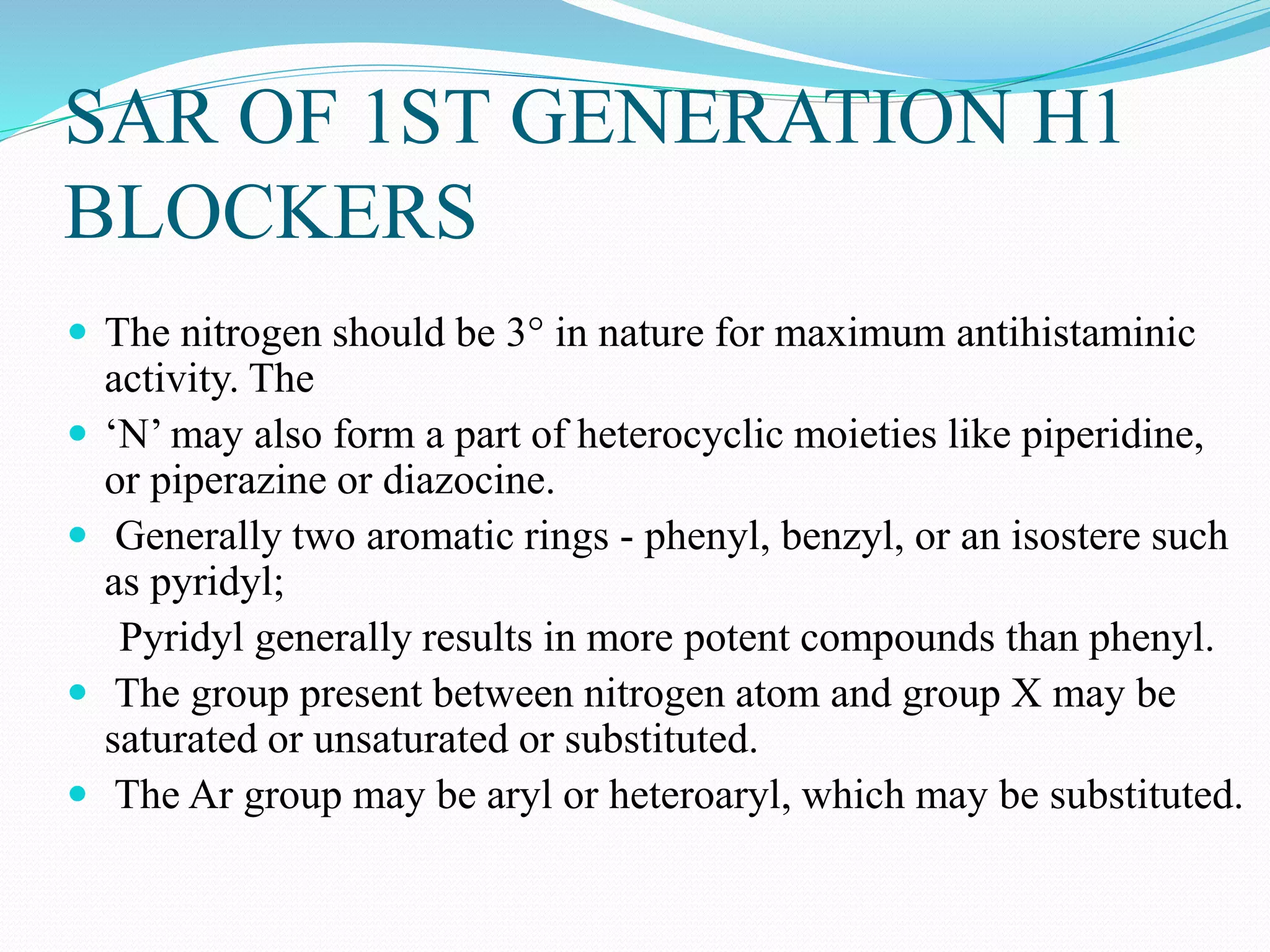
 The nitrogen should be 3° in nature for maximum antihistaminic
activity. The
 ‘N’ may also form a part of heterocyclic moieties like piperidine,
or piperazine or diazocine.
 Generally two aromatic rings - phenyl, benzyl, or an isostere such
as pyridyl;
Pyridyl generally results in more potent compounds than phenyl.
 The group present between nitrogen atom and group X may be
saturated or unsaturated or substituted.
 The Ar group may be aryl or heteroaryl, which may be substituted.
SAR OF 1ST GENERATION H1
BLOCKERS
X
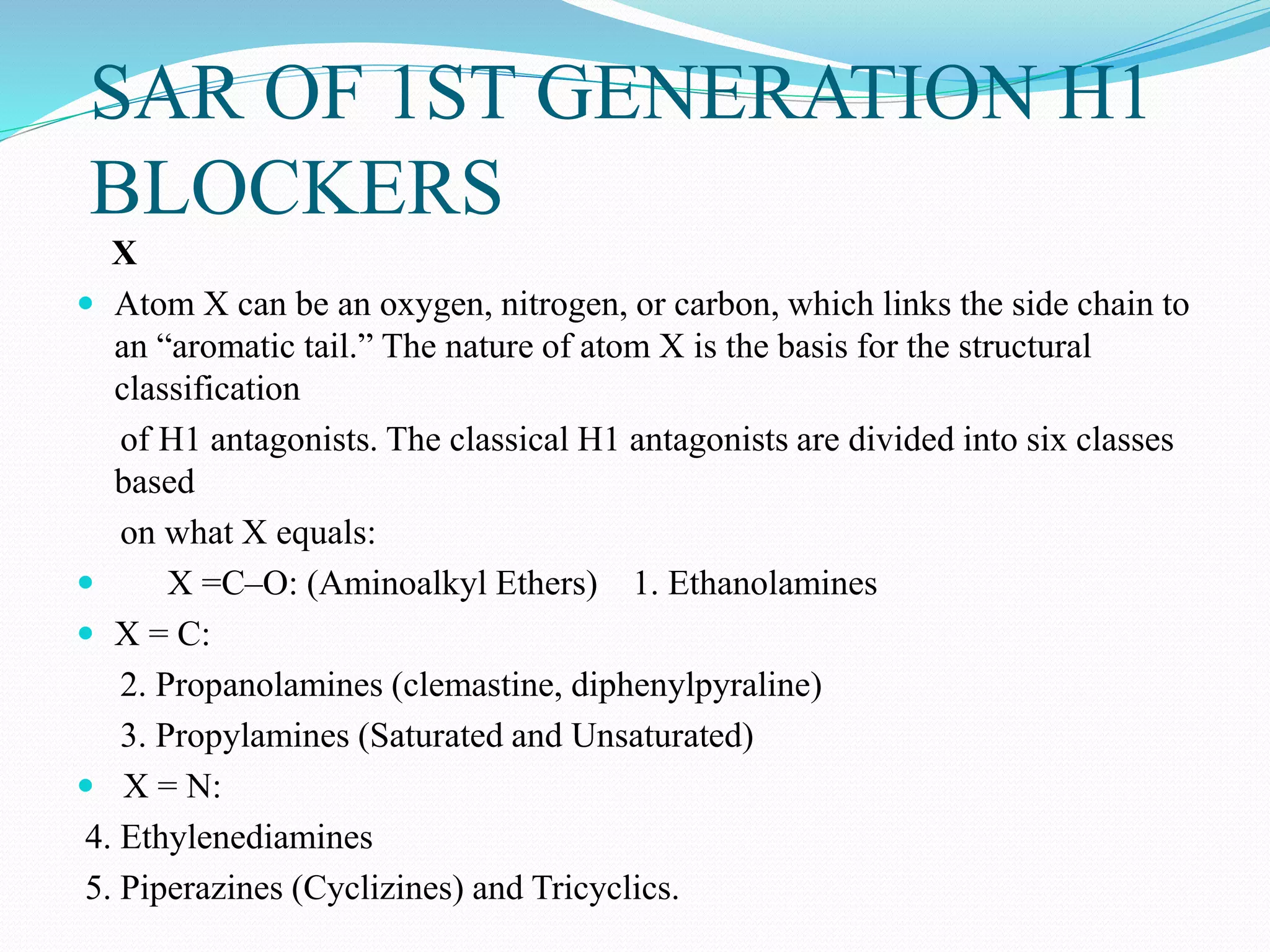
 Atom X can be an oxygen, nitrogen, or carbon, which links the side chain to
an “aromatic tail.” The nature of atom X is the basis for the structural
classification
of H1 antagonists. The classical H1 antagonists are divided into six classes
based
on what X equals:
 X =C–O: (Aminoalkyl Ethers) 1. Ethanolamines
 X = C:
2. Propanolamines (clemastine, diphenylpyraline)
3. Propylamines (Saturated and Unsaturated)
 X = N:
4. Ethylenediamines
5. Piperazines (Cyclizines) and Tricyclics.
Some Structures of Drugs
chlorpheniramine dhiphenhydramine pyrilamine
AMINOALKYL ETHERS
•Derivatives of N,N-dimethyl ethanolamines
•Characterised by the CHO connecting Moiety between the key diaryl
and tertiary amino groups and a two or three carbon moiety.
•The simple diphenyl derivative diphenhydramine was the firt clinically useful
member of the ethanolamines series and serves as a prototype.
AMINOALKY ETHERS
 Replacement of one of the phenyl rings of the
diphenhydramine with a 2-pyridyl group, as in doxylamine
enhances the antihistaminic activity.
 The diaryl tertiary aminoalkyl ether structure serves as a
pharmacophore for the muscarinic receptors.
 Drowsiness ,as well as other CNS effects, is a common side-
effects of tertiary amino alkyl ethers because of the ability of
these compounds to penetrate BBB and bind to the central H1
receptors.
 Conversion to a quaternary ammonium salt does not alter
the antihistaminic activity but does increases in anticholinergic
action.
AMINOALKYL ETHERS
Diphenhydramine HCL Doxylamine
carbinoxamine
bromodiphenhydramine
Bromodiphenhydramine synthesis
ETHELENDIAMINES
 R1 and R2 should be small (CH3) for maximum H1-
antagonist activity.
 Ar1 and Ar2 can be benzene ring or any other isosteric
rings such asheterocycles.
 One of the aromatic should be benzyl for better
activity which has Psubstitution
H1 Receptor Antagonists
Tripelennamine HCl Chlorpheniramine Maleate
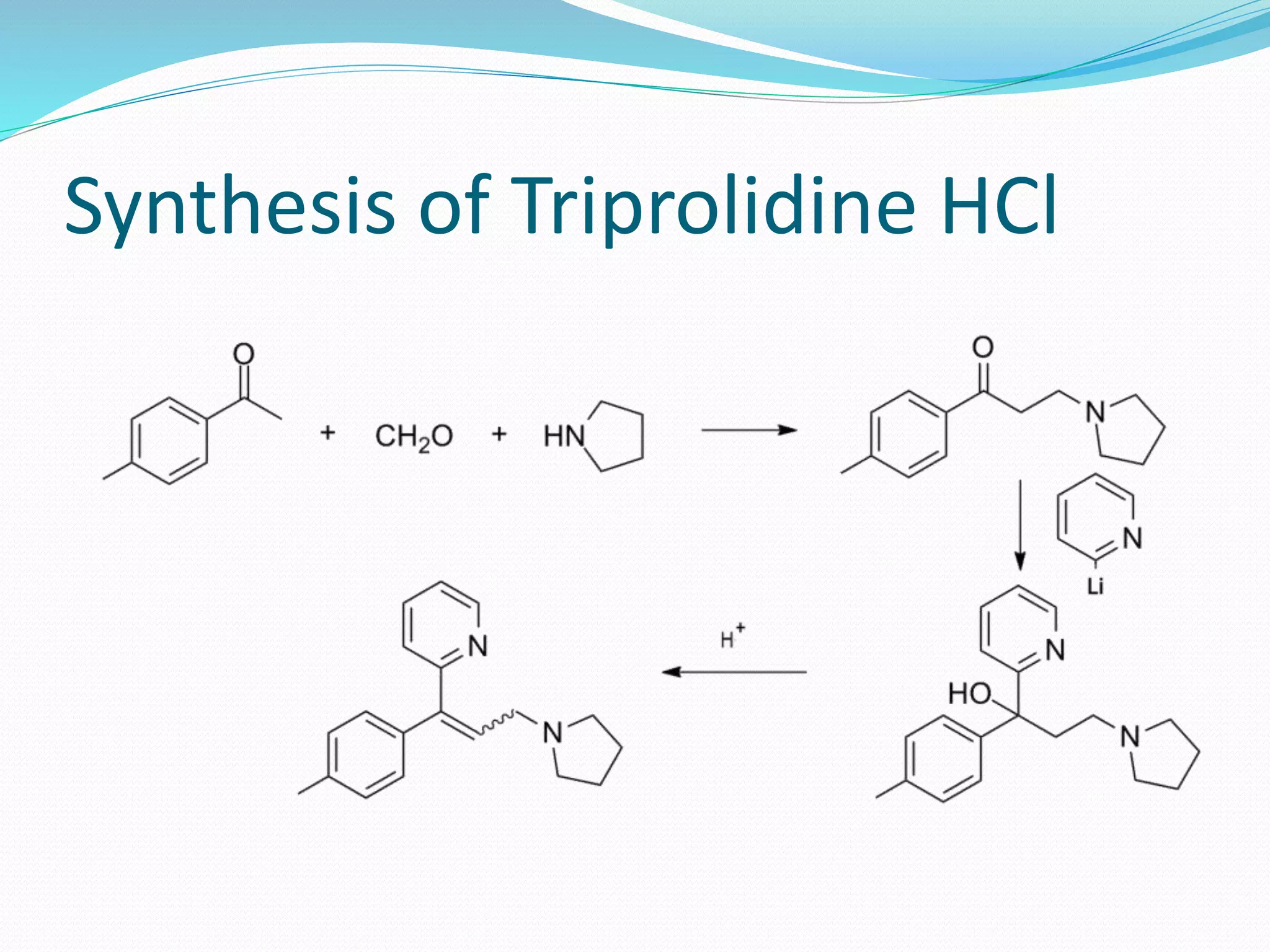
Synthesis of Triprolidine HCl
Promethazine HCl
Promethazine is used to prevent and treat nausea and vomiting related to
certain conditions (such as before/after surgery, motion sickness). It is also
used to treat allergy symptoms such as rash, itching, and runny nose.
Cyproheptadine HCl
Cyproheptadine is an antihistamine used to relieve allergy symptoms such as
watery eyes, runny nose, itching eyes/nose, sneezing, hives, and itching. It works
by blocking a certain natural substance (histamine) that your body makes during
an allergic reaction
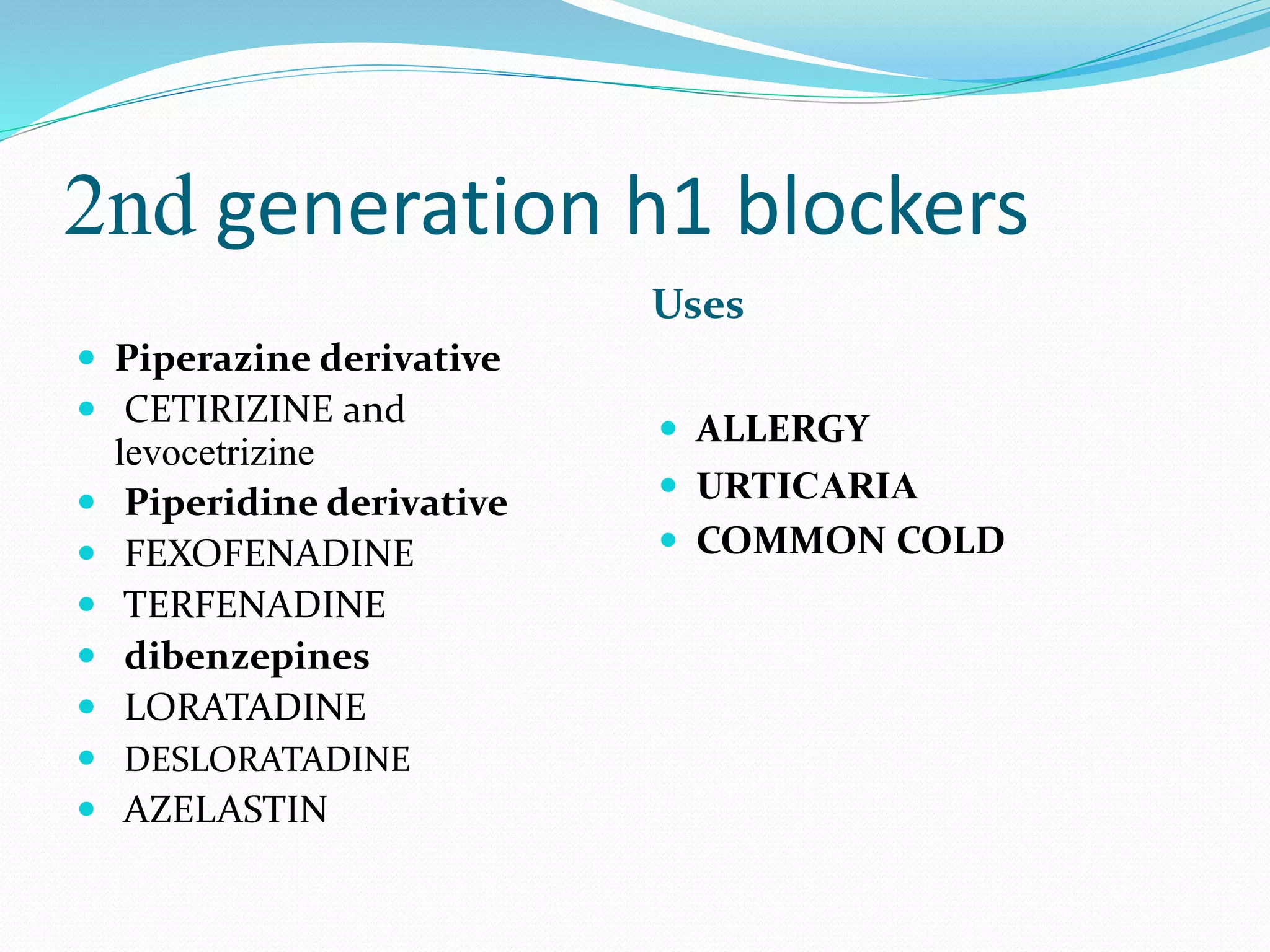
2nd generation h1 blockers
Uses
 Piperazine derivative
 CETIRIZINE and
levocetrizine
 Piperidine derivative
 FEXOFENADINE
 TERFENADINE
 dibenzepines
 LORATADINE
 DESLORATADINE
 AZELASTIN
 ALLERGY
 URTICARIA
 COMMON COLD
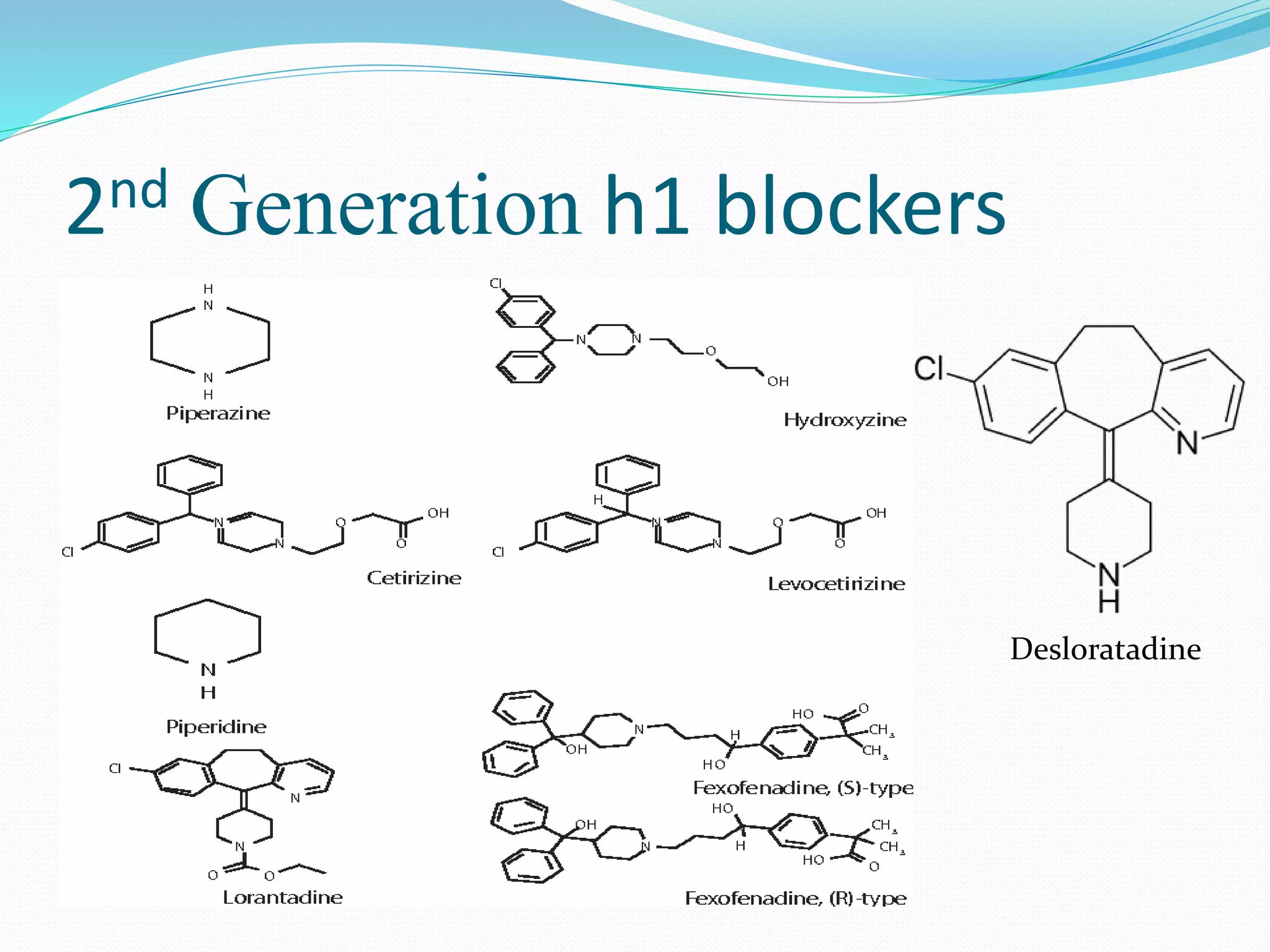
2nd Generation h1 blockers
Desloratadine
H2 Receptor Antagonists
 :- are a group of medicines that reduce the amount of acid
produced by the cells in the lining of the stomach are
commonly called H2 blockers.
 Cimetidine ( Tagamet)
 Ranitidine ( Zantac)
 Famotidine (Pepcid , Pepcid AC) - Nizatidine ( Axid)
These products have been approved for the relief of “heartburn
associated with acid indigestion, and sour stomach.” They
should not be taken for longer than 2 weeks and are not
recommended for children < 12 years of age.
MOA of H2 blockers
 The H2 antagonists are competitive antagonists of histamine at
parietal cell
 H2 receptor .They suppress the normal secretion of acid by parietal
cells and the meal –stimulated secretion of acid .
 They accomplish this by two mechanism : Histamine released by
ECL(enterochromaffin – like) cells in the stomach is blocked from
binding on parietal cell H2 receptor , which stimulate acid secretion :
therefore other substances that promote acid secretion ( such as
gastrin and acetylcholine ) have a reduce effect on parietal cell when
the H2 receptors are blocked
Side effects of H2 blockers
 Some of the side effects that may occur with H2 receptor
blockers include:
 constipation
 diarrhea
 difficulty sleeping
 dry mouth
 dry skin
 headaches
 ringing in the ears
 a runny nose
 trouble urinating
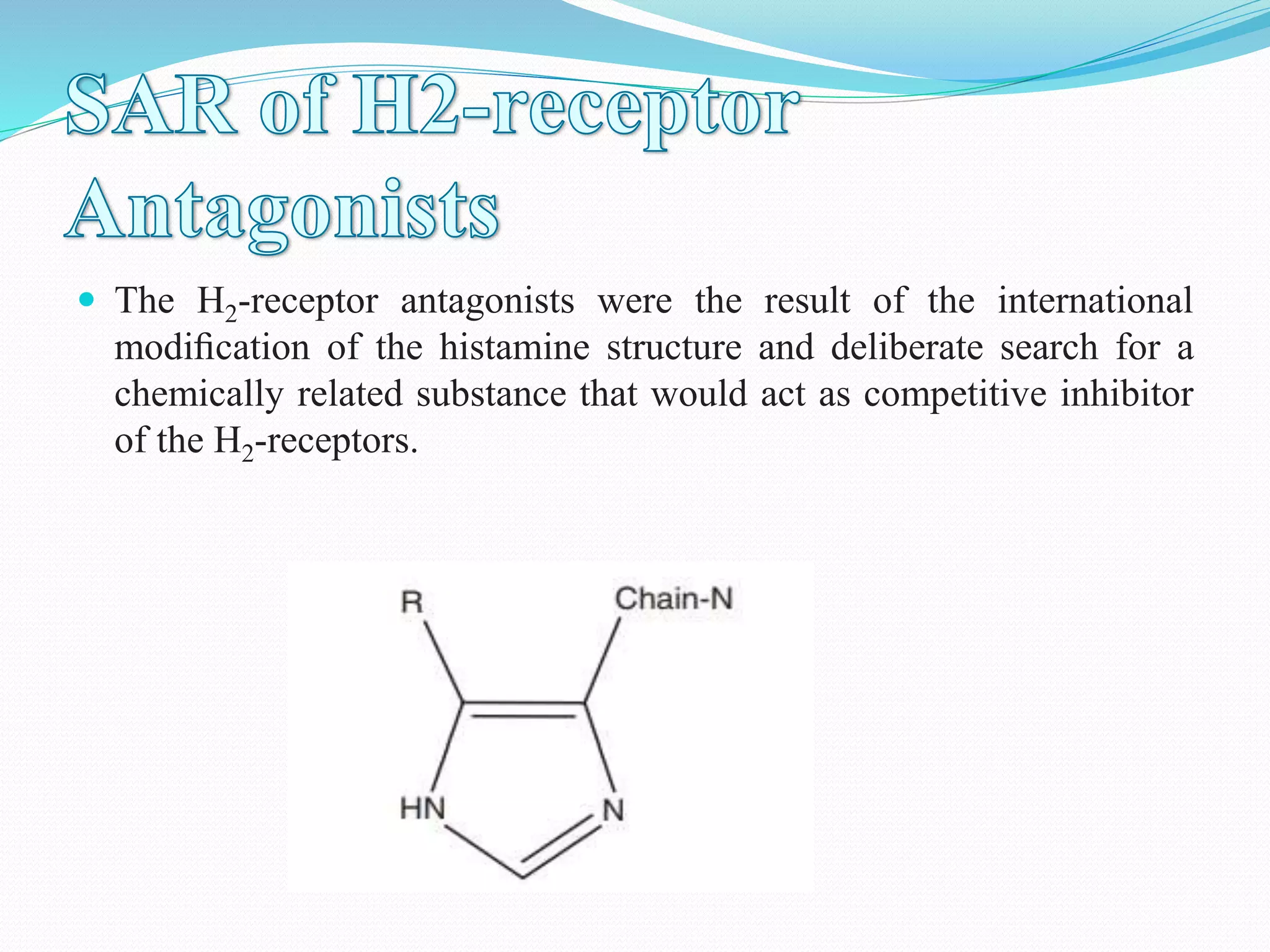
 The H2-receptor antagonists were the result of the international
modification of the histamine structure and deliberate search for a
chemically related substance that would act as competitive inhibitor
of the H2-receptors.
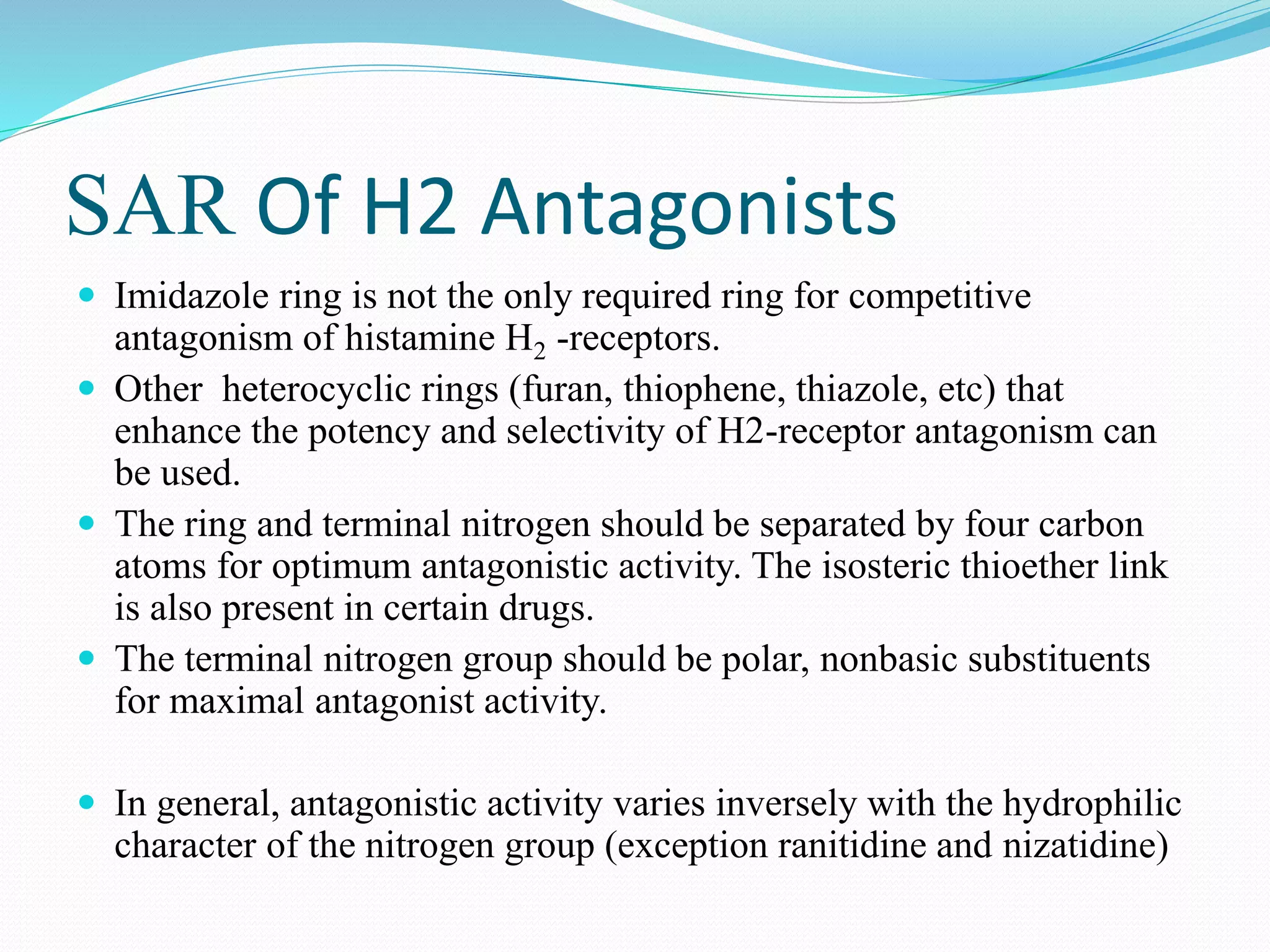
SAR Of H2 Antagonists
 Imidazole ring is not the only required ring for competitive
antagonism of histamine H2 -receptors.
 Other heterocyclic rings (furan, thiophene, thiazole, etc) that
enhance the potency and selectivity of H2-receptor antagonism can
be used.
 The ring and terminal nitrogen should be separated by four carbon
atoms for optimum antagonistic activity. The isosteric thioether link
is also present in certain drugs.
 The terminal nitrogen group should be polar, nonbasic substituents
for maximal antagonist activity.
 In general, antagonistic activity varies inversely with the hydrophilic
character of the nitrogen group (exception ranitidine and nizatidine)
Drugs of H2 Receptor Antagonists
When to Use H2 Receptor Antagonists
 To reduce acid reflux which may cause heartburn or inflammation of
the gullet (esophagitis). These conditions are sometimes called
gastroesophageal reflux disease (GERD).
 To treat ulcers in the stomach and in part of the gut (the duodenum).
 To help heal ulcers associated with anti-inflammatory agents
(NSAIDs).
 In other conditions where it is helpful to reduce acid in the stomach.
 Also :Damage to the stomach and/or intestines due to stress or
 trauma,
 -Pancreatic problems
 Stomach or intestinal ulcers (sores) resulting from damage caused by
medication used to treat rheumatoid arthritis.
References :-
1. https://en.wikipedia.org/wiki/H2_antagonist
2. https://www.slideshare.net/arzoodharasandiya/h1-
h2-receptor-blockers
For Listening

H1 & H2 receptor antagonist

  • 1.
    Ashok Mpharm. 1st Year 210121210013 GUIDEDBY :- Dr. MANOJ MEDAL Dept. of Pharmaceutical Sciences GJUS&THisar
  • 2.
    Histamine  Histamine :-Histamine: A substance that plays a major role in many allergic reactions, dilating blood vessels and making the vessel walls abnormally permeable. Histamine is part of the body's natural allergic response to substances such as pollens.  Functions of Histamines:- Histamine is a signaling molecule, sending messages between cells. It tells stomach cells to make stomach acid and it helps our brain stay awake. Some antihistamines can make us sleepy and other antihistamines are used to treat acid reflux.
  • 3.
  • 4.
  • 5.
    Histamine  English scientistsGeorge Barger and Henry H. Dale first isolated histamine from the plant fungus ergot in 1910, and in 1911 they isolated the substance from animal tissues.  It is formed by the decarboxylation (the removal of a carboxyl group) of the amino acid histidine.
  • 6.
    Histamine Receptors andTheir Distribution  Almost all mammalian tissues contains histamine.  Widely distributed in skin, GIT, mucosa, lungs, brain and bone- merrow .  It is also component of some venoms, Sting secreation, bacteria and plants .  The mast cell is predominant storage site for histamine in most tissues.  The concentration of histamine is particularly high in tissue that contain large members of most cells such as skin , bronchial tree mucosa and intestinal mucosa.
  • 7.
    HISTAMINE AND ITS RECEPTORS H1 – Smooth muscle, endothelium, CNS.- Bronchoconstriction, vasodilation, separation of endothelial cells, pain and itching, allergic rhinitis, motion sickness.  H2 – gastric parietal cell, basophils. Regulate gastric acid secretion, inhibition of IgE-dependent degranulation.  H3 - CNS cells, and some in peripheral NS. Presynaptic, feedback inhibition of histamine synthesis and release. They also control release of DA, GABA, ACh, 5-HT & NE.  H4 - Highly expressed in bone morrow and white blood cells. Mediate mast cell chemotaxis..
  • 8.
  • 9.
    H1 RECEPTOR BLOCKERS 1st generation h1 blockers:  Aminoalkylethers ( ethanolamines ): Ex. Diphenhydramine, dimenhydrinate, doxylamine succinate  Ethylenediamines : Ex Tripelennamine, pyrilamine maleate, antazoline phosphate  Propylamine derivatives: Ex. Chlorpheniramine, pheniraminemaleate.  Phenothiazine derivatives: Ex. Promethazine, trimeprazine tartrate.  Piperazine derivatives: Cyclizine ,chlorocyclizine, meclizine  Debenzocycloheptenes: Cyproheptadine, azatadine  Miscellaneous drug: Diphenyl pyraline
  • 10.
    Second-Generation antihistamines  Thesecond-generation antihistamines bind only to peripheral H1  receptors, and reduce allergic response with little or no sedation.  These newer agents are structurally divers, but are derivatives of first generation drugs.  The new second generation drugs currently on the market include:  Acrivastine  Cetrizine and levocetrizine  Desloratadine and loratidine  Fexofenadine  terfenadine
  • 11.
    SAR of Histamine A protonatable amine  A connecting atom X which can be O, C or N  A carbon chain, usually ethyl  Variations in the diaryl groups, connecting moiety, substituentson the connecting moiety, and substituents on the terminalnitrogen account for the differences observed in potency as well as pharmacologic, metabolic, and adverse reaction profiles
  • 12.
    SAR OF 1STGENERATION H1 BLOCKERS  The nitrogen should be 3° in nature for maximum antihistaminic activity. The  ‘N’ may also form a part of heterocyclic moieties like piperidine, or piperazine or diazocine.  Generally two aromatic rings - phenyl, benzyl, or an isostere such as pyridyl; Pyridyl generally results in more potent compounds than phenyl.  The group present between nitrogen atom and group X may be saturated or unsaturated or substituted.  The Ar group may be aryl or heteroaryl, which may be substituted.
  • 13.
    SAR OF 1STGENERATION H1 BLOCKERS X  Atom X can be an oxygen, nitrogen, or carbon, which links the side chain to an “aromatic tail.” The nature of atom X is the basis for the structural classification of H1 antagonists. The classical H1 antagonists are divided into six classes based on what X equals:  X =C–O: (Aminoalkyl Ethers) 1. Ethanolamines  X = C: 2. Propanolamines (clemastine, diphenylpyraline) 3. Propylamines (Saturated and Unsaturated)  X = N: 4. Ethylenediamines 5. Piperazines (Cyclizines) and Tricyclics.
  • 14.
    Some Structures ofDrugs chlorpheniramine dhiphenhydramine pyrilamine
  • 15.
    AMINOALKYL ETHERS •Derivatives ofN,N-dimethyl ethanolamines •Characterised by the CHO connecting Moiety between the key diaryl and tertiary amino groups and a two or three carbon moiety. •The simple diphenyl derivative diphenhydramine was the firt clinically useful member of the ethanolamines series and serves as a prototype.
  • 16.
    AMINOALKY ETHERS  Replacementof one of the phenyl rings of the diphenhydramine with a 2-pyridyl group, as in doxylamine enhances the antihistaminic activity.  The diaryl tertiary aminoalkyl ether structure serves as a pharmacophore for the muscarinic receptors.  Drowsiness ,as well as other CNS effects, is a common side- effects of tertiary amino alkyl ethers because of the ability of these compounds to penetrate BBB and bind to the central H1 receptors.  Conversion to a quaternary ammonium salt does not alter the antihistaminic activity but does increases in anticholinergic action.
  • 17.
    AMINOALKYL ETHERS Diphenhydramine HCLDoxylamine carbinoxamine bromodiphenhydramine
  • 18.
  • 19.
    ETHELENDIAMINES  R1 andR2 should be small (CH3) for maximum H1- antagonist activity.  Ar1 and Ar2 can be benzene ring or any other isosteric rings such asheterocycles.  One of the aromatic should be benzyl for better activity which has Psubstitution
  • 20.
    H1 Receptor Antagonists TripelennamineHCl Chlorpheniramine Maleate
  • 21.
  • 22.
    Promethazine HCl Promethazine isused to prevent and treat nausea and vomiting related to certain conditions (such as before/after surgery, motion sickness). It is also used to treat allergy symptoms such as rash, itching, and runny nose.
  • 23.
    Cyproheptadine HCl Cyproheptadine isan antihistamine used to relieve allergy symptoms such as watery eyes, runny nose, itching eyes/nose, sneezing, hives, and itching. It works by blocking a certain natural substance (histamine) that your body makes during an allergic reaction
  • 24.
    2nd generation h1blockers Uses  Piperazine derivative  CETIRIZINE and levocetrizine  Piperidine derivative  FEXOFENADINE  TERFENADINE  dibenzepines  LORATADINE  DESLORATADINE  AZELASTIN  ALLERGY  URTICARIA  COMMON COLD
  • 25.
    2nd Generation h1blockers Desloratadine
  • 27.
    H2 Receptor Antagonists :- are a group of medicines that reduce the amount of acid produced by the cells in the lining of the stomach are commonly called H2 blockers.  Cimetidine ( Tagamet)  Ranitidine ( Zantac)  Famotidine (Pepcid , Pepcid AC) - Nizatidine ( Axid) These products have been approved for the relief of “heartburn associated with acid indigestion, and sour stomach.” They should not be taken for longer than 2 weeks and are not recommended for children < 12 years of age.
  • 28.
    MOA of H2blockers  The H2 antagonists are competitive antagonists of histamine at parietal cell  H2 receptor .They suppress the normal secretion of acid by parietal cells and the meal –stimulated secretion of acid .  They accomplish this by two mechanism : Histamine released by ECL(enterochromaffin – like) cells in the stomach is blocked from binding on parietal cell H2 receptor , which stimulate acid secretion : therefore other substances that promote acid secretion ( such as gastrin and acetylcholine ) have a reduce effect on parietal cell when the H2 receptors are blocked
  • 29.
    Side effects ofH2 blockers  Some of the side effects that may occur with H2 receptor blockers include:  constipation  diarrhea  difficulty sleeping  dry mouth  dry skin  headaches  ringing in the ears  a runny nose  trouble urinating
  • 30.
     The H2-receptorantagonists were the result of the international modification of the histamine structure and deliberate search for a chemically related substance that would act as competitive inhibitor of the H2-receptors.
  • 31.
    SAR Of H2Antagonists  Imidazole ring is not the only required ring for competitive antagonism of histamine H2 -receptors.  Other heterocyclic rings (furan, thiophene, thiazole, etc) that enhance the potency and selectivity of H2-receptor antagonism can be used.  The ring and terminal nitrogen should be separated by four carbon atoms for optimum antagonistic activity. The isosteric thioether link is also present in certain drugs.  The terminal nitrogen group should be polar, nonbasic substituents for maximal antagonist activity.  In general, antagonistic activity varies inversely with the hydrophilic character of the nitrogen group (exception ranitidine and nizatidine)
  • 32.
    Drugs of H2Receptor Antagonists
  • 33.
    When to UseH2 Receptor Antagonists  To reduce acid reflux which may cause heartburn or inflammation of the gullet (esophagitis). These conditions are sometimes called gastroesophageal reflux disease (GERD).  To treat ulcers in the stomach and in part of the gut (the duodenum).  To help heal ulcers associated with anti-inflammatory agents (NSAIDs).  In other conditions where it is helpful to reduce acid in the stomach.  Also :Damage to the stomach and/or intestines due to stress or  trauma,  -Pancreatic problems  Stomach or intestinal ulcers (sores) resulting from damage caused by medication used to treat rheumatoid arthritis.
  • 34.
    References :- 1. https://en.wikipedia.org/wiki/H2_antagonist 2.https://www.slideshare.net/arzoodharasandiya/h1- h2-receptor-blockers
  • 35.