Steven Adler IBM Information Governance Solutions IBM Information Governance
Agenda 1.  A Data Driven Organization 2.  Start with what you know 3.  The Business Case 4.  Six Steps to Smart Governance
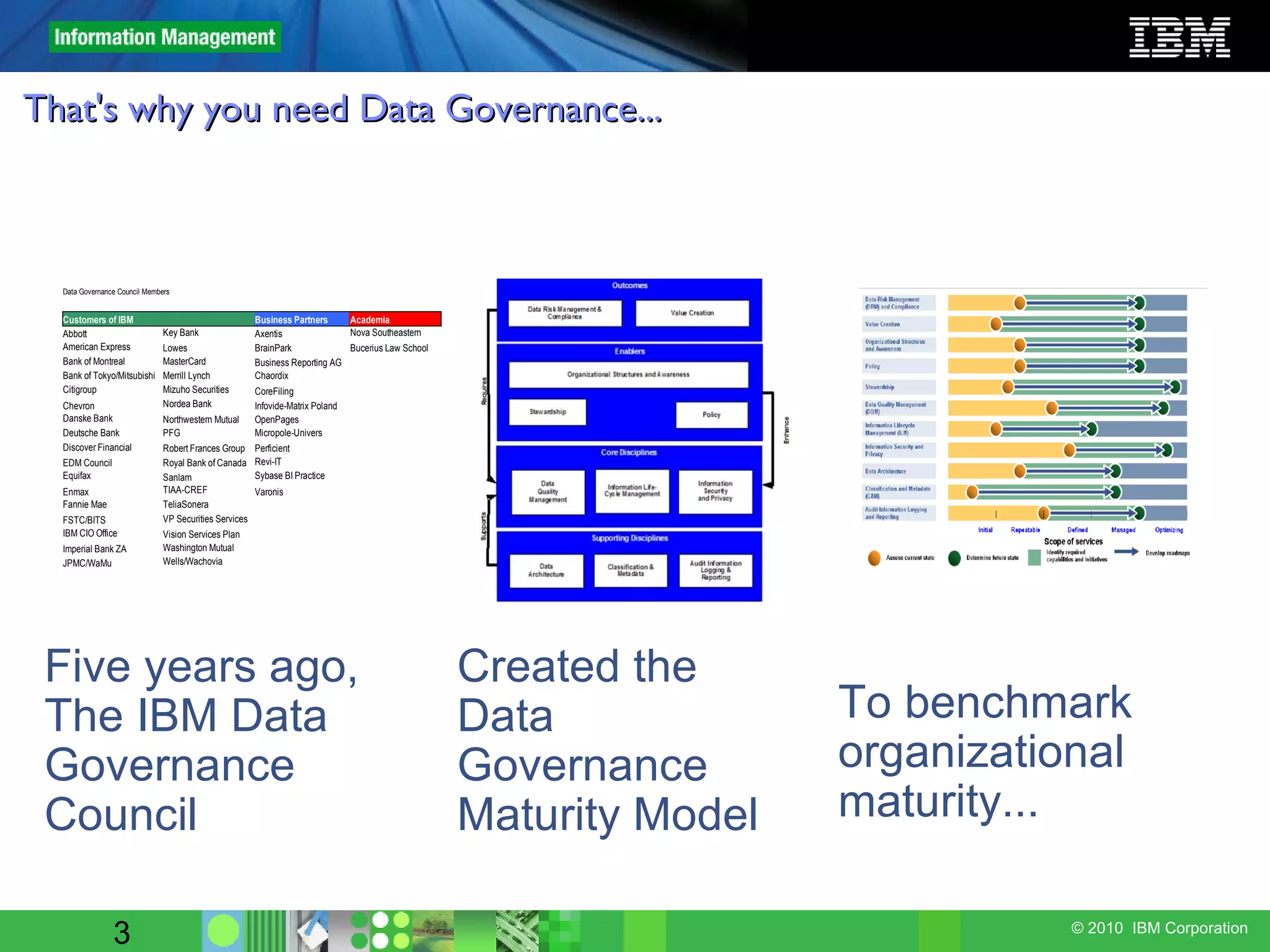
Outcomes That's why you need Data Governance... Five years ago, The IBM Data Governance Council Created the Data Governance Maturity Model To benchmark organizational maturity...
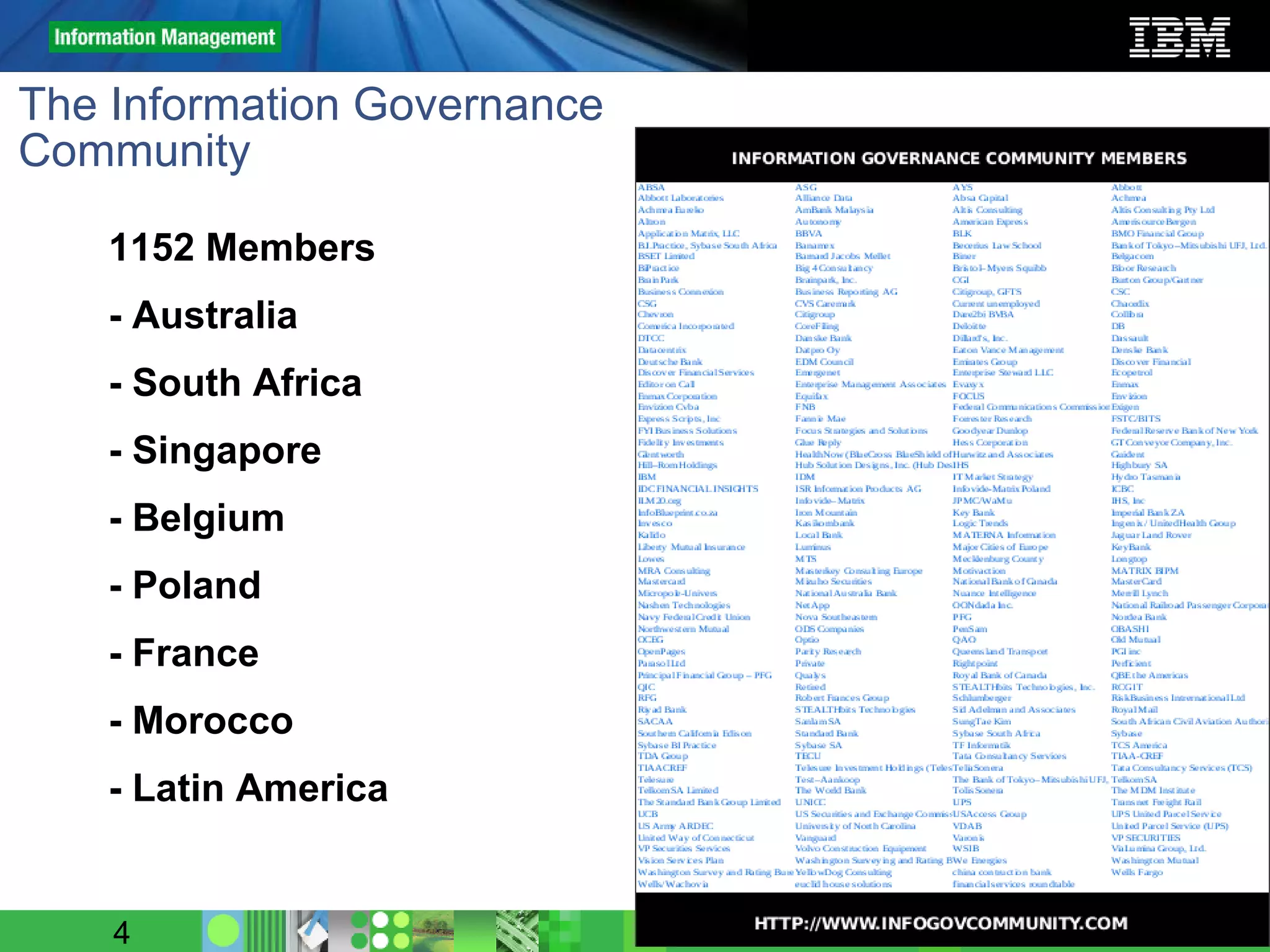
The Information Governance  Community 1152 Members - Australia - South Africa - Singapore - Belgium - Poland - France - Morocco - Latin America
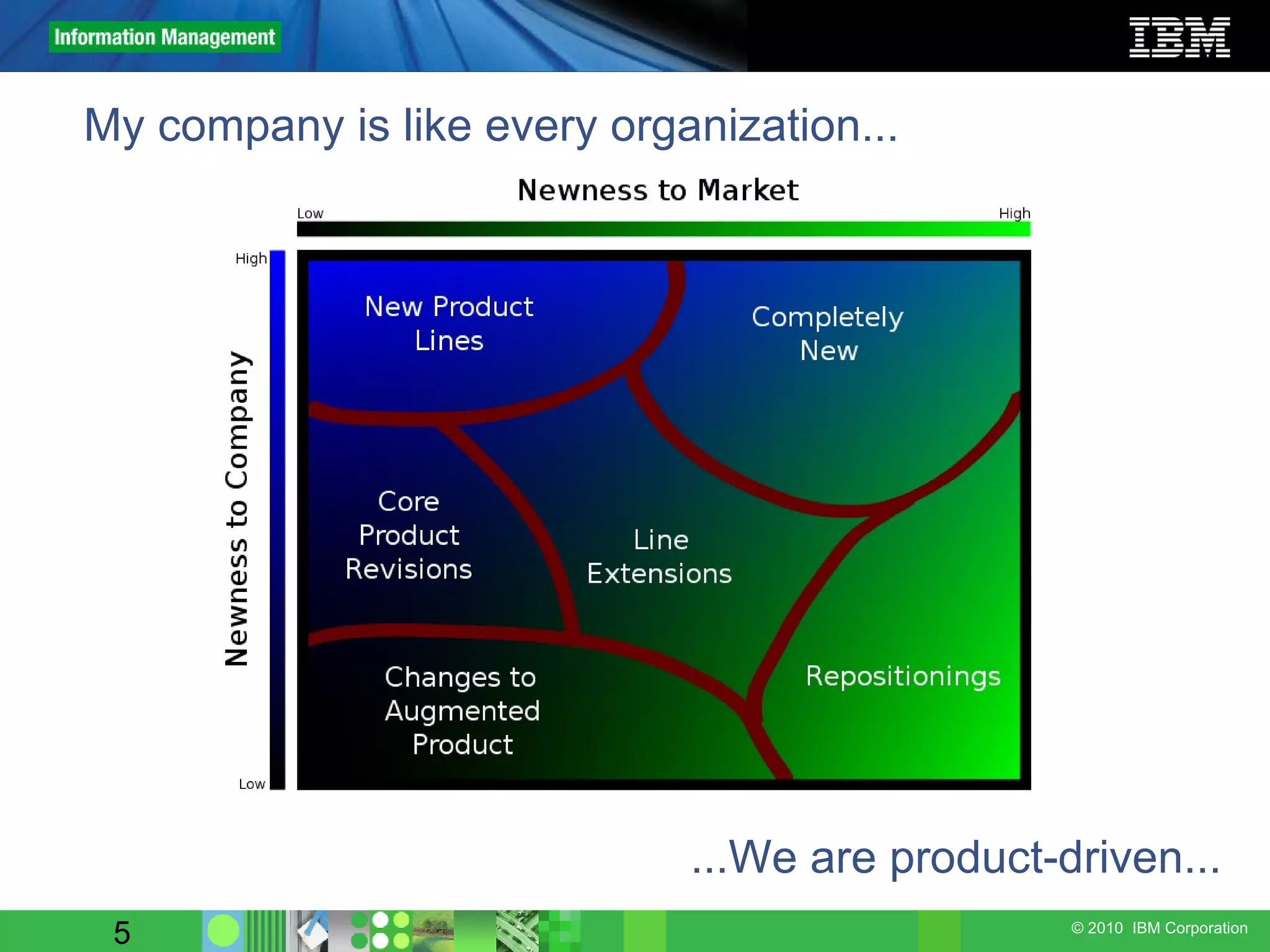
My company is like every organization... ...We are product-driven...
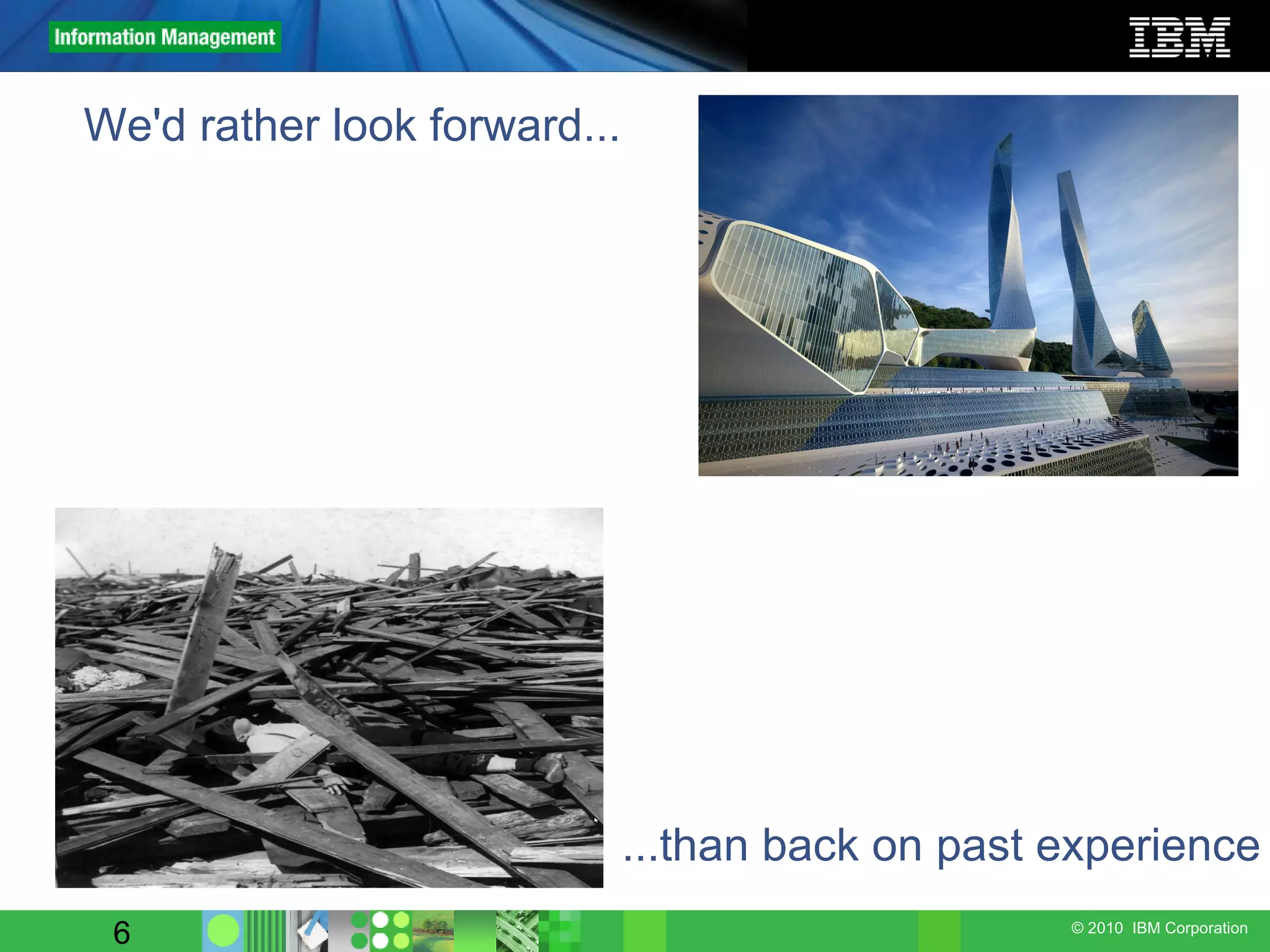
We'd rather look forward... ...than back on past experience
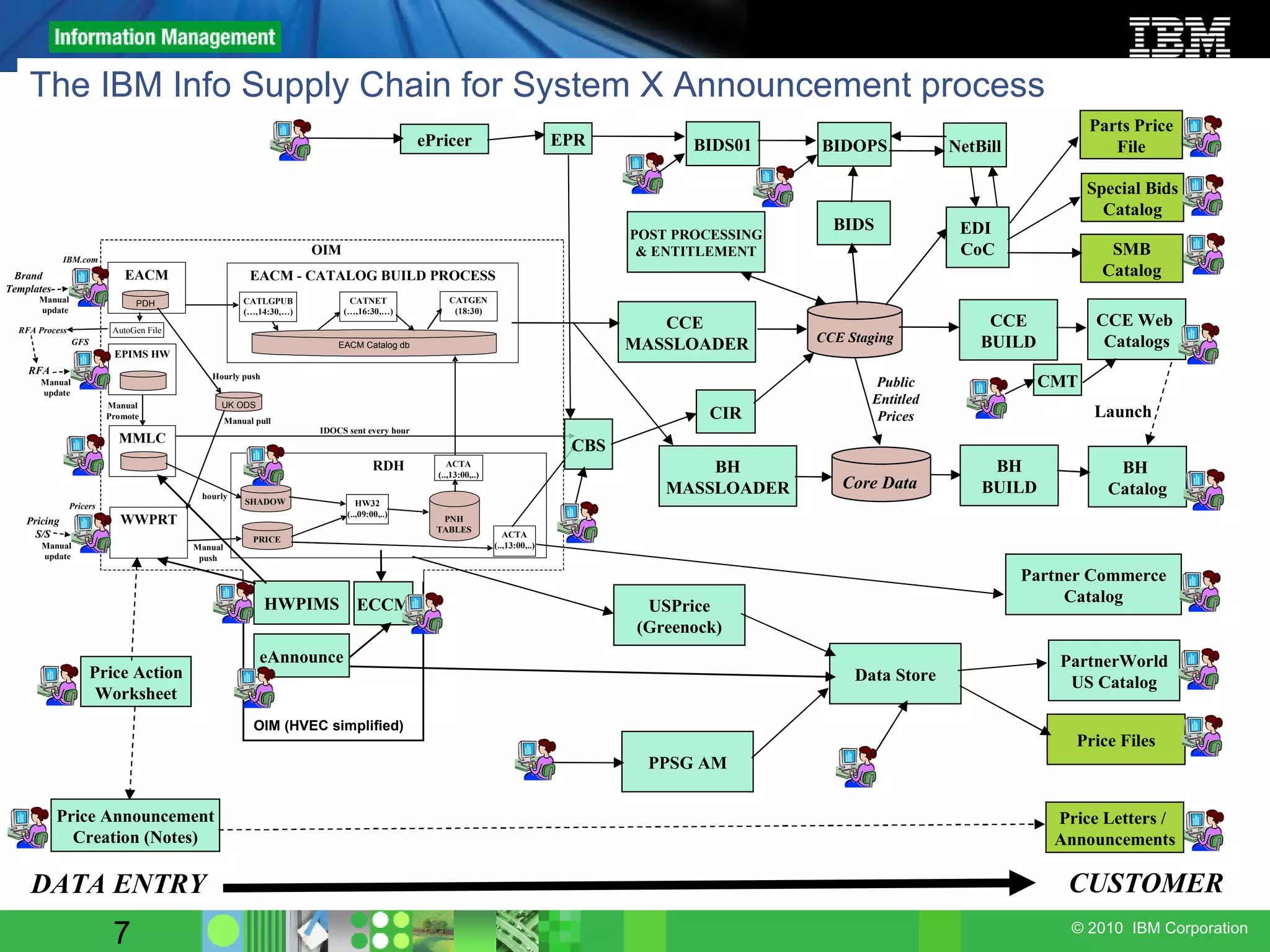
The IBM Info Supply Chain for System X Announcement process CBS CCE  MASSLOADER BH MASSLOADER CCE Staging Core Data BH BUILD CCE BUILD BH  Catalog CCE Web  Catalogs EDI  CoC Launch CIR POST PROCESSING & ENTITLEMENT Public Entitled Prices EPR ePricer CMT NetBill BIDOPS BIDS BIDS01 Parts Price File Special Bids Catalog SMB Catalog Price Letters /  Announcements PartnerWorld US Catalog Data Store USPrice (Greenock) PPSG AM Price Files Partner Commerce Catalog DATA ENTRY CUSTOMER Price Action Worksheet Price Announcement Creation (Notes) eAnnounce HWPIMS ECCM OIM (HVEC simplified)
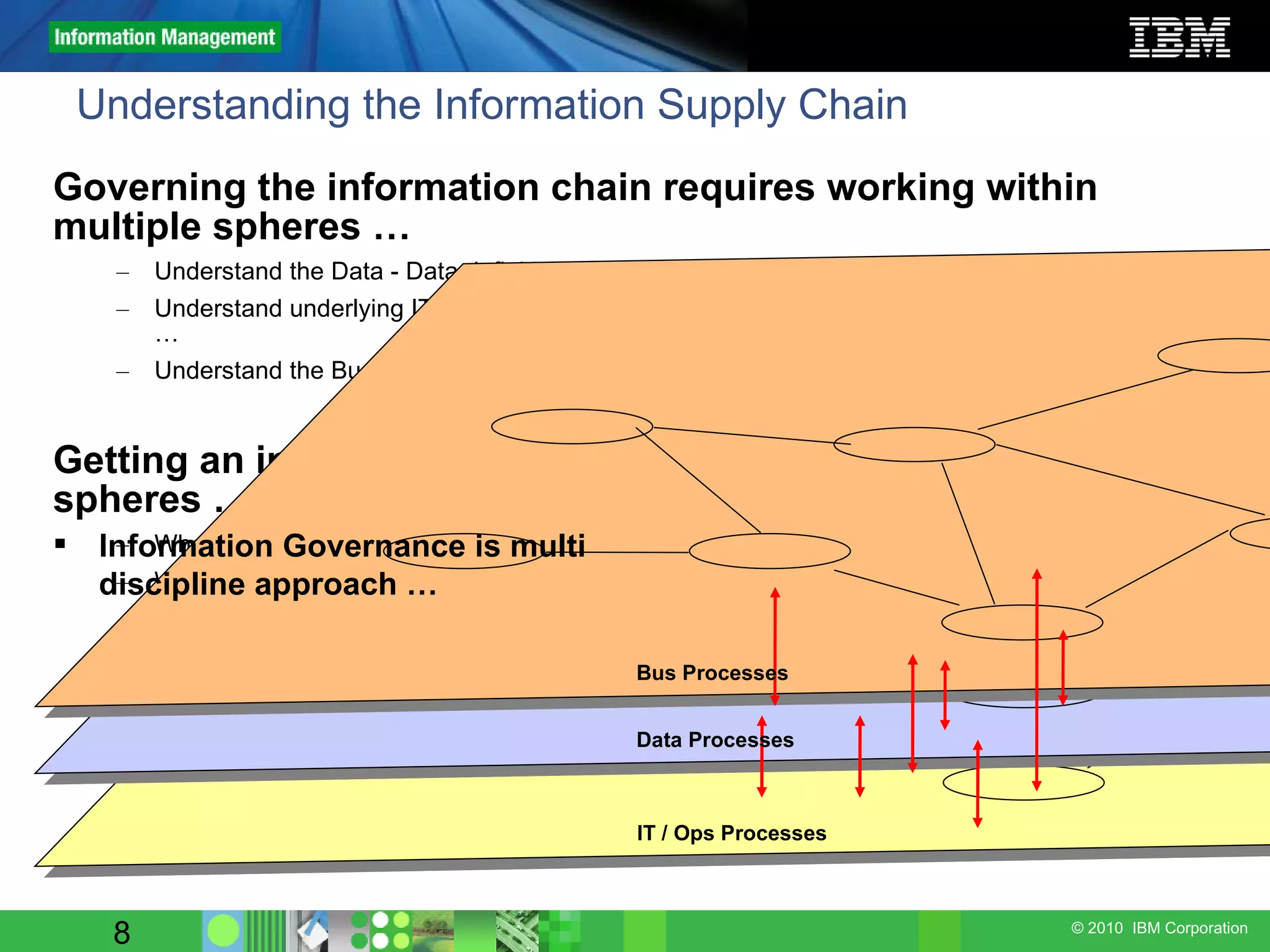
Understanding the Information Supply Chain  Governing the information chain requires working within multiple spheres … Understand the Data - Data definitions, Data flows, transformations, integrations… Understand underlying IT – System flows, Data structures, Interfaces, Service Level Agreements  … Understand the Business Process – Data entry, enrichment, business rules, decisions … Getting an integrated view of the Data / IT / Business Process spheres … Where is or Who has the knowledge – decide on  how to capture, make it available and maintain  What level of granularity level is practical  – iterative approach and deep dive as needed  Information Governance is multi discipline approach … Bus Processes  Data Processes IT / Ops Processes
We all share the same challenge... ...To become Data Driven Organizations
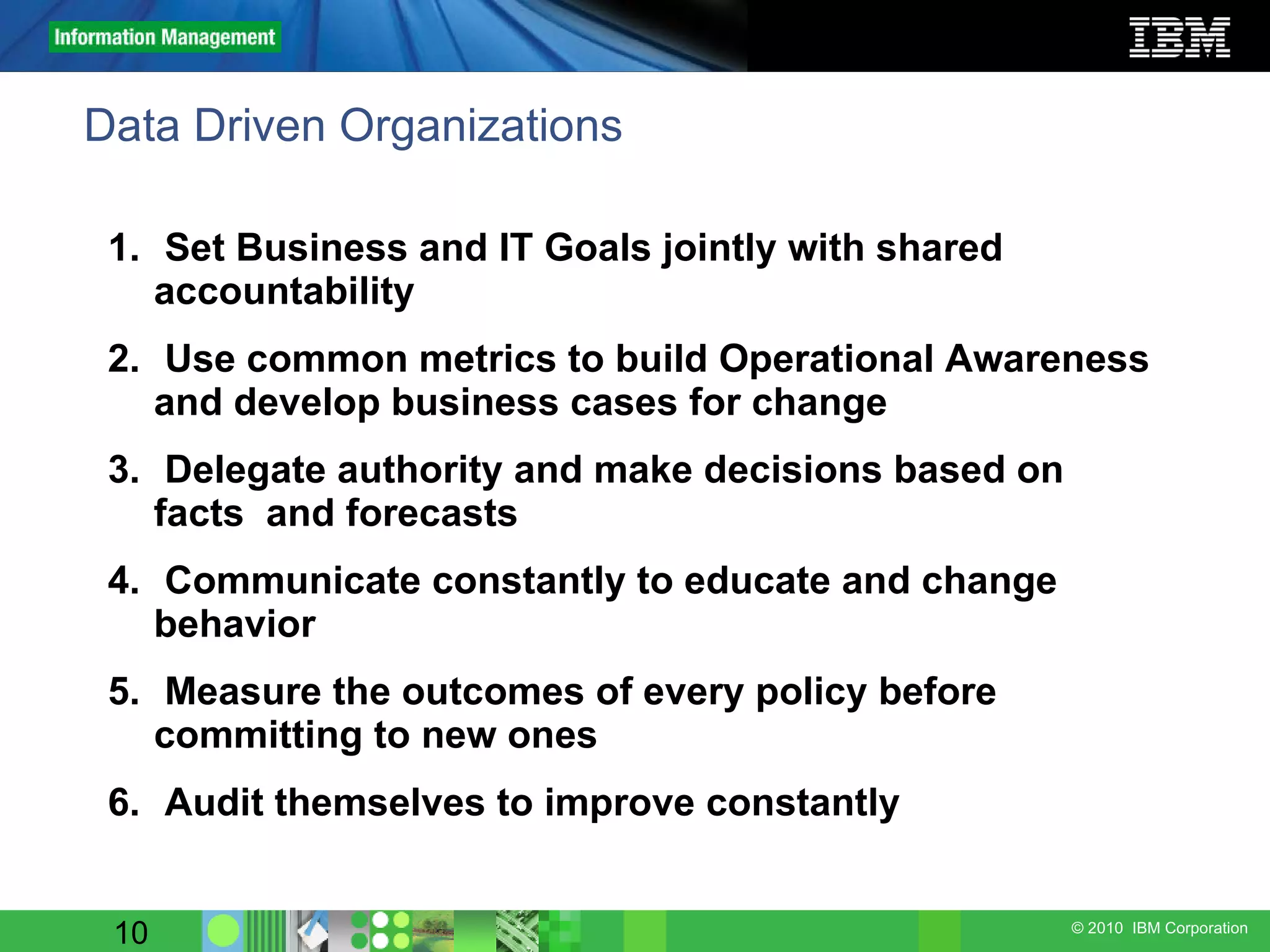
Data Driven Organizations Set Business and IT Goals jointly with shared accountability Use common metrics to build Operational Awareness and develop business cases for change Delegate authority and make decisions based on facts  and forecasts Communicate constantly to educate and change behavior Measure the outcomes of every policy before committing to new ones Audit themselves to improve constantly
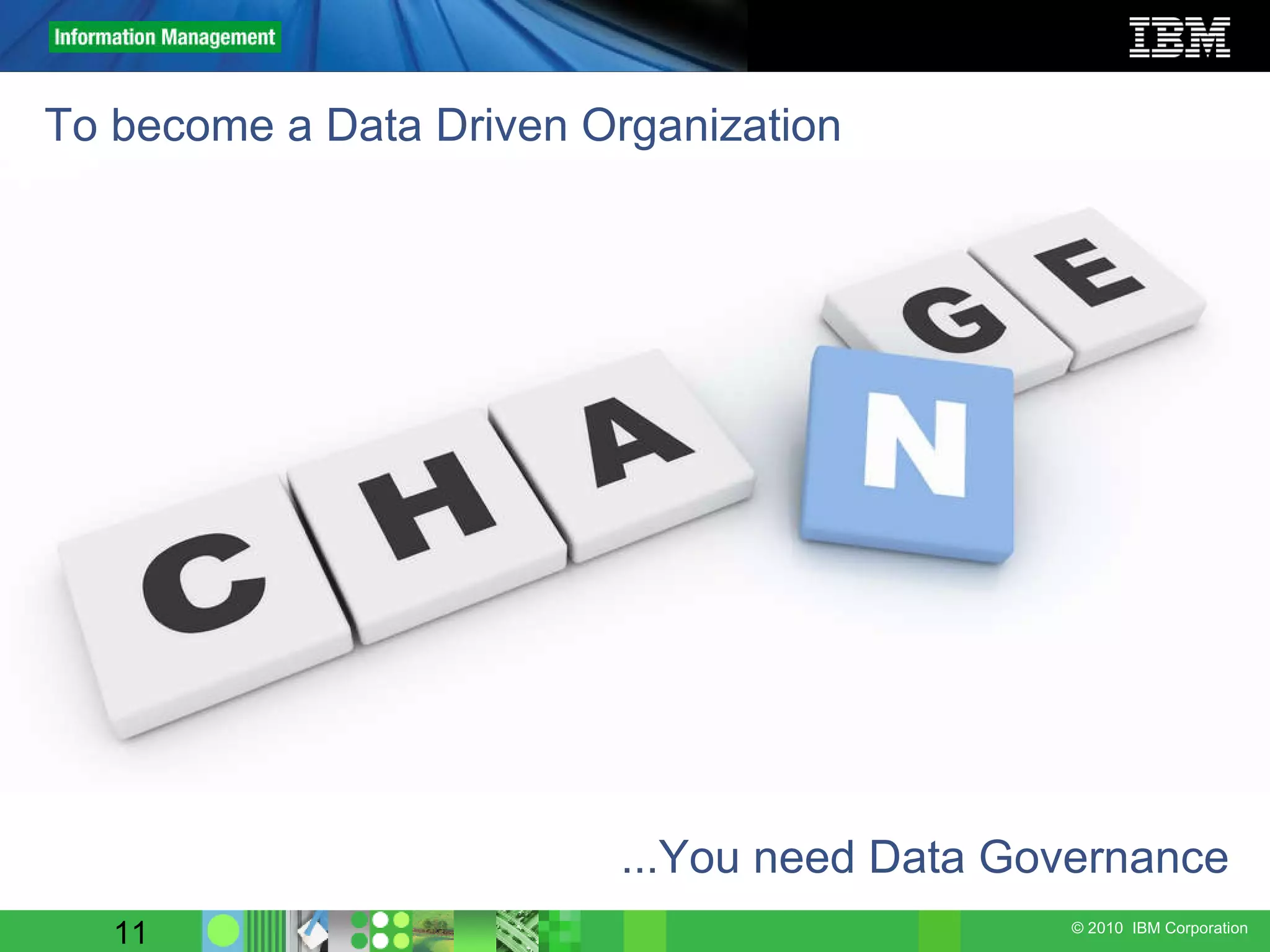
To become a Data Driven Organization ...You need Data Governance
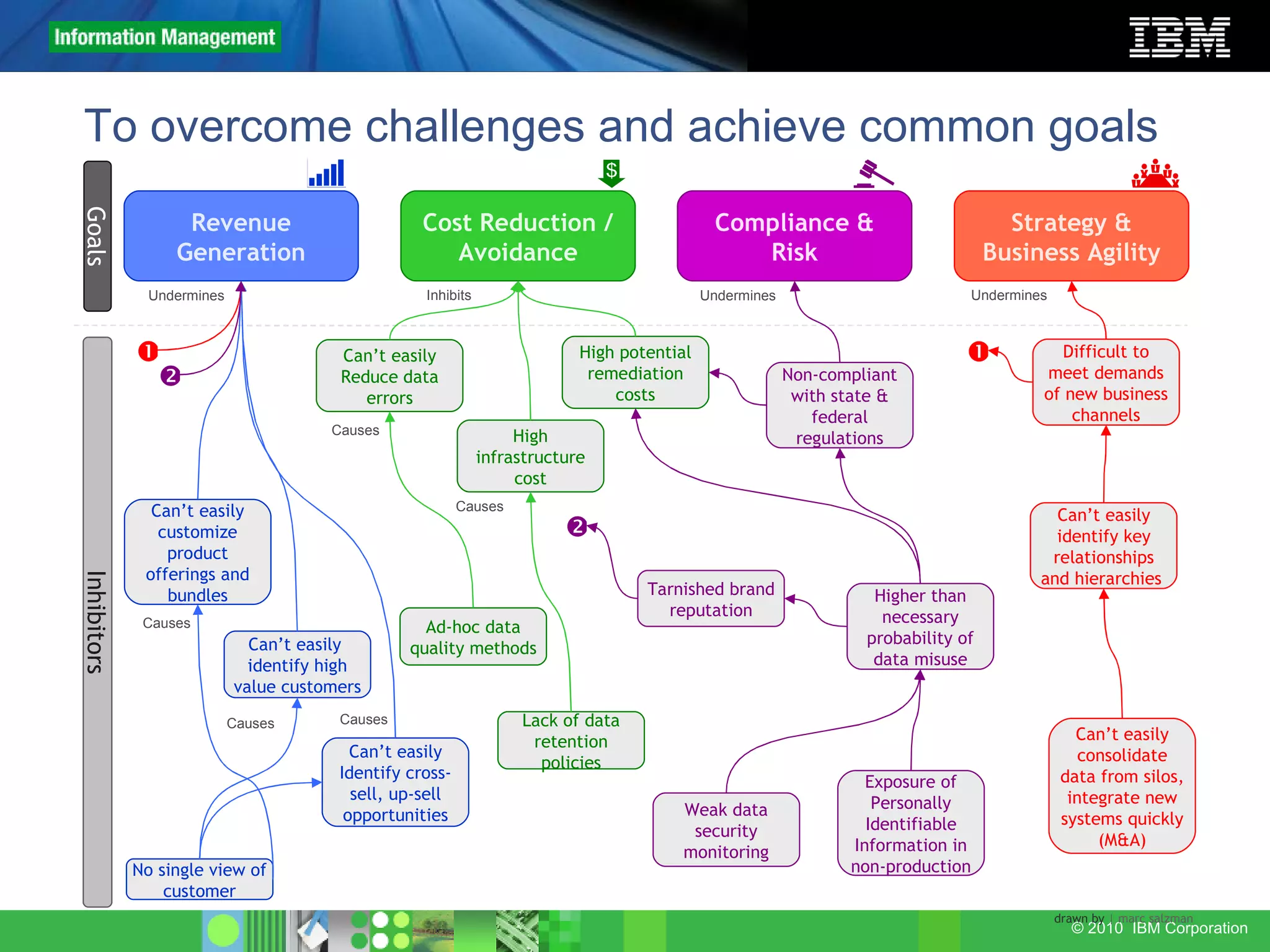
To overcome challenges and achieve common goals Revenue Generation Strategy & Business Agility Cost Reduction / Avoidance Compliance & Risk Goals Inhibitors Can’t easily customize product offerings and bundles No single view of customer Undermines Causes Can’t easily Identify cross-sell, up-sell opportunities Can’t easily  identify high value customers Causes Causes Can’t easily Reduce data errors Ad-hoc data quality methods Lack of data retention policies High infrastructure cost Causes Causes Inhibits Weak data security monitoring Exposure of Personally Identifiable Information in non-production Higher than necessary probability of data misuse Difficult to meet demands of new business channels Non-compliant with state & federal regulations High potential remediation costs Undermines Tarnished brand reputation Can’t easily identify key relationships and hierarchies  Can’t easily consolidate data from silos, integrate new systems quickly (M&A) Undermines     drawn by  | marc salzman
Governance is the Activity of Coordinating Communication To Achieve  Collective Goals Through  Collaboration
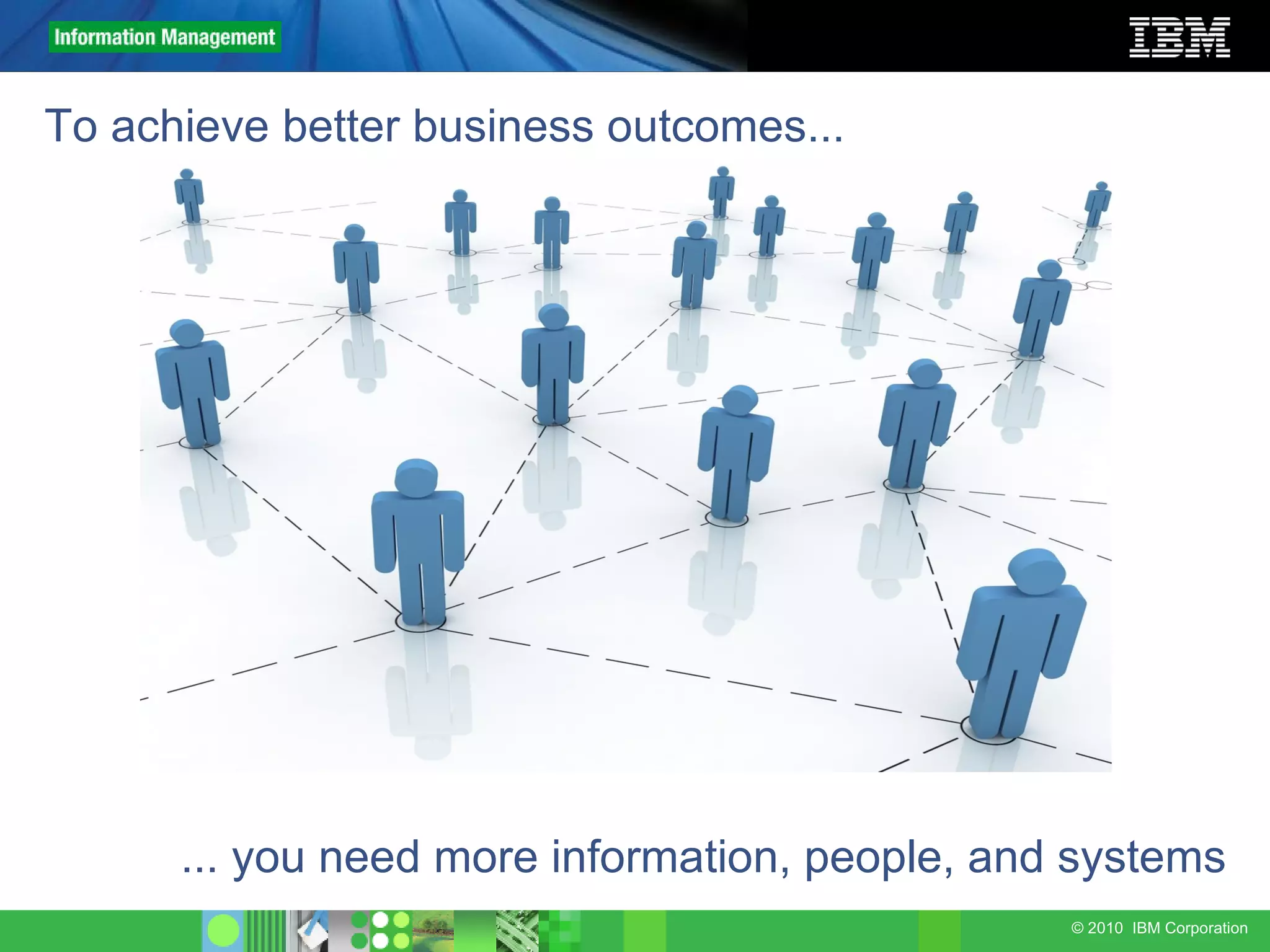
To achieve better business outcomes... ... you need more information, people, and systems
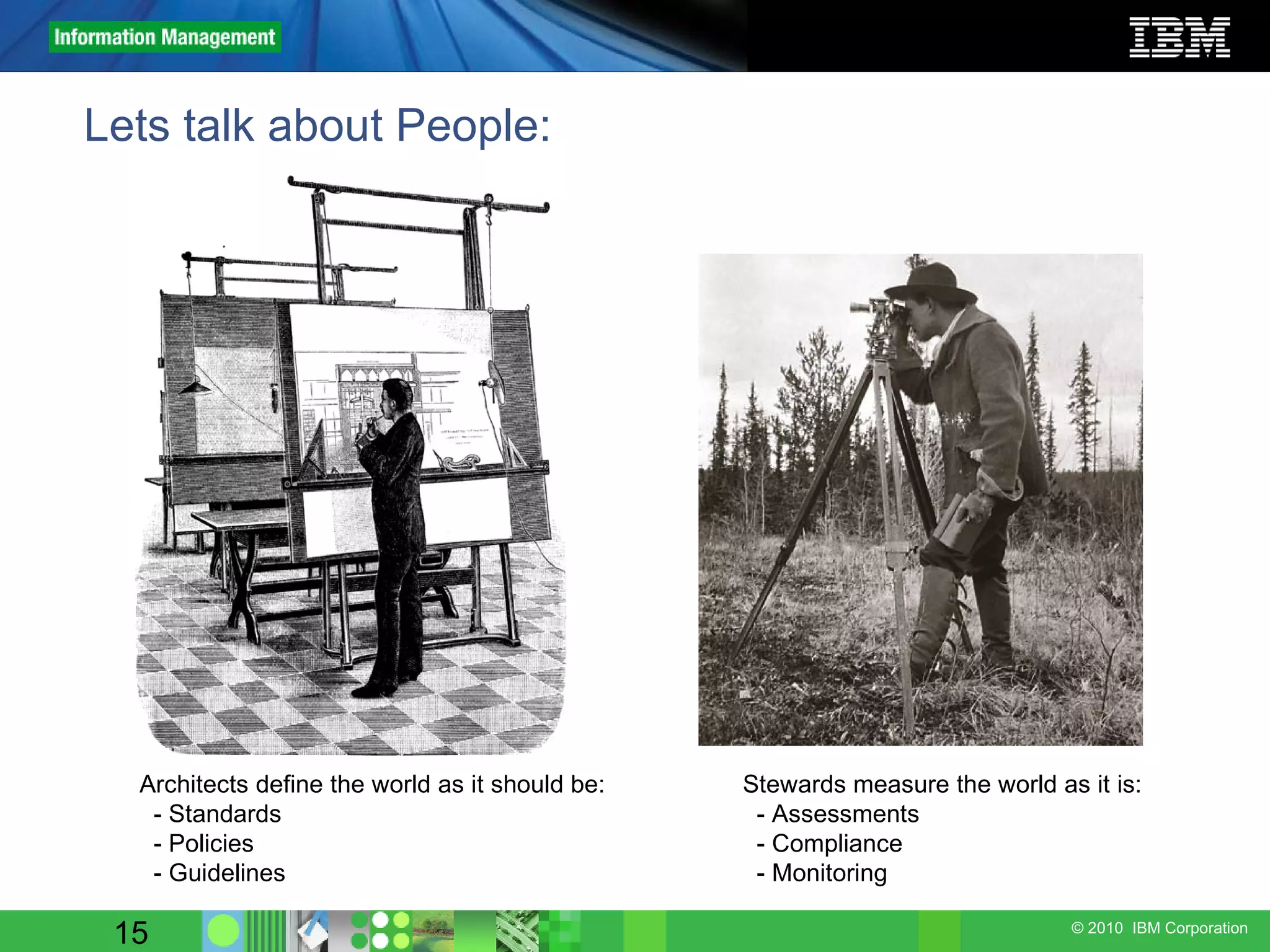
Lets talk about People: Architects define the world as it should be: - Standards - Policies - Guidelines Stewards measure the world as it is: - Assessments - Compliance - Monitoring
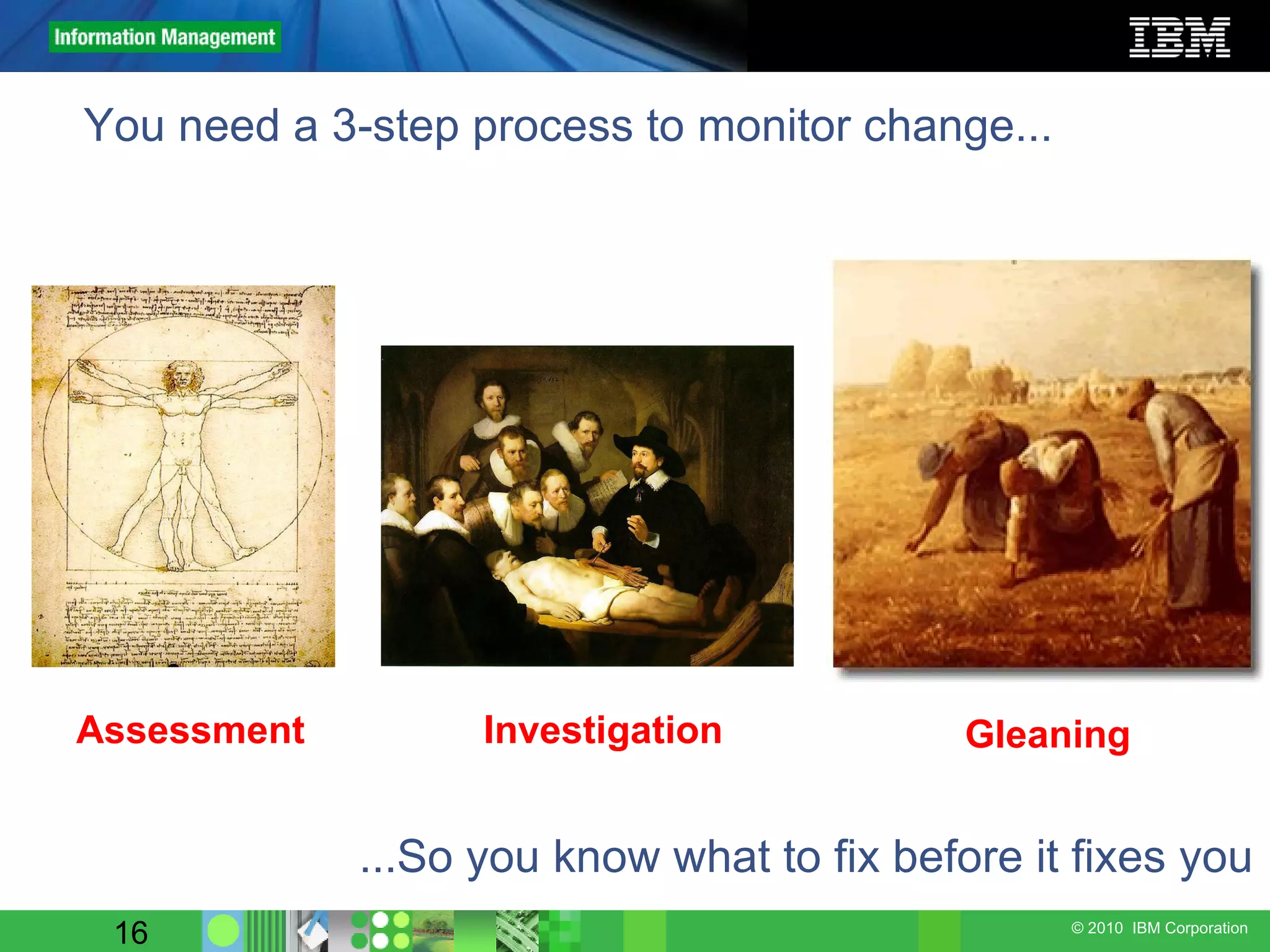
You need a 3-step process to monitor change... ...So you know what to fix before it fixes you Assessment Investigation Gleaning
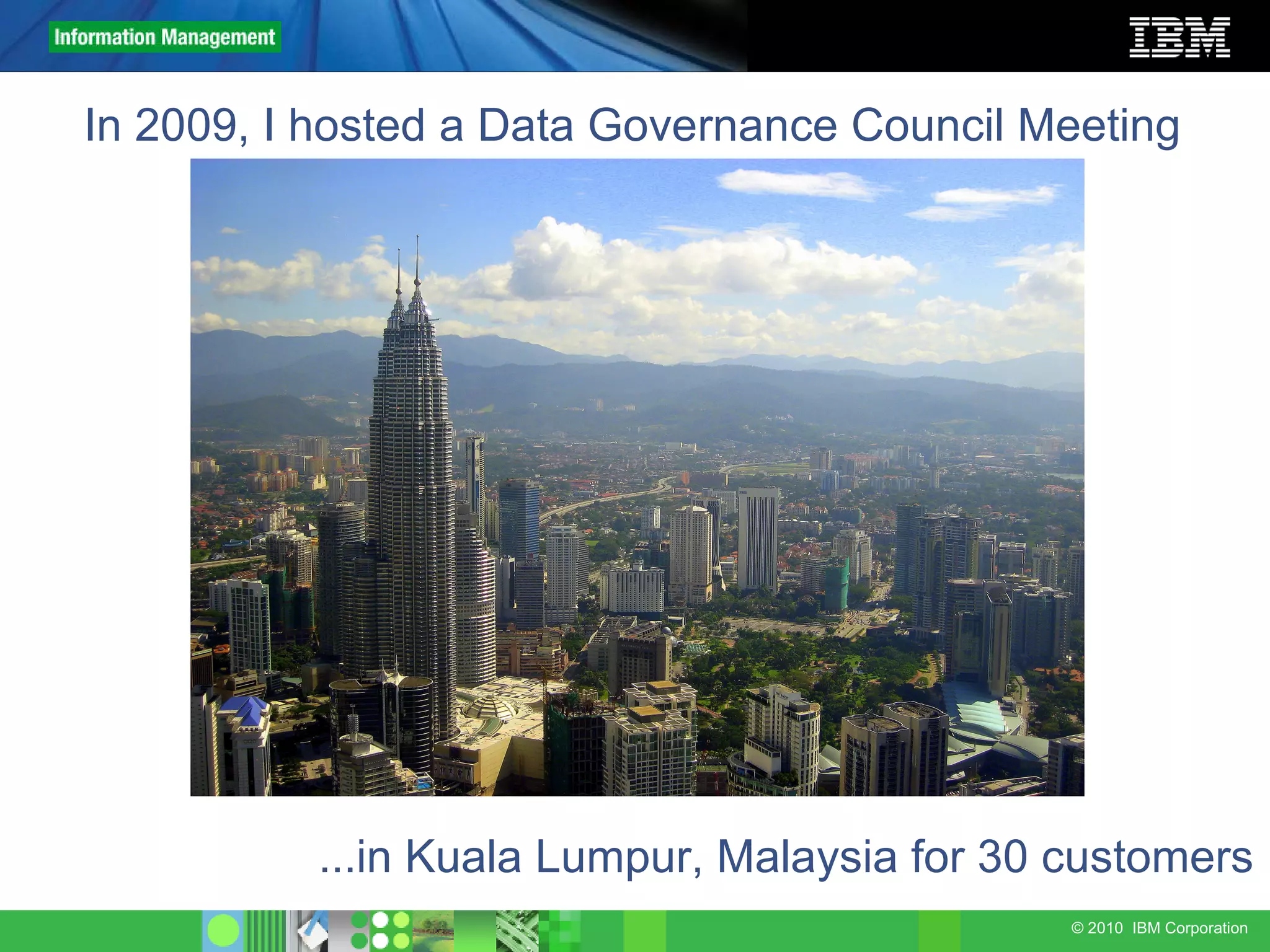
In 2009, I hosted a Data Governance Council Meeting ...in Kuala Lumpur, Malaysia for 30 customers
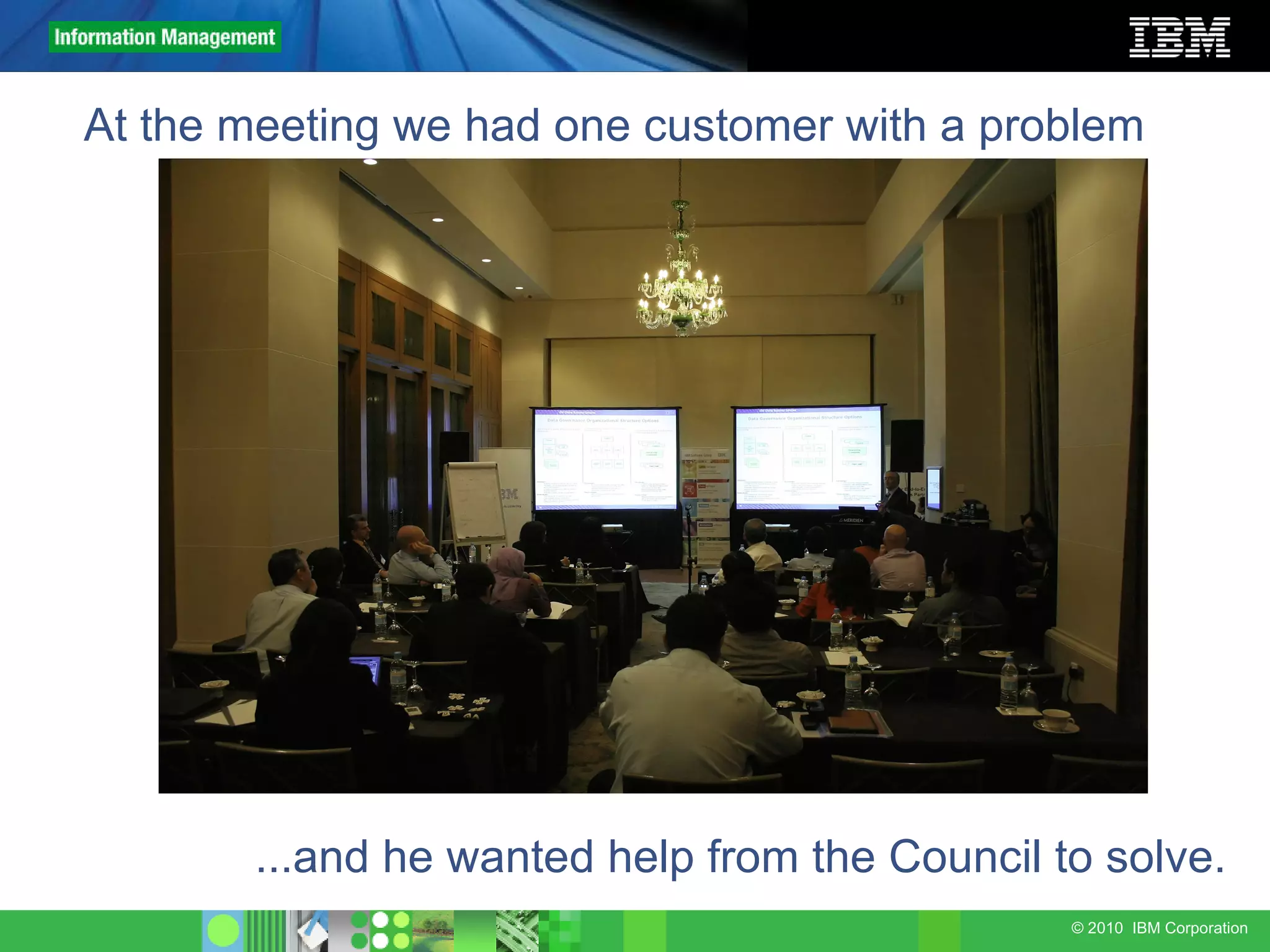
At the meeting we had one customer with a problem ...and he wanted help from the Council to solve.
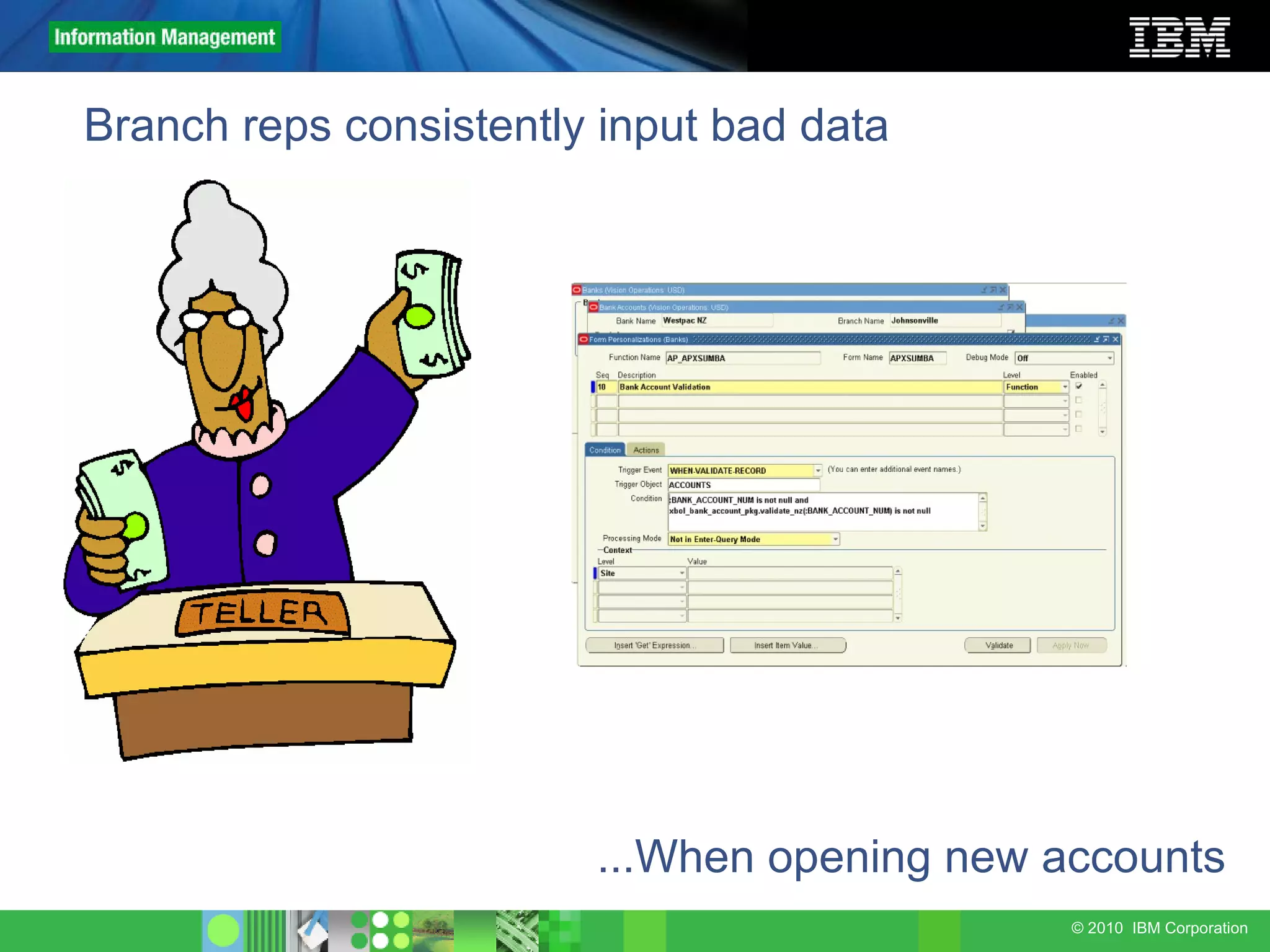
Branch reps consistently input bad data  ...When opening new accounts
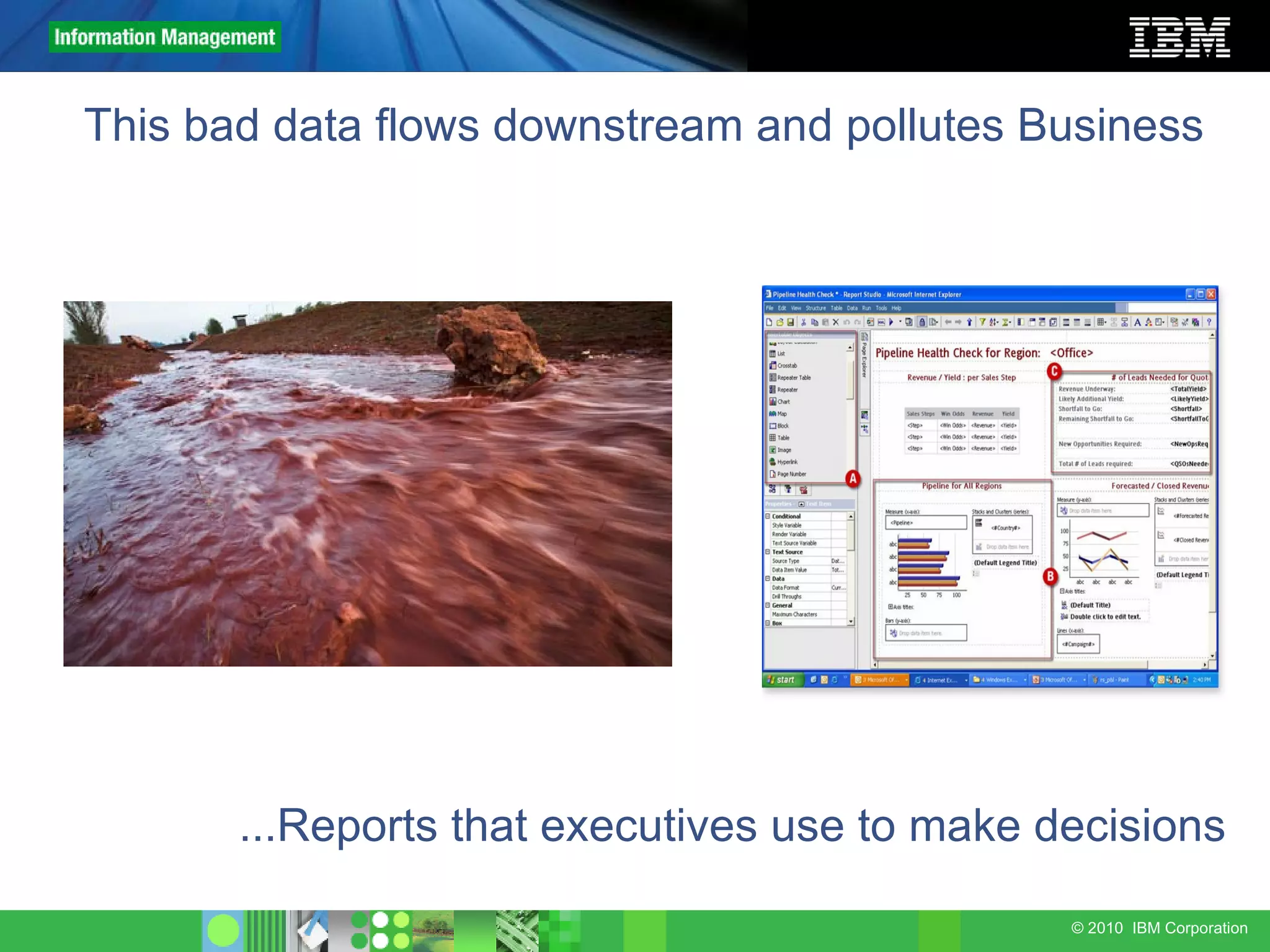
This bad data flows downstream and pollutes Business ...Reports that executives use to make decisions
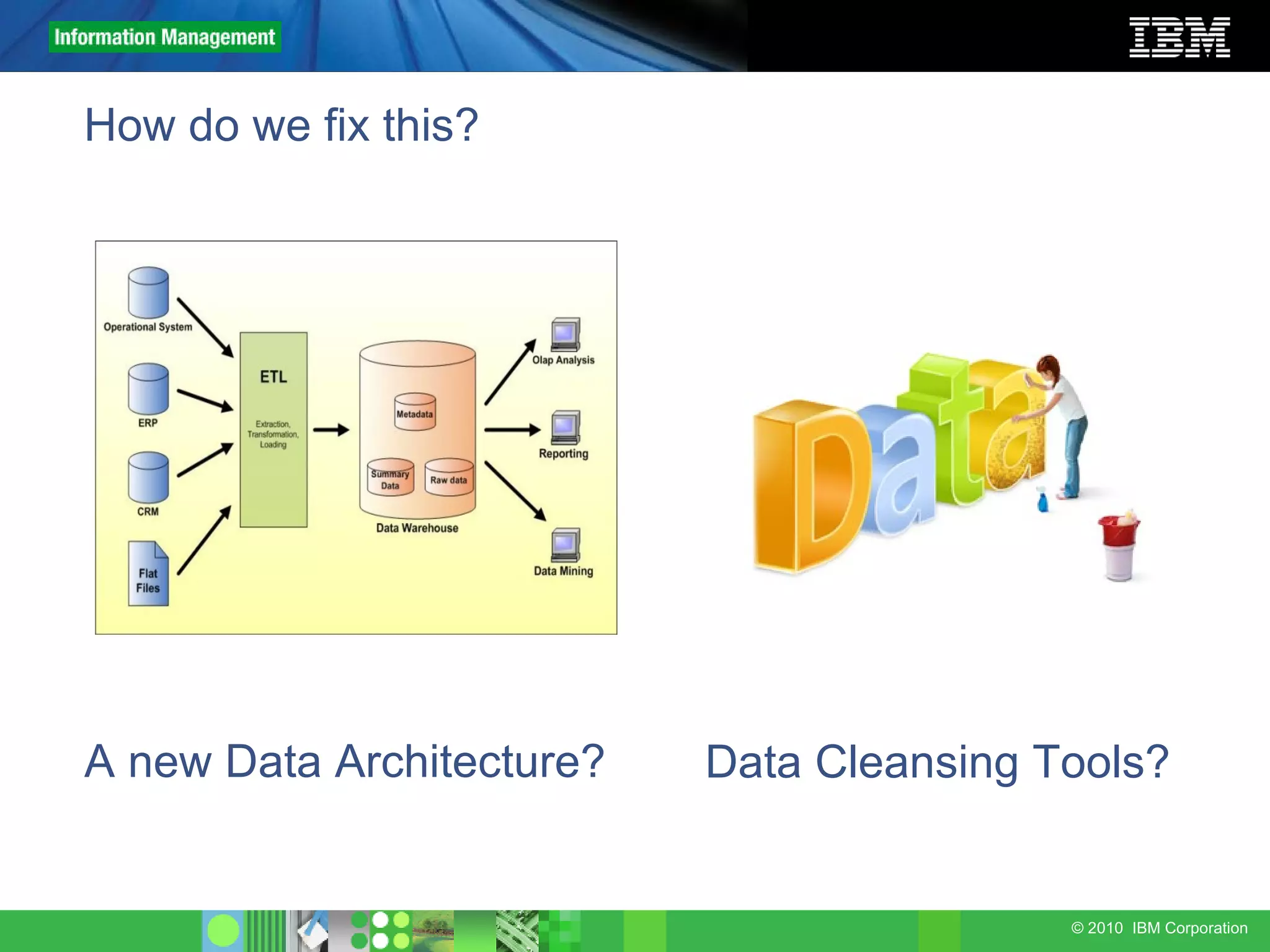
How do we fix this? A new Data Architecture?  Data Cleansing Tools?
We tried all of that...
The next day, a Council Member presented “ ...Yeah, we had that problem.”
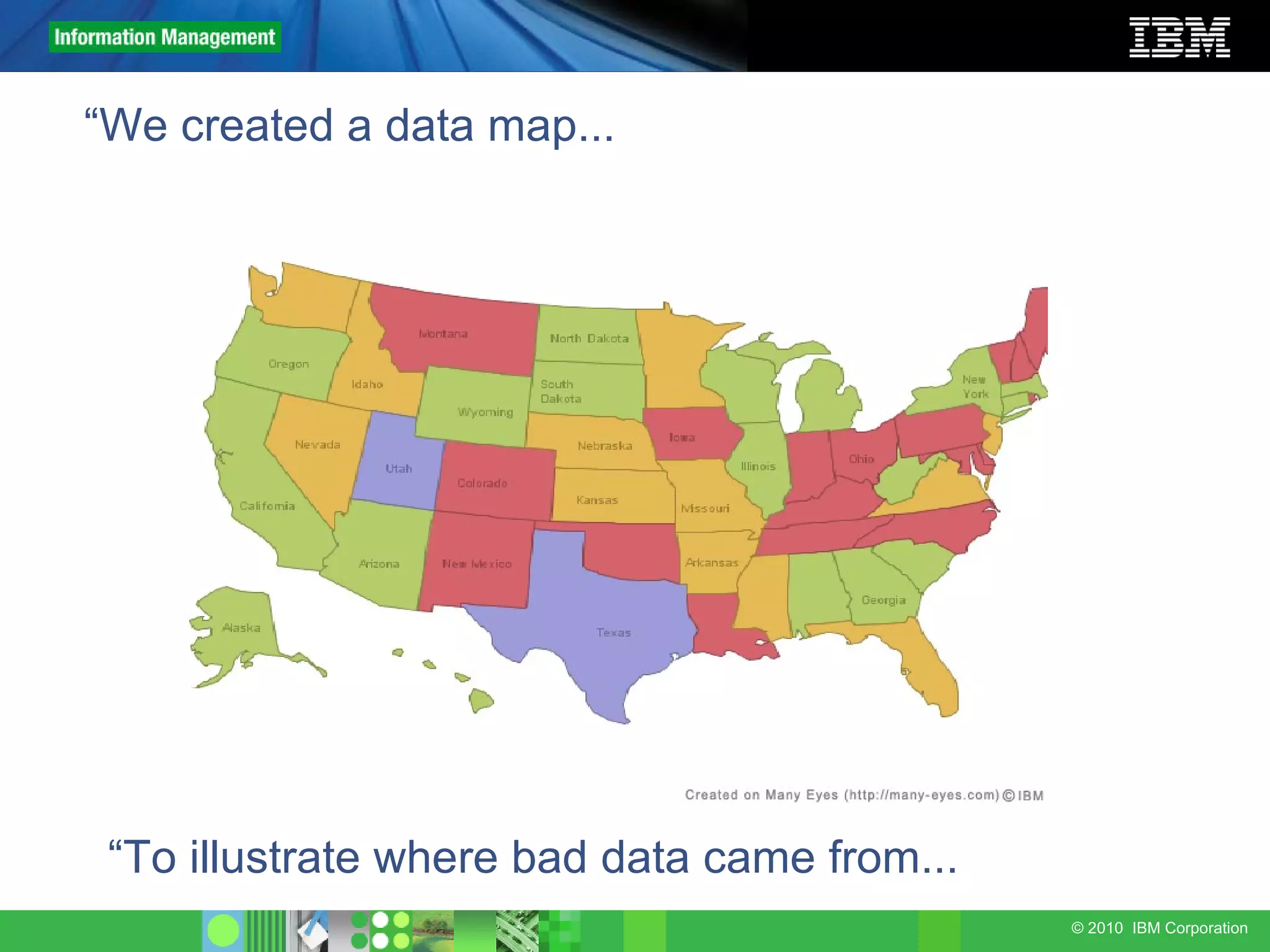
“ We created a data map... “ To illustrate where bad data came from...
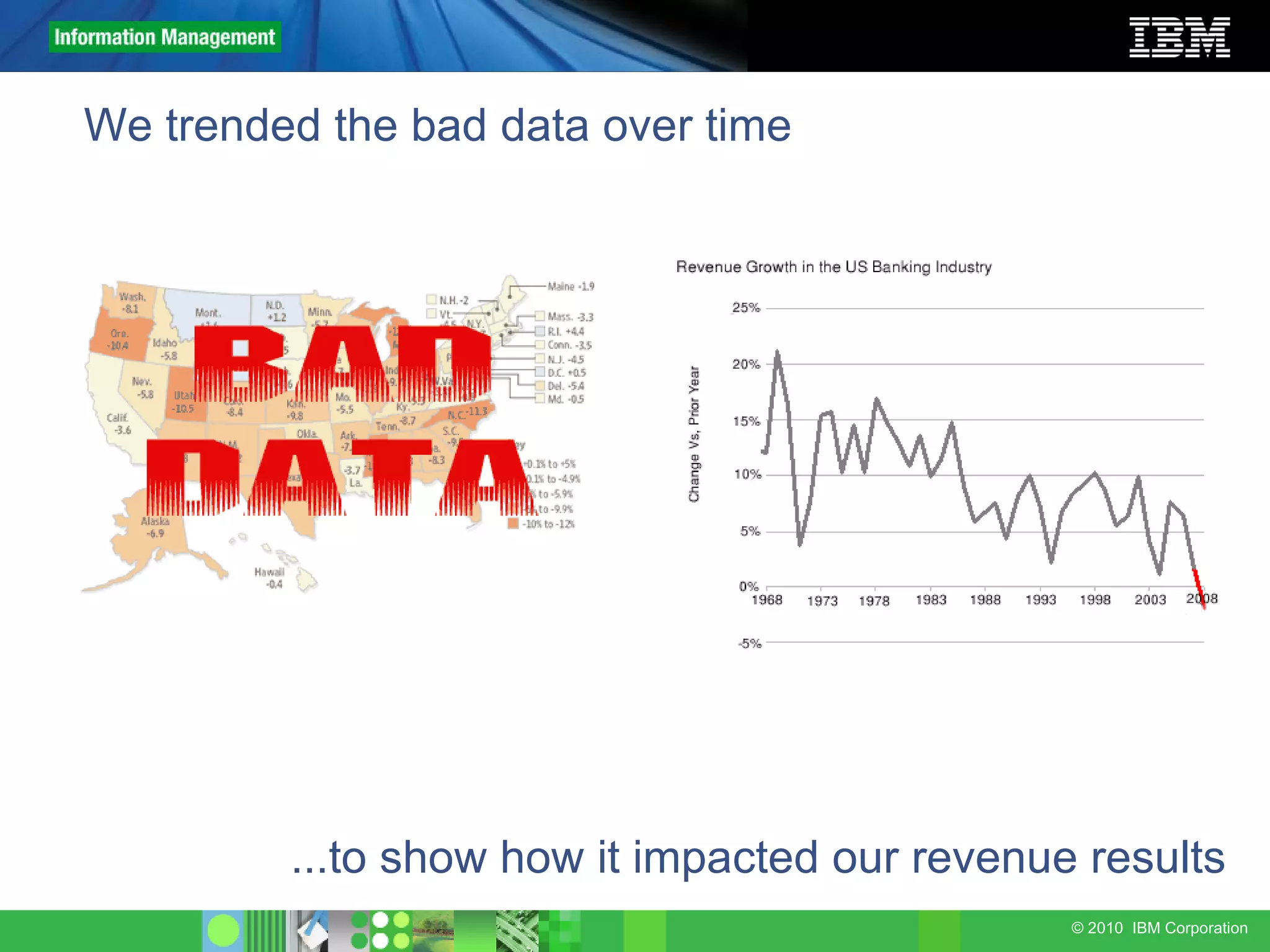
We trended the bad data over time ...to show how it impacted our revenue results
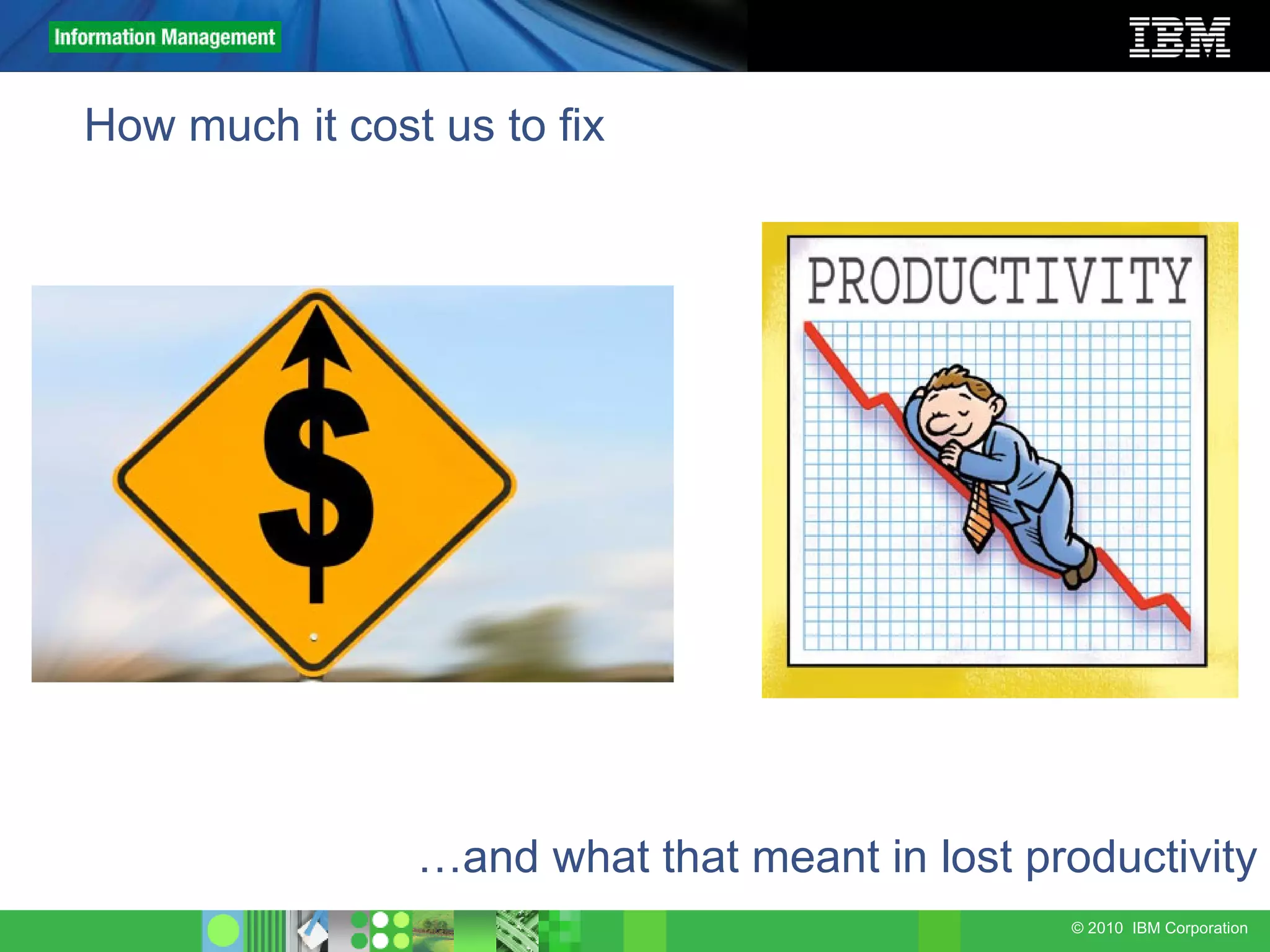
How much it cost us to fix … and what that meant in lost productivity
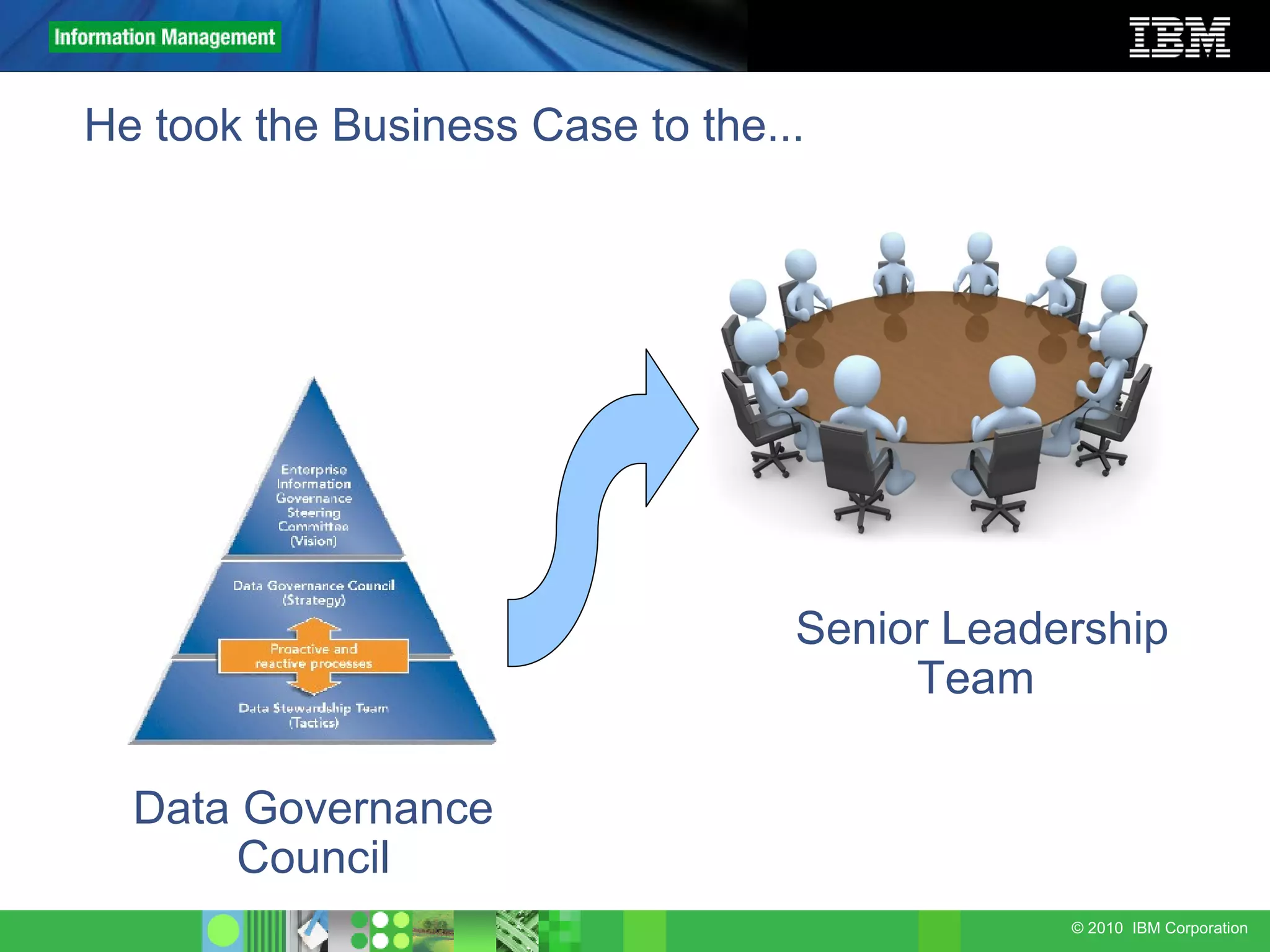
He took the Business Case to the... Data Governance  Council  Senior Leadership Team
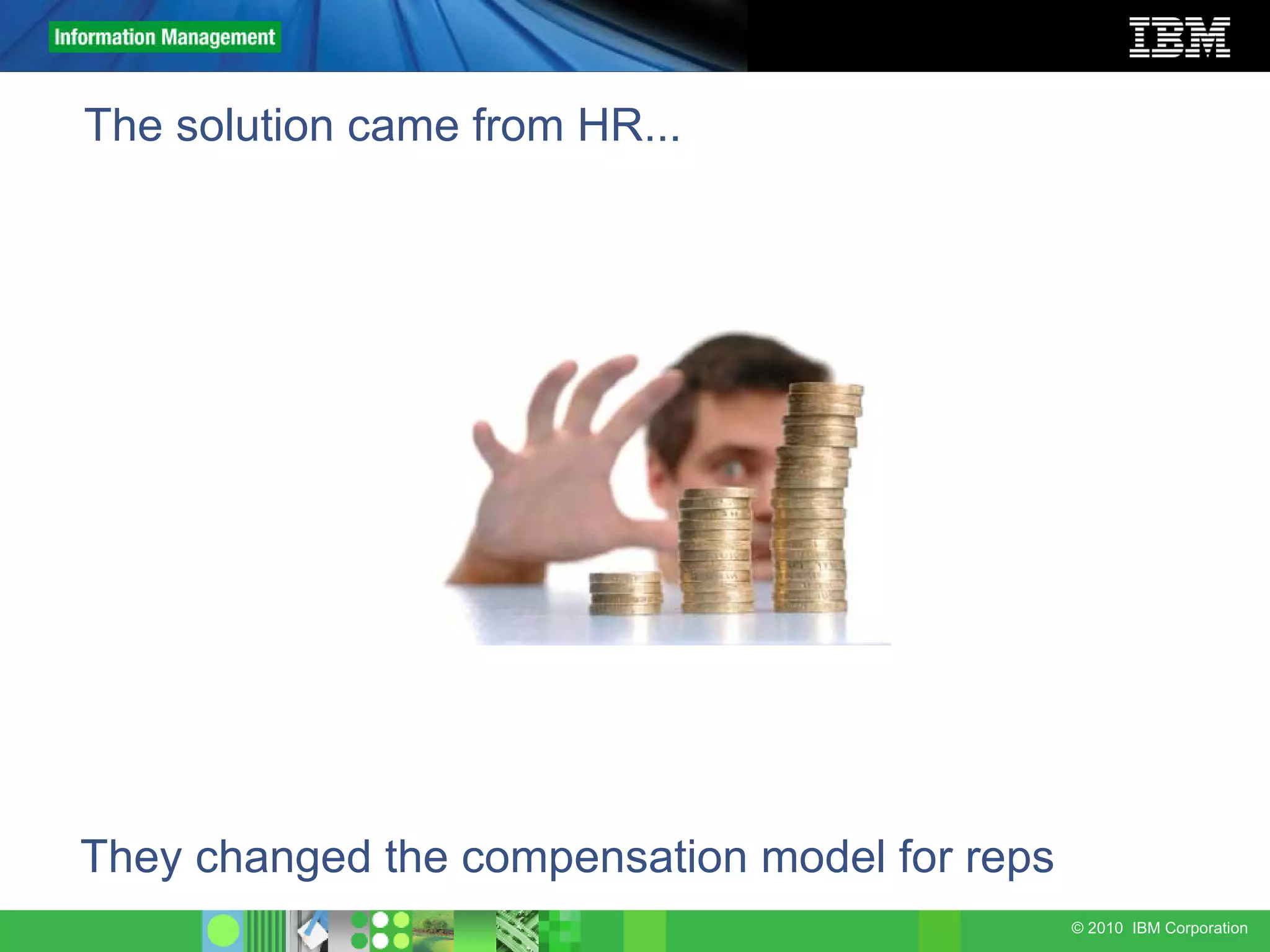
The solution came from HR... They changed the compensation model for reps
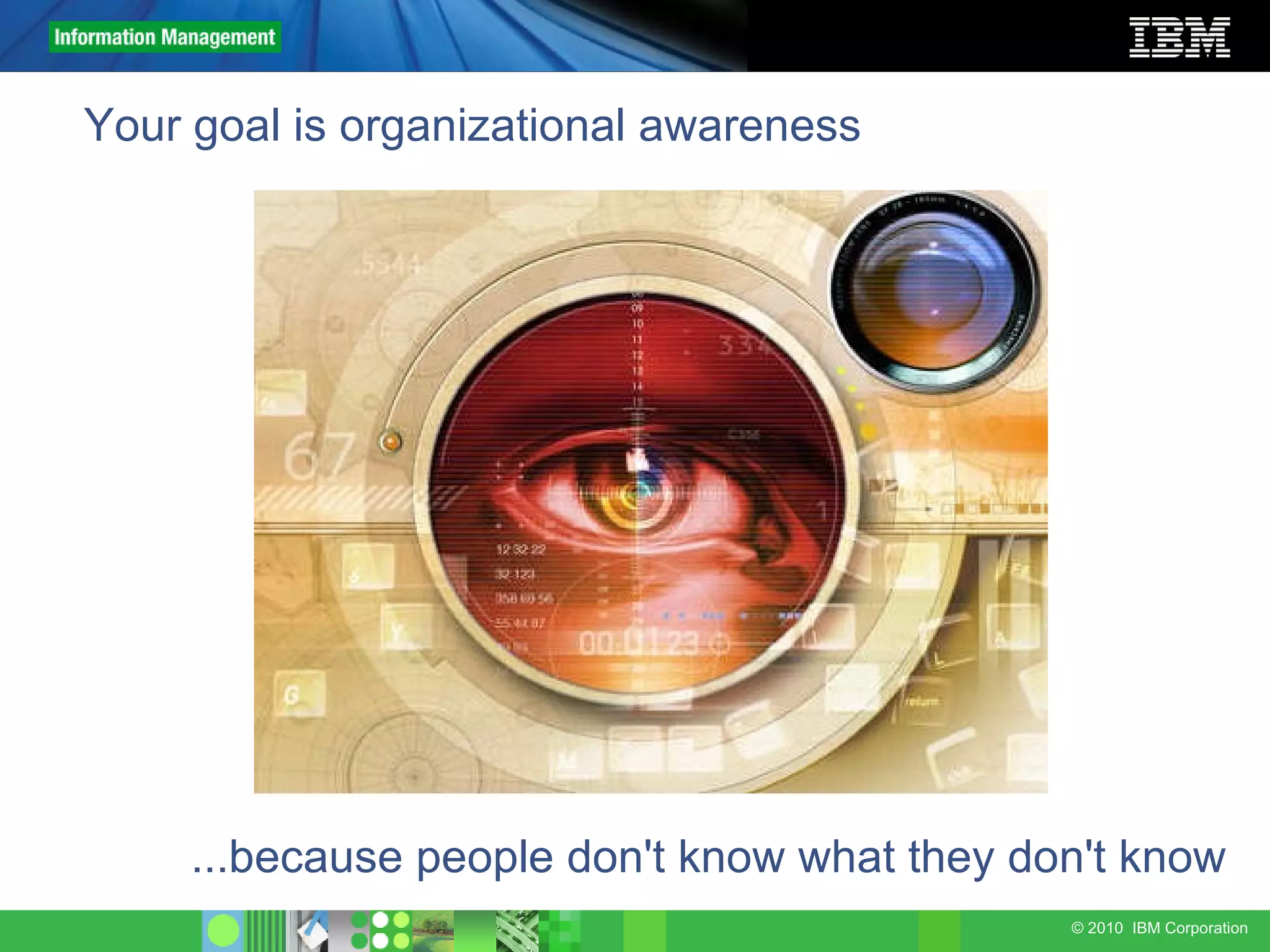
Your goal is organizational awareness ...because people don't know what they don't know
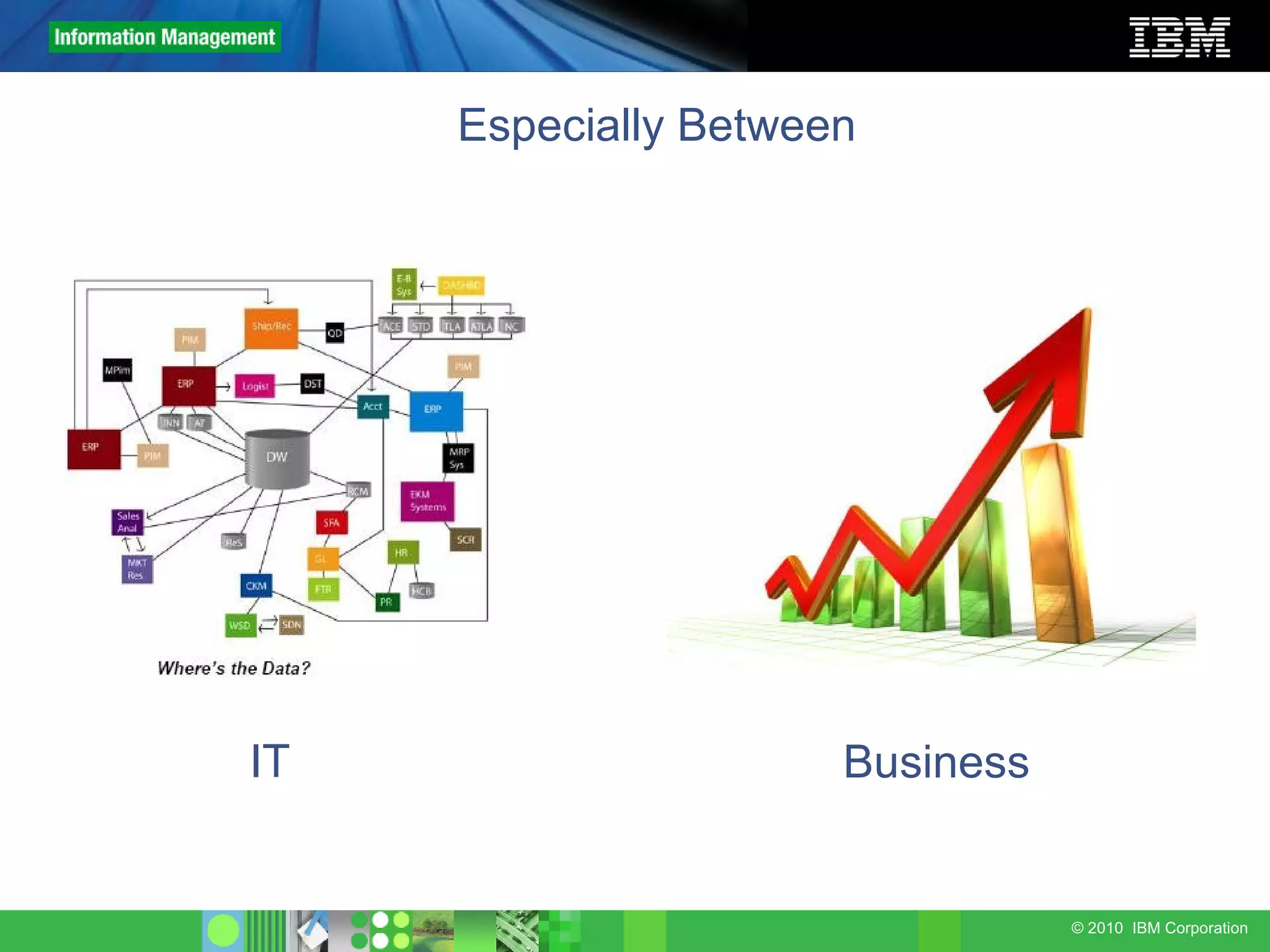
Especially Between IT Business
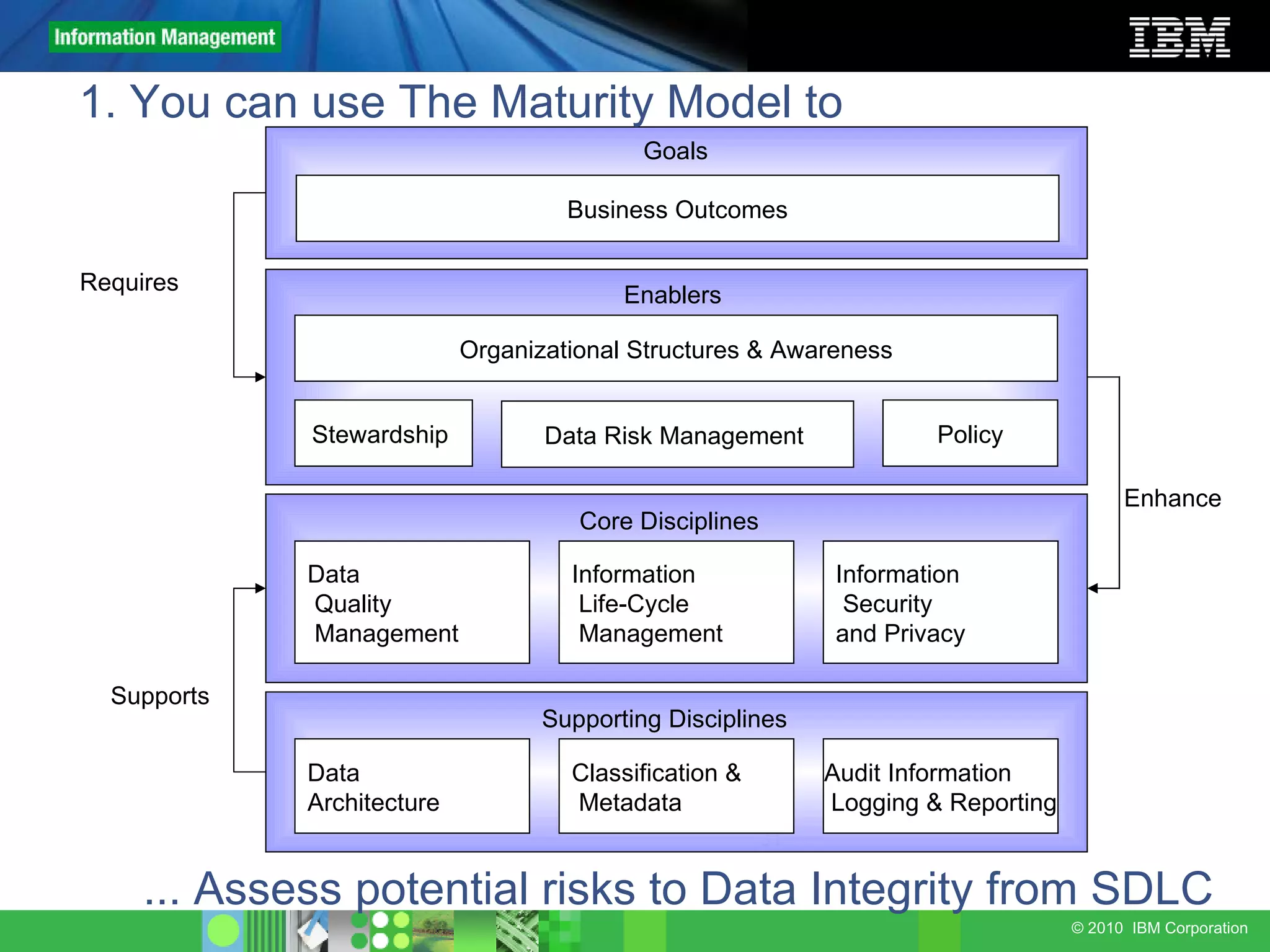
Data Quality Management Information Life-Cycle Management Information Security  and Privacy Core Disciplines Data  Architecture Classification & Metadata Audit Information Logging & Reporting Supporting Disciplines Organizational Structures & Awareness Enablers Stewardship  Policy Requires Supports Enhance Data Risk Management  Business Outcomes Goals 1. You can use The Maturity Model to ... Assess potential risks to Data Integrity from SDLC
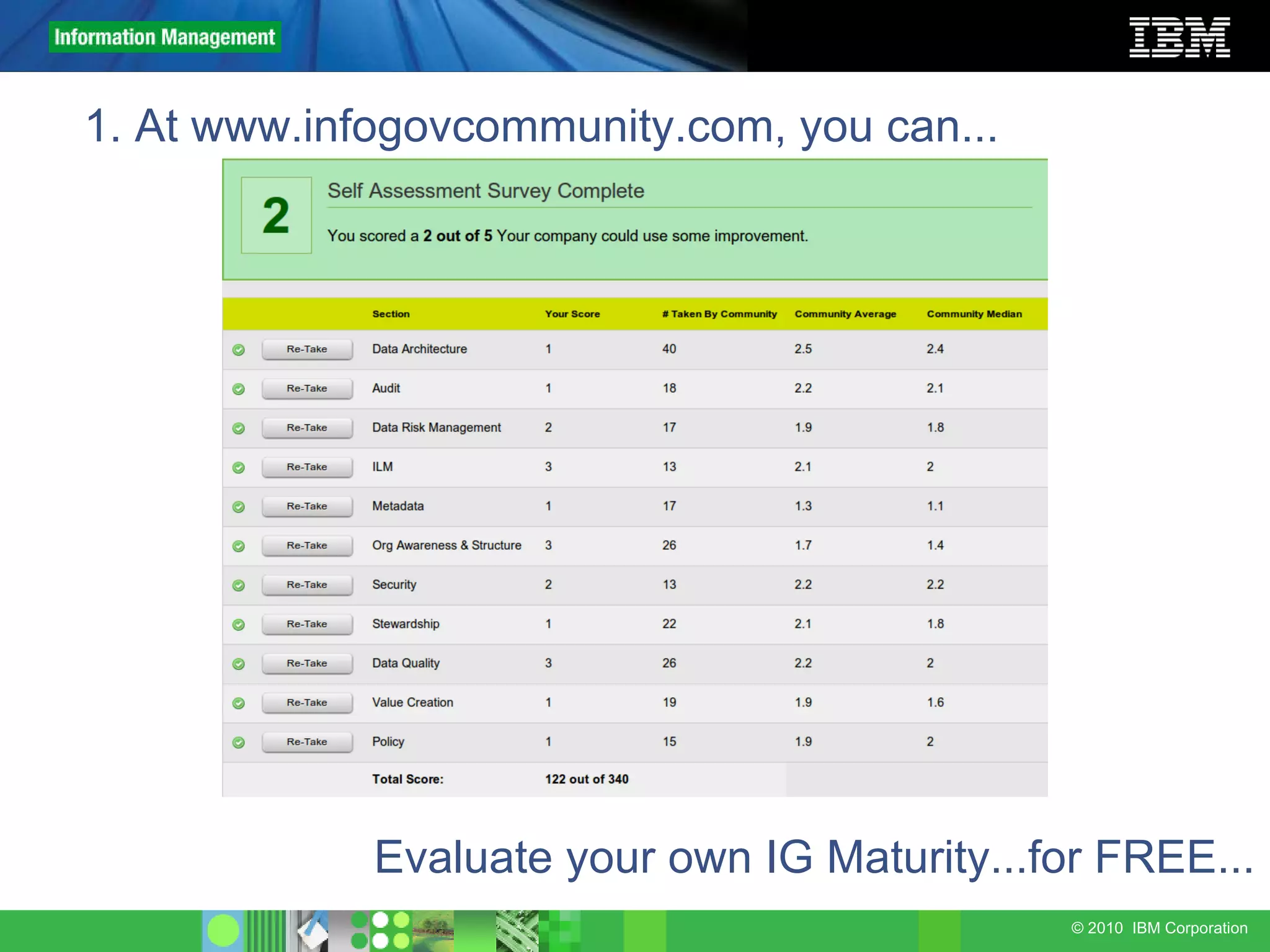
1. At www.infogovcommunity.com, you can... Evaluate your own IG Maturity...for FREE...
Join the global community and work with your peers www.infogovcommunity.com
And here's what you can do to succeed Join a Movement:  www.infogovcommunity.com - Benchmark your organization online  - Work with others on the Maturity Model - Compare best practices in online peer reviews - Be recognized for what you contribute on the Leaderboard Start a program: IBM can help! - Free workshops from the information Agenda Tiger Team - Best of breed solutions to help you succeed.

IBM

  • 1.
    Steven Adler IBMInformation Governance Solutions IBM Information Governance
  • 2.
    Agenda 1. A Data Driven Organization 2. Start with what you know 3. The Business Case 4. Six Steps to Smart Governance
  • 3.
    Outcomes That's whyyou need Data Governance... Five years ago, The IBM Data Governance Council Created the Data Governance Maturity Model To benchmark organizational maturity...
  • 4.
    The Information Governance Community 1152 Members - Australia - South Africa - Singapore - Belgium - Poland - France - Morocco - Latin America
  • 5.
    My company islike every organization... ...We are product-driven...
  • 6.
    We'd rather lookforward... ...than back on past experience
  • 7.
    The IBM InfoSupply Chain for System X Announcement process CBS CCE MASSLOADER BH MASSLOADER CCE Staging Core Data BH BUILD CCE BUILD BH Catalog CCE Web Catalogs EDI CoC Launch CIR POST PROCESSING & ENTITLEMENT Public Entitled Prices EPR ePricer CMT NetBill BIDOPS BIDS BIDS01 Parts Price File Special Bids Catalog SMB Catalog Price Letters / Announcements PartnerWorld US Catalog Data Store USPrice (Greenock) PPSG AM Price Files Partner Commerce Catalog DATA ENTRY CUSTOMER Price Action Worksheet Price Announcement Creation (Notes) eAnnounce HWPIMS ECCM OIM (HVEC simplified)
  • 8.
    Understanding the InformationSupply Chain Governing the information chain requires working within multiple spheres … Understand the Data - Data definitions, Data flows, transformations, integrations… Understand underlying IT – System flows, Data structures, Interfaces, Service Level Agreements … Understand the Business Process – Data entry, enrichment, business rules, decisions … Getting an integrated view of the Data / IT / Business Process spheres … Where is or Who has the knowledge – decide on how to capture, make it available and maintain What level of granularity level is practical – iterative approach and deep dive as needed Information Governance is multi discipline approach … Bus Processes Data Processes IT / Ops Processes
  • 9.
    We all sharethe same challenge... ...To become Data Driven Organizations
  • 10.
    Data Driven OrganizationsSet Business and IT Goals jointly with shared accountability Use common metrics to build Operational Awareness and develop business cases for change Delegate authority and make decisions based on facts and forecasts Communicate constantly to educate and change behavior Measure the outcomes of every policy before committing to new ones Audit themselves to improve constantly
  • 11.
    To become aData Driven Organization ...You need Data Governance
  • 12.
    To overcome challengesand achieve common goals Revenue Generation Strategy & Business Agility Cost Reduction / Avoidance Compliance & Risk Goals Inhibitors Can’t easily customize product offerings and bundles No single view of customer Undermines Causes Can’t easily Identify cross-sell, up-sell opportunities Can’t easily identify high value customers Causes Causes Can’t easily Reduce data errors Ad-hoc data quality methods Lack of data retention policies High infrastructure cost Causes Causes Inhibits Weak data security monitoring Exposure of Personally Identifiable Information in non-production Higher than necessary probability of data misuse Difficult to meet demands of new business channels Non-compliant with state & federal regulations High potential remediation costs Undermines Tarnished brand reputation Can’t easily identify key relationships and hierarchies Can’t easily consolidate data from silos, integrate new systems quickly (M&A) Undermines     drawn by | marc salzman
  • 13.
    Governance is theActivity of Coordinating Communication To Achieve Collective Goals Through Collaboration
  • 14.
    To achieve betterbusiness outcomes... ... you need more information, people, and systems
  • 15.
    Lets talk aboutPeople: Architects define the world as it should be: - Standards - Policies - Guidelines Stewards measure the world as it is: - Assessments - Compliance - Monitoring
  • 16.
    You need a3-step process to monitor change... ...So you know what to fix before it fixes you Assessment Investigation Gleaning
  • 17.
    In 2009, Ihosted a Data Governance Council Meeting ...in Kuala Lumpur, Malaysia for 30 customers
  • 18.
    At the meetingwe had one customer with a problem ...and he wanted help from the Council to solve.
  • 19.
    Branch reps consistentlyinput bad data ...When opening new accounts
  • 20.
    This bad dataflows downstream and pollutes Business ...Reports that executives use to make decisions
  • 21.
    How do wefix this? A new Data Architecture? Data Cleansing Tools?
  • 22.
    We tried allof that...
  • 23.
    The next day,a Council Member presented “ ...Yeah, we had that problem.”
  • 24.
    “ We createda data map... “ To illustrate where bad data came from...
  • 25.
    We trended thebad data over time ...to show how it impacted our revenue results
  • 26.
    How much itcost us to fix … and what that meant in lost productivity
  • 27.
    He took theBusiness Case to the... Data Governance Council Senior Leadership Team
  • 28.
    The solution camefrom HR... They changed the compensation model for reps
  • 29.
    Your goal isorganizational awareness ...because people don't know what they don't know
  • 30.
  • 31.
    Data Quality ManagementInformation Life-Cycle Management Information Security and Privacy Core Disciplines Data Architecture Classification & Metadata Audit Information Logging & Reporting Supporting Disciplines Organizational Structures & Awareness Enablers Stewardship Policy Requires Supports Enhance Data Risk Management Business Outcomes Goals 1. You can use The Maturity Model to ... Assess potential risks to Data Integrity from SDLC
  • 32.
    1. At www.infogovcommunity.com,you can... Evaluate your own IG Maturity...for FREE...
  • 33.
    Join the globalcommunity and work with your peers www.infogovcommunity.com
  • 34.
    And here's whatyou can do to succeed Join a Movement: www.infogovcommunity.com - Benchmark your organization online - Work with others on the Maturity Model - Compare best practices in online peer reviews - Be recognized for what you contribute on the Leaderboard Start a program: IBM can help! - Free workshops from the information Agenda Tiger Team - Best of breed solutions to help you succeed.

Editor's Notes

  • #8 Why is it so difficult to get the data right? This is a simplified view of the e2e landscape for System X product announcements IBM delivers Product & Price data to Partners via many different mechanisms There are multiple begin and end points, aka catalogs The Partners imbed the data from some of these feeds into their systems The way that we deliver product & price data to our customers & partners is highly complex and data driven. It relies on the synchronization of multiple data points in the flow in order for the correct data to be provided. When something goes wrong there is usually a customer impact that has a negative impact on IBM’s credibility and revenue. To get it right, for an announcement for example, requires the coordination of multiple activities performed by multiple organizations, according to a very tight schedule. When something goes wrong, tracing back through the flow to determine when and where a failure occurred can be complex and time consuming. Each of the nodes and manual intervention points can be a potential cause for data quality issues The goal is to identify data problems as early as possible to minimize customer impacts
  • #9 The Information chain is not just about “data” Data is the blood stream enabling and connecting business activity through IT systems and applications All 3 dimensions need to be understood, which can be a continuous learning experience Efforts on Business glossary and Meta Data solutions will help, but often gaps remain Initial challenge often is to find the right place or right SME to obtain information – Build a “who is who” along the way Detail knowledge is often in “people’s head” or disbursed across many places on the Intranet, Documents, archives etc. For long term sustainability decide on how to capture the information consistently, ensure it is easy to access and navigate and determine on how to maintain the information current Level of granularity can easily become burdensome and overwhelming to avoid turning this into a documentation exercise Stay practical, develop the knowledge as needed, ie what area and pain point is being worked and expand over time Working the information chain typically brings different teams together, IT operations, application defect mgmt, Business operations, Business transformation architects and analysts and process experts Often a blend of different disciplines will be applied depending on issues being worked and in which of the 3 spheres the improvements targeted The information chain mgmt can easily lead into Lean sigma projects and business performance mgmt methods being applied This can be seen as another dimension of e2e – bringing IT, Business and Data together, and while the blurring of the lines can cause confusion of accountabilities, it should be seen as key element of information chain management