Natural Lighting
Building Materials and
Science (AR 103)
By Anupama Chawla
What is the difference in lighting
in these photos?
What is Natural
Lighting/daylighting?
 Day lighting is the controlled admission of natural light, direct
sunlight, and diffused-skylight into a building to reduce
electric lighting and saving energy.
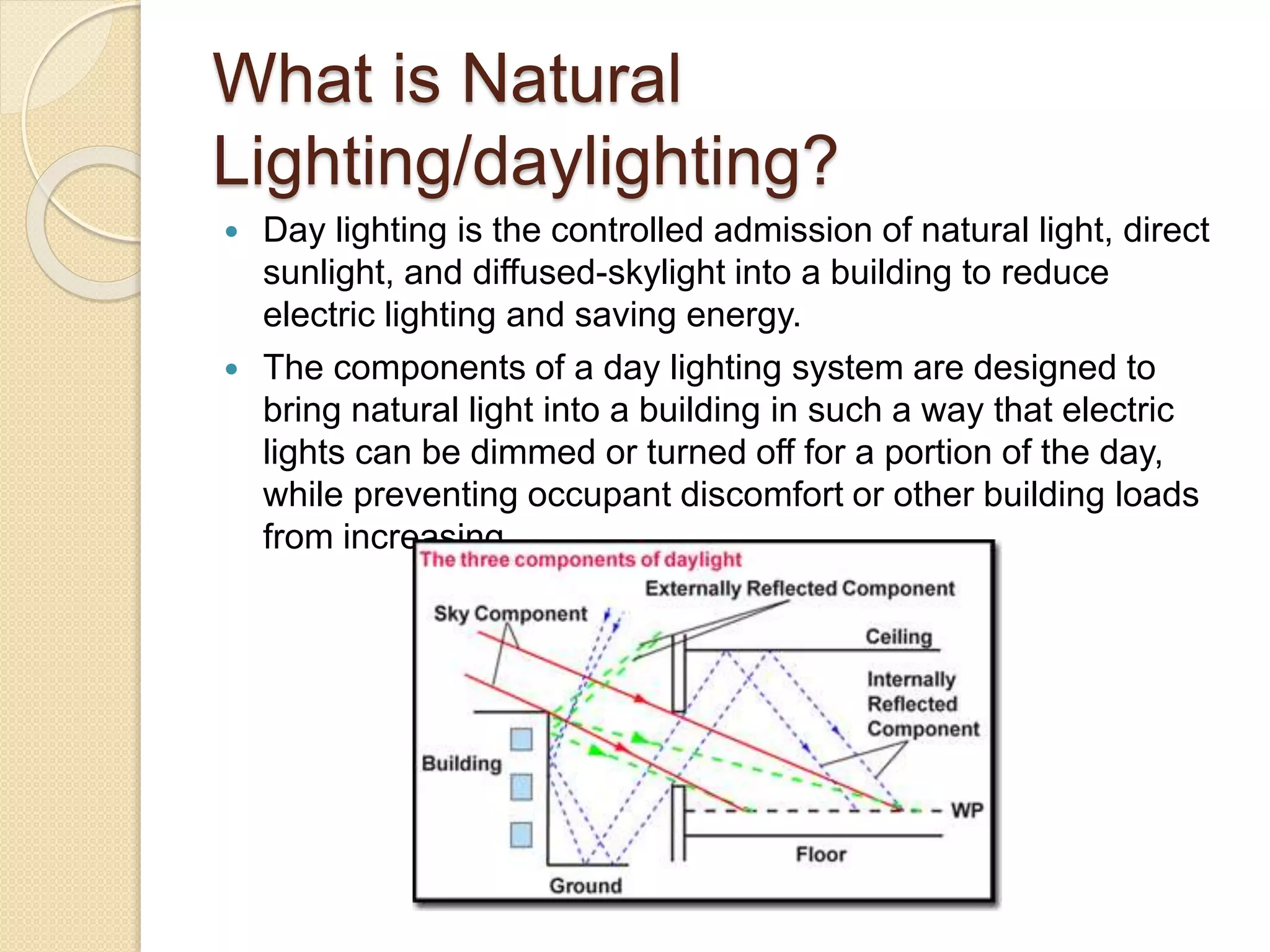
 The components of a day lighting system are designed to
bring natural light into a building in such a way that electric
lights can be dimmed or turned off for a portion of the day,
while preventing occupant discomfort or other building loads
from increasing.
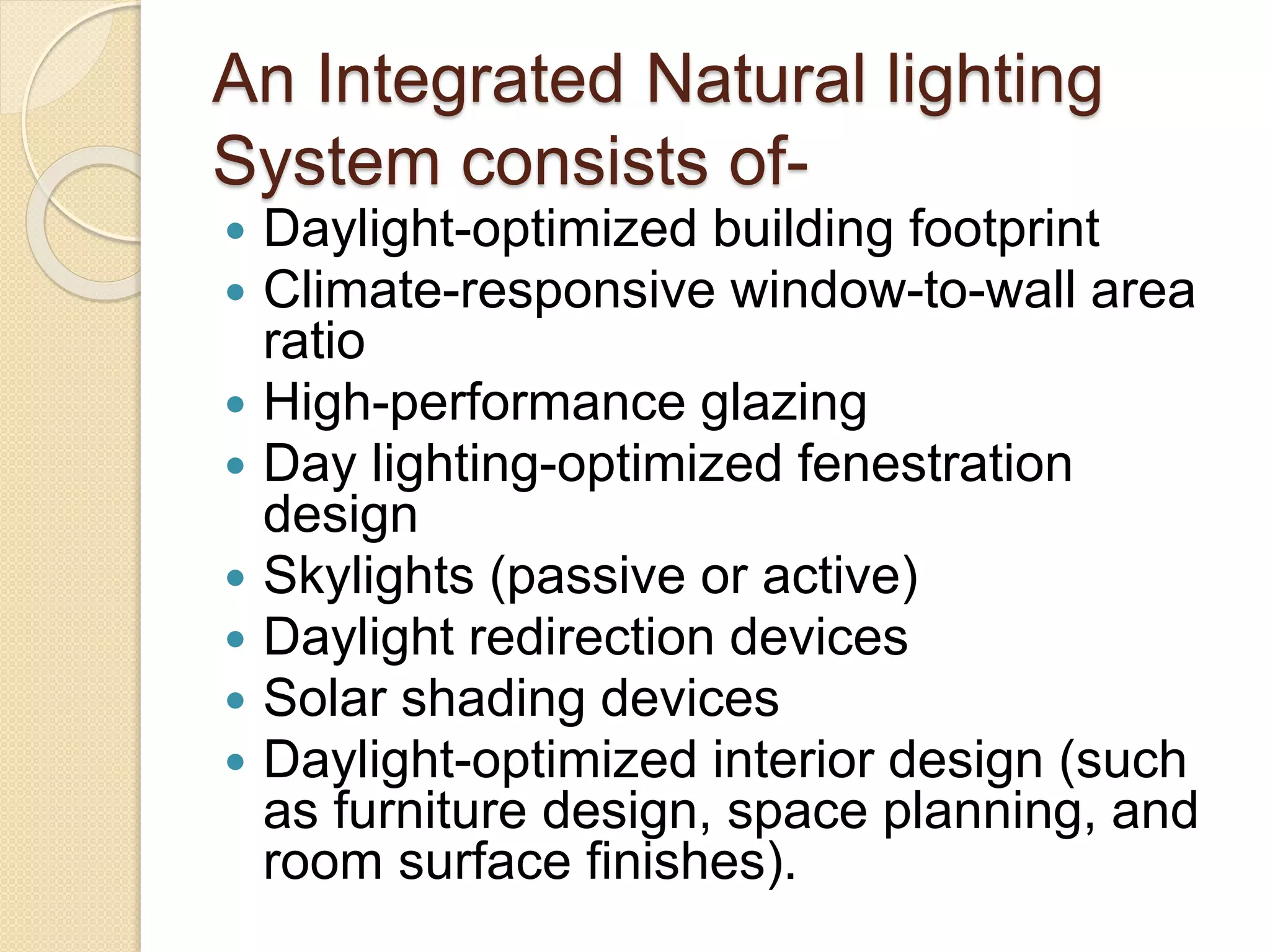
An Integrated Natural lighting
System consists of-
 Daylight-optimized building footprint
 Climate-responsive window-to-wall area
ratio
 High-performance glazing
 Day lighting-optimized fenestration
design
 Skylights (passive or active)
 Daylight redirection devices
 Solar shading devices
 Daylight-optimized interior design (such
as furniture design, space planning, and
room surface finishes).
Sources of Natural Lighting
Benefits of Natural Lighting
 Occupant Satisfaction
 Occupant Comfort
 Occupant Health-Circadian rhythm
 Time orientation
 Colour rendition
 Colour Temperature
 Reduced electrical load
 Reduced internal heat gain
Sun angles
Natural light enters the building through angles of the sun
Sun path, Altitude and Azimuth
angles
These are needed to know the sunshine hours on any
wall
Principles of Effective Natural
Lighting
 1. Orientation of the Building
 2. Form of the Building
 3.Glazing Ratio and specifications
 4. Window Height and location
 5. Overhead day lighting
 6. Daylight Redirection
1. Orientation of the Building
2. Form of the Building
Shadows in a courtyard
3.Glazing Ratio and
specifications
 Glazing ratio= Area of glazing/area of external wall
(25%-50%)
 The more the glazing ratio the more day lighting but
more the solar heat gain
 Optimum glazing ratio depends upon the user
requirement, building orientation, location, View of sky
 Triple glazing, tinted or reflective glass can reduce day
lighting but increase thermal comfort.
WWR <60%
4. Window Height and location
As a general rule, the higher the
window head height, the deeper into
the space the daylight can penetrate.
Therefore, good daylighting
fenestration practice dictates that the
window should ideally be composed of
two discrete components: a daylight
window and a view window.
National Building code says-
In office buildings, windows of 1.2m
opening with sill height 1m-1.2m above
floor and in residences, windows of 1-
1.1m and sill height to be 0.9-0.7m
above floor.
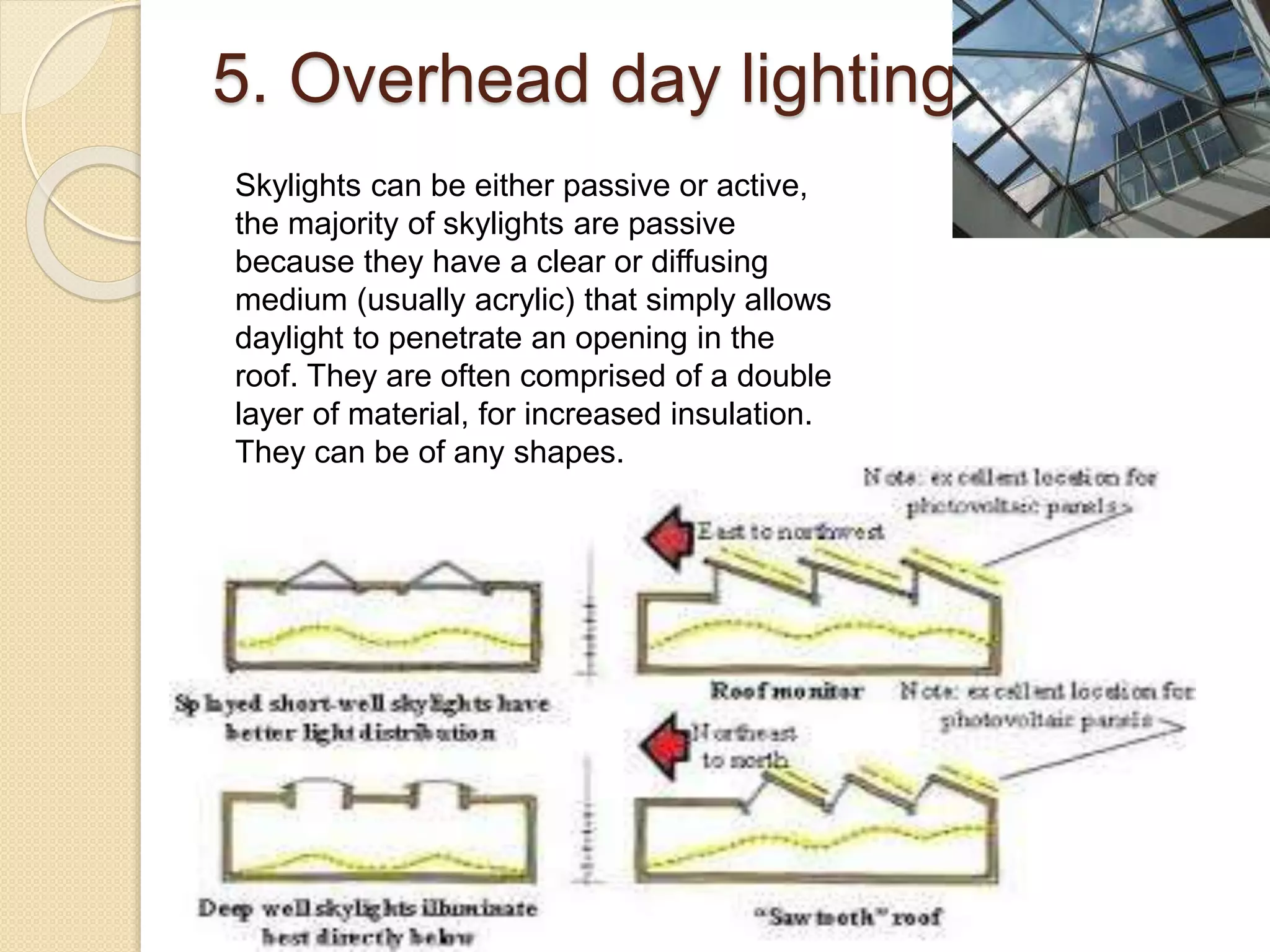
5. Overhead day lighting
Skylights can be either passive or active,
the majority of skylights are passive
because they have a clear or diffusing
medium (usually acrylic) that simply allows
daylight to penetrate an opening in the
roof. They are often comprised of a double
layer of material, for increased insulation.
They can be of any shapes.
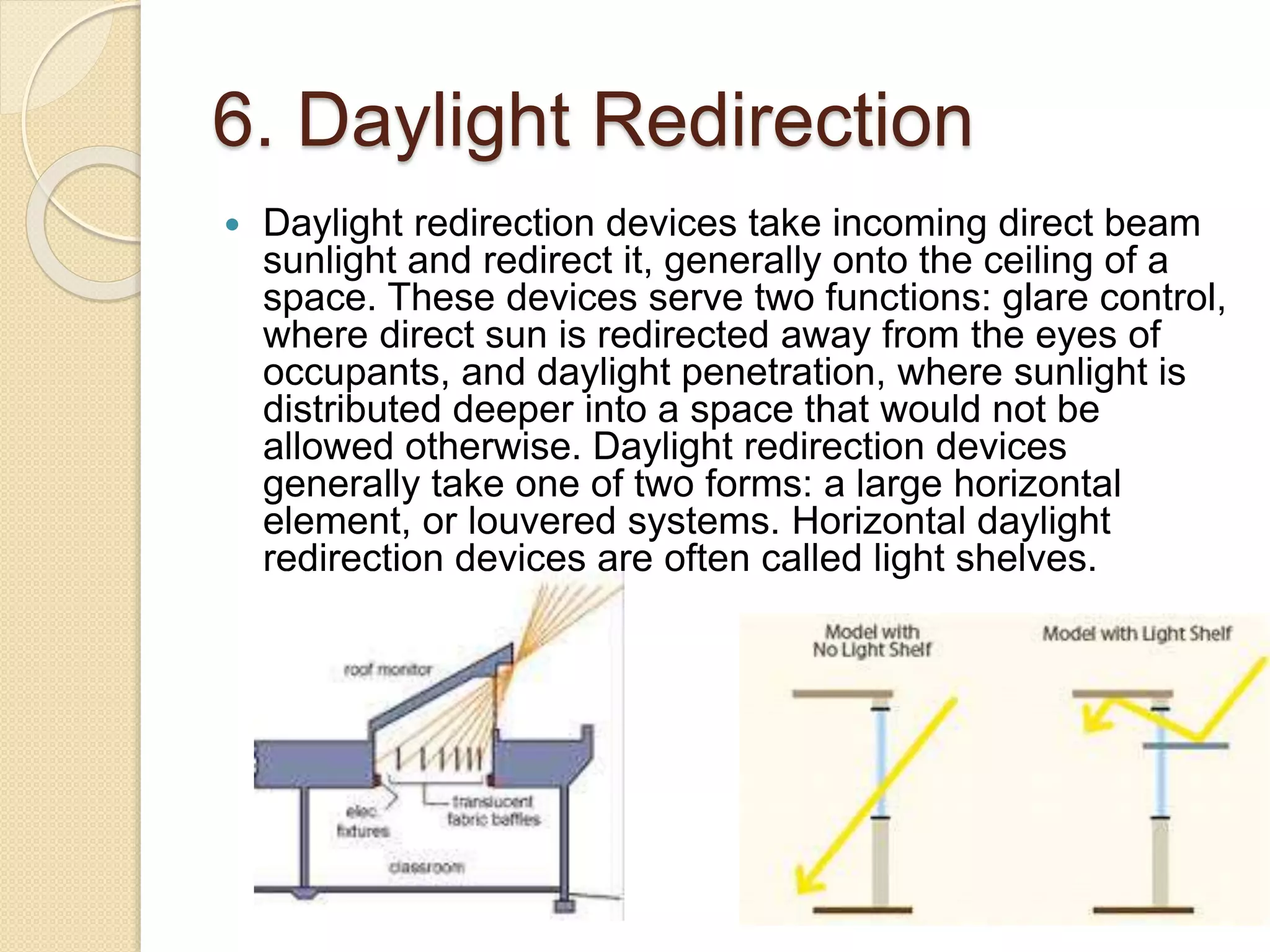
6. Daylight Redirection
 Daylight redirection devices take incoming direct beam
sunlight and redirect it, generally onto the ceiling of a
space. These devices serve two functions: glare control,
where direct sun is redirected away from the eyes of
occupants, and daylight penetration, where sunlight is
distributed deeper into a space that would not be
allowed otherwise. Daylight redirection devices
generally take one of two forms: a large horizontal
element, or louvered systems. Horizontal daylight
redirection devices are often called light shelves.
Tubular daylight devices
 Tubular daylight devices are another type of toplighting
device. These devices employ a highly reflective film on the
interior of a tube to channel light from a lens at the roof, to a
lens at the ceiling plane. Tubular daylight devices tend to be
much smaller than a typical skylight, yet still deliver sufficient
daylight for the purpose of dimming the electric lighting.
Glare
◦ Glare, or excessive brightness contrast within the field
of view, is an aspect of lighting that can cause
discomfort to occupants. The human eye can function
quite well if extreme levels of brightness are present in
the same field of view.
◦ According to National Building Code of India, Light
Control Media, such as translucent glass panes should
be provided in the upper portion of openings, to reflect
part of the light on to the roof, increasing the diffuse
lighting within the room, preventing Glare discomfort to
the occupants.
Direct solar Illuminance and sky
illuminance
According to the NBC, the light received by the
earth from the sun consists of 2 parts- Direct solar
illuminance and sky illuminance. For purposes of
daylighting design, only sky illuminance will be
considered. The relative amount of sky
illuminance depends upon on the position of the
sun defined by its altitude, which in turn depende
on the latitude of the place.
The external avilable sky illuminance values
which are exceeded for about 90% of the daytime
working hours may be take as outdoor design
illuminance values for ensuring adequacy of the
design.
The recommended design by illuminance values
are-
6800 lux for cold climate
8000 lux for composite climate
9000 lux for temperate climate
and 10500 for hot-dry climate
For integration with the artificial lighting during day
time working hours an increase of 500 lux in the
recommended sky design illuminance for
NBC says….
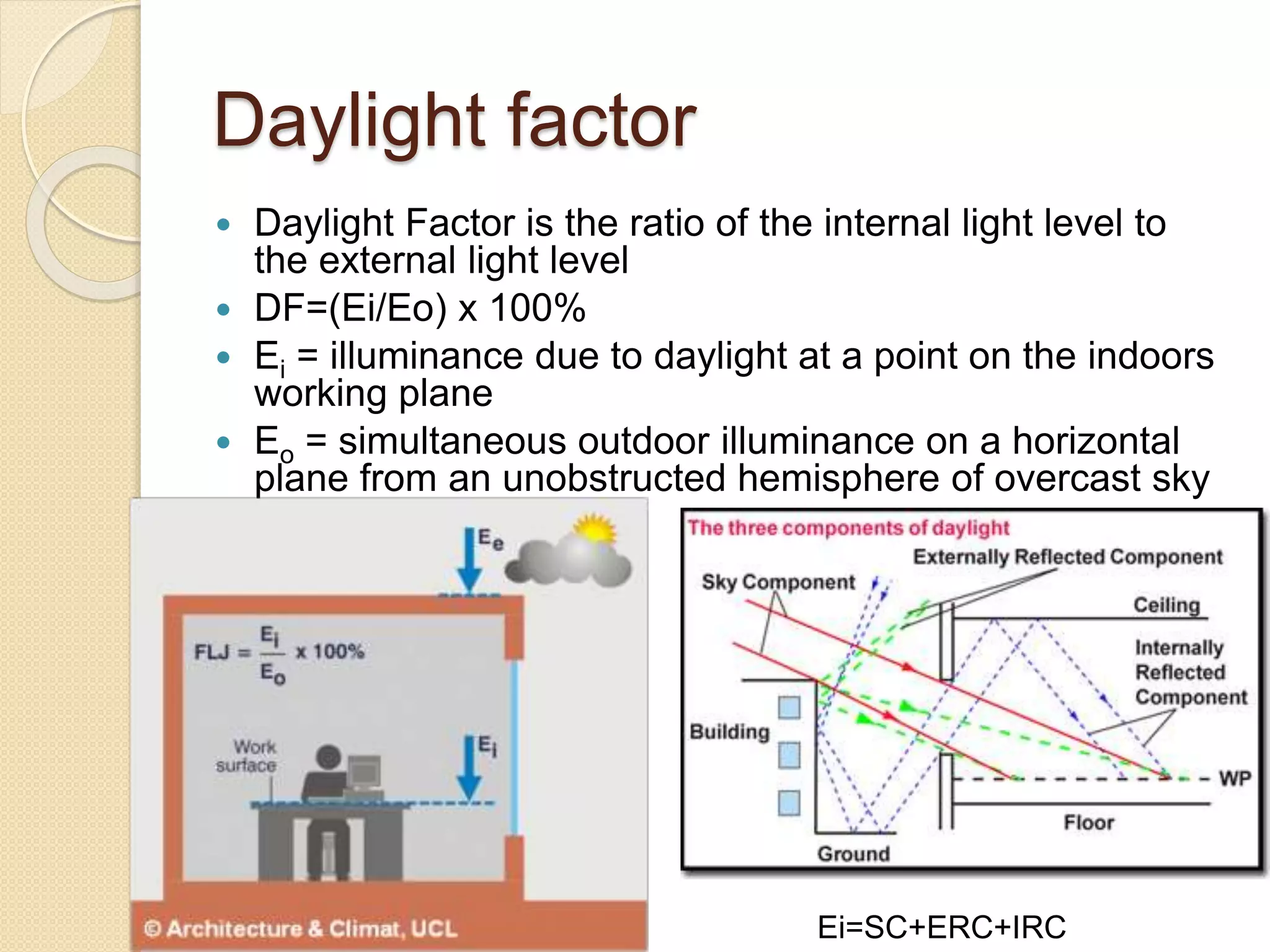
Daylight factor
 Daylight Factor is the ratio of the internal light level to
the external light level
 DF=(Ei/Eo) x 100%
 Ei = illuminance due to daylight at a point on the indoors
working plane
 Eo = simultaneous outdoor illuminance on a horizontal
plane from an unobstructed hemisphere of overcast sky
Ei=SC+ERC+IRC
Numerical- Daylight factor
Case study
 Take a room- 4m x 4m, ht 3m
 Take a window= 1.2m x 1.2 m in center of any
external wall, sill 0.9m.
 Calculate the daylight factor (DF) and check if
this window provides the required illumination
level at a working plane at a distance of 2m
from and 1m from one of the longer sides, as
per NBC
 Assume Obstruction outside to be higher than
working plane; avr. Reflectance of outside
obstruction= 0.2; Internal wall reflectance=70;
avr. Ext. illumination in Indian context=8000
lux.
Calculations
Initial SC=X-Y
=5.6-0.1
=5.5
Correction factor (CF) by avr vertical angle
=c-d=0.41-0.07=0.34
Avr vert angle=(a+b) /2
=(36+3)/2
=19.5 deg
final SC=Initial SC x CF
=5.5 x 0.34
=1.87
DF=SC+ERC+IRC
ERC=SC x avr. Ref of outside obs.
=1.87 x 0.2
=0.374
IRC calculation
Step 1- Ratio of WA to
TSA=1.44/80=0.018
Step 2- avr ref from tables= 56%
step 3- join 0.018 on tab A to 56 on tab
Step5 – join 0.75 on tab c to 16 on
tab D (ext angle of sun with obs.)
Step 6- IRC = 0.6 on tab E (with
Results
 Daylight Factor=
 SC (sky component)+ERC (ext reflected component)+IRC (internally
reflected component)
 SC+ERC+IRC
 =1.87+0.374+0.6
 =2.844
 DF= int Illumination x100 Int Illumination= DF x Ext Illumination
 Ext illimination 100
 = 2.844 x 8000
 100
 =227.52 lux < 300 lux
(NBC)
 Hence insufficient Int Illumination levels in room.
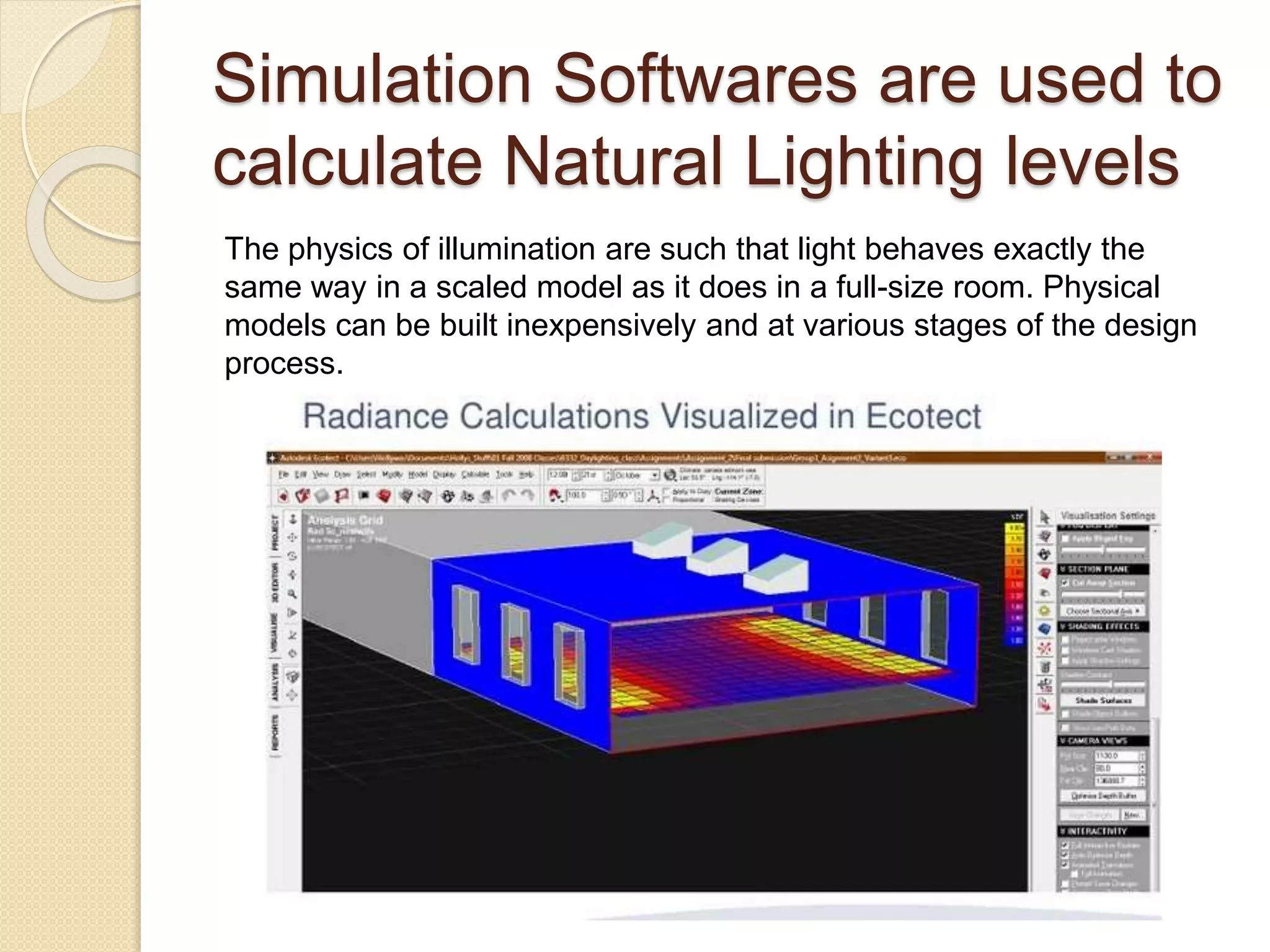
Simulation Softwares are used to
calculate Natural Lighting levels
The physics of illumination are such that light behaves exactly the
same way in a scaled model as it does in a full-size room. Physical
models can be built inexpensively and at various stages of the design
process.
Thoughts to ponder….
 Daylight should become the primary
light source in building for health,
productivity and sustainability.
Architects should design buildings to
maximise the use of daylighting and in
many countries are rewarded for doing
so by gaining points, e.g. under LEED,
GRIHA.
Bibliography
 David Thorpe; We Must Maximize the Use of Daylight in Buildings to
Reduce Energy Use; published in Sustainable cities, 2014
 http://www.sustainablecitiescollective.com/david-thorpe/1028301/we-
must-maximize-use-daylight-buildings-reduce-energy-use
 Gregg D. Ander; DAYLIGHTING ; published in Southern California
Edison,;2016
 https://www.wbdg.org/resources/daylighting
 http://www.slideshare.net/ParweenKarim/daylighting-slideshare
 http://www.slideshare.net/Aarongrt/grt-daylighting-presn20091112
 https://www.slideshare.net/SivaSankar8/national-building-code-2005
 http://www.bis.org.in/sf/ced/ced46(7830)WC.pdf
 http://www.blc.lsbu.ac.uk/webcreatif/BES/lighting-9/T9-5.html
 Poorva Keskar, DAYLIGHTING MEASURES FOR ECOHOUSING;
BNCA, Pune

Natural lighting

  • 1.
    Natural Lighting Building Materialsand Science (AR 103) By Anupama Chawla
  • 2.
    What is thedifference in lighting in these photos?
  • 3.
    What is Natural Lighting/daylighting? Day lighting is the controlled admission of natural light, direct sunlight, and diffused-skylight into a building to reduce electric lighting and saving energy.  The components of a day lighting system are designed to bring natural light into a building in such a way that electric lights can be dimmed or turned off for a portion of the day, while preventing occupant discomfort or other building loads from increasing.
  • 4.
    An Integrated Naturallighting System consists of-  Daylight-optimized building footprint  Climate-responsive window-to-wall area ratio  High-performance glazing  Day lighting-optimized fenestration design  Skylights (passive or active)  Daylight redirection devices  Solar shading devices  Daylight-optimized interior design (such as furniture design, space planning, and room surface finishes).
  • 5.
  • 6.
    Benefits of NaturalLighting  Occupant Satisfaction  Occupant Comfort  Occupant Health-Circadian rhythm  Time orientation  Colour rendition  Colour Temperature  Reduced electrical load  Reduced internal heat gain
  • 7.
    Sun angles Natural lightenters the building through angles of the sun
  • 8.
    Sun path, Altitudeand Azimuth angles These are needed to know the sunshine hours on any wall
  • 9.
    Principles of EffectiveNatural Lighting  1. Orientation of the Building  2. Form of the Building  3.Glazing Ratio and specifications  4. Window Height and location  5. Overhead day lighting  6. Daylight Redirection
  • 10.
    1. Orientation ofthe Building
  • 11.
    2. Form ofthe Building Shadows in a courtyard
  • 12.
    3.Glazing Ratio and specifications Glazing ratio= Area of glazing/area of external wall (25%-50%)  The more the glazing ratio the more day lighting but more the solar heat gain  Optimum glazing ratio depends upon the user requirement, building orientation, location, View of sky  Triple glazing, tinted or reflective glass can reduce day lighting but increase thermal comfort. WWR <60%
  • 13.
    4. Window Heightand location As a general rule, the higher the window head height, the deeper into the space the daylight can penetrate. Therefore, good daylighting fenestration practice dictates that the window should ideally be composed of two discrete components: a daylight window and a view window. National Building code says- In office buildings, windows of 1.2m opening with sill height 1m-1.2m above floor and in residences, windows of 1- 1.1m and sill height to be 0.9-0.7m above floor.
  • 14.
    5. Overhead daylighting Skylights can be either passive or active, the majority of skylights are passive because they have a clear or diffusing medium (usually acrylic) that simply allows daylight to penetrate an opening in the roof. They are often comprised of a double layer of material, for increased insulation. They can be of any shapes.
  • 15.
    6. Daylight Redirection Daylight redirection devices take incoming direct beam sunlight and redirect it, generally onto the ceiling of a space. These devices serve two functions: glare control, where direct sun is redirected away from the eyes of occupants, and daylight penetration, where sunlight is distributed deeper into a space that would not be allowed otherwise. Daylight redirection devices generally take one of two forms: a large horizontal element, or louvered systems. Horizontal daylight redirection devices are often called light shelves.
  • 16.
    Tubular daylight devices Tubular daylight devices are another type of toplighting device. These devices employ a highly reflective film on the interior of a tube to channel light from a lens at the roof, to a lens at the ceiling plane. Tubular daylight devices tend to be much smaller than a typical skylight, yet still deliver sufficient daylight for the purpose of dimming the electric lighting.
  • 17.
    Glare ◦ Glare, orexcessive brightness contrast within the field of view, is an aspect of lighting that can cause discomfort to occupants. The human eye can function quite well if extreme levels of brightness are present in the same field of view. ◦ According to National Building Code of India, Light Control Media, such as translucent glass panes should be provided in the upper portion of openings, to reflect part of the light on to the roof, increasing the diffuse lighting within the room, preventing Glare discomfort to the occupants.
  • 18.
    Direct solar Illuminanceand sky illuminance According to the NBC, the light received by the earth from the sun consists of 2 parts- Direct solar illuminance and sky illuminance. For purposes of daylighting design, only sky illuminance will be considered. The relative amount of sky illuminance depends upon on the position of the sun defined by its altitude, which in turn depende on the latitude of the place. The external avilable sky illuminance values which are exceeded for about 90% of the daytime working hours may be take as outdoor design illuminance values for ensuring adequacy of the design. The recommended design by illuminance values are- 6800 lux for cold climate 8000 lux for composite climate 9000 lux for temperate climate and 10500 for hot-dry climate For integration with the artificial lighting during day time working hours an increase of 500 lux in the recommended sky design illuminance for NBC says….
  • 19.
    Daylight factor  DaylightFactor is the ratio of the internal light level to the external light level  DF=(Ei/Eo) x 100%  Ei = illuminance due to daylight at a point on the indoors working plane  Eo = simultaneous outdoor illuminance on a horizontal plane from an unobstructed hemisphere of overcast sky Ei=SC+ERC+IRC
  • 20.
    Numerical- Daylight factor Casestudy  Take a room- 4m x 4m, ht 3m  Take a window= 1.2m x 1.2 m in center of any external wall, sill 0.9m.  Calculate the daylight factor (DF) and check if this window provides the required illumination level at a working plane at a distance of 2m from and 1m from one of the longer sides, as per NBC  Assume Obstruction outside to be higher than working plane; avr. Reflectance of outside obstruction= 0.2; Internal wall reflectance=70; avr. Ext. illumination in Indian context=8000 lux.
  • 23.
    Calculations Initial SC=X-Y =5.6-0.1 =5.5 Correction factor(CF) by avr vertical angle =c-d=0.41-0.07=0.34 Avr vert angle=(a+b) /2 =(36+3)/2 =19.5 deg final SC=Initial SC x CF =5.5 x 0.34 =1.87 DF=SC+ERC+IRC
  • 25.
    ERC=SC x avr.Ref of outside obs. =1.87 x 0.2 =0.374 IRC calculation Step 1- Ratio of WA to TSA=1.44/80=0.018 Step 2- avr ref from tables= 56% step 3- join 0.018 on tab A to 56 on tab Step5 – join 0.75 on tab c to 16 on tab D (ext angle of sun with obs.) Step 6- IRC = 0.6 on tab E (with
  • 26.
    Results  Daylight Factor= SC (sky component)+ERC (ext reflected component)+IRC (internally reflected component)  SC+ERC+IRC  =1.87+0.374+0.6  =2.844  DF= int Illumination x100 Int Illumination= DF x Ext Illumination  Ext illimination 100  = 2.844 x 8000  100  =227.52 lux < 300 lux (NBC)  Hence insufficient Int Illumination levels in room.
  • 27.
    Simulation Softwares areused to calculate Natural Lighting levels The physics of illumination are such that light behaves exactly the same way in a scaled model as it does in a full-size room. Physical models can be built inexpensively and at various stages of the design process.
  • 28.
    Thoughts to ponder…. Daylight should become the primary light source in building for health, productivity and sustainability. Architects should design buildings to maximise the use of daylighting and in many countries are rewarded for doing so by gaining points, e.g. under LEED, GRIHA.
  • 29.
    Bibliography  David Thorpe;We Must Maximize the Use of Daylight in Buildings to Reduce Energy Use; published in Sustainable cities, 2014  http://www.sustainablecitiescollective.com/david-thorpe/1028301/we- must-maximize-use-daylight-buildings-reduce-energy-use  Gregg D. Ander; DAYLIGHTING ; published in Southern California Edison,;2016  https://www.wbdg.org/resources/daylighting  http://www.slideshare.net/ParweenKarim/daylighting-slideshare  http://www.slideshare.net/Aarongrt/grt-daylighting-presn20091112  https://www.slideshare.net/SivaSankar8/national-building-code-2005  http://www.bis.org.in/sf/ced/ced46(7830)WC.pdf  http://www.blc.lsbu.ac.uk/webcreatif/BES/lighting-9/T9-5.html  Poorva Keskar, DAYLIGHTING MEASURES FOR ECOHOUSING; BNCA, Pune