INTEGRATED ENVIRONMENTAL SOLUTIONS
Common ANZ daylight, sunlight modelling approaches using
IESVE
29 YEARS OF SUSTAINABLE DESIGN
roger.cladingboel@iesve.com, aus.support@iesve.com
Common ANZ daylight modelling
approaches – summary of content
• General daylighting in the Australian context.
• Understanding the modelling/simulation types and background
DF Daylight Factor
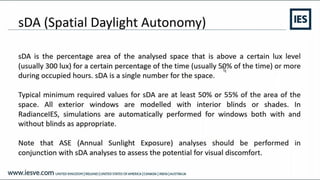
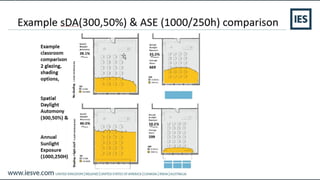
sDA Spatial Daylight Autonomy
ASE Annual Sunlight Exposure
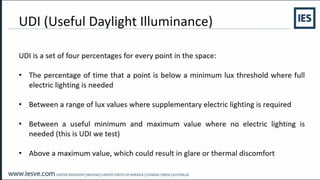
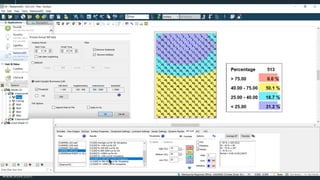
UDI Useful Daylight illuminance
• Daylight Autonomy Methodology and simulation
• Protocols and examples:
• NCC 2022 Section F6P1 –
• Green Star Buildings v1: DA aproach –
• NZ G7/VM1: Appexdix C (CBDM & DF)
• ASNZS 1680.2
• SEPP 65
Daylighting in Australia
• Daylighting is the practice of using natural light to illuminate indoor
spaces. It can be achieved through a variety of means, such as windows,
skylights, and light tubes. Daylighting has a number of benefits, including:
• Reduced energy consumption: Daylighting can reduce the need for
electric lighting, which can save energy and money.
• Improved health and well-being: Natural light has been shown to
improve mood, productivity, and sleep quality.
• Enhanced visual comfort: Daylighting can provide more even and
diffuse light than electric lighting, which can reduce glare and eye
strain.
• Increased connection to the outdoors: Daylighting can help people
feel more connected to the natural world, which can have a positive
impact on their overall well-being.
Daylighting in Australia
Australia has a high level of sunlight availability, making it ideal for
daylighting. In fact, some parts of Australia receive over 3000 hours of
sunlight per year. This means that there is significant potential to reduce
energy consumption and improve the quality of life for Australians through
the use of daylighting.
Benefits of daylighting in Australia
• Reduced cooling load: Daylighting can help to reduce the cooling load of
buildings, which can save energy and reduce greenhouse gas emissions.
This is particularly important in Australia, where summers can be very hot.
• Improved indoor air quality: Daylighting can help to improve indoor air
quality by reducing the need for electric lighting and ventilation. This is
important in Australia, where many people suffer from allergies and
asthma.
• Increased access to natural light: Daylighting can help to provide access
to natural light to people who live and work in densely populated areas or
in buildings with limited access to windows. This can have a positive
impact on their health and well-being.
Challenges of daylighting in Australia
High glare levels: Australia's high sunlight levels can lead to high glare levels
in buildings, which can reduce visual comfort and productivity.
Extreme temperatures: Australia's extreme temperatures can make it
difficult to design buildings that are both well-daylit and comfortable.
Overcoming the challenges:
• Using appropriate window glazing: Window glazing can be used to reduce
glare and heat gain, while still allowing in natural light.
• Using light shelves and other reflective surfaces: Light shelves and other
reflective surfaces can be used to redirect sunlight into deeper parts of
buildings.
• Using overhangs and shading devices: Overhangs and shading devices can
be used to block direct sunlight and reduce glare.
• Using automation and control systems: Automation and control systems
can be used to adjust the amount of sunlight entering a building
depending on the time of day and weather conditions.
• Understanding the
modelling/simulation types and
background
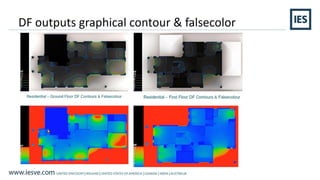
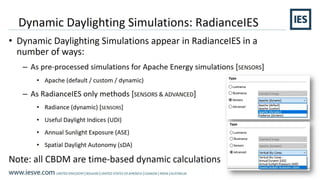
DF Daylight Factor
sDA Spatial Daylight Autonomy
ASE Annual Sunlight Exposure
UDI Useful Daylight illuminance
• Daylight Autonomy Methodology and simulation
www.iesve.com
Example simulation output – conduction gain breakdowns:
www.iesve.com
www.iesve.com
www.iesve.com
www.iesve.com
www.iesve.com
www.iesve.com
www.iesve.com
www.iesve.com
www.iesve.com
www.iesve.com
www.iesve.com
www.iesve.com
www.iesve.com
www.iesve.com
www.iesve.com
www.iesve.com
www.iesve.com
Common ANZ daylight modelling
approaches
Protocols:
• NCC 2022 Section F6P1 –
Natural lighting [Average daylight factor of not less than 2%]
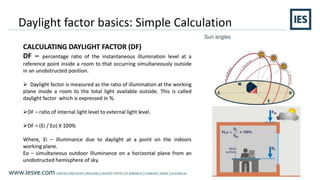
Average daylight factor: The ratio of the illumination level within
a room provided by daylight to the level of daylight outside the
building during overcast conditions.
• Green Star Buildings v1: DA aproach –
[160lux@80% nominated hours]
• NZ G7/VM1: Appexdix C (CBDM & DF)
Natural light shall provide an illuminance of no less than 30 lux
at floor level for 75% of the standard year
TABLE 2.1.2.3: Minimum Daylight Factors
• ASNZS 1680.2
• SEPP 65 70% of apartments - 2hrs of direct sunlight btw 9-3pm mid
Winter
www.iesve.com
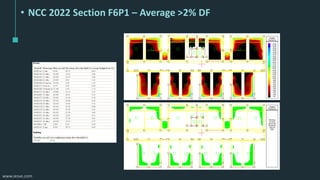
• NCC 2022 Section F6P1 & F6P2 Protocol :-
Natural lighting [Average daylight factor of not
less than 2%]
Average daylight factor: The ratio of the
illumination level within a room provided by
daylight to the level of daylight outside the
building during overcast conditions.
Artificial lighting >20lux as appropriate – direct
to Australian standard.
www.iesve.com
• NCC 2022 Section F6P1 – Average >2% DF
www.iesve.com
• NCC 2022 Section F6P1 & F6P2 Protocol :-
Natural lighting [Average daylight factor of not
less than 2%]
Average daylight factor: The ratio of the
illumination level within a room provided by
daylight to the level of daylight outside the
building during overcast conditions.
Artificial lighting >20lux as appropriate – direct
to Australian standard.
www.iesve.com
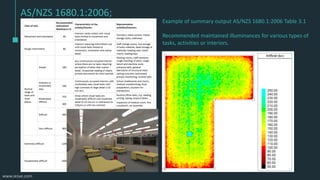
AS/NZS 1680.1:2006;
Example of summary output AS/NZS 1680.1:2006 Table 3.1
Recommended maintained illuminances for various types of
tasks, activities or interiors.
www.iesve.com
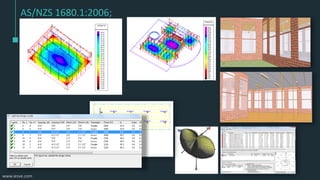
AS/NZS 1680.1:2006;
www.iesve.com
Daylighting Modelling of the Green Building Council of Australia
Daylighting modelling is a computer-based simulation tool that can be used to predict the amount and quality of
natural light in a building. It is a valuable tool for architects and engineers who are designing green buildings, as it
can help to ensure that buildings are well-daylit and energy-efficient.
The Green Building Council of Australia (GBCA) is a leading advocate for sustainable buildings in Australia. The GBCA
Green Star rating scheme is a national benchmark for sustainable building design, construction, and operation.
Daylighting modelling is a key requirement for achieving a number of Green Star credits, including:
• Indoor Environment Quality (IEQ) credit 12.1: Daylight
• IEQ credit 12.2: Visual Comfort
• Energy credit 6: Greenhouse Gas Emissions
How daylighting modelling works
Daylighting modelling software uses a number of factors to calculate the amount and quality of natural light in a
building, including:
The building's geometry, The orientation of the building, The type and size of windows, The type and placement of
shading devices, The surrounding environment etc etc.
Daylight factor and annual daylight autonomy common metrics used – DF largely superseded now.
www.iesve.com
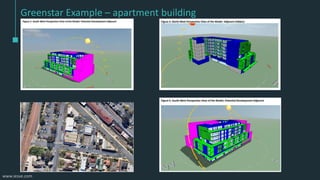
Greenstar Example – apartment building
www.iesve.com
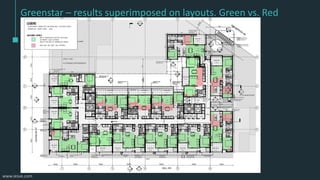
Greenstar – results superimposed on layouts. Green vs. Red
www.iesve.com
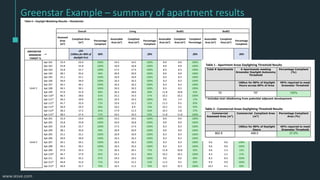
Greenstar Example – summary of apartment results
www.iesve.com
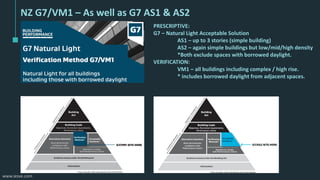
NZ G7/VM1 – As well as G7 AS1 & AS2
PRESCRIPTIVE:
G7 – Natural Light Acceptable Solution
AS1 – up to 3 stories (simple building)
AS2 – again simple buildings but low/mid/high density
*Both exclude spaces with borrowed daylight.
VERIFICATION:
VM1 – all buildings including complex / high rise.
* includes borrowed daylight from adjacent spaces.
www.iesve.com
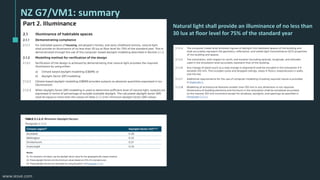
NZ G7/VM1: summary
Natural light shall provide an illuminance of no less than
30 lux at floor level for 75% of the standard year
www.iesve.com
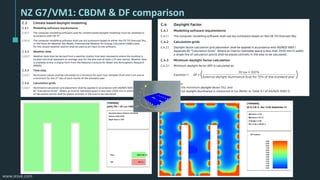
NZ G7/VM1: CBDM & DF comparison
www.iesve.com
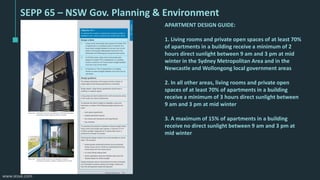
SEPP 65 – NSW Gov. Planning & Environment
APARTMENT DESIGN GUIDE:
1. Living rooms and private open spaces of at least 70%
of apartments in a building receive a minimum of 2
hours direct sunlight between 9 am and 3 pm at mid
winter in the Sydney Metropolitan Area and in the
Newcastle and Wollongong local government areas
2. In all other areas, living rooms and private open
spaces of at least 70% of apartments in a building
receive a minimum of 3 hours direct sunlight between
9 am and 3 pm at mid winter
3. A maximum of 15% of apartments in a building
receive no direct sunlight between 9 am and 3 pm at
mid winter
www.iesve.com
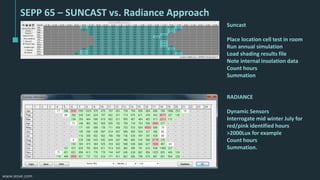
SEPP 65 – SUNCAST vs. Radiance Approach
Suncast
Place location cell test in room
Run annual simulation
Load shading results file
Note internal insolation data
Count hours
Summation
RADIANCE
Dynamic Sensors
Interrogate mid winter July for
red/pink identified hours
>2000Lux for example
Count hours
Summation.

Common ANZ daylight / sunlight modelling approaches using IESVE.

  • 1.
    INTEGRATED ENVIRONMENTAL SOLUTIONS CommonANZ daylight, sunlight modelling approaches using IESVE 29 YEARS OF SUSTAINABLE DESIGN roger.cladingboel@iesve.com, aus.support@iesve.com
  • 2.
    Common ANZ daylightmodelling approaches – summary of content • General daylighting in the Australian context. • Understanding the modelling/simulation types and background DF Daylight Factor sDA Spatial Daylight Autonomy ASE Annual Sunlight Exposure UDI Useful Daylight illuminance • Daylight Autonomy Methodology and simulation • Protocols and examples: • NCC 2022 Section F6P1 – • Green Star Buildings v1: DA aproach – • NZ G7/VM1: Appexdix C (CBDM & DF) • ASNZS 1680.2 • SEPP 65
  • 3.
    Daylighting in Australia •Daylighting is the practice of using natural light to illuminate indoor spaces. It can be achieved through a variety of means, such as windows, skylights, and light tubes. Daylighting has a number of benefits, including: • Reduced energy consumption: Daylighting can reduce the need for electric lighting, which can save energy and money. • Improved health and well-being: Natural light has been shown to improve mood, productivity, and sleep quality. • Enhanced visual comfort: Daylighting can provide more even and diffuse light than electric lighting, which can reduce glare and eye strain. • Increased connection to the outdoors: Daylighting can help people feel more connected to the natural world, which can have a positive impact on their overall well-being.
  • 4.
    Daylighting in Australia Australiahas a high level of sunlight availability, making it ideal for daylighting. In fact, some parts of Australia receive over 3000 hours of sunlight per year. This means that there is significant potential to reduce energy consumption and improve the quality of life for Australians through the use of daylighting. Benefits of daylighting in Australia • Reduced cooling load: Daylighting can help to reduce the cooling load of buildings, which can save energy and reduce greenhouse gas emissions. This is particularly important in Australia, where summers can be very hot. • Improved indoor air quality: Daylighting can help to improve indoor air quality by reducing the need for electric lighting and ventilation. This is important in Australia, where many people suffer from allergies and asthma. • Increased access to natural light: Daylighting can help to provide access to natural light to people who live and work in densely populated areas or in buildings with limited access to windows. This can have a positive impact on their health and well-being.
  • 5.
    Challenges of daylightingin Australia High glare levels: Australia's high sunlight levels can lead to high glare levels in buildings, which can reduce visual comfort and productivity. Extreme temperatures: Australia's extreme temperatures can make it difficult to design buildings that are both well-daylit and comfortable. Overcoming the challenges: • Using appropriate window glazing: Window glazing can be used to reduce glare and heat gain, while still allowing in natural light. • Using light shelves and other reflective surfaces: Light shelves and other reflective surfaces can be used to redirect sunlight into deeper parts of buildings. • Using overhangs and shading devices: Overhangs and shading devices can be used to block direct sunlight and reduce glare. • Using automation and control systems: Automation and control systems can be used to adjust the amount of sunlight entering a building depending on the time of day and weather conditions.
  • 6.
    • Understanding the modelling/simulationtypes and background DF Daylight Factor sDA Spatial Daylight Autonomy ASE Annual Sunlight Exposure UDI Useful Daylight illuminance • Daylight Autonomy Methodology and simulation
  • 7.
    www.iesve.com Example simulation output– conduction gain breakdowns:
  • 8.
  • 9.
  • 10.
  • 11.
  • 12.
  • 13.
  • 14.
  • 15.
  • 16.
  • 17.
  • 18.
  • 19.
  • 20.
  • 21.
  • 22.
  • 23.
  • 24.
  • 25.
    Common ANZ daylightmodelling approaches Protocols: • NCC 2022 Section F6P1 – Natural lighting [Average daylight factor of not less than 2%] Average daylight factor: The ratio of the illumination level within a room provided by daylight to the level of daylight outside the building during overcast conditions. • Green Star Buildings v1: DA aproach – [160lux@80% nominated hours] • NZ G7/VM1: Appexdix C (CBDM & DF) Natural light shall provide an illuminance of no less than 30 lux at floor level for 75% of the standard year TABLE 2.1.2.3: Minimum Daylight Factors • ASNZS 1680.2 • SEPP 65 70% of apartments - 2hrs of direct sunlight btw 9-3pm mid Winter
  • 26.
    www.iesve.com • NCC 2022Section F6P1 & F6P2 Protocol :- Natural lighting [Average daylight factor of not less than 2%] Average daylight factor: The ratio of the illumination level within a room provided by daylight to the level of daylight outside the building during overcast conditions. Artificial lighting >20lux as appropriate – direct to Australian standard.
  • 27.
    www.iesve.com • NCC 2022Section F6P1 – Average >2% DF
  • 28.
    www.iesve.com • NCC 2022Section F6P1 & F6P2 Protocol :- Natural lighting [Average daylight factor of not less than 2%] Average daylight factor: The ratio of the illumination level within a room provided by daylight to the level of daylight outside the building during overcast conditions. Artificial lighting >20lux as appropriate – direct to Australian standard.
  • 29.
    www.iesve.com AS/NZS 1680.1:2006; Example ofsummary output AS/NZS 1680.1:2006 Table 3.1 Recommended maintained illuminances for various types of tasks, activities or interiors.
  • 30.
  • 31.
    www.iesve.com Daylighting Modelling ofthe Green Building Council of Australia Daylighting modelling is a computer-based simulation tool that can be used to predict the amount and quality of natural light in a building. It is a valuable tool for architects and engineers who are designing green buildings, as it can help to ensure that buildings are well-daylit and energy-efficient. The Green Building Council of Australia (GBCA) is a leading advocate for sustainable buildings in Australia. The GBCA Green Star rating scheme is a national benchmark for sustainable building design, construction, and operation. Daylighting modelling is a key requirement for achieving a number of Green Star credits, including: • Indoor Environment Quality (IEQ) credit 12.1: Daylight • IEQ credit 12.2: Visual Comfort • Energy credit 6: Greenhouse Gas Emissions How daylighting modelling works Daylighting modelling software uses a number of factors to calculate the amount and quality of natural light in a building, including: The building's geometry, The orientation of the building, The type and size of windows, The type and placement of shading devices, The surrounding environment etc etc. Daylight factor and annual daylight autonomy common metrics used – DF largely superseded now.
  • 32.
  • 33.
    www.iesve.com Greenstar – resultssuperimposed on layouts. Green vs. Red
  • 34.
    www.iesve.com Greenstar Example –summary of apartment results
  • 35.
    www.iesve.com NZ G7/VM1 –As well as G7 AS1 & AS2 PRESCRIPTIVE: G7 – Natural Light Acceptable Solution AS1 – up to 3 stories (simple building) AS2 – again simple buildings but low/mid/high density *Both exclude spaces with borrowed daylight. VERIFICATION: VM1 – all buildings including complex / high rise. * includes borrowed daylight from adjacent spaces.
  • 36.
    www.iesve.com NZ G7/VM1: summary Naturallight shall provide an illuminance of no less than 30 lux at floor level for 75% of the standard year
  • 37.
  • 38.
    www.iesve.com SEPP 65 –NSW Gov. Planning & Environment APARTMENT DESIGN GUIDE: 1. Living rooms and private open spaces of at least 70% of apartments in a building receive a minimum of 2 hours direct sunlight between 9 am and 3 pm at mid winter in the Sydney Metropolitan Area and in the Newcastle and Wollongong local government areas 2. In all other areas, living rooms and private open spaces of at least 70% of apartments in a building receive a minimum of 3 hours direct sunlight between 9 am and 3 pm at mid winter 3. A maximum of 15% of apartments in a building receive no direct sunlight between 9 am and 3 pm at mid winter
  • 39.
    www.iesve.com SEPP 65 –SUNCAST vs. Radiance Approach Suncast Place location cell test in room Run annual simulation Load shading results file Note internal insolation data Count hours Summation RADIANCE Dynamic Sensors Interrogate mid winter July for red/pink identified hours >2000Lux for example Count hours Summation.