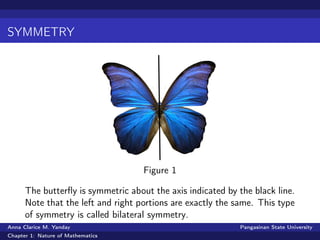
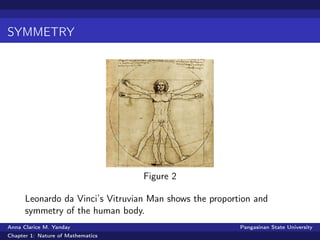
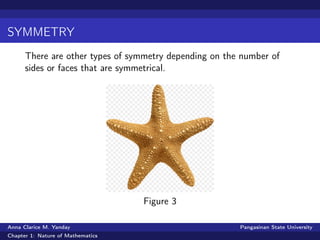
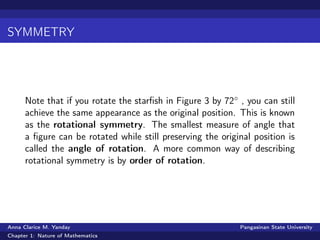
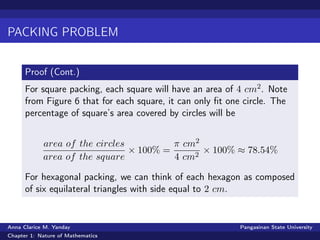
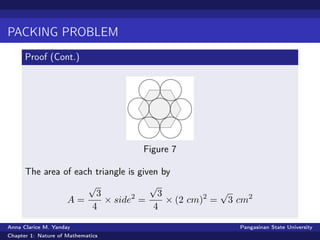
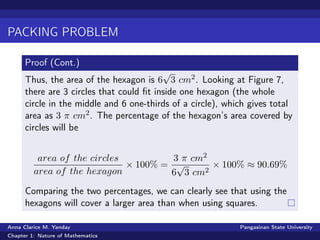
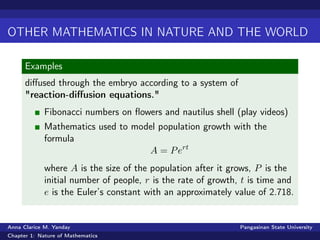
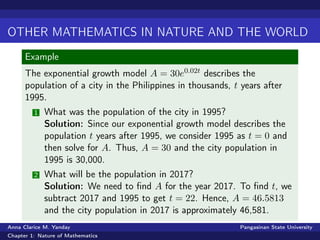
The document discusses how patterns and mathematics are present in nature. It provides examples of symmetry in butterflies and starfish and discusses how hexagonal structures allow for better packing than squares, as bees use in honeycombs. The document also discusses other examples of mathematics in nature, including Turing's explanation of animal coat patterns and the presence of the Fibonacci sequence in flowers and shells. It provides examples of using exponential growth models to determine past and future population sizes.