EHLER’S DANLOS
SYNDROMES
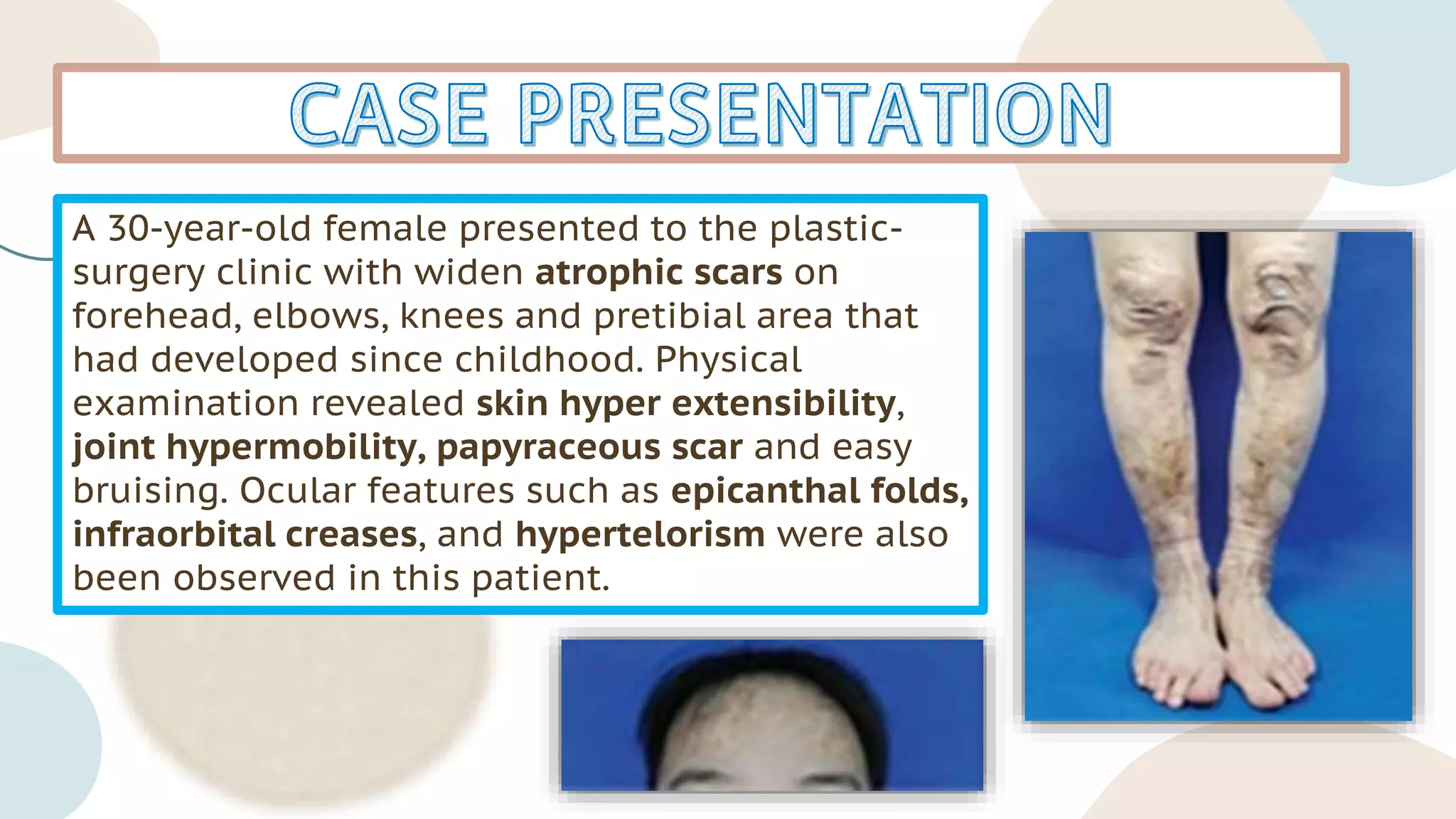
A 30-year-old female presented to the plastic-
surgery clinic with widen atrophic scars on
forehead, elbows, knees and pretibial area that
had developed since childhood. Physical
examination revealed skin hyper extensibility,
joint hypermobility, papyraceous scar and easy
bruising. Ocular features such as epicanthal folds,
infraorbital creases, and hypertelorism were also
been observed in this patient.
Results of laboratory tests and radiography examinations were
normal. No vascular abnormalities were found, and the family
history was negative. Whole exome sequencing revealed that the
proband carried a heterozygous pathogenic variant, c1997G > A
(p.P659P), in COL5A2 gene. Sanger sequencing of COL5A2 in this
patient also confirmed the presence of this variant.
The diagnosis of the classical Ehlers– Danlos syndrome was made.
The patient underwent facial scar resection and sutured in
minimizing tension and perfect apposition to avoid the post-surgery
scar formation. Follow-up 6 months after surgery, the wound
remained a fine line scar.
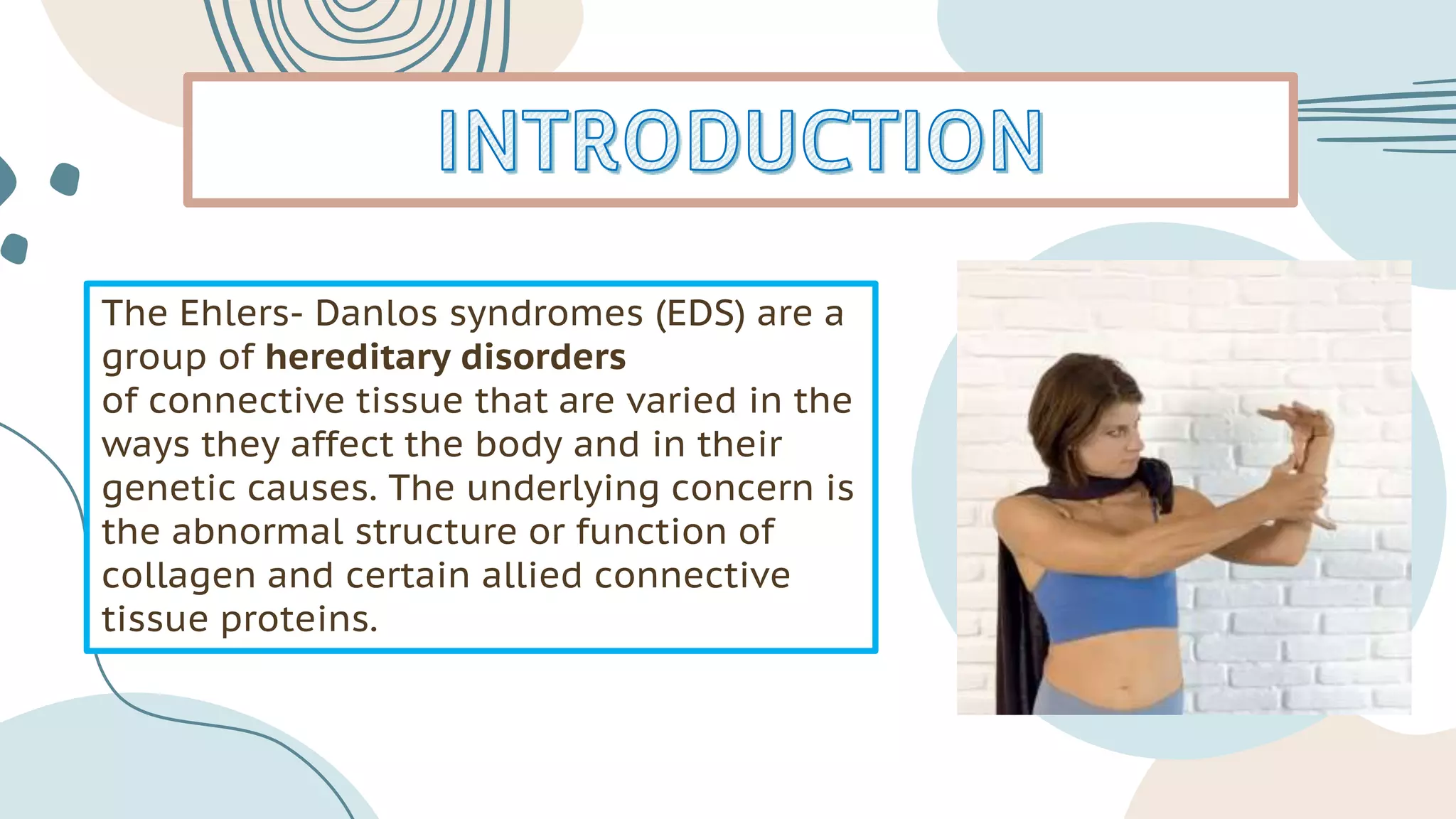
The Ehlers- Danlos syndromes (EDS) are a
group of hereditary disorders
of connective tissue that are varied in the
ways they affect the body and in their
genetic causes. The underlying concern is
the abnormal structure or function of
collagen and certain allied connective
tissue proteins.
In the Ehlers-Danlos syndromes, there are faults in the genes
that determine how the body makes collagen, and/or in some
subtypes other proteins that work alongside collagen. This
leads to the connective tissue becoming weaker. Different
tissues and organs can be affected in diverse ways depending
on the genetic fault. This explains why there are several
subtypes of EDS.
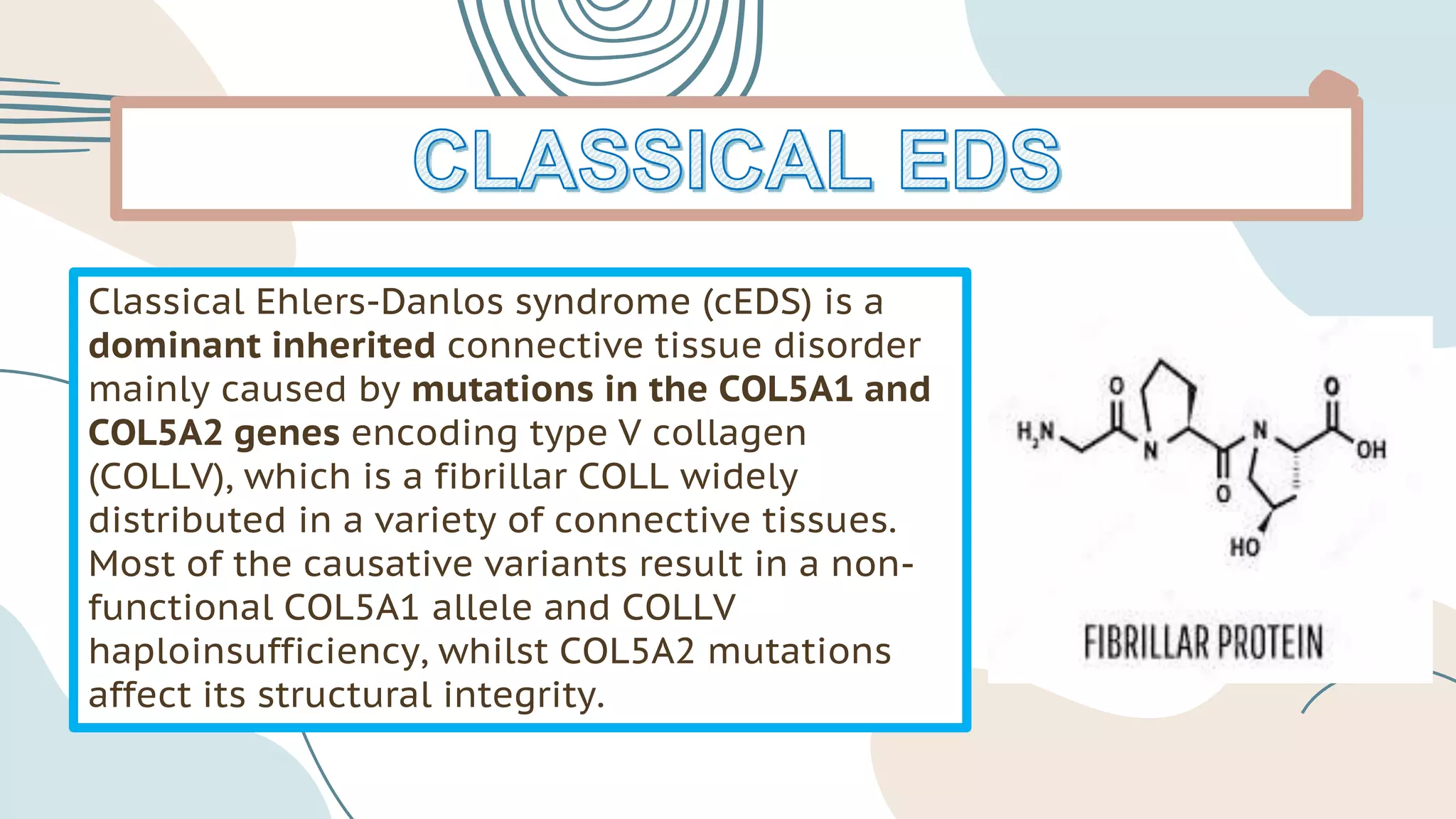
Classical Ehlers-Danlos syndrome (cEDS) is a
dominant inherited connective tissue disorder
mainly caused by mutations in the COL5A1 and
COL5A2 genes encoding type V collagen
(COLLV), which is a fibrillar COLL widely
distributed in a variety of connective tissues.
Most of the causative variants result in a non-
functional COL5A1 allele and COLLV
haploinsufficiency, whilst COL5A2 mutations
affect its structural integrity.
MAJOR CRITERIA MINOR CRITERIA
Skin hyper extensibility Easy bruising
Atrophic scarring Soft, doughty skin
Generalised joint hypermobility Skin fragility
Molluscoid pseudotumors (G)
Subcutaneous spheroids (F)
Hernia ( history)
Epicanthal folds
Complications of joint hypermobility
• Medications to relief pain and reduce blood pressure
• Proper and balanced nutrition
• Physiotherapy to strengthen muscles around weak joints
• Braces to stabilize joints and minimize dislocations
• Rarely, surgery to repair joints damaged by repeated dislocations
may be performed, if necessary.
• Cosmetic surgeries can correct droopy eyelids. Patients also
sometimes undergo a facelift to offset a deficiency of collagen
support in the skin.
• Bruising of skin and permanent scarring
• Repeated joint dislocations
• Early-onset arthritis
• Delayed wound healing
• Spontaneous rupture of blood vessels
• Aortic root dilatation
• Mitral valve regurgitation (blood flowing back into the heart)
• Progressive loss of motor function
• You may be advised to avoid some activities entirely, such as
heavy lifting and contact sports
• For some activities, you may need to wear appropriate
protection and be taught how to reduce the strain on your
joints
• If fatigue is a problem, you can be taught ways to conserve
your energy and pace your activities
• Avoiding unnecessary surgical procedures, since wound
healing may be compromised
• https://www.ehlers-danlos.org/information/classical-ehlers-
danlos-syndrome/
• https://rarediseases.info.nih.gov/diseases/6322/ehlers-danlos-
syndromes
• https://rarediseases.info.nih.gov/diseases/2088/classical-
ehlers-danlos-syndrome
• https://www.ncbi.nlm.nih.gov/pmc/articles/PMC3827857/#:~:tex
t=Usually%20classical%20EDS%20results%20from,single%20pro
%CE%B12(V)%20chain.
• https://www.frontiersin.org/articles/10.3389/fcell.2021.649082/f
ull
Ehlers danlos syndrome case.pptx

Ehlers danlos syndrome case.pptx

  • 1.
  • 2.
    A 30-year-old femalepresented to the plastic- surgery clinic with widen atrophic scars on forehead, elbows, knees and pretibial area that had developed since childhood. Physical examination revealed skin hyper extensibility, joint hypermobility, papyraceous scar and easy bruising. Ocular features such as epicanthal folds, infraorbital creases, and hypertelorism were also been observed in this patient.
  • 4.
    Results of laboratorytests and radiography examinations were normal. No vascular abnormalities were found, and the family history was negative. Whole exome sequencing revealed that the proband carried a heterozygous pathogenic variant, c1997G > A (p.P659P), in COL5A2 gene. Sanger sequencing of COL5A2 in this patient also confirmed the presence of this variant.
  • 5.
    The diagnosis ofthe classical Ehlers– Danlos syndrome was made. The patient underwent facial scar resection and sutured in minimizing tension and perfect apposition to avoid the post-surgery scar formation. Follow-up 6 months after surgery, the wound remained a fine line scar.
  • 6.
    The Ehlers- Danlossyndromes (EDS) are a group of hereditary disorders of connective tissue that are varied in the ways they affect the body and in their genetic causes. The underlying concern is the abnormal structure or function of collagen and certain allied connective tissue proteins.
  • 7.
    In the Ehlers-Danlossyndromes, there are faults in the genes that determine how the body makes collagen, and/or in some subtypes other proteins that work alongside collagen. This leads to the connective tissue becoming weaker. Different tissues and organs can be affected in diverse ways depending on the genetic fault. This explains why there are several subtypes of EDS.
  • 9.
    Classical Ehlers-Danlos syndrome(cEDS) is a dominant inherited connective tissue disorder mainly caused by mutations in the COL5A1 and COL5A2 genes encoding type V collagen (COLLV), which is a fibrillar COLL widely distributed in a variety of connective tissues. Most of the causative variants result in a non- functional COL5A1 allele and COLLV haploinsufficiency, whilst COL5A2 mutations affect its structural integrity.
  • 12.
    MAJOR CRITERIA MINORCRITERIA Skin hyper extensibility Easy bruising Atrophic scarring Soft, doughty skin Generalised joint hypermobility Skin fragility Molluscoid pseudotumors (G) Subcutaneous spheroids (F) Hernia ( history) Epicanthal folds Complications of joint hypermobility
  • 14.
    • Medications torelief pain and reduce blood pressure • Proper and balanced nutrition • Physiotherapy to strengthen muscles around weak joints • Braces to stabilize joints and minimize dislocations • Rarely, surgery to repair joints damaged by repeated dislocations may be performed, if necessary. • Cosmetic surgeries can correct droopy eyelids. Patients also sometimes undergo a facelift to offset a deficiency of collagen support in the skin.
  • 15.
    • Bruising ofskin and permanent scarring • Repeated joint dislocations • Early-onset arthritis • Delayed wound healing • Spontaneous rupture of blood vessels • Aortic root dilatation • Mitral valve regurgitation (blood flowing back into the heart) • Progressive loss of motor function
  • 16.
    • You maybe advised to avoid some activities entirely, such as heavy lifting and contact sports • For some activities, you may need to wear appropriate protection and be taught how to reduce the strain on your joints • If fatigue is a problem, you can be taught ways to conserve your energy and pace your activities • Avoiding unnecessary surgical procedures, since wound healing may be compromised
  • 18.
    • https://www.ehlers-danlos.org/information/classical-ehlers- danlos-syndrome/ • https://rarediseases.info.nih.gov/diseases/6322/ehlers-danlos- syndromes •https://rarediseases.info.nih.gov/diseases/2088/classical- ehlers-danlos-syndrome • https://www.ncbi.nlm.nih.gov/pmc/articles/PMC3827857/#:~:tex t=Usually%20classical%20EDS%20results%20from,single%20pro %CE%B12(V)%20chain. • https://www.frontiersin.org/articles/10.3389/fcell.2021.649082/f ull

Editor's Notes

  • #10 Reduction of type V collagen is central to the pathogenesis of cEDS. Type V collagen is a fibrillar collagen which is involved in fibrillogenesis.  Haploinsufficiency - The situation that occurs when one copy of a gene is inactivated or deleted and the remaining functional copy of the gene is not adequate to produce the needed gene product to preserve normal function.
  • #11  The formation of collagen fibrils and fibres. Collagen molecules are made by fibroblasts, which then secrete them into the extracellular matrix (ECM). Collagen molecules in the ECM then associate together in a staggered pattern to form a collagen fibril. These collagen fibrils consist mostly of the major collagen protein, type I, while the minor collagen proteins, such as type III and type V constitute only a fraction of fibril mass. The importance of these minor collagens, however, lies in their role in regulating the diameter and organization of collagen fibrils. In the example of type V collagen molecules, the presence of a non-collagenous domain which projects outwards introduces steric hindrances when incorporated within collagen fibrils. This limits the lateral growth of the fibrils and may also play a role in regulating their diameter. Multiple collagen fibrils together form collagen fibers which provide tensile strength to the connective tissue.  The absence of sufficient amounts of minor collagen proteins, like in EDS, can result in poorly formed collagen fibrils, and in turn, collagen fibers
  • #12 Focal adhesion kinase Collagen provides strength and elasticity  Because of the fragility, the skin of cEDS patients splits open easily  Potential pathways for impaired wound healing in cEDS tissue. In cEDS, collagen V deficiency results in irregular collagen microarchitecture, which features reduced tissue mechanics. Fibroblasts respond to the low ECM stiffness by exhibiting poor integrin adhesion formation and growth, which is unable to accommodate FAK binding. Signals from weak adhesion downregulate myosin contractility and actin polymerization, which again downregulates survival, proliferation and migration, which all impacts impaired wound healing.
  • #13 of a first degree relative who meets clinical criteria Subcutaneous spheroid (F). Huge molluscoid pseudotumor of the elbow (G).
  • #15 The strength of medication administered depends on the severity of pain such as Beta blockers, Angiotensin-converting enzyme inhibitors, Calcium channel blockers, Diuretic pills Vitamin C supplements may be recommended to aid in collagen synthesis and wound healing