Strengthening Science Communication
     Professional Workshop Series at the National University of Mongolia


                      Workshop #1
Introductions and “Elevator Talks”


                                  Dr. Christa Hasenkopf
                Fulbright Grantee | Research Associate
National University of Mongolia | University of Colorado
Introductions!


Tell Us About Yourself!
             Name
             Position (grad student,
             researcher)
             What kind of science
             are you interested in?
             Anything else?
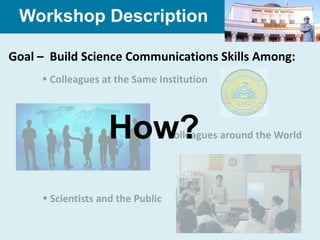
Workshop Description

Goal – Build Science Communications Skills Among:
      Colleagues at the Same Institution


                    How?        Colleagues around the World


      Scientists and the Public
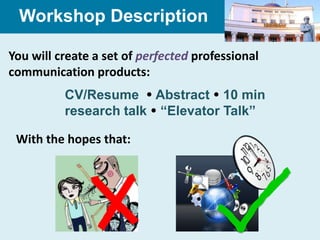
Workshop Description

You will create a set of perfected professional
communication products:
          CV/Resume  Abstract  10 min
          research talk  “Elevator Talk”

 With the hopes that:
Workshop Description

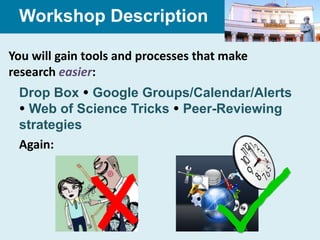
You will gain tools and processes that make
research easier:
 Drop Box  Google Groups/Calendar/Alerts
  Web of Science Tricks  Peer-Reviewing
 strategies
 Again:
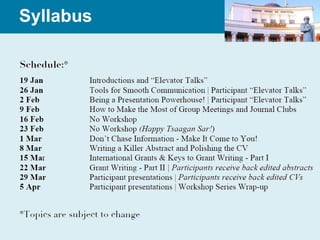
Syllabus
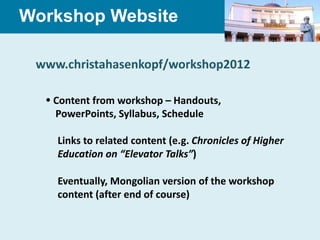
Workshop Website

 www.christahasenkopf/workshop2012

   Content from workshop – Handouts,
    PowerPoints, Syllabus, Schedule

    Links to related content (e.g. Chronicles of Higher
    Education on “Elevator Talks”)

    Eventually, Mongolian version of the workshop
    content (after end of course)
Workshop Description

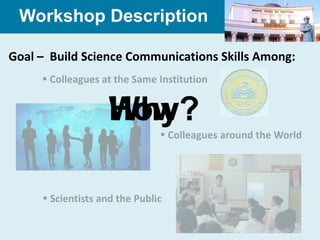
Goal – Build Science Communications Skills Among:
      Colleagues at the Same Institution


                    How?
                    Why?
                                Colleagues around the World


      Scientists and the Public
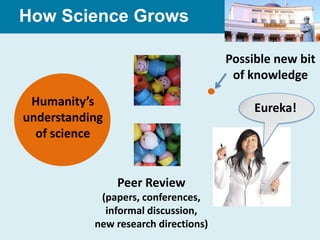
How Science Grows

                                      Possible new bit
                                       of knowledge
 Humanity’s                                Eureka!
understanding
  of science


                Peer Review
            (papers, conferences,
             informal discussion,
           new research directions)
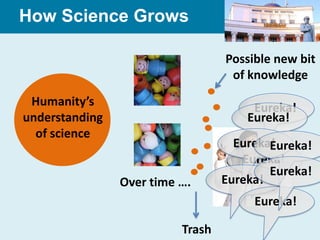
How Science Grows

                                  Possible new bit
                                   of knowledge
 Humanity’s                            Eureka!
understanding                         Eureka!
  of science
                                    Eureka!
                                          Eureka!
                                     Eureka!
                                          Eureka!
                Over time ….      Eureka!
                                       Eureka!

                          Trash
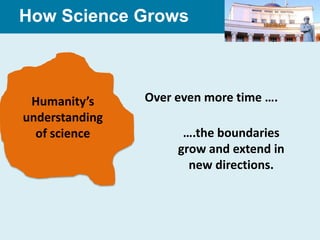
How Science Grows


 Humanity’s     Over even more time ….
understanding
  of science          ….the boundaries
                     grow and extend in
                       new directions.
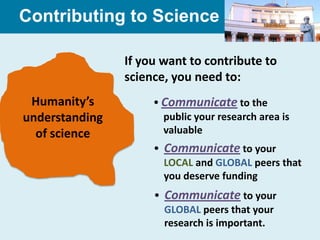
Contributing to Science

                If you want to contribute to
                science, you need to:
 Humanity’s           Communicate to the
understanding          public your research area is
  of science           valuable
                        Communicate to your
                         LOCAL and GLOBAL peers that
                         you deserve funding
                        Communicate to your
                         GLOBAL peers that your
                         research is important.
Workshop Description

Goal – Build Science Communications Skills Among:
      Colleagues at the Same Institution


   Humanity’s
                      Why?
                                Colleagues around the World
  understanding             Strong communication
    of science              skills are essential for
                            conducting science.
      Scientists and the Public
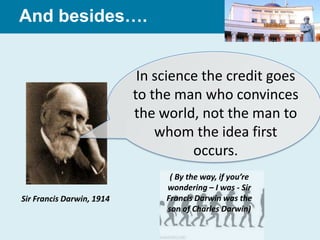
And besides….


                            In science the credit goes
                           to the man who convinces
                           the world, not the man to
                               whom the idea first
                                     occurs.
                                 ( By the way, if you’re
                                wondering – I was - Sir
Sir Francis Darwin, 1914        Francis Darwin was the
                                son of Charles Darwin)
Clear Communication
             Is Tough!
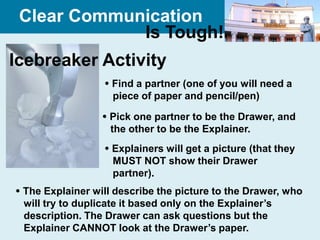
Icebreaker Activity
                   Find a partner (one of you will need a
                    piece of paper and pencil/pen)

                   Pick one partner to be the Drawer, and
                    the other to be the Explainer.
                   Explainers will get a picture (that they
                    MUST NOT show their Drawer
                    partner).
 The Explainer will describe the picture to the Drawer, who
  will try to duplicate it based only on the Explainer’s
  description. The Drawer can ask questions but the
  Explainer CANNOT look at the Drawer’s paper.
Clear Communication
            Is Tough!
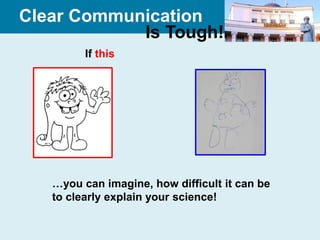
         If this can turn out like this…


   …you can imagine, how difficult it can be
   to clearly explain your science!
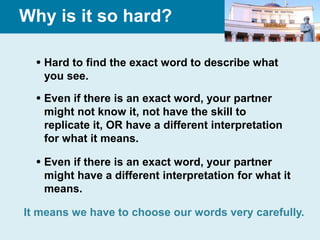
Why is it so hard?

   Hard to find the exact word to describe what
    you see.

   Even if there is an exact word, your partner
    might not know it, not have the skill to
    replicate it, OR have a different interpretation
    for what it means.

   Even if there is an exact word, your partner
    might have a different interpretation for what it
    means.

It means we have to choose our words very carefully.
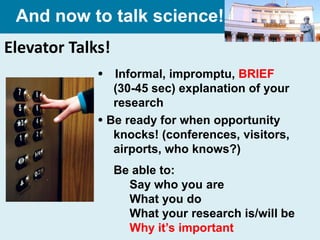
And now to talk science!
Elevator Talks!
              Informal, impromptu, BRIEF
                (30-45 sec) explanation of your
                research
              Be ready for when opportunity
                knocks! (conferences, visitors,
                airports, who knows?)
                  Be able to:
                    Say who you are
                    What you do
                    What your research is/will be
                    Why it’s important
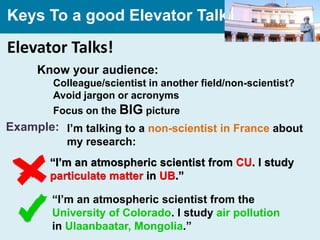
Keys To a good Elevator Talk

Elevator Talks!
     Know your audience:
        Colleague/scientist in another field/non-scientist?
        Avoid jargon or acronyms
        Focus on the BIG picture
Example: I’m talking to a non-scientist in France about
           my research:
        “I’m an atmospheric scientist from CU. I study
        particulate matter in UB.”

        “I’m an atmospheric scientist from the
        University of Colorado. I study air pollution
        in Ulaanbaatar, Mongolia.”
Keys To a good Elevator Talk

Elevator Talks!
    Know your audience:
      Colleague/scientist in another field/non-
      scientist?
      Avoid jargon or acronyms
      Focus on the big picture

    Write it out – maybe more than 1 version.

    Practice it

    Practice it again!
Example – My Elevator Talk

Audience: Educated, non-scientist
 I’m an atmospheric scientist from the University of Colorado. I’m
 currently working in Ulaanbaatar, Mongolia, collaborating with the
 National University of Mongolia, studying air pollution. Air pollution
 – especially in the form of soot - is a major problem in Ulaanbaatar.
 It is one of the most polluted cities in the world, and the health
 impacts have been severe. The World Bank estimates that
 approximately 25% of all deaths in Ulaanbaatar are related to the air
 pollution, yet there have been few studies published in the scientific
 literature. Another impact of air pollution from soot is that it can
 have a big effect on local and global climate. There’s a component of
 soot that is actually second only to carbon dioxide for causing global
 warming. All in all, this makes Ulaanbaatar an important place to
 study air pollution.
Examples


           Two good ones here:

           http://serc.carleton.edu/NAGTWorkshops/career
           prep/jobsearch/elevator_talks.html
Your Elevator Talk
Scenario: You’ve just gotten into an elevator with an
educated, non-scientist, who is interested in providing grants for
scientific research.
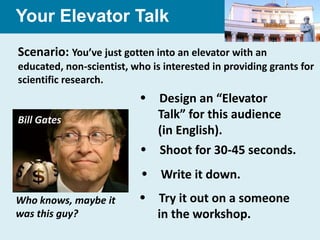
                            Design an “Elevator
Bill Gates                   Talk” for this audience
                             (in English).
                            Shoot for 30-45 seconds.
                            Write it down.
Who knows, maybe it         Try it out on a someone
was this guy?                in the workshop.
Next Time
  Polish your talk and bring it to class next
   time. You’ll have the opportunity to practice
   your elevator talk in front of the class.
  You’ll receive feedback from your workshop-
   mates.

  We’ll discuss Tools for
  Smooth Communication

  Who has a gmail
   account already?
One Last Thing….


   This workshop is for YOU.

 Have comments or suggestions
about ANYTHING in the class that
       can make it better?

         Let Me know!

Ws 1

  • 1.
    Strengthening Science Communication Professional Workshop Series at the National University of Mongolia Workshop #1 Introductions and “Elevator Talks” Dr. Christa Hasenkopf Fulbright Grantee | Research Associate National University of Mongolia | University of Colorado
  • 2.
    Introductions! Tell Us AboutYourself! Name Position (grad student, researcher) What kind of science are you interested in? Anything else?
  • 3.
    Workshop Description Goal –Build Science Communications Skills Among:  Colleagues at the Same Institution How?  Colleagues around the World  Scientists and the Public
  • 4.
    Workshop Description You willcreate a set of perfected professional communication products: CV/Resume  Abstract  10 min research talk  “Elevator Talk” With the hopes that:
  • 5.
    Workshop Description You willgain tools and processes that make research easier: Drop Box  Google Groups/Calendar/Alerts  Web of Science Tricks  Peer-Reviewing strategies Again:
  • 6.
  • 7.
    Workshop Website www.christahasenkopf/workshop2012  Content from workshop – Handouts, PowerPoints, Syllabus, Schedule Links to related content (e.g. Chronicles of Higher Education on “Elevator Talks”) Eventually, Mongolian version of the workshop content (after end of course)
  • 8.
    Workshop Description Goal –Build Science Communications Skills Among:  Colleagues at the Same Institution How? Why?  Colleagues around the World  Scientists and the Public
  • 9.
    How Science Grows Possible new bit of knowledge Humanity’s Eureka! understanding of science Peer Review (papers, conferences, informal discussion, new research directions)
  • 10.
    How Science Grows Possible new bit of knowledge Humanity’s Eureka! understanding Eureka! of science Eureka! Eureka! Eureka! Eureka! Over time …. Eureka! Eureka! Trash
  • 11.
    How Science Grows Humanity’s Over even more time …. understanding of science ….the boundaries grow and extend in new directions.
  • 12.
    Contributing to Science If you want to contribute to science, you need to: Humanity’s  Communicate to the understanding public your research area is of science valuable  Communicate to your LOCAL and GLOBAL peers that you deserve funding  Communicate to your GLOBAL peers that your research is important.
  • 13.
    Workshop Description Goal –Build Science Communications Skills Among:  Colleagues at the Same Institution Humanity’s Why?  Colleagues around the World understanding Strong communication of science skills are essential for conducting science.  Scientists and the Public
  • 14.
    And besides…. In science the credit goes to the man who convinces the world, not the man to whom the idea first occurs. ( By the way, if you’re wondering – I was - Sir Sir Francis Darwin, 1914 Francis Darwin was the son of Charles Darwin)
  • 15.
    Clear Communication Is Tough! Icebreaker Activity  Find a partner (one of you will need a piece of paper and pencil/pen)  Pick one partner to be the Drawer, and the other to be the Explainer.  Explainers will get a picture (that they MUST NOT show their Drawer partner).  The Explainer will describe the picture to the Drawer, who will try to duplicate it based only on the Explainer’s description. The Drawer can ask questions but the Explainer CANNOT look at the Drawer’s paper.
  • 16.
    Clear Communication Is Tough! If this can turn out like this… …you can imagine, how difficult it can be to clearly explain your science!
  • 17.
    Why is itso hard?  Hard to find the exact word to describe what you see.  Even if there is an exact word, your partner might not know it, not have the skill to replicate it, OR have a different interpretation for what it means.  Even if there is an exact word, your partner might have a different interpretation for what it means. It means we have to choose our words very carefully.
  • 18.
    And now totalk science! Elevator Talks!  Informal, impromptu, BRIEF (30-45 sec) explanation of your research  Be ready for when opportunity knocks! (conferences, visitors, airports, who knows?) Be able to: Say who you are What you do What your research is/will be Why it’s important
  • 19.
    Keys To agood Elevator Talk Elevator Talks! Know your audience: Colleague/scientist in another field/non-scientist? Avoid jargon or acronyms Focus on the BIG picture Example: I’m talking to a non-scientist in France about my research: “I’m an atmospheric scientist from CU. I study particulate matter in UB.” “I’m an atmospheric scientist from the University of Colorado. I study air pollution in Ulaanbaatar, Mongolia.”
  • 20.
    Keys To agood Elevator Talk Elevator Talks! Know your audience: Colleague/scientist in another field/non- scientist? Avoid jargon or acronyms Focus on the big picture Write it out – maybe more than 1 version. Practice it Practice it again!
  • 21.
    Example – MyElevator Talk Audience: Educated, non-scientist I’m an atmospheric scientist from the University of Colorado. I’m currently working in Ulaanbaatar, Mongolia, collaborating with the National University of Mongolia, studying air pollution. Air pollution – especially in the form of soot - is a major problem in Ulaanbaatar. It is one of the most polluted cities in the world, and the health impacts have been severe. The World Bank estimates that approximately 25% of all deaths in Ulaanbaatar are related to the air pollution, yet there have been few studies published in the scientific literature. Another impact of air pollution from soot is that it can have a big effect on local and global climate. There’s a component of soot that is actually second only to carbon dioxide for causing global warming. All in all, this makes Ulaanbaatar an important place to study air pollution.
  • 22.
    Examples Two good ones here: http://serc.carleton.edu/NAGTWorkshops/career prep/jobsearch/elevator_talks.html
  • 23.
    Your Elevator Talk Scenario:You’ve just gotten into an elevator with an educated, non-scientist, who is interested in providing grants for scientific research.  Design an “Elevator Bill Gates Talk” for this audience (in English).  Shoot for 30-45 seconds.  Write it down. Who knows, maybe it  Try it out on a someone was this guy? in the workshop.
  • 24.
    Next Time Polish your talk and bring it to class next time. You’ll have the opportunity to practice your elevator talk in front of the class.  You’ll receive feedback from your workshop- mates.  We’ll discuss Tools for Smooth Communication  Who has a gmail account already?
  • 25.
    One Last Thing…. This workshop is for YOU. Have comments or suggestions about ANYTHING in the class that can make it better? Let Me know!

Editor's Notes

  • #19 http://sciencecareers.sciencemag.org/career_magazine/previous_issues/articles/2009_03_13/caredit.a0900034
  • #22 Big picure, no acronyms, no jargon, might use “carbon dioxide” depending on audience.