Interview Skills
                        How to win an interview?


                Prepared by:
   Amir Mohamed Hany
Certified Corporate Trainer from CTCHD – Canada
           Marketing Team member in
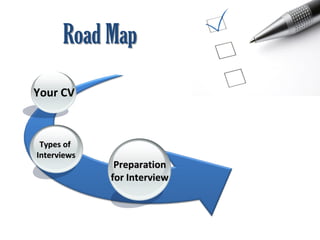
Road Map
Your CV


 Types of
Interviews
              Preparation
             for Interview
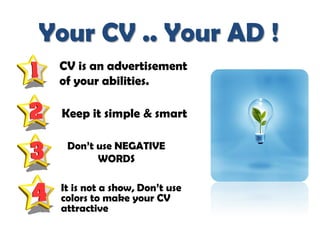
Your CV .. Your AD !
 CV is an advertisement
 of your abilities.

 Keep it simple & smart

  Don’t use NEGATIVE
        WORDS

 It is not a show, Don’t use
 colors to make your CV
 attractive
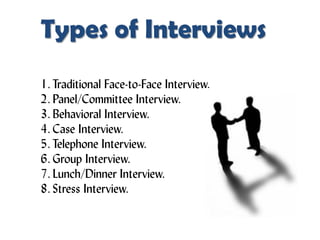
Types of Interviews
1. Traditional Face-to-Face Interview.
2. Panel/Committee Interview.
3. Behavioral Interview.
4. Case Interview.
5. Telephone Interview.
6. Group Interview.
7. Lunch/Dinner Interview.
8. Stress Interview.
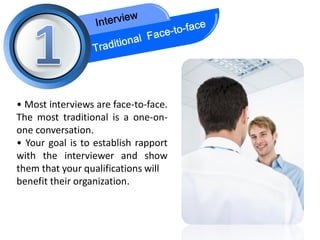
• Most interviews are face-to-face.
The most traditional is a one-on-
one conversation.
• Your goal is to establish rapport
with the interviewer and show
them that your qualifications will
benefit their organization.
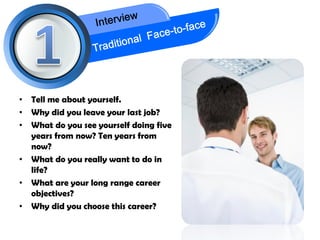
•   Tell me about yourself.
•   Why did you leave your last job?
•   What do you see yourself doing five
    years from now? Ten years from
    now?
•   What do you really want to do in
    life?
•   What are your long range career
    objectives?
•   Why did you choose this career?
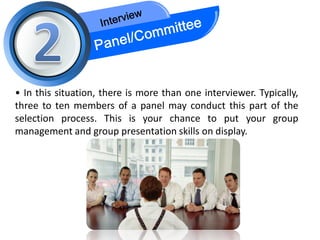
• In this situation, there is more than one interviewer. Typically,
three to ten members of a panel may conduct this part of the
selection process. This is your chance to put your group
management and group presentation skills on display.
• The basic premise behind this type
of interview is that your past behavior
is the best predictor of your future
actions. These types of questions may
be asked in any interview format
telephone, panel or one-on-one.
• Give me an example of
  a time when you set a
  goal and were able to
  meet or achieve it.
• Give me an example of
  a time when you
  motivated others.
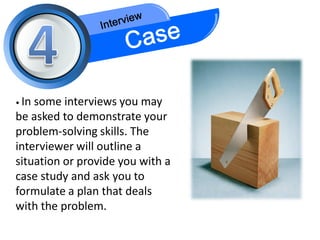
• Insome interviews you may
be asked to demonstrate your
problem-solving skills. The
interviewer will outline a
situation or provide you with a
case study and ask you to
formulate a plan that deals
with the problem.
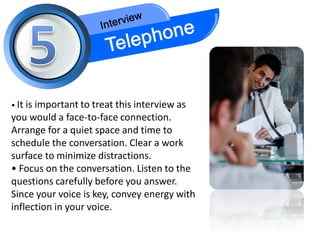
• It is
      important to treat this interview as
you would a face-to-face connection.
Arrange for a quiet space and time to
schedule the conversation. Clear a work
surface to minimize distractions.
• Focus on the conversation. Listen to the
questions carefully before you answer.
Since your voice is key, convey energy with
inflection in your voice.
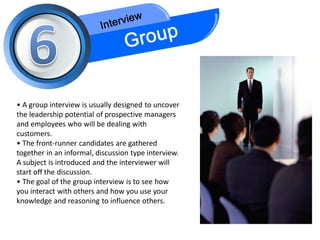
• A group interview is usually designed to uncover
the leadership potential of prospective managers
and employees who will be dealing with
customers.
• The front-runner candidates are gathered
together in an informal, discussion type interview.
A subject is introduced and the interviewer will
start off the discussion.
• The goal of the group interview is to see how
you interact with others and how you use your
knowledge and reasoning to influence others.
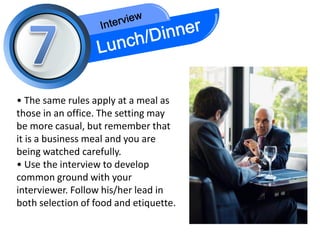
• The same rules apply at a meal as
those in an office. The setting may
be more casual, but remember that
it is a business meal and you are
being watched carefully.
• Use the interview to develop
common ground with your
interviewer. Follow his/her lead in
both selection of food and etiquette.
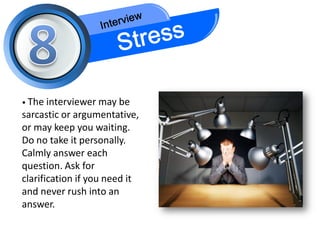
• The interviewer may be
sarcastic or argumentative,
or may keep you waiting.
Do no take it personally.
Calmly answer each
question. Ask for
clarification if you need it
and never rush into an
answer.
Preparing for the interview

   Know           Know the
  Yourself       organization
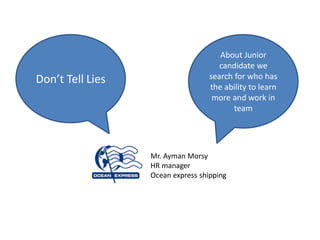
About Junior
                                      candidate we
Don’t Tell Lies                    search for who has
                                   the ability to learn
                                    more and work in
                                          team


                  Mr. Ayman Morsy
                  HR manager
                  Ocean express shipping
On the Interview Day
• Non-verbal Messages: Non-verbal language speaks
  larger than words.
• Greet the interviewer with a strong handshake.
• Eye contact is an important component of the
  interview.
• Always feel relaxed not confused or somewhat
  stressed.
• Speak clearly: Use good grammar and a friendly tone.
  Never answer just "yes" or "no" to a question. Always
  clarify, expand on your answers.
Thank You All 
Keep in touch:

Amir.mhany@gmail.com
0101375715

Interview skills

  • 1.
    Interview Skills How to win an interview? Prepared by: Amir Mohamed Hany Certified Corporate Trainer from CTCHD – Canada Marketing Team member in
  • 2.
    Road Map Your CV Types of Interviews Preparation for Interview
  • 3.
    Your CV ..Your AD ! CV is an advertisement of your abilities. Keep it simple & smart Don’t use NEGATIVE WORDS It is not a show, Don’t use colors to make your CV attractive
  • 4.
    Types of Interviews 1.Traditional Face-to-Face Interview. 2. Panel/Committee Interview. 3. Behavioral Interview. 4. Case Interview. 5. Telephone Interview. 6. Group Interview. 7. Lunch/Dinner Interview. 8. Stress Interview.
  • 5.
    • Most interviewsare face-to-face. The most traditional is a one-on- one conversation. • Your goal is to establish rapport with the interviewer and show them that your qualifications will benefit their organization.
  • 6.
    Tell me about yourself. • Why did you leave your last job? • What do you see yourself doing five years from now? Ten years from now? • What do you really want to do in life? • What are your long range career objectives? • Why did you choose this career?
  • 7.
    • In thissituation, there is more than one interviewer. Typically, three to ten members of a panel may conduct this part of the selection process. This is your chance to put your group management and group presentation skills on display.
  • 8.
    • The basicpremise behind this type of interview is that your past behavior is the best predictor of your future actions. These types of questions may be asked in any interview format telephone, panel or one-on-one.
  • 9.
    • Give mean example of a time when you set a goal and were able to meet or achieve it. • Give me an example of a time when you motivated others.
  • 10.
    • Insome interviewsyou may be asked to demonstrate your problem-solving skills. The interviewer will outline a situation or provide you with a case study and ask you to formulate a plan that deals with the problem.
  • 11.
    • It is important to treat this interview as you would a face-to-face connection. Arrange for a quiet space and time to schedule the conversation. Clear a work surface to minimize distractions. • Focus on the conversation. Listen to the questions carefully before you answer. Since your voice is key, convey energy with inflection in your voice.
  • 12.
    • A groupinterview is usually designed to uncover the leadership potential of prospective managers and employees who will be dealing with customers. • The front-runner candidates are gathered together in an informal, discussion type interview. A subject is introduced and the interviewer will start off the discussion. • The goal of the group interview is to see how you interact with others and how you use your knowledge and reasoning to influence others.
  • 13.
    • The samerules apply at a meal as those in an office. The setting may be more casual, but remember that it is a business meal and you are being watched carefully. • Use the interview to develop common ground with your interviewer. Follow his/her lead in both selection of food and etiquette.
  • 14.
    • The interviewermay be sarcastic or argumentative, or may keep you waiting. Do no take it personally. Calmly answer each question. Ask for clarification if you need it and never rush into an answer.
  • 15.
    Preparing for theinterview Know Know the Yourself organization
  • 16.
    About Junior candidate we Don’t Tell Lies search for who has the ability to learn more and work in team Mr. Ayman Morsy HR manager Ocean express shipping
  • 17.
    On the InterviewDay • Non-verbal Messages: Non-verbal language speaks larger than words. • Greet the interviewer with a strong handshake. • Eye contact is an important component of the interview. • Always feel relaxed not confused or somewhat stressed. • Speak clearly: Use good grammar and a friendly tone. Never answer just "yes" or "no" to a question. Always clarify, expand on your answers.
  • 18.
    Thank You All Keep in touch: Amir.mhany@gmail.com 0101375715