Subject: Testing and Measurements
TOPIC:
Subject: Testing and Measurements
Page 01
MUHHAMAD ALI #21
AQSA KHAN #10
MALAIKA FAZAL #07
MUQADAS YOUSAF #13
AREEBA AKRAM #22
FAHAD MAQSOOD #15
SUBMITTED BY: GROUP 3
SUBMITTED TO: Sir Ahmad Ikram
Subject: Testing and Measurements
Page 02
AN assessment approach focuses on the
interactions between situations and
behaviors to effect behavioral change.
Subject: Testing and Measurements
Page 03
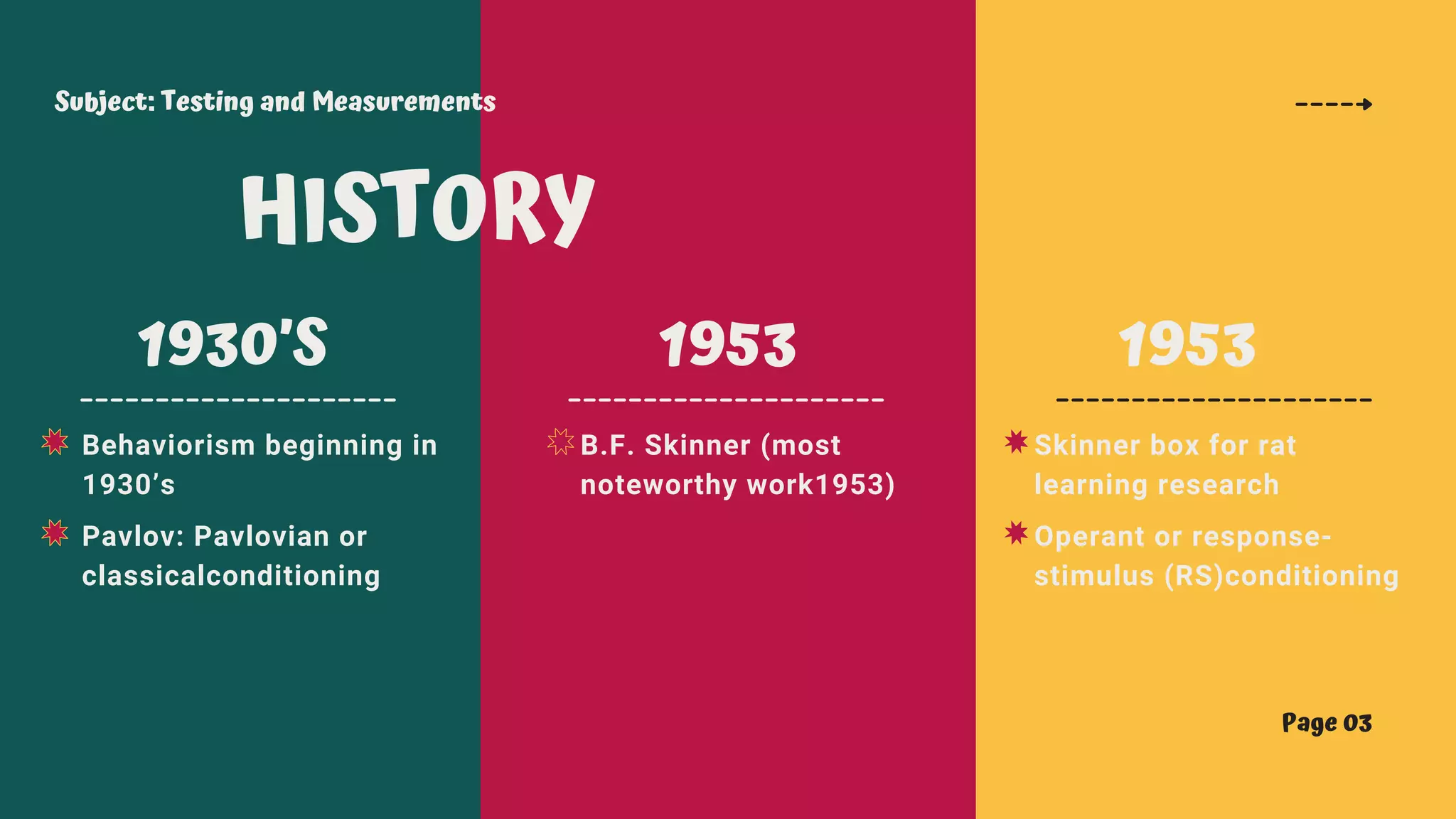
HISTORY
1953
Behaviorism beginning in
1930’s
1930’S
Pavlov: Pavlovian or
classicalconditioning
B.F. Skinner (most
noteworthy work1953)
Operant or response-
stimulus (RS)conditioning
Skinner box for rat
learning research
1953
Subject: Testing and Measurements
Page 04
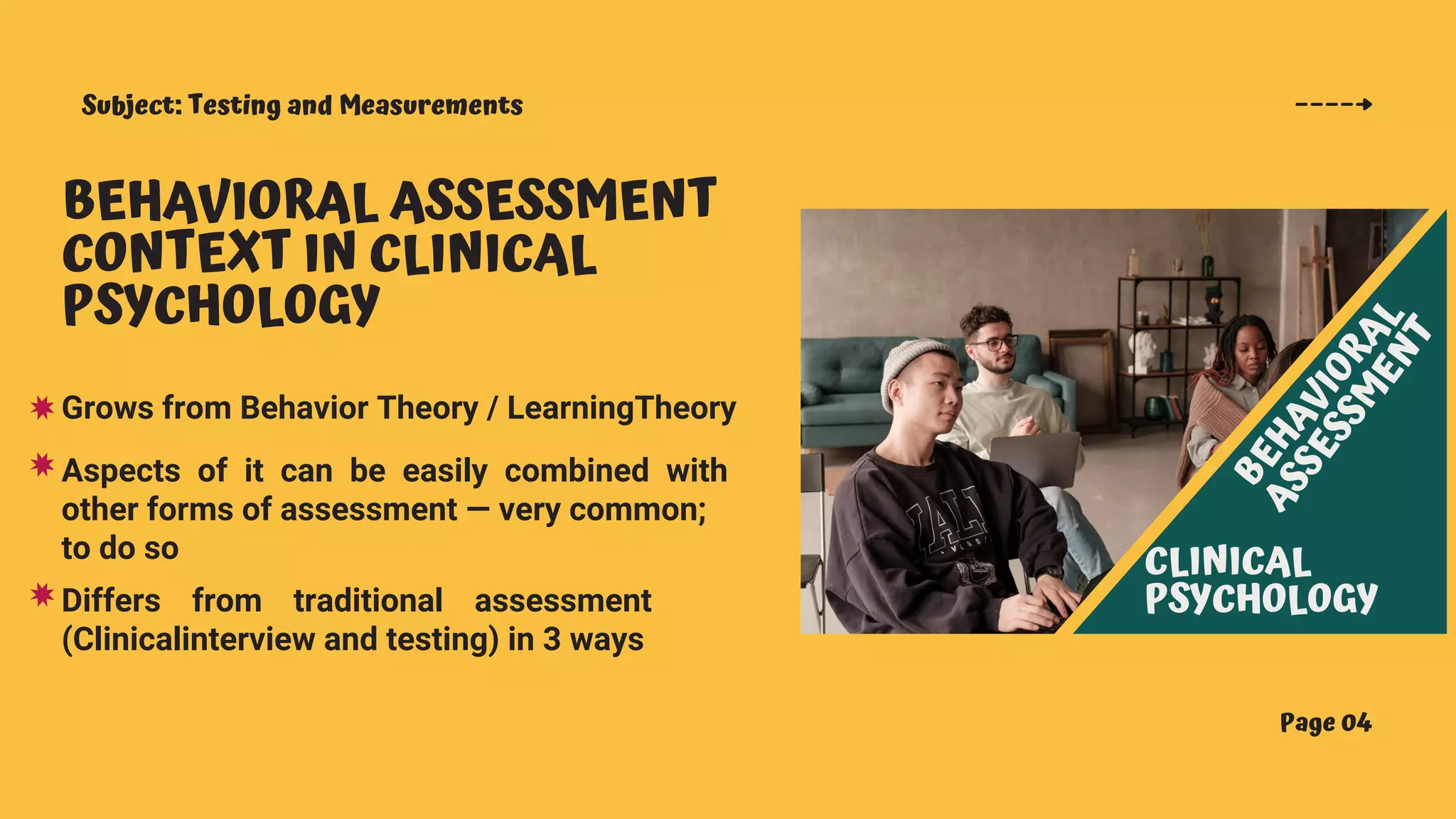
BEHAVIORAL ASSESSMENT
CONTEXT IN CLINICAL
PSYCHOLOGY
Grows from Behavior Theory / LearningTheory
B
E
H
A
V
I
O
R
A
L
A
S
S
E
S
S
M
E
N
T
CLINICAL
PSYCHOLOGY
Aspects of it can be easily combined with
other forms of assessment — very common;
to do so
Differs from traditional assessment
(Clinicalinterview and testing) in 3 ways
Subject: Testing and Measurements
Page 05
SAMPLE SIGN
VS
In behavioral assessment, test / interview
responses are interpreted as“samples” of
behavior that arethought to generalize to
othersituations
In traditional assessment (even
psychodynamic), we interpret test data as
“signs” of internal processes
Subject: Testing and Measurements
FUNCTIONAL BEHAVIORAL
ANALYSIS
Derived from Skinner's work with SR
(stimulus-response) learning
SORC model
ABC model (very similar)
Isolates a target behavior for analysis and
understanding in a very concrete,
prescripted manor
Page 06
Subject: Testing and Measurements
Page 07
SORC MODEL FORCONCEPTUALIZING A
BEHAVIOR
S= stimulus or “antecedent” factors
that occur before target behavior
O = organismic variables relevant
to target behavior
R = the response = the target behavior
C = consequences of target behavior
Subject: Testing and Measurements
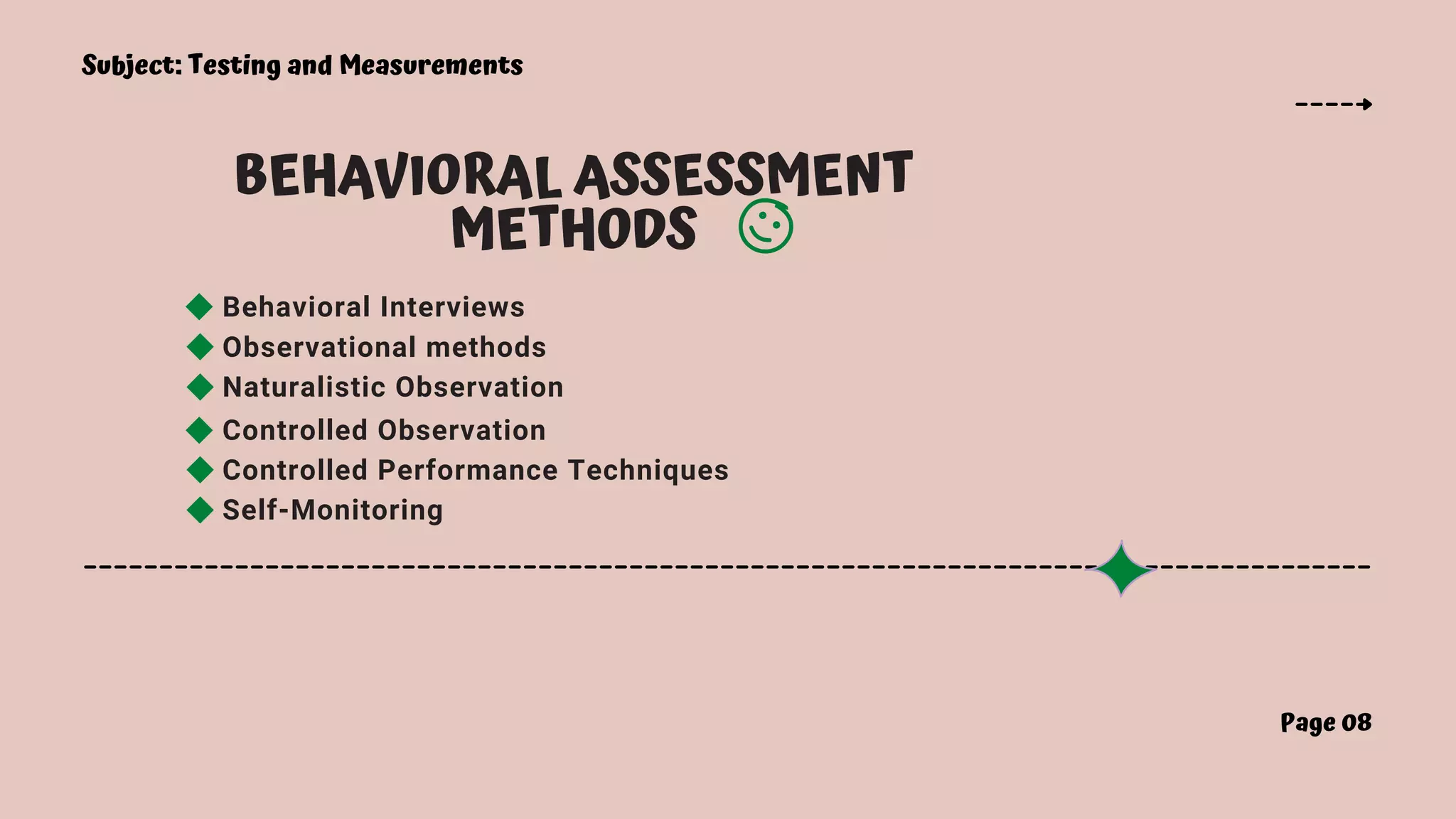
BEHAVIORAL ASSESSMENT
METHODS
Page 08
Behavioral Interviews
Observational methods
Naturalistic Observation
Controlled Observation
Controlled Performance Techniques
Self-Monitoring
Subject: Testing and Measurements
Page 09
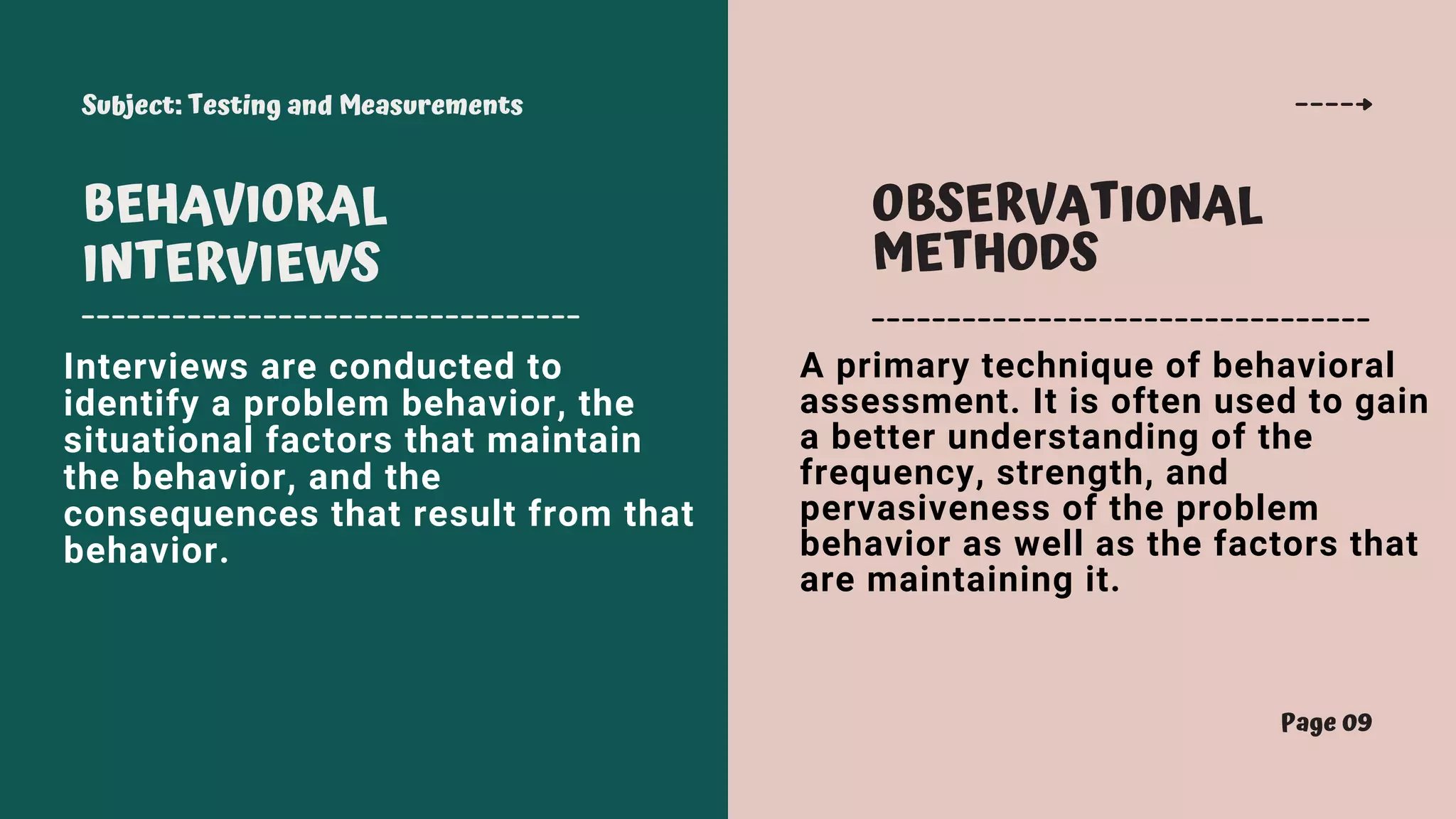
BEHAVIORAL
INTERVIEWS
OBSERVATIONAL
METHODS
Interviews are conducted to
identify a problem behavior, the
situational factors that maintain
the behavior, and the
consequences that result from that
behavior.
A primary technique of behavioral
assessment. It is often used to gain
a better understanding of the
frequency, strength, and
pervasiveness of the problem
behavior as well as the factors that
are maintaining it.
Subject: Testing and Measurements
Page 10
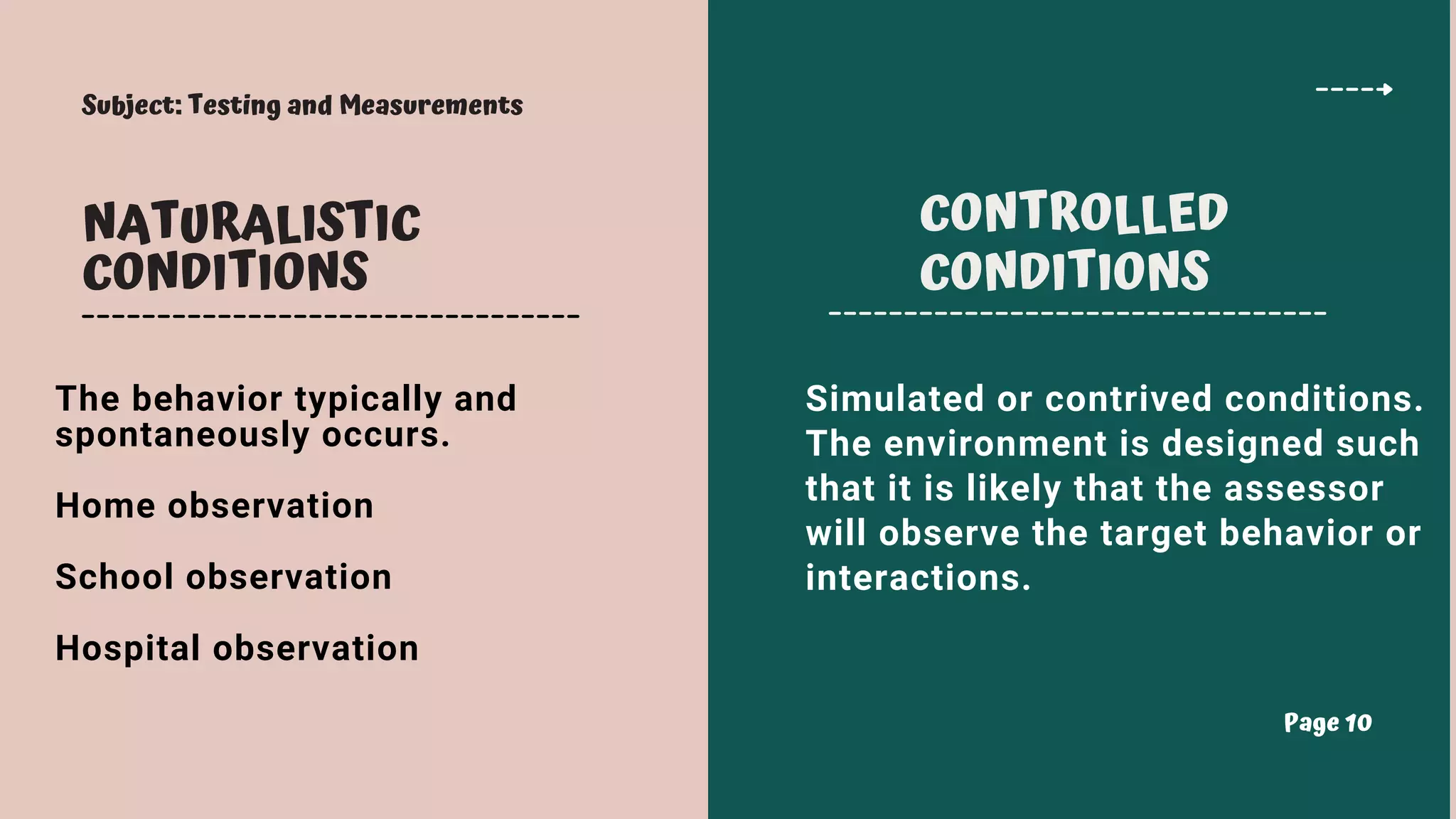
CONTROLLED
CONDITIONS
NATURALISTIC
CONDITIONS
Simulated or contrived conditions.
The environment is designed such
that it is likely that the assessor
will observe the target behavior or
interactions.
The behavior typically and
spontaneously occurs.
Home observation
School observation
Hospital observation
Subject: Testing and Measurements
Page 11
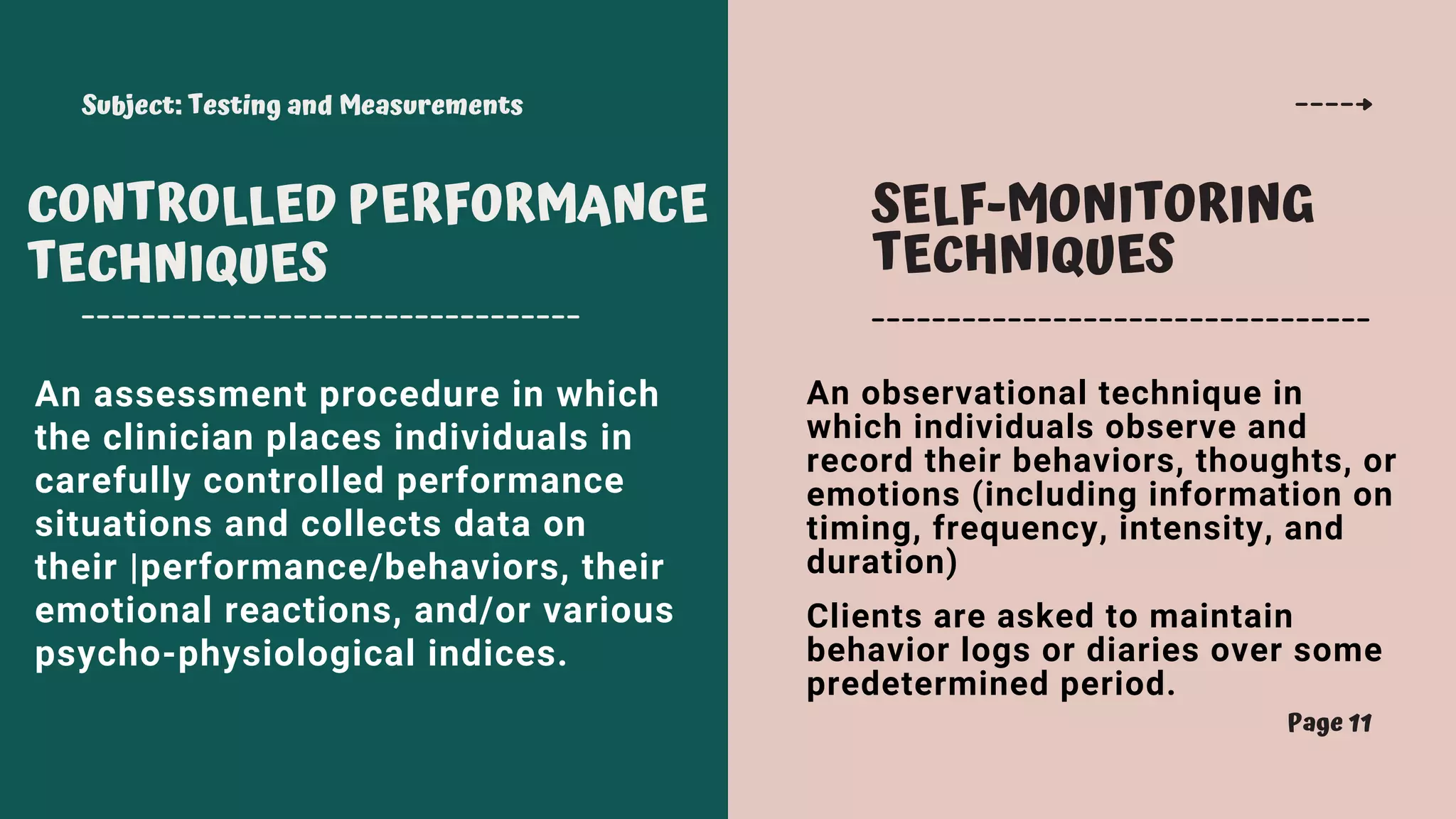
CONTROLLED PERFORMANCE
TECHNIQUES
SELF-MONITORING
TECHNIQUES
An assessment procedure in which
the clinician places individuals in
carefully controlled performance
situations and collects data on
their |performance/behaviors, their
emotional reactions, and/or various
psycho-physiological indices.
An observational technique in
which individuals observe and
record their behaviors, thoughts, or
emotions (including information on
timing, frequency, intensity, and
duration)
Clients are asked to maintain
behavior logs or diaries over some
predetermined period.
Behavioral assessment.pdf

Behavioral assessment.pdf

  • 1.
    Subject: Testing andMeasurements TOPIC:
  • 2.
    Subject: Testing andMeasurements Page 01 MUHHAMAD ALI #21 AQSA KHAN #10 MALAIKA FAZAL #07 MUQADAS YOUSAF #13 AREEBA AKRAM #22 FAHAD MAQSOOD #15 SUBMITTED BY: GROUP 3 SUBMITTED TO: Sir Ahmad Ikram
  • 3.
    Subject: Testing andMeasurements Page 02 AN assessment approach focuses on the interactions between situations and behaviors to effect behavioral change.
  • 4.
    Subject: Testing andMeasurements Page 03 HISTORY 1953 Behaviorism beginning in 1930’s 1930’S Pavlov: Pavlovian or classicalconditioning B.F. Skinner (most noteworthy work1953) Operant or response- stimulus (RS)conditioning Skinner box for rat learning research 1953
  • 5.
    Subject: Testing andMeasurements Page 04 BEHAVIORAL ASSESSMENT CONTEXT IN CLINICAL PSYCHOLOGY Grows from Behavior Theory / LearningTheory B E H A V I O R A L A S S E S S M E N T CLINICAL PSYCHOLOGY Aspects of it can be easily combined with other forms of assessment — very common; to do so Differs from traditional assessment (Clinicalinterview and testing) in 3 ways
  • 6.
    Subject: Testing andMeasurements Page 05 SAMPLE SIGN VS In behavioral assessment, test / interview responses are interpreted as“samples” of behavior that arethought to generalize to othersituations In traditional assessment (even psychodynamic), we interpret test data as “signs” of internal processes
  • 7.
    Subject: Testing andMeasurements FUNCTIONAL BEHAVIORAL ANALYSIS Derived from Skinner's work with SR (stimulus-response) learning SORC model ABC model (very similar) Isolates a target behavior for analysis and understanding in a very concrete, prescripted manor Page 06
  • 8.
    Subject: Testing andMeasurements Page 07 SORC MODEL FORCONCEPTUALIZING A BEHAVIOR S= stimulus or “antecedent” factors that occur before target behavior O = organismic variables relevant to target behavior R = the response = the target behavior C = consequences of target behavior
  • 9.
    Subject: Testing andMeasurements BEHAVIORAL ASSESSMENT METHODS Page 08 Behavioral Interviews Observational methods Naturalistic Observation Controlled Observation Controlled Performance Techniques Self-Monitoring
  • 10.
    Subject: Testing andMeasurements Page 09 BEHAVIORAL INTERVIEWS OBSERVATIONAL METHODS Interviews are conducted to identify a problem behavior, the situational factors that maintain the behavior, and the consequences that result from that behavior. A primary technique of behavioral assessment. It is often used to gain a better understanding of the frequency, strength, and pervasiveness of the problem behavior as well as the factors that are maintaining it.
  • 11.
    Subject: Testing andMeasurements Page 10 CONTROLLED CONDITIONS NATURALISTIC CONDITIONS Simulated or contrived conditions. The environment is designed such that it is likely that the assessor will observe the target behavior or interactions. The behavior typically and spontaneously occurs. Home observation School observation Hospital observation
  • 12.
    Subject: Testing andMeasurements Page 11 CONTROLLED PERFORMANCE TECHNIQUES SELF-MONITORING TECHNIQUES An assessment procedure in which the clinician places individuals in carefully controlled performance situations and collects data on their |performance/behaviors, their emotional reactions, and/or various psycho-physiological indices. An observational technique in which individuals observe and record their behaviors, thoughts, or emotions (including information on timing, frequency, intensity, and duration) Clients are asked to maintain behavior logs or diaries over some predetermined period.