CHARACTER THEORIES
ALEX HUNTER
WHAT ARE THEY?
Character Theories are used to analyse and understanding the roles of
characters in media. These are popular in research and the teachings of media
and film studies. This is because they assist in the appreciation of the structure
of types of media as well as the roles of the characters. Based most often on
stereotypes, character theories can be for positive and negative purposes.
PROPP’S NARRATIVE THEORY
Vladimir Propp was a Russian literacy critic who founded the idea that a certain type of character was to
be used in every narrative structure. His theory was produced from analysing 100 tales,. He implied that
there were 7 broad character types:
• The Villain (struggles against the hero)
• The Donor (prepares the hero or gives the hero some magical object)
• The Helper (magical person who helps the hero in the quest)
• The Princess (person the hero marries, often sought for during the narrative)
• The False Hero (perceived as good character in beginning but emerges as evil)
• The Dispatcher (character who makes the lack known and sends the hero off)
• The Hero (AKA victim/seeker/paladin/winner, reacts to the donor, usually marries the princess)
EXAMPLES OF PROPP’S NARRATIVE THEORY IN MEDIA
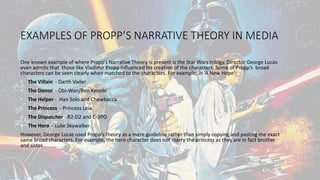
One known example of where Propp’s Narrative Theory is present is the Star Wars trilogy. Director George Lucas
even admits that those like Vladimir Propp influenced his creation of the characters. Some of Propp’s broad
characters can be seen clearly when matched to the characters. For example, in ‘A New Hope’:
• The Villain - Darth Vader
• The Donor - Obi-Wan/Ben Kenobi
• The Helper - Han Solo and Chewbacca
• The Princess - Princess Leia
• The Dispatcher - R2-D2 and C-3PO
• The Hero - Luke Skywalker
However, George Lucas used Propp’s theory as a mere guideline rather than simply copying and pasting the exact
same broad characters. For example, the hero character does not marry the princess as they are in fact brother
and sister.

Character theories

  • 1.
  • 2.
    WHAT ARE THEY? CharacterTheories are used to analyse and understanding the roles of characters in media. These are popular in research and the teachings of media and film studies. This is because they assist in the appreciation of the structure of types of media as well as the roles of the characters. Based most often on stereotypes, character theories can be for positive and negative purposes.
  • 3.
    PROPP’S NARRATIVE THEORY VladimirPropp was a Russian literacy critic who founded the idea that a certain type of character was to be used in every narrative structure. His theory was produced from analysing 100 tales,. He implied that there were 7 broad character types: • The Villain (struggles against the hero) • The Donor (prepares the hero or gives the hero some magical object) • The Helper (magical person who helps the hero in the quest) • The Princess (person the hero marries, often sought for during the narrative) • The False Hero (perceived as good character in beginning but emerges as evil) • The Dispatcher (character who makes the lack known and sends the hero off) • The Hero (AKA victim/seeker/paladin/winner, reacts to the donor, usually marries the princess)
  • 4.
    EXAMPLES OF PROPP’SNARRATIVE THEORY IN MEDIA One known example of where Propp’s Narrative Theory is present is the Star Wars trilogy. Director George Lucas even admits that those like Vladimir Propp influenced his creation of the characters. Some of Propp’s broad characters can be seen clearly when matched to the characters. For example, in ‘A New Hope’: • The Villain - Darth Vader • The Donor - Obi-Wan/Ben Kenobi • The Helper - Han Solo and Chewbacca • The Princess - Princess Leia • The Dispatcher - R2-D2 and C-3PO • The Hero - Luke Skywalker However, George Lucas used Propp’s theory as a mere guideline rather than simply copying and pasting the exact same broad characters. For example, the hero character does not marry the princess as they are in fact brother and sister.