

“Bi-connected Components”
Prepared by:-
Soni Axay R. (130240116056)
Guided by:-
Prof. Nimisha Sharma
Sub-Topics
 Introduction
 Articulation Point
 Identification of Articulation Point
 Identification of bi-connected components
 Finding Articulation point by DFS
 Example
Introduction
 Basically it is a Graph theory.
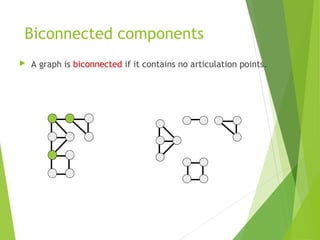
 A graph is biconnected if it contains no
‘articulation’ points.
 A components of graph G is maximal
“biconnected subgraph” .That means it is
not contained any larger biconnected
subgraph of G.
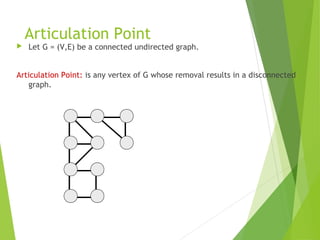
Articulation Point
 Let G = (V,E) be a connected undirected graph.
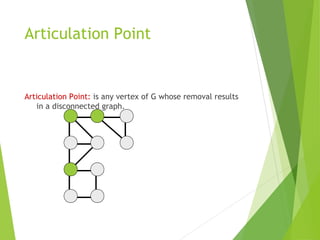
Articulation Point: is any vertex of G whose removal results in a disconnected
graph.
Articulation Point
Articulation Point: is any vertex of G whose removal results
in a disconnected graph.
Biconnected components
 A graph is biconnected if it contains no articulation points.
Identification of Articulation
point
 Keep track of removal vertex from each subtree?
 Too expensive
 Time complexity O(V(V+E))
 Another method is to use the DFS to find the articulation point in the graph.
 By using the DFS we will get the DFS Tree.
 Classification of graph categories:-
 Tree edge
 Back edge
 Forward edge
 Cross edge
Conditions:-
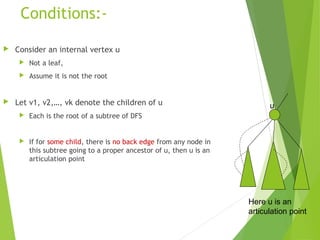
 Consider an internal vertex u
 Not a leaf,
 Assume it is not the root
 Let v1, v2,…, vk denote the children of u
 Each is the root of a subtree of DFS
 If for some child, there is no back edge from any node in
this subtree going to a proper ancestor of u, then u is an
articulation point
u
Here u is an
articulation point
internal vertex u
 Here u is not an articulation point
 A back edge from every subtree of u to proper
ancestors of u exists
u
What if u is a leaf
 A leaf is never an articulation point
 A leaf has no subtrees..
What about the root?
 the root is an articulation point if an only if it has two or more
children.
 Root has no proper ancestor
 There are no cross edges between its subtrees
This root is an
articulation point
Calculation By DFS
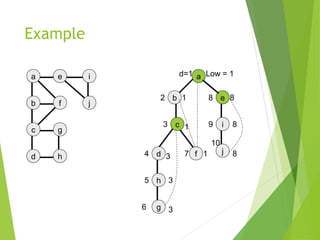
 Define Low[u]
 Low[u]: minimum of d[u]
and
{d[w] | where (v,w) is a back edge and v is a
(nonproper) descendent of u.}
Computing Low[u]
 Initialization:
Low[u] = d[u]
 When a new back edge (u, v) is detected:
Low[u] = min( Low[u], d[v])
 Tree edge (u, v):
Low[u] = min(Low[u], Low[v])
 Once Low[u] is computed for all vertices u, we can test
whether a nonroot vertex u is an articulation point
 u is an articulation point iff it has a child v for which
Low[v] >= d[u]
Example
a
j
ie
c
b
g
d h
f
a
b e
c
d
g
f
h
i
j
Low = 1
1
1
13
3
3
8
8
8
d=1
2
3
8
4
5
6
7
9
10
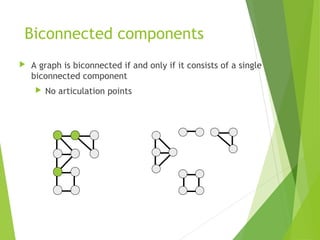
Biconnected components
 A graph is biconnected if and only if it consists of a single
biconnected component
 No articulation points
Thank
You!!!

Biconnected components (13024116056)

  • 1.
    “Bi-connected Components” Prepared by:- SoniAxay R. (130240116056) Guided by:- Prof. Nimisha Sharma
  • 2.
    Sub-Topics  Introduction  ArticulationPoint  Identification of Articulation Point  Identification of bi-connected components  Finding Articulation point by DFS  Example
  • 3.
    Introduction  Basically itis a Graph theory.  A graph is biconnected if it contains no ‘articulation’ points.  A components of graph G is maximal “biconnected subgraph” .That means it is not contained any larger biconnected subgraph of G.
  • 4.
    Articulation Point  LetG = (V,E) be a connected undirected graph. Articulation Point: is any vertex of G whose removal results in a disconnected graph.
  • 5.
    Articulation Point Articulation Point:is any vertex of G whose removal results in a disconnected graph.
  • 6.
    Biconnected components  Agraph is biconnected if it contains no articulation points.
  • 7.
    Identification of Articulation point Keep track of removal vertex from each subtree?  Too expensive  Time complexity O(V(V+E))  Another method is to use the DFS to find the articulation point in the graph.  By using the DFS we will get the DFS Tree.  Classification of graph categories:-  Tree edge  Back edge  Forward edge  Cross edge
  • 8.
    Conditions:-  Consider aninternal vertex u  Not a leaf,  Assume it is not the root  Let v1, v2,…, vk denote the children of u  Each is the root of a subtree of DFS  If for some child, there is no back edge from any node in this subtree going to a proper ancestor of u, then u is an articulation point u Here u is an articulation point
  • 9.
    internal vertex u Here u is not an articulation point  A back edge from every subtree of u to proper ancestors of u exists u
  • 10.
    What if uis a leaf  A leaf is never an articulation point  A leaf has no subtrees..
  • 11.
    What about theroot?  the root is an articulation point if an only if it has two or more children.  Root has no proper ancestor  There are no cross edges between its subtrees This root is an articulation point
  • 12.
    Calculation By DFS Define Low[u]  Low[u]: minimum of d[u] and {d[w] | where (v,w) is a back edge and v is a (nonproper) descendent of u.}
  • 13.
    Computing Low[u]  Initialization: Low[u]= d[u]  When a new back edge (u, v) is detected: Low[u] = min( Low[u], d[v])  Tree edge (u, v): Low[u] = min(Low[u], Low[v])
  • 14.
     Once Low[u]is computed for all vertices u, we can test whether a nonroot vertex u is an articulation point  u is an articulation point iff it has a child v for which Low[v] >= d[u]
  • 15.
    Example a j ie c b g d h f a b e c d g f h i j Low= 1 1 1 13 3 3 8 8 8 d=1 2 3 8 4 5 6 7 9 10
  • 16.
    Biconnected components  Agraph is biconnected if and only if it consists of a single biconnected component  No articulation points
  • 17.