International School of Informatics & Management
SUMMER INTERNSHIP PRESENTATION
Project Title:
“COMPANY OPERATIONS FOR FINANCE AND MARKETING
DEPARTMENT”
Training Undertaken At :
RELIANCE INDUSTRIES LTD.
Presented To: Presented By:
DR.Kavaldeep Dixit Mam Akanksha Saxena
MS.Hemlata Bhagtani Mam
INDEX
• INTRODUCTION TO THE COMPANY
• OBJECTIVE OF THIS STUDY
• RESEARCH METHODOLOGY
• DATAANALYSIS AND INTERPRETATION
• ELECTRICITY BILLING(EB) PROCESS
• KEY TERMINOLOGIES
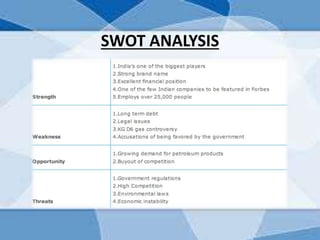
• SWOT ANALYSIS
• VENDOR MANAGEMENT
• CONCLUSION
• WEBLIOGRAPHY
INTRODUCTION
RELIANCE INDUSTRIES LIMITED
• Reliance industries is a Flagship company of Reliance group founded by Dhirubhai
Ambani in the year 1966.
• It is Headquartered in Mumbai, Maharashtra.
• largest private sector enterprise in India,
• With businesses in the energy and materials value chain.
• The largest polyester yarn and fibre producer in the world.
• Top five to ten producers in the world in major petrochemical products.
• Ranked 107(2013) in Fortune 500 companies holding previous ranking of 99(2012).
RIL is India’s largest private sector company on key financial parameters. It is a
significant global player in the integrated energy value chain, and has a growing
presence in the retail and digital services in India. Built on strong values, RIL is
steadfastly rooted in the culture of safety, integrity and commitment.
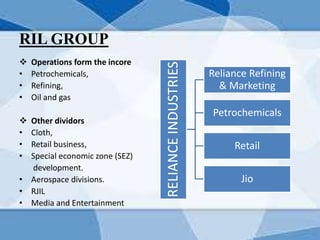
RIL GROUP
 Operations form the incore
• Petrochemicals,
• Refining,
• Oil and gas
 Other dividors
• Cloth,
• Retail business,
• Special economic zone (SEZ)
development.
• Aerospace divisions.
• RJIL
• Media and Entertainment
RELIANCEINDUSTRIES
Reliance Refining
& Marketing
Petrochemicals
Retail
Jio
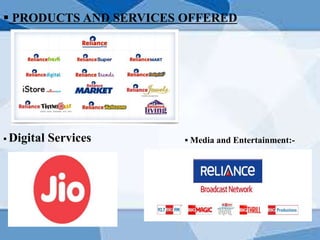
 PRODUCTS AND SERVICES OFFERED
 Digital Services  Media and Entertainment:-
OBJECTIVES OF THIS STUDY
• 1. To study the accounting practices of RIL.
• 2. To study their payment procedure.
• 3. To study the invoice raising strategy of RIL.
• 4. To study the terminology used in their financial
transactions.
RESEARCH METHODOLOGY
 This research is a descriptive research which is related to the Reliance jio
infocomm limited and its accounting practices have been stated.
• Through this study we are trying to analyze the various factors that may be
responsible for preference Reliance jio infocomm ltd. by the investors and
speculators.
 SECONDARY DATA-It is defined as a data which is collected earlier for
other purpose.
• As a result I have scanned lot of sources to get an access to secondary data
which have formed a reference base to compare the research findings.
• Secondary in this provided an insight and forms an outline for the core
objective established.
• The various sources of secondary data used for this study are:
1. news papers
2. magazines
3. text books
4. internet
DATA ANALYSIS AND INTERPRETATION
 Significant Accounting Practices
• BASIS OF PREPARATION OF FINANCIAL STATEMENTS- These financial
statements have been prepared to comply with Accounting Principles
Generally accepted in India (Indian GAAP). The financial statements are
prepared on accrual basis under the historical cost convention.
• USE OF ESTIMATES- The preparation of financial statements in conformity
with Indian GAAP requires judgements, estimates and assumptions to be
made that affect the reported amount of assets and liabilities, disclosure of
contingent liabilities on the date of the financial statements and the reported
amount of revenues and expenses during the reporting period.
 FIXED ASSETS :-
• Tangible Assets Tangible Assets are stated at cost net of recoverable taxes,
trade discounts and rebates less accumulated depreciation and impairment
loss, if any.
• Intangible Assets- Intangible Assets are stated at cost of acquisition net of
recoverable taxes less accumulated amortisation and impairment loss, if any.
• OPERATING LEASE Rentals pertaining to the period upto the date of
commissioning of the assets are capitalised.
• DEPRECIATION AND AMORTISATION:-
(i) Tangible Assets Depreciation on fixed assets is provided on straight line method .
• Leasehold land is amortised on a straight line basis over the period of lease.
• Leasehold improvements are depreciated on a straight line basis over the period of
lease.
(ii) Intangible Assets These are amortised as under :Sr. No. Particulars
Amortisation:-
Softwares Over a period of 5 to 10 years
 Internet Service Provider (ISP) Amortised equally over the remainder of the
License period License Fee of 15 Years from the date of commencement of the
commercial operation.
 Broadband Wireless Access (BWA) Spectrum Will be amortised from the date of
commencement of Fees and 1800 MHz Spectrum Fees commercial operation over the
balance validity period.
•REVENUE RECOGNITION
Revenue from services is recognised only when risks and rewards are
transferred to the customer. The revenue is recognised net of discounts and
service tax.
(ii) Interest Income is recognised on a time proportion basis taking into
account the amount outstanding and the interest rate applicable.
EMPLOYEE BENEFITS
i. Short term employee benefits The undiscounted amount of short-term
employee benefits are recognised as an expense during the period when
the employees render the services. These benefits include performance
incentive and compensated absences.
ii. Post-employment benefits :- The Company makes specified monthly
contributions towards Provident Fund, Superannuation Fund and Pension
Scheme. The Company’s contribution is recognised as an expense in the
Statement of Profit and Loss / Project Development expenditure during
the period in which the employee renders the related service.
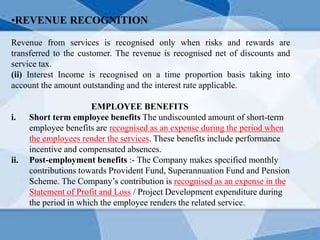
EB- THE COMPLETE PROCESS
 STEP 1:-PUNCHING OF BILLS IN IEM PORTAL
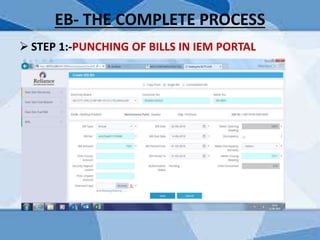
STEP 2: PUNCHING OF BILLS IN IEM PORTAL
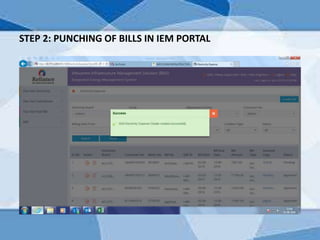
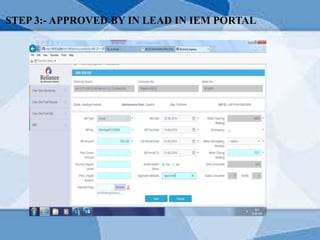
STEP 3:- APPROVED BY IN LEAD IN IEM PORTAL
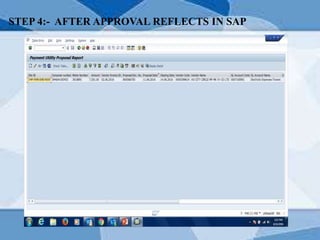
STEP 4:- AFTER APPROVAL REFLECTS IN SAP
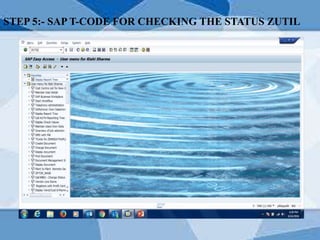
STEP 5:- SAP T-CODE FOR CHECKING THE STATUS ZUTIL
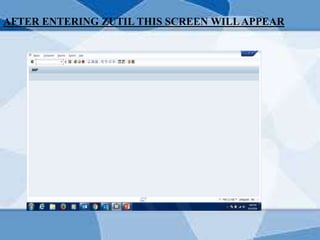
AFTER ENTERING ZUTIL THIS SCREEN WILLAPPEAR
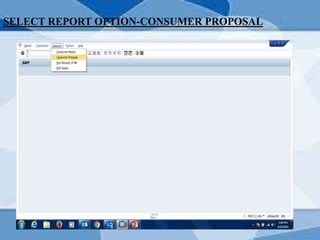
SELECT REPORT OPTION-CONSUMER PROPOSAL
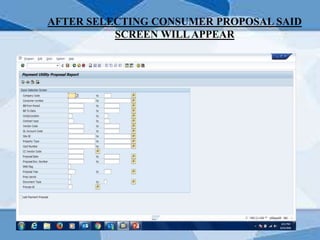
AFTER SELECTING CONSUMER PROPOSAL SAID
SCREEN WILLAPPEAR
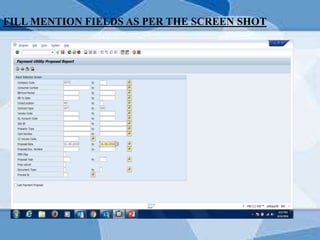
FILL MENTION FIELDS AS PER THE SCREEN SHOT
AFTER EXECUTING THIS SCREEN WILLAPPEAR
KEY TERMINOLOGIES
• ROW- A right-of-way is a right to make a way over a piece of land, usually to
and from another piece of land. A right of way is a type of easement granted or
reserved over the land for transportation purposes, this can be for a highway,
public footpath, rail transport, canal, as well as electrical transmission lines, oil and
gas pipelines.
• WBS- A work breakdown structure (WBS), in project management and
systems engineering, is a deliverable-oriented decomposition of a project into
smaller components.
• OFC- An optical fiber cable is a cable containing one or more optical
fibers that are used to carry light.Its elements are typically individually coated with
plastic layers and contained in a protective tube. Different types of cable are used
for different applications, for example long distance telecommunication, or
providing a high-speed data connection between different parts of a building.
•WO-A work order is an order received by an organization from a customer or client, or an
order created internally within the organization.
•EMD- Earnest money is a deposit made to a seller showing the buyer's good faith in a
transaction. Often used in real estate transactions, earnest money allows the buyer additional
time when seeking financing.
•TIN- Taxpayer Identification Number (TIN) and Employer Identification Number (EIN)
are defined as a nine-digit number that the IRS assigns to organizations. The IRS uses
the number to identify taxpayers who are required to file various business tax returns.
SWOT ANALYSIS
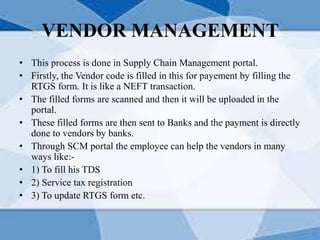
VENDOR MANAGEMENT
• This process is done in Supply Chain Management portal.
• Firstly, the Vendor code is filled in this for payement by filling the
RTGS form. It is like a NEFT transaction.
• The filled forms are scanned and then it will be uploaded in the
portal.
• These filled forms are then sent to Banks and the payment is directly
done to vendors by banks.
• Through SCM portal the employee can help the vendors in many
ways like:-
• 1) To fill his TDS
• 2) Service tax registration
• 3) To update RTGS form etc.
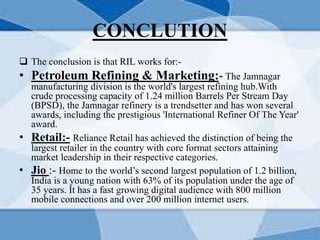
CONCLUTION
 The conclusion is that RIL works for:-
• Petroleum Refining & Marketing:- The Jamnagar
manufacturing division is the world's largest refining hub.With
crude processing capacity of 1.24 million Barrels Per Stream Day
(BPSD), the Jamnagar refinery is a trendsetter and has won several
awards, including the prestigious 'International Refiner Of The Year'
award.
• Retail:- Reliance Retail has achieved the distinction of being the
largest retailer in the country with core format sectors attaining
market leadership in their respective categories.
• Jio :- Home to the world’s second largest population of 1.2 billion,
India is a young nation with 63% of its population under the age of
35 years. It has a fast growing digital audience with 800 million
mobile connections and over 200 million internet users.
WEBILIOGRAPHY
• https://en.wikipedia.org/wiki/Reliance_Indu
stries
• https://en.wikipedia.org/wiki/Jio
• www.ril.com/ourBusinesses/Jio.aspx
• https://www.scribd.com/.../Project-Report-
on-Financial-Analysis-of-Reliance-Industry
SUMMER INTERNSHIP PPT

SUMMER INTERNSHIP PPT

  • 1.
    International School ofInformatics & Management SUMMER INTERNSHIP PRESENTATION Project Title: “COMPANY OPERATIONS FOR FINANCE AND MARKETING DEPARTMENT” Training Undertaken At : RELIANCE INDUSTRIES LTD. Presented To: Presented By: DR.Kavaldeep Dixit Mam Akanksha Saxena MS.Hemlata Bhagtani Mam
  • 2.
    INDEX • INTRODUCTION TOTHE COMPANY • OBJECTIVE OF THIS STUDY • RESEARCH METHODOLOGY • DATAANALYSIS AND INTERPRETATION • ELECTRICITY BILLING(EB) PROCESS • KEY TERMINOLOGIES • SWOT ANALYSIS • VENDOR MANAGEMENT • CONCLUSION • WEBLIOGRAPHY
  • 3.
    INTRODUCTION RELIANCE INDUSTRIES LIMITED •Reliance industries is a Flagship company of Reliance group founded by Dhirubhai Ambani in the year 1966. • It is Headquartered in Mumbai, Maharashtra. • largest private sector enterprise in India, • With businesses in the energy and materials value chain. • The largest polyester yarn and fibre producer in the world. • Top five to ten producers in the world in major petrochemical products. • Ranked 107(2013) in Fortune 500 companies holding previous ranking of 99(2012). RIL is India’s largest private sector company on key financial parameters. It is a significant global player in the integrated energy value chain, and has a growing presence in the retail and digital services in India. Built on strong values, RIL is steadfastly rooted in the culture of safety, integrity and commitment.
  • 4.
    RIL GROUP  Operationsform the incore • Petrochemicals, • Refining, • Oil and gas  Other dividors • Cloth, • Retail business, • Special economic zone (SEZ) development. • Aerospace divisions. • RJIL • Media and Entertainment RELIANCEINDUSTRIES Reliance Refining & Marketing Petrochemicals Retail Jio
  • 5.
     PRODUCTS ANDSERVICES OFFERED  Digital Services  Media and Entertainment:-
  • 6.
    OBJECTIVES OF THISSTUDY • 1. To study the accounting practices of RIL. • 2. To study their payment procedure. • 3. To study the invoice raising strategy of RIL. • 4. To study the terminology used in their financial transactions.
  • 7.
    RESEARCH METHODOLOGY  Thisresearch is a descriptive research which is related to the Reliance jio infocomm limited and its accounting practices have been stated. • Through this study we are trying to analyze the various factors that may be responsible for preference Reliance jio infocomm ltd. by the investors and speculators.  SECONDARY DATA-It is defined as a data which is collected earlier for other purpose. • As a result I have scanned lot of sources to get an access to secondary data which have formed a reference base to compare the research findings. • Secondary in this provided an insight and forms an outline for the core objective established. • The various sources of secondary data used for this study are: 1. news papers 2. magazines 3. text books 4. internet
  • 8.
    DATA ANALYSIS ANDINTERPRETATION  Significant Accounting Practices • BASIS OF PREPARATION OF FINANCIAL STATEMENTS- These financial statements have been prepared to comply with Accounting Principles Generally accepted in India (Indian GAAP). The financial statements are prepared on accrual basis under the historical cost convention. • USE OF ESTIMATES- The preparation of financial statements in conformity with Indian GAAP requires judgements, estimates and assumptions to be made that affect the reported amount of assets and liabilities, disclosure of contingent liabilities on the date of the financial statements and the reported amount of revenues and expenses during the reporting period.  FIXED ASSETS :- • Tangible Assets Tangible Assets are stated at cost net of recoverable taxes, trade discounts and rebates less accumulated depreciation and impairment loss, if any.
  • 9.
    • Intangible Assets-Intangible Assets are stated at cost of acquisition net of recoverable taxes less accumulated amortisation and impairment loss, if any. • OPERATING LEASE Rentals pertaining to the period upto the date of commissioning of the assets are capitalised. • DEPRECIATION AND AMORTISATION:- (i) Tangible Assets Depreciation on fixed assets is provided on straight line method . • Leasehold land is amortised on a straight line basis over the period of lease. • Leasehold improvements are depreciated on a straight line basis over the period of lease. (ii) Intangible Assets These are amortised as under :Sr. No. Particulars Amortisation:- Softwares Over a period of 5 to 10 years  Internet Service Provider (ISP) Amortised equally over the remainder of the License period License Fee of 15 Years from the date of commencement of the commercial operation.  Broadband Wireless Access (BWA) Spectrum Will be amortised from the date of commencement of Fees and 1800 MHz Spectrum Fees commercial operation over the balance validity period.
  • 10.
    •REVENUE RECOGNITION Revenue fromservices is recognised only when risks and rewards are transferred to the customer. The revenue is recognised net of discounts and service tax. (ii) Interest Income is recognised on a time proportion basis taking into account the amount outstanding and the interest rate applicable. EMPLOYEE BENEFITS i. Short term employee benefits The undiscounted amount of short-term employee benefits are recognised as an expense during the period when the employees render the services. These benefits include performance incentive and compensated absences. ii. Post-employment benefits :- The Company makes specified monthly contributions towards Provident Fund, Superannuation Fund and Pension Scheme. The Company’s contribution is recognised as an expense in the Statement of Profit and Loss / Project Development expenditure during the period in which the employee renders the related service.
  • 11.
    EB- THE COMPLETEPROCESS  STEP 1:-PUNCHING OF BILLS IN IEM PORTAL
  • 12.
    STEP 2: PUNCHINGOF BILLS IN IEM PORTAL
  • 13.
    STEP 3:- APPROVEDBY IN LEAD IN IEM PORTAL
  • 14.
    STEP 4:- AFTERAPPROVAL REFLECTS IN SAP
  • 15.
    STEP 5:- SAPT-CODE FOR CHECKING THE STATUS ZUTIL
  • 16.
    AFTER ENTERING ZUTILTHIS SCREEN WILLAPPEAR
  • 17.
  • 18.
    AFTER SELECTING CONSUMERPROPOSAL SAID SCREEN WILLAPPEAR
  • 19.
    FILL MENTION FIELDSAS PER THE SCREEN SHOT
  • 20.
    AFTER EXECUTING THISSCREEN WILLAPPEAR
  • 21.
    KEY TERMINOLOGIES • ROW-A right-of-way is a right to make a way over a piece of land, usually to and from another piece of land. A right of way is a type of easement granted or reserved over the land for transportation purposes, this can be for a highway, public footpath, rail transport, canal, as well as electrical transmission lines, oil and gas pipelines. • WBS- A work breakdown structure (WBS), in project management and systems engineering, is a deliverable-oriented decomposition of a project into smaller components. • OFC- An optical fiber cable is a cable containing one or more optical fibers that are used to carry light.Its elements are typically individually coated with plastic layers and contained in a protective tube. Different types of cable are used for different applications, for example long distance telecommunication, or providing a high-speed data connection between different parts of a building.
  • 22.
    •WO-A work orderis an order received by an organization from a customer or client, or an order created internally within the organization. •EMD- Earnest money is a deposit made to a seller showing the buyer's good faith in a transaction. Often used in real estate transactions, earnest money allows the buyer additional time when seeking financing. •TIN- Taxpayer Identification Number (TIN) and Employer Identification Number (EIN) are defined as a nine-digit number that the IRS assigns to organizations. The IRS uses the number to identify taxpayers who are required to file various business tax returns.
  • 23.
  • 24.
    VENDOR MANAGEMENT • Thisprocess is done in Supply Chain Management portal. • Firstly, the Vendor code is filled in this for payement by filling the RTGS form. It is like a NEFT transaction. • The filled forms are scanned and then it will be uploaded in the portal. • These filled forms are then sent to Banks and the payment is directly done to vendors by banks. • Through SCM portal the employee can help the vendors in many ways like:- • 1) To fill his TDS • 2) Service tax registration • 3) To update RTGS form etc.
  • 25.
    CONCLUTION  The conclusionis that RIL works for:- • Petroleum Refining & Marketing:- The Jamnagar manufacturing division is the world's largest refining hub.With crude processing capacity of 1.24 million Barrels Per Stream Day (BPSD), the Jamnagar refinery is a trendsetter and has won several awards, including the prestigious 'International Refiner Of The Year' award. • Retail:- Reliance Retail has achieved the distinction of being the largest retailer in the country with core format sectors attaining market leadership in their respective categories. • Jio :- Home to the world’s second largest population of 1.2 billion, India is a young nation with 63% of its population under the age of 35 years. It has a fast growing digital audience with 800 million mobile connections and over 200 million internet users.
  • 26.
    WEBILIOGRAPHY • https://en.wikipedia.org/wiki/Reliance_Indu stries • https://en.wikipedia.org/wiki/Jio •www.ril.com/ourBusinesses/Jio.aspx • https://www.scribd.com/.../Project-Report- on-Financial-Analysis-of-Reliance-Industry