SOLVENTLESS
REACTIONS
Why Are Reactions
Performed Using Solvents?
• To dissolve reactants.
• To slow or increase the rate of reactions.
• To act as a heat sink or heat transfer
agent.
• To prevent hot spots and run-away
reactions.
Issues with Organic Solvents
•Organic solvents are of concern to the
chemical industry because of the sheer
volume used in
synthesis,
processing, and
separation.
• Organic solvents are expensive
• Organic solvents are highly regulated.
• Many organic solvents are volatile,
flammable, toxic, and carcinogenic.
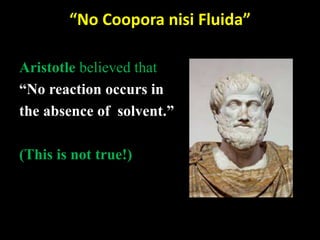
“No Coopora nisi Fluida”
Aristotle believed that
“No reaction occurs in
the absence of solvent.”
(This is not true!)
SOLVENTLESS REACTIONS
 A dry media reaction or solid-state reaction or
solventless reaction is a chemical reaction system in
the absence of a solvent.
 The drive for the development of dry media reactions in
chemistry is:
• Economics (save money on solvent)
• Not required to remove a solvent after reaction
completion ultimetly purification step not required
• Reaction rate is high due more availability of reactants.
• Environmentaly friendly because solvent is not
required.
Solid state reaction follows the fifth
principle of green chemistry which avoid
using toxic solvents in the chemical
reaction.
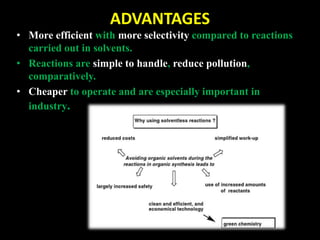
ADVANTAGES
• More efficient with more selectivity compared to reactions
carried out in solvents.
• Reactions are simple to handle, reduce pollution,
comparatively.
• Cheaper to operate and are especially important in
industry.
• Halogenation
• Michael Addition
• Aldol Condensation
• Grignard Reaction
• Reformatsky Reaction
• Pinacol-Pinacolone Rearrangement
• Benzil-benzilic acid rearrangement
• Beckmann Rearrangement
• Armoatic Substitution Reactions
• Oxidative coupling of phenols
Solid phase organic synthesis without using
any solvent
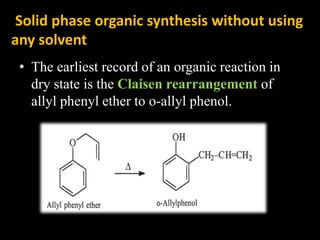
• The earliest record of an organic reaction in
dry state is the Claisen rearrangement of
allyl phenyl ether to o-allyl phenol.
HALOGENATION
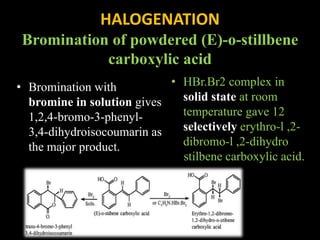
Bromination of powdered (E)-o-stillbene
carboxylic acid
• Bromination with
bromine in solution gives
1,2,4-bromo-3-phenyl-
3,4-dihydroisocoumarin as
the major product.
• HBr.Br2 complex in
solid state at room
temperature gave 12
selectively erythro-l ,2-
dibromo-l ,2-dihydro
stilbene carboxylic acid.
MICHAEL ADDITION
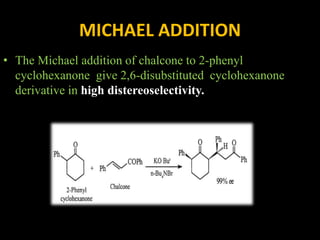
• The Michael addition of chalcone to 2-phenyl
cyclohexanone give 2,6-disubstituted cyclohexanone
derivative in high distereoselectivity.
ALDOL CONDENSATION
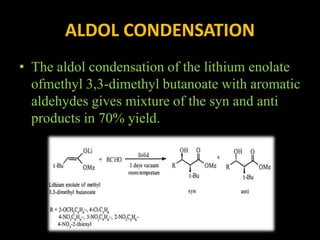
• The aldol condensation of the lithium enolate
ofmethyl 3,3-dimethyl butanoate with aromatic
aldehydes gives mixture of the syn and anti
products in 70% yield.
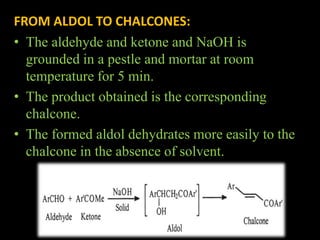
FROM ALDOL TO CHALCONES:
• The aldehyde and ketone and NaOH is
grounded in a pestle and mortar at room
temperature for 5 min.
• The product obtained is the corresponding
chalcone.
• The formed aldol dehydrates more easily to the
chalcone in the absence of solvent.
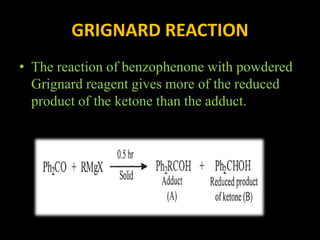
GRIGNARD REACTION
• The reaction of benzophenone with powdered
Grignard reagent gives more of the reduced
product of the ketone than the adduct.
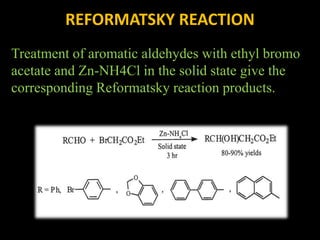
REFORMATSKY REACTION
Treatment of aromatic aldehydes with ethyl bromo
acetate and Zn-NH4Cl in the solid state give the
corresponding Reformatsky reaction products.
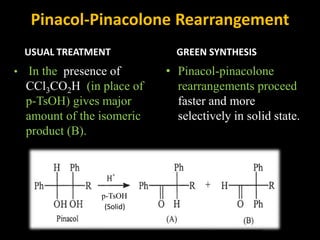
Pinacol-Pinacolone Rearrangement
USUAL TREATMENT
• In the presence of
CCl3CO2H (in place of
p-TsOH) gives major
amount of the isomeric
product (B).
GREEN SYNTHESIS
• Pinacol-pinacolone
rearrangements proceed
faster and more
selectively in solid state.
(p-TsOH
(Solid)
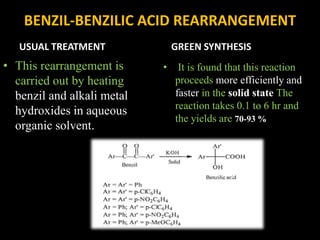
BENZIL-BENZILIC ACID REARRANGEMENT
USUAL TREATMENT
• This rearrangement is
carried out by heating
benzil and alkali metal
hydroxides in aqueous
organic solvent.
GREEN SYNTHESIS
• It is found that this reaction
proceeds more efficiently and
faster in the solid state The
reaction takes 0.1 to 6 hr and
the yields are 70-93 %
ARMOATIC SUBSTITUTION REACTIONS
Nuclear bromination of phenols with (NBS)
USUAL TREATMENT
• In solution a mixture of
mono and dibromo
derivatives is obtained.
GREEN SYNTHESIS
• The reaction of 3,5-
dimethylphenol with NBS in
the solid state for 1 min
gave the tribromo derivative
in 45% yield.
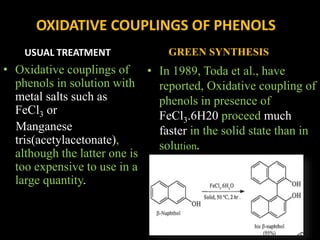
OXIDATIVE COUPLINGS OF PHENOLS
USUAL TREATMENT
• Oxidative couplings of
phenols in solution with
metal salts such as
FeCl3 or
Manganese
tris(acetylacetonate),
although the latter one is
too expensive to use in a
large quantity.
GREEN SYNTHESIS
• In 1989, Toda et al., have
reported, Oxidative coupling of
phenols in presence of
FeCl3.6H20 proceed much
faster in the solid state than in
solution.
• Synthesis of
Azomethines
• Dimerisation of [60]
fullerene
• Synthesis of Homoallylic
Alcohols
• Synthesis of Thio
carbonylimidazolide
Derivatives
BECKMANN REARRANGEMENT
USUAL TREATMENT
• Beckmann rearrangement of
oximes of ketones are
converted into anilides by
heating with acidic reagents
like PCls' HCOOH, SOCl2 etc.
GREEN SYNTHESIS
• Oxime of a ketone is mixed
with montmorillonite and
irradiated for 7 min in
microwave oven to give
corresponding anilide in 91 %
yield
• Solventless reactions of organic compounds
has gained much popularity.
• It is the one of the best techniques in green
chemistry by which many important
compounds can be synthesized in an efficient
& environment friendly manner.
DRAWBACKS
• Homogenous reactants should mix to a
system.
• Solvents are often still required during
work-up (e.g. extraction)
• Unsuitable for solvent assisted chemical
reactions.
REFERENCES
• Ahluwalia,Kidwai,New Trends in Green Chemistry,2nd
edition,Anamaya Publishers,New Delhi,2006.
• Alessandro Mordini, Ferenc Faigl, New Methodologies and
Techniques for a Sustainable Organic Chemistry,springer.
• Kumar.V, An introduction to green chemistry, vishal
publishing.co, New Delhi, First edition,May 2007.
• http://igss.wdfiles.com/local--files/carl-lecher/Green6.pdf
• http://www.ijddr.in/drug-development/greener-reactions-
under-solvent-free-conditions.php?aid=5569
• http://www.ias.ac.in/article/fulltext/reso/007/10/0059-0068
• http://www.ijrap.net/admin/php/uploads/554_pdf.

Solventless reaction in green chemistry

  • 1.
  • 2.
    Why Are Reactions PerformedUsing Solvents? • To dissolve reactants. • To slow or increase the rate of reactions. • To act as a heat sink or heat transfer agent. • To prevent hot spots and run-away reactions.
  • 3.
    Issues with OrganicSolvents •Organic solvents are of concern to the chemical industry because of the sheer volume used in synthesis, processing, and separation. • Organic solvents are expensive • Organic solvents are highly regulated. • Many organic solvents are volatile, flammable, toxic, and carcinogenic.
  • 4.
    “No Coopora nisiFluida” Aristotle believed that “No reaction occurs in the absence of solvent.” (This is not true!)
  • 5.
    SOLVENTLESS REACTIONS  Adry media reaction or solid-state reaction or solventless reaction is a chemical reaction system in the absence of a solvent.  The drive for the development of dry media reactions in chemistry is: • Economics (save money on solvent) • Not required to remove a solvent after reaction completion ultimetly purification step not required • Reaction rate is high due more availability of reactants. • Environmentaly friendly because solvent is not required.
  • 6.
    Solid state reactionfollows the fifth principle of green chemistry which avoid using toxic solvents in the chemical reaction.
  • 7.
    ADVANTAGES • More efficientwith more selectivity compared to reactions carried out in solvents. • Reactions are simple to handle, reduce pollution, comparatively. • Cheaper to operate and are especially important in industry.
  • 8.
    • Halogenation • MichaelAddition • Aldol Condensation • Grignard Reaction • Reformatsky Reaction • Pinacol-Pinacolone Rearrangement • Benzil-benzilic acid rearrangement • Beckmann Rearrangement • Armoatic Substitution Reactions • Oxidative coupling of phenols
  • 9.
    Solid phase organicsynthesis without using any solvent • The earliest record of an organic reaction in dry state is the Claisen rearrangement of allyl phenyl ether to o-allyl phenol.
  • 10.
    HALOGENATION Bromination of powdered(E)-o-stillbene carboxylic acid • Bromination with bromine in solution gives 1,2,4-bromo-3-phenyl- 3,4-dihydroisocoumarin as the major product. • HBr.Br2 complex in solid state at room temperature gave 12 selectively erythro-l ,2- dibromo-l ,2-dihydro stilbene carboxylic acid.
  • 11.
    MICHAEL ADDITION • TheMichael addition of chalcone to 2-phenyl cyclohexanone give 2,6-disubstituted cyclohexanone derivative in high distereoselectivity.
  • 12.
    ALDOL CONDENSATION • Thealdol condensation of the lithium enolate ofmethyl 3,3-dimethyl butanoate with aromatic aldehydes gives mixture of the syn and anti products in 70% yield.
  • 13.
    FROM ALDOL TOCHALCONES: • The aldehyde and ketone and NaOH is grounded in a pestle and mortar at room temperature for 5 min. • The product obtained is the corresponding chalcone. • The formed aldol dehydrates more easily to the chalcone in the absence of solvent.
  • 14.
    GRIGNARD REACTION • Thereaction of benzophenone with powdered Grignard reagent gives more of the reduced product of the ketone than the adduct.
  • 15.
    REFORMATSKY REACTION Treatment ofaromatic aldehydes with ethyl bromo acetate and Zn-NH4Cl in the solid state give the corresponding Reformatsky reaction products.
  • 16.
    Pinacol-Pinacolone Rearrangement USUAL TREATMENT •In the presence of CCl3CO2H (in place of p-TsOH) gives major amount of the isomeric product (B). GREEN SYNTHESIS • Pinacol-pinacolone rearrangements proceed faster and more selectively in solid state. (p-TsOH (Solid)
  • 17.
    BENZIL-BENZILIC ACID REARRANGEMENT USUALTREATMENT • This rearrangement is carried out by heating benzil and alkali metal hydroxides in aqueous organic solvent. GREEN SYNTHESIS • It is found that this reaction proceeds more efficiently and faster in the solid state The reaction takes 0.1 to 6 hr and the yields are 70-93 %
  • 18.
    ARMOATIC SUBSTITUTION REACTIONS Nuclearbromination of phenols with (NBS) USUAL TREATMENT • In solution a mixture of mono and dibromo derivatives is obtained. GREEN SYNTHESIS • The reaction of 3,5- dimethylphenol with NBS in the solid state for 1 min gave the tribromo derivative in 45% yield.
  • 19.
    OXIDATIVE COUPLINGS OFPHENOLS USUAL TREATMENT • Oxidative couplings of phenols in solution with metal salts such as FeCl3 or Manganese tris(acetylacetonate), although the latter one is too expensive to use in a large quantity. GREEN SYNTHESIS • In 1989, Toda et al., have reported, Oxidative coupling of phenols in presence of FeCl3.6H20 proceed much faster in the solid state than in solution.
  • 20.
    • Synthesis of Azomethines •Dimerisation of [60] fullerene • Synthesis of Homoallylic Alcohols • Synthesis of Thio carbonylimidazolide Derivatives
  • 21.
    BECKMANN REARRANGEMENT USUAL TREATMENT •Beckmann rearrangement of oximes of ketones are converted into anilides by heating with acidic reagents like PCls' HCOOH, SOCl2 etc. GREEN SYNTHESIS • Oxime of a ketone is mixed with montmorillonite and irradiated for 7 min in microwave oven to give corresponding anilide in 91 % yield
  • 22.
    • Solventless reactionsof organic compounds has gained much popularity. • It is the one of the best techniques in green chemistry by which many important compounds can be synthesized in an efficient & environment friendly manner.
  • 23.
    DRAWBACKS • Homogenous reactantsshould mix to a system. • Solvents are often still required during work-up (e.g. extraction) • Unsuitable for solvent assisted chemical reactions.
  • 24.
    REFERENCES • Ahluwalia,Kidwai,New Trendsin Green Chemistry,2nd edition,Anamaya Publishers,New Delhi,2006. • Alessandro Mordini, Ferenc Faigl, New Methodologies and Techniques for a Sustainable Organic Chemistry,springer. • Kumar.V, An introduction to green chemistry, vishal publishing.co, New Delhi, First edition,May 2007. • http://igss.wdfiles.com/local--files/carl-lecher/Green6.pdf • http://www.ijddr.in/drug-development/greener-reactions- under-solvent-free-conditions.php?aid=5569 • http://www.ias.ac.in/article/fulltext/reso/007/10/0059-0068 • http://www.ijrap.net/admin/php/uploads/554_pdf.

Editor's Notes

  • #3 Run away reactions: Chemical or nuclear reaction that is accelerated by the products of the reaction or its effects (such as a rise in temperature), so that it becomes uncontrollable and continues until there are no reactants left. Hotspot: An area or point within a reaction system at which the temperature is appreciably higher.