Contents:
 Definition
 Components
 An oily phase
 An aqueous phase
 Surfactant
 Co-surfactant
 Difference b/w emulsion and
microemulsion
 Preparation of microemulsion
 Advantages
 Disadvantages
Microemulsions are isotropic, thermodynamically stable
transparent (or translucent) systems of oil, water and
surfactant, frequently in combination with a cosurfactant
with a droplet size usually in the range of 20-200 nm.
 The most important excipient in formulation is oil phase,
because it can solubilize the required dose of the
lipophilic drug.
 It also increases the fraction of lipophilic drug
transported via the intestinal lymphatic system thereby
increasing absorption from GIT.
 Choice of Oil phase selection depends upon solubility of
drug.
 Example:
Mineral oil
 It contains hydrophilic active ingredients and
preservatives.
 Buffer solutions are also used as aqueous phase.pH of
the aqueous phase should be maintained between 7-8.
 Surfactants are wetting agents that lowers the interfacial
tension between 2 immiscible liquids.
 Examples:
Span, Tween
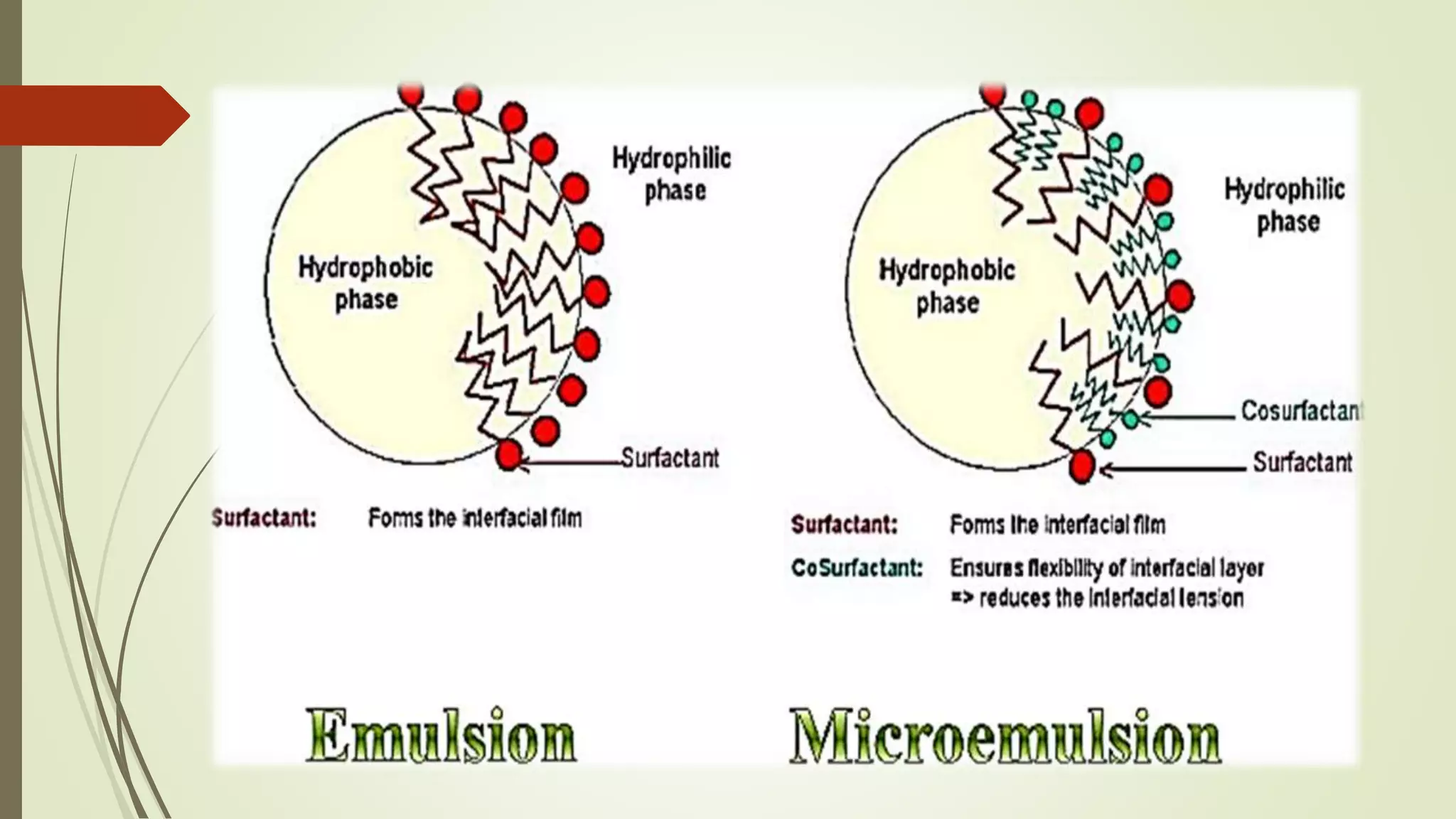
Allows the interfacial film a sufficient flexibility which can
readily deform around the droplets
Increase the fluidity of the interface and reduces
viscosity of formulation thereby increasing the
bioavailability of drug
Short to medium chain length alcohols are commonly
added as co-surfactants.
Example: Ethylene glycol, Propylene glycol
Properties Emulsion Microemulsion
Appearance Cloudy Transparent
Interfacial tension High Ultra Low
Droplet size ˃500nm 20-200nm
Phases Biphasic Mono phasic
Viscosity Higher viscosity
Lower viscosity with
Newtonian behavior
Stability
Thermodynamically
unstable
Thermodynamically
stable
Properties Emulsion Microemulsion
Phases Monophasic Biphasic
Preparation
Facile preparation,
relatively lower cost for
commercial production
Require a large input of
energy, higher cost
Viscosity
Low viscosity with
Newtonian behavior
Higher viscosity
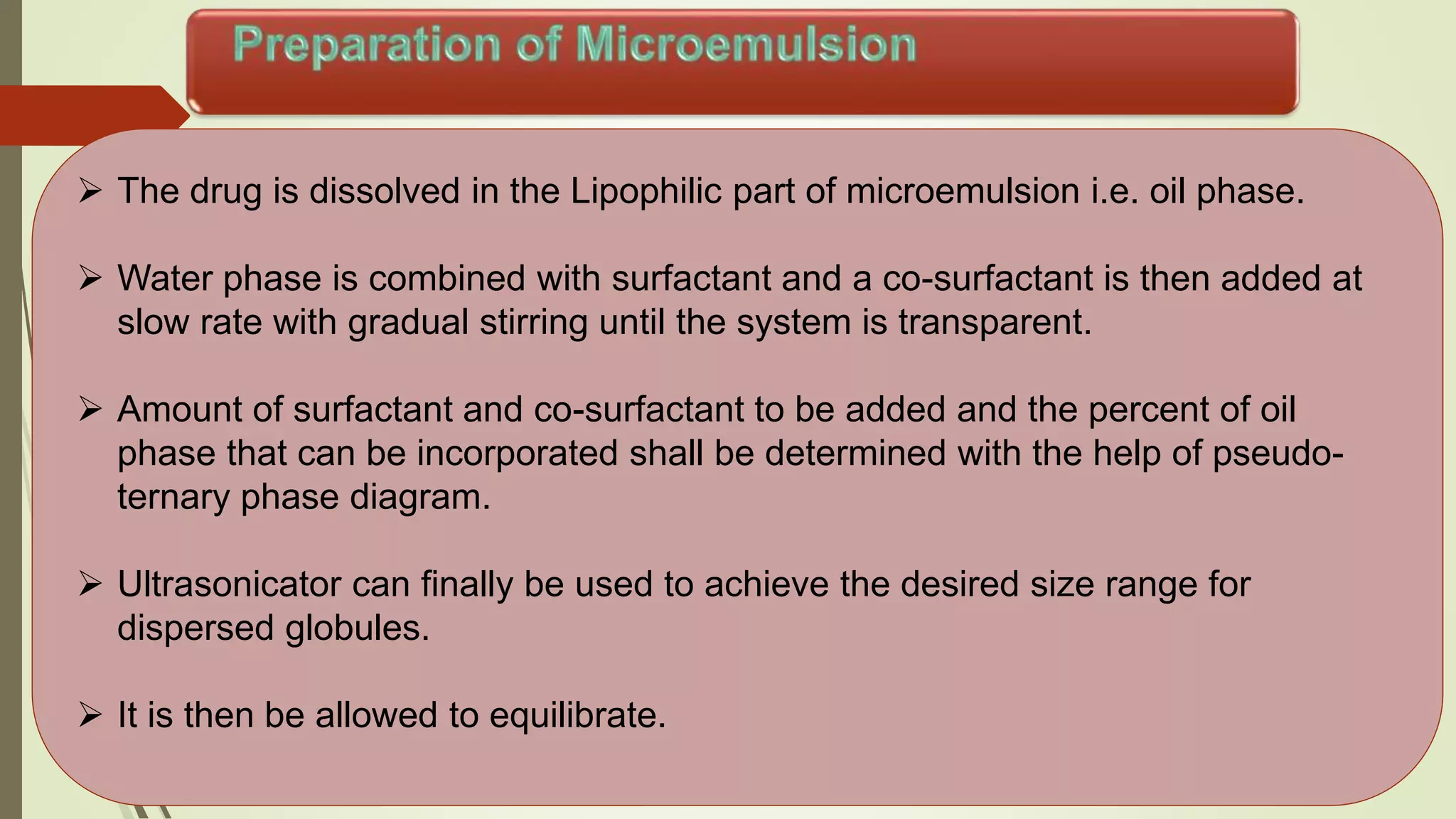
 The drug is dissolved in the Lipophilic part of microemulsion i.e. oil phase.
 Water phase is combined with surfactant and a co-surfactant is then added at
slow rate with gradual stirring until the system is transparent.
 Amount of surfactant and co-surfactant to be added and the percent of oil
phase that can be incorporated shall be determined with the help of pseudo-
ternary phase diagram.
 Ultrasonicator can finally be used to achieve the desired size range for
dispersed globules.
 It is then be allowed to equilibrate.
 Microemulsion acts as supersolvent for the drugs and it has the ability to
solubilize both hydrophilic and lipophilic drugs.
 Increased rate of absorption and Increased bioavailability of drug, due to
very small droplet size.
 Increased patient compliance due to liquid dosage form.
 Helpful in taste masking
 Rapid and efficient penetration of drug moiety.
 Easy manufacturing because it requires minimum energy for formation.
 Use of large concentration of surfactants and co-surfactants may leads
to toxicity problems.
 Microemulsions have limited solubilizing capacity for high-melting
substances.
 Microemulsion stability is influenced by environmental parameters such
as temperature and pH, which may cause phase separation
Microemulsion

Microemulsion

  • 2.
    Contents:  Definition  Components An oily phase  An aqueous phase  Surfactant  Co-surfactant  Difference b/w emulsion and microemulsion  Preparation of microemulsion  Advantages  Disadvantages
  • 3.
    Microemulsions are isotropic,thermodynamically stable transparent (or translucent) systems of oil, water and surfactant, frequently in combination with a cosurfactant with a droplet size usually in the range of 20-200 nm.
  • 5.
     The mostimportant excipient in formulation is oil phase, because it can solubilize the required dose of the lipophilic drug.  It also increases the fraction of lipophilic drug transported via the intestinal lymphatic system thereby increasing absorption from GIT.  Choice of Oil phase selection depends upon solubility of drug.  Example: Mineral oil
  • 6.
     It containshydrophilic active ingredients and preservatives.  Buffer solutions are also used as aqueous phase.pH of the aqueous phase should be maintained between 7-8.
  • 7.
     Surfactants arewetting agents that lowers the interfacial tension between 2 immiscible liquids.  Examples: Span, Tween
  • 8.
    Allows the interfacialfilm a sufficient flexibility which can readily deform around the droplets Increase the fluidity of the interface and reduces viscosity of formulation thereby increasing the bioavailability of drug Short to medium chain length alcohols are commonly added as co-surfactants. Example: Ethylene glycol, Propylene glycol
  • 9.
    Properties Emulsion Microemulsion AppearanceCloudy Transparent Interfacial tension High Ultra Low Droplet size ˃500nm 20-200nm Phases Biphasic Mono phasic Viscosity Higher viscosity Lower viscosity with Newtonian behavior Stability Thermodynamically unstable Thermodynamically stable
  • 10.
    Properties Emulsion Microemulsion PhasesMonophasic Biphasic Preparation Facile preparation, relatively lower cost for commercial production Require a large input of energy, higher cost Viscosity Low viscosity with Newtonian behavior Higher viscosity
  • 12.
     The drugis dissolved in the Lipophilic part of microemulsion i.e. oil phase.  Water phase is combined with surfactant and a co-surfactant is then added at slow rate with gradual stirring until the system is transparent.  Amount of surfactant and co-surfactant to be added and the percent of oil phase that can be incorporated shall be determined with the help of pseudo- ternary phase diagram.  Ultrasonicator can finally be used to achieve the desired size range for dispersed globules.  It is then be allowed to equilibrate.
  • 13.
     Microemulsion actsas supersolvent for the drugs and it has the ability to solubilize both hydrophilic and lipophilic drugs.  Increased rate of absorption and Increased bioavailability of drug, due to very small droplet size.  Increased patient compliance due to liquid dosage form.  Helpful in taste masking  Rapid and efficient penetration of drug moiety.  Easy manufacturing because it requires minimum energy for formation.
  • 14.
     Use oflarge concentration of surfactants and co-surfactants may leads to toxicity problems.  Microemulsions have limited solubilizing capacity for high-melting substances.  Microemulsion stability is influenced by environmental parameters such as temperature and pH, which may cause phase separation